Friday, September 18, 2015

Stories from Vietnam: Into the assassin's den

by Karen Petitt
375th Air Mobility Wing Public Affairs


9/12/2015 - SCOTT AIR FORCE BASE, Illinois -- Editor's Note:  This is a first in a series on Scott's Vietnam Veterans, and is part of the DoD's 50th Anniversary Commemoration of the Vietnam War.

Low on fuel, a radio call came over the net directing a search for a downed American pilot. Capt. Keith Sawyer was returning from directing an air strike in the mountains north of Saigon, the capital city of Vietnam in 1963, and instantly headed to the new coordinates.

As a Forward Air Controller, his job was to fly low to the ground in his L-19 (O-1A) "Bird Dog" aircraft to mark targets with smoke grenades or white phosphorus rockets called "Willie-Petes," signaling enemy positions for fighter aircraft to come in behind and destroy. On this mission he would have helped signal a rescue mission.

He searched for the pilot when red and yellow tracer rounds shot past him, and he suddenly realized it was a trap. The Viet Cong had infiltrated the radio signals, and finding himself sandwiched between a narrow pass in the valley and unable to turn, he braced himself to fly right through it.

Unable to perform defensive maneuvers, he prayed that he and his back seat South Vietnamese observer would make it back to base alive. He stayed fixated on his near-empty fuel tank until he arrived back at Tan Son Nhut Air Base, a major operating air field during the Vietnam War from 1959 through the Fall of Saigon in 1975.

"After we landed, everyone came out to inspect our aircraft to count the number of bullet holes, but there weren't any," said Sawyer, now a retired colonel who served in the Air Force for 30 years. "That alone was incredible, but we also checked our fuel because my gauges showed empty for most of the flight home. They got out a measuring stick. It came out dry. They went to the lowest point in the fuel tank and came out with one cup of fuel. From then on, everyone wanted to fly with me because of my 'invisible shield,' although I know it was divine intervention."

That divine intervention would last throughout his year-long service in Vietnam from April 24, 1963 to April 24, 1964 as he accumulated 600 flying hours that included 386 combat missions. This 26-year-old would become so good at finding, targeting and thus destroying important enemy targets that he would earn the prestigious Distinguished Flying Cross as well as the Air Medal with 16 oak leaf clusters--awarded to aviators who distinguished themselves in flight. He also became a target for enemy assassins.

Once, he landed on a road by a small village and walked in to coordinate air cover with the local Vietnamese army commander. The mission was delayed so he explored the two streets that made up the village. The mission was subsequently called off due to lack of enemy contact so Sawyer started walking back to his plane when a U.S. Army advisor came out of a house and told him an assassination squad had been seen in town that was after him. The price on his head was $500.

"That was a very small village that I had been walking around in that day," he said. "And the Viet Cong assassins only made $6 a month, so you can imagine the incentive that kind of money could give them. How we didn't see them or they see us as we walked around was unbelievable."

Another time he was in a Chinese restaurant near the hotel where he stayed in Saigon. Always on the lookout for the enemy, he selected a table near an exit and mapped out an escape plan--just in case. Before he finished his meal, two assassins burst through the front door with grenades in their hands. They pursued him on foot as Sawyer ran back toward his hotel, shooting at them with a pistol he always carried. Near his hotel, guards caught and killed one of assassins while the other one escaped.

This became the new normal for him, but it didn't deter him from his efforts in performing his missions. He cared about his safety because he had a young wife and 2½ year-old-daughter at home who were counting on him to return, but he said he also had the reassurance from his ecclesiastical leaders before he left that "evil would be banished from his footsteps."

"I was protected every day I was there, and I saw that protection in dramatic ways ... and sometimes in not so dramatic ways. Sometimes I was protected merely by the choices I made," he said.

For instance, he had made a vow to keep Sunday a day that was holy by going to church and refraining from entertainment. Once he declined a Sunday evening event at a movie theater and that very night it was attacked and 20 people were killed--right where he normally sat.

"I am not sure all the reasons why I was protected while so many others died. I knew men who lost their lives or who were shot down and became prisoners. I wrestled with this and like many, I felt guilty for surviving. Towards the end of my tour, I was assigned one mission that a visiting U.S. Air Force pilot asked to take. He was killed on that mission and that is hard to live with. I did my duty, but when I was just a week from coming home, I did not want to put myself in unnecessary risk just to achieve a 'milestone' such as my 400th combat mission. I saw others try to do that, only to lose their lives. I just decided that what was important was focusing on going home. So, during that week I flew 'safer' missions."

Going home could have been a challenge, but the faith and moxie of his wife, Amy Jo, made that adjustment not only bearable, but healing as well.

It was during this time that America was just beginning to see the impact of the growing military action. Ho Chi Minh had declared Independence after World War II and began a revolution to unify North and South Vietnam under his communist rule. What followed was a lengthy build up to war that by 1975 had killed nearly three million Vietnamese and claimed 58,000 American lives.

It was in 1963 that a Buddhist monk would soak himself in gas and set fire to himself at a main intersection in Saigon as part of a political protest. Back home, President John F. Kennedy would be assassinated and the South erupt with Civil Rights demonstrations in Birmingham, Ala.

Adding to the turmoil were images that brought the vicious fighting of Vietnam into everyone's living rooms showing how Americans were becoming more entrenched in the region. These images documented the bloody casualties on the ground and air strikes that left the jungles ablaze, leaving Amy Jo haunted with every news report of a downed aircraft near Saigon. She'd have to wait for days--even weeks--to find out if her husband was yet alive.

"Can you imagine not knowing?" she said. "I would read the newspapers and then just wait. I knew of Keith's blessing of protection, but he didn't tell me all that was going on with him. In fact, there are stories that he'll tell now that I'm still learning about. I know he worked hard to protect me from the dangers he faced. I just did a lot of praying and tried to live each day as normally as I could. It's not like today's families who are able to Skype to where they're serving. No, we didn't have anything like that. Today's families are blessed to have such instant communication."

Amy Jo proved wise as she kept a picture of him next to her daughter's bed and told her stories every night. That, he said, made all the difference when he came home a year later.

"Instead of being afraid of me, she ran into my arms and recognized me as her daddy," he said. "I consider that one of the greatest gifts my wife gave to me while I was gone. It meant everything to me to have my daughter know me and it speaks well of the efforts Amy Jo went to keep our home a safe and happy place while I was gone."

They had married when just 19 years old. He was a farmer near Gilbert, Ariz., and during the age of the cotton cash crops, he managed quite well for himself. She was a musically gifted and cultured "city girl" from Mesa. They had known each other since age 16, and once married they attended college where he joined the ROTC program and eventually committed to serving in the Air Force before being drafted into another branch of service.

During this time, his brother, Darrell, who had always dreamt of being a pilot, not only acquired his pilot's license but became the flight instructor who taught Keith how to fly. Those flying lessons came in handy during his service in Vietnam where he flew so low that he could see the enemy submerged in the river breathing through bamboo reeds.

Sawyer's many missions were dangerous and harrowing. He took lives. He saved lives. And he, like many veterans, suffered symptoms of Post Traumatic Stress Disorder, including nightmares and hyper sensitivity. Unlike veterans of today, there were no support groups and no PTSD therapy for Vietnam veterans. But, gradually, his nightmares disappeared, he said, as he continued to freely share his experiences with friends and family.

"There are many who still don't talk about their experiences even today," he explained. "I've always been able to talk about mine, so I think that has been its own type of therapy in a way."

After his tour in Vietnam, the farming industry was at a low point for Arizona, due to drought, so Sawyer decided to stay in the Air Force where he often returned to Vietnam between 1965 through 1974. This time he flew C-124 and C-141 cargo aircraft that brought in supplies to the troops throughout the country and he often airlifted the wounded back to the U.S. He continued a career in cargo aircraft settling into the C-141s becoming a squadron commander and a mission planner for several highly visible operations, including bringing the first round of POWs home from Hanoi.

Now, at age 78, with four children, 11 grandchildren, and one great-grandchild, he continues to serve in the community, at church and with his wife in her music activities. He said he plans to keep on sharing his memories as long as he's able and as long as there are people willing to hear the war stories from this Vietnam veteran.

Thursday, September 17, 2015

F-15 Eagles complete Hungarian deployment

by Staff Sgt. Chad Warren
52nd Fighter Wing Public Affairs


9/17/2015 - KECSKEMET AIR BASE, Hungary  -- Four F-15 Eagle fighter aircraft and support personnel assigned to the 123rd Expeditionary Fighter Squadron completed forward deployment to Kecskemet, Hungary, from Campia Turzii, Romania, Sept. 15, 2015.

The 123rd EFS is part of the 142nd Fighter Wing located in Portland, Oregon, and is deployed as part of the European theater security package.

The four aircraft forward deployed in support of Operation Atlantic Resolve in order to train and test their ability to operate out of Kecskemet Air Base, strengthen interoperability and demonstrate U.S. commitment to the security and stability of Europe.

"Overall, establishing the relationship with us being here and being able to communicate with them and integrate our training together solidifies our relationship with our NATO allies and makes it a lot easier for us to do this in the future," said U.S. Air Force Capt. Aaron Lamont, 123rd EFS F-15 pilot, while discussing the importance of gaining proficiency working with partner nation equipment and locations.

As part of Operation Atlantic Resolve, the U.S Air Force integrated with host nation partners, a task that can be challenging but crucial to working together effectively in potential future conflicts, said U.S. Air Force Lt. Col. David Christensen, 123rd EFS director of operations.

"Improving interoperability between countries is always important, especially if we have to work together in some kind of future conflict," Christensen said . "Everybody is more comfortable with who they are working with and understands what's going on so we can better improve our war-fighting."

Although the theater security package has brought U.S. aircraft to several European countries, this is the first deployment to Hungary for the mission and also the first Air National Guard TSP.

"It's important to show that we are out here and care about what's going on in Eastern Europe," Christensen said. "It's the first TSP, and it's also the first Guard TSP so it's important for the Guard to show that we are helping to support the active duty and all the missions that are out there."

Air National Guard or active duty, the TSP missions are about reassuring NATO allies and increasing combined war-fighting abilities for the future, a point that is not lost on 123rd EFS Airmen like Christensen.

"Being able to come out here and improve their operating and making it so we are set up to be able to operate out of their facilities is a huge advantage for the future," Christensen said.

Carter Honors 3 who Stopped Gunman on Paris-Bound Train


By David Vergun Army News Service

WASHINGTON, September 17, 2015 — On Aug. 21, three childhood friends were on a train bound for Paris when they heard a gunshot. Amidst screams and commotion, they quickly focused on a man wielding an AK-47 rifle, said Defense Secretary Ash Carter said today during a Pentagon ceremony honoring the three men.

The secretary thanked Oregon Army National Guard Spc. Alek Skarlatos, Air Force Airman 1st Class Spencer Stone and Anthony Sadler for their valor.

Carter described the chaotic scene on the train, where passengers were hiding, unsure of what to do, or running away. While that was happening, Skarlatos said, "Let's go," and the three sprinted toward the gunman, who had his weapon pointed at them.

Stone tackled the assailant and all three men worked to disarm him, the defense secretary continued. Besides the AK-47, the attacker was also armed with an automatic pistol, 270 rounds of ammunition, a box cutter and a bottle of gasoline.

"As we know, Spencer was stabbed in the effort," Carter said

After they knocked out the gunman, they tended to other injured on board the train before paramedics and police arrived, he added.

The defense secretary referred to the entire ordeal as "an amazing story, right out of a movie."

Returning to the theme of "Let's go," he said that "if this sounds familiar, that’s because it is," noting the similarity to the phrase used by a passenger on United Flight 93; "Let's roll."

Carter added that some of those passengers also "stood up and fought back against the terrorists who had aimed the plane toward Washington. While those heroes were lost, we will always remember and appreciate their courage and sacrifice."

Everyone in DoD -- uniformed personnel and civilians -- has "chosen to dedicate themselves to standing between order and disorder, between the way of life we cherish and those who threaten it," the defense secretary continued. They've all been willing and ready to say, "Let's go."

Medals For Heroism

Carter then presented the Soldier's Medal, Airman's Medal and Secretary of Defense Medal for Valor, to Skarlatos, Stone and Sadler respectively. The medals are the highest commendations for non-combat bravery that the Defense Department can bestow.

Additionally, Stone was awarded a Purple Heart Medal because he suffered multiple lacerations to the face, neck and thumb during the struggle. Carter noted that DoD has determined that since the event was deemed an act of terrorism, the Purple Heart could be awarded.

Previously, all three were awarded the Legion of Honor, France's highest recognition.

Skarlatos is with the Oregon Army National Guard’s 41st Infantry Brigade Combat Team. He recently re-enlisted, calling the Guard "fantastic."

Stone is a medic, assigned to the 65th Air Base Group at Lajes Air Base in Portugal. Next month, Stone is transferring to Travis Air Force Base in California.

Sadler started school this year at Sacramento State University "where I’m sure he’ll have the best 'what I did on my summer vacation' story on campus this fall," Carter quipped.

After the ceremony, Sadler told the media that he "couldn't think of two better people to be with in this situation."

It was the first time any of the men had been in the Pentagon or to Washington, D.C., and all said they were overwhelmed with the warm welcome they received from everyone, including the president.

A little grease doesn't get C-17 Globemaster III crew chief down

by Airman Valerie Monroy
JBER Public Affairs


9/17/2015 - JOINT BASE ELMENDORF-RICHARDSON, Alaska -- Airman Halbert arrives at the hospital for his appointment to get new glasses. Walking through the door, he notices how friendly everyone is. Each passerby grins or smirks at him.

The optometrist performing his eye exam has a comical glint in her eyes as she speaks to him. After the examination, an amused Airman has him try on different frames to find the ones he prefers.

As he looks in the mirror, something catches his attention. Horrified, he sees a black smudge on his upper lip, like the most enormous and grotesque mole he's ever seen, and all the pieces of the day fit together in his mind.

"I've talked to so many people today," Halbert mutters to himself.

Airman 1st Class Britton Halbert is an aerospace maintenance apprentice - also known as a crew chief - with the 703rd Aircraft Maintenance Squadron on Joint Base Elmendorf-Richardson.

Halbert said he is used to having permanently stained hands and being dirty from working on planes all day, but it had never caused him much embarrassment until that day. But it's all just part of the job, he explained.

His day begins with roll call at 6:45 a.m. Everyone is accounted for before the section chief relays the work requirements for the day.

Before any aircraft takes off, it has to go through the crew chiefs.

Crew chiefs are responsible for ensuring the plane is in perfect working order. If something's wrong, they coordinate with specialists to repair what's broken and get the plane on its way.

As soon as the morning briefing is over, they don't waste a moment before starting their jobs.

"People get to work," Halbert said. "Everyone knows what they need to do."

Halbert works on the C-17 Globemaster III, a high-wing, four engine cargo craft capable of carrying payloads up to 169,000 pounds.

Some of his day-to-day duties include performing scheduled inspections and preventive maintenance on the aircraft and aircraft-installed equipment. Crew chiefs also maintain and repair aircraft and perform general mechanical work.

Before every plane takes off, a walk-around is performed to make sure there is nothing wrong. The crew chiefs check for leaks, ensure nothing is missing from the plane, none of the screws have disappeared, and that the tires aren't flat, said Airman 1st Class Damien Sloan, a fellow aerospace maintenance apprentice with the 703rd AMXS.

When a plane lands, the crew chiefs do another inspection to ensure the aircraft is still in operating-ready condition.

For Halbert, keeping busy and working with his hands is the best way to get through the day.

"I'm not somebody who can just sit down," Halbert said, tapping his foot. "I enjoy seeing hard work pay off."

While Halbert said he loves his job, there are moments when it gets tough. Some days are longer than others.

The crew chiefs wait for everyone to finish whatever they were working on before leaving, he said.

"Everybody is getting ready to go home, but you have somebody still out there working on a plane," Halbert explained. "In that moment, you think it sucks - but when you see the plane in the sky you think, 'man, we're doing that.'"

With winter on its way, the job won't be getting any easier, especially for Halbert, from Texas.

"Today I couldn't even feel my fingers," he said. "And it's not even winter yet."

It took Halbert a while to realize this was the job for him.

"Technical school can only take you so far," he said. "You don't really know the job until you're actually doing it."

Getting the hands-on experience with the planes helped him realize why he was out there in the first place.

"I never saw myself in a mechanic role," Halbert said.

Both his grandfathers were mechanics and loved getting their hands dirty with whatever they could find. Halbert wonders if maybe it was in his blood the whole time and this is where he was always meant to be.

"Maybe it just took a spark to see that I was going to enjoy this job," he said.

After the crew chiefs are released, Halbert is exhausted - but he still goes to the gym.

"I'm all about the gains, yo," Halbert joked.

Halbert said at night he looks back on his life before the military and can't believe how much it has changed.

Though his days are long and often tiring, he said he looks forward to the possibilities of the next day - although hopefully without  a huge grease mark on his face.

AFE Airmen provide lifesaving equipment on every JBER flight

by Airman 1st Class Christopher Morales
JBER Public Affairs


9/17/2015 - JOINT BASE ELMENDORF-RICHARDSON, Alaska -- In 1995, Air Force Capt. Scott O'Grady was shot down over Bosnia. He survived a week until his rescue with only a 29-pound survival bag of gear, rations and most importantly, a radio.

A routine mission or an emergency night flight can have the same consequences. Human error and technical difficulties can take down an aircraft just as swiftly as anti-aircraft fire.

When all else fails, the personnel of Aircrew Flight Equipment are the last to let you down.

Their job is to inspect, maintain and configure aircraft and aircrew with the equipment they need to survive. They maintain oxygen equipment and survival gear for emergencies, in addition to flight helmets, masks and night vision goggles for everyday missions.

"We don't always see the fruit of our labor [because] the emergency equipment on board isn't used every day, which is a good thing," said Senior Airman Robert Moran, 3rd Operations Support Squadron AFE journeyman. "When they need to use AFE, it works every time."

AFE covers gear like lifeboats, chemical protection bags and personnel-recovery kits, as well as location-specific items  like arctic kits, survival vests and body armor.

From night vision goggles to parachutes and everything in between, the AFE Airmen check, inspect, correct and double-check for maximum mission-readiness.

Every piece of equipment must be inspected, so AFE Airmen operate on a cycle, such as a 90-day rotation for masks and helmets. The cycle differs based on the use  and nature of equipment.

"If [an item] has any write-ups they have to fix it again, and we check to see if it was done correctly. Then they put them it back in the lockers," said Air Force Staff Sgt. Felicia Druin, an AFE craftsman. "We also have technical orders. They go step-by-step by the TO."

The flight supports the 962nd Airborne Air Control Squadron as well as the 90th and 525th fighter squadrons.

"We have approximately 190 aircrew members, and each one has [a] locker room here with their helmets, masks, [protective] gear and other equipment," Moran said. "Sometimes, you are inspecting and maintaining gear that is just rarely used - but when it is, it really matters.

"We specialize in C-17 [Globemaster IIIs] and C-12 [Hurons],"  Moran said. "Sometimes, when the Airmen finish their upgrade training and are knowledgeable in this area and airframe, it's likely that leadership will move Airmen for their benefit to get a better understanding of the entire career field, not just focus on C-17s. [They then] get a taste of what it's like to work with the fighters."

Each aircrew member has a "D" bag, a chemical-defense bag which includes specialized in-flight protective equipment, such as coveralls and a mask with filters and a blower, gloves, hoods, boots, and detection papers.

"We maintain their helmet[s], and their masks," Moran said. "If the aircrew members are going to go on a mission, they usually come here in the morning requesting their gear."

The Airmen also maintain aircraft gear - from the oxygen masks for passengers to life rafts and life vests.

"We installed [personnel-recovery kits], which contain two C-cell radios which call out in case of emergency," Moran said. "There are instructions for our guys to follow, and it will reach out to a rescue unit which will find them and take them home."

Sometimes more or different equipment is packed.

"We have seven survival vests that go on the jet along with seven body-armor vests," Moran said. "This is what the aircrew members would use when flying over [a] hostile environment."

"In the winter time, we put on extra kits for the C-17 and C-12, called arctic kits," Moran said.

There are two on each C-17 and one on each C-12, he explained, each containing a 'wiggy-walk-around suit,' - like a walking sleeping bag - and other cold-weather gear.

The kits, designed for tundra survival, are placed on JBER aircraft between October and May each year.

"You always have [to] trust in what they do," said Air Force Capt. Joshua Topliff, 517th Airlift Squadron Readiness Flight commander.

There are low margins of error when flying, especially when the aircraft is only 500 feet above the ground in limited visibility, Topliff said.

Equipment differs by location. "At my last base, I packed personnel parachutes," Druin said. "It is very rewarding knowing that what you're doing is saving a life and giving them the good training they need."

AFGSC completes first New START bomber conversion

by Air Force Global Strike Command Public Affairs

9/17/2015 - BARKSDALE AIR FORCE BASE, La. -- Air Force Global Strike Command has begun the conversion of a portion of the B-52H bomber fleet from a nuclear to  a conventional only capability aircraft under the New Strategic Arms Reduction Treaty (New START).

The conversion of the first of 30 operational aircraft from across the command was completed at Barksdale Air Force Base, Louisiana, this summer with the Air Force Reserve Command 307th Bomb Wing's aircraft 61-1021. The conversion process preserves the full conventional capabilities of the B-52.

The 307th Bomb Wing Commander, Col. Bruce Cox said, "We were honored to accept the challenge of modifying the first of 30 B-52Hs in compliance with this historic treaty. Leveraging the unrivaled experience of the 307th Bomb Wing Citizen-Airmen maintainers, we quickly bridged the gap between engineering design and operational execution. I am very proud of the professionals of the 307th Bomb Wing Team."

The Air Force will also convert 12 non-operational B-52H aircraft currently maintained in storage at the 309th Aerospace Maintenance and Regeneration Group in Tucson, Arizona. The Air Force is scheduled to complete all conversions by early 2017.

Under New START, the U.S. and Russian Federation are required to have no more than 1,550 deployed warheads; 800 deployed and non-deployed intercontinental ballistic missile launchers, submarine-launched ballistic missile launchers and nuclear capable heavy bombers; and 700 deployed ICBMs, SLBMs and nuclear capable heavy bombers. AFGSC also began the transition of 50 Minuteman III launch facilities across the command to an operational non-deployed status in May 2015.

The Department of Defense announced its force structure in April 2014 to comply with New START requirements. The treaty-compliant force structure allows the U.S. Air Force to continue providing the nation with safe, secure and effective deterrent forces.

Beale conducts 'fini' flight for MC-12W Liberty

by Airman 1st Class Jessica B. Nelson
9th Reconnaissance Wing Public Affairs


9/17/2015 - BEALE AIR FORCE BASE, Calif. -- Beale Airmen conducted a "fini" flight in the MC-12W Liberty at Beale Air Force Base, California, Sept. 16, 2015.

A fini flight is an aviation tradition that can be traced back to the Vietnam War era.  It honors aircrew members or an aircraft model in a final flight at a particular location.

Airmen from the 427th Reconnaissance Squadron, 306th Intelligence Squadron and their families celebrated their time working with the MC-12W and the accomplishments they achieved.

"Every single person that I've met has poured their heart and soul into this, and we've had some great successes," said Lt. Col. Joseph M. Laws, 427th RS commander. "The real victory is the people that got to come home."

Although deployed Airmen are still supporting the mission downrange with the Army, the fini flight represents Air Combat Command's last MC-12W sortie. The final flight is a step toward the transformation of joint capabilities as the MC-12W moves to its new force providers.

The MC-12W is a medium- to low-altitude, twin-engine turboprop aircraft, capable of full-motion video, communications intelligence and signals intelligence that directly supports ground forces.

The aircraft has flown more than 400,000 combat hours and participated in more than 79,000 combat sorties since flying its first combat mission June 10, 2009.

"Warfare is ultimately a human endeavor; it is the marriage of technology and people," said Col. Douglas J. Lee, 9th Reconnaissance Wing commander. "The MC-12 is a great story because it linked those people in the aircraft with people on the ground, and it allowed them to carry out a critically important mission."

MC-12s have enabled ground forces to target high-value individuals and terrorist networks, provided situational awareness during troops-in-contact battles, and helped divert convoys around improvised explosive devices.

"Throughout the program, MC-12 Airmen have often been called airpower pioneers and game-changers, but even these bold terms understate the achievements of more than 2,200 Airmen who built and strengthened the program." said Col. Darren B. Halford, 9th Operations Group commander.  "While we reflect and commemorate today, we remember that our Airmen are still in combat, augmenting Army crews for another few weeks. This has been a landmark joint program, from air-to-ground joint integration, to joint aircrews flying together in the aircraft."

An American flag was flown in the MC-12W on the fini flight to commemorate its historical achievements thus far. The flag will be sent to the National Museum of the United States Air Force at Wright-Patterson Air Force Base, Ohio, to be archived.

"It's bittersweet for a lot of us to see this plane be transferred," Laws said.  "Our MC-12 Airmen are excited to go on and move toward their next challenges throughout the Air Force, but we are all going to miss the MC-12."

Beale has been the home to the MC-12W since June 6, 2011, Laws added, and the hard work and dedication of Airmen have made it possible for the aircraft to accomplish its mission.

"Our Airmen will miss this rewarding mission," Halford said. "Although the mission is leaving Beale and Air Combat Command, the aircraft are going to very good homes. Our joint and total force partners will ensure the MC-12 continues to help find, fix and finish the enemies of freedom."

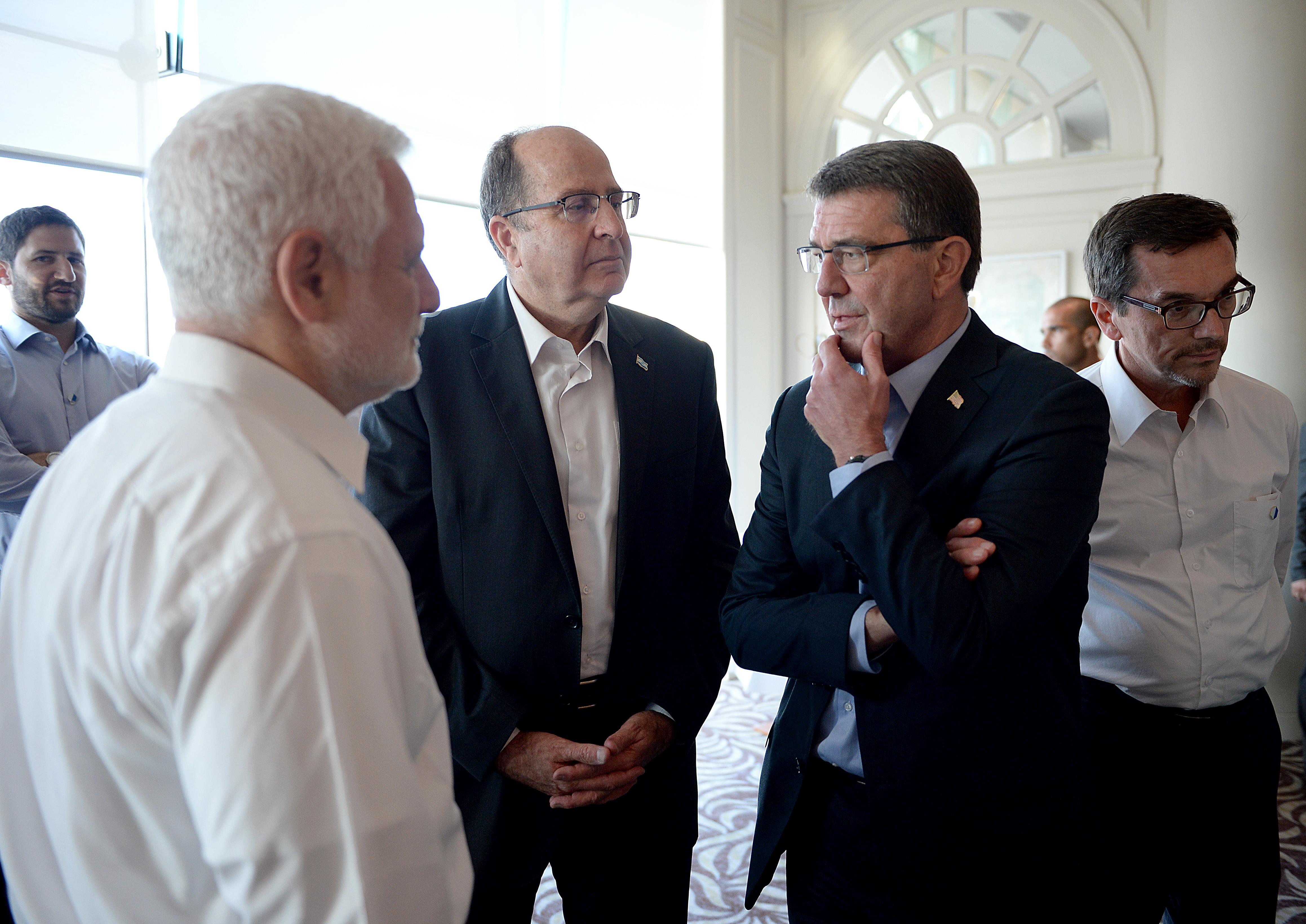
Carter Invites Israeli Defense Minister to Washington for Security Talks


By Terri Moon Cronk DoD News, Defense Media Activity

WASHINGTON, September 17, 2015 — Defense Secretary Ash Carter plans to host Israel’s Defense Minister Moshe Yaalon in late October for security talks here, Pentagon press secretary Peter Cook told reporters today.

Cook said the bilateral meeting between the two defense leaders will “underscore the strength of the U.S.-Israeli defense relationship and further several of the initiatives discussed during Secretary Carter’s visit to Israel in July.”

The secretary will place particular emphasis on consultations regarding ways to enhance Israel’s security, the spokesman added.

During their July meeting, Carter and Yaalon focused on ways to strengthen mutual security in the region from missile defense and cybersecurity to Israel’s qualitative military edge and joint-contingency plans for regional situations, according DoD News reports.

Carter’s meeting with Yaalon marked the secretary’s first stop in a weeklong trip to three Middle Eastern nations, which also included Saudi Arabia and Jordan, reports noted at the time.

“The secretary is looking forward to the visit by Minister Yaalon,” Cook said of the October meeting.