Monday, August 17, 2015

Face of Defense: Airman Aids Home Island During Typhoon Recovery


By Air Force Staff Sgt. Alexander Riedel 36th Wing

ANDERSEN AIR FORCE BASE, Guam, August 17, 2015 — When Typhoon Soudelor struck the small island of Saipan Aug. 2, the tropical storm likely was a side note in the daily news headlines for many Americans.

But for one of Andersen Air Force Base’s own, the storm literally hit close to home.

U.S. Air Force Senior Airman Louie Lacsina, an air transportation specialist with the 36th Mobility Response Group and a native of Saipan, deployed along with five 36th Contingency Response Group wingmen to assist ongoing relief efforts on his home island.

Arriving Aug. 9 aboard a U.S. Navy MH-60S Seahawk helicopter, Lacsina said he was shocked by the devastation left behind by the storm.

Hundreds of island residents lost their homes, including some of his friends, Lacsina said.

“As a returning former resident, some places are just not recognizable anymore,” he said. “What looked like paradise just got flattened. Most of my family is fine and their houses are ok, but they are missing power and water and went without a good clean shower for a few days.”

In the absence of electricity, Lacsina said many have to leave their windows open at night, which allows mosquitoes and other bugs to enter. Some friends completely lost the roofs of their houses, he said. Meanwhile, electricity and water will take a while to be fully restored, Lacsina said.

“One family I know currently lives together in a single room, the only one with a functioning roof,” he said. “It’s pretty bad and sad to see, but I’m also glad that I’m here and able to help out.”

Part of a Rapid Response Force

As an aerial porter tasked with unloading equipment and supplies from aircraft, Lacsina is one of a select few airmen chosen to serve as a rapid response force for combat operations and humanitarian emergencies. Together with highly skilled security forces, engineering and medical specialists, they make up a team that is tailored for disaster relief -- ready to go anywhere in the world to establish airfield and base operations. Earlier this year, Lacsina and his wingmen rushed to support international earthquake recovery efforts in Nepal, where his team unloaded more than 200 aircraft.

“As the contingency response group, we go wherever help is needed -- with as little as 12 hours’ notice,” he said. “As an air transportation specialist, my job ... is to provide transportation support and forklift loader support to aircraft to unload cargo and move it to its staging positions.”

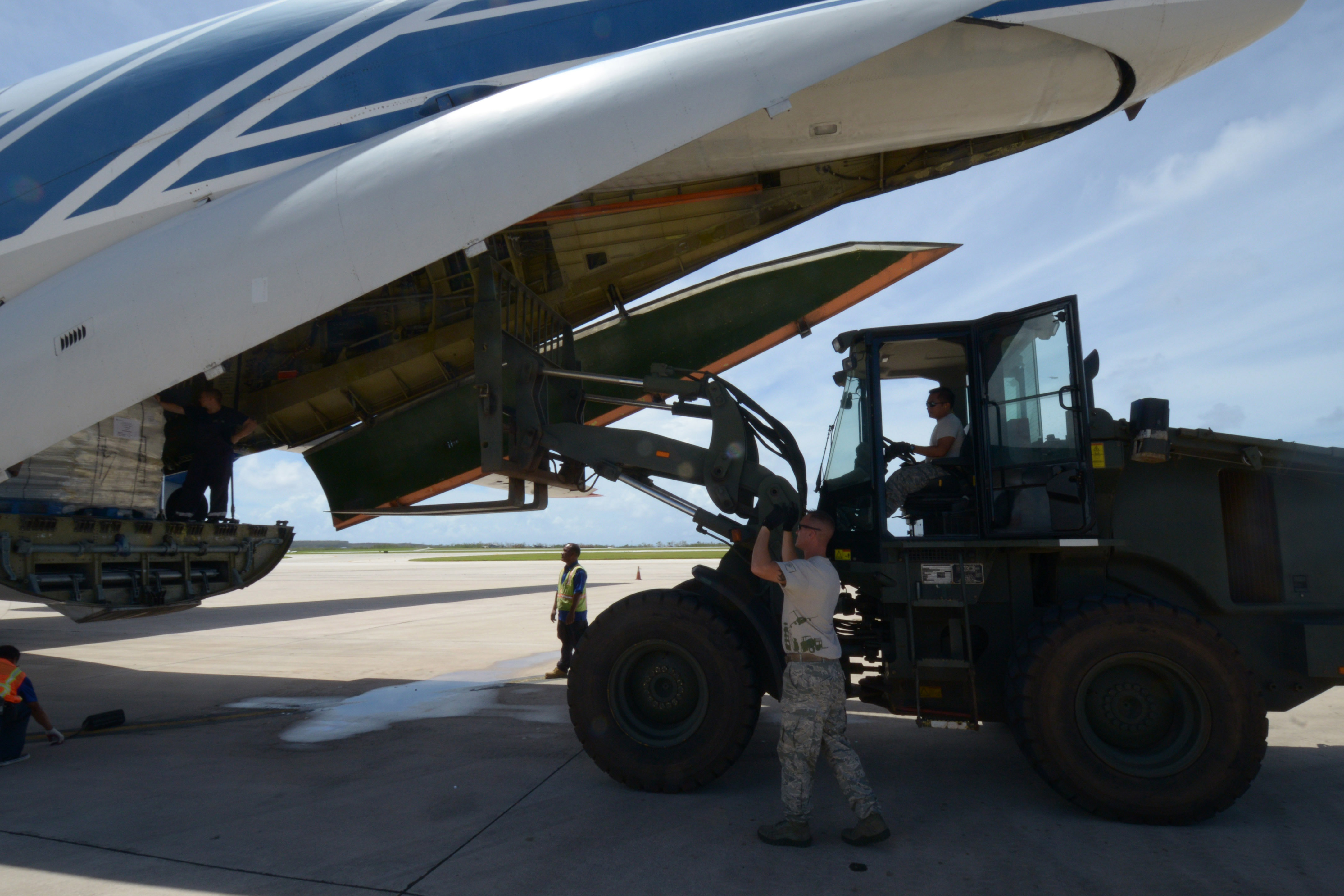
Together with units from Joint Base Pearl Harbor-Hickam, the teams provided two Tunner 60K Aircraft Cargo Loaders, which provide high-lift support to reach aircraft that the local airport can’t reach, and military-grade, adverse-terrain fork lifts.

“Currently the airport here has only one forklift in operation and it’s much smaller than what is needed for these jobs, so we brought two large forklifts capable of loading 10,000 pounds each,” Lascina said. “We bring these forklifts on missions like this because we don’t know what we’re going to encounter.”

Growing Up in Paradise

Before becoming an airman, Lacsina grew up between palms and the waves of the West Pacific and calls the Saipan villages of San Antonio and Chalan Kiya home.

“I grew up outdoors, by the beach, sheltered by distance from the outside world,” he recalled. “Saipan is a great place to grow up on. A lot of people call it paradise.

“When typhoons hit when I was young, it was a pretty exciting and scary time," he continued. "As an adult, I see how painful they can be for a small island like Saipan.”

Deciding whether or not to join the Air Force after high school was an easy decision, Lacsina said. A curiosity for the world urged the young student to look for opportunities beyond the small U.S. commonwealth.

“It really was a group effort between my friends and me,” he said. “We could either try to work our way through and potentially never leave the island, or join the military to gain experiences. We eventually decided together that we’d join the military.”

Lacsina’s military assignments have taken him across the globe, from Ramstein Air Base, Germany, to Yokota Air Base, Japan.

“ has really paid off for me,” he said. “I got to experience different things and went to different places in the world as part of my job. Growing up, I’d never have thought I’d eventually work with aircraft and now I work with different aircraft and different nations. It’s a great experience.”

While his immediate family now lives in Hawaii, Lacsina still has aunts and uncles residing on Saipan. He surprised them with a visit to lighten the mood after the storm.

“Being stationed on Guam, I do have the opportunity to go back occasionally, but the most recent one isn’t the way I wanted it to be,” Lacsina said. “They were pretty happy to see me and knowing that I’m with the military also gave them the reassurance that there is a U.S. presence helping out on island.”

Local Knowledge an Asset

For the Saipan recovery team, Lacsina’s knowledge of the island infrastructure and its people has been a real mission asset, said Master Sgt. Corey Long, contingency response team chief with the 36th CRG.

“Having a Saipan native on the team is awesome,” Long said. “Whether it’s a local language barrier or directions, he’s instrumental in that he knows the area.”

Even if the airfield staff could unload all arriving supplies, local teams would get backlogged because they’d have to individually load things onto trucks, Long continued, making Lacsina an essential part of the team.

“We enable the crews to get supplies off the airplane, onto trucks and directly to the people who urgently need this help,” he said. “The forklift driver is the key in this operation. Without his expertise these operations would stall or delay emergency aid.

“Lascina is highly proficient in his job,” Long continued. “His job experience shows and what would take a new guy two hours, he gets done in a fraction of the time. That counts when we try to get essential aid to the people who need it most.”

For the foreseeable future, the teams have their work cut out for them as many residents are still living without electricity and potable water.

“There is so much more to do,” he said. “So much rebuilding remains to be done around the island. It’s good to at least be home and help out. I joined the U.S. to help my country as a whole, but there is nothing better than coming home to do this. It’s a good feeling.”

“They always say, ‘your home is where your heart is,’” Lacsina said.

Lacsina’s skills driving a 10-K All-terrain forklift were on display on the western side of the runway at Saipan International Airport Aug. 12. In concert with personnel from the Commonwealth of the Northern Marianas Ports Authority and the Federal Emergency Management Agency, the team unloaded a cargo plane that arrived from Manila. In 1 hour and 6 minutes, they moved 45 pallets onto the tarmac for a customs inspection and then onto flatbed trucks for transport to a central distribution site.
As a result, 53,000 pounds of water, tents and cots were on their way to the people of Saipan.

Technological Advances in Military Getting Commercial Treatment


Technology has had a major impact on industries across the globe, but one particular area of industry that gets some impressive tech long before the private world gets a glimpse of its the military. Military applications of technology are as vast as they are impressive. Of course, it makes sense that providing the soldiers tasked with protecting lives cutting edge equipment to make the task easier and better. However, more and more of the military technology developed by companies is making its way into the private sector to be used for protection of commercial assets. While drones, smart weapons, and other offensive gear get regular highlights in video games, the area of safety and protection does not get enough credit.

Cable guardrails by Gibraltar are in regular use alongside roadways to keep potential threats at bay. Gibraltar also provides anti-ram vehicle barriers that can be used at jewelry stores, apartment buildings, chemical plants, and any facility in need of better protection. The available barriers can lift, lower, raise, or otherwise fold completely out of sight, only to be activated when called upon by the user. Since the barriers are rated for serious attacks or dangerous situations, they hold up to the most intense pressure. In short, the company provides anti-ram technology to keep vehicles out of a location. That technology was developed for military applications to protect checkpoints, borders, soldiers, and other valuable facilities.

Success in the military world is by no means a guarantee of success in the private sector, but the abuse and use the military puts equipment through serves as the ultimate product testimonial. After all if the military trusts protecting the lives of its soldiers to an anti-ram system built by Gibraltar, just about any facility in need of protection can trust that the product works effectively. Therefore, many technology companies struggle to produce military grade equipment. The importance of providing soldiers and peacekeepers with top of the line equipment that is built to the most rigid standards can propel a company into the future. When the product becomes ready for the private sector, many former personnel are familiar with the brand and already know the piece of equipment can be relied upon.
Safety applications are more likely to hit the commercial world than a drone. While the cost is a major factor, the real selling point is the versatility of the equipment. When workers, staff, and equipment need to be kept safe, a military grade product is the most logical choice. After all, nobody is better at keeping someone out of an area than a military force. While the strategy has a lot to do with it, the technology the military gets it a cut above.

In the end when safety and security are priorities, commercial companies turn to the advances set forward by the military. Most companies understand that cost and expense are investments in the safety of its workers. Employees enjoy the benefits of cutting edge technology that has previously been used for years in the military often without even knowing it. Military tech has a lot of applications that can be used in private business. Companies that enter that particular market understand the concept and rally to produce the type of equipment that can be relied upon when lives matter, which is also a core goal at any major corporate safety initiative.

Holloman receives Pete Taylor Partnership of Excellence Award

by Senior Airman Aaron Montoya
49th Wing Public Affairs


8/14/2015 - HOLLOMAN AIR FORCE BASE, N.M. -- Holloman received the Pete Taylor Partnership of Excellence Award on Aug. 18, from the Military Child Education Coalition for their participation in the Otero STEM program.

STEM provides specific education in science, technology, engineering and mathematics to children in real-world applications.

The Holloman and Otero STEM program began five years ago with the goal to engage local students that have a passion for technology and science in a variety of hands-on projects.

The local program had a humble beginning.

"We started from scratch," said U.S. Air Force Lt. Col. Brian Neff, 96th Test Group deputy commander. "There wasn't much funding devoted to this. It was based off the passion of a few key individuals who made it happen on their own time."

The military training nature of Holloman, which encourages education, provides a vast array of opportunities for children to learn about cutting edge technology and engineering.

"We have a wealth of resources available on base with the test track and all the testing that goes on here at the 96th TG, the Remotely Piloted Aircraft flying squadrons and also the F-16 Fighting Falcon training squadrons," said Neff. "There is a great amount of technical expertise on the base that we would like to expose the youth to."

Having Holloman's trained professionals take part in the program offers a unique perspective on these modern technologies to the children involved.

"We send some of our experts down to the local schools as mentors in various projects from Lego building competitions to robotics competitions," said Neff. "Just to get some of those experts out there to encourage the students to get interested in the programs we have here."

Holloman plans to continue their support in the Otero STEM program, helping to ensure the children with interests in science and technology stay passionate and continue their scientific studies.

"There is no better way to get the future recruits and future experts than to get them interested in the career fields at a young age," said Neff. "We want to continue to carry this forward and continue to work with Alamogordo public schools and the local community to further this effort. We're not going to stop now."

Continuing evolution: 75 years of Nellis History

by Airman 1st Class Jake Carter
99th Air Base Wing Public Affairs


8/14/2015 - NELLIS AIR FORCE BASE, Nev.  -- Closing in on its 75th anniversary, Nellis Air Force Base has stood the test of time. Although the Las Vegas Army Air Field opened in 1941, the base's roots can be traced back to a little over a decade earlier when a new airfield opened in the barren desert of Las Vegas.

Pop Simon, a local fuel distributor and entrepreneur, opened Las Vegas Airport in 1929, which was located eight miles northwest of downtown Las Vegas. In 1932, the airfield was purchased by Western Air Express, which carried passengers in between Los Angeles and Salt Lake City.

The U.S. Army surveyed the field in 1940 for use as the Army Air Forces Flexible Gunnery School because of the good flying weather throughout the year, the available access to vacant land for gunnery ranges, as well as being a good distance away from the Pacific Ocean's coastline.

After the survey was completed, the city of Las Vegas purchased the airfield on Jan. 2, 1941 for $10. The U.S. Army leased the airfield three days later.

In October 1941, the airfield was dedicated as the Las Vegas Army Air Field.

Starting in 1942, gunnery training at Las Vegas Army Air Field commenced with student gunners progressing from skeet shooting from atop moving vehicles to mobile sperry ball turrets and stationary top turrets for the B-17 Flying Fortress and, by 1945, for the B-29 Superfortress.

The training produced approximately 55,000 B-17 and 3,500 B-25 Mitchell gunners for World War II.

From July to August 1942, a training film called "The Rear Gunner" which starred Ronald Reagan and Burgess Meredith, was produced at Las Vegas Army Air Field to generate volunteers as military flying was an exclusively volunteer business.

Operations at the base wound down after World War II came to an end which ultimately put the base in stand-by status in December 1946. The base re-opened in January 1949 for advanced pilot training with the first gunnery meet and the opening of the Aircraft Gunnery School in May 1949.

On May 1, 1950, Las Vegas Army Air Field was officially renamed Nellis Air Force Base, after the late 1st Lt. William Nellis, who was shot down while flying during the Battle of the Bulge.

Many of the Korean War aces trained at Nellis AFB or served as instructors after their combat tours.

Later in 1950, Nellis AFB opened its first base chapel and a movie theatre, which provided Airmen an escape from the base's mission during their off-duty time.

In 1956, the 3595th Air Demonstration Flight was assigned to Nellis AFB, which today is known as the U.S. Air Force Air Demonstration Squadron, the Thunderbirds.

In 1965, Nellis AFB opened the U.S. Air Force Medical Facility, which was classed as a 50-bed hospital that could care for 9,000 military personnel and their dependents, and an additional 3,000 retired military personnel.

In 1991, the Tactics Weapons Center was redesignated as the U.S. Air Force Fighter Weapons Center and was changed to the U.S. Air Force Warfare Center in October 2005.

Today, Nellis AFB hosts many operations, which include Red and Green Flag, and the U.S. Air Force Weapons School -- all of which contribute to the base's mission of "Testing, Training and Tactics."

To Gerald White, 99th Air Base Wing historian, the history of Nellis AFB has fascinated him since the day he arrived in 2009.

"I didn't know a lot about fighter aircraft with my background in air mobility, but I also didn't know a lot about training and the history in Las Vegas because I had only been here once as a tourist," White said. "I learned how Las Vegas was selected for the mission after it was re-opened after World War II because of its location as well as the development of fighter and their weapons and how the base supported operations in North Korea and Vietnam."

Daniel Wheaton, 57th Wing historian, also is amazed at how large the mission at Nellis AFB has become.

"The big thing I've learned about Nellis AFB is the amazing mission of the 57th Wing that occurs here," Wheaton said.  "This wing has many missions not found anywhere else in the world; the U.S. Air Force Weapons School, the Aggressors, the Thunderbirds, the 561st Joint Tactics Squadron, the U.S. Air Force Advanced Maintenance and Munitions Operations School, the many exercises under the 57th Operations Group including Red Flag and Green Flag-East and -West, and the many airframe types utilized by and maintained by wing units.

"Every Airman in these units plays a significant role in these missions, and these missions play a vital role in influencing the success of the U.S. Air Force all over the world.  It is quite amazing when you think about it."

There is a never ending learning process about the history of Las Vegas, Nellis AFB and the missions that go on during a daily basis, but White has noticed that the city and the base have coincided and have grown up together.

"In January, it will be the 75th anniversary of the lease of the base," White said. "So basically there has been an Air Force presence in the city of Las Vegas for the last 75 years and the town has grown up with the Air Force growing up with it."

Saturday, August 15, 2015

Carter, Top Leaders Honor Victims of Chattanooga Attack


By Terri Moon Cronk
DoD News Features, Defense Media Activity

WASHINGTON, August 15, 2015 — The lives of the five “fallen patriots” who were killed as a result of the July 16 attacks in Chattanooga, Tennessee, were “truly exemplary,” Defense Secretary Ash Carter said today during a memorial service in that city.

Carter joined Vice President Joe Biden, Navy Secretary Ray Mabus, Navy Adm. Jonathan Greenert, the chief of naval operations, and Marine Gen. Joseph Dunford, the current commandant of the Marine Corps who was confirmed by the U.S. Senate to become the next chairman of the Joint Chiefs of Staff, and other officials at the ceremony.

Those in attendance honored the service of Marines Sgt. Carson Holmquist, Gunnery Sgt. Thomas Sullivan, Lance Cpl. Skip Wells, Staff Sgt. David Wyatt and Navy Petty Officer 2nd Class Randall Smith, who died from the shooting attack on the Navy Operational Support Center Chattanooga.

Never Forget
Speaking to the service members’ families, Carter said “we have no words for what you feel today because, try as we may, and try as we do, we can never fully know.  But we do know what the lives of your loved ones meant to the security of our country, and we will never forget.”

The defense secretary praised the service and sacrifice of the slain Marines and sailor.

“Many of them served abroad, and fought on the front lines of faraway battlefields in places like Iraq and Afghanistan,” Carter said. “And here at home, they were serving among the many men and women in uniform who represent our military communities – in communities across the country, on the front lines of the force of the future.”

Carter said U.S. leaders take acts of harm against Americans “personally” and will do what it takes to protect the service members who serve and protect the nation.

“The few who threaten or incite harm to Americans -- violent extremists or terrorists, wherever they are -- will surely, very surely, no matter how long it takes, come to feel the long arm and the hard fist of justice,” he said, drawing audience applause.

More United

“Those who attempt to inspire fear or terror will find no satisfaction, have no success, in the United States of America. Instead, we come back -- we come back from tragedy stronger and more united than before,” the secretary said.

Carter said he has directed the military services to fundamentally review their domestic security procedures and take immediate steps “to improve the security and force protection of our personnel. And we will do more if necessary,” he said.

Despite the attacks, recruits are lining up to volunteer, “in some cases, more than they were before,” the secretary noted.

“Young men and women are still signing up to serve and defend their country,” Carter said. “They will carry forward the legacy of the fallen, and like them, they too will serve in the finest fighting force the world has ever known.”

Courageous Families

The vice president told the grieving families their courage is an inspiration to “hundreds of thousands of people across the country who are struggling with their own sense of loss. “I promise you give them hope … America owes you just for being here,” he said.

“You’ve lost so much and you’ve given so much,” Biden told them, adding that one day, the memory of their loved ones will bring smiles to their faces.

Biden said the five were members of “The 9/11 generation,” part of the “finest generation of warriors the world has ever known.”

Extraordinary Heroism

Mabus praised the courage of the slain Marines and sailor, as well as that of their fellow service members, first responders and Chattanooga police officers who put their lives on the line to shield others from the gunfire.

“Together we will assure that they, like those that went before, will be remembered as heroes, because that is what they are,” Mabus said. “Ordinary people, facing extraordinary circumstances. An ordinary Thursday became a day of extraordinary horror, but also extraordinary heroism.”