Wednesday, August 01, 2018

Language Barrier No Obstacle for Deployed Doctors


By Air Force Tech. Sgt. Nick Wilson, 435th Air Expeditionary Wing

NIAMEY, Niger -- A worldwide average of 1.2 million people die from vehicle accidents each year. Deployed service members from multiple nations collaborated here recently to prevent adding another death to this statistic.

An Italian civilian woman was involved in a nearly fatal car accident adjacent to Nigerien Air Base 101 here. She likely would have died at the civilian hospital here if it weren’t for the efforts of service members from the U.S., Canada, France, Germany and Italy, according to Air Force Lt. Col. Kyle Korver, commander of the 768th Expeditionary Air Base Squadron.

“When we were notified by the Italians of this particular incident, we basically started calling and coordinating with them on how we could possibly help,” Korver said.

A male passenger was also in the car during the accident. Nigerien ambulance services rushed both patients to the civilian hospital here. Due to the extent of the woman’s injuries, she needed to be transported to a more advanced medical facility. That’s where the doctors and staff of Special Operations Command Forward North and West Africa’s Ground Surgical Team, and the airmen at Air Base 101 worked together to help save a life.

International Intervention

“Once we found out they intended to move the individuals and were trying to get them airlifted somewhere else, [Italian leaders] approached our ground surgical team through Special Operations Command Africa channels and actually asked if this patient in particular, who was the worst off of the two, could come over here for a lifesaving surgery,” Korver said.

The Italians sought medical advice from the U.S. ground surgical team, which recommended treatment before the woman was airlifted to another hospital.

“There were findings on the CT scan that indicated there were likely injuries that would require surgical care [gas and fluid in the abdomen],” said Air Force Capt. Nicholas McKenzie, the ground surgical team general surgeon for Special Operations Command Forward North and West Africa.

Nigerien doctors in Niamey had performed the CT scan roughly 20 hours before the patient arrived at Air Base 101.

“While difficult to quantify survival accurately, given the delay in recognition, the patient had injuries that would be fatal from abdominal sepsis,” McKenzie said. “We felt very strongly she would not survive a flight to receive care.”

“You literally had medical personnel from five different countries all coordinating on the care of this patient,” said Air Force Lt. Col. Justin Tingey, a flight doctor with the 768th EABS.

Multilingual Care

An Italian doctor coordinated the patient’s transfer from the hospital to Air Base 101, and then on to her final destination at a hospital in Senegal. The doctor spoke three languages in an effort to synchronize information sharing with French, Nigeriens, Italians, Senegalese, Germans and Americans.

“The French and Germans were actually brought in because the French were integral to coordinating a lot of the activities that went on here,” Tingey said. “The Germans -- they actually were a backup plan to get the patient out of here if the original plan did not work as far as bringing a civilian in to perform an aeromedical evacuation.”

Additionally, the medical specialists on the German team were integral to consultations on all aspects of the patient care, he said.

The woman is back in Italy and on the road to recovery, according to Air Base 101’s Italian team. As a whole, the event highlights the capability U.S. forces can provide to Niger and the surrounding region when needed, Korver said.

Tuesday, July 31, 2018

Navy Chief Seeks to Strengthen U.S. Alliances in Latin America


By Jim Garamone, DoD News, Defense Media Activity

WASHINGTON -- The bedrock of America’s military advantage is the system of alliances the United States maintains around the world.

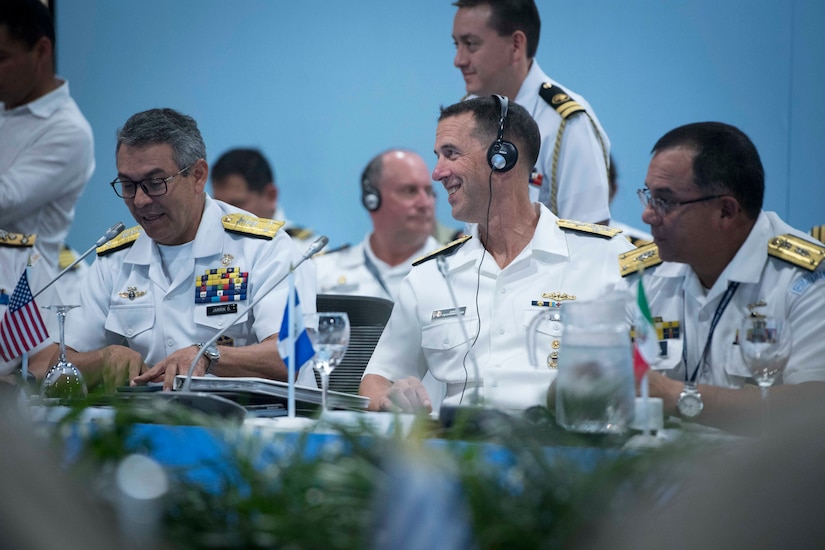
Navy Adm. John M. Richardson, the chief of naval operations, reached out to allies in South and Central America at the 28th Inter-American Naval Conference last week in Cartagena, Colombia.

In line with the National Defense Strategy, Richardson is looking to strengthen partnerships with like-minded nations.

Commitment to Regional, Global Institutions

"We are all Americans here; however, we are bound by more than simply our shared geography," Richardson said during an address to conference attendees. “We share inter-American values and a commitment to regional and global institutions that are designed to confront common security challenges.”

He added, “That we are here together is no coincidence. While military-to-military-relationships are important, I believe Navy-to-Navy partnerships are the 'first among equals.' These Navy relationships are so natural because we share backgrounds, cultures, knowledge, and a love and respect for the sea and what it can provide.”

That the conference was held in Cartagena was itself significant. The city was once the seat of a notorious drug cartel. Colombia was the scene of the longest-running civil war in the Western Hemisphere. But democratic institutions won out and last year, peace talks between the government and the Revolutionary Armed Forces of Colombia bore fruit and FARC laid down its arms. Colombia is now an exporter of security, and a valued ally.

“Despite the challenges we face -- internal to our nations or common to all -- our regional security relationship forms the keel of our shared American ship,” the admiral said. “For me, this conference reaffirms that keel is as steady and as strong as it has ever been.”

Building, Strengthening Relationships

The United States, he said, is committed to building new relationships and strengthening old ones.

“The best thing to do is to be the best possible partner to our friends and allies, and that's why the majority of our efforts here in this region are focused on strengthening the partnerships that are backbone of the regional security network,” Richardson said.

The nations work together in many different areas. Chile, Colombia and Peru are all participating in the Rim of the Pacific exercise near Hawaii. Colombia is participating for the 12th time. It is a sign of the confidence the United States holds in its South American allies that Chilean Commodore Pablo Niemann serves as the Combined Force Maritime Component Commander; in effect, commanding all maneuvering afloat forces in a series of high-end warfare missions.

“This RIMPAC is a landmark -- partners achieving their maximum potential naval power, improving together,” Richardson said.

Exercise Unitas

Later this year, Colombia will host Exercise Unitas. Planning for the exercise -- held yearly since 1959 -- has begun with Argentina, Brazil, Canada, Colombia, Costa Rica, Ecuador, United States, Honduras, Mexico, Panama, Peru, the United Kingdom and the Dominican Republic meeting to discuss scenarios. The purpose of the exercise is to improve coordination among naval forces.

“Our mutual participation in these exercises reflect the security interests and the prosperity interests of our respective countries,” Richardson said. “This is part of a broader, enduring effort to steam together with your navies so that through training, we can learn to communicate, navigate and operate together.”

But the deployments also serve a higher purpose, the admiral said.

“They enhance security. They maintain order. They preserve a system that is legal, transparent, and fair for all nations,” he said. “And they promote prosperity for all.”

Richardson will continue on and meet with officials in Brazil, Argentina and Chile.

California Air Guard Drone Helps Authorities Fight Carr Fire


By Army Staff Sgt. Edward Siguenza, California National Guard

ANDERSON, Calif. -- A critical aspect of fighting a raging wildfire, such as the Carr Fire in Northern California, comes from the skies and onto a sheet of paper.

A team from the California Air National Guard‘s 195th Airlift Wing is being used as a reconnaissance and surveillance unit, providing the state’s Department of Forestry and Fire Protection agency with up-to-date intelligence used to battle current wildfires.

“We’re able to provide real-time eyes on in any area where the fire’s at,” said Air Force Maj. Nicholas Edwards, intelligence analyst manager. “We can provide information to where CAL FIRE can direct resources. We give information to the decision makers in a timely manner.”

Working Together

The California Guard team works side by side with CAL FIRE analysts. In about a week the wildfires have affected nearly 90,000 acres, destroying more than 500 homes and buildings and killing at least six people. Thousands of Redding residents have been evacuated.

The Guard’s contributions are “seriously helping us,” said Capt. Robert DeCamp, CAL FIRE intelligence officer. “The knowledge they have and the information they provide are critical for us to fight the fire. They have equipment we don’t have, and that helps us tremendously.”

Air Force Tech. Sgt. Matthew LeMaire, an imagery expert, and Air Force Staff Sgt. Marlon Ramos, an analyst, monitor the fire via an MQ-9 Reaper, a remotely piloted aircraft. The drone employs its wide-range sensors to collect and send precise data.

Providing Information

Twice daily, LeMaire and Ramos gather the drone’s information and provide printouts to CAL FIRE. The information is transcribed onto maps and other information products and are released to firefighters and emergency crews.

This information is used to track the fire’s movements so authorities can position defenses and notify the public if evacuations are necessary.
“This is one fire that’s very unpredictable, but we can track it with the capabilities the Guard provides us,” DeCamp said.