by Senior Airman Kate Thornton
100th Air Refueling Wing Public Affairs
8/26/2015 - RAF MILDENHALL, England -- It's
been 95 years since the 19th Amendment to the U.S. constitution was
ratified, granting women the right to vote, and Aug. 26 remains a day of
celebration as Women's Equality Day.
Nearly a century later, some women continue to fuel their equality by refueling planes 30,000 feet in the air.
Female boom operators from the 351st Air Refueling Squadron make an
impact on current training and operations all over the world almost
every day - just like their male counterparts.
"(Being in a male dominant career) isn't anything I notice, because I
look around and my only thought is 'these are the people I work with,'"
said Senior Airman Amy Lizauckas, 351st ARS boom operator.
Staff Sgt. Catherine Norcom, 351st ARS instructor boom operator,
explained how this is a day to celebrate coming a long way from where
women were all those decades ago. She celebrates by wearing her flight
suit with pride.
"I think it's important that people see women in flight suits and
uniform, because there are so few of us," said Norcom. "It really sets
an example."
The 351st ARS has four female boom operators out of the 36 total
assigned, but they agree that everyone is held to the same standard.
"When we're being evaluated, they're not basing it off our gender, they're basing it off our performance," said Norcom.
"I think you just go to work, do your job and don't even have to think about it," Lizauckas added.
Although they're treated equally, there are some situations they find
themselves in that males don't even think about. Norcom and Lizauckas
listed things they, and other female booms, have had to worry about at
some point in their careers:
"What do I do with my flight suit when I use the bathroom?"
"Is the toilet working on the jet?"
"Is there toilet paper on the jet?"
"Can I wear an underwire bra or will it melt to my body in the event of a fire?"
The last one received the reply of "If your bra is melting to your body, the material wouldn't save you anyway."
They're small issues and easy to work around according to the ladies,
but they both agree that more women in the career field would be helpful
for mentoring young female Airmen and answering questions that males
might not have the answer to.
"I think it's strange that it's male dominated, because there's nothing specifically masculine about this job," Lizauckas said.
Women have progressed and are still striving not to be better than men,
but to be seen as equal human beings. With all the advances in politics,
military, science and education, there is still some concern as to
whether or not women are truly equal. The female boom operators seem to
think so.
"I'm an equal part of the aircrew when I fly and I'm an equal part of the squadron when I come to work every day," said Norcom.
The successful passage of the 19th Amendment marked a crucial milestone
in the fight for women's equality in the U.S., and so did the
designation of Aug. 26 as Women's Equality Day in remembrance of women's
suffrage and the continuing efforts toward women's equality in the U.S.
Thursday, August 27, 2015
New 3rd AF commander charts path to organizational success
by Tech. Sgt. Ryan Crane
U.S. Air Forces in Europe and Air Forces Africa Public Affairs
8/27/2015 - RAMSTEIN AIR BASE, Germany -- In 9th grade he made up his mind.
Lt. Gen. Timothy M. Ray, 3rd Air Force and 17th Expeditionary Air Force commander, had dreams of flying his whole life and, at the end of his freshman year of high school, determined the Air Force Academy would make his dream a reality.
Thirty years after graduating from the Academy and more than 4,000 hours in seven military aircraft, Ray's focus has shifted to that of a strategic leader and commander of operational air forces in Europe and Africa.
The general outlined his priorities and shared his vision for the future of the 3rd AF and 17th EAF during an interview here Aug. 7.
"It's not about what you are here to do, but why you are here to do it," he stressed. "it's all about producing American Airpower and we all have a key role in that. We are not just here to execute a flying schedule or pull our shift. We are here to produce American airpower and that takes American Airmen and the unique Airman's culture. Europe is a very strategic place at an important time in history, and American airpower will be the difference between success and failure for our nation and our joint and combined team. What we are doing makes a difference in the world."
Ray explained that the U.S. Air Force is able to respond quickly to support U.S. European Command, U.S. Africa Command and U.S. Central Command priorities because of the forces stationed here.
"We can make an immediate impact for peace and stability in these areas," Ray explained. "It's different than being in the States. Our presence and our capabilities directly supports two combatant commanders in executing the mission we have right here in front of us every day."
He said that while the command supports many contingency operations, he still has an obligation to ensure the Airmen in his command are organized, trained and equipped properly.
"We have to keep a very careful balance between operational missions and training, and we have to make sure that balance is correct," Ray said.
He said whether it's an operational mission or a training exercise, leaders set the tone for success in any unit.
"Leaders strike a vision for the future and chart the course for change," Ray said. "My job is to lead leaders and set the culture and the climate."
The success of an organization can be traced back to the climate a commander has fostered. Ray hopes to foster a climate that values dignity, respect and a balance of work and family. He and his wife have been married for 28 years and have four children.
He said his family's support has been invaluable throughout his career.
"When you can choose between work and family, choose your family," Ray said, "because there will be times where you can't choose, and your family needs to know when those times are. The peace and happiness you get with your family when you are out of the military is worth 10 times more than any rank you will ever make."
The DeLand, Fla., native said that after pride in his family, and being an American Airman he takes great pride in airpower and the faith he has in his peers and fellow Airmen.
"The people I work with are just incredible," Ray said. "It is absolutely fascinating to be working the operational issues in the strategic landscape of Europe and Africa with them. I can't think of a more exciting place in the world to be than right here with this team. This is the best job in the U.S. Air Force right now."
Schriever Airmen beautify Ellicott Elementary
by Staff Sgt. Debbie Lockhart
50th Space Wing Public Affairs
8/26/2015 - ELLICOTT, Colo. -- Six Schriever Air Force Base Airmen volunteered their time to enrich the Ellicott Elementary School facility and its grounds by pulling weeds, trimming bushes and picking up litter as part of a campus cleanup event, Friday, Aug. 21.
The heavy rains that Ellicott and the surrounding area experienced this past summer caused an increase of weeds and wild grass to grow around the school, prompting the cleanup effort.
"Over the summer break you get a lot of the weeds growing up around the building and it's important to make it look like a nice place so the kids will take pride in their school," said Master Sgt. Ryan Laube, 50th Contracting Squadron base infrastructure flight superintendent. "Honestly, it is just something good to do for the school."
The principal and the Airmen involved insisted the campus cleanup will benefit the students by helping them develop a sense of ownership for their school.
"It is very important for students to take pride in their school and pride in their community, and curb appeal is part of that," said Joe Torrez, Ellicott Elementary School principal. "Students can see a nice looking school on the inside and on the outside and they get a sense of stewardship.
Many students who attend the Ellicott School district have parents who live or work at Schriever AFB.
"Ellicott is an important part of our community," said Master Sgt. David Wright, Top III liaison for Ellicott School. "We have skin in the game, our kids go here so we definitely want to maintain our good relationship and jump in to help out when we can."
For Torrez, volunteer opportunities like the campus cleanup strengthens his sense of community.
"I think while Airmen are assigned to Schriever, they want to be a part of the community, and their kids are our kids here at Ellicott," said Torrez. "We appreciate everything that the Airmen do and having a strong relationship with the folks out at the base really just brings it closer as a community."
Whether Airmen have students attending Ellicott School District or not, there are many volunteer opportunities to get involved with.
"At the preschool, middle school, high school and the elementary school we have numerous opportunities for parents across the community or Airmen at Schriever Air Force Base to get involved with - whether that is tutoring, a campus cleanup or volunteering on field days - if they're willing to volunteer, we can find a spot for them to help us out in school," said Torrez.
Wright added there will be more volunteer opportunities to come, to include campus cleanups, science fairs, field days and a bike rodeo.
Those who would like to volunteer with Ellicott School District can contact Master Sgt. David Wright at 719-567-3811 or the Ellicott School District Office at 719-683-2700.
Airmen return home from six-month deployment
by Airman 1st Class Mozer O. Da Cunha
2nd Bomb Wing Public Affairs
8/25/2015 - BARKSDALE AIR FORCE BASE, La. -- Airmen from the 20th Bomb Squadron here, returned home Aug. 24, following a six-month deployment to Andersen Air Force Base, Guam, in support of Continuous Bomber Presence operations.
Air Force Global Strike Command's deployment of long-range heavy bombers to Andersen AFB, demonstrates the command's ability to deter enemies and assure allies, exemplifying their commitment to providing global vigilance, reach and power.
"This deployment was unique because it showed us the bigger picture of why we are such a vital element to the pacific theater of operations and how we are able to help with maintaining the balance of power in the Pacific region in addition to assisting our friends and allies in that area of operations." said Maj. Joe Foster, 20th BS assistant director of operations.
Airmen train year-round to become experts in their career fields.
"At home station, we train, prepare, test and evaluate ourselves, because when we deploy it gives us the ability to show the world how prepared we are and what we are made of," said Foster of his third deployment.
Barksdale's Airmen participated in a variety of exercises while deployed.
"We worked together with all agencies that comprise the 36th Wing as well as international units and other services," Foster said. "It was a total joint international effort to support the Continuous Bomber Presence mission in the region."
Airmen get the opportunity to get to know their brothers- and sisters-in-arms more closely through their close living quarters over the course of the six-month deployment.
"Being in close quarters with the same group of people for an extended period of time gives you an opportunity to get to know the guys," said Staff Sgt. Trevor Stackpole, 2nd Munitions Squadron storage crew chief. "Living together like that you work together, learn each other's likes and dislikes and find common ground we share."
Now that the Airmen accomplished their part of the mission, it was their time to reconnect with families and friends.
"Now that I'm back. what I'm looking forward to the most is spending time with my fiancé," said Stackpole. "Between moving to our new apartment and planning our wedding, we will have plenty to do. I'm just happy to be back."
With the 20th BS now home, the 23rd BS, Minot Air Force Base, North Dakota, takes its turn in the rotation to Guam, supporting AFGSC's continuous commitment to nuclear deterrence and assurance. As they will be back before they know it, the 20th BS will continue to perfect their skills for when they are called upon again.
Washington firefighting mobilization center stages at Fairchild
by Staff Sgt. Veronica Montes
92nd Air Refueling Wing Public Affairs
8/26/2015 - FAIRCHILD AIR FORCE BASE, Wash. -- A Type 3 Incident Management team arrived here Aug. 22 to stand up a fire mobilization center aiding the firefighting efforts across Eastern Washington.
The 15-man team from San Diego manages the staging area on base for 16 fire trucks, 8 water tankers and more than 50 firefighters.
According to Chris Heiser, the team's incident commander, the resources, inbound from California, Arizona, Idaho, Utah, Colorado and Nevada, will form eight task force components. Each component contains two fire trucks, a water tanker and a supervisor. Currently seven task force teams have already been sent to fight fires and three will be going out by Aug. 28.
"Our main focus as the incident management team is the mobilization of resources," he said. "[Fairchild] was selected because it was ideal and the base had the infrastructure to facilitate. The support Fairchild has offered has been well above our expectations."
Currently, 32 major fires are burning in Washington with more than six thousand firefighters involved. According to Chief Doug Bleeker, Spokane County Fire District 9 deputy chief, every resource in the state of Washington is currently in use to fight the fires.
Governor Jay Inslee's approved request for a federal emergency declaration to the U.S. president resulted in Federal Emergency Management Agency's involvement with the state to provide additional resources.
Heiser said that the state's request is what resulted in their deployment, but what is really making it happen for them on the ground right now is the aggressive support Fairchild AFB has provided.
"We have opened up what we could to support them, and the requests they have had were easy and within our ability to support," said Jeffrey Johnson, 92nd Mission Support Group deputy and Emergency Operations Center director. "This team has been very great to work with and we have established a great partnership to ensure the fire trucks and firefighters were able to be staged, formed in their task forces and sent forward to fight the fires as quickly as possible."
Johnson said Fairchild is currently providing workspace for the incident management team, water for the fire trucks and allowing team members access to installation facilities.
Heiser said the help is greatly appreciated and Fairchild's assistance has been a key component in the rapid fashion these fire suppression resources and personnel packages have gotten out to conduct their mission.
"It's about neighbors helping neighbors," Heiser continued. "I have never seen this level of support; Fairchild has opened up the entire base to us and we couldn't do this job without their support."
Getting help getting ahead with education
by Dave Smith
21st Space Wing Public Affairs staff writer
8/25/2015 - PETERSON AIR FORCE BASE, Colo. -- Transitioning from military life to civilian life can be a daunting task in itself. Transitioning from military life into college life can be an even bigger challenge. More than one million veteran and active-duty service members attend college annually, and a significant number of them face hurdles their civilian counterparts do not.
Some colleges and universities do a good job assisting veterans and active members of the armed services. For local military men and women the good news is there is plenty of help and support available to make continuing education a successful pursuit.
Schools like University of Colorado at Colorado Springs, Colorado College and Pikes Peak Community College provide various resources to active duty military and veterans to assist them transitioning into the academic world.
Pikes Peak Community College has offices on Peterson AFB in the Education Services building. There are classes offered on base five times a year to make picking up credits easier, as long as there are eight students enrolled.
"If they are going to PPCC they can get classes on base. For young (Airmen) in the dorms they don't have to go downtown," said Ron Shields, program manager, Department of Military and Veterans Programs for the school.
Students enrolled and taking classes on base are also able to use all PPCC facilities. There is a dedicated veterans' center on the central campus staffed with people who are familiar with military issues. The center has a lounge area with plenty of outlets for charging devices as well as computers to apply for Veterans Affairs benefits, apply to school and other uses.
Military students can connect with academic advisors at the center and at Peterson. At both sites students and prospective students can get more information and help in filling out the required paperwork for G.I. Bill funds, enrollment and other forms.
"When students have been out of school for a while we want to help them be successful," Shields said.
UCCS has a dedicated Office of Veteran and Military Student Affairs to help with the transition to the world of academia. Everyone working in the center is on or was on the G.I. Bill, said John Woods, Veterans and Military Student Outreach Coordinator. Woods, an Army veteran himself, earned a bachelor's degree using the G.I. Bill.
The office spends a lot of time helping veterans get their G.I. Bill benefits set up each semester. That assistance includes getting the paperwork processed and into the VA system. The center serves as a resource hub as well.
"We are connected to a lot of resources," Woods said. The staff can make navigating the campus and its systems an easier task.
Private schools also seek to assist the military community as well. Colorado College participates in the Yellow Ribbon program teaming with the VA to provide financial assistance, said school President Jill Tiefenthaler. The program provides funds in addition to G.I. Bill funds. Schools agree to offer a certain number of awards and the VA matches them for veterans at 100 percent of Bill benefits.
"CC has signed an agreement with the VA to disburse up to five Yellow Ribbon awards per year to undergraduate students at $7,000 each and 10 awards to graduate students at $5,000 each. These awards are then matched dollar for dollar by the VA," Tiefenthaler said. For the 2014-15 academic year the school awarded six Yellow Ribbon awards, five of them to undergraduate students.
Besides helping navigate the flow of paperwork and finances local school provide assistance following the initial steps in becoming a student. PPCC and UCCS have services available to assist veterans and military persons to be successful in the classroom as well. Connecting with academic advisors, tutors, and math and writing labs are part of the plan in these institutions where military students are concerned. UCCS even has a Student Veterans Panel and a Veterans Education Training Support program giving faculty and staff sensitivity training regarding veteran and military students.
"We give faculty and staff an awareness and bust stereotypes," Woods said.
PPCC Office of Accommodative Services and Instructional Support, OASIS, offers help to students with documented disabilities, including Post Traumatic Stress Disorder, get services delivered to meet their specific needs among other resources.
Wednesday, August 26, 2015
Thai combat controllers, U.S. air support operations make it rain
by Staff Sgt. Wes Wright
JBER Public Affairs
8/26/2015 - JOINT BASE ELMENDORF-RICHARDSON, Alaska -- Fliers and ground crews got used to a lot of foreign accents throughout Red Flag Alaska 15-3.
However, for U.S. and coalition C-130 Hercules pilots, one unique accent that routinely pierced the steady droning noise of their Pratt and Whitney motors came from Royal Thai Air Force combat controllers.
Going by their call signs, RTAF combat controllers "Nok" and "Piglet," Flight Sgt. 1st Class Saknarong Wongin and Flight Lieutenant Phongsakron Namjit, worked with side-by-side with a U.S. Air Force air mobility liaison officer, Capt. Michael Spanogle from the 3rd Air Support Operations Squadron to drop common delivery system bundles and paratroopers from the back of coalition aircraft in simulated combat situations.
"This was a very unique opportunity for both parties," Spanogle said. "Just to see how their special forces and combat controllers operate is helpful. There are a lot of parallels when it comes to passing nine-lines, radio operations and things of that nature."
While there are vast differences and scopes of responsibility between not only AMLOs and CCTs, one constant is the ability to be a one-man air traffic controller in an austere location.
"Whenever there is an air drop, my job is to go out and survey the area, make sure it's safe for operations, and coordinate with the users," Spanogle said. "My job is to go out as a single resource, which is what I normally do, or, in this case, working with the Royal Thai Air Force to help train them."
The U.S.-Thai ground team focused on improving radio platform integration and streamlining communication.
"It was good working with the Americans to learn new communication techniques and procedures," Wongin said. "It was fun. [Spanogle] taught us a lot. We will use the lessons we learned in the future for improved cooperation."
While the U.S. AMLO and Thai CCT personnel were working to improve their craft, 3rd ASOS technicians, took the opportunity to install radio equipment onboard a Humvee. They were then able to test and demonstrate the improved voice and digital radio capabilities to the Thais.
According to Tech. Sgt. Mike Whiteman, 3rd ASOS support superintendent, the capabilities, tactics, techniques and procedures demonstrated to the RTAF CCT members shows how an improved radio platform can increase communication with both ground and air resources.
The combined efforts are representative of the learning processes required from international forces during large operations and continue to prove how crucial these events are to conducting streamlined operations for future exercises and real world operations, Whitman said.
In addition to radio communication, Spanogle, Nok and Piglet worked together to set up point-of-impact markings and landing zone panels to guide aircraft. They also shared techniques on recording data and how to best pass that information to an inbound aircraft.
"It's absolutely critical," Spanogle said. "From a flying standpoint, when integrating with other nations, you see a lot of dynamics and aspects come together. From the ground sense, it's a very unique opportunity. Learning how they think and operate is awesome. It teaches us how to make things more streamlined and safe. That way, if we do go to combat, those lessons will make us more effective when we integrate."
While the Thai CCT personnel and U.S. AMLO had operational duties to perform together, the same amount of effort was put into solidifying their personal relationships.
A common understanding among participants at Red Flag was if you went near the Thai aircrew area around lunch time, you'd be invited to stay for food, according to several aircrews.
"Personal relationships are huge," Spanogle said. "That first day you get to meet someone really sets the tone for how things are going to go. I have nothing but accolades to sing for them. They were very professional and kind. They were here for more than to just drop things out of the back of an airplane. They were here to build a relationship with our forces."
JBER partnerships with local schools
by Senior Airman Tammie Ramsouer
JBER Public Affairs
8/26/2015 - JOINT BASE ELMENDORF-RICHARDSON, Alaska -- Sneakers, boots and other footwear moved across pavement and hallways as hundreds of children made their way back to school, returning to the education that will help them in the future. Service members wanting to contribute to that future have the opportunity to do so through the Joint Base Elmendorf-Richardson School Partnership Program.
The partnership between JBER and the Anchorage School District began in 2009 with U.S. Army Alaska and expanded to the 673d Air Base Wing in 2011.
"The program is a way to provide positive role models in the school setting and [is] a way to give back to the local community," said Adele Daniels, 673d Force Support Squadron school liaison officer.
In previous years, more than 200 service members have volunteered their time and knowledge to multiple elementary, middle and high schools throughout the Anchorage area.
"Depending on what the principal of each school is interested in having the student body learn, they may have service members participate in career days for the students," Daniels said. "It's a way for them to understand what our military members do in each of their jobs."
The service members express their gratitude by providing a look into military life.
"I heard about the program three years ago," said Sgt. Matthew Macarah, a 3rd Battalion, 509th Infantry Regiment paratrooper and a volunteer at Gruening Middle and Alpenglow Elementary schools. "We had just come back from a deployment. It was a perfect opportunity for me to work with kids again. My excitement stemmed from being back in the school setting and sharing the daily training activities of a paratrooper."
Macarah has a background in school administration and teaching in the Los Angeles education system.
Although the units stay the same, the personnel volunteering for the program come and go each school year.
"The only difference we have every year is the points of contact for each of the units," Daniels said. "They typically go to another duty location or have decided to put another individual in charge of the program for their unit for that school year."
"We always have new volunteers helping and showcasing what they do in their jobs," said Wendy Brons, Ursa Minor Elementary School principal.
Bronze added that the program is an excellent way for service members to see how different the curriculum is now compared to when they were going to school.
"Even if the individual volunteering is a young Soldier, there is so much information that is new in the school system they never even knew about while going through elementary school," Brons said.
Macarah said the interactions between the Soldiers, faculty and students have been very rewarding.
"Several of the volunteers have aspirations to become teachers," he said. "By volunteering at [the local schools], the faculty is able to help show the Soldiers exactly what to expect in their future careers."
Service members participate in the many activities at each school, by reading to students and working out with the students during physical education.
For those who do not want to directly volunteer with students, there are other ways to get involved.
"We have so many different opportunities for a wide range of volunteers who don't feel comfortable being with the students," Brons said.
These opportunities can be helping the librarian put books away, or by helping teachers get ready for each class.
Throughout the program, service members and students create lasting impacts.
"I think the program creates connections between the students and the service members on a level that isn't like any other," Brons said. "When these Soldiers walk into the classrooms with their uniforms on, the students react in a positive manner."
Both military and civilian students have the opportunity to speak with service members and understand what they do on a daily basis, Macarah said.
Bronze said she hopes the program will last and keep the connection between the military and school districts.
"I think this program is great, because it gets the adults in the community to come in and get a realistic view of what really goes on at school," Brons said. "I hope this partnership goes on so we keep that connection of parents and the school system alive."
For more information about this program or other school-affiliated programs, contact the School Liaison Office at 384-1505.
Carter Praises New Transcom Commander’s Experience, Commitment
By Amaani Lyle DoD News Features, Defense Media Activity
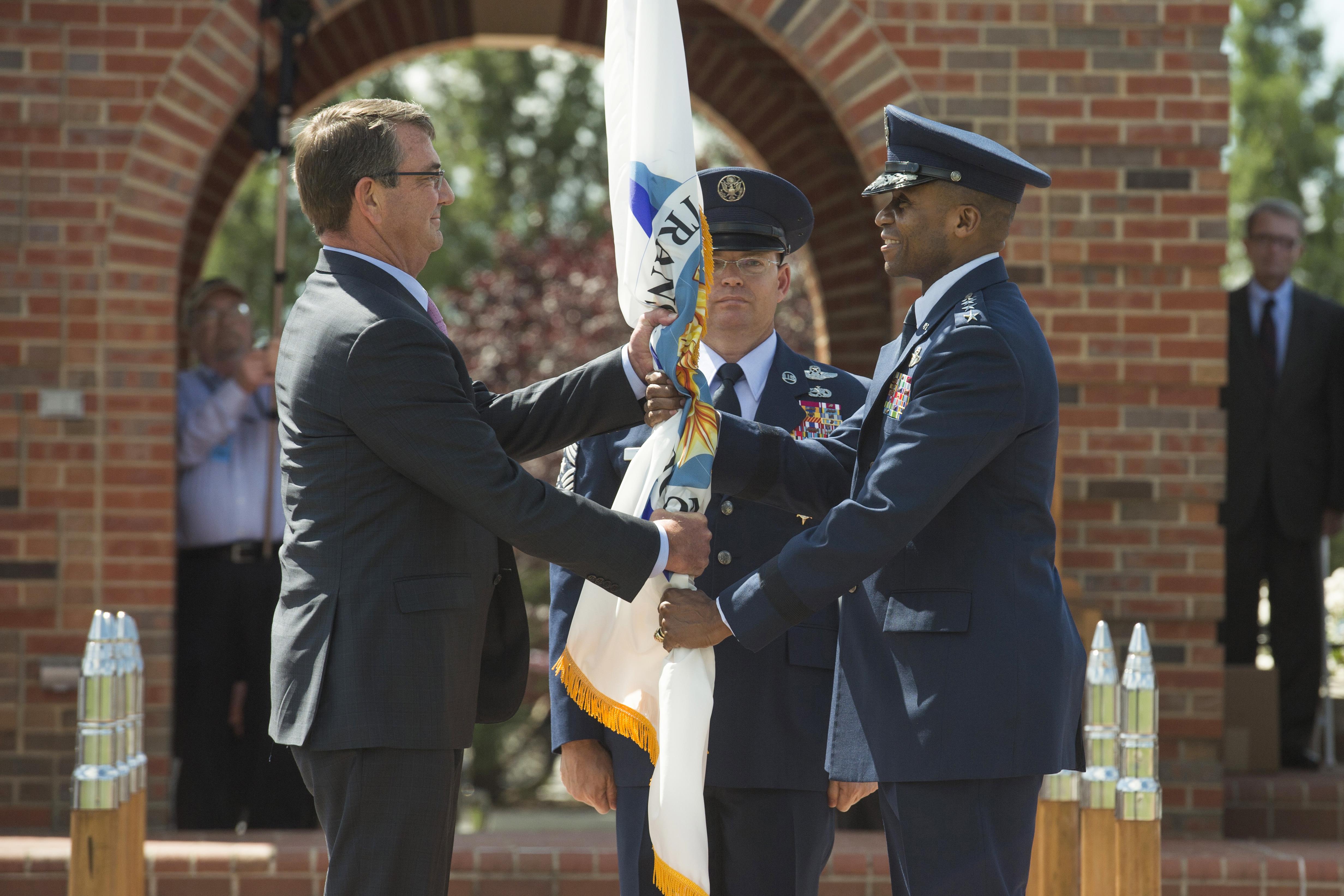
WASHINGTON, August 26, 2015 — As Air Force Gen. Darren McDew
took U.S. Transportation Command’s reins during an assumption-of-command
ceremony at Scott Air Force Base, Illinois, today, Defense Secretary Ash Carter
noted the general’s credentials for his new post.
Carter said McDew’s teachers recognized his potential, and
that later, when leaders named him regimental commander at Virginia Military
Institute, the general’s commitment to service became a hallmark of his
educational and professional journey.
“For more than three decades in our Air Force, whether at
the squadron, wing or group level, General McDew has stood out for his uncommon
ability to lead,” Carter said, adding that the four-star leader brings “an
understanding of military logistics from the inside out” to the command, which
provides for the Defense Department’s mobility needs around the globe.
A Tested Operator
“He is a tested operator who has logged more than 3,000
hours on tankers, C-17s and C-130s, and delivered critical support and supplies
to soldiers, sailors, airmen and Marines on several continents.”
In providing the flexibility and mobility to execute
missions globally, much of Transcom’s strength, Carter explained, stems from
its ability to evolve, adapt and respond quickly to new challenges and demands.
The secretary recalled that while serving as undersecretary
of defense for acquisition, technology and logistics, he saw firsthand how
Transcom supported deployed troops who toiled during the ramp-up days in
Afghanistan.
“It was one of the most difficult places in the world to
wage a war,” the secretary said. “It has … some of the most forbidding terrain
imaginable, limited transportation system, and landlocked to boot.” And yet,
Carter said, U.S. forces were able to surge forces and build hundreds of
forward and contingency bases during a period of heated conflict.
But Transcom’s complex logistical orchestration, once dubbed
the “Afghanistan miracle,” now must morph strategically into preparation for
meeting challenges from high-end adversaries, which he said will require major
logistical lift.
Reform, Innovation Are Critical
“As we reduce our focus on counterinsurgency and place more
emphasis on full-spectrum, rapid response capabilities, Transcom’s ability to
reform and innovate will become more critical,” Carter said.
The secretary’s ongoing Force of the Future discussions have
highlighted examples of technology and innovation, and he reported that
Transcom already has improved its capacity to track deliveries in real time and
predict with greater accuracy the arrival of shipments.
“These reforms have allowed our forces in the field to plan
more effectively and efficiently and help bring costs down,” the secretary
said.
Transcom also has strengthened and streamlined efforts with
private sector providers, Cater said. “By finding new ways to use existing
commercial infrastructure, by spurring greater competition among private sector
partners, Transcom continues to make our operations more cost effective,” he
added.
The command’s commitment to expanding these reforms remains
vital, and with good reason, Carter said.
Value for the Taxpayer
“As we deliver for the warfighter, we have an obligation to
deliver value for the taxpayer as well,” he said, noting the importance of
Congress allowing a budget for Transcom that charts a responsible course and
invests in its people. “When we’re forced to make irresponsible cuts, it’s
readiness that suffers first,” The secretary said.
Carter commended McDew’s breadth of experience. “Through
serving as military aide to the president and as vice director of strategic
plans at the Pentagon,” he said, “he has developed a keen, strategic
understanding of the judicious and effective use of American power.”
But McDew’s stalwart commitment to the enrichment and
development of what he described as the military’s most valuable asset --
people -- is what distinguishes him among leaders, Carter said. He noted that
as McDew assumes the vital command, he succeeds Air Force Gen. Paul Selva, now
the 10th vice chairman of the Joint Chiefs of Staff.
“That the president has nominated some of our most
distinguished military leaders to assume this command speaks volumes about the
vital importance of Transcom and its people,” he said.
Whether enabling the United States to lead a global Ebola
containment effort in West Africa, helping the United States to save lives and
provide urgent relief to Yazidis on Mount Sinjar in northern Iraq or delivering
70,000 pounds of rescue operations supplies to Nepal after its earthquake,
Transcom ensures American power can reach anywhere, Carter said.
“We know the people of Transcom will carry forward a
steadfast commitment to deliver what our force requires, whenever, wherever
they require it,” he added.
Airman author brings fictional, real heroes to life
by Staff Sgt. Darren Scott
460th Space Wing Public Affairs
8/26/2015 - BUCKLEY AIR FORCE BASE, Colo. -- In stories, the hero is often called upon to accomplish a great task, to take on the weight of a burden they did not anticipate, even though they know that hardships may plague every step of their journey. For storytellers, joy often comes from seeing the hero overcome the many obstacles placed in front of them to emerge strong and victorious against the odds.
Senior Airman Brian McLean is the author of such stories. He is also, in his own way, the hero.
As a 11th Space Warning Squadron Future Operations Flight staff instructor, McLean has been handed some heavy responsibility of his own, becoming the main point of contact for all things HEO-3, the newest highly elliptical orbit satellite in the Space-Based Infrared System.
"It's very exciting to be in charge of something like this," McLean said. "At the time I didn't really think much of it. I thought 'Cool, I'll get some regular hours, get off shift, you know, do something more than just the routine day to day.' To find out that you're going to be the point of contact for everything HEO-3 is kind of terrifying. You sure? I'm only a senior airman, here."
Aside from being the main point of contact for getting HEO-3 operational, McLean was also responsible for developing and implementing the training program for space operators working with HEO-3, as well as designing their evaluation system. For him, one of the most humbling aspects was that his leadership put their faith in him.
"To be completely trusted to handle all of this, at a senior airman level, that is just insane to me," McLean said, "Having that kind of role and responsibility has been eye-opening. I've been in the military four years and this is where I am right now. That's unheard of for someone at my level, so low on the totem pole. It's intense."
Not only did he head up this initiative, but McLean had an enormous impact on the overall mission. He ensured that HEO-3 was not only operational within one year of launching, but also two years ahead of schedule, securing one more piece of the space-based missile warning mission. It's an accomplishment he is quite proud of.
"The amazing thing is, HEO-3 shouldn't even be doing anything right now. It should just be up there, waiting for us to launch HEO-4, so we can take HEO-1 and 2 and do other things with them. So the fact that it's up in the air and actively in operations right now is great," McLean said, "It really is a point of pride to actually sit back, now that we have HEO-3 up and running and the operators I've trained are actually performing the mission. It's exhilarating."
Staff Sgt. Tim Lukenbaugh, NCO in charge of future operations and McLean's supervisor, says having an Airman like him is a vital asset to the mission and makes his job all the more enjoyable.
"It's easy. He just goes," Lukenbaugh said. "You give him one thing, and he'll do everything you tell him to do better than you ask for. No arguing, no complaining, no negativity. You talk to any leadership in our squadron and they'll give you the same answer: I'll do anything for that guy. That's the kind of reputation he has."
Operations and training aren't the only thing McLean authors, however. He is also a passionate writer, having minored in creative writing in college. Despite the high-speed work environment of his job, he still finds the time to practice what he loves.
"I have a great idea in my head and I need to get it out, that way I can breathe, exhale, walk away and do something else," McLean said. "It's always something I've been passionate about. I'd love to write a book someday, even if it is just some project on the side."
McLean treats his writing just as seriously as he treats his work, devoting himself to his writing with passion and drive. When he gets in the zone, he says, it's like the when HEO-3 got up and running. It's a great feeling.
"When I'm in the zone, I don't even notice the sun come up, I don't notice the sun go down," McLean said. "I'm completely in the moment for that story. When you actually get done with it, and you physically have something in front of you that you're proud of, it's a great feeling."
McLean is proud of the work he's done, and has confidence in the work he has yet to do. In a career field that often deals with spacecraft thousands of miles away, he says having something tangible to see is encouraging.
"It's hard to shake that feeling of accomplishment when you sit there and see all the work just paid off. That's where it is, right there. When I write a story, it's the exact same way. I did something, I accomplished something that is my own voice, no one's ever going to replicate it the same way I do."
Whether he's creating plans for new space operators or a new fictional world, Senior Airman McLean can rest easy, knowing he not only can create a hero, but be one as well.
Team Robins remembers Hurricane Katrina 10 years later
by Angela Woolen
78th Air Base Wing Public Affairs
8/26/2015 - ROBINS AIR FORCE BASE, Ga. -- The stories tell the same tales. The destruction Hurricane Katrina left when it made landfall Aug. 29, 2005, was immense. Now 10 years later, Robins team members are sharing their stories of what it was like during and after the storm.
"The devastation was unbelievable," said Marty Cain, 78th Air Base Wing legacy systems maintainer, who traveled to Biloxi, Mississippi, with a group of co-workers and church members.
"All the oak trees were just stripped. The houses were stripped to the foundations," Cain remembered. What his group of a few dozen did was mostly repair homes and cut down trees. Part of their efforts included rescuing an elderly lady who had been trapped in her home due to fallen trees.
During his week-long stay -- in which the assembly stayed in tents on someone's farm in Lyman, Mississippi -- Cain saw another place which was buzzing with hummingbirds looking for food.
"You can't appreciate the scope of the damage through videos or pictures," he said.
In fact, the storm affected areas from Louisiana to Alabama causing 1,304 deaths and $50 billion in damages, according to a report by Dr. Daniel Haulman, Nov. 17, 2006, titled, "The U.S. Air Force Response to Hurricane Katrina."
Between Aug. 23 and 29, the Air Force flew 109 hours in WC-130 airplanes which were used to measure and track the hurricane in the Gulf of Mexico.
"Air Force fixed wing aircraft, including C-130s, C-17s and C-5s, flew crucial airlift missions to transport both people and equipment and supplies," the report said.
The Air Force evacuated 2,602 medical patients and an additional 26,943 displaced people from the area.
In all branches, the Department of Defense "flew 12,786 helicopter sorties, rescued 15,000 citizens and transported 80,000 people," Haulman said.
A 433rd Airlift Wing C-5 shuttled more than 1,200 patients from New Orleans to San Antonio, Texas. The aircraft also brought in large water pumps from Ramstein Air Base, Germany, to help pump water from the flooded New Orleans.
Robins deployed 68 personnel and $4 million in equipment for the relief effort from the 51st Combat Communications Squadron and volunteers from the 52nd Combat Communication Squadron were also called upon to aid in setting up communications, according to Tech Sgt. Joshua Bendall, historian for the group.
"We brought everything we had," said Master Sgt. Brad Schafer, 78th Medical Group first sergeant and formerly with the 5th Combat Communications Group.
The main mission for the group was to set up communications at Keesler Air Force Base near Gulfport, Mississippi, and to provide assistance to the Federal Emergency Management Agency. The deployed Airmen stayed in the student triangle at the base during their six- to eight-week stay.
Schafer remembered the base commissary being flooded with water and cars floating. He said technical school students at the base were told to leave their cars and were evacuated to other bases.
Cars were spray painted with insurance company's names, and houses were also marked to let others know it had been checked for survivors.
"It reminded me of a city dump," Schafer said. "All around were trash piles, but those piles were houses. It looked like someone had picked the house up, crumbled it and dropped it back down,"
Master Sgt. Avis Smith, now the the Robins Airman and Family Readiness Center noncommissioned officer in charge, was stationed at Keesler during the storm. Her husband and three children evacuated to Atlanta while she sheltered on base.
She and her fellow co-workers stayed in the dorms, which were made of thick concrete while the storm hit. In the interior rooms, Smith said she couldn't hear much, but in the bathroom or stairwell the noise was a different story.
"It sounds like the roof was falling apart," she said.
Her siblings lived in New Orleans and lost their homes. Her father, a firefighter in the city, had to gut his house.
For years, Smith wouldn't drive along the coast.
"I couldn't stand looking at it," she said of the loss of the antebellum homes along the Gulf Coast along with countless trademark restaurants and shops.
Cain was one who did drive along the beach.
"There was not a single home standing. It was as ugly as it could get," he said.
Joel Watson, a C-130 aircraft overhaul supervisor with the 560th Aircraft Maintenance Squadron, was on a different mission. He went to the city as part of an animal rescue. His wife heard there were three women who wanted to help animals in the area.
"When we got off the exit, going into Mobile, Alabama, there were people looting," Watson said.
The closer they got to where the hurricane made landfall, the worse the roads were.
"There were big old shrimp boats turned upside down. It was creepy," Watson said.
Watson said even with all the devastation and the sadness that came with the tragedy, he was able to take away a touch of happiness when he brought home a Catahoula hound dog he named Jazz.
"I got a good dog from it," Watson said.
Labels:
hurricane katrina,
robins air force base
"Double McGuffin" pulled on SMC/AD and ORS leadership changes
by James Spellman, Jr.
Space and Missile Systems Public Affairs
8/25/2015 - KIRTLAND AIR FORCE BASE, N.M. -- At the beginning of the 1979 film, The Double McGuffin starring Ernest Borgnine and George Kennedy, narrator Orson Welles informs the movie audience a McGuffin is an object that serves as the focal point of the plot in the thriller genre. This particular film had two such objects -- a suitcase of money and a severed hand - leading to the prevention of a political assassination.
Meanwhile, back at the Space and Missile Systems Center . . . nothing dramatic as a movie plot took place. Instead, a couple of leadership changes occurred Aug. 17 within two of SMC's Directorates: the Operationally Responsive Space Office and the Advanced Systems and Development Directorate, both located at Kirtland AFB.
Col. John S.R. Anttonen assumed command as director of the Advanced Systems and Development Directorate and commander of SMC's Detachment 1 at Kirtland in an assumption of command ceremony presided over by Maj. Gen. Robert McMurry, SMC's vice commander. The AD Directorate's mission is to deliver responsive space capabilities to users across the National Security Space community and conduct developmental planning, science and technology, and pre-systems acquisition for SMC, headquartered at Los Angeles Air Force Base in El Segundo, Calif.
Anttonen leads a combined team of more than 740 military, government civilians, and contractors in four geographically separated units responsible for development, acquisition, demonstration, launch, test and operations of Department of Defense and civil space systems. Prior to assuming his new position, Anttonen was the director of the Operationally Responsive Space Office at Kirtland, overseeing the development, demonstration, and fielding of space capabilities focused on timely satisfaction of joint force commanders' needs.
"Ask yourself, if you aren't trying to change the world, then why are you doing what you are doing? Changing the way space operations is performed now, five years from now, and well into the future is what this directorate is all about," said Anttonen in his remarks upon assuming command of SMC/AD. "My goal is to instill this culture and get each and every person to "Think" especially about their future and how he/she can revolutionize space operations."
Filling the spot freshly vacated by Anttonen during a change of command ceremony an hour earlier and also presided over by General McMurry is Col. Shahnaz Punjani as the new director of the Operationally Responsive Space Office.
"I've been aware of ORS since its infancy," said Punjani in her remarks to the audience. "I'm just ecstatic to be a part of this office with its current path on future programs and role in space. The ORS Office is a proactive step to adapt space capabilities to changing national security requirements and to be an agent for change across the community."
The ORS Office works with the broader space community to provide assured space power focused on timely satisfaction of Joint Force Commanders' needs. The end state of the ORS concept is the ability to address emerging, persistent and/or unanticipated needs through timely augmentation, reconstitution and exploitation of space force enhancement, space control and space support capabilities.
ORS is taking a new approach to risk and mission assurance to rapidly deploy capabilities that are good enough to satisfy warfighter needs across the entire spectrum of operations, from peacetime through conflict.
Prior to taking command of ORS, Punjani served as commander of the 30th Launch Group, 30th Space Wing, Air Force Space Command at Vandenberg Air Force Base, Calif. In this role, she was responsible for launch processing mission assurance and integration for the DOD, Air Force, National Reconnaissance Office, Missile Defense Agency, Defense Advanced Research Projects Agency and the National Aeronautics and Space Administration.
Both officers bring a wealth of experience and unique talents and skill sets to their respective new directorates.
Anttonen was commissioned in 1989 through the Air Force ROTC program at Oregon State University where he studied Mechanical Engineering. During his career, Anttonen served in a variety of space research and development positions including Propulsion Development, Test Resource Management, Military Spaceplane Technology Development, DARPA Deputy Program Manager for the Falcon Spacelift Program and at the National Reconnaissance Office.
He is a graduate of the Air Force Institute of Technology at Wright-Patterson Air Force Base, Ohio, where he earned a Doctorate in Aeronautical Engineering with a dissertation entitled "Techniques for Reduced Order Modeling of Aeroelastic Structures with Deforming Grids." In 2007, he attended the prestigious Industrial College of the Armed Forces in Washington, D.C. where he earned Distinguished Graduate honors and the Department of Homeland Security award for Excellence in Research for his paper entitled "The Three Computer War."
Anttonen deployed twice as a United Nations Ballistic Missile Expert for Arms Control to Iraq. Additionally, he deployed in support of Operation Enduring Freedom serving in the Office of Security Assistance, Logistics in Kabul, Afghanistan.
Punjani received her commission from the Air Force ROTC program at Pennsylvania State University in May 1991 with a Bachelor of Science degree in Aerospace Engineering. She holds a Master of Science in Aeronautical Engineering from the Air Force Institute of Technology at Wright-Patterson AFB, Ohio and a Master of Science degree from the Air Command and Staff College at Maxwell AFB, Ala. She graduated from the Air Force Test Pilot School's Flight Test Engineer Course in 1999.
Punjani is a career acquisition officer with assignments at the research laboratory, flight test center, program office, and Air Staff levels. Her experience includes chemical defense systems; hypersonic propulsion technology; aircraft and weapons flight test; Air Force programming and budgeting; test and evaluation of demonstration satellites; launch system telemetry relay; and acquisition education. Punjani is Level III certified in Systems Planning, Research, Development, and Engineering, Test and Evaluation and Program Management.
"These two organizations -- ORS and SMC/AD -- are as important as ever," said McMurry in reflecting on his presiding over the two ceremonies and changes in leadership. "The nation needs rapid, operationally relevant, and robust solutions to space mission challenges more than ever. Col. Punjani and Col. Anttonen are exactly the right people to lead the way."
Labels:
leadership changes,
movie plot,
orson wells
Marines overcome hardships, prepare for the battlefield
by Airman 1st Class Luke W. Nowakowski
460th Space Wing Public Affairs
8/24/2015 - BUCKLEY AIR FORCE BASE, Colo. -- "Fire mission!" comes out over the radio and creates a frenzy in the gun pit, as each Marine moves rapidly into position to fire the M777 A2 Howitzer. Within seconds, a round is loaded and a Marine stands waiting for the command to fire. 'Fire!' the chief yells, after a last glance at the sights. A thunderous boom shakes the ground as the 100-pound round is ejected out of the barrel. Dirt and gun powder fill the air as the other Howitzers on the line follow suit. Miles away, black clouds appear on a hillside identifying where the rounds impacted. Quebec Battery, 5th Battalion 14th Marines, has made its presence known in Guernsey, Wyoming.
Q Battery is a reserve Marine artillery unit staged out of Buckley Air Force Base. Recently, Q Battery, which is made up of over 150 Marines, took to the countryside for three days to train at Camp Guernsey.
"Every single Marine plays a huge role in making those guns go boom," said Gunnery Sgt. Zachary Storrud, Q Battery 5/14 battery gunnery sergeant. "Everyone in artillery needs to be there. It's probably the coolest military occupational specialty in the Marine Corps, because we have 13 to 14 different MOS's that do one job, which is make those guns go boom."
Firing artillery is much more complex than just point and shoot. From fire direction control, to communications, to the gun line, the choreography of artillery takes many men with varying specialties to put rounds down range effectively.
Before a Howitzer can fire, an advanced party must scout out an area that the Marines feel is appropriate to fire from. When the advanced party reaches an area they feel comfortable firing from, they scout the area for any signs of enemy combatants before calling in the guns. Once an area is deemed safe, communications, survey, and fire direction control are set up and await the arrival of the guns.
When the guns arrive on scene, they are brought to pre-determined locations marked with aiming posts which help align the guns. Marines use compasses to correctly place the guns on a line they feel will give them accurate fire. Once in line, they lay the guns in place and ready them to be fired.
Geometry is used to calculate the correct position the gun needs to be in for accurate fire. When a round impacts, a forward observer radios back whether the round was on target or if adjustments need to be made. If the round was off target, data collected from the forward observer will be used by fire direction control to calculate what adjustment needs to be made to the position of the gun, which are radioed to the gun line.
"The howitzers have to get laid on an azimuth of fire and it's done by trigonometry," Storrud said. "Once that's done, then they pick a firing point. After the firing point is done, then they can start getting missions."
As a reserve unit, Q Battery only has an opportunity to fire live rounds a few times out of the year. Because of this, these types of exercises are crucial in keeping the Marines proficient at their craft.
"You always learn something new every time you go out," said Lance Cpl. Ulises Araiza, Q Battery 5/14 cannoneer. "Being in the reserves as a cannoneer, you don't get as much experience as active duty does."
This three-day field-operation in Guernsey came with its challenges for Q Battery. Not only was a new staff directing operations, but many of the reservists were doing jobs they hadn't done before.
"We put new guys in new places," Storrud said. "Anytime you put someone new in a new position or a new billet, you degrade the quality. It wasn't due to the Marines, but due to the new jobs. We can't continue to keep our top dogs in the same positions. You have to rotate guys through so we get a wealth of knowledge."
Although the exercise wasn't as clean as Q Battery would have liked, a lot of insight came out of the three-day field-op.
"I thought some of the pluses were we actually came together as a staff and we're now implementing new procedures for drill dates for when we go out to the field and shoot artillery," Storrud said. "I think it was a good thing that we didn't have the best field-op because we learned as a battery what some of our downfalls were and where we can improve and are now putting in procedures for that."
One of the staff members that helps train the reservists, Lance Cpl. Daniil Kravchuk, Q Battery 5/14 towed artillery systems technician, comes from the Fleet and brings experience and knowledge to the reserve battery. As a 'gun doc,' he is able to give valuable training to reservists whose job is to maintain the Howitzer.
"Coming out here, I like to think I bring experience here that other individuals don't have," Kravchuk said. "I am able to pass that down to the reserve artillery mechanics and teach them and give them real world scenarios they can use and learn from."
Active duty Marines like Kravchuk help to train the reservists and keep them up to speed with what is expected from a Marine artillery battery. Although Q Battery was met with challenges during the exercise, it was apparent these Marines are motivated warriors.
"They are dedicated hard working Marines and they want to be there," said Kravchuk. "The guys out there do go the extra mile, they care about their job. We have fantastic chiefs and fantastic cannoneers. Quebec Battery is dedicated."
Quebec Battery is a motivated, hardworking group of Marines. Despite facing hardships during the exercise due to new positions within the battery and limited time conducting live-fire exercises, the Marines came together and showed they can bring the fight to the enemy anytime, anywhere.
Subscribe to:
Posts (Atom)