Showing posts with label military spouses. Show all posts

Monday, September 21, 2026

Military Spouse Commission Holds First Meeting, Identifies Top Issues

The Military Spouse Commission held its first meeting today at the White House. 

The commission, which President Donald J. Trump established via executive order Aug. 3, is tasked with advising and assisting the president on policies that affect military spouses and families.
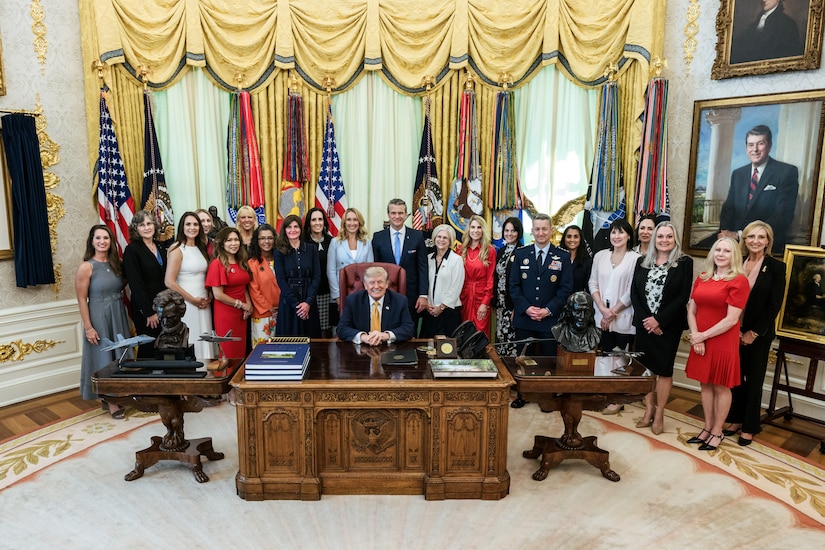
A man in business attire sits at a large wooden desk inside an office, surrounded by roughly two dozen men and women.
 

Secretary of War Pete Hegseth, who attended the meeting as a guest, spoke briefly to the roughly 20 attendees. 

“A lot of things that need to happen in our department happen with the stroke of a pen from either your husbands, at [their] level, and if not, up at the office of secretary of war level; and we are prepared to wield that pen,” Hegseth told the commission, which comprises the spouses of the War Department’s most senior military leaders.   

His wife, Jennifer Hegseth, chairs the commission and spoke about its establishment. 

“We're here to help President Trump improve the lives of America's nearly 1 million military spouses, which you all are a part of. And as you know firsthand, military spouses make a sacrifice for our nation together with the sacrifice of your warrior,” she said. 

She went on to explain that the commission will work to tackle big issues like employment, housing, education and healthcare, as well as micro issues that also need addressing. 

“Many of those solutions will be new, but some already exist and have gotten stuck in the bureaucracy — and we'll find those too,” she said. 

Jennifer Hegseth noted that some of those issues will need to be revived from past efforts to fix them, and that some solutions will require Congressional legislation.  

“We will work to find solutions to all of them, so thank you all again for being willing to serve,” she said. 

Each commission member then introduced themself and spoke about the issues that they prioritize the most. As the meeting continued, it became clear that the three most referenced issues were: healthcare, employment and housing. 

Donna Caudle, the wife of the chief of naval operations, said that as a licensed healthcare professional, she has seen firsthand and heard from countless Navy families about the challenges they face when accessing healthcare. 

“I look forward to working with the commission to help President Trump improve continuity of care and capacity, reduce appointment wait times, and close the gaps in specialty care and mental health services for our military families,” she added. 

Debbie Schiess, the wife of the chief of space operations for the Space Force, said she would love to see legislation that allows spouses who are licensed in any state to practice on federal installations.  

“This would tackle two issues at once: aiding in spouse employment and increasing our mental health providers,” she said. 

Regarding employment, Angie Perryman — who’s married to Master Chief Petty Officer of the Navy John Perryman — explained that spousal employment is near and dear to her. 

“I've been a full-time federal employee with the Department of War for almost 20 years as a licensed clinical social worker, and I know firsthand that military spouse employment is not simply about finding a job; it's about preserving a career,” Angie Perryman said. 

She noted the importance of allowing spouses to maintain their jobs despite frequent changes of location. 

“My goal is to help make military-directed moves as close to career-neutral as possible through portable work, remote work, meaningful license, portability, and employment policies that allow spouses to build careers that move with their families,” she further explained. 

Katrina Isom, the wife of the senior enlisted advisor to the chairman of the Joint Chiefs of Staff, explained that experiencing numerous moves over her husband’s nearly 40-year career has led her to focus on the quality of military housing. 

“During our time in the military, I've seen and experienced firsthand the struggles of increasing costs of housing, and the challenges of ensuring [the basic allowance for housing] meets the needs of our service members. As a member of this commission, I look forward to helping ensure that we are doing everything possible to ensure the housing needs of our military members is adequately met,” Isom said.

A silhouette of two adults and two children standing with their backs to the camera, holding hands while watching the sun set over a beach.

Following all the introductions, the secretary of war had high praise for the quality of talent among the commission members, as well as the 544 years combined of active-duty spouse experience the members share. 

“What an incredible background of human beings — Americans who gave the entirety of your lives to the whims of where the government sent your family,” he said. “And the least we can do is try to look back on that [time] and give.” 

The commission is scheduled to meet monthly at the White House.

Sunday, August 30, 2015

‘I Will Wait’ Tells Stories of Generations of Military Spouses


By Jim Garamone DoD News, Defense Media Activity

WASHINGTON, August 28, 2015 — America sends its sons and daughters to war, and a new play titled “I Will Wait” looks at the effect of these deployments across the generations.

The brainchild of Amy Uptgraft, the play connects the experiences of spouses from World War II, the Korean War, Vietnam, Desert Storm, Afghanistan and Iraq. Uptgraft wrote the play with Gregory Stieber, who also directed the play. It premiered July 31 in Fort Wayne, Indiana.

Uptgraft built on her experiences as an Army spouse. Her husband, Jamie, has deployed four times so far in the course of their marriage. They have lived the subhead used in advertising the play -- “For every one gone, someone waits.” They live in Denver with their four children.

Uptgraft, who worked as an actress and taught theater, came up with the idea for the play while visiting her home in Fort Wayne. “I was sitting with Greg and a friend from college and talking about what we had been through,” she said during an interview. “Greg said we ought to write a play.”

In the cold light of day, she said, it still sounded like a good idea, and the two researched the subject. “The more stories you heard the more, the more connections you saw across the generations,” she said. “This just impacts such a huge population of people that we don’t always think about. We obviously think about the soldier, and rightfully so. That’s where our focus should be. But the ripple effects of war are huge, and there are just millions of Americans who have experienced what it’s like to send soldiers to war and welcome them home, and their lives are forever changed as well.”

World War II Spouses Remember

She started by visiting with three 92-year-old women who waited while their husbands served in World War II. “When we sat down to talk, they told me about where their husbands served and what they did,” Uptgraft said. “But that was not what I wanted to hear, so I said, ‘That’s great, but what did you do? What was life like for you? What was it like when he left? What was it like when he came home?’

“I could tell they were so taken aback,” she continued. “But they opened up. Seventy years later, those women still had it all right in their hearts.”

She went on to speak with spouses of those who served in Korea, Vietnam, Desert Storm, Afghanistan and Iraq. Characters in the play portray spouses from each of those wars. Uptgraft and Stieber used experiences from a number of people to write the parts for the characters. In between the parts, actors read testimonials from spouses of the era.

After writing the play, the two decided to stage it to see what they had. “We had no money or funding for the project,” Uptgraft said. “I really needed to find people who I knew and trusted and knew to be very talented artists, musicians and dancers who would be willing to do it, potentially for free.”

She went back to her roots and contacted people she knew in college. Stieber is the production manager with the Fort Wayne Ballet and well-connected in the local community.

No Small Effort

This is not a small effort. The play has more than 40 characters, and the story is told with dialogue, music and dance. The cast was excited to be a part of it, Uptgraft said. “Really, no one in the cast is impacted by the military like I am, but they were honored to be a part of it, and it was a really successful first run,” she added.

Through the research, Uptgraft found that the experiences she was going through are not unique. “They are felt really by millions of family members who send people off to war,” she said.

Uptgraft said she believes the play gets across the idea “that we get through all this because we are together.”

“You have spouses that walked before you, and you will have spouses that walk after you and people that walk beside you,” she said. “We get through it together.”

The play received an “overwhelmingly positive reception,” she said. “I was worried because I had so much invested,” she added. “My big worry was, ‘What happens if no one cares?’ Fifteen minutes into the show and I could hear people crying and being moved. When the play ended, people were immediately on their feet.”

Hoping for Expansion

Now, Uptgraft said, she would like to see the play expand. “Now that we saw it open and saw it did move people and people were very excited and energized by it, I’m really anxious to see it grow,” she said. She would like it to entertain and inform the general population, she said, but she also would like to see it performed at bases and installations, incorporating the experiences and feelings of local spouses into the mix.

An abbreviated version of “I Will Wait” will play in Nashville next month, and it will be restaged in Fort Wayne. “I definitely feel it has legs, and I was moved to see how much it moved people,” Uptgraft said. “These stories don’t mean anything if there is no one to tell them to.”