Showing posts with label mass casualty drill. Show all posts

Tuesday, November 03, 2026

Army Medical Center Tests Emergency Readiness During Mass Casualty Exercise

Brooke Army Medical Center participated in an annual mass casualty exercise at Joint Base San Antonio-Fort Sam Houston, Texas, Oct. 21, to test the hospital's emergency preparedness and response capabilities.

A man in athletic attire sits on a hospital bed as three women in medical scrubs gather around him; another woman in a camouflage military uniform and reflective vest stands in the foreground.

The exercise was designed to assess the surge capabilities of hospitals in the 26,000-square-mile region covered by the Southwest Texas Regional Advisory Council. It specifically covered participating hospitals' treatment processes, patient tracking abilities and family reunification procedures. 

"As one of two Level 1 trauma centers, we not only treat military members and their beneficiaries but also civilian trauma patients," said George Wible, Brooke Army Medical Center emergency manager. "So, if there ever was a mass casualty incident, BAMC will be one of the primary recipients of patients." 

As part of the simulated drill, BAMC physicians, nurses, medical personnel and staff received news via text shortly after 8 a.m. that a midair collision occurred near San Antonio International Airport. Soon after, about 55 "victims," or volunteer role players, began arriving in emergency vehicles with various life-threatening mock injuries. 

Army Lt. Col. Michael Rowland, BAMC trauma medical director, said the trauma department's participation in the annual exercise is vital.  

"By treating patients through a variety of emergency scenarios, the exercise allows our trauma surgeons to provide quality care for critically injured patients should an incident ever happen," he said. 

BAMC was one of 50 hospitals and healthcare facilities in the region to participate in the exercise. 

Air Force Col. Amy Brown, BAMC deputy commander of surgical services, said the medical center takes an "all-hands-on-deck approach" while conducting the disaster drill. 

"Disaster response is directed by the hospital incident commander, with additional team members having assigned roles and areas of responsibility," she said. "We have playbooks that allow for dynamic collaboration between departments ... and chaplain services play a vital role in assisting families separated from victims and providing reunification." 

Army Capt. Cristina Western, medical center dietitian, volunteered to be an observer/controller and was responsible for tracking patient movements from point of entry to placement. She also noted procedures that could be improved. 

"I didn't realize how widespread across San Antonio that [the exercise] was and how many external entities were involved," Western said. "It was eye-opening to see what the whole process involves." 

According to the regional advisory council, the south Texas medical community uses a four-pronged approach to emergency preparedness: plan, equip, train and exercise. The event results are used to improve emergency plans and identify equipment shortages and other areas for improvement. 

After the four-hour exercise ended, Wible provided an early assessment of the simulated drill. 

"I've heard positive remarks that things went a lot more smoothly and effectively than previous exercises," he said. "Of course, not everything went flawlessly. Ultimately, what we hope to have accomplished is that we identify any gaps or inconsistencies that we can improve upon. We will take those lessons learned and put them into a revised plan, and when we do it again, hopefully we will do even better." 

Monday, September 29, 2025

Naval Hospital in Japan Tests Readiness During Mass Casualty Drill

Navy Medicine Readiness and Training Command Yokosuka, Japan, conducted a large-scale mass casualty drill Sept. 23, testing its ability to triage, treat and transport multiple simulated patients during a crisis.

The exercise included 10 simulated casualties, ranging from a femur fracture with controlled bleeding to complex scenarios such as punctured lungs, cardiac emergencies and burn injuries. Throughout the day, patients were received, stabilized and transferred, with the final casualty requiring medical evacuation through Naval Air Facility Atsugi.

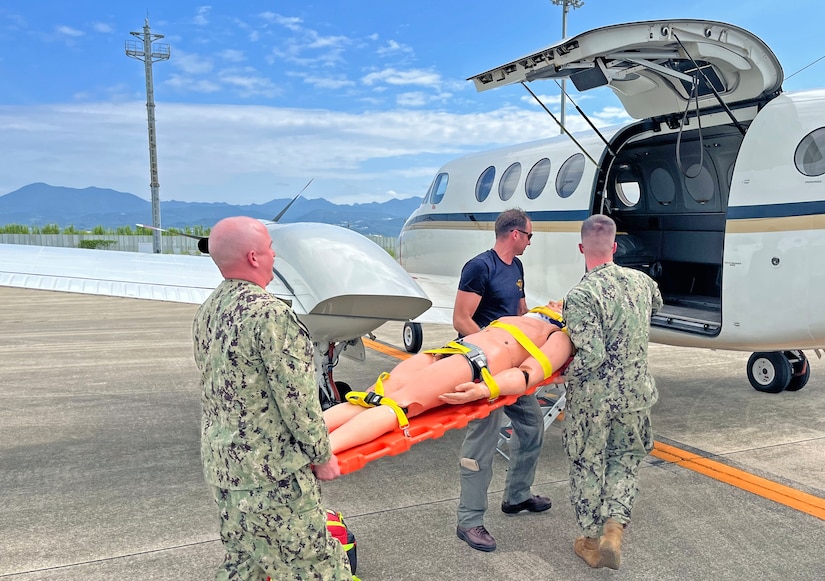
Two sailors wearing camouflage military uniforms and a man in civilian attire load a medical mannequin onto a medical jet.


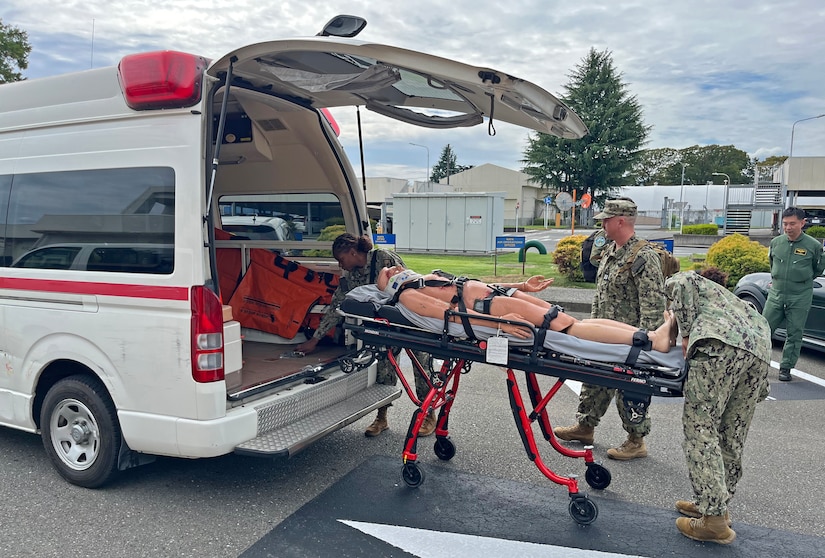
In the culminating scenario, medical personnel from Navy Medicine Readiness and Training Unit Sasebo transferred a simulated casualty to Nagasaki Airport, where it was met by a C-12 Huron aircraft assigned to NAF Atsugi and a medical crew from NMRTC Yokosuka. The aircraft flew to Atsugi, where the patient was offloaded and transported by ambulance to Naval Hospital Yokosuka for further treatment.

"This drill gave us the opportunity to test not only our in-hospital care but also our coordination with outside commands, such as Fleet Air Western Pacific, to ensure rapid evacuation when needed," said Nikolai Kerry, emergency manager at NMRTC Yokosuka.

Navy Capt. Torrin Velazquez, commanding officer of NMRTC Yokosuka, emphasized the importance of integrating new patient transport and aviation evacuation procedures into the command’s training cycle.

"Testing these new capabilities is essential to building the kind of muscle memory that ensures our teams can respond instinctively when seconds matter," Velazquez said. "By practicing these processes until they come naturally, we strengthen our readiness and safeguard the lives of those who depend on us. I want to thank every sailor, civilian and partner command who played a role in making this exercise successful."

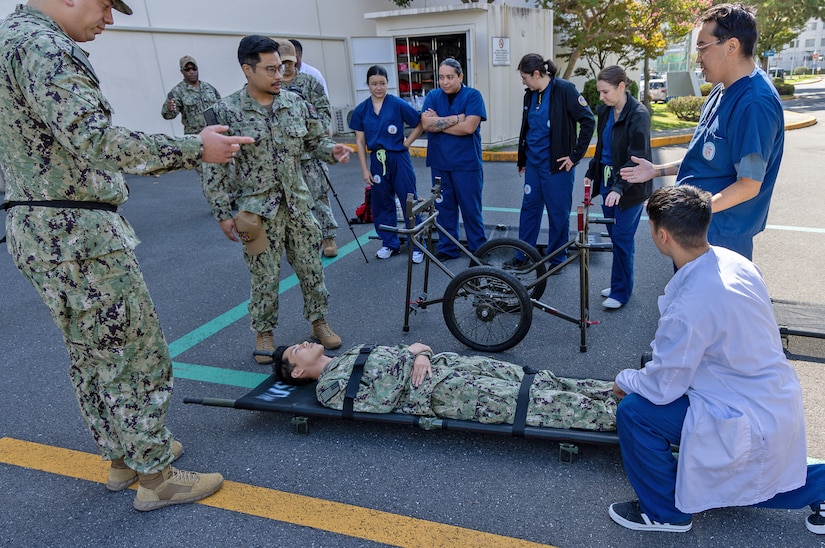
Two sailors wearing camouflage military uniforms speak to two medical personnel wearing scrubs as a sailor wearing a camouflage military uniform is lying on the ground strapped to a stretcher. Other people dressed in medical scrubs stand by and observe.


Mass casualty drills are designed to prepare medical providers, first responders and supporting personnel for large-scale incidents such as natural disasters, terrorist attacks or major accidents. These events test readiness by requiring participants to triage patients, allocate limited resources and coordinate across commands in time-sensitive situations.

"While the scenarios are simulated, the pressure is real," Kerry said. "These drills highlight gaps in our procedures, strengthen teamwork across agencies, and most importantly, help us save lives when an actual emergency happens."

The exercise featured realistic injuries on a timed schedule to challenge hospital personnel. Early scenarios focused on orthopedic trauma, such as wrist and ankle fractures, while later patients presented more medically complex cases, including pregnancy issues and cardiac conditions.

Drills like this benefit both the Navy and the broader community by improving readiness, refining processes and ensuring all personnel know their roles in a crisis. NMRTC Yokosuka conducts mass casualty drills at least once or twice a year, often in partnership with other Navy installations and commands.

Three sailors wearing camouflage military uniforms load a medical mannequin into the back of an emergency vehicle.


"This kind of training goes beyond the hospital walls," Kerry said. "By practicing in different environments and with different partners, we ensure we’re prepared for anything — from a disaster on base to a real-world emergency at sea."

The day concluded with the successful execution of the simulated casualty transfer from Sasebo to Yokosuka, underscoring the importance of interoperability and rapid response across Navy medical facilities in Japan.