Showing posts with label kc-135 stratotanker. Show all posts

Friday, March 20, 2026

Air Refuelers Among Transcom's Most Critical Assets

Aircraft such as the KC-135 Stratotanker and the new KC-46 Pegasus, both mid-air refuelers, play a major role in helping the U.S. Transportation Command extend the reach of the joint force worldwide.
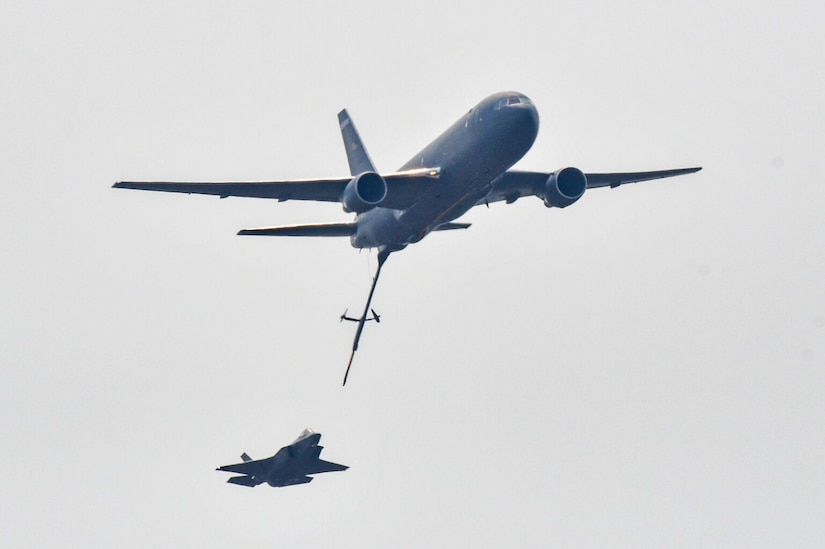
Two military aircraft fly near each other with the larger aircraft having a refueling boom extended toward the other.

"[Operation] Midnight Hammer showed just how much it actually takes to move the joint force at speed," said Air Force Gen. Randall Reed, Transcom commander, during testimony before the House Armed Services Committee's cyber, information technologies and innovation subcommittee, March 18. "And we continue to see that each time we engage in operations." 

Refueler aircraft played a large role in helping American bombers make it from the United States to Iran in June 2025 to execute Operation Midnight Hammer, where U.S. forces dropped massive bombs on Iran's Fordow Fuel Enrichment Plant, resulting in the destruction of Iranian nuclear capabilities. 

Reed told lawmakers during the hearing that refuelers are among the most critical assets in the Transcom inventory. 

"Currently, the air refueling fleet is the most stressed fleet that we have," he said. "But it is the one that I use the most to actually set the conditions to get the joint force on the move."

The KC-135 Stratotanker was first introduced in the late 1950s. It is an aircraft that is still playing an important role for Transcom, though it needs modernization to remain a contributor to the command's mission. Transcom is also using the newly introduced KC-46 Pegasus.
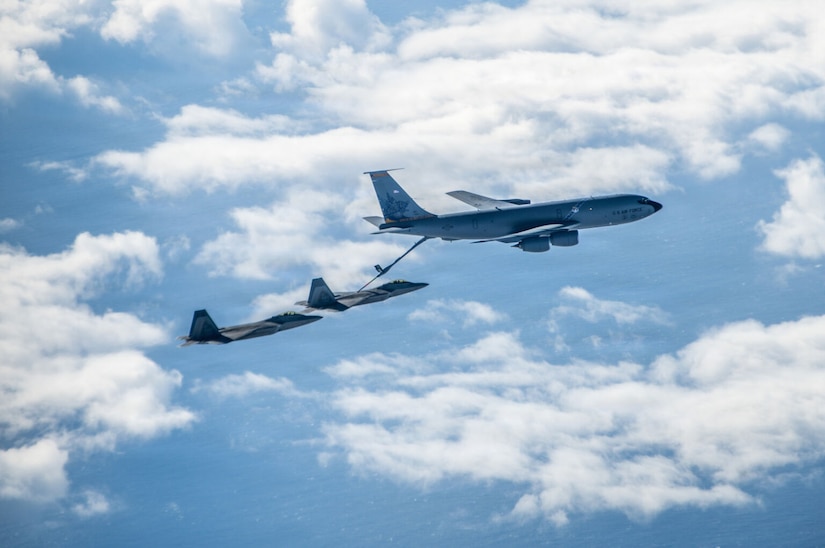
Three military aircraft fly near one another. One aircraft is connected to another with a refueling boom.

"For the KC-135 that we continue to fly, we appreciate the continued investment and sustainment and spare parts for it," Reed said. "It is a fantastic plane." 

Right now, Reed said, Congress is funding efforts to address connectivity issues with the KC-135. 

"Adversaries continue to advance in their ability to see us and to affect us," Reed said. "With that, we continue to press for increased connectivity of [the] fleet, to be able to get information inside the airplanes, to the crew, so that they could see what's happening around them, that I can give them direction and control and that they can be more responsive." 

As the Air Force continues to buy newer KC-46 Pegasus aircraft, older KC-135 Stratotankers will be retired, Reed said, adding that Transcom will always have enough refueling capabilities. 

"Once we get to the current end of the buy [cycle of KC-46], we will still have about 300 KC-135s," he said. "They will be close to 70 years old, and they will need some care. And so, whatever we do, we need to invest in the whole thing, because I need them all."

Monday, August 10, 2015

Boom simulator preps students for refueling mission

by Senior Airman Dillon Davis
97th Air Mobility Wing Public Affairs


8/10/2015 - ALTUS AIR FORCE BASE, Okla. -- Altus Air Force Base is home to one of the most advanced systems used to train future U.S. Air Force KC-135 Stratotanker refueling aircraft boom operators.

The Boom Operator Weapons System Trainer is a simulator used by boom operator students here at Altus AFB to provide hands-on training before they even leave the ground. The simulated training allows the students to run through nearly any scenario possible and tests their abilities to respond appropriately to a variety of challenges they may encounter during an actual refueling mission.

"The BOWST saves approximately $217,603 per student in flight hours," said U.S. Air Force Tech. Sgt. Thomas Vesser, 97th Training Squadron boom operator instructor. "This is because we were able to reduce our flying requirement by three sorties and move that training into the BOWST."

Aside from the obvious cost-saving reasons for simulator training, the BOWST ensures that boom operator students are better prepared to handle in-flight refueling. The students are able to hone their skills in a risk-free environment; therefore, they are able to make "rookie" mistakes without endangering lives or Air Force assets.

"As a boom operator, you are not only responsible for accomplishing the mission, but you are predominantly responsible for the lives onboard your aircraft and the receiving aircraft," said U.S. Air Force Senior Airman Mary Claire Bolo, 203rd Air Refueling Squadron boom operator student, Hawaii Air National Guard. "Like anything else, things can go wrong and the BOWST gives us the opportunity to recognize, be aware and calmly correct the conditions that are deemed unsafe."

Each boom operator student completes a total of 16 BOWST training simulations before they take to the skies. The required simulations test the Airmen on a variety of different possible scenarios they may encounter while refueling other aircraft.

"This is where we apply what we've learned in the classroom setting on a KC-135 boom operator simulator," said Bolo. "We go through multiple abnormal and normal operating procedures until our instructors feel we are proficient and ready for the real deal. Being in the BOWST broadens our situational awareness in all aspects of flight for when we, the boom operators, are in control of the aircraft."

The classroom instruction gives students the knowledge necessary to safely perform the air refueling mission, however, it is not until they reach the BOWST portion of their training that they are able to put that knowledge into action and reaction.

"The most important thing I'll be taking away from the BOWST is the malfunction procedures," said Bolo. "We work closely with our instructors, who are prior boom operators, and they share with us their knowledge and expertise on what to expect once we become operational."

The boom operators in training get to learn their craft from highly qualified and experienced instructors who were previously boom operators.

"The BOWST also gives the instructor an opportunity to explain in detail and even pause the scenario to discuss the procedures throughout the training event," said Brian Buss, boom operator instructor.

Simulators, in conjunction with expert instructors, have not only improved training efficiency, but also the quality of training received here at the 97th Training Squadron.

"The BOWST portion of training, I feel, is absolutely necessary to accomplish as a boom operator student," said Bolo. "If I didn't first fly the BOWST, I wouldn't feel comfortable at all stepping on an aircraft."