Showing posts with label basic training. Show all posts

Monday, September 14, 2026

Development, Training Flight Shapes Future Airmen

For recruits assigned to the 926th Wing at Nellis Air Force Base, Nevada, their journey starts long before basic military training. Before ever setting foot on the drill pad, these future airmen are already learning exactly what it takes to succeed in the Air Force Reserve. 

Serving as the catalyst for this transition, the 926th Wing Development and Training Flight bridges the gap between civilian life and operational military service. By coming in regularly alongside current wing members, trainees get a firsthand glimpse into their future. During this time, they are introduced to the core tenets of military life, learning essential customs and courtesies, drill procedures and rank structure to establish a baseline of knowledge.

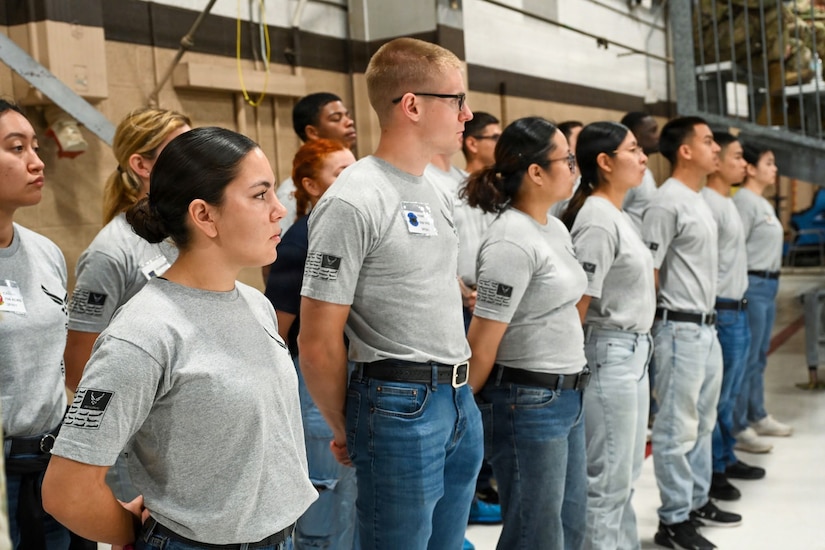
About a dozen people in casual attire stand at attention in rows inside a warehouse.

However, the training flight goes one step further with an initiative specifically designed to start building the wing from within. Beyond military fundamentals, trainees also embed with operational squadrons to gain firsthand experience with units they may eventually join. 

"The development and training flight is built for newly enlisted reservists that come into our wing," said Air Force Tech. Sgt. Bench Riche Lagus, a program coordinator assigned to the 926th. "It helps them prepare for [basic military training] and tech school, but it also helps them get integrated with the wing that they're about to work for." 

Trainees recently observed the 555th Rapid Engineer Deployable Heavy Operational Repair Squadron Engineers and traveled to Creech Air Force Base, Nevada, to witness security forces field operations. 

For trainees like Abril Fonseca, a future vehicle mechanic with the 555th, this early exposure eases the transition into military life and provides a tangible goal. 

"It's cool to see what our day-to-day [life] is going to look like," Fonseca said. "Everybody is just so pumped."

Nearly two dozen people in athletic attire and two people in camouflage military uniforms gather for a group photo under an inflatable arch that says, "Finish."
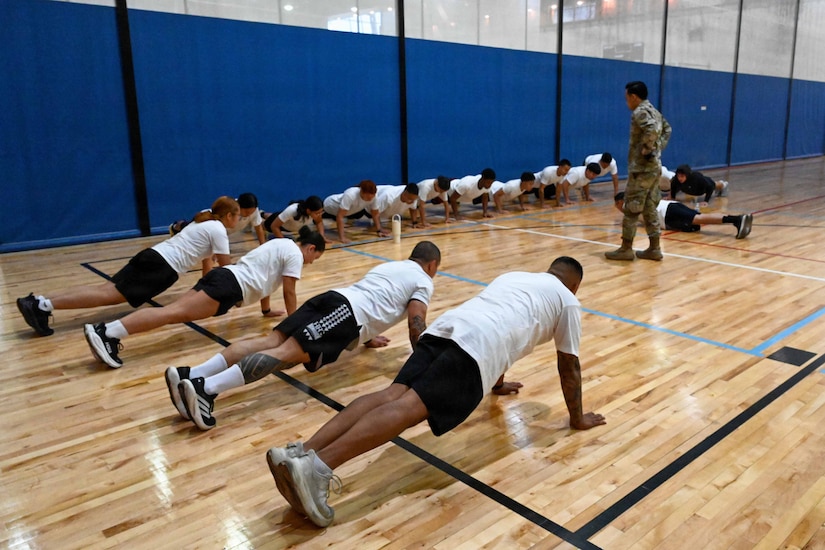
A man in camouflage military uniform stands and observes as about a dozen people in athletic attire perform pushups inside a gym.
Establishing a common baseline can be a challenge as trainees enter the flight with different levels of experience, from recent high school graduates to those with established civilian careers. As they move through the program, they rely on one another to learn military expectations and adjust to their new environment. 

"The other trainees around me that have been there longer helped me out," Fonseca said. "It's a cycle; the people who have been here the longest help the newbies out, and then we just carry that on." 

Alongside military fundamentals and wing integration, physical readiness remains a cornerstone of the development and training flight curriculum. The program incorporates monthly fitness tests, group workouts and participation in wing fitness events to familiarize trainees with Air Force fitness standards. 

This proactive approach ensures recruits arrive at basic training already equipped with the physical resilience required for military service. For many trainees, the group environment provides the exact motivation they need. 

"I was not good at working out consistently before I got to the flight," Fonseca said. "But now it feels like I can actually do it. What makes it better for me is that I have my teammates around me supporting and pushing me."

Friday, June 10, 2011

Traditional Wisconsin Guardsman first to fill assigned drill sergeant role

By Staff Sgt. Andy Poquette
Wisconsin Army National Guard

The "Smokey the Bear" brown campaign hat. The cold stare that freezes blood in the veins. The loud, piercing voice barking commands. Anyone who has spent any time in an Army boot camp can recognize these trademark signs of a drill sergeant - the tough-as-nails noncommissioned officer charged with turning civilians into Soldiers in roughly two months.

Until recently, drill sergeants primarily resided in the active Army and in Army Reserve training regiments. Now, however, drill sergeants are showing up in the Wisconsin Army National Guard's Recruiting and Retention Battalion, preparing young recruits for basic training. The newest drill sergeant - a member of Detachment 1, Company B who graduated drill sergeant school June 2 - is the first traditional Wisconsin Army National Guard member to fill that role.

"It's a very challenging program, but also very rewarding," said Sgt. Leslie "LJ" Maple of Mosinee, who drills on a monthly basis just like his recruits. "I'm able to give our new recruits the tools they will need to succeed and become honor graduates at the schools they attend."

Maple - whose wife, Senior Master Sgt. Jessica Maple was recently selected as the national level Airman of the Year - joins Staff Sgt. William Shafer, who works full-time with the Wisconsin Army National Guard's Recruiting and Retention Battalion, as one of the few National Guard Soldiers to graduate from the course.

"I've always wanted to do this and help new Soldiers, and this program was a great way to bring back the latest and greatest teachings to our Soldiers here," Maple said. "The Wisconsin National Guard having a drill sergeant means we can bring back the best techniques for training our Soldiers and set them up for success."

The benefit of having drill sergeants training National Guard recruits include similarity of instruction from the recruit sustainment companies to basic training, and less culture shock from one training environment to the next.

The Recruiting and Retention Battalion has 12 drill sergeant positions for six companies. 1st Sgt. Joshua Reed, a recruiting and retention noncommissioned officer in charge stationed in Green Bay, said that some Army Reserve drill sergeants have transferred into the Wisconsin Army National Guard's recruit sustainment companies, and that two other part-time National Guard Soldiers attended drill sergeant school but did not transfer to the battalion.

"Maple is our first home-grown drill sergeant on the traditional side of the house," he said.

The U.S. Army Drill Sergeant School, established in 1967, is now the Army's only drill sergeant school after the schools at Fort Benning, Ga., and Fort Leonard Wood, Mo., closed in 2007 and 2008, respectively.

Tuesday, February 08, 2011

Building Resilience Must Start at Basic Training, Mullen Says

By Terri Moon Cronk
American Forces Press Service

WASHINGTON, Feb. 7, 2011 – Leadership that builds resilience in service members and their families starting with the first day of basic training is essential to the U.S. military’s future, the chairman of the Joint Chiefs of Staff said today.

“That kind of investment up front will prevent us from the expenditure of a huge number of resources down the road,” Navy Adm. Mike Mullen told the audience of 600 people at the Defense Centers of Excellence for Psychological Health and Traumatic Brain Injury’s third annual Warrior Resilience Conference in Arlington, Va.

The conference’s “Total Force Fitness” theme supports a joint strategy to build resilience for service members’ multidimensional and holistic fitness.

“This is as important as who we are, where we are and what we need to do with respect to the future as anything we have,” Mullen said.

The need for resilience emerged over time, the chairman said, and it’s only going to grow.

“We’re going to see a set of problems we’ve been stuffing away in compartments that we didn’t want to deal with that are potentially going to rise dramatically in terms of severity and sheer numbers,” he said. “We need to attack that issue, not just wait for it to show up.”

Mullen noted that Army Chief of Staff Gen. George W. Casey Jr. has talked about leadership taking care of service members when they’re home, “which is something we haven’t been focused on in a long time.”

The chairman said he recently visited Joint Base Lewis-McChord, Wash., noting that the 35,000 troops there represent the largest number of service members stationed there in a long time.

“It struck me that the only ones who knew anything about [that kind of leadership] were the E-8s and E-9s. … They took care of that leadership at a time when we hadn’t done that kind of leadership for almost a decade,” Mullen said.

But that group eventually will rotate out or retire in the next few years, he added.

“We are in a race to provide garrison leadership that is critical to our future to those soldiers and airmen, there [and] across the board,” the chairman said.

Service members who now are home between deployments for twice as long as has been the case over the last decade will present challenges that “deeply penetrate” them and their families, Mullen said, calling it a fundamental change that also alters the meaning of total force fitness.

A mental health assessment team that has gone into the combat theater about a half dozen times to look at the troops’ mental health recently briefed the Joint Chiefs of Staff, the chairman said.

“The message that came out is we’re better than we’ve been, and in some ways significantly better,” he said. “We have been able to build resilience in ways a couple years ago we didn’t understand an awful lot about.”

And while much still is unknown, he added, the services will be “in the ad hoc world with respect to that until we systematically approach ‘This is one way to do that.’”

Mullen told the group he frequently addresses mental health and resilience and feels passionate about it is because the military’s future is at stake. He noted that over the next few weeks, the fiscal 2012 defense budget will be a hot topic in the nation’s capital.

“We’ll talk about our people, but oftentimes the conversation gets dominated by the ‘stuff,’” he said. “If we don’t get it right for our people and put together the kind of capabilities we have, … it won’t make any difference what we get.”

Many good people are leaving the military, the chairman said, and the nation can’t afford for that to continue. “The impact of that will be long-term, significant, and it won’t matter what kind of [budget] we have coming,” he said.

Another concern the chairman discussed is what he calls an “unwillingness to reach out to the best there is.”

“Many of us think we are the best there is, and I understand that and want professionals who think that way,” he said. “But the best there is needs to listen to somebody else who’s the best there is. Too often, we’re far too limited in our willingness to look in other places [or] to listen to breakthroughs that occurred somewhere else [that] may apply to us.

“This has to do with the speed, the openness and the urgency to get at the challenges that exist,” he continued. “We cannot rest on our status quo, no matter how good we think we are or somebody else says we are. There’s change that’s constantly occurring [that is] particularly invigorating and a difficult challenge.”

Change must be led by leaders to make a difference, Mullen said, noting that with the active involvement of leaders, the best practices can be extended into the Veterans Affairs Department and into the communities where veterans live.

Mullen acknowledged that more work needs to be done to improve the transition for service members’ care when they separate from the military.

“We have a system that’s incredibly stovepiped -- that says while you’re on active duty or while you’re wearing a uniform, the Department of Defense takes care of you. After that, the VA takes care of you. And after that, the VA turns you over to communities and says, ‘Have a nice life,’” Mullen said. “So we take our most precious resources, [the] people we care about so much while they’re here, and we turn them over to other stovepipes and hope it goes well.”

Breaking down those stovepipes is essential, the chairman said, so veterans “who made such a difference, who sacrificed incredibly, are well taken care of for the rest of their lives.”

Total fitness through individuals to their families and their experiences really is the message of today, the chairman said. “Building that to the best possible level we can possibly build it is absolutely required,” he added.

Mullen urged the audience to tackle the issues, understand solutions that might exist, and adopt the best practices until something else comes along – keeping in mind those whose lives are changed forever and the families of the fallen.

“As one surviving spouse told me, ‘On Monday, I was in the Army. On Tuesday, I was gone,’” the chairman said. “We need to make sure that does not happen anywhere. They sacrificed too much, and they’re too special.”

Monday, January 26, 2009

Surviving Boot Camp

On February 20, 2009, Conversations with Heroes at the Watering Hole will feature a discussion Sergeant Michael Volkin, USA, the author of The Ultimate Basic Training Guidebook, on Surviving Boot Camp.

Program Date: February 20, 2009
Program Time: 2100 hours, Pacific
Topic: Surviving Boot Camp
Listen Live:
http://www.blogtalkradio.com/LawEnforcement/2009/02/21/Surviving-Boot-Camp

About the Guest
Sergeant
Michael Volkin is a U.S. Army veteran. He served in Operation Enduring/Iraqi Freedom as a Chemical Operations Specialist and received an Army Commendation Medal for his efforts and for the fitness programs he designed to help his fellow soldiers. He has a Bachelor’s and Master’s degree in Science from Stephen F. Austin State University in Texas. In addition to being in the Army Reserves, Michael works as a Real Estate Broker in California. Michael Volkin is the author of The Ultimate Basic Training Guidebook.

About the Watering Hole
The Watering Hole is
police slang for a location cops go off-duty to blow off steam and talk about work and life. Sometimes funny; sometimes serious; but, always interesting.

About the Host
Lieutenant Raymond E. Foster was a sworn member of the Los Angeles Police Department for 24 years. He retired in 2003 at the rank of Lieutenant. He holds a bachelor’s from the Union Institute and University in
Criminal Justice Management and a Master’s Degree in Public Financial Management from California State University, Fullerton; and, has completed his doctoral course work. Raymond E. Foster has been a part-time lecturer at California State University, Fullerton and Fresno; and is currently a Criminal Justice Department chair, faculty advisor and lecturer with the Union Institute and University. He has experience teaching upper division courses in law enforcement, public policy, law enforcement technology and leadership. Raymond is an experienced author who has published numerous articles in a wide range of venues including magazines such as Government Technology, Mobile Government, Airborne Law Enforcement Magazine, and Police One. He has appeared on the History Channel and radio programs in the United States and Europe as subject matter expert in technological applications in law enforcement.

Listen, call, join us at the Watering Hole:
http://www.blogtalkradio.com/LawEnforcement/2009/02/21/Surviving-Boot-Camp

Program Contact Information
Lieutenant Raymond E. Foster, LAPD (ret.), MPA
editor@police-writers.com
909.599.7530