Showing posts with label NATO training. Show all posts

Friday, October 02, 2026

Kentucky Guardsmen Sharpen Capabilities Alongside NATO Partners

Two people jump out of the back of a military aircraft over water while a third person in a camouflage military uniform looks on.

Airmen assigned to the Kentucky Air National Guard enhanced their global capabilities while training alongside NATO partners from the United Kingdom and Canada in Scotland this summer. 

The guardsmen deployed four C-130J Super Hercules aircraft, 62,000 pounds of equipment and 60 personnel to Glasgow Prestwick Airport in South Ayrshire, Scotland, Aug. 14-22. 

While there, they conducted specialized fueling operations, low-level formation flying and rapid-reaction aircraft launches to maintain combat mission certifications. The airmen also completed maritime equipment and personnel airdrops, including two open-ocean rescue scenarios with a helicopter unit assigned to the British Royal Navy. 

"The deployment was designed to accomplish a large amount of C-130J continuation and tactical training while taking advantage of an unfamiliar overseas operating environment and opportunities to work directly with allied partners," said Air Force Lt. Col. Nick Reinke, the mission commander and a C-130 pilot assigned to the 165th Airlift Squadron. 

He added that while many of the individual training events could be conducted in the U.S., it is much harder to reproduce an unfamiliar environment.  

A large military aircraft flies over a green, hilly terrain.

"At home station, crews know the airspace, air traffic control procedures, airfields, support agencies and local practices," Reinke said. "In Scotland, even something as routine as a proficiency circuit required crews to understand and coordinate with a different [air traffic control] system." 

Reinke said coordination with host nation agencies was critical to the exercise's success. 

"That forces crews to solve the kinds of interoperability, communication, planning and adaptation problems they encounter when operating globally. Worldwide capability is more than simply being able to fly across the Atlantic. It means arriving with the people and equipment needed to operate, understanding an unfamiliar airspace and support structure, integrating with allied forces, adapting when weather or circumstances change the plan, and continuing to accomplish the mission." 

Reinke added that the deployment also underscored the importance of relationships. 

The Kentucky unit, based in Louisville, worked closely with civilian support agencies at Glasgow Prestwick Airport to complete specialized fueling operations, during which a C-130J was refueled while its engines were still running. Reinke said this "hot pit" method validated the airport's ability to support the technique and provided practical experience to host-nation fuel personnel. 

"That partnership leaves behind a more capable location for follow-on and allied forces in the future, rather than the benefit ending when our deployment ended," he noted. 

One of the deployment's key accomplishments was a five-ship formation flight, conducted with four Kentucky aircraft and one C-130J from the Royal Canadian Air Force. 

"The Canadian aircraft commander was actually a U.S. Marine Corps exchange pilot," Reinke said. "That meant our mission planning and briefing had to reconcile U.S. Air Force, Royal Canadian Air Force and U.S. Marine Corps procedures and terminology to make sure everyone had the same understanding before execution. That is exactly the kind of interoperability that is difficult to simulate." 

The silhouettes of three people standing in the back of a military aircraft while looking at another military aircraft on a runway.

The deployment's other main focus was open-ocean rescue. 

The scenario required a U.S. Air Force C-130 crew to locate a stranded airman floating in a life raft on the Atlantic Ocean, miles from shore. Loadmasters then airdropped an inflatable motorboat near the victim, and three special tactics airmen used precision jumpmaster techniques to parachute into the ocean, deploy the boat and provide first aid. Once complete, they coordinated with the Royal Navy's 814 Naval Air Squadron to execute helicopter hoist operations and extract the victim as the C-130 provided overwatch. 

"The integration with the Royal Navy was one of the highlights of the exercise," Reinke said. "It allowed our pararescue personnel and C-130J crews to integrate fixed-wing airdrop, maritime rescue, rotary-wing insertion and recovery, and on-scene command and control with a NATO partner." 

A pararescue flight chief for the special tactics team described the operating environment in Scotland as "vastly different" from training locations in the United States. 

"It's a lot colder here, and the salt water is an unusual factor for us," he said. "The Royal Navy also uses different geolocation methods, and they have different tactics and techniques than we typically employ." 

He noted that the Royal Navy's helicopter, a Merlin Mk2, generates substantially more rotor wash than the UH-60 Black Hawk. 

"Those are the kinds of things you don't anticipate, but we were able to work through them and figure out what worked best for their guys and for us," the airman said. "We had to be flexible on the spot to get the mission done." 

Royal Navy Capt. James Hall said the exercise provided valuable opportunities for the Merlin Mk2 force to enhance capabilities outside of its normal role in antisubmarine warfare. 

A man wearing a flight suit lies on his side in the back of a military aircraft and peers off into the distance.

"Exercises such as this, conducted alongside our United States Air Force partners, enable our crews to maintain and enhance critical search and rescue skills, while strengthening the interoperability that underpins NATO's collective security," he said. 

Royal Navy Lt. S. Cass, a flight commander assigned to the 814 Naval Air Squadron, agreed, adding that he hopes to continue working with "our friends across the pond" in the years to come. 

Reinke called the deployment an unqualified success, not necessarily for any single event but for the readiness training they were able to layer into one exercise. 

"We were able to use legitimate flight training requirements to generate maximum value, ensuring worldwide readiness while working with our international partners," he said. "We also were able to build strong human relationships with the men and women of our partner nations, laying the kind of foundation that makes coalition operations successful."

Thursday, July 30, 2026

U.S., U.K. Air Forces Conduct Fighter Weapons Certification During Exercise Combat Archer

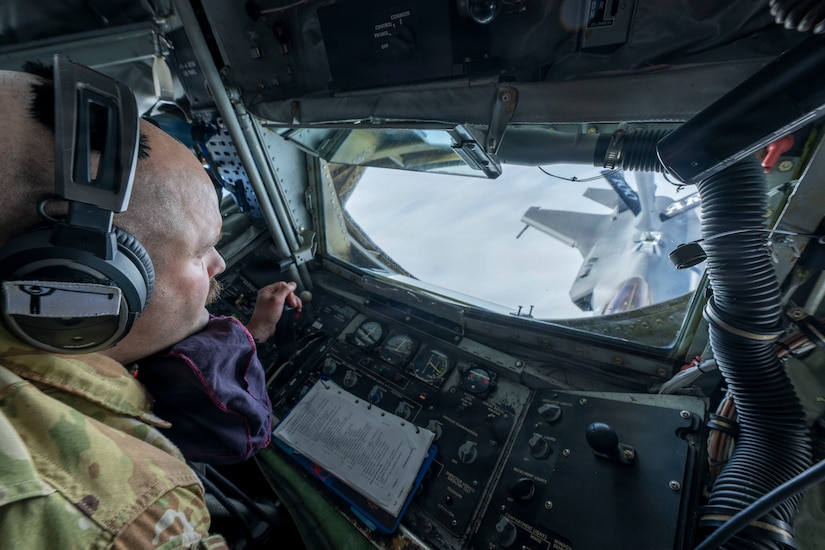
A man wearing a camouflage military uniform and headphones sits in the cockpit of a tanker aircraft.
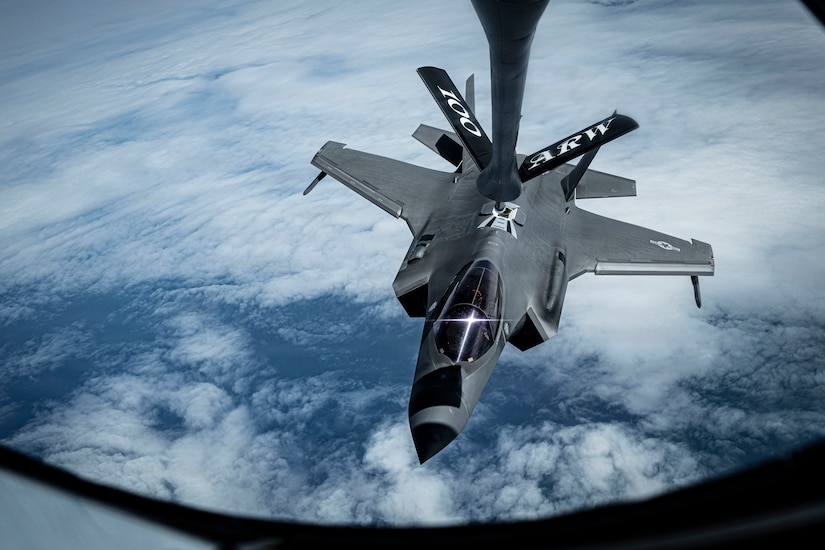
A fighter jet is connected to the boom of a tanker aircraft while refueling in flight.
After two weeks of high-end, tactical air and missile training, Exercise Combat Archer U.K. 26 concluded July 24, with the combat certification of the U.S. Air Force's 492nd and 493rd Fighter Squadrons stationed at Royal Air Force Lakenheath, England.

Led by U.S. Air Forces in Europe and Air Forces Africa, alongside Royal Air Force F-35B Lightning fighter jets, the exercise paired an evaluation unit with active U.S. fighter squadrons to certify pilots and ground crews for combat operations.

The squadrons were supported by the 351st Aerial Refueling Squadron from Royal Air Force Mildenhall, England, and the 83rd Fighter Weapons Squadron from Tyndall Air Force Base, Florida, which conducted the evaluation.

Exercise Combat Archer U.K. focused on air-to-air, weapons system evaluation training scenarios, ensuring high-end combat readiness for global operations. 

In accordance with chief of staff of the Air Force directives, operational units are required to certify in all aspects of air-to-air weapons system employment before executing real-world taskings. Exercises like Combat Archer further confirm Air Force units are postured and ready as a credible force to assure, deter and defend in an increasingly complex security environment.

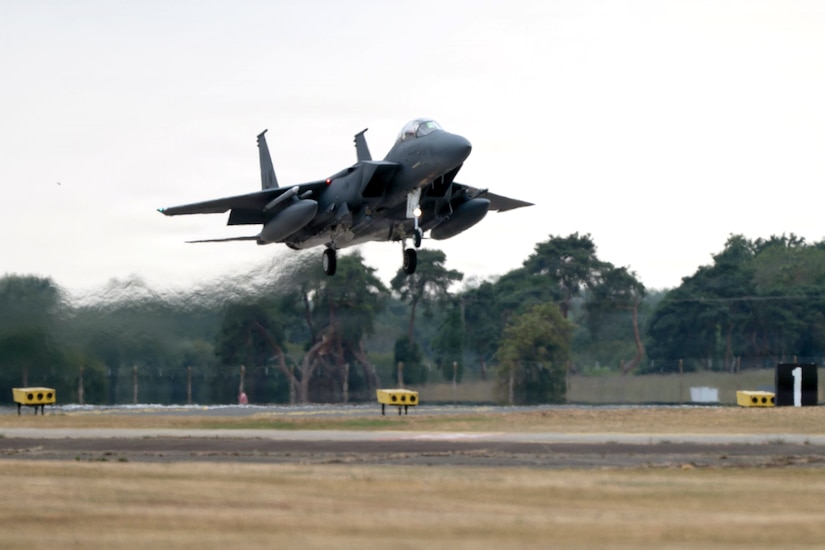
A fighter jet lands on an airstrip; there is a tree line in the background.

"Across the command we know we have pockets of lessons learned and exercising them together in a challenging environment, before the time of need, gives us a strategic advantage," said Air Force Lt. Gen. Jason Hinds, U.S. Air Forces in Europe and Air Forces Africa commander. "Exercises like Combat Archer U.K. 26 ensure tactical proficiency, readiness of our maintainers and operators and confidence in the weapon system."

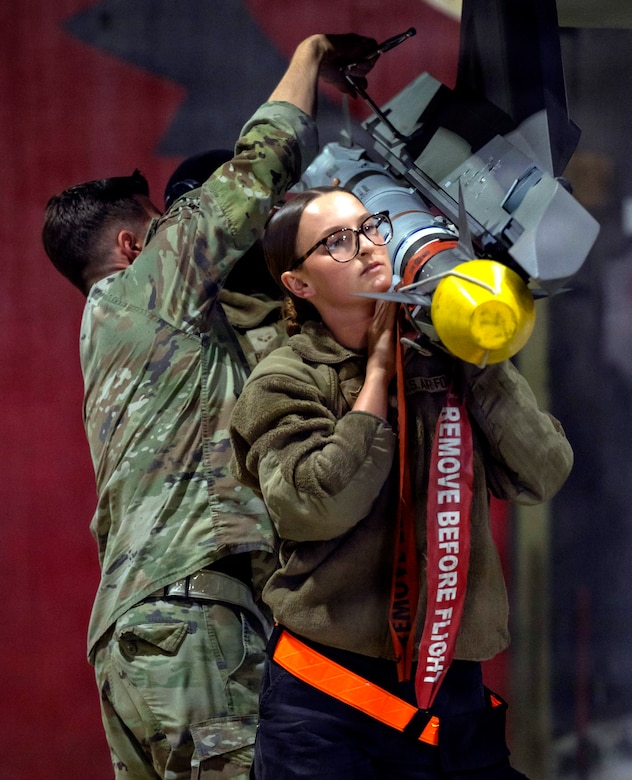
During the exercise, ground crews and pilots gained valuable experience employing air-to-air missiles and aerial gun weapons. While maintenance personnel focused on building, loading and arming munitions onto aircraft, aircrew ground training focused on determining appropriate payloads for their assigned realistic combat scenarios. All training culminated in live fires where pilots executed weapons employment on airborne targets.

"It's a chance, in a controlled environment, for pilots to actually experience what live weapons employment looks like," said Air Force Capt. Thomas Holmes, 48th Fighter Wing project officer and 493rd Fighter Squadron pilot. "Exercises like Combat Archer U.K. really hone those air-to-air skills. There is no substitute for that kind of training."

A woman wearing a military camouflage uniform lifts a missile on her shoulder as two men wearing similar attire connect it to a fighter jet.

The Royal Air Force F-35 fighter jets executed critical beyond-visual-range weapons scenarios, directly synchronizing allied tactics, techniques and procedures to forge deeper trust and operational confidence.

Specialized certification training like this ensures forces are ready, lethal and postured to safeguard against any threat to U.S. interests in Europe and around the globe. The exercise provided crucial data to system engineers, enabling them to improve aircraft and munition guidance systems for the Air Force.

The 83rd Fighter Weapons Squadron evaluated both the ground and air components of weapons employment while simultaneously using traceable air-to-air missiles, enabling for detailed real-time telemetry data analysis. The integration of U.S. 4th- and 5th-generation fighter jets alongside Royal Air Force aircraft allowed forces to test their ability to provide and sustain combat operations in a realistic training environment alongside allies and partners. 

Monday, July 20, 2026

Minnesota National Guard, Croatia Celebrate 30 Years of Partnership

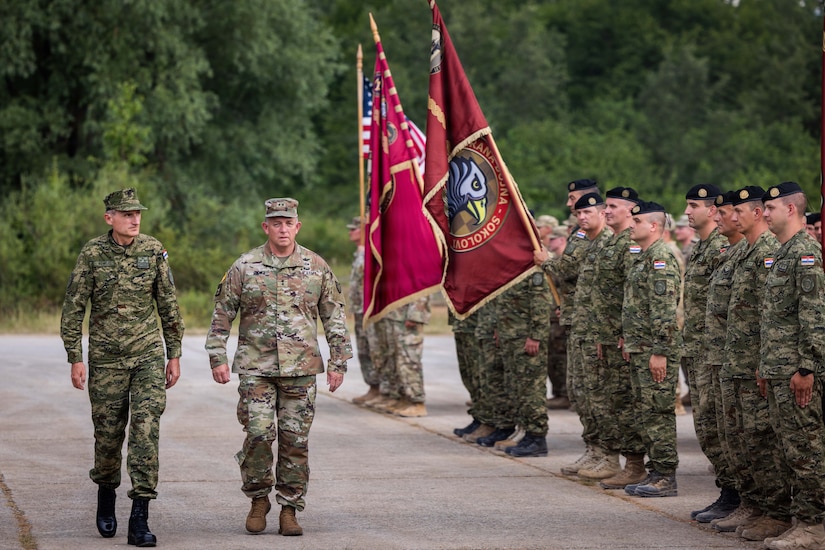
Minnesota and Croatia celebrated the 30th anniversary of their partnership through the National Guard Bureau's State Partnership Program during Exercise Combat Power 26, near Slunj, Croatia, June 29. 
 
"This partnership is best measured not only in years, exercises or official milestones, but in people," said Nicole McGraw, U.S. ambassador to Croatia. "It is measured in Croatian and American soldiers who have trained together, learned from one another and form a kind of trust that only comes from serving side by side."

Two men wearing camouflage military uniforms walk past a formation of military personnel holding various flags.

The SPP joins a U.S. state with a NATO-allied nation to strengthen military capabilities, enhance interoperability and foster long-term institutional relationships. The celebration came just days after the 35th anniversary of Croatian independence, June 25. 
 
Over the years, members of the Minnesota National Guard and Croatian Armed Forces served together in Afghanistan, trained alongside one another in Minnesota and Croatia and exchanged expertise in areas including cyber defense, medical capabilities, explosive ordnance disposal, water purification and military modernization. 

Thirty years later, Exercise Combat Power 26 provided another opportunity for the two forces to train together. 
 
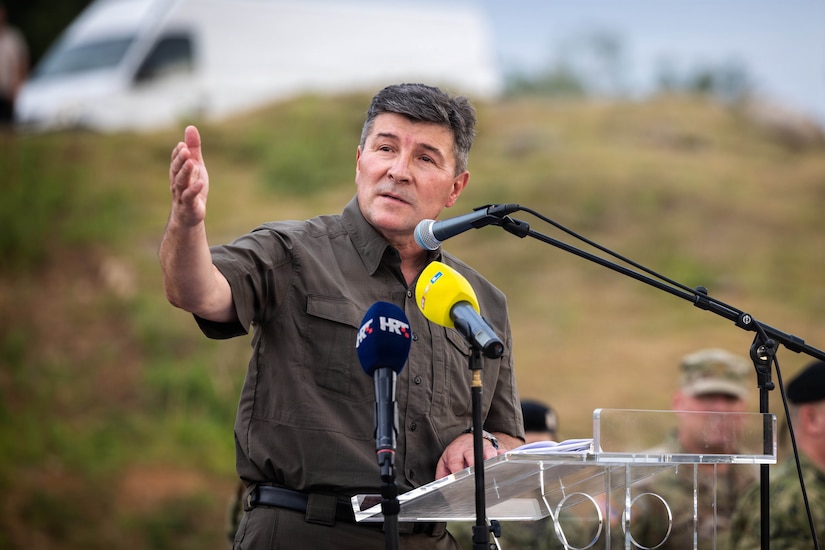
"This exercise is more than a training event," said Lt. Gen. Tihomir Kundid, chief of the general staff of the Croatian Armed Forces, during the ceremony's opening remarks. "It is a good opportunity to exchange knowledge, share experiences and build professional relationships. Armed forces readiness has never been more important than today."

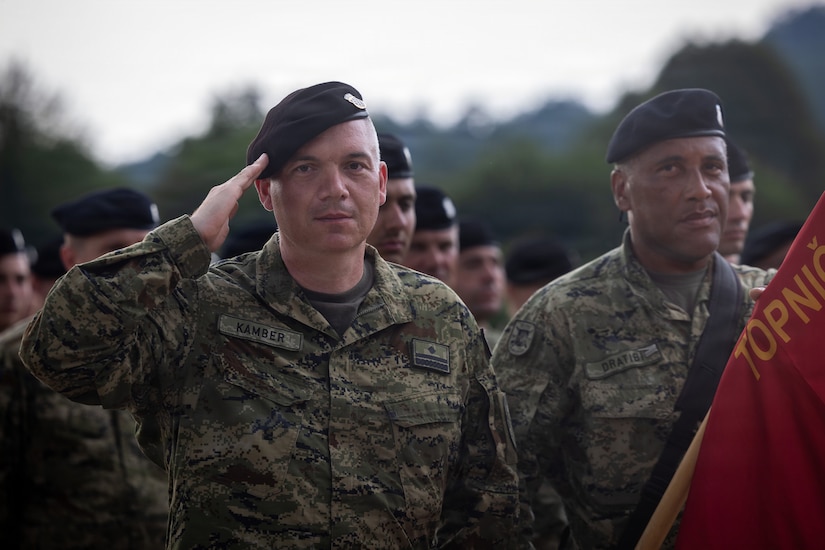
A man wearing a camouflage military uniform renders a salute while holding a flag. Other people in similar attire stand in formation.
A man stands at a lectern and points to his right.
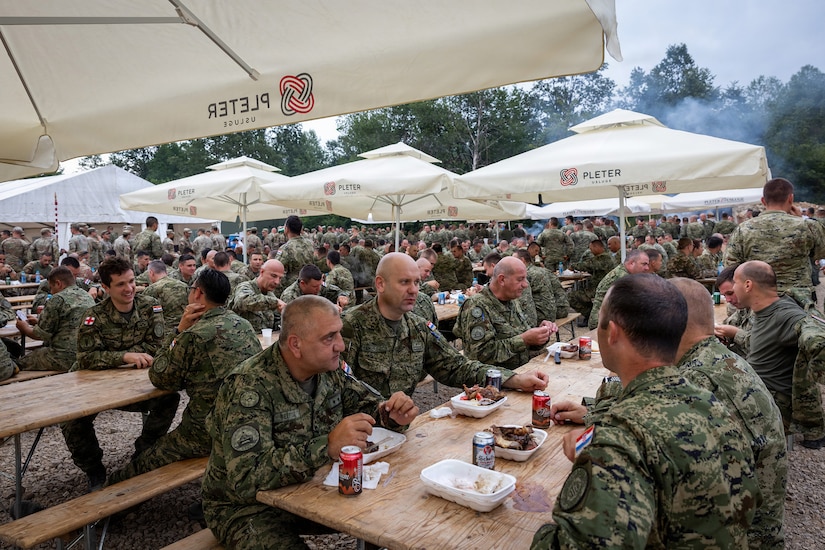
After the ceremony, the smell of grilled steaks filled the air at the Eugen Kvaternik Military Training Area as Minnesota volunteers served dinner to U.S., Croatian and allied service members participating in the exercise. 
 
"This gave me the chance to support and recognize this long-standing partnership between the Croatian Armed Forces and the Minnesota National Guard," said retired Army Command Sgt. Maj. Doug Wortham. "It was an awesome opportunity to share this taste of home with the service members and see NATO allies break bread together after a long day supporting Combat Power 26. 
 
Serving Our Troops, a Minnesota-based nonprofit organization, traveled to Croatia to prepare and serve 1,000 steaks as service members and leaders commemorated the 30th anniversary of the partnership between the Minnesota National Guard and the Croatian Armed Forces. 

"A good meal may seem simple, but for those who serve, and for those families who support them, it can mean a great deal," McGraw said. "Tonight's dinner is a reminder that service is not only honored in ceremonies. It is honored in acts of gratitude, in communities that remember and in citizens that take the time to say thank you." 
 
For many of the Minnesota National Guard soldiers participating in the exercise, it marked their first time training in Croatia. For others, it continued the relationships built over years of exchanges and shared missions.

Groups of people wearing camouflage military uniforms sit at tables under canopies for a meal.

Army Maj. Gen. Shawn Manke, adjutant general of the Minnesota National Guard, said the trust built during exercises like Combat Power 26 can develop into relationships that last well after the training ends. 
 
"Over the last 30 years, we have built true friendship and trust," Manke said. "The trust that you built during this exercise is a seed that will flourish and bloom years down the road."