Thursday, September 14, 2017

Face of Defense: Volunteer Devotes Time to Keep Fellow Airmen Safe


By Air Force Senior Airman Robert Volio 30th Space Wing

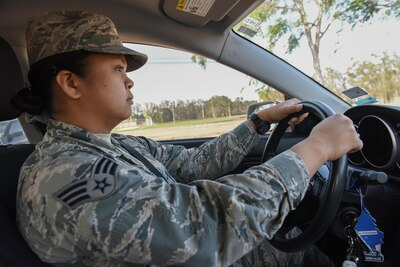
VANDENBERG AIR FORCE BASE, Calif., Sept. 14, 2017 — Air Force Senior Airman Lanimarie Baclian, an Airmen Against Drunk Driving volunteer, is always happy to answer her phone.
AADD

“I've been a volunteer driver since February,” said Baclian, an intelligence, surveillance and reconnaissance target development analyst with the 614th Air Operations Center here. “I recently became an AADD squadron representative in June. I'm the point of contact for my squadron when it comes to AADD events. I recruit volunteers from my squadron, and coordinate my hours with the driving coordinator. I enjoy being part of an organization whose sole function is to look out for and help other people.”

Since she became an AADD volunteer, Baclian has worked 27 shifts for a total of 162 hours. During that time, she has picked up airmen all over the Central Coast and sometimes on base during official functions.

What started as a favor to a friend became a much more important cause.

“I initially started volunteering as a driver because my friend was recruiting volunteers and not a lot of people were volunteering, so I decided to step up,” Baclian said. “However, the more active I was, the more important it became to me. While there are other options airmen can utilize, AADD gives people a safe, reliable, and anonymous option if someone were to find themselves stranded.”

Consequences

Driving while intoxicated can have extreme repercussions, not only on those driving, but for passengers and other drivers on the road.

“Driving under the influence can have a significant impact on other people,” Baclian said. “A person is putting other peoples’ lives at risk when they decide to drink and drive. My mom instilled in me at a young age that when you make that choice and you end up crippling or killing someone, that feeling stays with you forever. No amount of goodwill bring that person back to life. You may think you're fine, but it's not worth your life and someone else's as a result of poor decision-making.”

Getting caught driving under the influence can also end a career.

“Driving under the influence can have severe implications on your career,” Baclian said. “It can cost you your career: a demotion, referral performance report, an Article 15 that will make it difficult for re-enlistment, and a potential criminal conviction.”

Volunteers Needed

AADD is always looking for volunteers, and not just drivers, Air Force Staff Sgt. Isis Land, AADD president said..

“We solicit for five people a night on weekends, holidays and events to be a dispatcher, primary or alternative female driver, and primary or alternative male driver,” said Land, the 30th Medical Group Periodic Health Assessments noncommissioned officer in charge. “To get involved, members can reach out to their squadron reps, our driver coordinators or any of the council members and let us know when they would like to help.”

Through her contributions and involvement with AADD, Baclian has been a consistent wingman for her fellow airmen.

“It's a great feeling,” Baclian said. “I'd drive any one of my friends if they needed it, and this allows me to expand and be a wingman to other people.”

With the potential to save a career or a life, AADD is always just a phone call away. Volunteers like Baclian are always happy to answer that call.

“It has been drilled into our heads at every safety brief to have a plan,” Baclian said. “You should not be ashamed to ask for help. There are people who work every week to drive out and make sure you get home safe.”

Mattis to Visit Bomber Crews, Missileers as Part of Nuclear Posture Review


By Cheryl Pellerin DoD News, Defense Media Activity

WASHINGTON, Sept. 13, 2017 — Defense Secretary Jim Mattis left this morning on a three-day nuclear-focused trip that comes during ongoing reviews of the U.S. nuclear posture and ballistic missile defense.

Minot Air Force Base in North Dakota will be his first stop tomorrow, and the same day he will travel to U.S. Strategic Command in Omaha, Nebraska.

On Sept. 15 Mattis will travel to Mexico, the first U.S. defense secretary to participate in Mexican Independence Day activities.

“We’re on the way to Minot,” the secretary told reporters traveling with him today on his military aircraft, referring to Minot Air Force Base in North Dakota.

“I want to see the airmen who serve out there, on alert, all the time, intercontinental ballistic missile airmen and B-52 airmen, and talk to their commander, talk to the troops, just get a feel for how it's going and hear directly, unfiltered, their view of their mission, their readiness,” he added.

Touring the Triad

Minot is the only U.S. base that is home to two legs of the nuclear triad -- strategic bombers and intercontinental ballistic missiles. On August 9, Mattis visited with sailors maintaining the third leg of the nuclear triad -- ballistic missile submarines -- at Naval Base Kitsap in Washington state.

At Minot, Mattis will tour a missile alert facility used to control ICBMs, and a weapons storage area where airmen maintain ICBM warheads.

“I know they're ready,” the secretary said of the airmen at Minot, “but I want to know the obstacles for their readiness so I can do something about it. I get good reports but I always like going out and talking to human beings face to face,” the secretary said.

Afterward, at Stratcom, which uses tailored nuclear, space, cyberspace, global strike, missile defense and other capabilities for deterrence and assurance, Mattis will meet with the leadership to discuss 21st-century strategic deterrence.

“At Stratcom, I’ll be talking to them about the broader aspects of the Nuclear Posture Review,” he explained, “[and receive] their view of how it's going, their ability to get input to it, just to make sure that what I'm getting is a real well-informed review. We'll also talk about various international issues.”

Nuclear Posture Review

As the NPR process continues, Mattis said that he reviews it every couple of weeks.

“I have different people in; the people who are leading it, the greybeards who are over-watching and checking it out, the scientists. And I want to make certain as I'm getting informed by them, I'm also getting this input,” Mattis said, adding, “I'm also talking to people who have nothing to do with the current DoD, people outside the government who have studied this for many years as well.”

Mattis said that every time the review comes back to him he sends out more questions and they get answered.

“Pretty soon you're narrowing the areas of nonquantifiable uncertainty. And as you get that, then you can start making judgment calls that make sense … we’ve got three legs of the triad. Does each one need to exist? Within each leg, there are different weapons -- does each need to be there? Are they stabilizing weapons, are they necessary?”

Mattis says he’s still in the narrowing part of the process.

21st-Century Deterrence

Asked if he sees eliminating a leg of the triad as a cost-saving mechanism, Mattis said no.

“Not as a cost-savings mechanism. There's a way to do cost-saving within a triad. But I think what is most important is, in a deterrent, you can leave no doubt at all that [it will work] … You want the enemy to look at it and say, ‘This is impossible to take out in a first strike, and the retaliation is such that we don't want to do it.’ That's how a deterrent works,” the secretary said.

Another question was about whether the department, because of cost, has to prioritize conventional or nuclear warfare.

“Oh, sure, we'll be prioritizing, but not one or the other,” he said.

The decisions involve how to maintain the deterrent and how to keep up conventional forces, Mattis added.

“If I was to sum up the challenge we face right now in the U.S. military, it's how do you maintain a nuclear deterrent, safe and effective so those weapons are never used, and at the same time maintain a decisive conventional force because, as expensive as that is, it's much less expensive than having to fight a conventional war because someone thought you were weak,” he said.

The priorities would be across all those elements, Mattis said.

In the end, he added, it’s about the deterrent.

“It is about the deterrent because … when you're dealing with conflict, it is a fundamentally unpredictable phenomenon,” the secretary said. “So what you want in your combat systems, whether they be nuclear, conventional … you want redundancy, and you want something that has a built-in shock absorber to take technological surprise or tactical surprise in stride.”

Paying Respects in Mexico

In Mexico, Mattis will reaffirm the U.S.-Mexico commitment to the bilateral defense relationship and to the North America community and, he said, “Pay our respects, military respects, for their independence day.”

The military to military relationship is very good, the secretary said, as the Mexicans battle internal enemies -- “primarily the narco guys,” he added.

“And it’s a neighbor,” he said. “The only all-honors parade that I've done since I've been [defense secretary] was for Canada, Mexico and the United States together on the parade deck.”

This is a continuing effort with Mexico, he said.

Soldiers Continue to Support Irma Response


WASHINGTON, Sept. 13, 2017 — The Army -- including active duty, Reserve, and National Guard members -- remains involved in, or is prepared to support state, territory, or other federal agencies such as the Federal Emergency Management Agency, as part of Hurricane Irma relief operations in the continental United States and the Caribbean, Army spokesperson Cynthia O. Smith said today in a statement.

Governors are best postured to determine the needs of their residents and establish response priorities, Smith said, and are currently using both Army National Guard and active duty soldiers to help meet those needs. As they continue to assess their support requirements in the aftermath of the hurricane, Army equipment and personnel remain in the affected areas to ensure additional resources are readily available if/when needed.

Army Support Highlights as of 5 p.m. Eastern Standard Time, Sept. 13, 2017

-- The current Total Army response for Hurricane Irma is more than 15,000 soldiers and Army Corps of Engineers civilians in the U.S. Virgin Islands, Puerto Rico, and the continental United States.

-- The Army has 48 aircraft, more than 515 trucks, and more than 80 generators already committed to relief efforts. The Army has more than 100 aircraft, more than 80 generators, 150 boats, and 2,900 trucks on standby to support response efforts if called upon.

-- Army National Guard soldiers from Florida, South Carolina, North Carolina, Puerto Rico and the Virgin Islands are currently on State Active Duty status and are either responding, or prepared to respond to each Governor’s priorities. Additionally, National Guard units in Florida, Alabama, Georgia, and South Carolina are conducting routine inactive duty training, which they will utilize to prepare for a Hurricane Irma response, if required.

-- The Army Corps of Engineers is working in the Virgin Islands and Puerto Rico to assist with power restoration efforts and have teams on stand-by to assist in Florida if/when needed. The Corps is also monitoring conditions at the Herbert Hoover Dike (Lake Okeechobee) and continues to provide expert status updates.

-- Army Reserve officers assigned with FEMA Regions II, IV, and V Headquarters are assisting with providing expert military advice on storm response efforts.

-- Fort Jackson, South Carolina, is providing shelter to 128 personnel displaced by the hurricane and are still accepting persons seeking shelter.

-- The Corps of Engineers has three divisions and three districts activated to support federal response operations, with more than 400 deployed at key response nodes and 158 personnel manning key communication nodes.

-- Since operation began, the Army National Guard units in Florida have conducted more than 113 ground missions.