By Navy Lt. Haider Mullick, U.S. Army North
RALEIGH, N.C. -- After two weeks of preparing and providing
relief to communities devastated by Hurricane Florence in North Carolina,
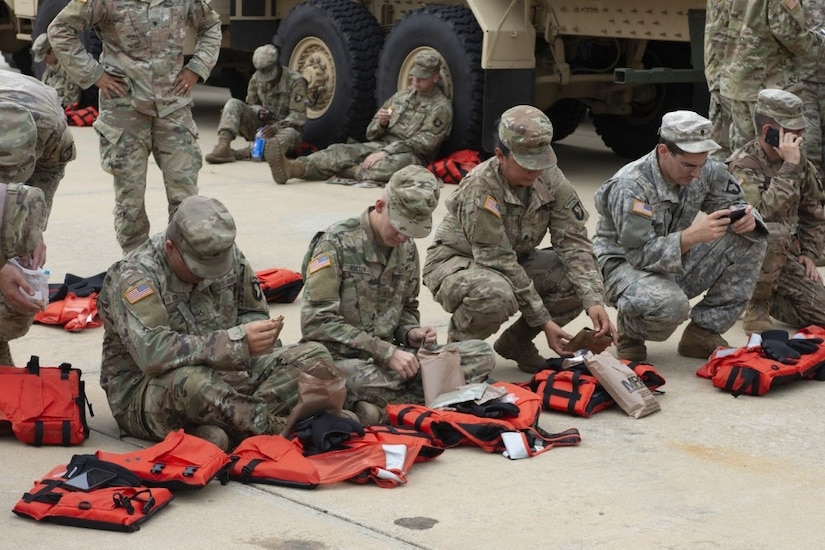
active-duty soldiers are winding down rescue efforts while remaining ready to
meet federal and local needs.
At the peak of the response, more than 12,000 National Guard
and federal military personnel supported the hurricane response efforts,
rescuing people and pets, transporting first responders and delivering food and
water.
Under the framework of state joint force commands
established in North and South Carolina, active duty and Reserve Component
military forces supported the Federal Emergency Management Agency and state
authorities in response to the needs of citizens affected by the storm.
Federal forces were prepared to assist both North and South
Carolina, said Lt. Gen. Jeffrey S. Buchanan, commander of U.S. Army North and
U.S. Northern Command’s Joint Forces Land Component Command.
Team Effort
“We brought together all the resources of the federal side of
the military -- Army, Navy, Air Force, Marine Corps,” Buchanan said.
Army North’s higher headquarters, Northcom, is the Defense Department’s synchronizer for Defense
support of civil authorities, and brought additional capabilities and capacity
to the hurricane response efforts. These capabilities included communication
support for landlines and cell phone towers, medical units, and five-ton troop
transportation trucks with high suspension to maneuver flood waters.
Additionally, a Navy surface group led by the USS Kearsarge
departed Norfolk, Virginia, for the open seas, then followed the storm toward
the shore and postured near the coast to be ready to provide support off shore.
Acting on lessons learned from Hurricanes Harvey, Irma and
Maria, Army North became fully engaged in response efforts for Hurricane
Florence before the storm made landfall, building logistical networks to
facilitate rapid lifesaving and sustaining operations.
“While we acknowledge that every natural disaster is
distinct, we have learned that coming in early helps tremendously to ensure we
are not late” to provide assistance, Buchanan said.
The Army North staff worked closely with forces commanded by
Army Maj. Gen. James Ernst of the North Carolina National Guard, who was designated
as the dual status commander by the secretary of defense.
“It's my job to coordinate the efforts of both the North
Carolina National Guard and the active-duty units that come in,” Ernst said.
Soldiers Support Disaster Response Mission
The 3rd Expeditionary Sustainment Command from Fort Bragg
commanded key units such as the post’s ad hoc “Task Force Truck” and the 101st
Sustainment Brigade as they conducted high water rescue missions across North
Carolina’s coastal towns including flood-ravaged Lumberton and Wilmington.
Soldiers in tactical vehicles helped rescue displaced residents in waist-high
water.
Soldiers from the 74th Composite Truck Company, 129th Combat
Support Sustainment Battalion, 101st Sustainment Brigade, 101st Airborne
Division from Fort Campbell, Kentucky, conducted high-water rescues in
Lumberton from Sept. 17-21.
“It felt really good to help people,” said Army Spc. Mathew
Perkins.
Other members of the unit also shared their stories after
returning to Fort Bragg, North Carolina, after transitioning remaining missions
to National Guard units.
“My job was to keep all our Army vehicles and the vehicles
of the [North Carolina National] Guard operational, and we did that,” Army Spc.
Rochelle Llorico said. “We saved lives, and the support from the people was
overwhelming.”
Army Staff Sgt. Jeremy Allen remembered one family -- a
single mom with two young teen daughters.
“They decided to stay because they loved their home. It was
everything they had,” Allen said. “We gave them some supplies, and they were
resilient. Their story is the American story. We’re stronger when we help each
other.”
‘The People Are Very Grateful’
Army Sgt. Demetri Robinson recalled rescuing three men and a
cat. “They were so glad we also saved the cat,” he said. “The people are very
grateful, and we’re all united in saving lives.”
In South Carolina, the state established a dual status
command headed by Army Maj. Gen. R. Van McCarty. The National Guard postured
assets statewide to ensure county emergency planners had resources available
for whatever was needed to assist their citizens through the aftereffects of
the storm.
Even as the federal military returns some capabilities to
home station to resume other DoD missions, Army North remains vigilant,
Buchanan said. The command is monitoring continued flooding in the Carolinas as
well as two weather systems in the Pacific and four in the Atlantic.
The Virgin Islands and Puerto Rico remain vulnerable
following hurricanes Irma and Maria last year, so Army North has prepositioned
communications equipment to be postured for the 2018 hurricane season.
While the primary mission of Northcom is defending the
American homeland, helping Americans impacted by natural disasters will always
be a DoD responsibility, Buchanan said.
“You know, we in the Army have deployed all over the world
-- Afghanistan, Iraq, Yemen, Somalia, Honduras,” he said. “But it is uniquely
gratifying when you serve fellow Americans at home.”




 Posts
Posts

