By Air Force Tech. Sgt. Chuck Broadway, DoD News, Defense
Media Activity
WASHINGTON -- As of 2017, about two million people were
serving in the U.S. military. All of these service members chose to don their
respective service’s uniform for varying reasons. Many sign up to give back to
their country. Others join for a steady paycheck, to learn a new skill or for
access to the benefits available to service members, such as medical care and
education.
For some, they join to continue a family heritage. Such is
the case for Marco and Ivan Kalkbrenner, two brothers who chose to continue
their family’s legacy of service; following in the footsteps of their father
and grandmother. Ivan is an Air Force staff sergeant assigned to MacDill Air
Force Base, Florida, as a security forces member. Marco retired from the Air
Force in 2017 as a master sergeant following 20 years of service, also as a
security forces member.
While their paternal grandmother began the family’s lineage,
it was their father, Anthony Dimitri Kalkbrenner, who instilled the extreme
sense of pride and service to the military.
“My father would give you the shirt off his back for anyone
in need,” Ivan said. “He was just that type of person; an incredible role
model. They really broke the mold when they made him and I’m striving to become
more like him.”
A Family Calling
Anthony served in the Navy and served 30 years, retiring as
a chief warrant officer four, the highest warrant officer position in the Navy
at the time. During his career, he was stationed around the world, including
stops at Norfolk, Virginia; and Spain, where Marco was born. Early in his life,
Marco was engrained in the military culture, inspired by his father’s service,
mentorship and discipline.
“When you heard my dad talk, you knew he had Navy running
through his veins,” Marco said. “He didn’t force us to be in the military, we
did it because that was our calling. I loved the military and serving and
protecting the country. My dad had such pride in the military and I saw that and
it rubbed off on me and my brother.”
So in 1996, following an unsuccessful attempt at community
college, Marco decided to join the military. With aspirations to be a pilot,
and eventually an astronaut, Marco trekked to the local recruiter’s office.
“I spoke to the Navy recruiter first, and he upset me
because he told me I couldn’t be a pilot,” Marco said. “A couple days later I
went to the Air Force recruiter. He was straightforward with me, told me not
what I wanted to hear, but what I needed to hear.”
Without a college education, the recruiter said Marco wasn’t
qualified to be a pilot, but could still work on aircraft as a crew chief. On
July 24, 1996, the recruiter offered him a guaranteed position as an F-16
Fighting Falcon crew chief, his favorite aircraft. The catch was he had to
leave that night. Marco immediately phoned his father, who encouraged him to
accept the offer.
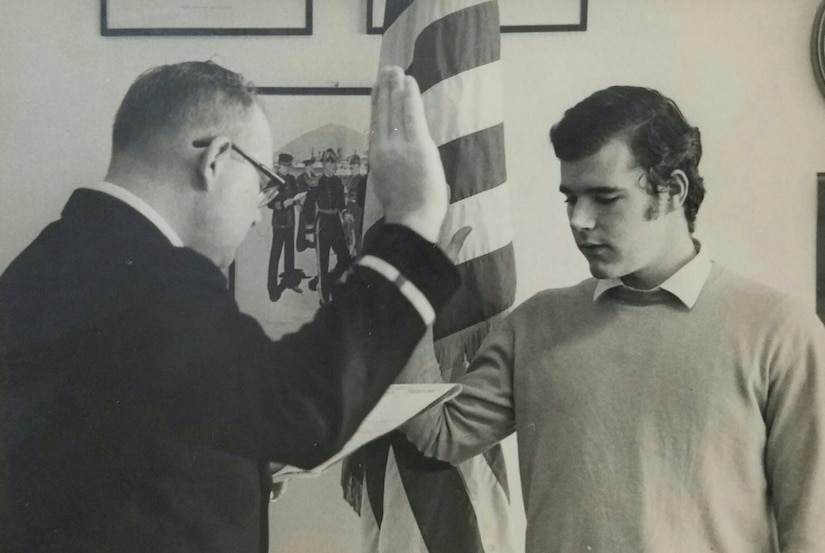
He came home that day to a duffel bag, packed by his father
with all the necessities, including a toiletry bag Marco still possesses. At
the Military Entrance Processing Station, Marco asked the recruiter if Anthony
could swear him into the Air Force.
“I knew when I joined the military that I wanted my dad to
be a part of [my career],” Marco said. “My dad really didn’t have a father
figure, so I wanted my dad to be a part of everything I did in my life.”
Change of Plans
The request was granted, the ceremony completed and Marco
was off to basic training.
A job change shortly followed and Marco graduated security
forces technical training, where his father attended and pinned his security
forces shield on him at Lackland Air Force Base, Texas.
Marco served in several locations around the world,
including multiple deployments to Iraq and Bosnia. Keeping with his wishes of
having his father heavily involved in his career, Marco asked Anthony to
perform every reenlistment ceremony throughout his career. Without fail,
Anthony made it happen, sometimes taking several flights to the other side of
the world to complete the task.
“The reason I had my dad involved in everything military,
was because he had so much pride serving his country,” Marco said. “He
instilled that in us when raising us. Take pride and ownership in what you do,
both the good and the bad.”
Eventually, Marco became a security forces technical school
instructor and in 2008, pinned the security forces shield onto his brother, in
the exact same location where Marco received his shield 12 years before.
“It makes me proud that my brother decided to join the
military and continue the tradition,” Marco said. “Being a part of his training
for tech school was cool. He knew me as ‘Instructor Kalkbrenner’, which is
totally different than Marco. He had it a little bit harder [than other
students]. We played a bunch of jokes on him with my team instructors to let
him know we were watching.”
No Free Rides
Just like his brother before him, Ivan wanted his father to
perform the enlistment ceremony. When Ivan got a short-notice opportunity to go
to basic training, his father once again did whatever he could to ensure he
enlisted his son.
“He would impress upon us, ‘When you join the military, this
is what it is,’” Ivan said. ‘You’re there for each other no matter what.’ So my
dad dropped everything and took off work, drove up and swore me in.”
Being a military child, and with a brother serving as an
instructor in the career field he was entering, Ivan figured basic training and
technical school would be a cake walk.
“The military definitely opened my eyes and it’s a continual
process of learning something new,” he said. “But being broken down and built
back up, I found a lot of my own weaknesses and made them my strong points.”
Figuring his technical school would be a breeze with Marco
serving as an instructor, Ivan received a rude awakening upon arrival.
“He pointed me out to his buddies and they all started
smirking,” Ivan recalled. “At that point I realized it was going to be
interesting. I feel my brother made it harder on me, not out of spite, or
picking on me, but to let me know there’s no free rides. It doesn’t matter who
you know, you still have to put in the work and earn your keep. He made it very
clear that’s what I had to do from day one. Without that, I probably would have
taken my whole career as a free ride thinking, ‘Who do I know to make this
process easier for myself?’ That alone was one of the biggest lessons I had.
You’ve got to earn your keep.”
Mentorship, Guidance
Ivan also kept his father heavily involved in his career.
His father performed every reenlistment ceremony and Ivan sought his mentorship
and guidance through hard times.
“The whole time in the military, if he was around, I could
always go to him,” Ivan said. “I loved his old school mentality on military
things. No matter what the issue was, if I was conflicted, indecisive, or just
needed someone to talk to, I would just give him a call. It didn’t matter the
hour, he would answer, just listen and after an hour of listening, he would go
into a lecture. I needed that in my life.”
Unfortunately, Ivan no longer makes those calls, and his
father can no longer reenlist him.
On March 31, 2016, Ivan was on a maritime patrol in Florida
when he got a call from Marco at 4 a.m.
“The first thing he said was, ‘What are you doing right
now?’ I could tell in his voice something was off,” Ivan said. “He never calls
me at that hour and I’ve never heard the tremble in his voice like that ever.
So my heart started pounding and he asked, ‘How soon can you get home?’”
Anthony had suffered a major heart attack and passed away.
“I was completely crushed,” Ivan said. “I’ve lost people in
the service before; good friends, people I’ve deployed with. That really shook
me. But losing your role model and mentor without getting to say goodbye or ask
for some last minute tips on how to live, it crushed me.”
Several years earlier, Marco and his father discussed
preparations for when Anthony passed away. When the day finally came, Marco
knew he had to be strong for his family.
“When my dad passed away I went into the mode of getting
everything ready for the funeral,” Marco said. “After all was done, it started
to dawn on me that my dad isn’t going to be there to reenlist me again.”
Retirement
The duty of reenlisting him could only be filled by Anthony,
and with his 20 year retirement date approaching, Marco said it was time to
leave the military. He set his retirement in motion, scheduling the ceremony
April 1, 2017, one year and a day after his father’s passing, and exactly nine
years after Ivan enlisted in the Air Force.
“I wanted to make everything symbolic to my dad’s military
career, so my retirement ceremony was all about paying tribute to my career in
the military, but also paying tribute to my dad as well,” Marco said. “I had it
all planned out for my dad to officiate the ceremony. At the end, he was going
to say, ‘I put you in, I made sure you stayed in, and now it’s time for you to go.
You are dismissed.’”
Unfortunately, that never happened. Keeping with his plan to
honor his father’s legacy, he went to a Navy recruiter and explained his
intentions in honoring Anthony’s legacy. The recruiter quickly volunteered to
pull watch behind an empty chair, representative of his father’s presence.
“To be at my brother’s retirement, that my father was
supposed to be at, it kind of brought me back and humbled me,” Ivan said.
“Being that my father wasn’t there, he had the chair, but no one sat in it. [My
brother] had a seaman pull watch and stand at parade rest behind the chair
during the entire ceremony. I saw it and it made sense. I kept staring at the
chair, and started tearing up a little bit. He mentioned the chair at the end
of the ceremony and that’s when the waterworks turned on.”
When Anthony retired from the Navy, he had a plaque made
showing the names and service dates of every Kalkbrenner who has served in the
military. ”
“He said, ‘I’m passing this plaque on to you, when you
retire, you send it to the next Kalkbrenner in the bloodline serving the
country,’” Marco said. “So when I retired, I had that plaque, put my dates of
service on there, and put Ivan’s name on there, with the date he swore in, with
a dash and a blank. I presented Ivan the same plaque, and said the same thing
to him that my dad had told me.”
Transition
Marco transitioned quickly from military service to civilian
service as he joined the ranks of the Goldsboro Police Department in North
Carolina, patrolling the city surrounding his last military assignment --
Seymour Johnson Air Force Base, North Carolina. While he has no regrets in
choosing to retire when he did, he still feels the connection and brotherhood
he felt for 20 years, often stopping by to say hello to his former airmen at
the base’s entry control points.
“I became a civilian police officer because [of my] service
in the military. I loved it so much that I wanted to do it as a civilian as
well,” Marco said. “I love the military and have the same mentality my dad had.
It’s my Air Force.”
Marco said joining the military and following in his dad’s
footsteps is just the ‘Kalkbrenner’ thing to do now. Just as his father before
him, Marco said he would be proud of his kids joining the military, but he
wouldn’t push them. However, both brothers believe the legacy will continue on.
“I don’t think it’s going to stop,” Ivan said. “It’s only a
matter of time before Marco’s kids, and my kids, start asking questions. Then
we’ll explain to them who my father and mother were and why we serve. Just like
it did to us, something is going to light a fire in them and not make it go
out. I hope it makes me as proud as my dad was of us.”




 Posts
Posts

