Monday, November 24, 2025

Medal of Honor Monday: Army Lt. Col. Edward Silk

When Army Lt. Col. Edward A. Silk realized that his platoon wasn't going to put a dent in the enemy positions firing at them in France during World War II, he went on a one-man rampage to take the guns out himself. Miraculously, his mission succeeded. For his heroics, he received the Medal of Honor.

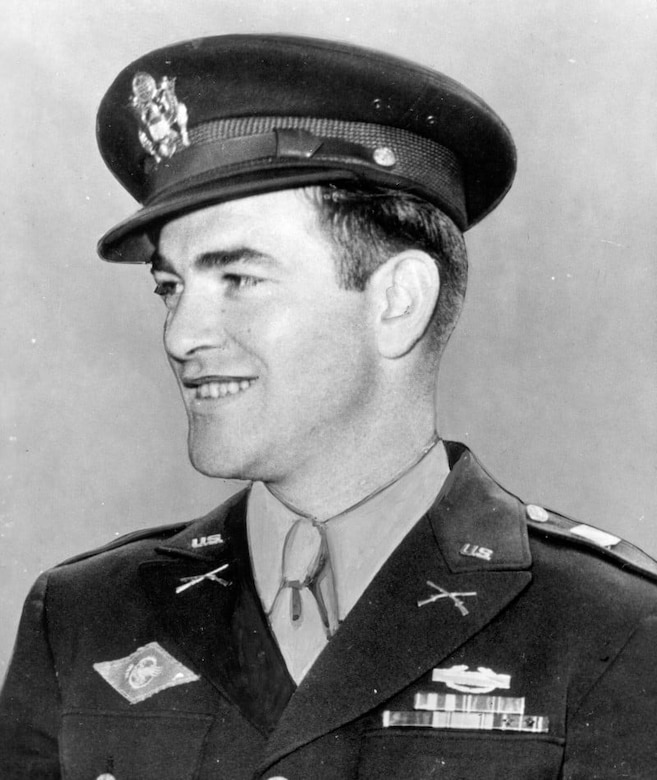
A man in a uniform and cap poses for a photo.

Silk was born June 8, 1916, in Johnstown, Pennsylvania, to Irish immigrants Michael and Mary Silk. He was the youngest of 11 children.

When Silk was 2, his father died in an accident at the local Bethlehem Steel mill, according to the newspaper The Daily Herald out of Everett, Washington. His mother tried to care for all 11 children on her own, but she couldn't, so she eventually moved with her four youngest to Illinois to live at Mooseheart Child City, a residential child care community run by the Loyal Order of Moose, of which Silk's father was part. Mooseheart provides children and families in need with stability, support and education.

Silk did well at Mooseheart. According to the Moose organization, he played football for the high school and chose to stay an extra year due to job scarcity from the Depression so he could get training in ornamental concrete work. After graduating in 1935, he attended St. Bonaventure College in western New York for a time before eventually dropping out to join the workforce.

In April 1941, months before the U.S. entered World War II, Silk joined the Army Reserve. At some point he married his girlfriend, Dorothy Weimer, and had a son named Jerry. 

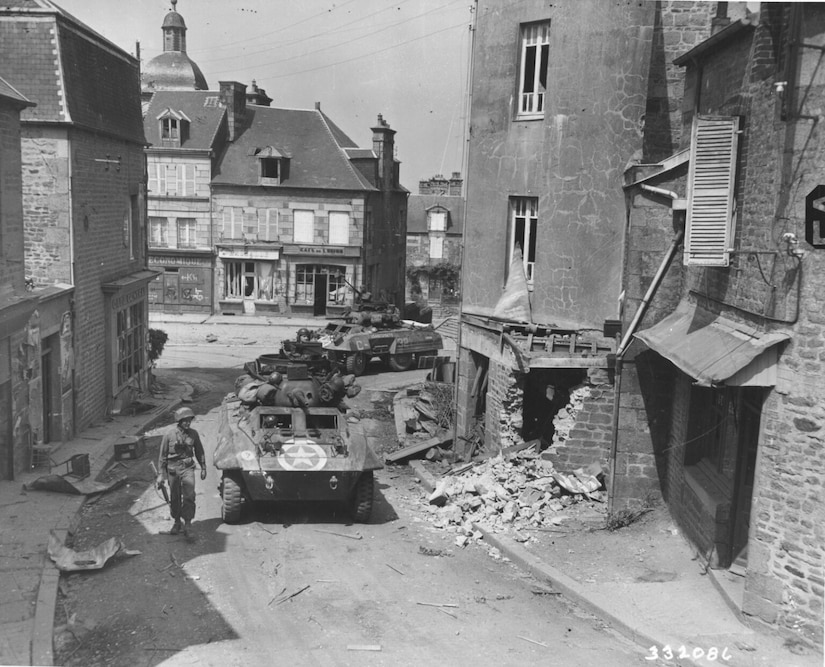
Two tanks move through small, winding streets in a dilapidated town.

Silk was ordered to active duty Aug. 31, 1942. He earned a commission at Fort Benning, Georgia, before being sent to France in October 1944 with the 398th Infantry, 100th Infantry Division. About two months later, his brazen courage earned him the nation's highest medal for valor.

On Nov. 23, 1944, then-1st Lt. Silk's battalion was tasked with seizing high ground overlooking Moyenmoutier, France, ahead of a planned attack to liberate the city. Silk was commanding a weapons platoon in Company E that took the lead at dawn. By noon, they'd reached the edge of the woods near St. Pravel, where scouts saw in the valley below an enemy sentry standing guard outside a farmhouse.

Almost immediately, the scouting squad was pinned down by intense gunfire coming from within the house. Silk's platoon returned fire, but after about 15 minutes, there was no letting up in the enemy gunfire. So, Silk decided to take matters into his own hands.

He ran 100 yards across an open field before taking shelter behind a low stone wall directly in front of the farmhouse. After firing into the door and windows with his carbine, Silk then vaulted over the wall sheltering him and dashed another 50 yards through a hail of enemy gunfire to the left side of the house. He then tossed a grenade through an open window. The explosion that followed silenced the enemy machine gun and killed its two gunners.

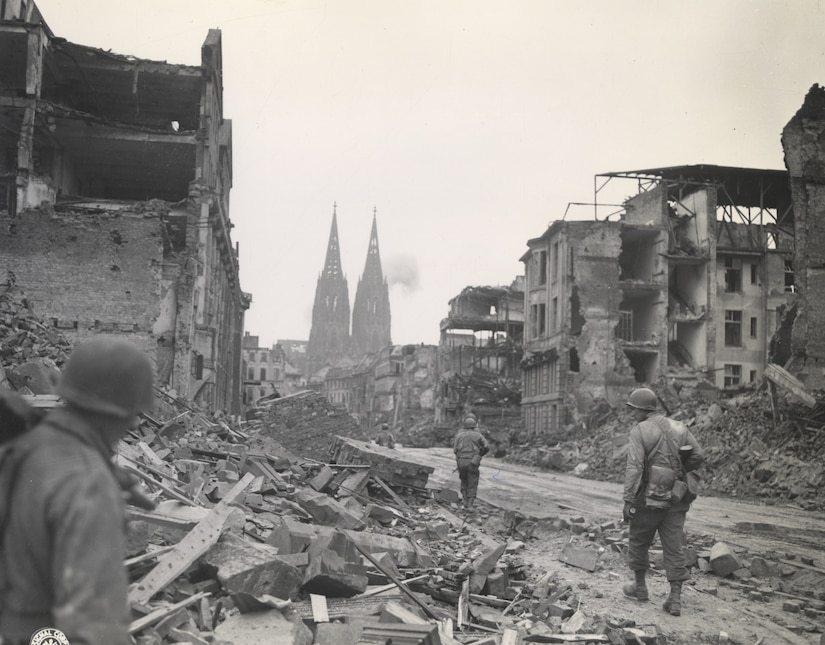
Soldiers walk past rubble in a destroyed city.

When Silk tried to move to the right side of the house, another enemy machine gun began firing on him from a nearby woodshed. Summoning every ounce of courage he had, Silk rushed that position head-on, dodging direct fire to get close enough to throw more grenades, which destroyed that gun and its gunners as well.

By that point, Silk had run out of grenades — but not fortitude. Silk ran to the back side of the farmhouse, where he began to throw rocks through the window, demanding the remaining enemy soldiers' surrender. "Twelve Germans, overcome by his relentless assault and confused by his unorthodox methods, gave up to the lone American," Silk's Medal of Honor citation said.

Thanks to his decision to take on the burden of the attack alone, Silk's battalion was able to continue its advance on Moyenmoutier and eventually liberate the city.

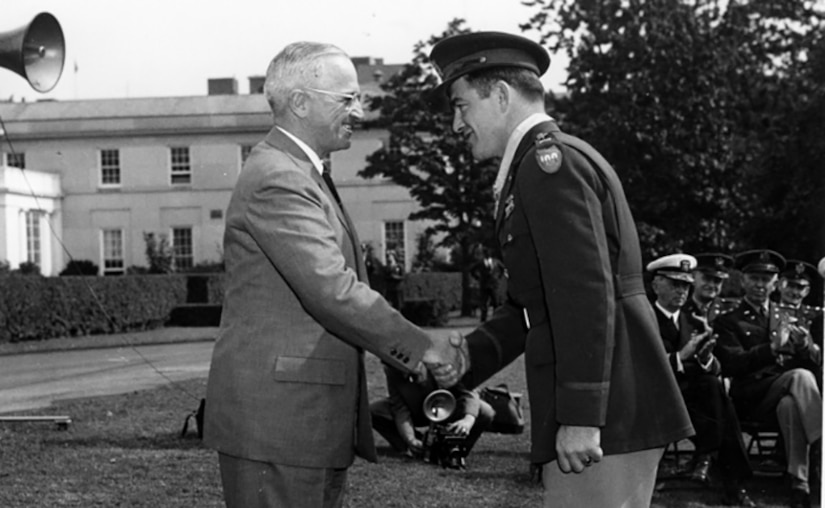
Two men smile and shake hands on a lawn. Others sit in chairs in the background, clapping.

Silk returned home in September 1945 as a hero. On Oct. 12, 1945, he and 14 other deserving service members received the Medal of Honor from President Harry S. Truman during a White House ceremony.

Silk remained in the Army after the war, working for a time while still on active duty as a patient consultant for the Department of Veterans Affairs. One of his last posts was with the 7822nd Station Complement Unit in Stuttgart, Germany.

By 1952, Silk had risen to the rank of lieutenant colonel. He and his wife went on to have two more children, Judith and Daniel.

In December 1954, Silk took command of the ROTC unit at Canisius College (now university) in Buffalo, New York, as a professor of military science and tactics.

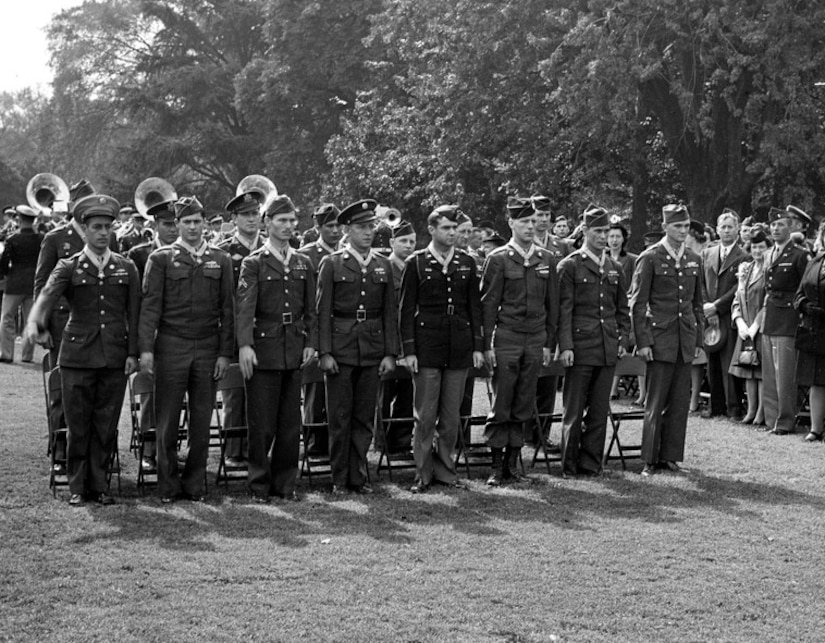
Two rows of service members stand at attention on a lawn. A band and an audience are in the background.

Sadly, about 10 months later, Silk fell critically ill due to intestinal ulcers. He underwent at least three surgeries at a local military hospital before succumbing to complications on Nov. 19, 1955. He was only 39.

During his funeral services, the newspaper The Buffalo News reported that 600 ROTC cadets from Canisius marched behind Silk's hearse for 3 miles to St. Joseph's Cathedral, where his services were held. Silk was then buried in Arlington National Cemetery.

In 2004, Johnstown renamed a bridge in the hometown hero's honor. At the time, his daughter told newspapers that her father was a strict disciplinarian, but he was kind and had a great sense of humor.  

This article is part of a weekly series called "Medal of Honor Monday," in which we highlight one of the more than 3,500 Medal of Honor recipients who have received the U.S. military's highest medal for valor. 

Saturday, November 22, 2025

Army Pilots First Autonomous Dining Facility in South Korea

The 19th Expeditionary Sustainment Command opened the Army's first autonomous dining facility, Nov. 12, in South Korea, to explore how automation can improve food service operations. The pilot dining facility, called Market 19, combines automated food preparation, cooking and serving with soldier oversight. 

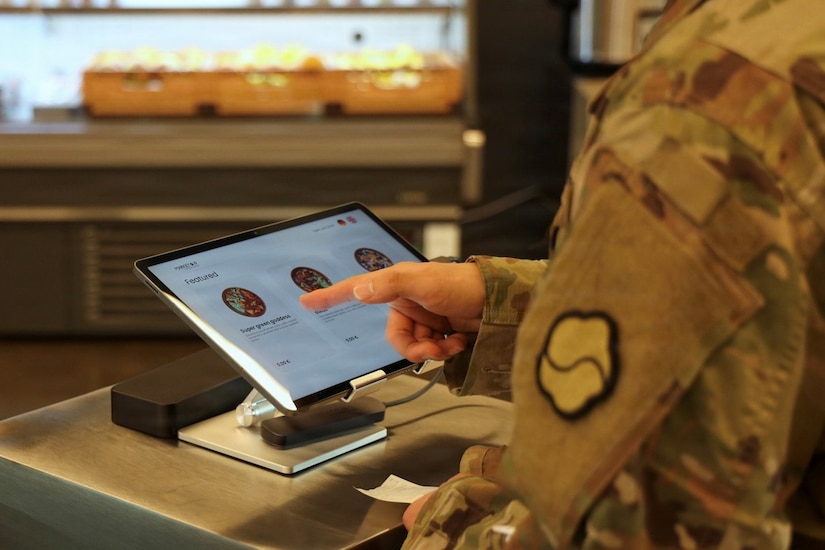
A soldier wearing a camouflage military uniform chooses a meal on a touchscreen tablet.

 
"This pilot helps us evaluate how automated cooking systems can make Army dining operations more consistent, efficient and resilient," said Chief Warrant Officer River Mitchell, food advisor, 19th ESC.  

Mitchell emphasized that the effort is not about replacing people but about strengthening the ability to feed soldiers "anytime, anywhere." 
 
"The pilot originated as a 19th ESC initiative," he added.  

Planning for the pilot facility began in early May as an opportunity for 19th ESC to innovate upon the Army food program.  

"Market 19 represents successful and efficient collaboration between the U.S. Army, [South] Korea and industry partners," he said. "It was formally approved under the Pacific Multi-Domain Training and Experimentation Capability program in coordination with U.S. Army Pacific."  

The Pacific Multi-Domain Training and Experimentation Capability program is an Army Pacific initiative that tests and evaluates new technologies to enhance sustainment and readiness across the Indo-Pacific region. The project supports PMTEC experimentation and uses funding from the Pacific Deterrence Initiative, which advances deterrence and operational capability in the region. 

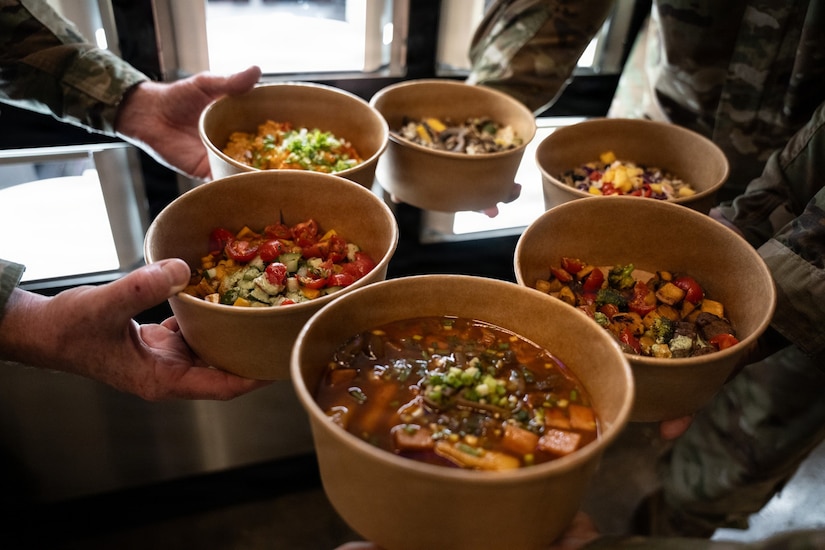
"Our aim is to add capacity and consistency in feeding operations without changing the current workforce," Mitchell explained. "The autonomous kitchen uses robotic cooking modules programmed to prepare meals from fresh ingredients following standard Army recipes."  

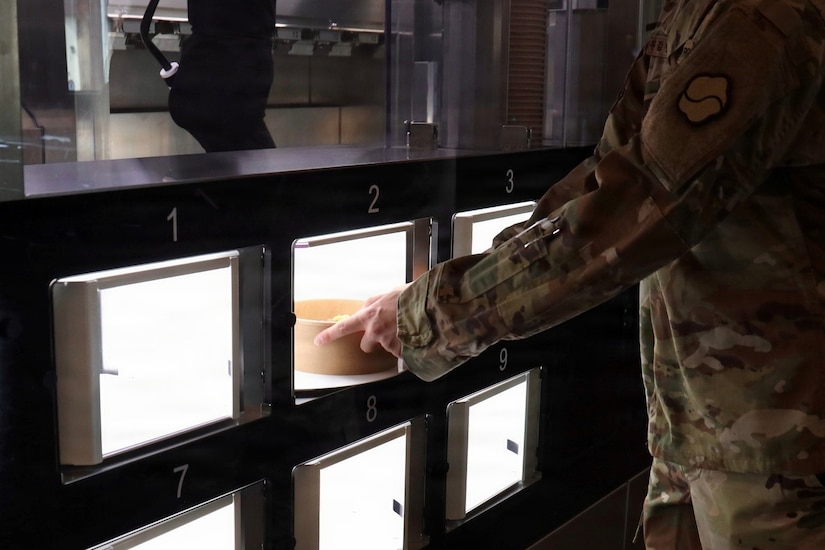
A soldier dressed in a camouflage military uniform reaches for a bowl of food sitting in the window of an autonomous food preparation system.

Soldiers and civilians can select menu items on a touchscreen interface, and the system automatically portions, cooks and plates each meal. 
 
"Human oversight remains critical," Mitchell said. "Our culinary specialists still handle food safety, ingredient prep and quality control."  

All ingredients come from the Defense Logistics Agency Troop Support supply chain and the Army food catalog, ensuring the same nutrition and safety standards as traditional facilities. 
 
Each meal display includes clear nutritional information, giving soldiers better visibility into what they are eating. Menu options are performance-oriented and include Korean dishes such as bibimbap, kimchi fried rice and budae jjigae. 
 
"This system gives us a 24/7 feeding capability that supplements — not replaces — our existing dining operations," Mitchell said.  

The pilot operates within the Camp Walker Dining Facility with soldiers and contracted staff jointly evaluating performance. Culinary specialists manage quality assurance and nutrition education. They also supplement meals with additional food options. The culinary specialists who prepare the meal recipes and ingredients for the machine have been trained extensively by both Army and local national chefs. 
 
"The goal is to free our [culinary specialists] to focus on readiness training and improving meal quality," Mitchell said. "Automation is one way we can modernize without losing our human touch." 
 
He explained that integrating robotic technology into dining operations allows the Army to stay ready under any conditions, from garrison to field environments, while preserving the expertise of its culinary specialists. 

The pilot supports the Army's ongoing modernization efforts and also aligns with the Holistic Health and Fitness program by giving soldiers consistent access to balanced, nutritious meals that sustain performance and recovery. 

A close-up photo of six bowls containing various fresh ingredients.

 
"Consistent, quality food directly supports readiness," Mitchell said. "If a soldier eats well, that soldier performs well."  

The six-month pilot will conclude with an assessment on expanding autonomous capabilities and will give the kitchen a chance to implement changes based on gathered feedback. 
 
"The data we collect here will guide decisions about future locations and applications," Mitchell said. "We want to see how this can support sustainment both in the Pacific and eventually in the continental United States."  

He emphasized that the current phase is strictly evaluative. 
 
"This is an experiment," Mitchell said. "We're testing performance, soldier feedback and long-term reliability before considering anything broader." 

Friday, November 21, 2025

First, Second Ladies Visit Military Installations in North Carolina

In a mutual demonstration of support and appreciation, First Lady Melania Trump and Second Lady Usha Vance visited Marine Corps Base Camp Lejeune and Marine Corps Air Station New River in North Carolina, Nov. 19, engaging with service members, military families and students at Department of Defense Education Activity schools on both installations. 

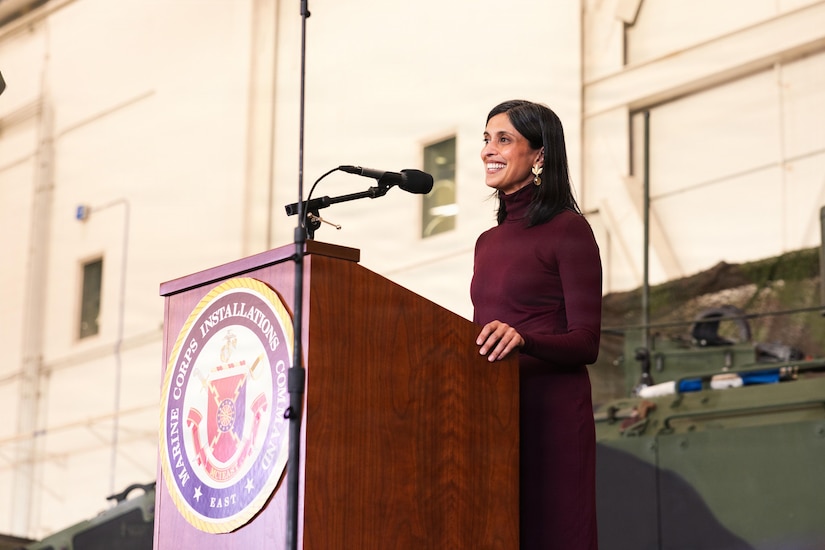
A woman wearing business casual attire stands in front of a lectern while speaking into a microphone. A large American flag is in the background.
A woman wearing business attire stands in front of a lectern while speaking into a microphone.
This landmark visit marked the first joint trip to both installations for both ladies, underscoring their commitment to the military community. 

With a shared goal of acknowledging the sacrifices made by those serving or deployed this holiday season, the visit provided an invaluable opportunity for both women to connect with service members and families. 

Upon arrival at the airport in Richlands, North Carolina, Trump and Vance were greeted by Marine Corps Brig. Gen. Ralph J. Rizzo, Jr., commanding general of Marine Corps Installations East-MCB Camp Lejeune; his wife, Mila Rizzo; and Lisa Worth, wife of Marine Corps Lt. Gen. Calvert Worth, commanding general of the II Marine Expeditionary Force. 

Rizzo spoke about the significance of the visit, emphasizing the attention it gave to the military community. 

"It is deeply meaningful to welcome the first and second ladies who have come here to express gratitude to our installation, to our Marine Corps, to our Marines, sailors and their families," he said. "This visit shines an important light on the strength of our Marines and sailors and especially on the resilience of our military families." 

Trump and Vance first visited Lejeune High School, where they discussed with students how artificial intelligence is being used in school projects. Trump launched the Nationwide Presidential AI Challenge in August, inviting K-12 students and educators across America to participate, noting the challenge will prepare the next generation with a base understanding of this important new technology.

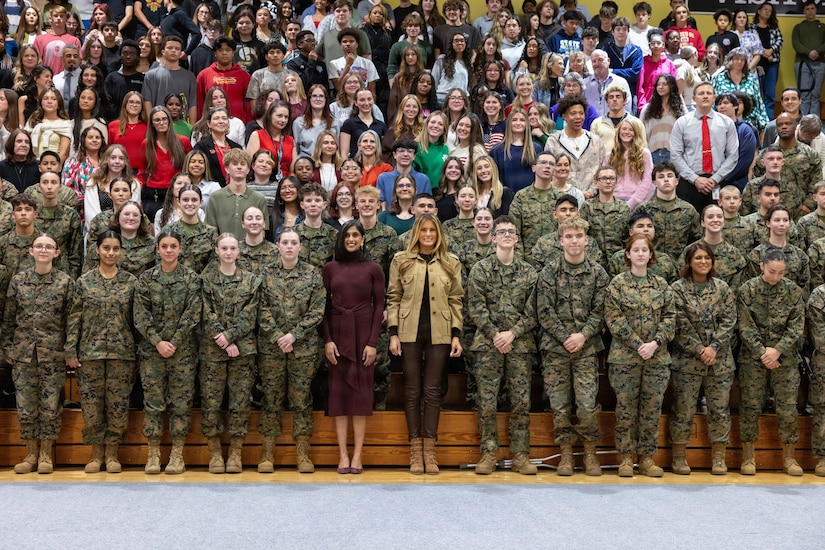
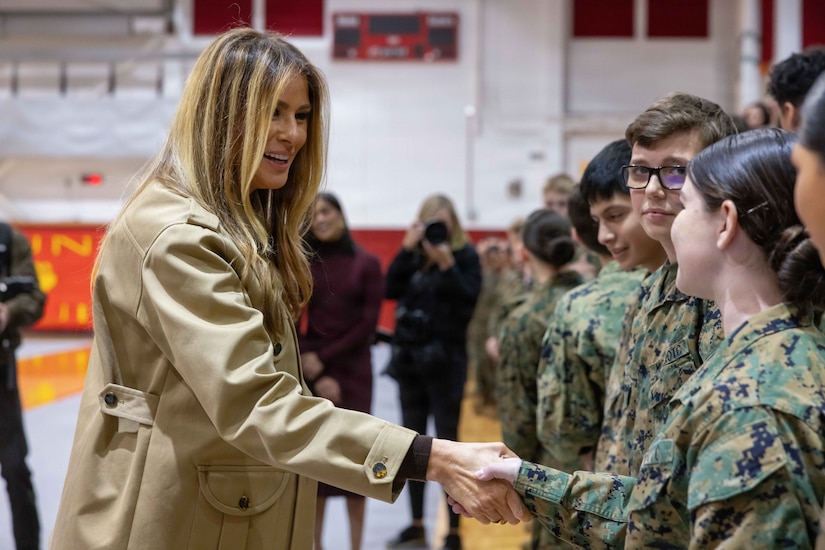
Two women wearing business casual attire pose for a photo with dozens of children in a gymnasium. The kids in the front two rows are wearing military camouflage uniforms, while the other kids wear casual attire,

Later, they joined students and volunteers from the USO to build care packages for deployed service members with the 22nd Marine Expeditionary Unit. 

The party then transitioned to MCAS New River to visit DeLalio Elementary School, where the women joined students and families of deployed service members to create Thanksgiving crafts. 

Finally, Trump and Vance each took turns addressing an audience of about 1,500 service members and families in a mega hangar, surrounded by various aircraft and assets that comprise the Carolina Marine Air-Ground Task Force. After a brief introduction by Rizzo, Vance told the attendees, "We are so grateful to you for carrying on the Marine Corps' proud traditions of duty, honor and service."

She went on to praise the local military community. 

"I am so impressed by your commitment to building strong communities and schools," Vance said. "Military families are truly the model for our country and for my own family." 

Vance then welcomed Trump on stage. 
 
Trump's speech centered on the transformative potential of AI and its pivotal role in the future of warfare. 

Referencing her earlier interactions with students at Lejeune High School, she said, "To win the AI war, we must train our next generation, for it's America's students who will lead the Marine Corps in the future." 

The first lady also took the opportunity to recognize exceptional service, presenting Marine Corps Sgt. Blake Donoher, an aircraft avionics technician assigned to Marine Medium Tiltrotor Squadron 365, as the 24th Marine Expeditionary Unit Warrior of the Month and Marine Corps Cpl. Daishamari Cannon, an aviation maintenance data specialist assigned to the same squadron, as the unit Noncommissioned Officer of the Quarter. 

She then turned her focus on those in the audience, especially those with loved ones currently deployed. 

"The [Camp] Lejeune and [MCAS] New River community impressed me today," she said, adding, "Military families are the quiet strength of our nation; your love, patience and courage give our service members the confidence to serve with honor and the comfort of knowing home is always waiting." 

In a final expression of gratitude, the first lady conveyed her appreciation for the opportunity to experience the dedication and commitment firsthand. 

"It has been a memorable day and an honor to meet the men and women of the United States Marine Corps," Trump said. "To you and your families who give so much for our country, thank you." 

Wednesday, November 19, 2025

Calm Under Pressure: Airman's Quick Thinking Saves Infant's Life

What began as a quiet autumn Sunday for Air Force Senior Airman Hannah Lillund quickly turned into a moment that would test her composure, skills and instinct.

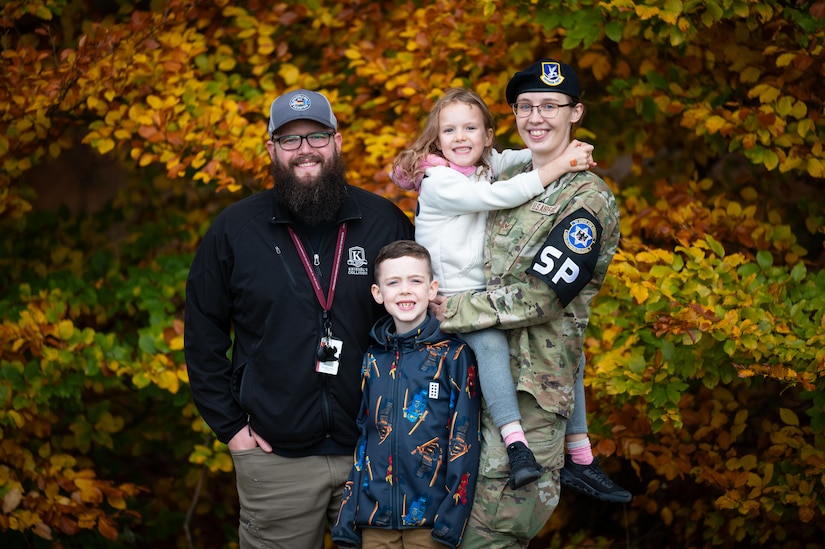
An airman wearing a camouflage military uniform smiles while holding a child. The airman is standing next another child and a person dressed in business casual attire. There are trees with yellow, brown and green leaves in the background.

 
"I was just sitting on the couch relaxing," said Lillund, a 569th U.S. Forces Police Squadron vehicle registration clerk stationed at Kapaun Air Station, Germany. "I heard someone yelling, 'Help us! She's not breathing!' So I ran down the stairwell barefoot, in pajamas, to help." 
 
Air Force Senior Airman Elena Lucas, an 86th Communications Squadron client systems technician, and her husband, Mason Edlin, were frantically trying to save their 9-month-old daughter, Eumi, who suddenly began choking. 
 
"We were just in our living room playing with her," Lucas said. "One second she was fine, and the next, she started coughing and then went completely silent. Her eyes were wide and she wasn't breathing. I yelled for my husband to call [emergency services] and we ran outside the apartment screaming for help." 
 
Thankfully, Lillund heard the call for help and her instincts as a first responder kicked in. On her way down the stairs, she ran into her kids, who were on their way to alert her.

She and her husband, Tanner, immediately sprinted out of their apartment to help. She went to their neighbor's apartment while Tanner went to find emergency services. 
 
As she arrived, Lillund found Lucas still striking her baby's back, desperately trying to clear Eumi's airway. 
 
"She came down so calm," Lucas said. "She just said, 'Can I see her?' and took her from me. I swear, it was just three taps on the back and suddenly all this saliva came out of her mouth; she coughed and the color came back to her face. It was like watching a miracle happen right in front of us." 
 
Within two minutes of calling, emergency services arrived on the scene, Edlin said. Paramedics assessed Eumi and found her breathing steadily. 
 
"The fire department got there so fast," he said. "But by then, Hannah had already saved her. The whole thing happened in about five minutes, but it felt like forever." 
 
Lillund said her training kicked in like muscle memory. 
 
"In security forces [technical] school, they teach you how to keep calm under pressure," she said. "They make you perform while your heart's racing. You learn to breathe, focus and just do what needs to be done." 

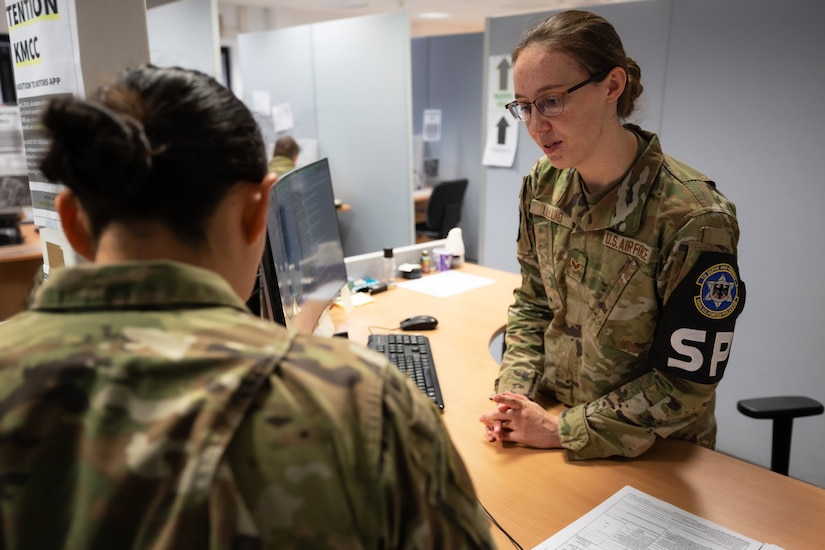
An airman wearing a camouflage military uniform stands behind a desk while observing another airman in similar attire fill out paperwork.

 
For Lucas and Edlin, the experience remains both terrifying and humbling. 
 
"I've never felt more helpless," Edlin said. "I was doing everything I knew to do but it wasn't working. And then Hannah shows up cool, calm and collected, like she's done it a hundred times. She really saved Eumi's life."
 
The first baby girl delivered at Landstuhl Regional Medical Center this year, Eumi is now back to her usual self. 
 
"I still think about it sometimes," Lillund said. "How everything lined up perfectly. My kids seeing it, me being home when it happened and being trained for moments like this. It reminds me why we do what we do. You never know when you'll need to be ready." 
 
For one family, that readiness made all the difference.

Legendary Marines From Throughout Corps' 250 Years

The stories of legendary Marines are familiar to all leathernecks, many of whom are inspired by them. 

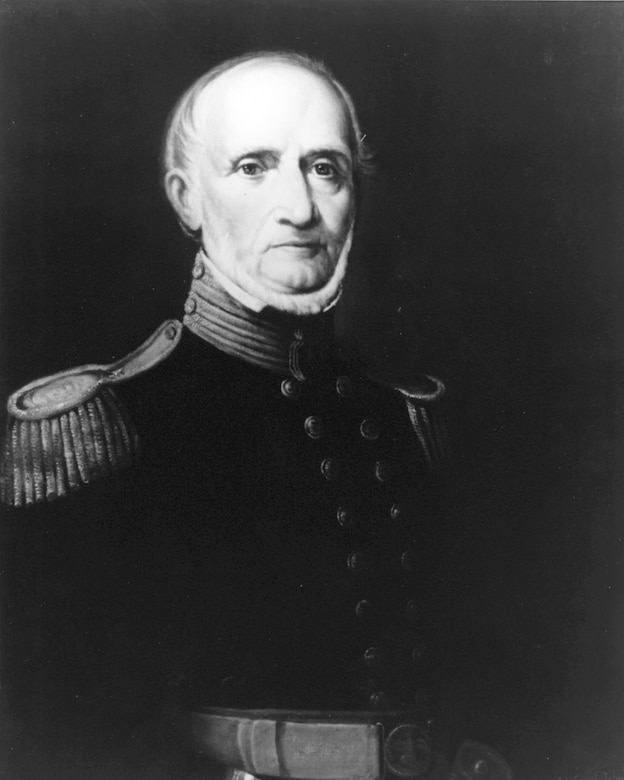
A portrait painting of a man in a military dress uniform is shown.

Marines call Col. Archibald Henderson the "grand old man of the Marine Corps." He served in the Marine Corps from 1806 to 1859 and was commandant from 1820 to 1859, making him the longest-serving commandant.

During the War of 1812, Henderson served aboard the heavy frigate USS Constitution, the world's oldest commissioned naval warship still afloat today. The Constitution fought in a number of victorious engagements. 

Henderson led Marines in combat during the Indian campaigns in 1836 and 1837 in Florida and Georgia, as well as in the Mexican War, from 1846 to 1848. He was decorated for his bravery. 

The sword presented to him at the end of the Mexican War was inscribed, "From the Halls of Montezuma to the Shores of Tripoli," which became the first stanza of the Marines' Hymn. 

When President Andrew Jackson tried to merge the Marine Corps with the Army in 1829, Henderson stopped the effort and ensured Marines would remain under the Navy Department.

Henderson, who was born in Colchester, Virginia, Jan. 21, 1783, died Jan. 6, 1859, while still on active duty. The transport USS Henderson and Henderson Hall Barracks in Virginia were named in his honor.

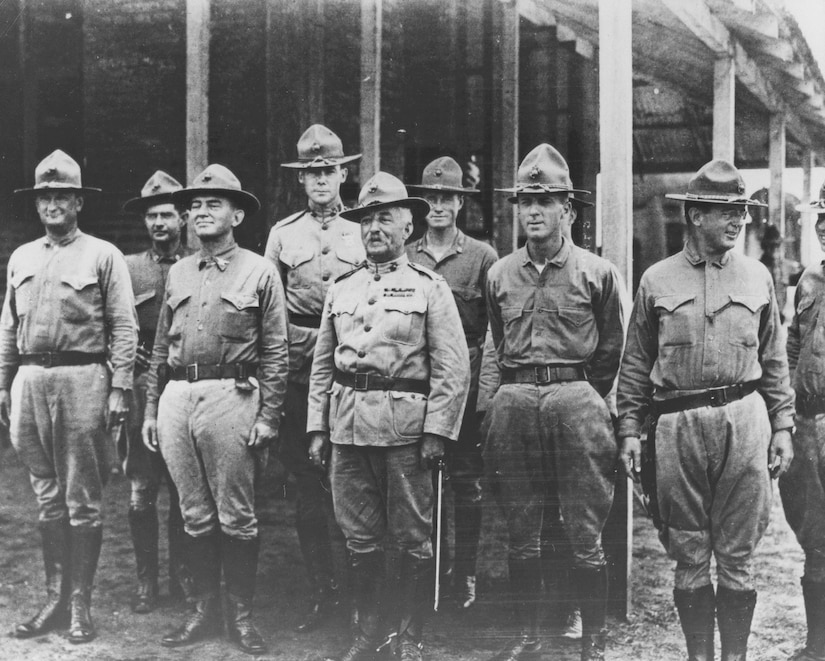
Marine Maj. Gen. Smedley Butler served in the Marine Corps from 1898 to 1931 and is one of only two Marines to receive two Medals of Honor, the first for action at Vera Cruz, Mexico, in 1914; the second for valor in Haiti in 1915.

Marines standing in uniform pose for a photo outside.

Butler also served in the Spanish-American War in 1898, the Philippine-American War from 1899 to 1902, the Boxer Rebellion in China, which lasted from 1899 to 1901, the occupation of Nicaragua, which lasted from 1912 to 1933, World War I in France, which lasted from 1917 to 1918 and the expedition to Tianjin, China, from 1927 to 1929.

Later, Butler went public with criticism of intervention in nations to benefit U.S. businesses and also wrote a book on the topic titled "War is a Racket."

In 1924, while still on active duty, Butler was invited by Philadelphia's mayor to run the city's police and fire department and rid the city of crime and corruption. He was effective in doing so and worked in that capacity until 1925. 

Butler, who was born in West Chester, Pennsylvania, July 30, 1881, died in Philadelphia on June 21, 1940. Marine Corps Base Camp Smedley Butler on Okinawa, Japan, is named for him.

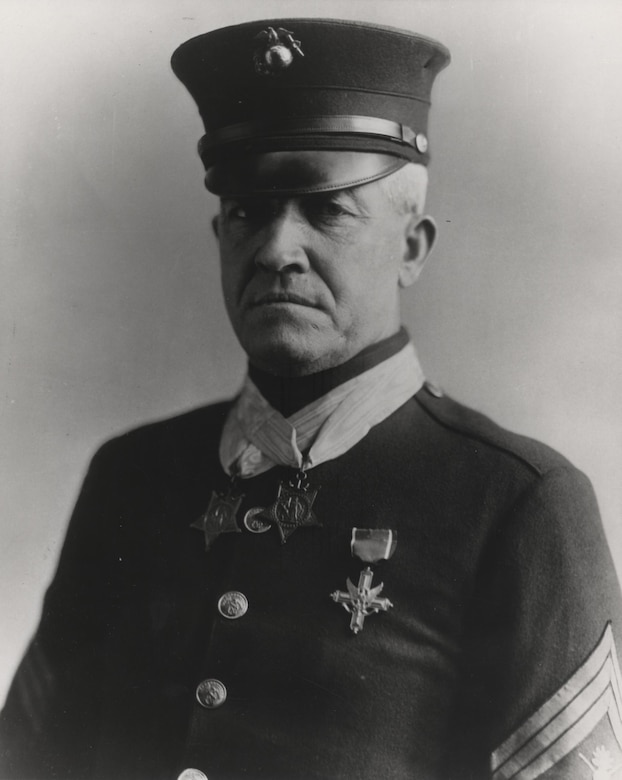
Marine Corps Sgt. Maj. Dan Daly also earned two Medals of Honor, the first during the Boxer Rebellion and the second in Haiti, the same year Butler received his. 

A Marine in uniform wearing medals poses for a black and white photo.

During World War I, he earned the Navy Cross Medal and the Distinguished Service Cross. 

Daly was court-martialed once for drunkenness on post and spent three weeks in the military jail at the Boston Navy Yard, thereby further enhancing his legend. He was also widely known as a skilled boxer.

On Feb. 6, 1929, Daly retired from the Marine Corps and found work as a bank guard on Wall Street in New York City. 

Daly, who was born in Glen Cove, New York, Nov. 11, 1873, died in New York City on April 27, 1937. The destroyer USS Daly was named for him.

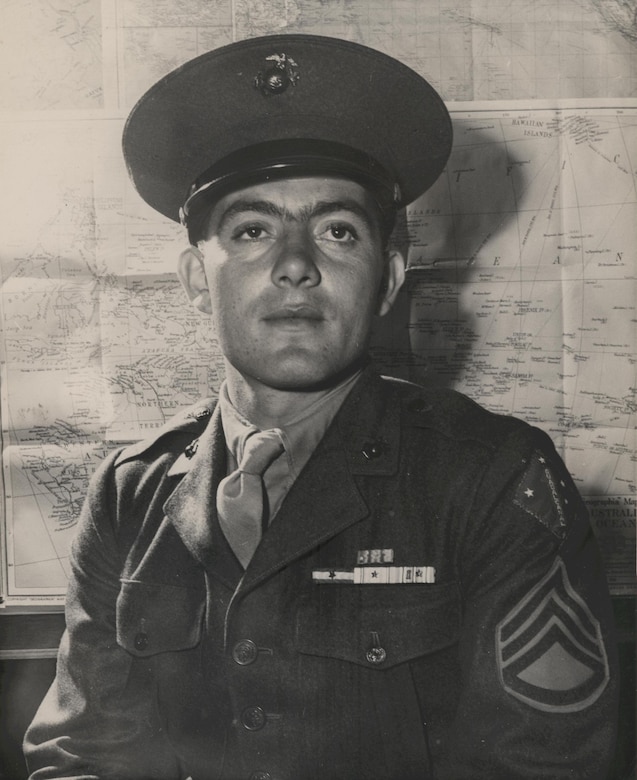
Marine Corps Gunnery Sgt. John Basilone served in the Army from 1934 to 1937 before enlisting in the Marine Corps, July 11, 1940. While in the Army and stationed in Manila, he gained fame as a champion boxer, which earned him the nickname Manila John.

A Marine in uniform and wearing medals poses for a photo.

In September 1942, he fought in the Battle of Guadalcanal. The following month, he received the Medal of Honor.

Basilone, who was born in Buffalo, New York, Nov. 4, 1916, was killed on the first day of fighting during the Battle of Iwo Jima, Feb. 19, 1945. He was posthumously awarded the Navy Cross for heroism on Iwo Jima. Two destroyers were named for him.

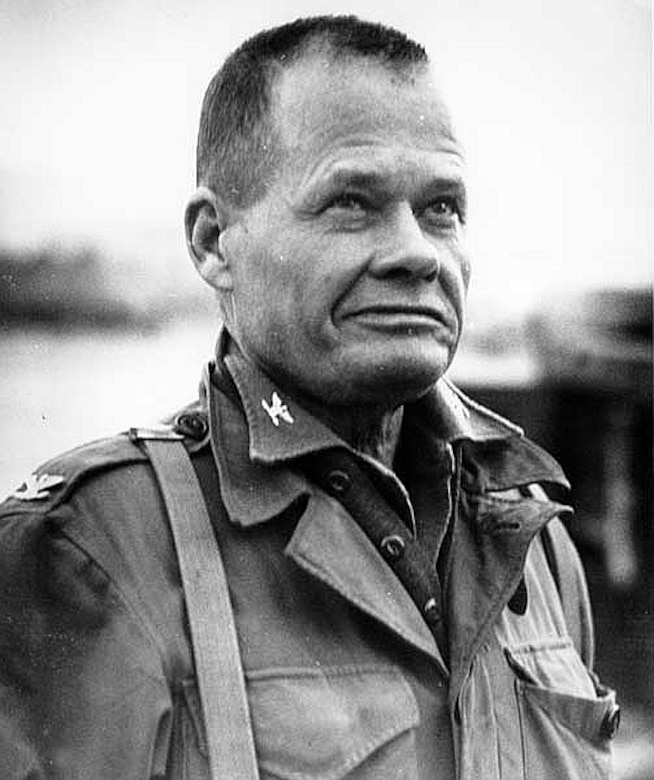
Marine Corps Lt. Gen. Lewis Burwell Puller is better known as Chesty Puller. Although Puller never received the Medal of Honor, he's considered the most decorated Marine, having earned five Navy Crosses for valor in the 1928 Nicaragua campaign, the 1932 Nicaragua campaign, 1942 on Guadalcanal, 1943 on New Britain and in North Korea in 1950.

A Marine in uniform poses for a photo.

Puller also earned the Distinguished Service Cross from the Army for action in North Korea in 1950. 

He is beloved by enlisted troops and is credited with the tradition of officers receiving rations last when in the field. To this day, as soon as Marine recruits hit the rack, they chant "Good night, Chesty, wherever you are."

Also, when Marines are doing pullups or other exercises, they are often told to "Do one for Chesty" at the end when they're fatigued.

The official Marine Corps mascot, an English bulldog, is perpetually named "Chesty." Puller had a barrow chest and bulldog face, so the resemblance is apt. 

Puller, who was born in West Point, Virginia, June 26, 1898, died in Hampton, Virginia, on Oct. 11, 1971. The frigate USS Lewis B. Puller was named for him.

Incidentally, Puller's distant cousin was Army Gen. George S. Patton. 

Other notable Marines include, but are not limited to: 

  • Col. John Glenn, the first American to orbit the Earth, and who later became a senator from Ohio. 
  • Cpl. JD Vance, who became a senator from Ohio and is currently serving as vice president of the United States. 
  • Sgt. Chuck Mawhinney, a sniper credited with 103 confirmed kills during the Vietnam War. 

Marine Veteran Dies While Rescuing Trapped Coal Miners

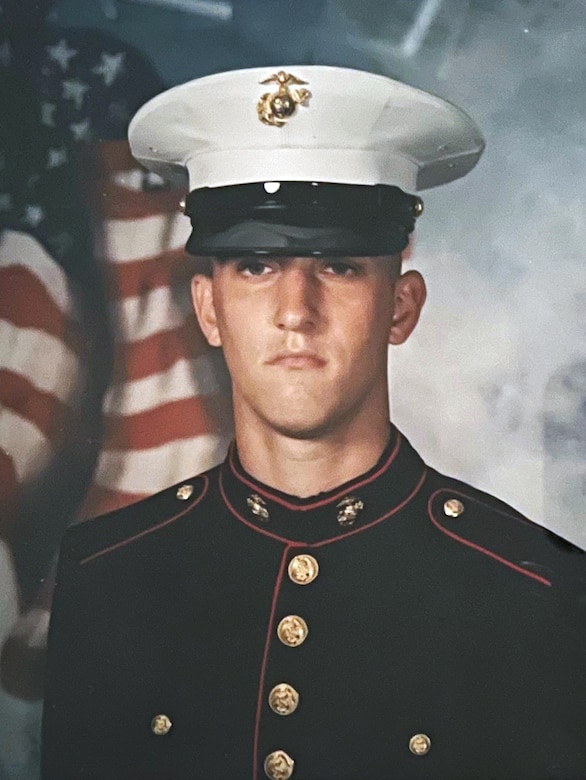
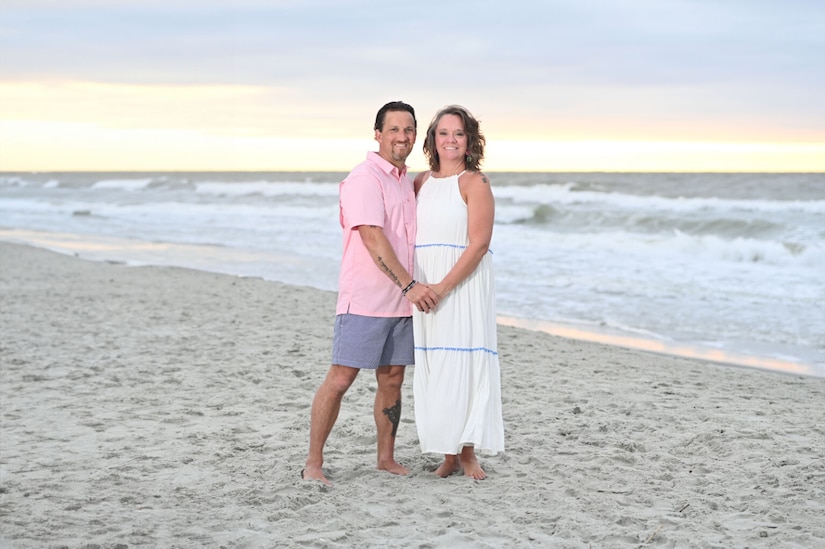
Marine Corps combat veteran Steven M. Lipscomb lost his life, Nov. 8, while looking after the safety of his crew at the Rolling Thunder Mine in Nicholas County, West Virginia.

A Marine in a dress blue uniform poses for a photo with the American flag in the background.

"All of West Virginia mourns the loss of this courageous man," said West Virginia Gov. Patrick Morrisey in a Nov. 14 proclamation, which also ordered state flags flown at half-staff. "He spent his final moments ensuring his men could escape to safety." 

During routine operations at the coal mine, a crew encountered a sudden and substantial inflow of water, said a report from the mine's owner. Lipscomb was last seen attempting to ensure the safety of his crew but was unable to reach safety himself. All other miners in the area evacuated safely. 

"Lipscomb, the foreman, stood his ground until every member of his crew was evacuated. The water filled the shaft, making escape impossible. For five days, crews worked around the clock to rescue Lipscomb, but sadly, he did not survive," Morrisey said. 

"Our coal miners represent some of the most courageous among us, and Steve was a testament to that," the governor added. 

Lipscomb participated in the First Battle of Fallujah in Iraq, which began April 4, 2004, according to his obituary. He was wounded in Iraq seven days later, when his Humvee hit a roadside bomb, said Heather Lipscomb, his wife of 20 years. 

The corporal was medically discharged May 1, 2005, as a result of his extensive injuries, she said, adding that they wed as soon as he returned to their hometown of Elkview, West Virginia. 

"Retired Marine Steve Lipscomb represents the best of our American military and embodies the hero spirit. This Purple Heart recipient and Operation Iraqi Freedom veteran protected his nation and community until the very last day," said Secretary of War Pete Hegseth.

A man and a woman, in a slight embrace, pose for a photo on a beach, hands clasped.

"Steve's life will forever be an example of service and sacrifice for myself and for all who serve. My prayers remain with the Lipscomb family; your father, husband and son will never be forgotten," Hegseth said. 

"A great American. Semper Fi, Steve," wrote Vice President JD Vance on his social media account. Vance is also a Marine veteran. Semper Fi is short for Semper Fidelis, Latin for Always Faithful, the Marine Corps motto. 

Lipscomb enlisted in the infantry as a rifleman on Feb. 25, 2002, shortly after the terrorist attacks of 9/11. 

"I think Steven was a very selfless person. He had 17 men on his crew in the coal mines. He was more worried about everybody else getting out and getting to safety, more than he was concerned about himself," Heather Lipscomb said. 

She said she credits his Marine training with preparing him for the arduous rescue task, even if it meant sacrificing his own life. 

Steven Lipscomb began his mining career in 2006, working alongside his brother, Joseph, according to his obituary. "Steve built a distinguished career and earned the deep respect of his fellow miners, working his way up to become a foreman in 2015," it reads. 

Lipscomb's awards include the Global War on Terrorism Service Medal, National Defense Service Medal and the Sea Service Deployment Ribbon. 

He is survived by his wife, two daughters, ages 13 and 17, as well as a sister, a brother and a sister-in-law.

Tuesday, November 18, 2025

Help From Above: Marines Airlift Relief to Hurricane-Hit Jamaica

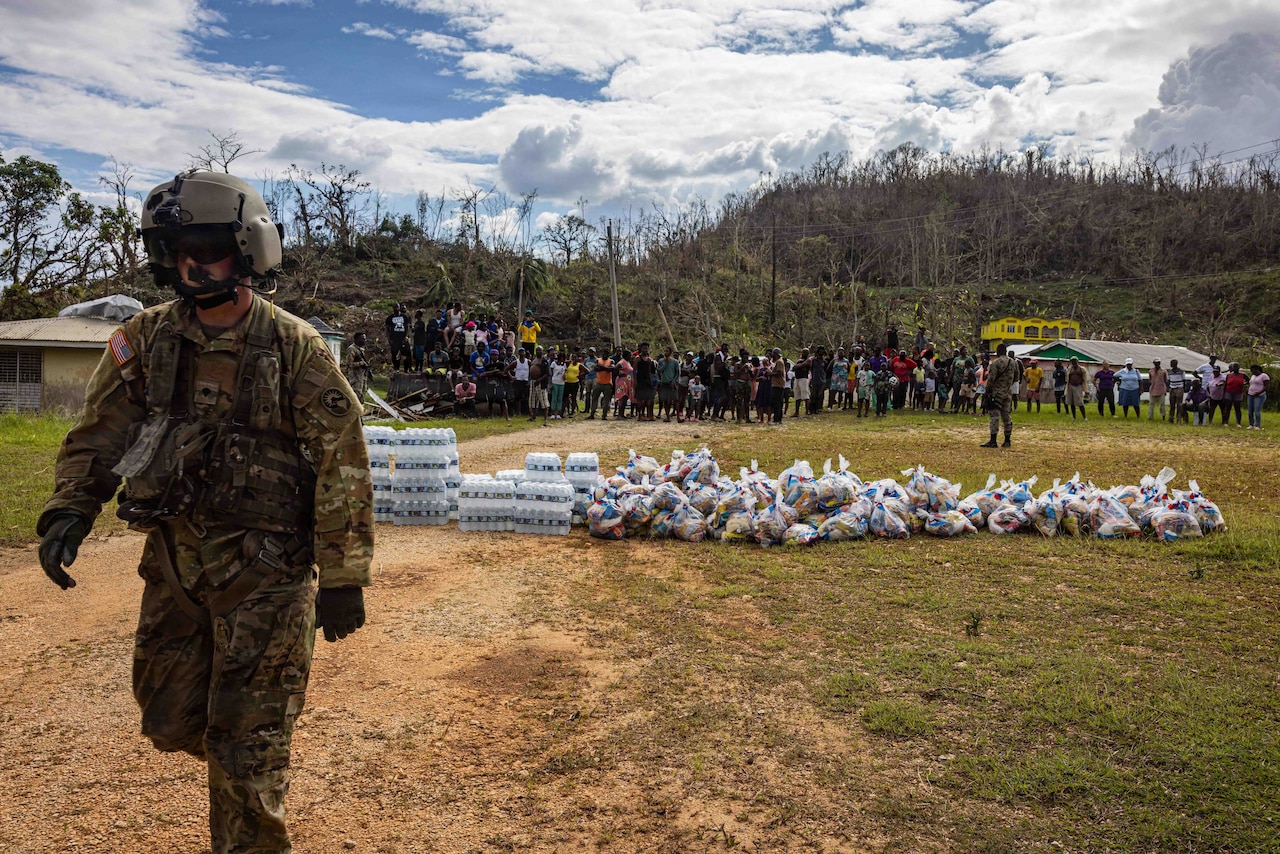
A man in a camouflage military uniform and aviation headgear walks away from a stack of food and water supplies while people in the background wait for the supplies to be distributed.

Joint Task Force Bravo, in concert with the 22nd Marine Expeditionary Unit, provided critical humanitarian assistance to Jamaica in the aftermath of Hurricane Melissa from Oct. 31 to Nov. 13. 
 
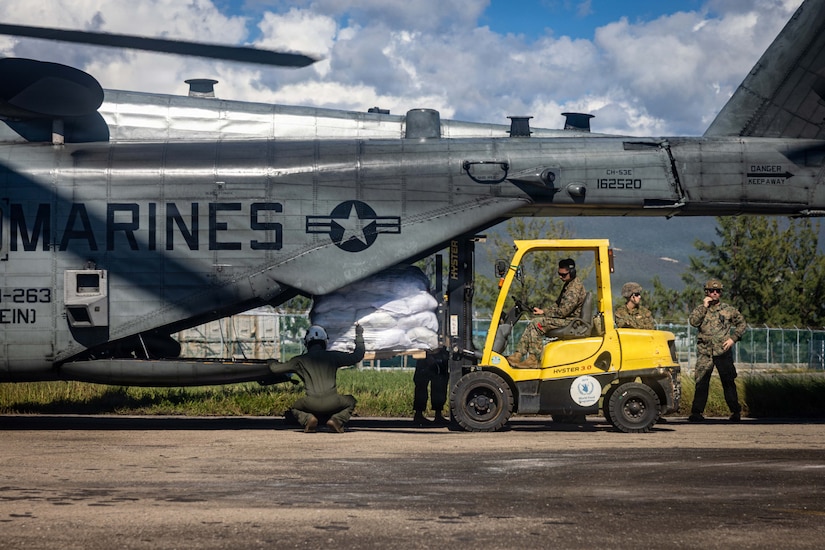
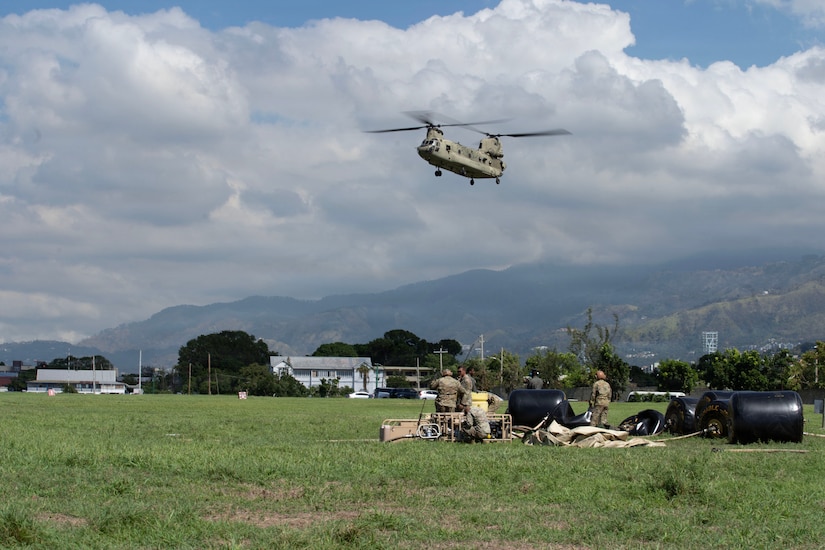
As part of the U.S. military response, nine aircraft were allocated to support the effort, including three CH-47 Chinooks and three UH-60 Black Hawks from the 1st Battalion, 228th Aviation Regiment, JTF Bravo, and three CH-53E Super Stallions from the 22nd MEU, operating from the USS San Antonio.  

In total, the team flew 249 hours across 133 flights, transporting more than 779,000 pounds of lifesaving assistance, including approximately 600,000 pounds of food and water, 179,000 pounds of equipment, and 428 critical personnel movements. 

A man wearing a camouflage military uniform drives a forklift with a pallet of supplies into the back of a military aircraft while another man in a military flight suit guides him. Two other men in camouflage military uniforms observe in the background.

 
"JTF Bravo is designed and trained to rapidly respond when our nation or partners need us," said Army Col. Robert Snyder, joint task force commander. "What really stands out in a mission like this is the expertise and professionalism of our incredible service members — from the pilots and aircrew flying long hours to our troops on the ground managing logistics, airfield and flight operations, aircraft maintenance, and communications to ensure we accomplish the mission. I am very proud of our soldiers, airmen, Marines and sailors." 
 
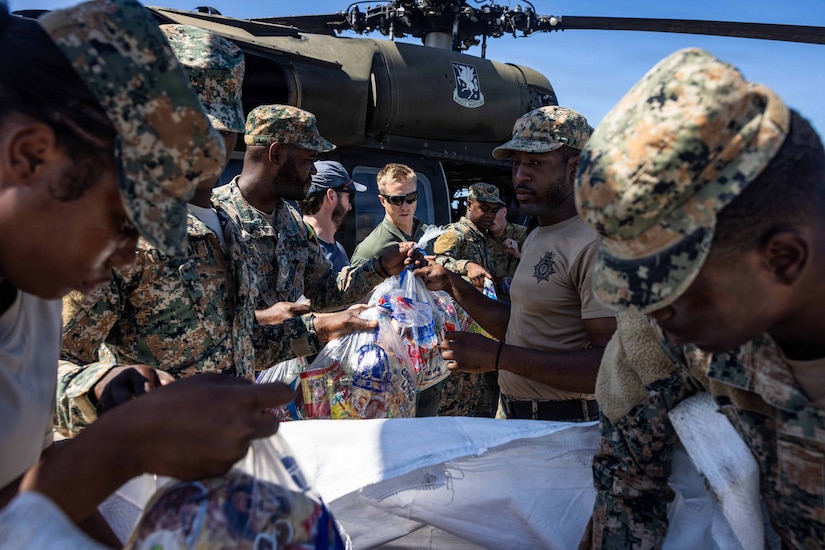
JTF Bravo and 22nd MEU, in partnership with the Jamaica Defense Force and the U.S. State Department's Disaster Assistance Response Team, were able to facilitate critical airlift of essential relief supplies to dozens of hurricane-affected communities across Jamaica that were otherwise inaccessible. 
 
"Watching our teams work side by side with the State Department, Jamaica Defense Force and dozens of other organizations, it is clear to me that everyone shared the same goal: save lives and help the people of Jamaica," Snyder said. "Throughout the operation, I have been extremely impressed with the professionalism and dedication of the Jamaica Defense Force, and I look forward to working with them again. I know we made a difference for the people of Jamaica, and we strengthened our partnership with the Jamaica Defense Force." 
 
To maximize the amount of time aircraft were able to operate on station, the task force established a forward arming and refueling point, accessible to JTF Bravo and 22nd MEU aircraft. This capability delivered nearly 25,000 gallons of fuel, which allowed aircraft to immediately refuel upon returning from missions, enabling a quicker return to follow-on missions. 

A military helicopter comes in for a landing in an open field while four people in camouflage military uniforms wait beside refueling equipment. There are several houses and mountains in the background.

 
Furthermore, the 22nd MEU facilitated safe operations of all aircraft through the employment of a Marine air traffic control mobile team, who oversaw arming and refueling operations, conducted surveys of helicopter landing zones, and established procedures for the safe loading of cargo onto aircraft. 
 
"As a combat logistics battalion deployed with a Marine expeditionary unit that serves as a crisis response force, providing foreign humanitarian assistance is what we do, said Marine Corps Lt. Col. Zach Hornbaker, commanding officer of Combat Logistics Battalion 26, 22nd MEU. "I am incredibly proud of what we have been able to accomplish working alongside Joint Task Force Bravo and our partners in the Jamaica Defense Force." 
 
Hurricane Melissa made landfall Oct. 28 in Jamaica as a Category 5 storm with winds sustained at 185 mph. Within 72 hours, U.S. service members from the task force were on location to reinforce the State Department-led response, assessing the needs of the affected areas and coordinating logistic and airlift support to get emergency food, water, shelter materials and other relief supplies where they were needed most. 
 
"The partnership between the Jamaica Defense Force and JTF Bravo, along with the 22nd MEU, is forged in a shared commitment to regional security," said Jamaica Defense Force Lt. Col. Morton Stewart, bridge executive officer of the Maritime Air and Cyber Command. "This was proven by the immediate deployment to Jamaica following Hurricane Melissa, swiftly integrating into the JDF response mechanism to address Jamaica's needs. This united effort showcases a resilience that not only thrives on interoperability, but also the incredible professionalism of the United States military, strengthening the very foundation of our bilateral cooperation to overcome any adversity." 

Several men in camouflage military uniforms move bags of food into a helicopter.

 
For more than 50 years, U.S. Southern Command has worked to build regional and interagency partnerships to ensure the continued stability of the Western Hemisphere. 

During much of that time, JTF Bravo has supported U.S. military and humanitarian operations, providing critical airlift, medical, logistics, and security assistance to partner nations. JTF Bravo functions as Southcom's rapid response element, enhancing regional security, promoting stability, and strengthening partnerships through disaster response, joint exercises and capacity-building.  

The 22nd MEU is a forward-deployed, rapid response force with aviation, ground and logistics combat elements. For this mission, its combat logistics battalion was tasked to deliver foreign humanitarian assistance, alleviate suffering and help Jamaican communities recover from the devastating impact of the storm. The 22nd MEU came ashore to supplement JTF Bravo with additional logistical and aviation support, ensuring rapid, flexible assistance. 

Medal of Honor Monday: Marine Corps Pfc. Richard Kraus

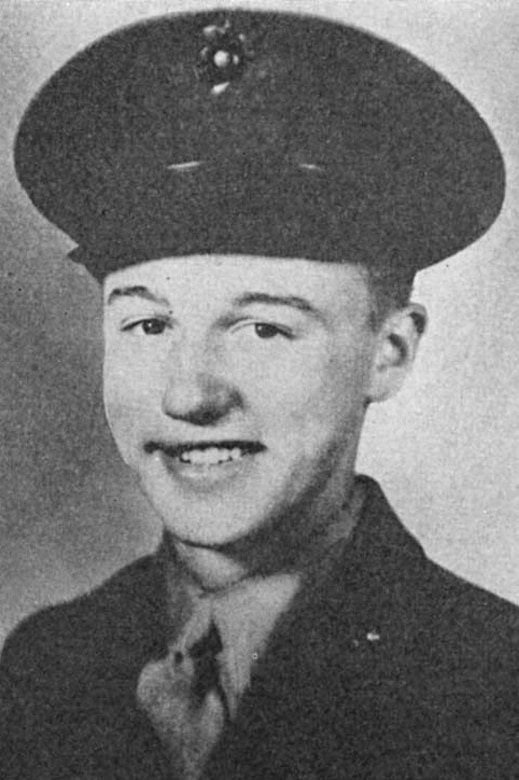
Marine Corps Pfc. Richard Edward Kraus had only been overseas for three months during World War II when he gave his life to save his fellow Marines. For making the ultimate sacrifice, the 19-year-old received a posthumous Medal of Honor.  

A man wearing a military dress uniform and cap poses for a photo.

Kraus was born Nov. 24, 1925, in Chicago to Hazel and August Kraus. He had a sister, Yvonne. When his mother later remarried, he gained two sisters, Gail and Marlys.  

When Kraus was 7, his family moved to Minneapolis. His parents described him as an average boy who attended church, liked sports and was "full of fun," according to a July 1945 article in the Minneapolis Star newspaper.  

Kraus graduated from Edison High School in 1943, as World War II raged. By the end of that year, he'd turned 18 and enlisted in the Marine Corps Reserve. Kraus spent the first half of 1944 training in San Diego at Camp Pendleton. In early July 1944, he was deployed to the Pacific, where he served with the 8th Amphibious Tractor Battalion, 3rd Amphibious Corps, Fleet Marine Force. 

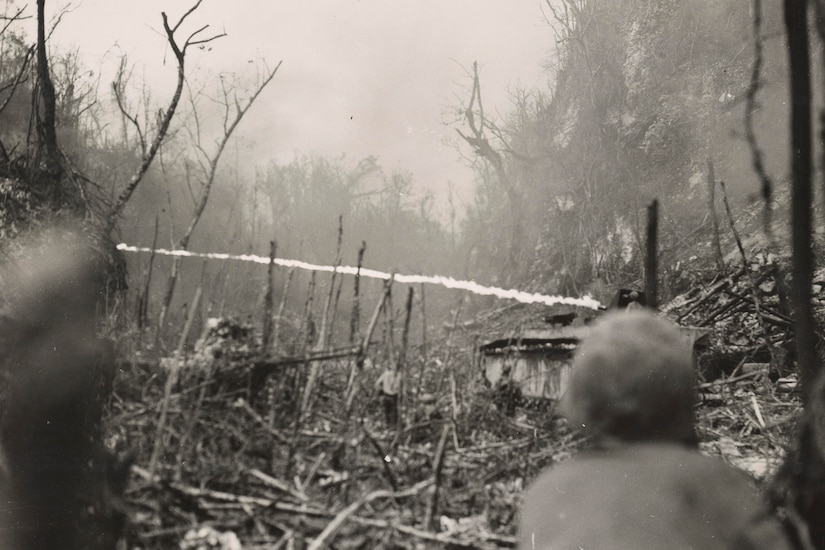
The first and only major offensive in which Kraus took part was the Palau Islands campaign. By mid-September, Kraus landed on the island of Peleliu. Within weeks, Marines and soldiers made headway in securing the island from Japanese forces.  

A person wearing a military uniform looks forward at the edge of a burned-down forest. Another person in a military uniform walks in the distance, and a line of flame from a flamethrower rips from a tank sitting in the middle of the carnage.

On Oct. 5, 1944, Kraus and three other Marines volunteered to evacuate a wounded comrade from the front lines. Despite the extreme danger, the small group courageously made their way across enemy lines with a stretcher. They made it a good distance before the enemy began throwing a barrage of hand grenades in their direction, forcing them to take cover before eventually abandoning the mission.  

As the four men headed back, two men dressed like Marines approached them. When Kraus asked them for a password to prove they were who they said they were, the pair didn't answer. Instead, one of them threw a grenade into the middle of the four Marines.  

Without hesitating, Kraus threw himself on top of the explosive device, covering it with his body so he would absorb the impact of the blast, sparing his comrades. Kraus gave his life to save his fellow Marines.  

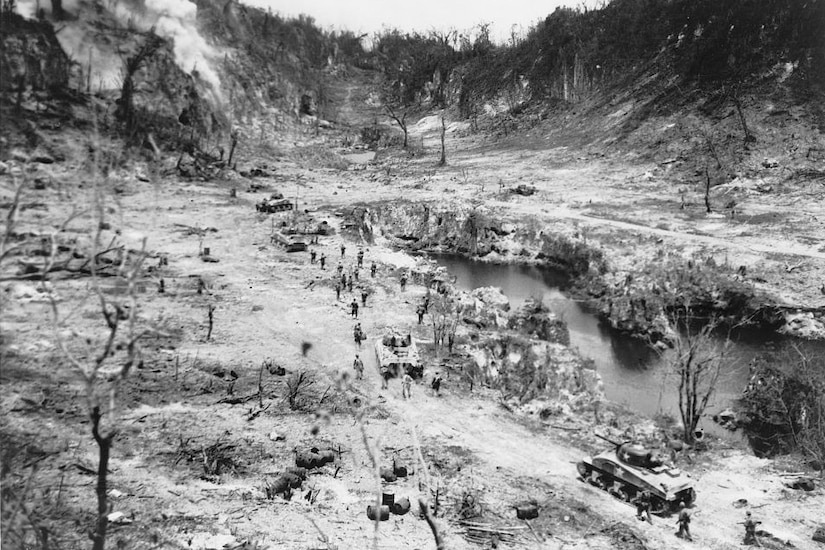
An aerial view of tanks and people walking through a burned-out ravine.

On Aug. 2, 1945, Kraus' mother received the Medal of Honor on her son's behalf during a ceremony in downtown Minneapolis. Seven other Marines received the nation's highest honor for valor for their actions in Peleliu.  

Kraus was initially buried in an American cemetery on Peleliu, but his remains were repatriated in 1948. He was reburied in Fort Snelling National Cemetery in Minneapolis.  

Kraus has not been forgotten. The destroyer USS Richard Kraus was commissioned in his name in May 1946. It served through the Vietnam War and remained in service until its decommissioning in July 1976.  

A main street on Camp Pendleton was also named in Kraus' honor.  

Friday, November 14, 2025

Department of War Name Set in Bronze at Pentagon Entrances

 Nov. 13, 2025 | By C. Todd Lopez, Pentagon News

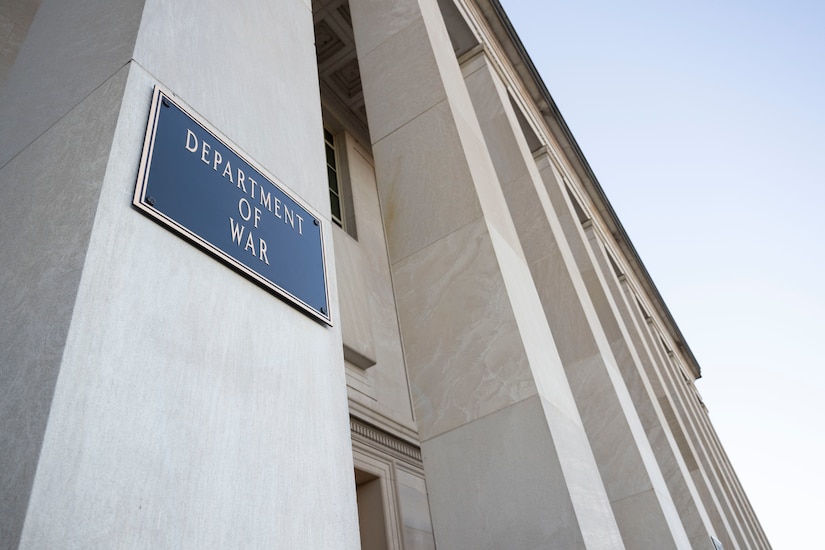
At the Pentagon today, facilities personnel took down outdated bronze plaques at two of the building's entrances and replaced them with recently minted plaques bearing the new name of the federal agency that leads America's fighting force: "Department of War."

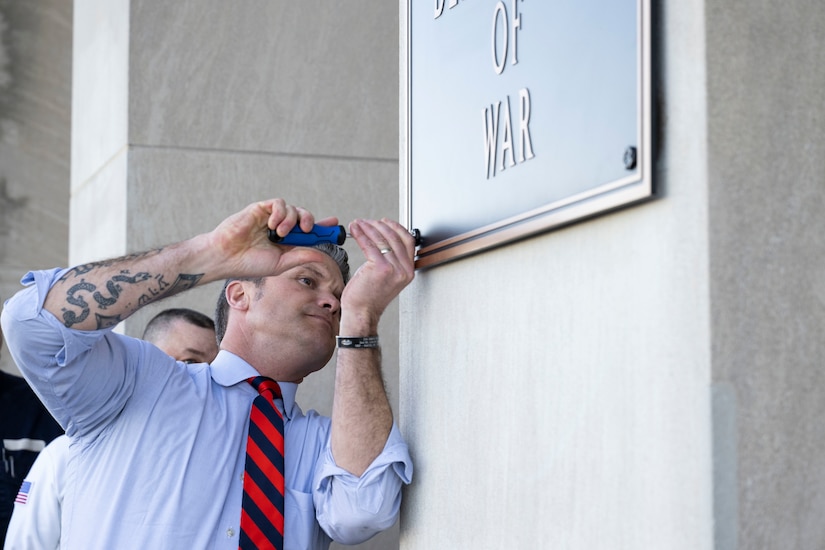
A person in business attire uses a screwdriver to secure a plaque to a concrete wall.

One of those new plaques was put up at the River Entrance, which faces the Potomac River and serves as the Pentagon's grand entrance. It's where Secretary of War Pete Hegseth greets counterparts from partner and allied nations, as well as other dignitaries and distinguished visitors. 

The Mall Entrance, which faces north toward the National Mall in Washington, also got a new sign. Outside that entrance are the Pentagon's helicopter landing pads. 

"We wanted to replace [the old signs] because we want everybody who comes through this door to know that we are deadly serious about the name change of this organization," Hegseth said. 

In early September, President Donald J. Trump signed an executive order changing the name of the Defense Department back to the War Department — a name the department held for more than 150 years, from 1789 to 1947. 

Construction on the Pentagon began in 1941 and was completed in 1943. When the building opened that year, it housed the Department of War. In fact, the dedication stone on the Pentagon — located outside the Mall Entrance — has "War Department" engraved at the top, along with the names of Franklin D. Roosevelt, who was president at the time, and Henry L. Stimson, who served as Secretary of War from 1940 to 1945. 

Now, the Pentagon again houses the War Department. 

A plaque on a wall reads "Department of War."

"We love everything that the Department of Defense represented," Hegseth said. "But this is a new era of the Department of War that is focused on winning wars ... and making sure that we know exactly what the mission is and that the troops are sent there to succeed and win." 

The name "Department of War," Hegseth said, harkens back to America's founding. 

"[We are] reestablishing [the department] back to Henry Knox and George Washington and the founding of our nation — to fight and win our nation's wars if called upon," he said. "And of course, the whole goal is to deter wars in the first place ... to establish peace." 

The new name also reflects a new ethos for the department, Hegseth said, after he personally fastened the last screw on the new River Entrance plaque. 

"We are rebuilding it; we are reestablishing deterrence — it's based on America first, peace through strength and common sense," he said. "And now everybody that enters this building, whether it's generals or civilians or foreign leaders, is going to see: this is not just on paper. This is not just a title. This is exactly who we are." 

The new bronze plaques are each roughly 30 by 20 inches and weigh about 60 pounds. 

The old plaques, which say "Department of Defense," had been on the building for more than 70 years, Hegseth said. 

Monday, October 27, 2025

Clash of Titans: How Freemasons Shaped the Cold War


“The temple we seek to build is not merely a monument of stone, but the living sanctuary within the chambers of our own heart.”

— The Temple Within (Foster, 2025)


When Titans Wore Aprons

At the dawn of the Cold War, two men stood astride history: Harry S. Truman and Douglas MacArthur. Each was a national hero, a symbol of postwar American power, and, significantly, a Freemason. Bound by oaths to the same Craft, they were taught the same moral vocabulary of duty, humility, and fidelity to principle. Yet, across the Pacific, they would come to embody opposite interpretations of Masonic leadership.

Truman, the steady builder, had risen through the degrees of Masonry by patient labor and deliberate service, convinced that true mastery is earned only through discipline and restraint. MacArthur, the born commander, had been made a Mason “at sight,” an honor reserved for those whose lives already seemed to reflect the virtues of the Craft. For him, mastery was not attained by slow chiseling but conferred by destiny itself.

Their clash during the Korean War was not merely political. It was philosophical—a contest between the Mason who built and the Mason who believed himself already complete. Beneath the uniforms and offices lay a deeper drama: whether the temple of democratic order would be governed by the trowel or by the sword.


The Builder of the Craft — Harry S. Truman

Harry S. Truman’s Masonic story began long before his presidency. Initiated in 1909 at Belton Lodge No. 450 and later serving as the first Worshipful Master of Grandview Lodge No. 618, he advanced through the ranks to become Grand Master of the Grand Lodge of Missouri in 1940 (Truman Library, 2024). His Masonic worldview was shaped by labor: every degree, every lesson, every office occupied by effort. He once wrote that Freemasonry is “a system of morals which makes it easier to live with your fellow man, whether he understands it or not.”

For Truman, the Craft was not ornamental. It was architecture—an ordered geometry of ethics. The Square symbolized fairness, the Level equality, and the Plumb uprightness. When he entered the White House upon Franklin Roosevelt’s death in 1945, those working tools became his moral compass. The decision to end World War II with the atomic bomb, the desegregation of the armed forces, and the Marshall Plan’s rebuilding of Europe each reflected the same internal design: measured strength guided by moral proportion.

In the presidency, as in the lodge, Truman valued process over passion. He viewed government as a temple that must be preserved stone by stone, its integrity more vital than the ambitions of any single man. The president’s role was not to wield the hammer of power but to ensure that the structure held firm against both tyranny and chaos. In this, Truman lived the lesson of the ancient builder who refused to reveal the secret of his art, preferring to die rather than betray his trust.


The Mason Made in a Moment — Douglas MacArthur

If Truman was the Craftsman, MacArthur was the Commander. In 1936, the Grand Lodge of the Philippines made him a Mason “at sight,” a rare and symbolic act. It bypassed the usual ritual progression, declaring that MacArthur’s life already embodied Masonic virtue: courage, honor, intellect, and faith in destiny. To many, he was the perfect archetype of the enlightened warrior—disciplined, visionary, and loyal to what he called “Duty, Honor, Country.”

Yet, his Masonic identity was fundamentally different from Truman’s. It was recognition, not construction. MacArthur saw himself as an instrument chosen for great works—first in liberating the Pacific, later in rebuilding Japan. His oversight of Japan’s postwar constitution and democratization remains one of the most remarkable feats of statecraft in modern history (Brands, 2016).

But the same conviction that gave him courage also bred defiance. MacArthur’s faith in moral clarity often eclipsed his respect for hierarchy. He believed he saw the divine plan of history with a soldier’s precision and a prophet’s certainty. In the lodge’s allegory, he was not the one carving the stone by instruction; he was the man convinced he already knew the temple’s completed form. The danger in such certainty, Masonically speaking, is that the pursuit of Light can become a reach for ownership of Light itself.


The Fault Line — What They Clashed About

The Korean War: Context

The fault line between these two Masons opened over the Korean Peninsula. On June 25, 1950, North Korean forces, armed and supported by the Soviet Union, crossed the 38th parallel and invaded South Korea. Truman, interpreting the invasion as a direct challenge to postwar order, authorized the use of American and United Nations forces to repel the attack (Gaddis, 2005).

MacArthur, Supreme Commander of the Far East, executed a daring amphibious landing at Inchon, reversing the war’s momentum. Seoul was retaken, and MacArthur’s name was again celebrated across the free world. But his triumph carried a perilous momentum. As U.N. forces pushed northward toward the Yalu River, China entered the war. Truman, fearing escalation into World War III, ordered a strategic withdrawal and adopted a doctrine of containment rather than total victory.

MacArthur saw that as appeasement. He urged permission to bomb Chinese bases, blockade their coast, and, if necessary, employ nuclear weapons. Truman refused. To him, expanding the war risked catastrophe. “This war is not about conquest,” he said, “but about the defense of principle” (McCullough, 1992). When MacArthur publicly criticized that policy and communicated with Congress and the press in defiance of orders, Truman relieved him of command in April 1951.

2. The Masonic Metaphor

In Masonic symbolism, Truman stood upon the Square—law, hierarchy, and disciplined order—while MacArthur grasped the Sword, convinced that moral clarity required decisive action regardless of procedural restraint.

Truman’s response echoed the lesson of the ancient builder: that fidelity to one’s oath outweighs the temptation to seize mastery prematurely. MacArthur’s defiance mirrored the eternal danger of confusing inspiration with authority. Truman saw disobedience not as courage but as hubris—the rejection of the very geometry that keeps power just. MacArthur, in turn, viewed Truman’s restraint as weakness—a failure to fulfill the moral mission entrusted to America’s might.

The result was a fracture of extraordinary visibility: two Freemasons, two visions of duty, standing on opposite sides of the Pacific, each certain that his path alone preserved the Light.


How the Clash Shaped Cold War Policy

Containment over Crusade

Truman’s decision to remove MacArthur became the defining moment of civilian supremacy in modern American history. It established that no general, no matter how decorated, could substitute personal conviction for constitutional authority. More profoundly, it defined the Cold War’s moral framework.
Rather than pursue crusades of liberation through total war, the United States would fight through containment, deterrence, and alliance-building. The Truman Doctrine pledged aid to nations resisting communist aggression but within boundaries of legality and diplomacy. The Marshall Plan rebuilt Europe not as conquest but as partnership. The North Atlantic Treaty Organization (NATO) institutionalized collective security without resorting to pre-emptive warfare.
In this measured architecture, one can sense the builder’s touch: restraint as strength, moral clarity expressed in structure rather than fire. Truman’s actions reflected the Masonic principle that Light must be diffused through harmony, not domination.

The Moral Geometry of Power

MacArthur’s dismissal also illuminated the other side of the moral geometry. His vision of a decisive, world-redeeming struggle against Communism prefigured later debates within U.S. policy—most notably the “rollback” strategies considered under Eisenhower and Kennedy (Leffler, 2007). His legacy survived not in policy but in ethos: the belief that America’s moral duty might one day require unrestrained force.
Thus, the Truman–MacArthur conflict did not simply end a command; it set the Cold War’s boundary of morality. It defined what it meant for America to lead the “Free World”: through measured stewardship rather than messianic crusade. The Sword would remain in the builder’s hand—but under the rule of the Square.

Symbolic Legacy in the Lodge of Nations

Both men left behind enduring structures. Truman’s careful diplomacy laid the foundation for Western recovery and the long-term containment of Soviet expansion. MacArthur’s bold reconstruction of Japan gave Asia a model democracy and an economic powerhouse.

Each, in his way, became a builder of temples: one diplomatic, one constitutional. Truman built with mortar; MacArthur built with vision. Together, though they clashed bitterly, they shaped the architecture of a world that still bears their mark. Their opposing interpretations of Freemasonry produced not destruction but balance—two columns supporting the same edifice of postwar order.


The Hidden Lesson of the Craft

Freemasonry teaches that the Light cannot be taken by force; it is revealed to those who labor in faith. The legend of the ancient builder—who kept his trust even when threatened—reminds Masons that mastery comes through integrity, not ambition. In that quiet lesson lies the key to understanding Truman and MacArthur.

Truman lived as the builder, guarding the temple of democratic order against both tyranny abroad and arrogance at home. His refusal to yield civilian authority preserved the constitutional sanctum. MacArthur, driven by vision, sought to complete the temple swiftly—to raise it to glory by his own design. Yet his impatience, like all untempered zeal, threatened the very balance he hoped to defend.

Their confrontation was not a betrayal of the Craft but its ultimate testing: what happens when two men of Light interpret their oaths differently? The answer was written not in ritual but in history itself. Truman’s decision affirmed that leadership must be answerable to law; MacArthur’s defiance reminded the world that even moral conviction must bow before order.

In the moral architecture of the Cold War, both were essential. Truman’s plumb line gave the West its enduring vertical of stability. MacArthur’s vision gave it reach, daring, and idealism. The temple they contested still stands—a structure of competing virtues held in tension, preserved by discipline, inspired by courage.


Light Through Conflict

The Truman–MacArthur confrontation was the crucible in which modern American power was forged. It tested whether democracy could wield atomic strength without losing its moral foundation. It asked whether men of conviction could remain servants of a higher design rather than masters of it.

In the end, Truman’s decision to relieve MacArthur did more than end a dispute; it defined the moral limits of the nuclear age. It ensured that the United States would fight its greatest struggles not as conqueror but as custodian—guarding a fragile balance between freedom and destruction.

Both men were Masons. Both believed they served the same Light. Yet one built by measure, and the other by vision. Their clash revealed that even among brothers, the path to Light diverges—one through restraint, the other through destiny—but both, in the end, shaping the temple of history.


References

Brands, H. W. (2016). The General vs. the President: MacArthur and Truman at the Brink of Nuclear War. Doubleday.
Foster, R. E. (2025). The Temple Within: A Master Reflection on Light, Labor and Legacy. WaveCloud Corporation.
Gaddis, J. L. (2005). The Cold War: A New History. Penguin Press.
Leffler, M. P. (2007). For the Soul of Mankind: The United States, the Soviet Union, and the Cold War. Hill and Wang.
McCullough, D. (1992). Truman. Simon & Schuster.
Pike, A. (1872). Morals and Dogma of the Ancient and Accepted Scottish Rite of Freemasonry. Southern Jurisdiction.
Truman Library. (2024). Harry S. Truman’s Masonic Life. Harry S. Truman Presidential Library and Museum.
Sunday, October 26, 2025

The Front Lines of Hunger: How the Government Shutdown Starves America’s Military Families

I. Introduction – The New Battlefront

At a base commissary on a quiet weekday morning, a fictional Marine named Staff Sergeant Evans stands in line, uniform pressed, rucksack at his feet. Beside him waits Ms. Jenner, a composite character modeled after furloughed DoD maintenance workers, clutching a grocery list she may not be able to afford to fill. Though these figures are fictional, their circumstances represent the very real struggles unfolding across military installations during the 2025 government shutdown. While active-duty personnel have temporarily received pay through redirected Department of Defense funds, tens of thousands of DoD civilians and contractors have gone weeks without income. The consequences ripple outward — from the barracks to the breakroom to the dinner table — threatening not just mission readiness, but the basic well-being of America’s defenders and those who support them. This essay argues that the shutdown has exposed an invisible front line, where hunger unites soldiers, civilians, and contractors in a shared battle for stability.


II. Background – How a Political Stalemate Became a Human Crisis

When the federal government funding lapsed as of September 30, 2025, agencies entered contingency operations. The Pentagon announced that it would redirect unused research and development funds to ensure mid-October pay for active-duty troops. (Air & Space Forces Magazine) Meanwhile, legislation such as the proposed “Pay Our Military Act” remains stalled. (Federal News Network) The shutdown marks a convergence of high cost-of-living, inflation, frequent relocations, and the low pay of junior enlisted personnel—conditions that already placed some military families in precarious financial positions prior to the lapse.


III. A Fragile Ecosystem: Military Families Already on the Edge

Data from the RAND Corporation show that approximately 25 – 26 % of active-duty service members, and their families, report some level of food insecurity. (RAND) Enlisted families are disproportionately affected, with one study finding 27 % of enlisted active-duty family respondents reporting low or very low food security, compared with just 4 % of officer families. (Blue Star Families) Contributing factors include spouse under-employment (especially after relocations), frequent moves, housing and childcare costs, and a stipend structure (such as Basic Allowance for Housing) that may reduce eligibility for food-assistance programs. (Feeding America Action) These structural pressures mean that even before the shutdown, the defense community was fighting an uphill battle against hunger.


IV. Civilian and Contractor Fallout – The Hidden Threads in Military Life

The military family experience extends beyond the uniformed service member. DoD civilian employees and contractor personnel are part of the base ecosystem — from maintenance, commissary staffing, food service, base housing, childcare, to logistics. During the shutdown, many civilian DoD staffers have been furloughed or required to work without pay; many contracts are paused or delayed due to lack of funding. (AP News) When base support functions falter, the impact falls to families: food-service workers may stop receiving pay, leading to reduced commissary hours; contractors who service base housing may delay repairs, increasing cost burdens on military families; and local economies domiciled around bases — home to many military spouses and contractor households — experience strain. In military communities, one spouse may serve in uniform, another in the civilian or contractor workforce; when one or both paychecks falter, the household’s food security immediately teeters. As a nonprofit executive observed: demand at a military-community food pantry spiked 300 % during the shutdown. (TIME)


V. Commissaries and Food Banks – When Support Systems Collapse

On many bases, the commissary and exchange remain open, but their staffing and operations depend on funding flows and civilian/contractor labor. During the shutdown, reduced hours or temporary closures are reported. (MOAA) Local food-assistance programs tied to military communities are overwhelmed. For instance, the Armed Services YMCA and other organizations report dramatic increases in need among service-members and military-family households. (TIME) At Camp Pendleton and Los Angeles AFB the labels of “military family” now include civilian and contractor families equally reliant on assistance. One base chaplain adds, “We all wear different badges, but we’re all hungry the same.” The convergence of uniformed, civilian, and contractor homelessness or hunger underscores that base communities function as integrated ecosystems.


VI. The Broader Impact – Readiness, Morale, and Trust

Hunger in a household undermines more than nutrition — it affects mental health, morale and military readiness. Studies show that food insecurity in soldiers is associated with increased odds of depression, hazardous drinking, and intent to leave service. (PMC) For service members whose spouse or partner is furloughed or unemployed due to shutdown-induced contractor disruptions, the stress compounds. The pledge “we support our troops” rings hollow when those same troops’ families stand in food-pantry lines. The resulting erosion of trust and morale threatens the very readiness the DoD seeks to uphold. Moreover, local base economies suffer when contractors cut back or furlough employees — reducing the second-tier economic buffer that military families often rely upon.


VII. Policy Solutions – Repairing the Defense Food Chain

Short-Term

  1. Congress should rapidly pass a “Pay Our Military & Defense Workforce Act” guaranteeing pay continuity for active-duty, essential civilian and contractor employees during funding lapses. (National Military Family Association)

  2. The DoD should establish an emergency Defense Food Security Fund—jointly administered with USDA—that can deploy rapid food-assistance grants to military communities facing funding-pause stress.

Structural

  1. Index military pay, Basic Allowance for Housing (BAH), Basic Allowance for Subsistence (BAS) and other allowances to regional cost-of-living and household food-security metrics.

  2. Require quarterly reporting across the defense workforce (uniformed, civilian, contractor) of food-insecurity prevalence and trigger automatic relief when rates exceed thresholds (e.g., 20 %).

  3. Foster public-private partnerships (Rotary, USO, YMCA) to build resilient food-support networks on or near installations, and enlist local businesses servicing the base community.

  4. Reform food-assistance eligibility rules for military families (e.g., exclude BAH from SNAP income calculation) to better align need and support. (Feeding America Action)


VIII. Conclusion – One Team, One Fight

The Marine spouse at the commissary; the civilian technician standing nearby; the contractor’s family in a base-town rental. Three roles, one mission: keeping America’s defenses strong. Yet in the emptiness of a grocery cart, the nation’s promise falters. Hunger inside a military family is not an individual failure—it is a systemic betrayal. The federal government may argue readiness, budget, appropriations—but when those who defend the nation share a food line instead of a mission line, the enemy isn’t hunger—it’s indifference. Until America ensures that no soldier’s child goes hungry, our national security remains incomplete.

How You Can Help

Every community can stand with the men and women who serve. Whether you donate food, volunteer time, or share awareness online, collective action makes an immediate difference. Organizations like Rotary clubs, Armed Services YMCA branches, and civic coalitions are rallying across California and beyond to close the gap left by policy gridlock. You can join this effort by visiting www.feedingmilitaryfamilies.org

 References
Rabbitt, M. P., & Beymer, M. R. (2024). Comparing food insecurity among the U.S. military and civilian adult populations (Report No. ERR-331). U.S. Department of Agriculture, Economic Research Service. (Economic Research Service)
Tong, P. K., Asch, B. J., & Rennane, S. (2023). Military compensation and food insecurity: Analysis in support of the fourteenth quadrennial review of military compensation (Research Report RRA-2923-1). RAND Corporation. (RAND)
“Food insecurity among military families unacceptable, advocates say.” (2024, September 24). Army Times. (Army Times)
“How the government shutdown is affecting troops, families.” (2025, October 1). Military Times. (Military Times)
“Help available for Airmen, Guardians, civilians to mitigate lapse in appropriations impact.” (2025, September 30). U.S. Air Force News. (af.mil)
“Military Hunger.” (2020). Feeding America Action. (Feeding America Action)

Monday, October 20, 2025

HMS Dreadnought: Britain’s Leap into the Nuclear Age

When HMS Dreadnought slid down the slipway at Barrow-in-Furness on October 21, 1960, Britain quietly entered a new epoch of naval power. The submarine was not merely another addition to the Royal Navy’s proud lineage—it was a revolutionary vessel that altered the balance of maritime strategy in the Cold War. Just as the battleship Dreadnought of 1906 had redefined surface warfare, her nuclear namesake reshaped the underwater domain, marking Britain’s first successful step into nuclear propulsion.


The Nuclear Submarine Revolution

The idea of a submarine that could remain submerged indefinitely had captivated military planners since World War II. Conventional diesel-electric submarines were limited by the need to surface or snorkel to recharge batteries, exposing them to detection. The introduction of nuclear propulsion changed that calculus. The United States Navy demonstrated the concept with USS Nautilus in 1955, a submarine that could cross the Atlantic without surfacing and remain submerged for weeks.

For Britain, whose empire and global presence were rapidly contracting after 1945, nuclear propulsion promised to maintain great-power relevance in an age increasingly dominated by superpower competition. The Royal Navy, once the guarantor of maritime freedom, needed a technological leap to remain strategically credible within the North Atlantic Treaty Organization (NATO). A nuclear submarine would provide endurance, speed, and stealth—qualities that allowed navies to project power without reliance on surface support or air cover (Hennessy & Jinks, 2016).


Conception and Design

The British government formally approved the nuclear submarine project in 1956, though the nation lacked the necessary reactor technology. The 1958 United States–United Kingdom Mutual Defence Agreement provided the breakthrough: Washington agreed to supply the same pressurized water reactor used in American submarines. The S5W reactor, manufactured under U.S. license, became the beating heart of HMS Dreadnought (Friedman, 2006).

While the reactor plant and propulsion system were of American origin, the rest of the submarine was distinctly British. Designed by the Admiralty and built by Vickers-Armstrongs at Barrow-in-Furness, Dreadnought combined foreign technology with domestic craftsmanship. The vessel displaced roughly 4,000 tons submerged, measured 266 feet in length, and could achieve speeds exceeding 25 knots underwater. She carried torpedo armament and featured improved sonar and navigation systems that foreshadowed later British designs (Royal Navy Archives, n.d.).

Launched by Princess Marina, Duchess of Kent, Dreadnought became the physical embodiment of the post-Suez British resolve to remain a first-rank naval power. Commissioned into service on April 17, 1963, she entered a world where nuclear submarines had already become central to deterrence and intelligence missions.


Operational Role and Early Service

HMS Dreadnought was not a ballistic missile submarine; she was a fleet or attack submarine (SSN), designed to hunt Soviet submarines, protect British carriers, and shadow hostile fleets. Her first years were marked by intensive trials that tested not only her propulsion but also the safety protocols surrounding nuclear engineering at sea.

By 1964, Dreadnought was conducting long patrols in the North Atlantic, gathering intelligence and demonstrating the endurance only nuclear propulsion could provide. The crew adapted to an entirely new environment—air was recycled, water distilled, and life unfolded in continuous underwater isolation. Commanding officers learned the tactics that would define the Royal Navy’s submarine service for decades: silent running, acoustic stealth, and constant readiness for anti-submarine warfare.

Her success gave confidence to British shipyards and policymakers to pursue a wholly indigenous design. The Valiant-class submarines that followed were fully British nuclear boats, improving on Dreadnought’s lessons with domestic reactor systems developed at the Atomic Energy Establishment in Dounreay (Hennessy & Jinks, 2016).


Strategic Context and NATO Cooperation

During the 1960s, NATO relied heavily on undersea deterrence to offset Soviet naval expansion. While the United States maintained the majority of the alliance’s nuclear submarine force, Britain’s contribution was symbolically and practically significant. HMS Dreadnought demonstrated that the Royal Navy could operate nuclear submarines alongside American counterparts and maintain independent operational capability.

This partnership extended to intelligence sharing and joint exercises. The submarine also strengthened Britain’s industrial base, creating expertise in reactor safety, metallurgy, and submarine construction that would support both the attack and ballistic missile programs. Without Dreadnought, the later Resolution-class submarines—Britain’s first ballistic missile boats—would have been far more difficult to realize (Friedman, 2006).


Technological and Symbolic Legacy

Technologically, Dreadnought was a hybrid. Yet symbolically, she was pure British resolve. Her construction and service represented the nation’s determination to innovate amid economic austerity and geopolitical realignment. The submarine’s design experience directly influenced future generations of Royal Navy vessels, culminating in the Trafalgar- and Astute-class boats that remain in service today.

After nearly two decades of operational service, HMS Dreadnought was decommissioned in 1980. Like many of her nuclear contemporaries, she awaits final disposal as part of the Ministry of Defence’s Submarine Dismantling Project, currently stored at Rosyth Dockyard. Despite her quiet retirement, her name continues to resonate in Royal Navy tradition—a reminder of Britain’s enduring ability to adapt to technological revolution.


Conclusion

The launch of HMS Dreadnought was a turning point in Britain’s maritime story. She bridged the gap between the glory of the surface fleet and the shadowed future of undersea deterrence. In her reactor core beat not only the power of nuclear propulsion but also the determination of a nation unwilling to surrender its maritime legacy.

Like her famous predecessor of 1906, HMS Dreadnought of 1960 transformed the naval landscape. Beneath the waves, she carried forward the same spirit of innovation, ensuring that Britain remained, as it had for centuries, a master of the seas—even in the silent world below.


References

Friedman, N. (2006). British Submarines in the Cold War Era. Annapolis, MD: Naval Institute Press.

Hennessy, P., & Jinks, J. (2016). The Silent Deep: The Royal Navy Submarine Service Since 1945. London: Allen Lane.

Polmar, N., & Moore, K. J. (2004). Cold War Submarines: The Design and Construction of U.S. and Soviet Submarines. Washington, DC: Potomac Books.

Royal Navy Archives. (n.d.). HMS Dreadnought (S101) – The First British Nuclear Submarine. London: Admiralty Historical Branch.

UK Ministry of Defence. (2010). The Submarine Heritage Collection. Whitehall, London: Defence Heritage Office.