Friday, September 12, 2025

Lieutenant Earns His Bars the Hard Way

 Sept. 12, 2025 |Pentagon News

The Army's newest officers pinned on gold bars at Fort Benning, Georgia, Sept. 4, as Officer Candidate School Class 501-25 crossed the stage during a graduation ceremony. Secretary of War Pete Hegseth was the guest speaker.  
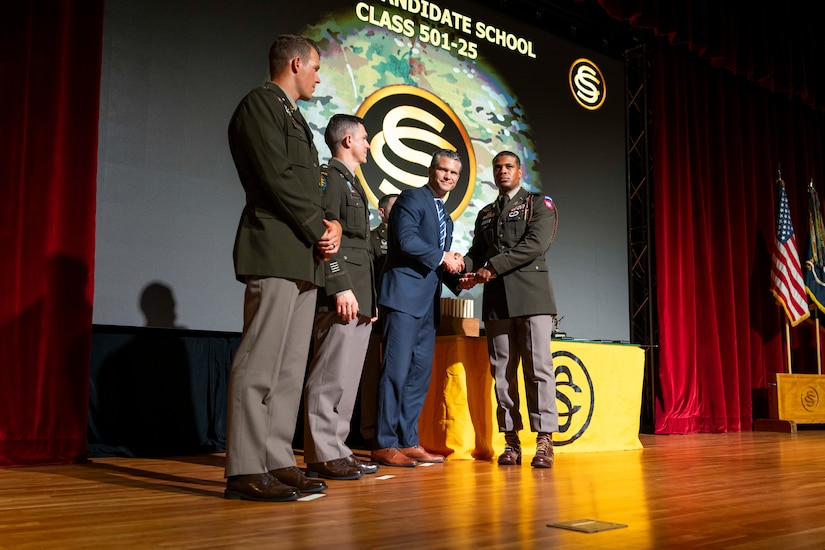
A person in a blue suit and tie hands an item to a soldier in a green uniform as two other soldiers look on.

Among the graduates was Army 2nd Lt. Darren Greene, a prior enlisted paratrooper, whose decade in uniform began in basic training and now turns toward leading soldiers. 

"I'm living the life right now," Greene said after the graduation. 

Greene called the ceremony "perfect," the culmination of a well-rehearsed week. In the days leading up to graduation, he said the class "rehearsed constantly, nonstop" from Monday through Thursday to make sure every movement landed on time and to standard. 
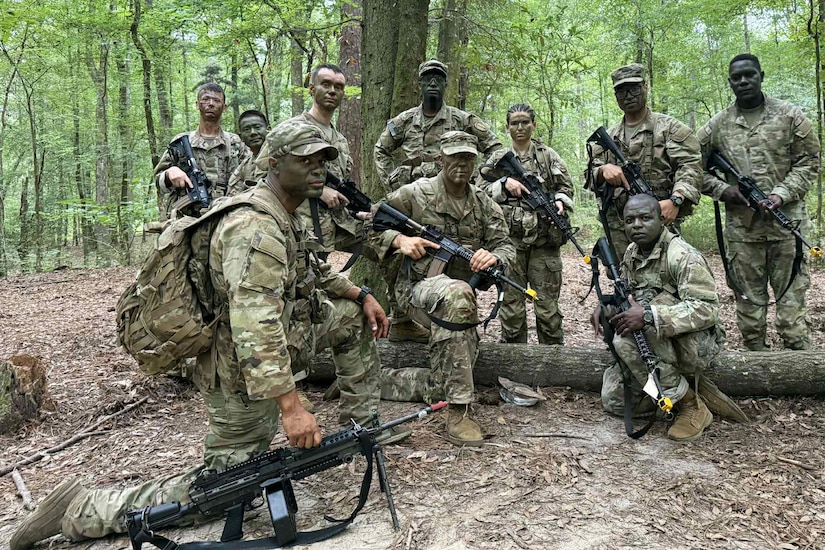
Soldiers in camouflage uniforms with guns mill about in the forest.

Greene's path to becoming a commissioned officer did not follow a straight line. He first entered military training as a college student at West Virginia University, where ROTC shared space with big campus distractions.  

"I kind of got sucked into the big party, school lifestyle, frat parties, house parties," he said.  

Greene left Morgantown without a commission, enlisted in 2014 and went to infantry training and Army Airborne School before reporting to the 82nd Airborne Division. 

From 2016 through 2017, Greene deployed to Iraq during Operation Inherent Resolve, supporting missions that moved from Baghdad northward. The experience cemented his decision to make the Army a career, and he began chipping away at the college credits he needed to finish his degree.  
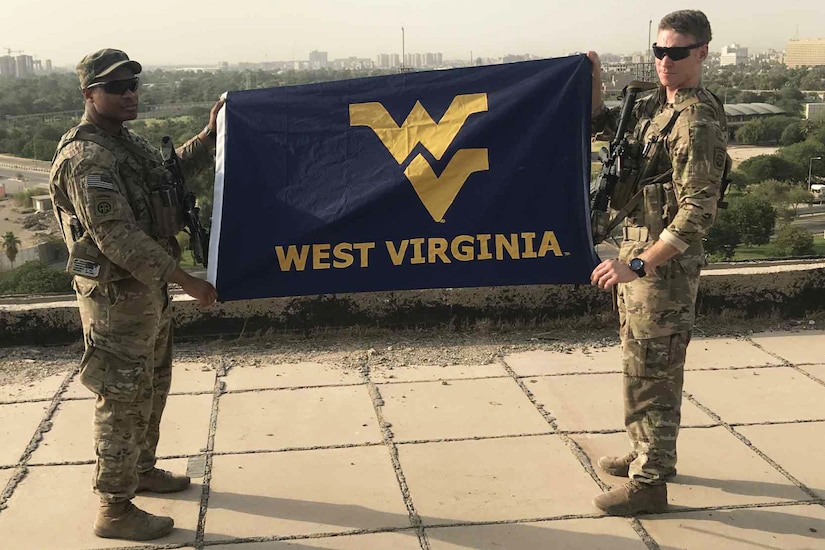
Soldiers in camouflage uniforms hold up a University of West Virginia flag.

"I took the long route to my college graduation, right?" he said, describing years of part-time coursework that ultimately led back to West Virginia University and a completed capstone in 2023. 

Greene advanced from private to sergeant and served overseas in Italy before returning to the 82nd Airborne Division, where familiar leaders noticed his trajectory. He credits mentors for hammering home expectations he intends to carry into his commission.  

"The two biggest things that you are responsible for are yourself and the reputation of your unit," Greene said. "If you're not the standard-bearer, you can't, like, you can't expect people to follow you." 
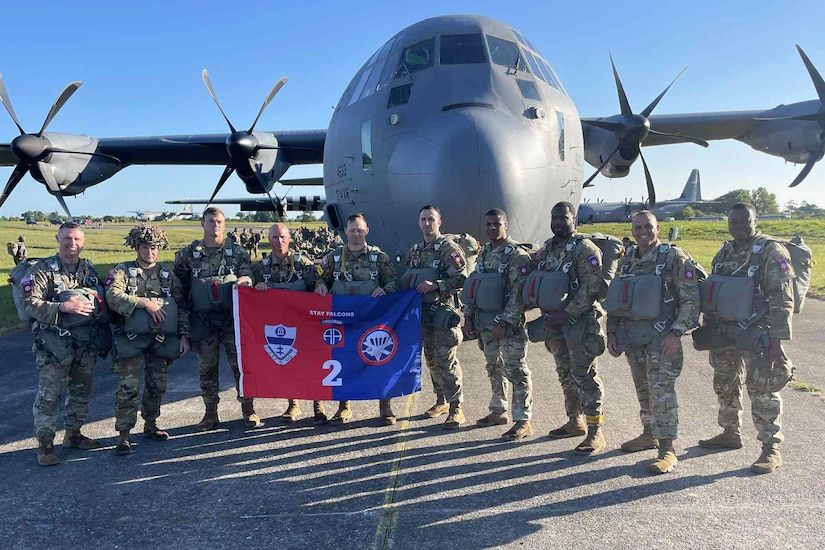
Soldiers stand in front of a four-propeller aircraft on a runway.

Hegseth's message to the class echoed that mindset and the school's motto.  

"It is great to be here at Fort Benning. And it is Fort Benning," he emphasized, before praising the OCS creed of "standards, no compromise."  

Hegseth urged graduates to anchor their leadership in fundamentals and preparation, invoking a battlefield lesson popularized by Army Lt. Gen. Hal Moore: "There's always one more thing you can do to increase your odds of success."
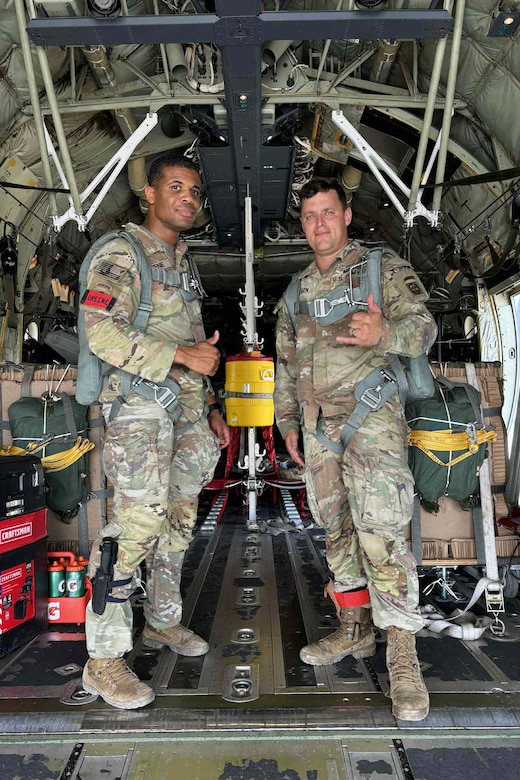
Two soldiers in camouflage uniforms stand in the back of an aircraft, each making a signal with one hand.

That preparation, he said, begins with knowing the mission, the terrain and the formation, then trusting and leveraging experienced noncommissioned officers. The secretary also emphasized decentralized decision-making in combat.  

"We're going to make sure that decisions are pushed down to the lowest possible level where they should be made," Hegseth said. 

OCS's 12-week crucible is designed to make those expectations real. The class's prior service population — including soldiers like Greene, who had already led squads and teams — brought practical experience to land navigation, small-unit tactics and troop-leading procedures. The transition now moves from OCS to the Basic Officer Leader Course, where lieutenants learn branch-specific skills before reporting to their first platoons. 

Greene understands that the work ahead will test his time-management skills as much as his tactics. He and his wife are raising two young sons, ages 3 and 1, and BOLC will mean months away from home. But he views the sacrifice as an investment in the soldiers he will soon lead and the noncommissioned officers he plans to rely on. 

Greene's deployment and subsequent years in airborne formations shaped a leadership philosophy that fits OCS's emphasis on standards and accountability. He talks about earning trust through preparation, showing up ready and listening hard to the NCOs who own the craft. Those habits — and his insistence that a leader's personal reputation is inseparable from the unit's — mirrored the ceremony's themes and the charge delivered from the lectern. 
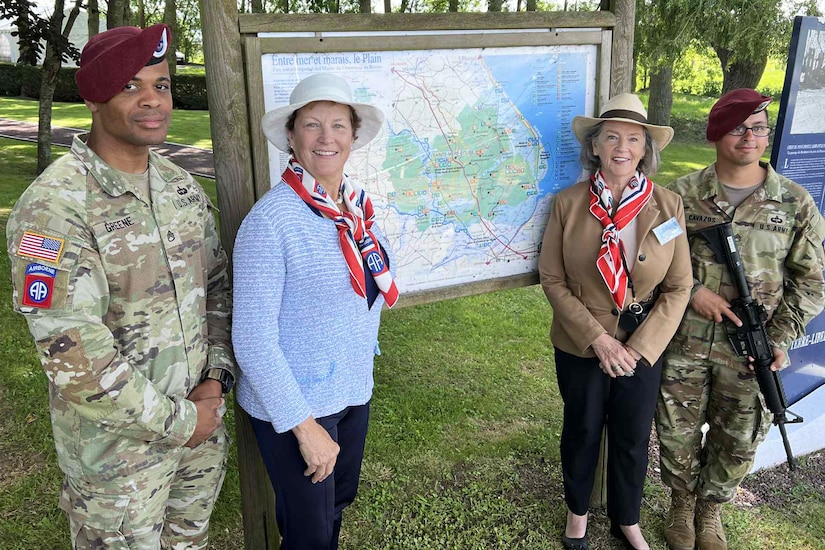
Two soldiers in camouflage uniforms, one holding a rifle, stand next two people dressed in civilian clothing near a map displayed in a grassy area, with trees in the background.

"You have been forged and now you will forge," Hegseth told the graduates.  

The line landed as both a compliment and a warning: the hard part starts next. The 12-mile rucks and field problems will give way to training calendars, maintenance meetings and the daily work of building lethal, disciplined teams that can execute under pressure. 

Greene, for his part, leaves OCS clear-eyed about that responsibility. The pride of crossing the stage quickly yields to the reality of a first platoon sergeant waiting on a new lieutenant to set a tone. Standards, he knows, flow from the front — and they are contagious.

Thursday, September 11, 2025

Armed Forces Medical Examiner Accelerates Colony Glacier Mission

 Sept. 11, 2025 | By Army Staff Sgt. Noah Coger, Armed Forces Medical Examiner System

It's been 73 years since a C-124 Globemaster II, carrying 52 military members, tragically crashed into Mount Gannett in the Chugach Mountains of eastern Alaska, 40 miles from its destination of Joint Base Elmendorf-Richardson.

It's believed the crash created an avalanche that, in some places, caused debris to be covered in hundreds of feet of drifted snow. Because of extremely challenging conditions, recovery efforts were terminated after one week, leaving the service members and their memories frozen in time for six decades. Then, in 2012, a survival raft was discovered on the north-flowing Colony Glacier, roughly 12 miles from the original crash site, just above Lake George.
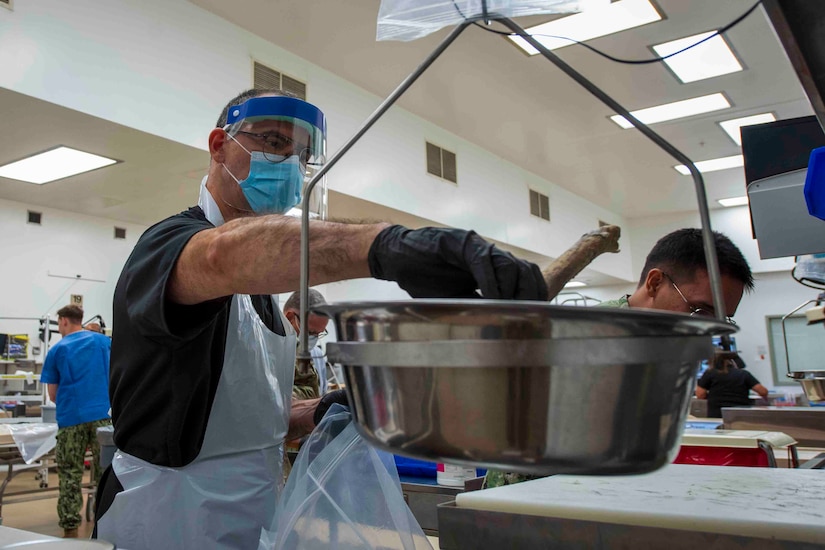
A man wearing a protective face shield and a plastic apron places human remains on to a scale. There is a man in the background also wearing a protective face shield taking notes and a man wearing a camouflage military uniform.

Since the discovery, members from numerous organizations have gathered every summer to search the glacier for more remains in Operation Colony Glacier, an effort to identify and bring home the men who perished. Among the organizations that are a part of the operation, the Armed Forces Medical Examiner System plays a crucial role.

For the past eight years, Carlos Colon, Armed Forces Medical Examiner System medicolegal death investigator, has been a part of the operation.

"So, 2017 was the first time I flew onto Colony Glacier," Colon said. "That trip was basically a site visit where we assessed a number of things. After that trip, we started discussions about the benefits of having somebody from AFMES being involved in the search and recovery."

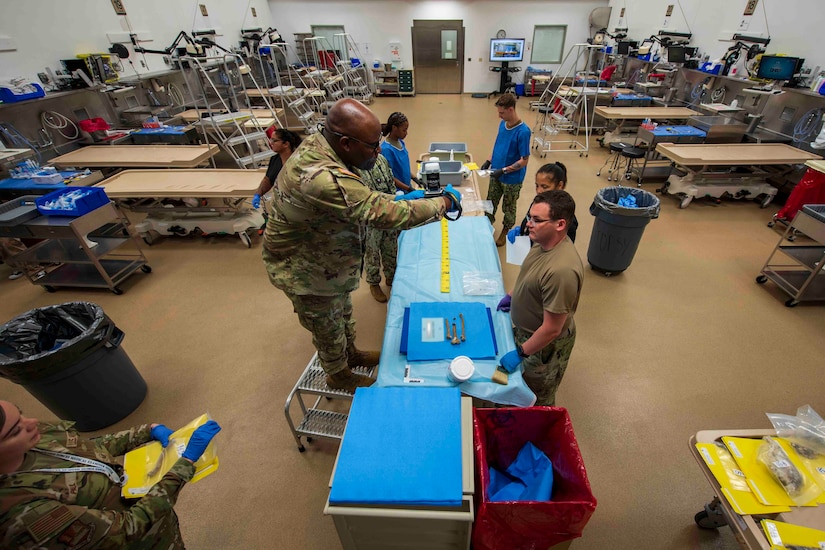
A man dressed in a camouflage military uniform and standing on a foot stool is taking a photograph of human remains. There are several others in similar attire watching or taking notes.

Colon was chosen to participate in the operation not only as subject matter expert on the identification and collection of remains, but also because of his background in search and recovery.

"As medicolegal investigators we have training in search and recovery and we do response to aircraft mishaps," Colon said. "A lot of our aircraft mishaps have highly fragmented remains. It can be difficult to discern those remains from things like rocks or wood, especially when they have been exposed to extreme elements for so long. By the time I went to Colony Glacier, I had already seen remains being sampled here at AFMES for two years, so I was already very familiar with what to look for out there."

Along with the type of knowledge that investigators like Colon bring, comes the continuity that is essential to an operation like Colony Glacier.

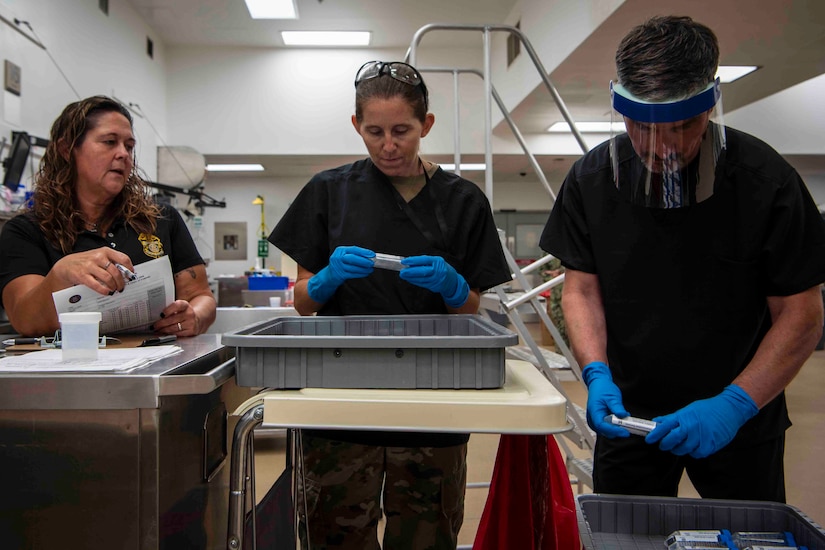
A woman at the center of the image dressed in black scrubs looks at human remains, as a man to her right in similar attire and wearing a protective face shield also looks at human remains, while a woman on the left also in similar attire takes notes.

"Most people on the team are only there for one year," Colon said. "Usually, the officers in charge of ground forces and the commander from the Air Force Mortuary Affairs Operations will have been on the team two years at max. So, we're [medicolegal investigators] really bringing that knowledge of not only what human remains look like, but also bringing insight on how remains are triaged, sampled and tested here at AFMES. It's extremely beneficial for the people on the ground to be speaking the same language as the people doing the sampling, and the DNA folks actually doing the testing because we're always thinking, 'how can we maximize our chances of getting new identifications?' Whether that be advising on refocusing efforts to find more osseous material, teeth or soft tissue, or concentrating on other locations that have samples we know will likely produce a good DNA profile. We are always thinking more about the identifications and the forensic sciences behind the recovery."

The glacier, however, presents a special set of challenges that make traditional recovery methods extremely difficult.

"With the glacier, everything is ephemeral," Colon said. "Things shift on the glacier and the glacier itself moves; it's basically a moving river of ice. We found pretty quickly that a lot of prior methods being used, which are typically really thorough and great for documenting a scene, documenting a recovery and knowing exactly where everything was found, were not working well and it's because those traditional techniques are for sites that are static."

New methods had to be employed along with a different mindset of how to navigate the recovery in this desolate and ever-changing landscape.

"Together, AFMAO and AFMES, realized that there has to be a little bit more urgency," Colon said. "AFMAO is primarily concerned with finding as many personal effects as possible and for AFMES, we want to get as many remains and samples as possible. So, we started refocusing our priorities on getting as many samples from different parts of the glacier with as much variety as possible, to hopefully increase the chances of making new identifications."

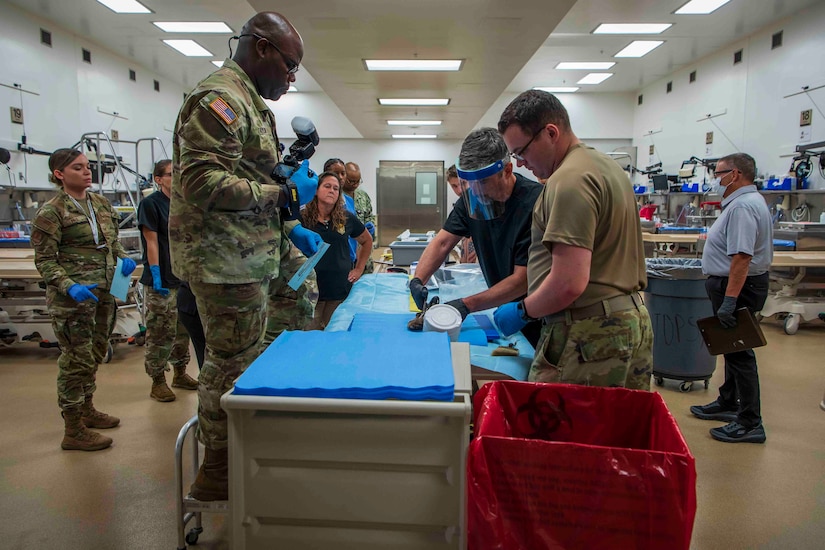
A man wearing a face shield, cuts open a boot as several people dressed in camouflage military uniforms or civilian attire watch in a laboratory setting. There is one man standing at an elevated position holding a camera.

This forensic approach has helped shape ongoing recovery efforts; everything from training, managing timelines and resources and bringing a new perspective to the operation as a whole.

"Before we even go out, I'll provide necessary training to our folks," Colon said. "I'll give presentations, show them what things look like, inform about what happens at AFMES post-recovery, how remains get to Dover, how our mortuary affairs specialists, medical examiners and medicolegal death investigators triage, photograph, sample and submit to DNA. I also provide summaries on adipocere, mummification, skeletonization and patterns of decomposition that are more relevant to what we see on the glacier."

This methodology means that time and resources are amplified to the fullest extent.

"We've lost a lot of the glacier," Colon explained. "It's very dynamic compared to a standard anthropological site, and the way we're operating now is more focused on knowing that we have limited amount of time and resources. We only have four weeks each year to conduct this recovery so we're always trying to get the most out of the time we have left with the debris field, because it's moving further down-glacier. Our goal is always to be more conscious of how we spend our time. We know if we are not efficient with our resources at the site, it will lead to our medical examiners and DNA technicians' time not being used properly back at AFMES. Having said that, every year our lab gets better, there is always a new process or new technology, so in the field we try and adjust and be more efficient and better every year as well."

The samples collected in the field are sent back to the AFMES where the Armed Forces DNA Identification Laboratory will compare extracted DNA against a robust database of family member references that have been gathered over decades. Family members can donate DNA samples through requesting a sample kit or attending a family member update or an annual government briefing hosted by the Defense POW/MIA Accounting Agency.

To date, 50 of the 52 fallen members have been identified. The 50th identification was made just this year.

Army Air Forces Airman 3rd Class James Ronald Kimball, a flight steward, a career field similar to a modern-day crew chief, was assigned as a crew member on the flight.

"This was a big deal," Colon said. "Kimball was the one that we were told we had very little shot of identifying because he had no family member DNA reference; he was adopted with no children. But what he did have was a very specific fingerprint pattern on his right thumb and what looks like a burn scar on his right index finger. Fortunately, we knew this because of the fingerprints that were on file."

Even more fortunate, his personnel files survived a devastating 1973 fire, which destroyed between 16-18 million official military personnel files in the National Personnel Records Center in St. Louis.

"During our second trip out there, I received a radio call from one of the team members, [Air Force 1st Lt. Mason] Tarkenton," Colon said. "They were searching a smaller debris field, that was not previously found, in the upper limits of our established area. He said 'Carlos, I found a right hand up here near what looks like a crew jacket,' and I was like 'there is no way,' because Kimball was the last crew member that was still missing. The hand was so well preserved that, once I got back to the morgue, I was able to send pictures to our fingerprint expert at the FBI, and within six hours they were able to make a positive ID. That was exciting; it was the fastest identification we've made."

Prior to the AFMES' involvement, 585 specimens were recovered for sampling over a period of five years. In the first five years of the AFMES' involvement, 4,520 specimens were recovered, with a total of 6,528 specimens recovered since 2017. This year alone, 373 samples were collected and accessioned for DNA testing in a record five days. Each year the team becomes more exact in carrying out this mission, as they strive to bring closure to families who have had to wait so long.

"We've had really great collaboration with our partners at AFMAO," Colon said. "We always go out there as Team Dover, and ultimately, we want the same exact thing, which is for all of the members on board to be accounted for."

Joint Service Teamwork Forged During Exercise Sage Eagle

Army Green Berets and supporting elements assigned to the 3rd Special Forces Group teamed with security forces airmen from the Air National Guard for Sage Eagle 25-4, a joint training exercise designed to enhance the services' interoperability and readiness, conducted in late August.

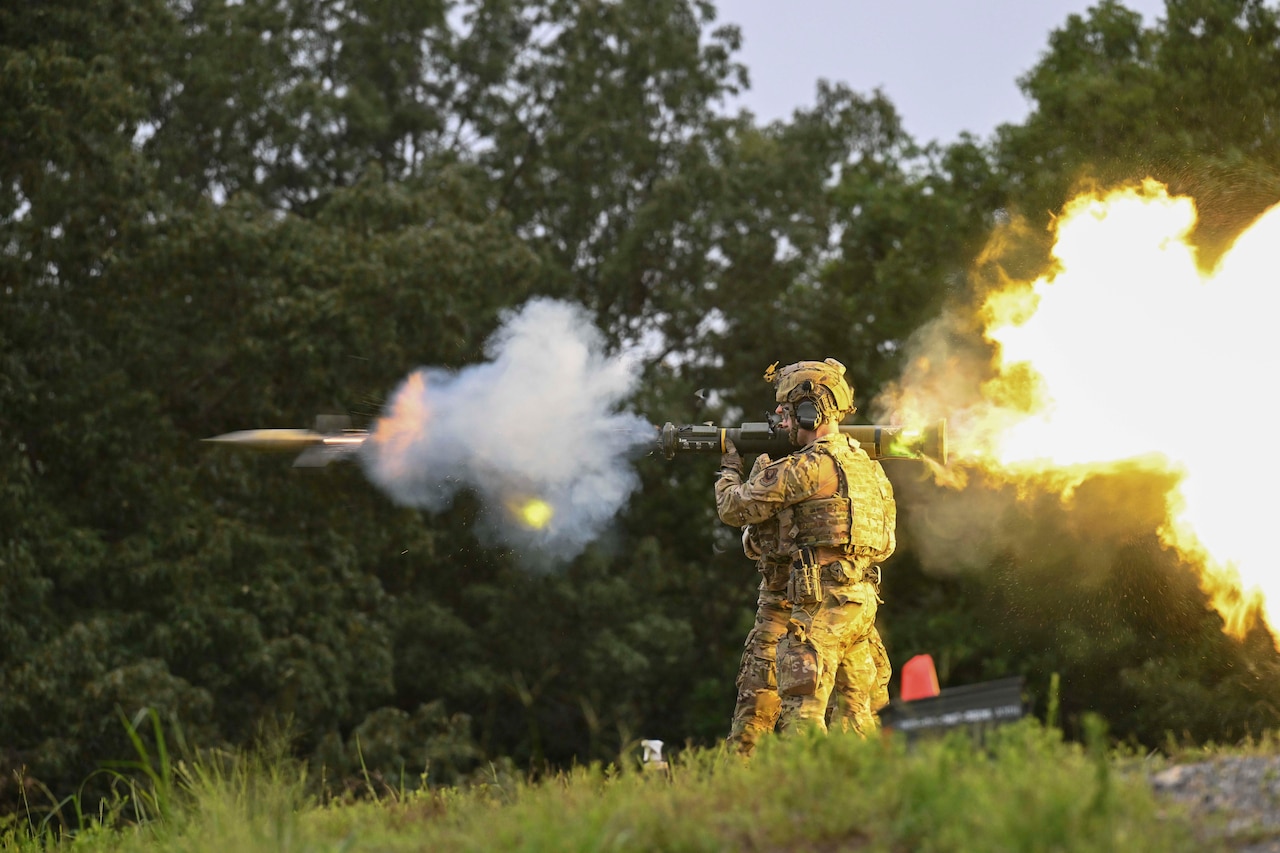
Two service members wearing camouflage stand close to each other as one fires a shoulder-launched missile that creates smoke in front and fire behind the launcher.

With a focus on small-unit tactics, joint mission planning and advanced combat scenarios, the training at Fort A.P. Hill, Virginia, aimed to better prepare special operations forces and the Air National Guard for real-world missions that reinforce their ability to jointly operate in diverse operational environments. 
 
Sage Eagle 25-4 commenced with weapons familiarization, pairing soldiers and airmen in a series of classes that built a foundational understanding of weapons handling and functions. Green Berets trained the airmen on multiple weapons systems, including the M320 grenade launcher and the M249 squad automatic weapon.  

Weapons training culminated in an M4 rifle qualification range before transitioning into advanced tactical training. From dawn to dusk, airmen repeatedly conducted realistic training simulations in small-unit tactics, including close-quarters battle drills, ambushes and raids, immersing them in the demanding tempo of special operations.  

"I think it's great to see the different ways that the Green Berets teach things, for example, room clearing," said Air Force Airman 1st Class Leann Minnick, a security forces airman assigned to the 193rd Special Operations Security Forces Squadron. "They taught us many ways to do it that I'm generally not trained to do, so I could bring that back to my unit." 
 
Following multiple days of weapons training, teams entered a five-day field environment, plagued with rugged terrain and dense vegetation, which challenged even the most experienced service members.  

Limited access to supplies and the need for covert movements through rugged landscapes added another layer of complexity to the training, requiring teams to adapt quickly or risk mission failure. Following days of training from the Army's elite, airmen applied what they learned to plan and execute simulated raids and ambushes, evading a multitude of different enemy threats to complete the mission. 

"[The Green Berets] are experts at detail, which is what it boils down to," said Air Force Tech. Sgt. Jason Tartaglia, a security forces airman assigned to the 166th Security Forces Squadron. "And that's really what makes them so great. Just thinking outside the box or looking at something from a different angle makes a huge difference." 
 
The training culminated in a realistic joint forcible entry exercise, leveraging the unique skills of each service in a mission to capture a high-value target. Soldiers breached the compound under simulated hostile fire, systematically clearing each floor of enemy threats and overcoming tight stairwell fighting positions, barricaded rooms and simulated casualties on every level.
 
While Green Berets maneuvered throughout the compound, the Air National Guard security forces secured the exterior of the compound, facing unruly crowds and demonstrators. Leveraging their training, the security forces mitigated all potential threats, enabling both services to seamlessly withdraw. 
 
Sage Eagle isn't just tactical training; it's a crucible for joint force integration. The exercise honed critical skills in cross-service communication, adaptive planning and mission execution in complex environments. Participants gained instrumental insights, directly enhancing current operations and fortifying readiness for future challenges. 
 
"This training pushed us to our limits, but that's how we get better," Minnick said. "When we walk away tired, dirty and more capable than before — we know it was worth it."

Wednesday, September 10, 2025

Marines Test Drone Systems During Defense Innovation Unit Challenge

Sept. 10, 2025 | By Marine Corps 2nd Lt. Logan Tompkins, I Marine Expeditionary Force

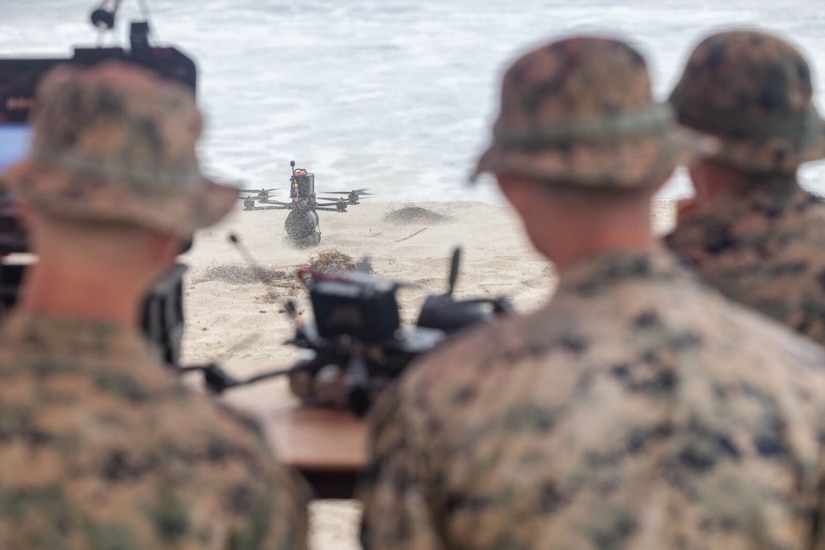
Marines assigned to I Marine Expeditionary Force partnered with the Defense Innovation Unit and industry leaders during phase two of the DIU's Project GI challenge to evaluate commercial small unmanned aerial systems in realistic operational environments, Aug. 18-29. 

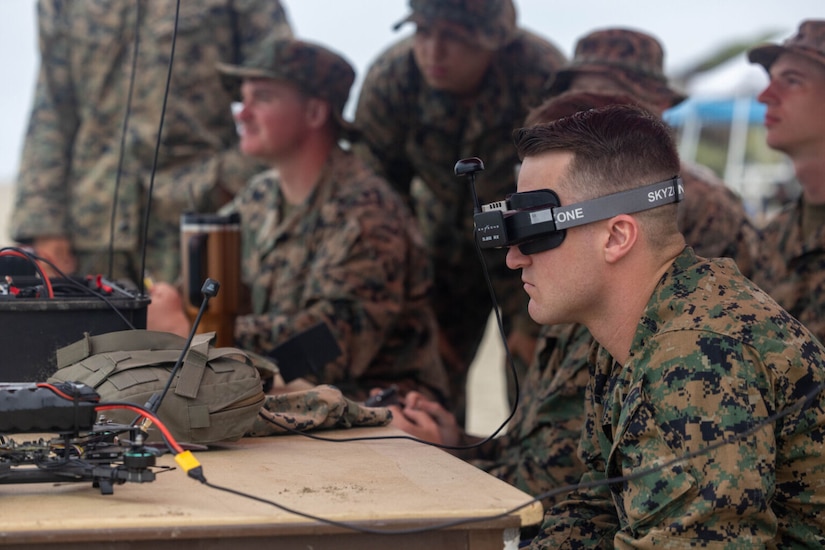
A person wearing a camouflage military uniform wears a headset to monitor an unmanned aerial system that is not pictured. People wearing similar attire are in the background, also looking at something not pictured.

The 12-day event brought together Marines assigned to 1st Marine Division — including operators, leaders and subject matter experts — to test vendor-loaned systems across multiple ranges. The training period included four days of Marine-led familiarization, followed by six days of scenario-based demonstrations. Assessments will directly inform War Department procurement decisions and accelerate the integration of resilient, cost-effective small UASs into the joint force. 

"The GI challenge puts our Marines at the center of capability development. Their expertise, combined with the innovation of our industry partners, is shaping the next generation of unmanned systems," said Marine Brig. Gen. Michael Nakonieczny, deputy commanding general of I Marine Expeditionary Force. "I MEF is proud to play a leading role in advancing technologies that directly enhance the lethality and survivability of our Marines." 

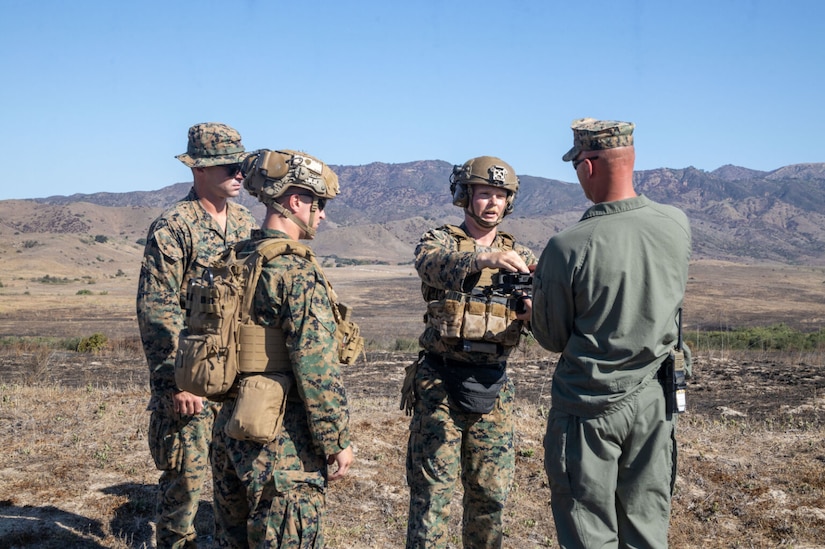
Four people wearing military uniforms stand outside in a desert environment with mountains in the background. Two look on as the person in the middle hands a small, black drone to the person standing the furthest right.

Marines evaluated systems against operational criteria, including setup, deployment time, weatherproofing, payload capacity and performance across varying terrain and climates. Evaluations emphasized how each system affected tactics, techniques and procedures during realistic combat scenarios. 

"Robotics are revolutionizing the battlefield, and it's no secret that first-person-view drones have become one of the most lethal and disruptive weapons worldwide," said Marine Maj. Steven Atkinson, I Marine Expeditionary Force DIU event lead planner. "Our mission is to ensure America's warfighters get the very best, battle-tested technology so they can be effective anywhere in the world." 

The challenge represents the second phase of a three-part competitive selection process. Phase one involved an initial screening in which the DIU reviewed vendor proposals and chose the most promising systems for further testing. Phase two brought those selected vendors to Marine Corps Base Camp Pendleton, California, for hands-on evaluation by the I Marine Expeditionary Force. A final phase three round will determine which systems advance to procurement, with winning platforms expected to be added to DOW's "Blue UAS Cleared List" — drones compliant with current law and policy, validated as cybersecure and available for DOW purchase and operation — by March 15, 2026. 

"Bottom-up refinement is something the Marine Corps has always valued. The ability for dedicated [noncommissioned officers] to test, stress and provide input on these products is exactly what was needed for this project and the service," said Marine 2nd Lt. Kienan Morrissey, an intelligence officer assigned to 3rd Light Armored Reconnaissance Battalion who participated in the evaluation of the vendor-loaned small UAS platforms. 

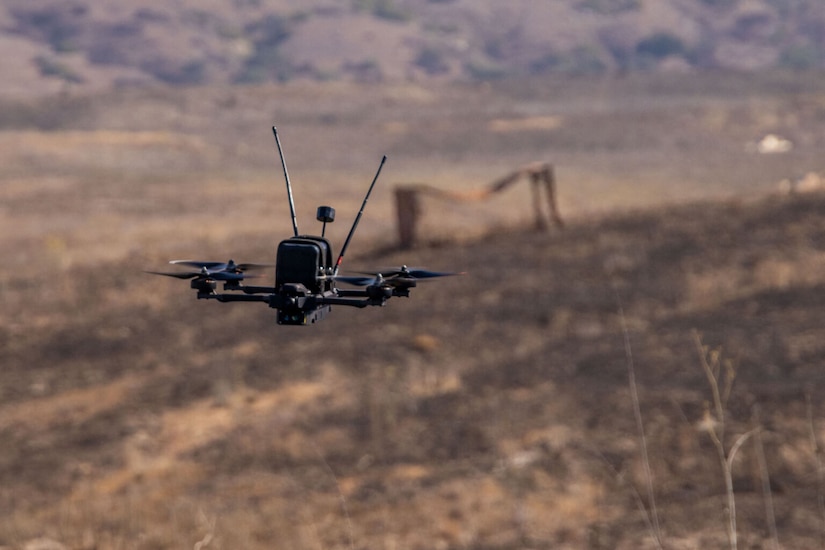
A small, black drone hovers over a desert landscape.

Marines stress-tested the systems in contested environment simulations, focusing on modern kill chain operations and first-person view effects capabilities. Vendors were required to provide at least three prototypes for testing, though some platforms received exemptions due to design characteristics or employment concepts. 

Following evaluations, Marines conducted detailed debriefs to capture feedback that will guide procurement and influence future small UAS capability development across DOW. Units within I Marine Expeditionary Force will continue working with selected systems beyond the challenge to provide additional recommendations for improvement. 

People wearing camouflage military uniforms look toward multiple small drones in a desert environment.

The DIU's Project GI challenge represents one of the Marine Corps' largest field-based industry engagements, focusing on emerging drone technology and directly supporting modernization priorities identified by Marine Corps and Pentagon leaders for operations against peer adversaries. 

"Events like these ensure our Marines will have the best available tools at their disposal in the next conflict," Morrissey said. 

Tuesday, September 09, 2025

JTF-DC Medic Doubles as Third-Year Medical Student so Others May Live

 Sept. 9, 2025 | By Army Master Sgt. Whitney Hughes, National Guard Bureau

Not many people can say their interest in one of the body's most complicated organs began with a water pump. 
 
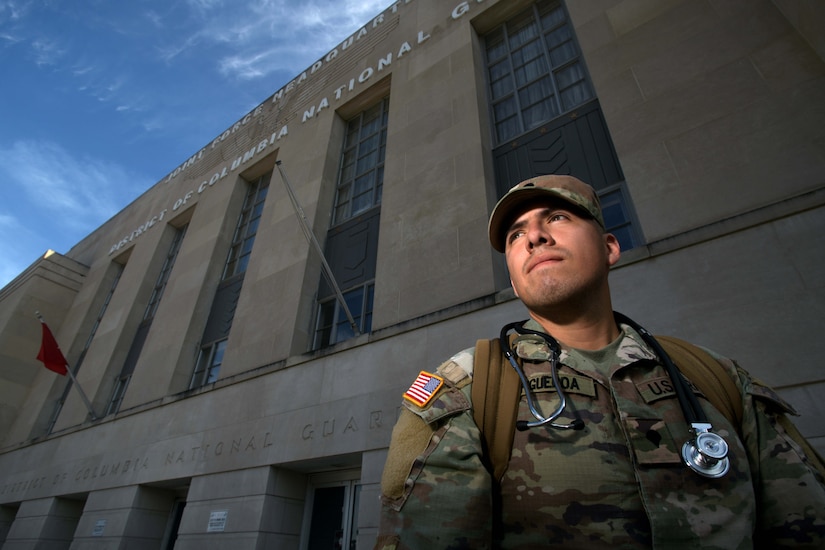
However, for Army Spc. Elias Figueroa, a combat medic assigned to the D.C. Army National Guard and third-year medical student, his interest in medicine began with helping his father install a water pump. His inherent understanding of the pump system and the similarities he drew to the human cardiovascular system are what drew him to the field. 

A person wearing a camouflage military uniform stands outside in front of a building and gazes up into the distance.

 
"Just understanding the pump systems, the math made sense and the picture made sense in my head," said Figueroa, adding that it converted so well in his first two years of medical studies that he was tutoring other students. 
 
This same curiosity and hands-on approach drove him to join the Army National Guard as a combat medic and led to his current assignment with the D.C. Safe and Beautiful Task Force, Joint Task Force District of Columbia. He initially joined the National Guard in 2020 and qualified as a combat medic upon graduating from an intense 16-week course focused on emergency medical technician, emergency medical services and tactical combat casualty care training. 
 
Since being on duty with the task force, his duties have included treating fellow soldiers and responding to several incidents involving civilians. 
 
His squad leader, Army Sgt. Jay Whited, said Figueroa's experience and skill set have been invaluable in many of the situations they have encountered. 
 
"He's treated at least half a dozen civilians at Union Station since the mission started," Whited said. "We are very lucky to have such a well-trained medic. He's right there, and he's pretty close to being a doctor, so that makes us feel good. It's good for him. It's an actual medical emergency in public that he can get his hands on and do something about." 
 
While assigned to the task force, Figueroa has provided hands-on treatment or assessments for everything from a heat casualty to a narcotic overdose. He said experience like that gives him an advantage going into his third year of medical school, where studies move from the classroom to practical application with patients. 
 
"A lot of us [medical students] kind of fumble to the point to where some people repeat a semester because they just can't do the clinical part," Figueroa said. "So, I've been able to kind of hone my abilities a little bit. I'm a little more confident. I was like, 'Oh, I can do that. I can take vitals without even hesitating. I can go through an assessment.'" 
 
Despite the added confidence, he doesn't take the gravity of his position lightly. 
 
"It's a responsibility," Figueroa said. "You can't freak out. You have to keep a level head and relax. For all those events, when someone yells 'Medic!' I'm calm as heck, I don't overreact." 
 
He said he often reminds himself to begin with the basics to stay calm as he assesses and reassures the patient. 
 
"And that's kind of the first thing that comes to mind is just relax and do the job," Figueroa said. 
 
For the 28-year-old, medicine goes beyond a job to a spiritual and moral code. When he "found Christianity and God" during college, Figueroa asked himself what his strengths were and how he could use them to serve others. That also tied in with a duty he felt as a naturalized citizen to serve his country. 
 
His family emigrated from Peru, and he and his parents became American citizens in 2011. 
 
"My dad got citizenship that January, and I got it through him, because I was still a minor," Figueroa said. "I always felt I didn't really earn it. My dad took the test. My dad did all this work. So, part of me was like, I want to actually earn this." 
 
His family started off in an apartment, and now they own three properties — one of which is the house where he helped install the water pump that inspired his interest in cardiology, he noted. 
 
"This country gave us a lot, it's kind of like the American dream showed itself," Figueroa said, who will conclude his time with the D.C. task force in two weeks to return to his role as a full-time medical student. 

Monday, September 08, 2025

Medal of Honor Monday: Army Pfc. Ernest Prussman


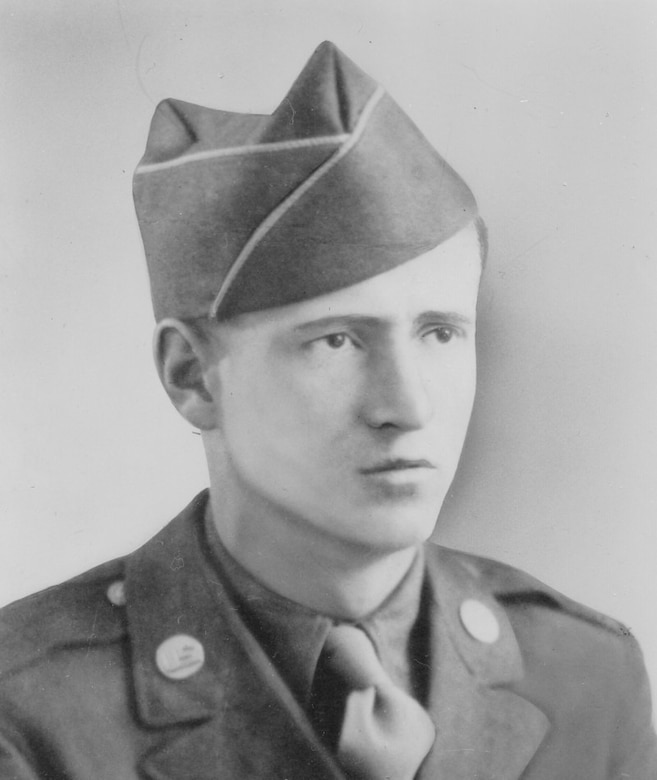
Army Pfc. Ernest William Prussman fearlessly led his squad into battle as the Allies pushed into Europe to free the continent from tyranny during World War II. Prussman didn't survive the mission, but his bravery demoralized the enemy and helped several battalions move forward. For his actions, Prussman was awarded a posthumous Medal of Honor. 

A man wearing a military uniform poses for a photo.

Prussman was born Sept. 15, 1921, in Baltimore, Maryland, to Herbert and Helen Prussman. He had a twin brother named Earl. Two other brothers, Calvin and Henry, also served during World War II.  

When Prussman was 5, his family moved to Brighton, Massachusetts, outside of Boston, where he grew up and graduated from Brighton High School.  

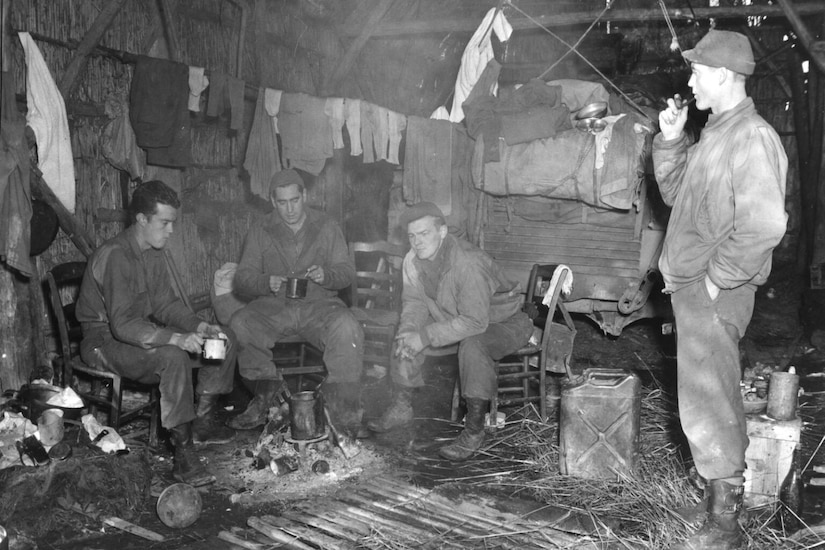
Prussman worked as a chain store clerk before joining the Army in October 1942. In July 1944, weeks after the Allies had regained a foothold on the European continent, Prussman's unit, the 13th Infantry Regiment, 8th Infantry Division, was sent to France. 

Three men sit in chairs in a shed filled with gadgets. A fourth man stands, smoking a pipe.

Two months later, Prussman gave his life in the fight for freedom.   

On Sept. 8, 1944, Prussman was with two battalions moving through the northwest Brittany region of France when their advance was halted by intense enemy mortar, machine gun and sniper fire. The assault was coming from an enemy fortification on Prussman's left, so he quickly prepared his squad to assault that position. 

Prussman took the lead and hurdled a hedgerow before disarming two enemy riflemen. He then led his squad across an open field to another hedgerow before advancing to a machine gun position, destroying the gun and capturing its crew and two additional enemy riflemen.  

Prussman continued to move ahead of his squad. This time, however, he was mortally wounded by an enemy bullet. But before he fell to the ground, he was able to throw a hand grenade, which killed one more enemy fighter.  

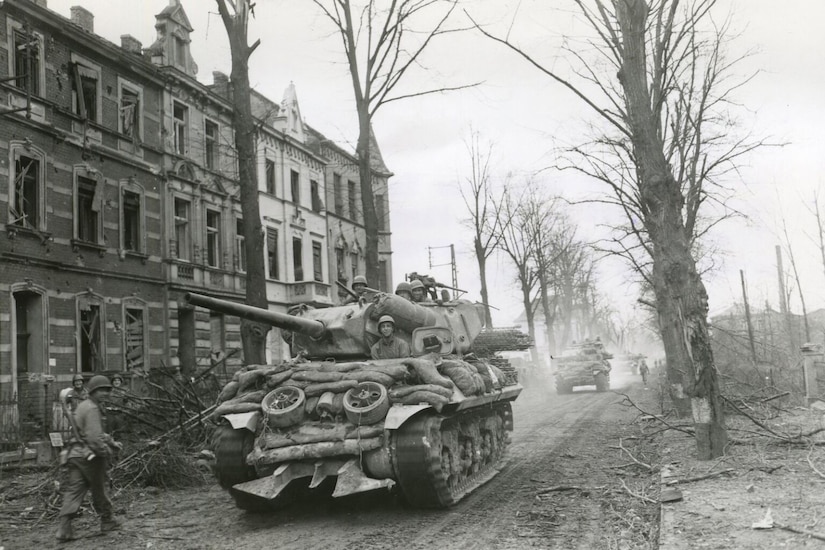
A tank rolls along a dirt road in a destroyed city.

While Prussman didn't survive, his leadership and heroic actions demoralized the enemy enough that their resistance collapsed, which allowed the Allied battalions to continue their march.  

On April 19, 1945, Prussman's parents and twin brother accepted the Medal of Honor on his behalf from Army Maj. Gen Sherman A. Miles during a celebration in Boston. Prussman also received the French Croix de Guerre with Bronze Star for his selfless actions. 

Prussman is buried in the Brittany American Cemetery in St. James, France.  

The young private has not been forgotten. At Army Garrison Rheinland-Pfalz in Germany, Prussman Avenue was named in his honor. A Medal of Honor monument was also established in Boston in 2016 in remembrance of his legacy. 

This article is part of a weekly series called "Medal of Honor Monday," in which we highlight one of the more than 3,500 Medal of Honor recipients who have received the U.S. military's highest medal for valor. 

EPA Partners With Local Farm to Fight Food Waste, Support Military Families

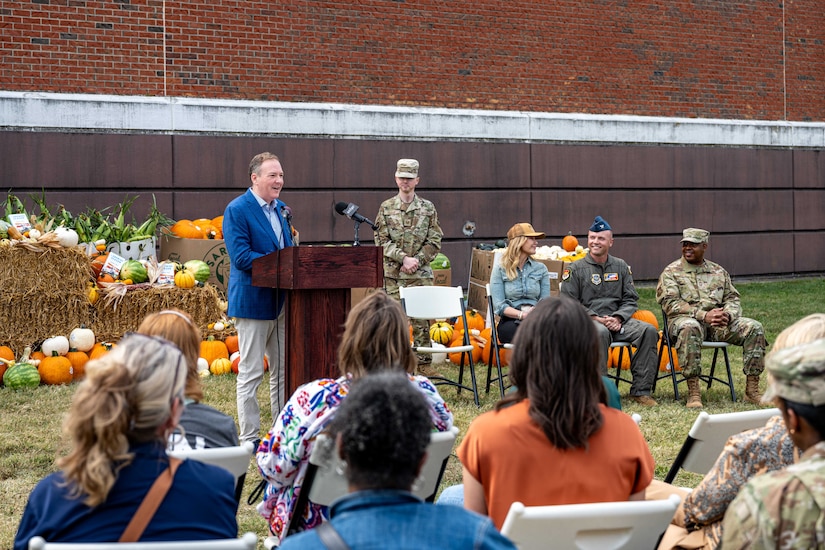
Last week, Lee Zeldin, an administrator with the Environmental Protection Agency, joined forces with a local farm to bring over 20 pallets of produce to Scott Air Force Base, Ill., as part of a nationwide collaboration to reduce food waste. 

A man in business attire stands at a lectern and speaks to a crowd. There is a person in a camouflage military uniform standing to the right of the lectern and two people in military uniforms and one in casual attire sitting to the right of the lectern. There are pumpkins and other produce displayed in the background.

Airmen and their military families on base were treated to hundreds of free watermelon, corn and pumpkins and watermelon juice under the EPA's "Feed It Onward" initiative to connect farmers with nearby military installations to share their bounty with those who serve.

As a retired Army officer himself, Zeldin first expressed his thanks to "the line of patriots" and their families, as well as retirees who were in the audience for the event.    

"I'm thinking about their collective service and stories of sacrifice … at times holidays, anniversaries and birthdays missed. The decision to serve in our military may be difficult for some … and for those who continue to raise their hand [to serve] is something for the rest of America to take a step back and reflect on, maybe every day of our lives," he said. 

"Everything we cherish about being able to live in the greatest country in the history of the world is all made possible because of the men and women who answer the call to defend our freedom, our liberty. I'm honored to be able to say thank you for your service." 

He shared how the collaboration came about when addressing the amount of food that is wasted in this country and how it needs to be cut down. He cited an EPA study about the cost of food waste to each American consumer being about $728 per year.  

Two people in casual attire shake hands while standing in front of boxes of produce. There is a man in a military uniform to the left and other people in casual attire talking and congregating in the background.

The Feed It Onward program, which is also part of the country's 250th birthday celebration next year, seeks to connect food donors with communities in need while reducing the environmental impact of food waste in landfills.    

Zeldin said he believes today's event will serve as an inspiration for other farms across the nation to partner with the Department of War to ensure that this food goes to good use instead of landfills. From the event last week, he said, "we can all serve as ambassadors" to talk about the many ways to address and solve this issue. 

Sarah Frey, chief executive officer of the farm, is one of those passionate ambassadors who brings a depth of understanding about this issue. What started as a small truck route at age 16 has grown into a multi-state operation and a supplier to major retailers. Her business is located about an hour and a half east of the base, and while they grow all types of fresh fruits and vegetables, they are the nation's leading producer of pumpkins.   

With the amount of acreage she manages, Frey said she sees firsthand the amount of food that gets wasted — at the consumer and the farm level.  

She told the audience that when they take their "perfectly delicious melons home," to just remember that it was rejected at the grocer because it wasn't the right size or had a small imperfection according to their retail standards. So, the waste, she emphasized, has nothing to do with the quality of the product, but something else. 

A woman in casual attire stands at a lectern and speaks to a crowd. A display of produce is in the background.

"This food is so good and nourishes our body, and it kills me to see so much go to waste," she said. "Through Feed It Onward, I feel we have an opportunity to connect the military bases across the U.S. with farmers, and to get fresh food to our military heroes, [and] for this to be an incredibly successful partnership that will ultimately reduce the amount of food that is wasted in our country." 

On behalf of the men and women at team Scott, Air Force Col. Matt Collins, 375th Air Mobility Wing and installation commander, thanked the EPA and the farm, as well as those who worked behind the scenes to bring this fresh "fall-themed" produce to the base. 

"This exemplifies the selfless collaboration for which team Scott is known and highlights the amazing relationship our installation enjoys with our local community. We deeply appreciate their commitment to our service members and their families."  

Air Force 1st Lt. Colton Stanislawski, 458th Airlift Squadron, added, "I can't think of a better way to use the produce that doesn't fit the bill at the grocery stores. It's obvious there's a huge demand for it, and for it to go to waste would be quite a shame. As we see here, it only took about 15 minutes for it to pretty much be gone … so this is great." 

Saturday, September 06, 2025

Premier Army CBRNE Command Supports Ulchi Freedom Shield in South Korea

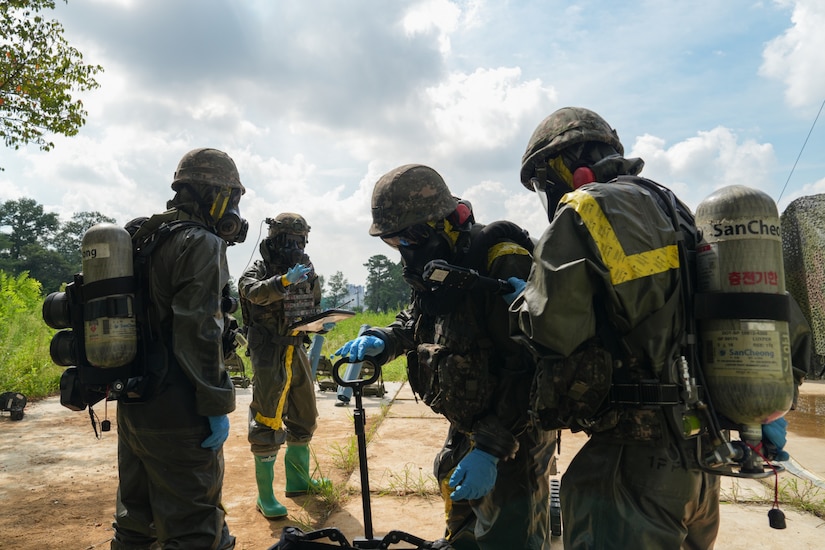
The U.S. military's premier joint task force-capable chemical, biological, radiological, nuclear, explosives formation participated in exercise Ulchi Freedom Shield 25 in South Korea, Aug. 18–28.

Soldiers and Army civilians assigned to the 20th CBRNE Command's early entry command post exercised with 8th Army and Combined Forces Command units on the Korean Peninsula and employed capabilities from their home station located at Aberdeen Proving Ground, Maryland. 

"It is always an honor to train together with our South Korean partners," said Army Brig. Gen. W Bochat, commanding general of the 20th CBRNE Command. "For more than seven decades, American soldiers have proudly defended liberty with our South Korean allies on freedom's frontier. This exercise is another chance to make one of the world's strongest alliances even stronger." 
 
Ulchi Freedom Shield 25 is a defense-oriented exercise, featuring live-fire, constructive and field training exercises that engage allied forces and governmental agencies. The training is focused on conducting all-domain operations. 
 
The annual exercise enhances the combined, joint, all-domain and interagency operating environment and the South Korea-U.S. alliance's response capabilities. 
 
Soldiers and Army civilians assigned to the 20th CBRNE Command deploy from 19 bases in 16 states to confront and defeat the world's most dangerous hazards in support of joint, interagency and multinational operations.

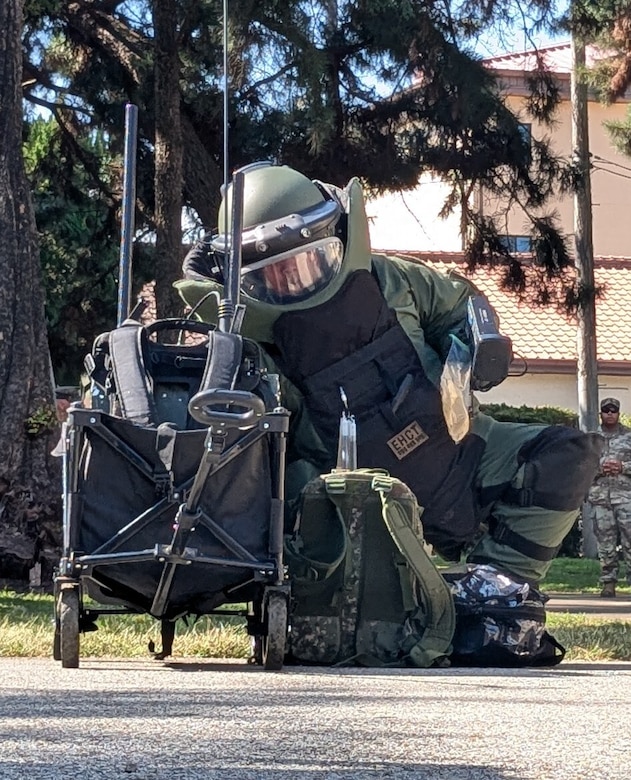
A soldier in a protective bomb suit crouches on the ground next to a backpack and roller cart. There are trees and a building in the background.
Headquartered at Aberdeen Proving Ground in northeast Maryland's science, technology and security corridor, the 20th CBRNE Command is home to the majority of the active-duty Army's CBRN specialists and explosive ordnance disposal technicians, as well as the 1st Global Field Medical Laboratory, CBRNE Analytical and Remediation Activity, weapons of mass destruction coordination teams and nuclear disablement teams. 
 
Members routinely deploy to South Korea for exercises, and the command also deploys a chemical company to support rotational forces during deployments to the Korean Peninsula.
 
The Fort Hood, Texas-based 181st Chemical Company is serving in South Korea on a rotational deployment in support of the 23rd CBRN Battalion, 210th Fires Brigade, 2nd Infantry Division/ROK-U.S. Combined Division and 8th Army. 
 
During their second deployment to South Korea in three years, the 181st Chemical Company is serving near the Korean Demilitarized Zone, the world's most heavily guarded border. 
 
The 181st Chemical Company is part of the 2nd CBRN Battalion, 48th Chemical Brigade and 20th CBRNE Command.

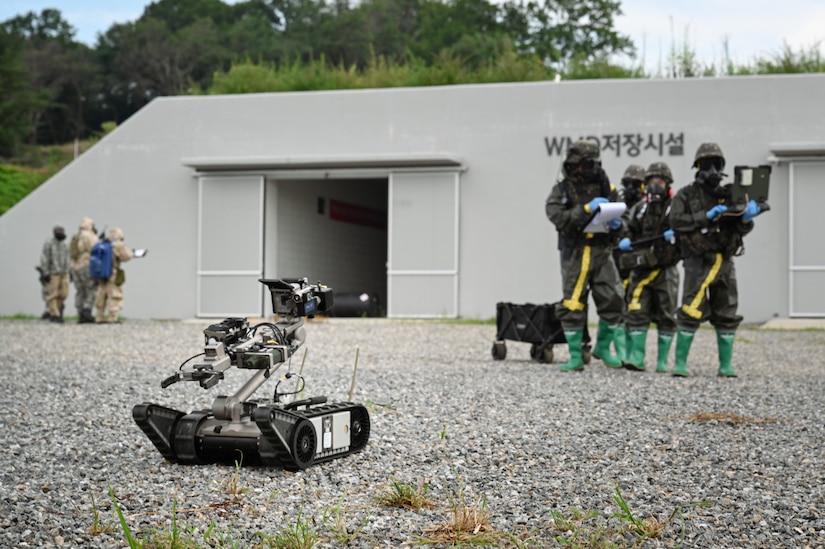
A bomb robot is rolling on the ground as four soldiers wearing camouflage military uniforms and personal protective equipment stand in the background holding laptops and other equipment. There is a large gray facility behind the soldiers.

 
Army hazardous response companies conduct CBRN reconnaissance, surveillance and decontamination operations in support of conventional and special operations forces around the world and provide support to civil authorities across the nation.

Friday, September 05, 2025

Kentucky Air Guard Special Tactics Airmen Test Maritime Skill in Caribbean

A squadron of special tactics airmen from the Kentucky Air National Guard completed a grueling five-day exercise, Aug. 30, testing their ability to perform a broad spectrum of operations in a maritime environment while responding to an enemy threat. 

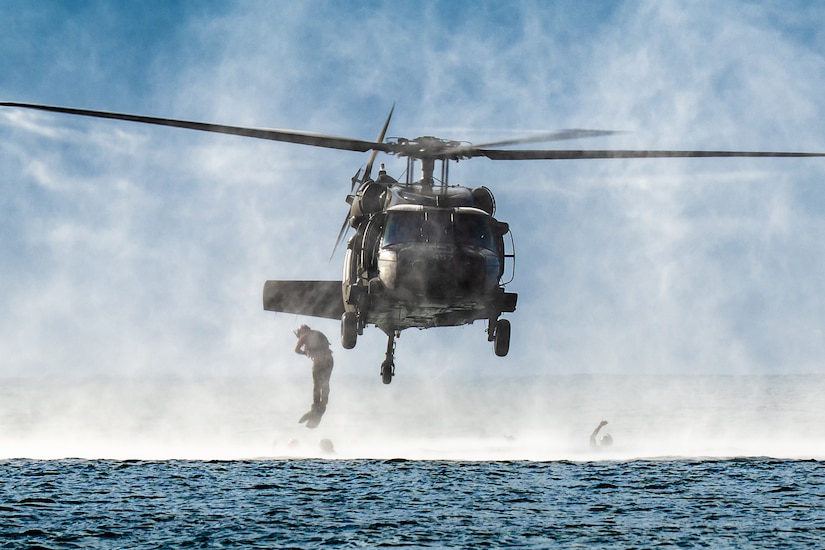
A person jumps from a military helicopter into a body of water. The sky is blue, with clouds and a smoky mist rises above the water.

 
The airmen, including combat controllers, pararescuemen and special reconnaissance troops, operated from the island of St. Croix, U.S. Virgin Islands, to conduct land, sea and air missions with fixed- and rotary-wing aircraft as part of Exercise Emerald Warrior 25.2, according to the special tactics officer who served as lead planner. 
 
"Our airmen exercised their unique skill sets to parachute into contested territory, establish airfield operations, control aircraft, respond to search and rescue scenarios, manage notional medical evacuations and conduct reconnaissance and targeting operations on a very tight timeline," the officer said. 

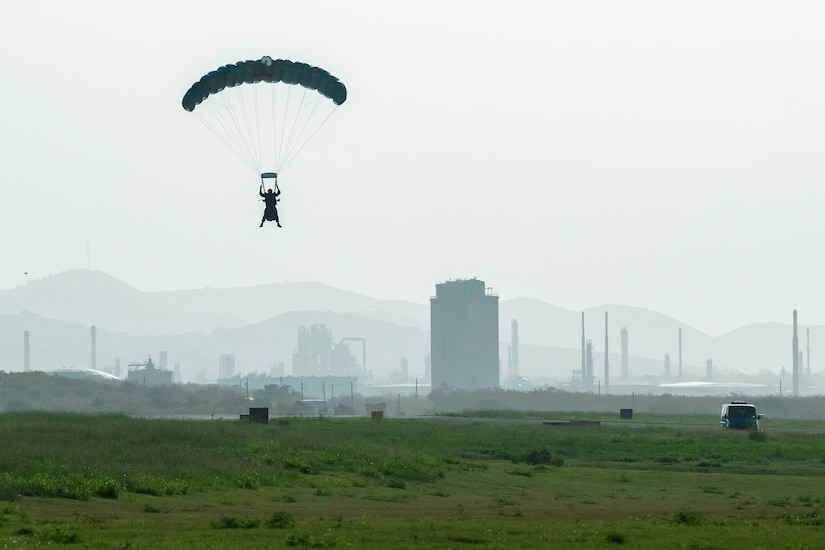
The silhouette of a person hanging from a parachute and landing in a green grassy field with buildings and mountains in the background.

 
St. Croix and its neighboring islands provided an ideal training environment, he added. 
 
"Operations in the Caribbean simulate many of the geographical features our forces may encounter when deployed around the globe," he said. "Having to overcome the kinds of challenges presented here will make us a more lethal and effective force the next time we conduct littoral operations anywhere in the world." 
 
The St. Croix event was just one piece of Emerald Warrior, a large-scale special operations exercise staged in multiple locations by Air Force Special Operations Command to train special operations components, sister services, interagency and partner forces. The exercise simulates missions for a theater campaign to support combatant commanders operating in a volatile environment against strategic competitors. 

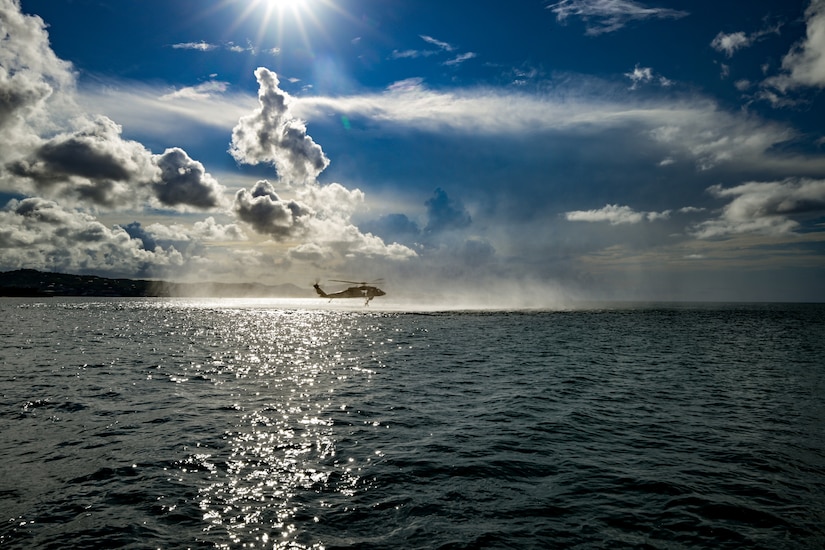
Mist rises from a body of water as a military helicopter hovers over it. The sky is blue with clouds, and the sun shines above the aircraft, creating a glow in the water below.

 
A key focus was an agile combat employment exercise, meant to advance the ability to project air power in complex, unfamiliar or contested environments while working from distributed locations with limited support, the officer said. 
 
The exercise, staged and executed by forces from the Louisville, Kentucky-based 123rd Airlift Wing, kicked off Aug. 26 when six special tactics airmen parachuted into the Caribbean Sea with an inflatable boat, 3 miles off the shore of St. Croix, from a Kentucky Air Guard C-130J Super Hercules. Eleven more combat controllers and pararescuemen then jumped directly into Henry E. Rohlsen Airport from the same aircraft, with both forces combining to take control of the airfield. Within minutes, the airmen had cleared the runways, established perimeter security and implemented air traffic control, allowing the C-130 to land and offload crucial assets. 

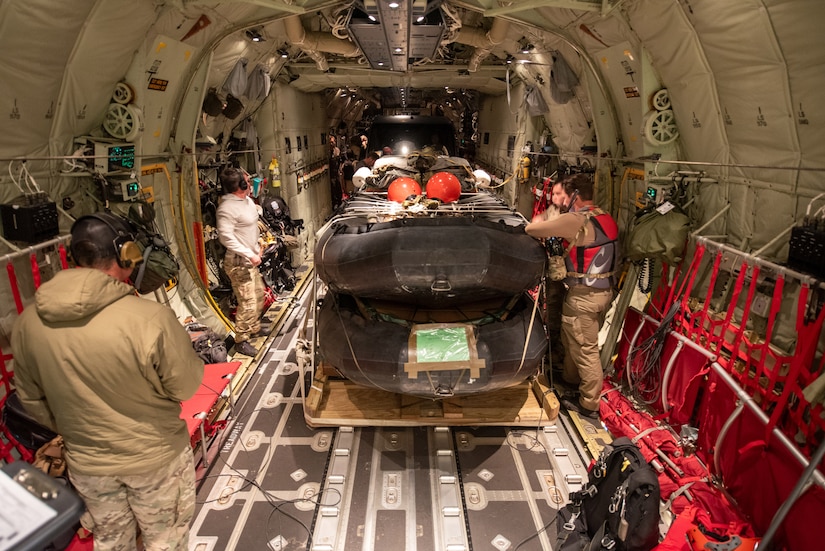
A group of people wearing brown military uniforms prepare to airdrop a boat from the inside of a military aircraft.

 
In another mission, spanning two days, a group of airmen traveled 75 nautical miles by boat to conduct reconnaissance and targeting operations on a nearby island held by simulated enemy forces. 
 
Two other scenarios tested the squadron's ability to conduct search and rescue operations and provide medical care in challenging environments. 

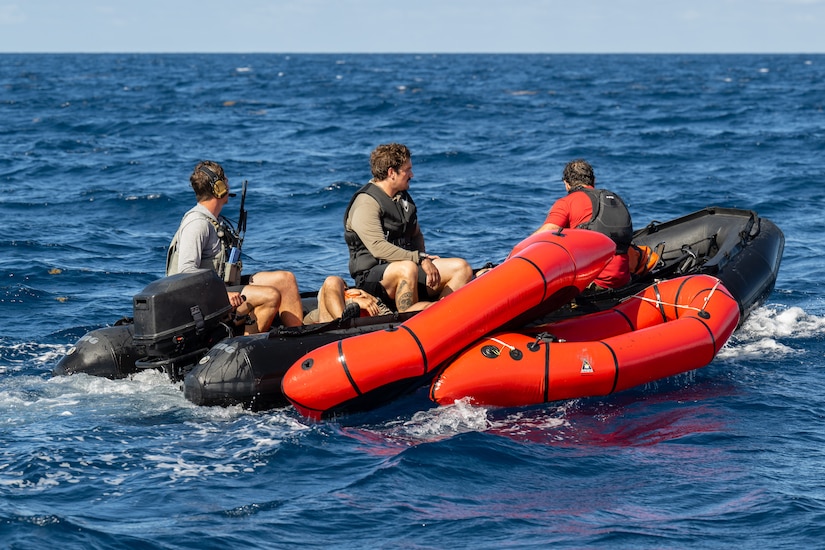
Three people sit in an orange and black life raft in the ocean.

 
In the first event, six pararescuemen and combat controllers were tasked with finding survivors floating in life rafts on the open ocean after their plane crashed at sea. Over the course of a 32-hour scenario, the airmen located the victims while flying over the crash site in a C-130J, parachuted into the ocean with two inflatable boats, provided on-scene medical care and controlled medical evacuations via helicopter hoist operations. 
 
"This was a particularly demanding scenario designed to test both the rescue capabilities and the survival skills of our airmen on the open ocean," the planner said. 

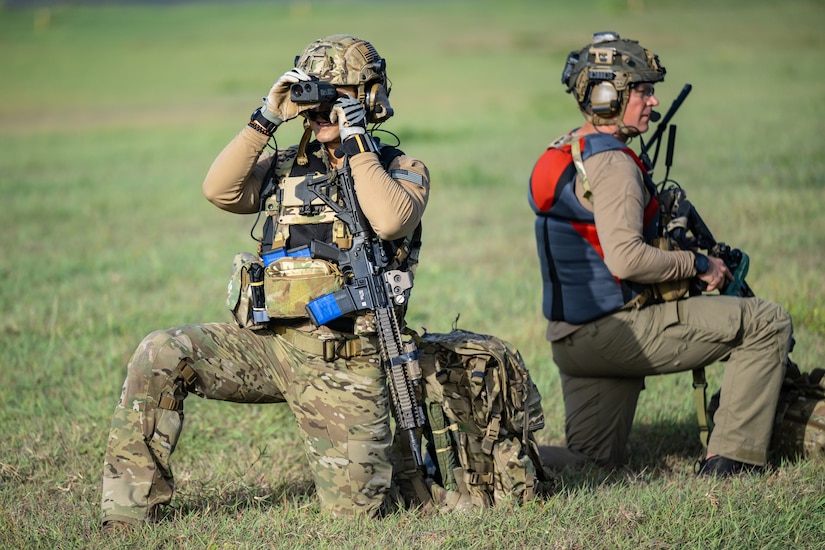
Two people wearing camouflage military uniforms kneel in a grassy field facing opposite directions. Both have weapons, and one is holding binoculars.

 
Other training included exfil and infil operations on land and sea from UH-60 Black Hawk helicopters, provided by the Mississippi Army National Guard's 185th Aviation Brigade, as well as a mass casualty exercise involving civilians wounded by an industrial accident. In that event, airmen were required to triage patients, provide battlefield medical care and control their evacuation via Black Hawk helicopters from the Virgin Islands Air National Guard Station. 
 
Such complex operations required coordination with numerous entities, the planner said, including the U.S. Coast Guard; the U.S. Virgin Islands Governor's Office, Police Department and Air National Guard; officials at Henry E. Rohlsen Airport; local marinas and dozens of area businesses. 

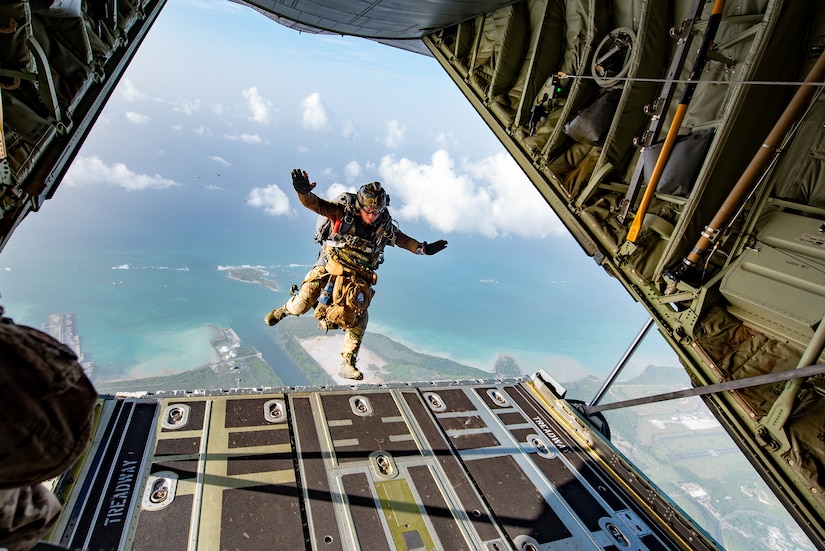
A man wearing a camouflage military uniform and parachute equipment jumps from a military aircraft. The rear of the aircraft is in front of him, and behind him is a blue sky with clouds.

 
The exercise also relied on essential capabilities provided by the squadron's combat mission support team, including radio technicians, diving gear specialists, parachute riggers, vehicle maintenance troops and administrative specialists. 
 
"An exercise of this scope, which has been in the planning stage for over a year, would not have been successful without the combined efforts of everyone involved, from our combat support troops to the governor's office to local citizens who were so supportive of our efforts to ensure our nation's security." 

Wednesday, September 03, 2025

Air National Guard Medics Train Under Pressure for Real-World Combat Casualty Care

 Sept. 3, 2025 | By Air Force Senior Master Sgt. Julie Avey, 168th Wing

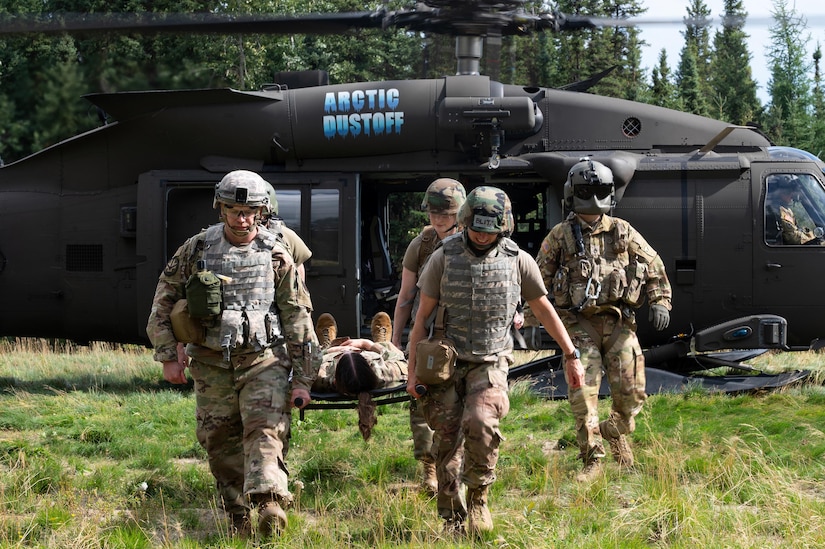
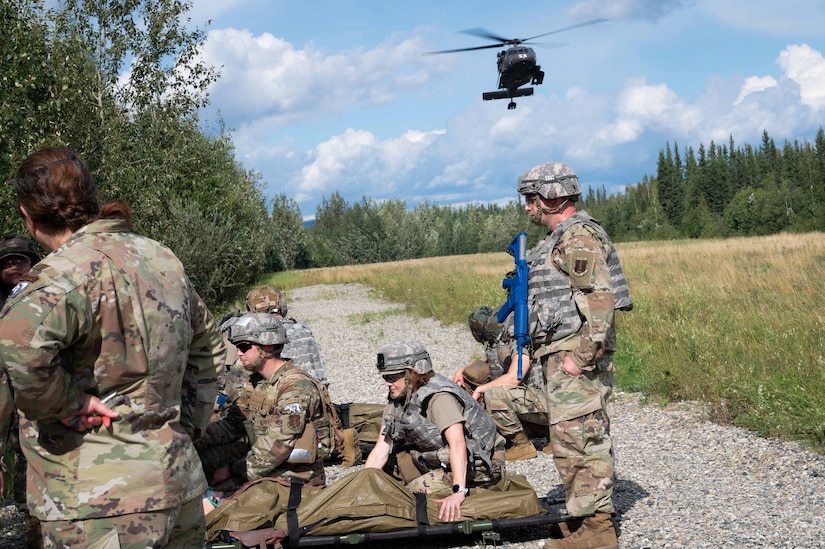
Airmen assigned to 168th Medical Group, Alaska Air National Guard, engaged in an advanced, rigorous, combat casualty care exercise designed to sharpen their skills in delivering lifesaving care under hostile conditions at Fort Wainwright, Alaska, Aug. 5, 2025.  

Four airmen wearing camouflage military uniforms, helmets and vests carry a stretcher with another person in a camouflage military uniform on top of it. There is another person wearing a camouflage military uniform and an aviation helmet to the right of the people carrying the stretcher and a helicopter in the background.

The training, conducted in coordination with 1st Battalion, 52nd General Support Aviation Battalion, 16th Combat Aviation Brigade, the Army UH-60 Black Hawk unit at Fort Wainwright, pushed medics to operate with precision and speed in the face of simulated battlefield chaos. 

"This exercise prepares them for real-world scenarios," said Air Force Col. Russell Pierce, 168th Medical Group commander. "Many are civilian caregivers, and while some skills transfer to military settings, others don't, making this training invaluable." 

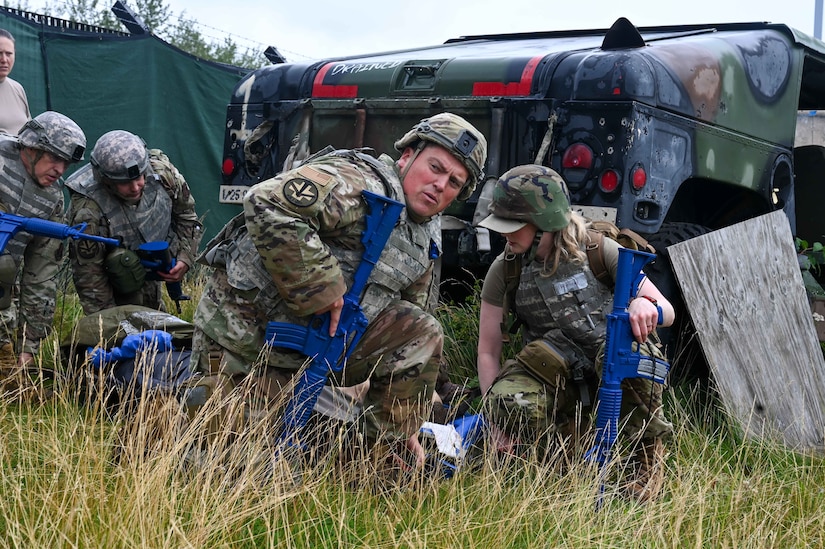
Several airmen wearing camouflage military uniforms with blue training rifles in their hands prepare to lift a simulated casualty off the ground. There is tall grass in the foreground and a military vehicle in the background.
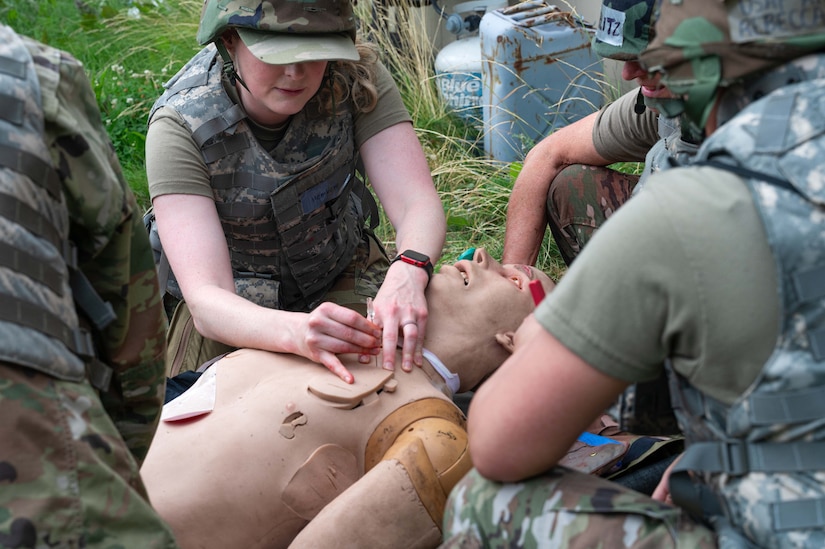
A woman wearing a military camouflage uniform and helmet places a needle in a simulated casualty mannequin while other people in similar attire observe.
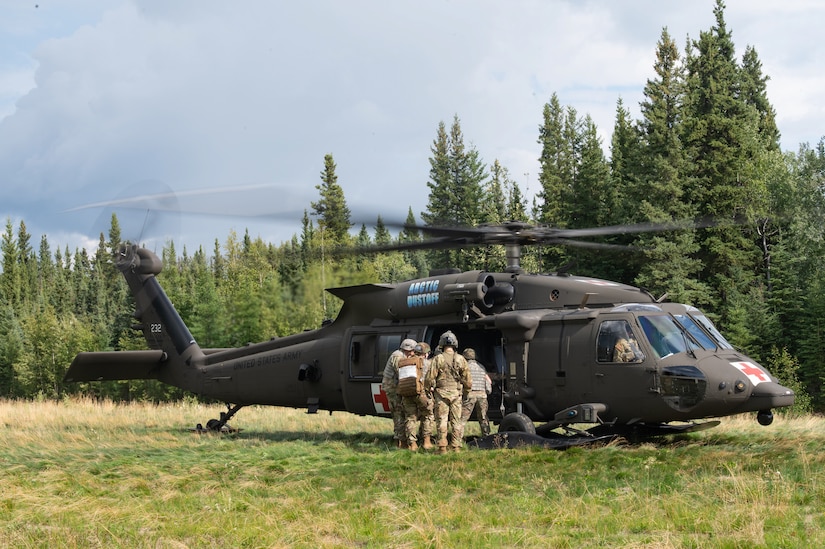
The training was designed to equip medics for real-world missions involving multiple casualties in hostile environments. Airmen advanced in tactical formation teams to a remote location, where they responded to simulated emergencies. The scenario featured a coordinated Black Hawk medevac operation, including a landing for a field instruction course, followed by an extraction of patients. 
 
The scenario-driven exercise featured multiple complex challenges, including simulated improvised explosive device blasts in a remote field. Participants navigated realistic combat conditions, caring for simulated casualties while under mock enemy fire. 

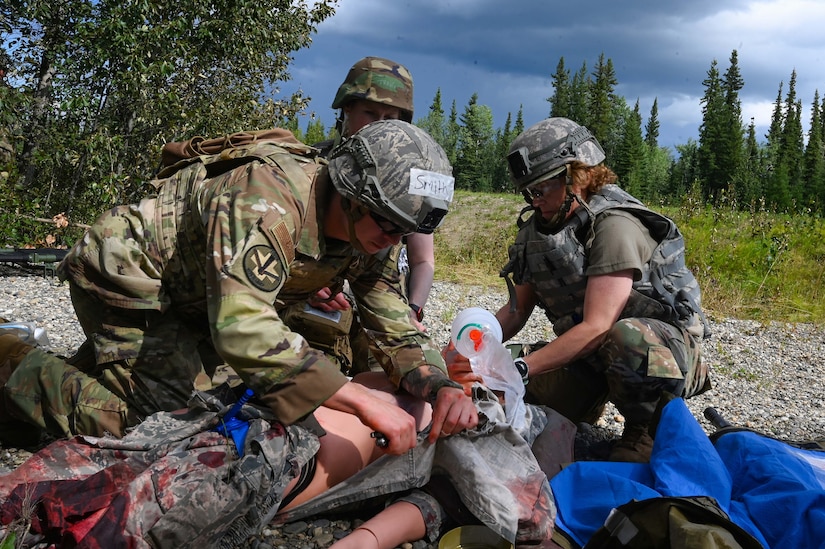
A man wearing a military camouflage uniform and helmet places a needle in a simulated casualty mannequin while a woman in similar attire places an oxygen mask on the mannequin.

 
The transition from care under fire to tactical field care challenged airmen to stabilize patients while maintaining situational awareness, where they immediately began assessing and treating injuries.  

Under the pressure of simulated enemy engagement, medics applied tourniquets, neutralized threats and performed advanced life-saving procedures, including needle decompressions and chest seal applications. 
 
A critical component of the exercise involved placing a 9-line medevac request to coordinate a rapid evacuation. 

Men and women wearing military camouflage uniforms stand and kneel over two stretchers with mannequins inside on a paved road near an open field surrounded by trees. A helicopter is flying above.
Several airmen wearing camouflage military uniforms load a simulated casualty into a helicopter. The helicopter’s blades are spinning as the pilot waits to takeoff from a field with trees in the background.

 
"The coordination with Army aviation intensified the training and made it more realistic," said Air Force Capt. Jennifer Dieken, 168th Medical Group training instructor. "This exercise emphasized the value of integrated training between the Air Force medics and Army aviation, continuing to ensure medical personnel are ready to respond decisively and effectively in real-world combat medical scenarios." 

Tuesday, September 02, 2025

Face of Defense: Sailor Unlocks Full Potential, Trains Future Generations

 Sept. 2, 2025 | By Austen McClain, Naval Education and Training Command

Ward is one of countless individuals shaped by NETC training, but his story makes one thing clear: world-class training leads to real-world results. From the first day of rescue swimmer school to joint operations with the Coast Guard, he has seen how high standards and hard instruction translate directly to fleet impact. 

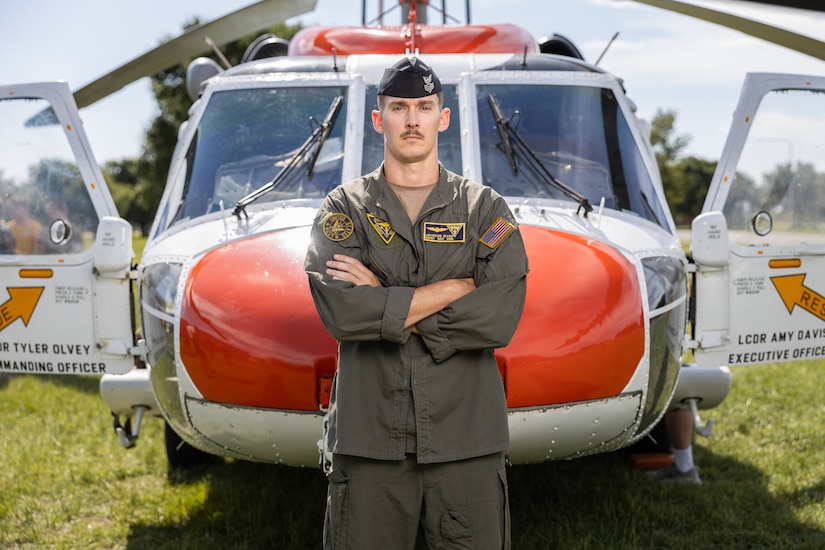
Some join the Navy for the benefits. Others join to see the world. For Navy Petty Officer 1st Class Jackson Ward, it was about the chance to unlock his full potential and be part of something greater. 

A sailor stands in front of a red and white helicopter parked on a field on a sunny day

"I joined the Navy because I felt stuck," Ward said. "College was not working out, and my job in sales was not fulfilling. What drew me to the Navy was the chance to get uncomfortable, to test myself and to find out what I was really made of." 

Ward enlisted in 2016 on an aviation rescue swimmer contract and began an intense pipeline of training under Naval Education and Training Command. From boot camp to the Aviation Rescue Swimmer School at Naval Air Station Pensacola, Florida, he was immersed in a program that demanded not just physical grit but mental resilience and technical precision.  

"The instructors did not just teach us how to survive. They taught us how to think, how to make decisions under pressure and how to be accountable," Ward said. "Those lessons [stayed] with me long after training ended."  

From Training Grounds to Operational Success  

After graduating from the NETC pipeline, Ward was assigned to Helicopter Sea Combat Squadron 2 for fleet replacement training, then to Helicopter Sea Combat Squadron 22, an expeditionary helicopter squadron. There, he put his training to the test in real-world operations ranging from NATO exercises with U.S. 6th Fleet to interdiction deployments with 2nd Fleet. 

One mission stands out to him. During a counternarcotics deployment in the Caribbean Sea, Ward's crew was tasked with locating a vessel suspected of smuggling narcotics from South America toward Puerto Rico. After hours of coordinated search with other assets, including a Coast Guard AC-130 aircraft, they identified the suspected boat — but were forced to return for fuel. By the time they relaunched, the aircraft had lost radar contact.  

That is when training kicked in. "I noticed something in the water, a faint wake," Ward recalled. "We moved in closer and used forward-looking infrared to get a positive ID without tipping them off."  

The team confirmed the vessel had contraband on board. When it ignored verbal warnings and warning shots, a Coast Guard precision marksman disabled the engines with a .50-caliber rifle. The boarding team seized both the crew and the cargo.  

"Everything we did that night — teamwork, communication, staying calm under pressure — it was straight out of the training pipeline," Ward said. "It was not a rescue, but the mindset was the same: solve the problem and bring people home safe." 

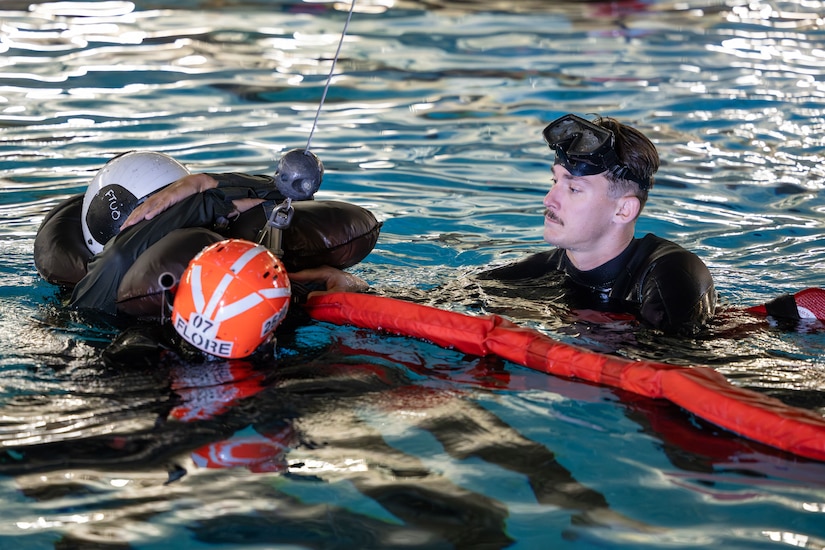
A sailor in a wetsuit instructs another sailor in a wetsuit in a pool.

 Training the Next Generation 

Today, Ward serves as a high-risk training instructor and leading petty officer at Aviation Rescue Swimmer School, part of Naval Aviation Schools Command. 

His mission is to shape the next generation. 

"For most students, the hardest part is not physical; it is mental," Ward said. "We are teaching them how to believe in themselves. If they show up with the right attitude and the drive, we will get them to the finish line." 

He does not believe in breaking people down just for the sake of it. Instead, his approach is about building them up with accountability, structure and mentorship. 

"Be where you are supposed to be, when you are supposed to be there," Ward said. "Show up ready to learn. Be humble. That is how you succeed here and in life." 

Building Warfighters and Protectors 

"The Navy taught me how to lead and how to hold myself accountable," Ward said. "And that started in training." 

Whether recovering personnel or tracking down smugglers in the Caribbean, Ward's work shows how NETC plays a critical role in building a ready, capable force that keeps the homeland secure. 

NETC recruits and trains those who serve the nation, taking them from "street-to-fleet" by transforming civilians into highly skilled, operational and combat-ready warfighters while providing the tools and opportunities for continuous learning and development. 

Monday, September 01, 2025

Medal of Honor Monday: Army Capt. Frederick F. Henry

During the early days of the Korean War, Army Capt. Frederick Funston Henry chose to take the brunt of an enemy attack alone so the rest of his platoon could survive. For his gallant actions and self-sacrifice, Henry received a posthumous Medal of Honor.  
A man in a military dress uniform poses for a photo.

Henry was born Sept. 23, 1919, in Vian, Oklahoma, to James and Ida Mae Henry as the third oldest of 13 children. As if they knew he would go on to do great things, his parents named him after Army Maj. Gen. Frederick Funston, a Medal of Honor recipient who served during the Philippine-American War at the turn of the century. 

The family eventually moved about three hours west to Clinton, Oklahoma, where Henry grew up before enlisting in the Army in September 1940. Five of his brothers also served during World War II, while two continued their service in Korea.  

Henry served in the 6th Army during World War II and earned a battlefield commission to second lieutenant while in the Pacific Theater in 1945. After hostilities ended, he served in Germany, where he met Lavon "Bonnie" Southam, a combat nurse, according to The Salt Lake Tribune. The pair later married and had two children, Frederick Jr. and Sharon.  

When the Korean War broke out, Henry's unit, Company F of the 28th Infantry Regiment, 2nd Infantry Division, was one of the first to deploy to the peninsula in the summer of 1950.  

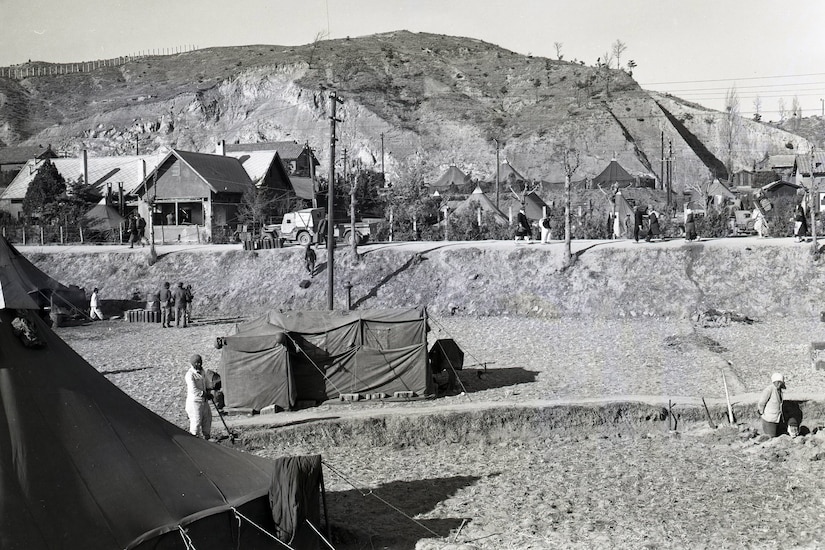
A small building and some tents are set up beside a barren hill. There are people in civilian attire walking around the area, and large buildings in the background.

On Sept. 1, 1950, the 33-year-old first lieutenant was leading his platoon as it held a strategic ridge near the town of Andong, South Korea, when they were attacked by a much larger enemy force. Heavy mortar and artillery fire quickly threw the platoon into disarray. To keep the unit together, Henry left his foxhole so he could move around his men, ordering them to stay in place and return fire.  

Encouraged by Henry's bravery, the platoon reformed its defensive line and delivered intense fire back, impeding the enemy's advance. Unfortunately, the enemy succeeded in knocking out all communications, so Henry had no way of knowing if the main line of resistance was still in place.  

"There were bullets and shells falling all around," Army Sgt. Richard Siman, who was part of Henry's platoon, later told officials. "Our ammunition was running low." 

Despite being seriously injured, Henry stayed put while ordering the wounded men in his platoon to evacuate. He had them give him all their weapons and ammunition before they left, so he could set up a one-man position. He then ordered the rest of his platoon to withdraw.  

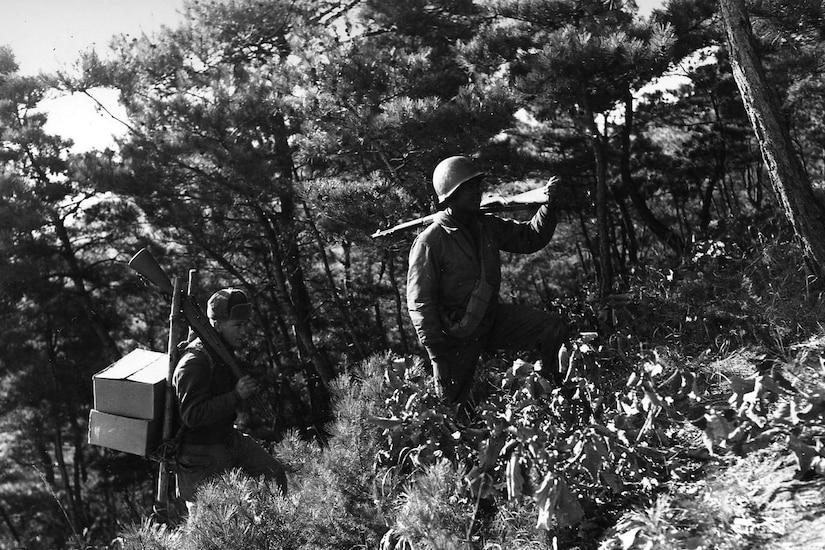
Two men in military uniforms carrying guns and boxes march up a hillside.

Henry was last seen firing every weapon he had at the enemy. His Medal of Honor citation stated that his effort caused approximately 50 enemy casualties before he ran out of ammunition, and his position was overrun. His selfless actions that day saved his platoon and kept the enemy at bay long enough for the main line of resistance to fully push them back.  

Henry was initially listed as missing in action. He was officially declared dead on Dec. 31, 1953, and posthumously promoted to captain. His name is listed on the Wall of the Missing at the National Memorial Cemetery of the Pacific in Honolulu. According to the Defense POW/MIA Accounting Agency, his remains have not yet been recovered.  

On Jan. 9, 1951, Henry's widow received the Medal of Honor on his behalf from President Harry S. Truman during a White House ceremony. Four other fallen soldiers also posthumously received the honor that day.  

Henry has not been forgotten. In May 1960, a U.S. camp that's part of current-day Army Garrison Daegu was named Camp Henry in his honor. In 2004, a memorial was dedicated to him at a park in his hometown of Vian. In 2013, he was inducted into the Oklahoma Military Hall of Fame. A year later, a highway near his hometown was renamed for him.