Showing posts with label scott air force base. Show all posts

Monday, September 08, 2025

EPA Partners With Local Farm to Fight Food Waste, Support Military Families

Last week, Lee Zeldin, an administrator with the Environmental Protection Agency, joined forces with a local farm to bring over 20 pallets of produce to Scott Air Force Base, Ill., as part of a nationwide collaboration to reduce food waste. 
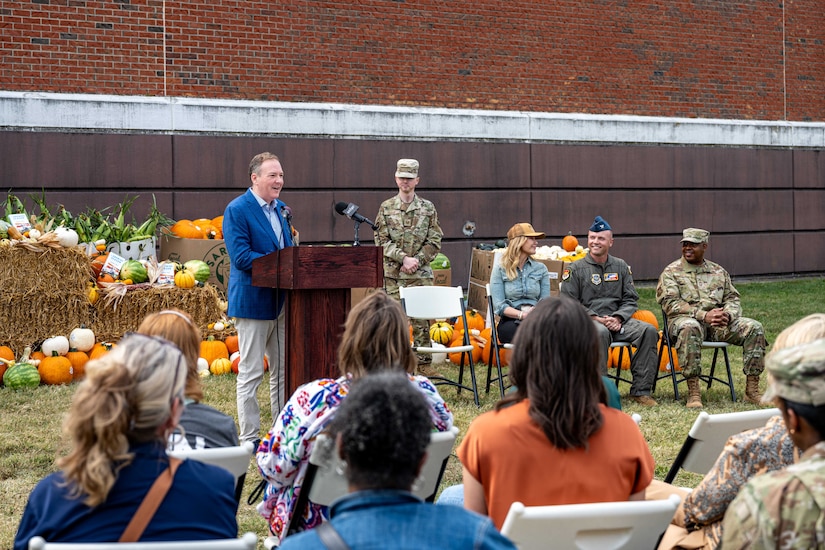
A man in business attire stands at a lectern and speaks to a crowd. There is a person in a camouflage military uniform standing to the right of the lectern and two people in military uniforms and one in casual attire sitting to the right of the lectern. There are pumpkins and other produce displayed in the background.

Airmen and their military families on base were treated to hundreds of free watermelon, corn and pumpkins and watermelon juice under the EPA's "Feed It Onward" initiative to connect farmers with nearby military installations to share their bounty with those who serve.

As a retired Army officer himself, Zeldin first expressed his thanks to "the line of patriots" and their families, as well as retirees who were in the audience for the event.    

"I'm thinking about their collective service and stories of sacrifice … at times holidays, anniversaries and birthdays missed. The decision to serve in our military may be difficult for some … and for those who continue to raise their hand [to serve] is something for the rest of America to take a step back and reflect on, maybe every day of our lives," he said. 

"Everything we cherish about being able to live in the greatest country in the history of the world is all made possible because of the men and women who answer the call to defend our freedom, our liberty. I'm honored to be able to say thank you for your service." 

He shared how the collaboration came about when addressing the amount of food that is wasted in this country and how it needs to be cut down. He cited an EPA study about the cost of food waste to each American consumer being about $728 per year.  
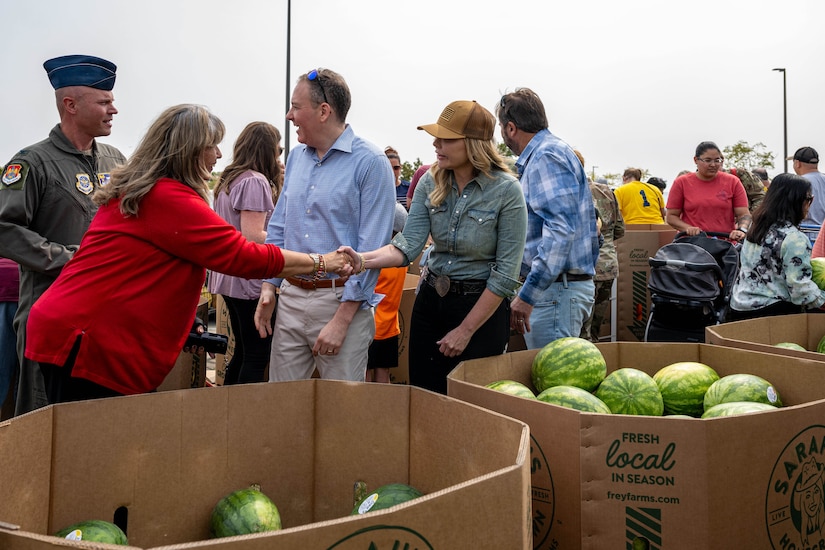
Two people in casual attire shake hands while standing in front of boxes of produce. There is a man in a military uniform to the left and other people in casual attire talking and congregating in the background.

The Feed It Onward program, which is also part of the country's 250th birthday celebration next year, seeks to connect food donors with communities in need while reducing the environmental impact of food waste in landfills.    

Zeldin said he believes today's event will serve as an inspiration for other farms across the nation to partner with the Department of War to ensure that this food goes to good use instead of landfills. From the event last week, he said, "we can all serve as ambassadors" to talk about the many ways to address and solve this issue. 

Sarah Frey, chief executive officer of the farm, is one of those passionate ambassadors who brings a depth of understanding about this issue. What started as a small truck route at age 16 has grown into a multi-state operation and a supplier to major retailers. Her business is located about an hour and a half east of the base, and while they grow all types of fresh fruits and vegetables, they are the nation's leading producer of pumpkins.   

With the amount of acreage she manages, Frey said she sees firsthand the amount of food that gets wasted — at the consumer and the farm level.  

She told the audience that when they take their "perfectly delicious melons home," to just remember that it was rejected at the grocer because it wasn't the right size or had a small imperfection according to their retail standards. So, the waste, she emphasized, has nothing to do with the quality of the product, but something else. 
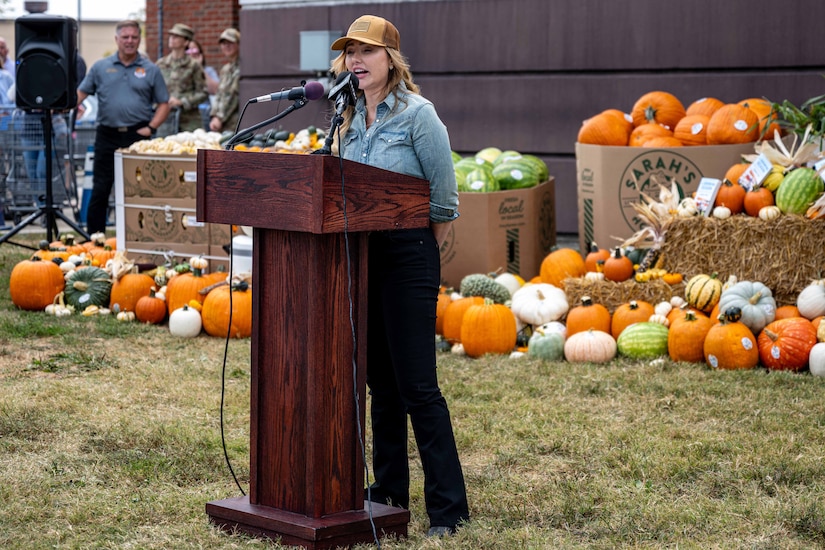
A woman in casual attire stands at a lectern and speaks to a crowd. A display of produce is in the background.

"This food is so good and nourishes our body, and it kills me to see so much go to waste," she said. "Through Feed It Onward, I feel we have an opportunity to connect the military bases across the U.S. with farmers, and to get fresh food to our military heroes, [and] for this to be an incredibly successful partnership that will ultimately reduce the amount of food that is wasted in our country." 

On behalf of the men and women at team Scott, Air Force Col. Matt Collins, 375th Air Mobility Wing and installation commander, thanked the EPA and the farm, as well as those who worked behind the scenes to bring this fresh "fall-themed" produce to the base. 

"This exemplifies the selfless collaboration for which team Scott is known and highlights the amazing relationship our installation enjoys with our local community. We deeply appreciate their commitment to our service members and their families."  

Air Force 1st Lt. Colton Stanislawski, 458th Airlift Squadron, added, "I can't think of a better way to use the produce that doesn't fit the bill at the grocery stores. It's obvious there's a huge demand for it, and for it to go to waste would be quite a shame. As we see here, it only took about 15 minutes for it to pretty much be gone … so this is great." 

Saturday, November 07, 2015

Airmen receive mentorship lesson, get inspired at A/TA 15

by Staff Sgt. Stephenie Wade
Headquarters Air Mobility Command


11/6/2015 - SCOTT AIR FORCE BASE, Ill. -- A sea of blue filled the Orlando World Center Marriot, Florida. No, the resort was not filled with water, but with more than 1,500 U.S. Air Force Airmen from across the globe.

Airmen from a wide range of specialties attended Oct. 29 through Nov. 1, to learn about this year's theme, 'Mobility Airmen's excellence in action in the past, present and future' during the 47th Annual Airlift/Tanker Association Convention and Air Mobility Symposium.

The symposium serves as a key professional development forum for Air Mobility Command's Total Force Airmen.

AMC selects 98 Airmen to attend the symposium. The Airmen are divided into classes by rank - Phoenix Stripe for E-5 and E-6, High Flight for O-1 to 0-3 and Cornerstone for civilians. They are provided a specific agenda dedicated to learning topics their ranks will benefit from the most.

They are also provided direct access to senior Air Force leaders including the Chief Master Sergeant of the Air Force, Chief of Staff of the Air Force and Mobility leaders, Gen. Darren McDew, the U.S. Transportation Command commander, and Gen. Carlton Everhart, AMC commander. The environment fosters open dialogue and honest discussions.

Another benefit of the symposium is a large amount of mobility Airmen in one place at one time. This was the first opportunity the new Air Mobility Command commander, was able to speak to so many Mobility Airmen in person. During his time addressing the professional development classes, he discussed how their jobs impact' the overall Rapid Global Mobility mission. He told them AMC is the only command that can enable and sustain United States military missions by providing a refueling service no one else can, swift airdrops, aerial refueling and aeromedical evacuation.

"Rapid Global Mobility is essential to our nation's response, and there is a growing need for what we do," said Everhart. "The key to the mobility enterprise, past, present and future, is well-educated and professionally developed Airmen. In order to shape our global enterprise, we must face challenges and find ways to succeed against overwhelming odds. Because our nation needs Mobility Airmen to lead us to a future where today's innovations will become routine."

As examples, he referenced the Mobility Airmen who helped design the C-5M Super Galaxy, C-130J Super Hercules and KC-46A. Everhart described the C-5M as a game changer in terms of speed, payload and mission reliability. He called the C-130J one of the most flexible airlifters in the world, then he posed questions to the audience.

"The fleet is in a good place right now, but what about the future? What will the airlift aircraft look like and what new capabilities will it bring? How will we use directed energy, hypersonic, nano-technology or remotely piloted aircraft? Are the answers in the technologies that the next tanker or airlifter will utilize, or will they use something that hasn't been imagined yet? These are only a few questions remaining for Mobility Airmen to solve while training to prepare for the future."

One of the attendees, Staff Sgt. Heather Clifton, fire protection journeyman in the 628th Civil Engineer Squadron at Joint Base Charleston, S.C., said she didn't know what to expect from the symposium when she was notified she was selected by leadership to attend.

This is her first time working for Air Mobility Command in her seven-year career. Since she joined, she has worked for Air Combat Command and Pacific Air Force Command. She has been at working for AMC for a year now.

In fire protection, the Airman's main job is to protect the aircraft according to Clifton, who hadn't realized what a small piece her career field plays in the big puzzle of Rapid Global Mobility.

"This convention put into perspective of how well we [AMC] provide global mobility and how much we do for the rest of the Air Force.. "I was really in awe," said Clifton.

The AT/A convention motivated her to be a better mentor and leader for her Airman, Clifton said. She had an opportunity to talk to Everhart after he gave his keynote speech on the last day. After his speech, he addressed Phoenix Stripe for a discussion.

Clifton asked the general, "How do you bring people together and inspire them?" He replied, "You just have to love your people and love what you do," she said.

Out of the more than 50 seminars available at A/TA, Clifton said the best briefing she attended was called, "Mentoring-How We Do It," which consisted of a panel with the three male generals and one female lieutenant colonel. She said she got a good perspective from all spectrums on what it takes to be a mentor.

"If you are a good leader, you inspire others to want to get the job done well," she said. "Professional development is mentoring your Airmen so they can be better than you are now when they get to your rank. It takes leadership and mentoring to help them accomplish this, and that's what I intend to take back to my work center... Hopefully [this information] will broaden our small career field of fire protection."

In the beginning, she was a little uncertain what she would learn, especially since she was new to AMC. But after it was all done, Clifton said she is glad she had the opportunity, even though it took her outside of her comfort level.

For those who are interested in attending the Mobility Symposium as part of the Phoenix Stripe Program in the future, Clifton provided some advice.

"Take the time to notice your weaknesses, improve upon them and ask leadership questions. It will help you figure out your impact in the big mobility mission," she said. "Overall I learned, if you develop Airmen to be the best they can be, and you inspire them both professionally and on a personal level, Airmen are going to want to work for those leaders, because they know their leaders care about them. Gen. Everhart is very inspiring and makes me want to do the mission based on how much he cares for people."

Monday, September 14, 2015

Scott nurses save boy's life

by Airman 1st Class Kiana Brothers
375 Air Mobility Wing Public Affairs


9/11/2015 - SCOTT AIR FORCE BASE, Ill. -- A 9-year-old boy would not be alive today if not for the quick action and skills of two Scott AFB nurses.

Capts. Michelle Trujillo and Linda Clarkson, both with the 375th Medical Group, spent the Labor Day weekend camping at Lost Valley Lake Resort in Owensville, Missouri., when they noticed a child being brought out of the water and people gathered around.

"I grabbed Trujillo by the arm and said 'let's go!'" said Clarkson. The child was laying on the bank when they finally reached him, and without thinking they both yelled to call 9-1-1.

The boy was blue and unresponsive, and when they checked for a pulse they couldn't find one. Trujillo started compressions and Clarkson took control of his airway.

"Before we knew it, we were both down in position and starting CPR," said Clarkson. "I keep saying this is what we train for, and this is what we do, because it was over whelming and nerve wrecking."

Trujillo added, "We continued doing compression until, finally, he started breathing on his own. After we got the boy to breathe on his own again, the ambulance arrived."

They explained that they were near a small swim area with a lot people in the lake. The boy, Isaiah West, was there for the weekend and his dad was at the scene.  According to the sheriff's report, three teens "felt something under water" and immediately pulled Issiah out of the chest-deep water and onto shore.

"We've talked about it a couple times, and thinking back on it and we just did what we were supposed to do," she said. "We stayed calm and relied on our training to get us through the situation.  We know we have been trained well, and we gave that family back their son.  We have the satisfaction of knowing that little boy is alive and back at school."

Since the incident, they've kept in touch with family who said they are "extremely grateful" and have sent pictures of Issiah coloring and smiling as if "nothing really happened."

All the attention from local media and base officials have been a way for them to encourage others to learn and know CPR.

"We're hoping that individuals take the opportunity to learn CPR. People on that beach felt helpless because they were not prepared," Clarkson said.

If an Airman is in a situation that they are trained to handle, they should definitely step up whether it be medical or nonmedical, said Truijllo.

Lost Valley Lake and Issiah's parents plan to host a celebration for all those who had a hand in saving his life. The resort also wants to incorporate CPR training into the event for their staff members and their guests in hopes to become more prepared.

Wednesday, September 09, 2015

Scott Airman completes humanitarian mission in Honduras

by Senior Airman Megan Friedl
375th Air Mobility Wing Public Affairs


9/9/2015 - SCOTT AIR FORCE BASE, Ill. -- The Air Force is known for developing skills with each Airman they train, one of which is to support and build relations with local communities.

Tech. Sgt. Mark Lopez, 375th Medical Support Squadron biomedical equipment supervisor, did his part by spending two months in Honduras supporting locals at the Dr. Salvador Paredes Hospital in downtown Trujillo.

He and his team also supported New Horizons exercise personnel who constructed a two-classroom schoolhouse in Ocotes Alto.  As a 375th Medical Support Squadron biomedical equipment technician, Lopez ensured equipment was in good working order. That's not all he did though.

"I went really far out of my scope. I assisted with surgeries, and I even delivered a baby," he said.

The 15-person medical team that Lopez was a part of also worked in many new ways.
They repaired medical equipment, trained partner nation personnel, and developed a preventative maintenance program.

Maj. Norman Zellers, 60th Medical Operations Squadron medical physician assistant, from Travis Air Force Base, California said, "Lopez was integral to establishing a relationship with the local hospital. His work repairing the medical equipment and developing a relationship with the Honduran medical repair department made our presence in the hospital much more beneficial to the overall humanitarian mission."

New Horizons is a joint humanitarian assistance exercise that the U.S. launched in the 1980s and is annually done with a partner nation in Central America, South America, or the Caribbean.

"For me it was just so gratifying," said Lopez. "It felt like I really made a difference, and I could see firsthand what I'm doing directly impacted the community."

The experience also gave Lopez more perspective of what his family's heritage is like. He grew up in Miami, Florida, but his family is from Colombia.

"I got a little taste of what I want my life to be like after the military," said Lopez. "I want to go back to my roots."

The team was left with a lasting impression of how their actions affected others.

"I will not forget how the local community went out of their way to thank the United States and their military members for being in the hospital and seeing Hondurans," said Zellers. "It was touching on many levels."

After returning from his trip to Honduras, Lopez believed the mission helped much more than the Hondurans.

He said, "It not only enriched our relationships with our neighbors, but it enriched our own lives."

Tuesday, August 11, 2015

AMC welcomes a new commander

by Staff Sgt. Stephenie Wade
Air Mobility Command Public Affairs


8/11/2015 - SCOTT AIR FORCE BASE, Ill. -- Air Mobility Command welcomed its 12th commander at Scott Air Force Base, Illinois, August 11.

Gen. Carlton D. Everhart II took command of AMC from Gen. Darren W. McDew during a ceremony officiated by Air Force Chief of Staff Gen. Mark A. Welsh III.

Welsh opened the ceremony by speaking about AMC's accomplishments since they inherited the missions of Military Airlift Command and Strategic Airlift Command.

"Over two remarkable decades you [Air Mobility Command] have answered the call of others so that they may prevail," said Welsh. "There is no place on earth beyond your reach. Whether it's the homeland or the beyond the horizon, you bring America's warriors to where the nations needs them and sustain them while their there. And they know no matter the conditions, you will bring them home."

Addressing the men and women of AMC for the first time, Everhart expressed his enthusiasm to continue to lead AMC Airmen and why they are the best at what they do.

"I am proud to be a part of this team and grateful for this opportunity to lead this world-class organization," he said. "When I think back on the events of the past decade, I have to thank our mobility airmen for their courage, determination and professionalism."

Formerly as the 618th Air and Space Operations Center and 18th Air Force commander, Everhart has played a direct role in the operational side of mission execution and was responsible for providing mobility and sustainment for America's armed forces worldwide.

"Our nation's adversaries are determined and are as dedicated in their cause more than they have ever been," said Everhart.

"That is why we must remain operationally focused and manage a fiscally constrained budget while providing our Airmen with the best training and equipment they need to accomplish the missions. While bringing new platforms such as KC-46 and putting them into the hand of the Airmen who need them the most. We must do this all as a total force."

During the ceremony, McDew expressed his confidence in Everhart's ability to continue to lead AMC's rapid global mobility mission.

McDew said, "It's been a privilege to serve as your commander. From the mundane to the monumental, you make it look easy. Every single one of you is vital to the AMC mission and to the defense of the nation. I thank each and every one of you for your contribution to the mission and for making Air Mobility Command great.

I can think of no finer officer to take the reins of Air Mobility Command then Gen. Carlton "Dewey" Everhart and his bride Michelle. He is a proven leader who knows our command and cares about Airmen."

As AMC commander, Everhart will lead all Mobility Air Forces comprised of nearly 132,000 civilian, active duty, Air National Guard, and Air Force Reserve personnel. AMC sustains America's military operations worldwide through its airlift, aerial refueling and aeromedical evacuation capabilities. The command also responds to humanitarian crises at home and around the globe.

Everhart concluded, "The world and the warfighter need Air Mobility Command. You work quietly behind the scenes getting the mission done and answering our nations call. There is no doubt you are the best at what you do. I know the challenges we face are daunting but here is my pledge to you: Michelle and I will be right there with you, supporting you and your families every step of the way. Together we will continue to provide unparalleled rapid global mobility.

Tuesday, August 04, 2015

Mobility Airmen provide care to stranger during fire emergency

by Staff Sgt. Stephenie Wade
Air Mobility Command Public Affairs


8/4/2015 - SCOTT AIR FORCE BASE, Ill. -- Maj. Jim Cote was driving to his new job at Air Mobility Command Headquarters, July 29, when he saw a man on fire on the side of the road in Shiloh, Illinois.

According to St. Clair County authorities, the riding lawnmower operator attempted to mow too close to a ditch.  The mower overturned, trapping the operator and dousing him with gasoline.  Seconds later, the gasoline ignited.

"Just within a matter of seconds, he burst into flames," said Cote, an Air Force aero-medical nurse. He said the man came running out of the area engulfed in flames.

Cote was the first person on scene and as he instinctively rushed to aid the seventy-four year old victim, he immediately applied his military and medical training.

"I ran across the street ... to put the flames out with my uniform shirt," Cote said. "Then others, including more Airmen, stopped to help.  It took about three ABU [Airmen Battle Uniform] tops before [the flames were extinguished]."

All the while, Cote said the mower was still on fire only ten feet away.  The victim was airlifted from the scene minutes later.

Shortly after, the local community learned that the elderly man did not survive.

Cote has been a nurse for more than seventeen years and says, from his experiences, it helps to talk about these traumatic situations.

Cote concluded, "While I am still not sure how you train for this situation, I think my years of Air Force training probably taught me to just react, despite the danger, to do what [I] can to help someone in need."

Friday, July 31, 2015

AMC receives Air Force Organizational Excellence Award

by Air Mobility Command, Public Affairs

7/31/2015 - SCOTT AIR FORCE BASE, Ill. -- Air Mobility Command recently received the Air Force Organizational Excellence Award by the Secretary of the Air Force Personnel Council Awards and Decorations Branch, for the period of Jan 1, 2012 to Dec 31, 2013.

Significant contributions leading to the award include Mobility Airmen spearheading a $58 billion KC-46 "Pegasus" basing program and a $3.5 million Advance Air Refueling Capability Concepts program initiative.  Additionally, AMC designed an improved aircrew scheduling program, reducing fuel consumption by 4.1 million gallons a year, all while continuing to provide support to Operation ENDURING FREEDOM and retrograde operations, removing more than 11,000 tons of equipment to include 307 combat vehicles.

The Secretary of the Air Force authorized the AFOEA on Aug. 26, 1969 to recognize the achievements and accomplishments of U.S. Air Force organizations or activities. It is presented to Air Force internal organizations that are entities within larger organizations. They are unique, unnumbered organizations or activities that perform functions normally performed by numbered wings, groups, squadrons, etc.

Airmen assigned to AMC during the qualifying period are authorized to wear the Air Force Organizational Excellence Award ribbon.

Friday, July 24, 2015

Scott area earns Abilene Trophy

by Christine Spargur
375th Air Mobility Wing Public Affairs


7/23/2015 - SCOTT AIR FORCE BASE, Ill. -- The Abilene Chamber of Commerce's Military Affairs Committee presented the annual Air Mobility Command Community Support Award, the Abilene Trophy, to the Leadership Council Southwestern Illinois July 15 at MidAmerica Airport. The award recognizes the Leadership Council's and the greater St. Louis metropolitan region's support to Scott Air Force Base in 2014.

The achievements in 2014 include the Air Force Times' ranking Scott as the best assignment for Airmen. Scott AFB tied with Wright-Patterson AFB for the No. 1 spot. The Air Force Times compared several factors such as costs of living, availability of affordable housing, the quality of schools, area attractions, and overall quality of life both on and off base in its survey of bases.

Illinois' elected leaders also passed House Bill 3939 in June 2014 strengthening the state's participation in the Interstate Compact. "This assures for the first time ever that prior schooling counts for the children of military personnel transitioning to Scott," said Gerry Schuetzenhofer, Chairman of the Military Affairs Committee of the Leadership Council, during the trophy presentation. "In 2013, Illinois had the weakest set of protections for military children among the 46 participating states in the voluntary Interstate Compact for Educational Opportunity for Military Children.

"The Scott AFB Task Force led by St. Clair and Madison Counties and the Leadership Council made these concerns known to then Illinois Lt. Gov. Sheila Simon and Illinois State Representative Eddie Lee Jackson, whose district includes Scott AFB," said Schuetzenhofer. "They took an active interest and introduced a bill to fix the compact's deficiencies. With overwhelming support, House Bill 3939 passed both house of the Illinois General Assembly and Governor Pat Quinn signed the bill into law..."

Other highlights of community support in 2014 were the creation of a new networking event to help veterans, military spouses, separating and retiring servicemembers meet local employers and the Leadership Council's Salute to Scott at its in annual dinner.

Speaking to community leaders, Col. Kyle Kremer, Installation Commander and Commander of the 375th Air Mobility Wing, said, "The Air Force Times No. 1 ranking, the Abilene Trophy--these awards are your awards. We didn't win the Abilene Trophy. You won the Abilene Trophy. On behalf of all the mission partners on Scott, thank you for all you have done to support the base. We are incredibly proud to celebrate your victory."

The Abilene Trophy was established in January 1999 to recognize the best community support to an AMC base each calendar year. Communities submit a binder documenting their support to the Abilene Chamber's Military Affairs Committee. With approval by the AMC Commander, the Abilene Chamber's Military Affairs Committee then determines the winning community.

Kristina Jones, Vice Chair of the Abilene Chamber's Military Affairs Committee, said, "Depending on the year, there are five to seven judges looking at a stack of binders from communities across the United States. What the judges are really looking for among all the words and pictures is what the communities are doing for their base."

Gray Bridwell, Chair of the Abilene Chamber's Military Affairs Committee, said, "What really stood out above the other submissions is the collaboration among your communities. Communities have to work together to achieve the goal of supporting Airmen and you [the Leadership Council and the St. Louis region] did it better than anybody else."

"It is impossible to truly understand the depth of the sacrifices made by the Airmen of AMC without walking in their combat boots; nor, can we fully comprehend the extent to which this type of service impacts the personal lives of their family members," Schuetzenhofer said. "What the community can do however is what the businesses and individuals of this region are doing by continually seeking out ways to honor these servicemen, recognize their contributions, and work to enhance their quality of life while they live here with us."

The Abilene Trophy, which will travel to the surrounding communities for display, depicts an eagle with wings spread perched on a rock. Jones explained the symbolism and said, "I really see the eagle as our military, our Air Force and what they do for our freedoms. ... The rock is the mountain, the solid foundation the eagle has the power of leverage to take off from to soar to the missions that need to be accomplished. This is the spirit of the Abilene Trophy."

This is the second time the Abilene Trophy has been awarded to the Leadership Council and the communities surrounding Scott AFB. The first win recognized the communities' support in 2012.

Thursday, July 16, 2015

Squadron hosts memorial service for deceased K-9

by Airman 1st Class Kiana Brothers
375 Air Mobility Wing Public Affairs


7/15/2015 - SCOTT AIR FORCE BASE, ILL. -- The 375th Security Forces Squadron paid their final respects to Breston, a 375th SFS military working dog, during a memorial service July 9 at Scott. A canine prayer along with a poem was recited, and the Scott Air Force Base Honor Guard rendered military honors for Breston during the service.

The dog, a Belgian Malinois, was diagnosed with cancer June 18 and due to his medical complications, he was euthanized the same day after more than eight years of military service.

"Breston was a great dog and a loyal, dedicated friend always," said Tech. Sgt. Bryan Dell, 375th SFS kennel master of the military working dog section.

Breston was a drug detector and a patrol dog for the Air Force and was deployed to Afghanistan.

He served with 13 handlers, but during his final moments, he was being maintained by Staff Sgt. David Yaronczyk.

The canine's last moments were spent at the Scott Veterinarian Clinic, June 18, and he was surrounded by his fellow 375th SFS military working dog section members. Before his planned euthanizing, security forces members cooked a juicy steak for him as his last meal, however, he was so weak from the pain and medication that he didn't want to eat. "

That dog loved to eat his food, so seeing that was upsetting because when you work with these dogs day in and out, you know when something is wrong, and when they aren't acting like themselves," said Staff Sgt. David Yaronczyk, 375th SFS military working dog handler. "I had never seen him like that before."

Breston received military honors broadcast across the security forces' radios during his final moments.

"I felt a tremendous amount of sadness seeing him pass away," said Yaronczyk. "I knew that the Air Force lost a great asset and MWD. Breston meant the world to me. He was my first K9 partner assigned to me as a handler. The bond between us was very strong, I loved and cared about him very much."

Military working dogs are trained on various tasks depending on if they are a bomb dog or a drug dog.

They are also trained to attack fleeing suspects. Handlers and their dogs train daily to keep the dogs at the top of their game.

"Breston, in comparison to other MWDs, during work was a 'beast' in bite work," said Yaronczyk. "He loved to bite the'bad guys' and he had an amazing drive to work to find drugs and bad guys during training and in the real world."

"I went on my first temporary duty as a MWD handler with him to Grissom Air Reserve Base for a drug interdiction mission," said Yaronczyk.

"He was very protective of his Kennel or 'house' as we call it. He also was protective of his handler, and I saw this on every traffic stop I made or while on walking patrols with him."

Yaronczyk said his partner would always like standing up in his kennel and licking his face while he was driving. He also loved to stare down anyone near the car even if it as a fellow K9 handler.

"Outside of work, when I would come in to run with him and exercise, he was a big baby," said Yaronczyk. "

He loved to play with his Kong and play keep away with the aggression balls we have at the kennels."

This is heartbreaking, and I feel like I lost a small piece of my career in a sense.

I know that when I come into the kennels the next time I won't see him wagging his tail waiting for me to come by and say hi.

I will always remember how great of a partner, friend, and family member he was. Breston will be truly missed and always remembered."

Wednesday, July 15, 2015

AFNIC receives new commander

by Warren Neary
AFNIC


7/15/2015 - SCOTT AIR FORCE BASE, Ill. -- Col. John J. Dunks assumed command of the Air Force Network Integration Center from Col. Amy V. Arwood, July 1 in a ceremony officiated by Gen. John E. Hyten, Commander of Air Force Space Command.

Dunks joins AFNIC from Anderson Air Force Base, Guam, where he served as the Mission Support Group Commander for the 36th Wing. He has served in a variety of cyberspace mission areas ranging from the tactical to operational and staff level ranging from major command to joint operations. Additionally, he has held command assignments at the flight, squadron and group level during his 24 years of service.

During the change of command ceremony, Hyten highlighted the long and distinguished history of AFNIC. Additionally, he praised AFNIC's enterprise engineering and integration expertise along with the center's ability to adapt to the constant change that is required to support not only the Air Force, but joint operations and the nation in a rapidly evolving cyber environment.
"When somebody queues their keypad to open a communications link on the other side of the planet, they don't ask how it performed in the validation environment here, they just assume that it did," Hyten said. "When somebody uploads data to an F-35 someplace around the world to connect to the latest targeting software in the helmet, they just assume the software is secure, and they can safely drop the ordinance they've been asked to drop without worry. When the Air Force considers placing a new cyber capability into operation, nobody wonders if it's going to be interoperable with what we do. You make it right every time. You are the best in the world at this."

After the symbolic passing of the guidon, Dunks addressed the men and women of AFNIC, "It's an honor and a privilege for me to be here today, so I thank you for the opportunity and for placing your trust and confidence in me," he said. "I promise I will give you everything I have. I will be fair and I will be equitable, mission focused and always take care of the Airmen. I will do my utmost to serve this organization and the Air Force well as we move forward."

AFNIC, a direct reporting unit to Air Force Space Command, serves as the Air Force cyberspace technical center of excellence for enterprise engineering and integration. In collaboration with Headquarters Air Force Space Command, 24th Air Force and the Air Force Life Cycle Management Center, AFNIC supports the nation's warfighter by providing data-driven, decision-quality information and technical expertise required to design, develop and deploy air, space and cyberspace systems and capabilities into/onto the Air Force network and shape the AF provisioned portion of the Joint Information Environment.

Wednesday, April 25, 2012

Face of Defense: Air Force Officer Tackles NFL Dream


By Air Force Staff Sgt. Brian Valencia
375th Air Mobility Wing Public Affairs

SCOTT AIR FORCE BASE, Ill., April 25, 2012 – At 6 feet, 6 inches tall and 305 pounds, Air Force 2nd Lt. Ben Garland looks more like a football player than a typical officer.

That’s because he's a defensive lineman contracted to play for the NFL’s Denver Broncos. Garland will attend the team's conditioning and tryout camps which last through mid-June.

The 23-year-old Air Force Academy graduate has been approved to be released from active duty through the Air Force’s Palace Chase program, which offers qualified active duty enlisted members and commissioned officers the opportunity to petition for transfer to National Guard or Reserve status.

Meanwhile, Garland has spent his time here performing a disciplined balancing act to meet Air Force and NFL physical fitness requirements.

"To play defensive lineman you have to be a pretty big guy. I need to be around 300 pounds to stay competitive and that's not really the Air Force body type where you're going to run a mile and a half really fast and you're going to have a small waist," said Garland, who served here as the 375th Air Mobility Wing Public Affairs chief of media operations. "Even with the pushups and sit-ups, you're pulling and pushing a lot more weight than the average Air Force member so it makes the testing extremely difficult."

But, Garland's no stranger to achievement, as he aced his most-recent fitness assessment with an overall score of 90.4, though he admits that meeting the waist measurement is the toughest part since it does not take into consideration height or body composition. For maximum points, his waist needed to be less than 35 inches, and in order not to fail it had to be no more than 39 inches. He measured 38 inches.

"I know a lot of people who struggle with the waist measurement; it has been difficult trying to maintain standards and be competitive in football," said Garland, a Denver native. "But it's one of those things you have to take and push through. You have to take the Air Force standards and make them your No. 1 priority."

Garland said the Air Force has been his top priority ever since he dreamed about becoming an Air Force officer. He had received athletic scholarship offers from several top-ranked football schools but instead worked to earn an academy appointment purely on academics and leadership.

"I wanted to earn it. I did not want to be given a waiver or an exception because I was a football player. I wanted to be evaluated and accepted in every area and get in on my own merit
-- it meant more to me that way," Garland said.

During his successful career at the academy where he majored in systems engineering management and became well known for his on-field intensity, several professional football teams showed interest in signing him.

Air Force 1st Lt. Tyler Weeks, a fellow academy football player, described Garland as “a relentless, physical, and dominating football player who gives 100-percent effort on every play” and never quits.

“Ben has always been a loyal teammate who motivates others to perform at their highest potential. His example and encouragement lift the play of those around him and make Ben a valued member of any team," said Weeks, a former offensive lineman who now serves as Air Mobility Command’s financial management and comptroller executive officer.

Though Garland had been preparing to become a pilot, when the opportunity came to play professional football, he made "the tough call."

"I dreamt of flying for the Air Force ... and playing in the NFL for the Broncos ... it was a tough choice but I ultimately decided to play for my home team," Garland said.

The Broncos gave him a three-year contract and placed him on inactive reserve status so he could complete his Air Force commitment. As an academy graduate Garland was committed to serving two years active duty before being eligible to separate. After graduation he served as a strength and conditioning coach at the academy until the Air Force sent him to become a public affairs officer with his first duty station here.

He arrived here in July 2011 and it didn't take too long for people to start noticing the big guy around the base.

"I didn't think anyone was aware of my intentions to be a professional football player," Garland said. "No one let on they knew and if they did, I didn't see it at first. But, then I would be training at the gym, and people would ask me questions about football, about Tim Tebow, [former] quarterback for the Denver Broncos, or someone would just ask for fitness tips."

If there is a perception that football players are just "dumb jocks" then getting to know Garland breaks that perception very quickly, according to his supervisor here.

"We absolutely adore Lieutenant Garland!" said Karen Petitt, chief of public affairs. "He's this big gentle giant with a great laugh, strength of character, and genuine interest in his team. He's got this amazing gift for details and a memory that keeps us on track with all the taskings that come our way.

“Everyone just naturally looks to him as a leader,” Petitt continued, “but not because he's the 'office linebacker' like you see on those TV commercials, but because he's got integrity and charisma, and they know they can depend on him."

Weeks agreed, noting that Garland is a humble, easy-going person who gives back to the community and mentors young athletes.

"Ben's athleticism and sheer work ethic stand out the most,” Weeks said. “Some players rely on athleticism alone to be 'good' players. Ben has become a 'great' player because he dedicates every fiber of himself to becoming a better athlete every day."

Garland said he's not bothered by football player stereotypes.

"Everyone who plays -- even at the college level -- is continually analyzing and thinking multiple steps ahead of what they're going to do and how it will affect the game,” he said. “To understand the schemes and understand what goes into the full game, you have to be intelligent even if you're only intelligent in the ways of football.”

When he's wasn't leading the public affairs office’s 27-person shop through mobility exercises, crisis response situations or media events, Garland traded in his uniform for PT gear to put in another five hours at the gym to keep competitive for the Broncos training camp. Though he has signed a contract with the Broncos, he said, there's still a vigorous selection process.

Garland said he kept his workouts consistent no matter what obstacles got in the way. Even when tired or sick, or after a long day, he pushed through to get his workout in.

"Some days I might work a 12-hour shift, go home and eat a full meal until I'm stuffed, and then I go work out as hard as I can because I know there's some other guy out there working as hard as he can to beat me out for that roster spot,” he said. “I also know there is someone who is training hard to line up across from me, so I need to stay on top of my game for that.”

Garland said he must consume between 6,000 and 8,000 calories a day to fuel his body. A typical day's worth of food, he said, consists of different combinations of lean meats, vegetables, protein and good fats such as nuts and avocados. Eating that much food is expensive and his average grocery bill reached $200 a week.

"My diet is nowhere near the average airman's," Garland said. "I have to eat so much food that it can be tough scheduling it around working out and the full-time commitments of the Air Force. But, it's all about discipline. You have to balance everything while keeping focused on your end goals."

With what remained of his spare time on the weekends, Garland read books on football defense and studied the game -- always looking for ways to improve. Those who know Garland believe he’ll achieve his goal of becoming an NFL player. Garland gives credit to the Air Force.

"The Air Force has influenced me on the football field in every aspect from work ethic to teaching me how to work as a team member to just being disciplined," Garland said. "In the Air Force it’s, ‘Excellence In All We Do,’ and on the football field you put that same excellence into every play. If your job is to hold this gap, then I'm going to do everything in my power to be in that gap."

Meanwhile, Garland’s supporters here say they’ll cheer him on throughout the Broncos tryouts.

"I work hard and served the best that I could," Garland said. "I dedicated myself to serving my country ... and now it's time to play some football!”

Sunday, November 06, 2011

Face of Defense: C-17 Crew Gives Aid to Earthquake Victims

By Air Force Airman 1st Class Leah Young
62nd Airlift Wing

JOINT BASE LEWIS-MCCHORD, Wash., Nov. 4, 2011 – A group of U.S. airmen took to the air to deliver humanitarian relief supplies for victims of the magnitude 7.2 earthquake that struck eastern Turkey Oct. 23.

The five-member C-17 Globemaster III crew, assigned to the 10th Airlift Squadron here, flew to Turkey Nov. 1 and delivered a 75,000-pound load of tents at Erzurum Airport.

"The men and women of McChord are always ready to provide airlift at a moment's notice," said Air Force Maj. Corey Simmons, the squadron’s director of operations. "It is an honor for the 10th Airlift Squadron pathfinders to provide relief to our great partner Turkey in their time of need."

According to officials at the 618th Tanker Airlift Control Center at Scott Air Force Base, Ill., the tents will provide shelter to earthquake survivors as recovery efforts continue. The tents are six-sided, pyramidal-shaped shelters that can comfortably house up to 10 people plus their clothing and equipment.

The tent's wind-, mildew- and fire-resistant construction and materials, officials added, ensure the warmth and dryness of the occupants even in frigid temperatures.

"Our airmen are focused on providing support at home and around the world at any time," Simmons said. "Rapid global mobility is a key to providing assistance at times like these."