Friday, April 24, 2020

DOD Plans for Resumption of Normal Operations After Pandemic


April 24, 2020 | BY Jim Garamone , DOD News

Defense Department planners are working on how to resume normal military operations following the coronavirus pandemic, Pentagon spokesman Jonathan Rath Hoffman said.

Because defense is a full-time necessity, the military cannot shut down, Hoffman said at a Pentagon news conference today. Still, officials curtailed exercises, limited training, stopped military moves and took other measures in an effort to flatten the curve of coronavirus infections.

"We'll be evaluating many different areas," Hoffman said. "One is training — how are we protecting our trainees, and how are we keeping the pipeline full? We're continuing to look at that, continuing to adopt and adapt so that we can pursue full training classes in the future."

Defense Secretary Dr. Mark T. Esper is also closely following the stop-movement order. The order goes until June 30. "But once it is lifted — and the secretary is reevaluating that every 15 days — how are we going to deal with the backlog of individuals that need to move throughout the world?" Hoffman said.

This is a complex issue, and the planners at the U.S. Transportation Command have the lead for the department.

DOD has done a good job of protecting strategic forces, but officials are still going to look at the process to see if there aren't better ways to do this in the future, Hoffman said.

Even if there is a return to normal, the virus will still be around. DOD planners are looking at the testing program, and officials are putting the final touches on the system it will employ and getting the supplies that will be needed. DOD scientists and doctors are also heavily involved in developing a vaccine  and for treatment protocols for COVID-19, Hoffman said. "We're going to be doing that for months and months going forward," he added.

Finally, the department is looking at the industrial base with an eye to replenishing the DOD stockpile in case of future crises, and to produce more equipment for the coronavirus fight, he said.

Hoffman announced that the Navy hospital ship USNS Comfort will soon leave New York City. It will return to its homeport of Norfolk, Virginia, to restock and get ready for another mission, if needed. "We'll be looking to [the Federal Emergency Management Agency] to identify where that next location is; they are the federal government's lead on this, and so they're the ones who will be tasking us," he said.

Hoffman cited "modest progress" in mitigating the virus in the nation's hardest-hit city, calling that "a welcome sign." The rate of infections in New York is declining, he noted, adding that there are still many places where this is not the case, and that the department stands ready to assist.

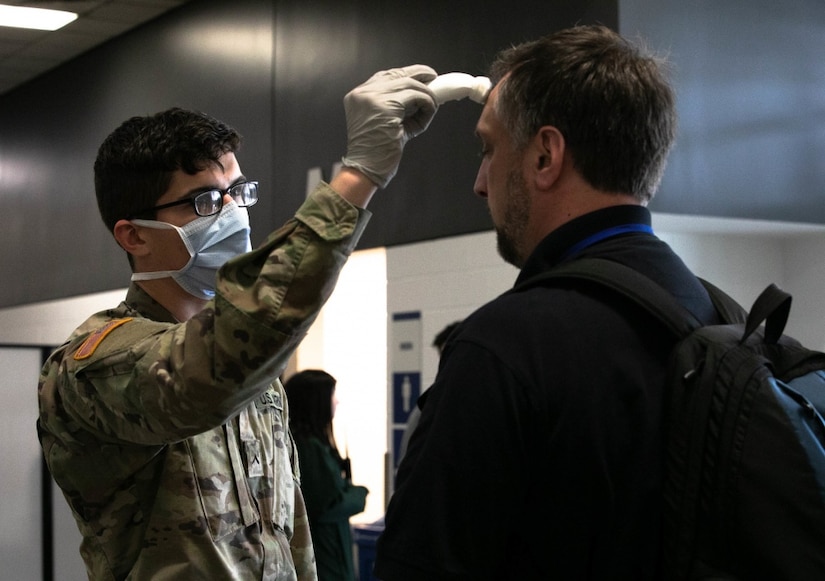
"As of today, we have more than 60,000 personnel deployed nationwide, including 4,400 medical professionals on the front lines," Hoffman said.

Thursday, April 23, 2020

Troops' Skill Sets During Pandemic Sharpen the Sword


April 23, 2020 | BY Terri Moon Cronk , DOD News

More than 56,400 Defense Department personnel are on the front lines of the war against the silent enemy known as the COVID-19 virus that's affected the nation, a DOD spokesman said.

Active-duty service members, reservists and National Guardsmen medical personnel and support troops are in place waging the fight against the virus, Army Lt. Col Chris Mitchell said yesterday.

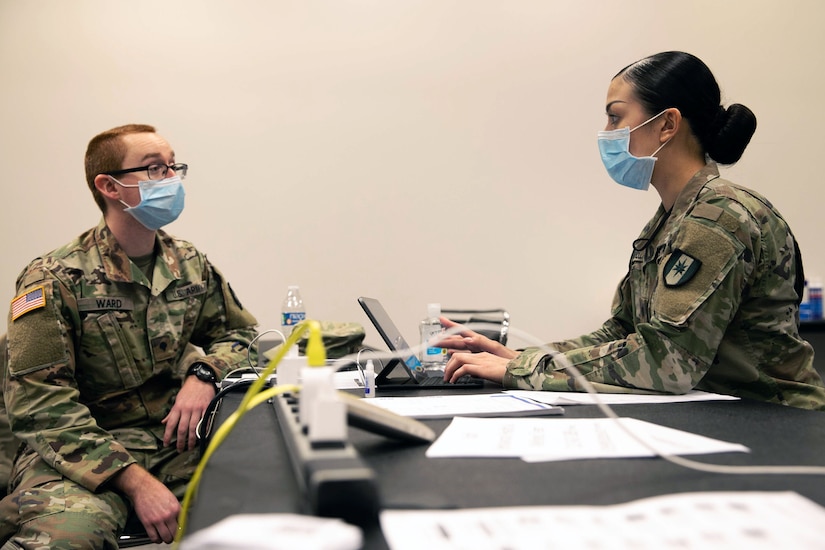
Doctors, nurses, Army medics and Navy corpsmen are treating COVID-19 and non-COVID-19 cases in support of local-area health-care workers.


U.S. Northern Command is responsible for DOD's active-duty personnel, with more than 14,000 people deployed, including 4,320 medical personnel, in support of response operations. And more than 1,000 medical providers are embedded nationwide within local hospitals, according to Northcom.

Nearly 3,000 Army Reserve soldiers support COVID-19 response via the 14 Army Urban Augmentation Medical Task Forces in these locations:

1 New York City, with six UAMTFs supporting the alternate care facility at the Jacob K. Javits Convention Center and local hospitals.
2 New Jersey, with three UAMTFs supporting the Edison Exposition Center, Newark University Hospital, the Atlantic City Convention Center alternate care facility and Salem Hospital.
3 Stamford, Conn., with one UAMTF at the Bennett Medical Center treating patients. Additional help is due to arrive this week.
4 Massachusetts, with a UAMTF at the Boston Convention and Exposition Center alternate care facility and another at Tewksbury Hospital that will be fully operational later this week.
5 Pennsylvania, with a UAMTF for the Temple University alternate care facility, and one in East Stroudsburg that has achieved initial operational capability.
6 Detroit, with a UAMTF at the TCF Center alternate care facility.

A Navy Expeditionary Medical Facility detachment is also at work at an alternate care facility in New Orleans' Ernest N. Morial Convention Center, and is providing support in Baton Rouge, La.

More than 350 Navy, Air Force and Army Reserve citizen warriors were mobilized in the last week to support the DOD COVID-19 response. Most reservists will deploy to New York City hospitals to assist on the front lines. More than 5,100 reservists are on military orders supporting COVID-19 operations.

The Navy Reserve has more than 1,500 sailors engaged in COVID-19 pandemic relief efforts around the world, including more than 650 reservists at the Javits Convention Center alternate care facility and hospitals in the New York City area, and more than 200 reservists are serving aboard the Navy hospital ships USNS Mercy and USNS Comfort.

The Air Force Reserve mobilized more than 150 medical professionals to New York City, and they were expected to arrive at Joint Base McGuire-Dix-Lakehurst, New Jersey, yesterday.

National Guard Troops

Nearly 42,000 National Guardsmen are supporting COVID-19 response at the direction of their governors. State priorities are focused on testing and screening, and providing logistical support through warehousing and distribution of medical supplies and food.

DOD's readiness posture is not degraded, Mitchell said. "Any time service members put their skills to use, it sharpens the sword. They're going to be better prepared to deal with this kind of thing next time around because they're using their skills and testing processes and things like that in a situation where they're under stress."

A New Normal: Service Academies Cope With COVID-19


April 23, 2020 | BY Katie Lange , DOD News

People all over the world are dealing with life changes that have occurred due to the coronavirus pandemic, and that includes students at the nation's storied military academies.

Thousands of students attend the five U.S. service academies — the Military Academy in West Point, New York; the Naval Academy in Annapolis, Maryland; the Air Force Academy in Colorado Springs, Colorado; the Coast Guard Academy in New London, Connecticut, and the Merchant Marine Academy in Kings Point, New York.

Discipline and routine are essential for those students, but both were upended in mid-March when COVID-19 began to spread across the country.

Most students were on spring break when social distancing rules went into place, so academy leaders extended those breaks until they were able to get distance learning up and running. The Air Force Academy, which was the only school not on spring break at the time, sent its underclassmen home.

There are always some students for whom going home isn't an option, and accommodations have been made for their continued learning. Each school has a yearly sponsorship program in which local families help take care of the students who can't get home to their relatives. Those families have stepped up during the COVID-19 pandemic, as well.

"A lot of those sponsor families have still been kind enough to host some of those students," Coast Guard Academy spokesman Cmdr. Dave Milne said.

By late March, students at all five academies were set up with resources to finish their coursework online. Students have adjusted relatively well, officials said, despite having to adapt to challenges such as time zones, missing equipment and the occasional spotty internet connection.

"I live on a rural farm in Ohio, and we have satellite internet," said West Point Cadet Edmund Coleman, who will graduate this year. "As a result, sometimes if the weather's bad, I don't have great access to the online meetings. Most of my teachers have anticipated that and they've recorded lessons and put them online so that I can view them when I do [get the] internet back. As of now, it hasn't really been an issue."

The challenges are forcing many to get creative. One West Point teacher set up a show-and-tell portion of his class to get the students to interact more.

But there have still been some frustrations, especially for graduating seniors who have questions that, so far, remain open-ended. 

"They [seniors] had some capstone projects in the works and a lot of questions, preparing for their next assignments and permanent change of station moves," Milne said. "But they understand and … they've been really open and grateful and flexible."

All service academy students have been encouraged to keep up their physical training as well, whether on their own or through school resources. Each academy has created online workouts and exercise sessions for students to access. 

Many spring and summer activities at the schools have been canceled, including sporting events. Even some commissioning ceremonies are still in question.

The Air Force Academy graduated its cadets early, on April 18. The ceremony, which was moved up by more than a month, allowed the Class of 2020 to celebrate together, albeit without any of the annual precommissioning festivities. The graduates — including the first batch of Space Force officers — stood 6 feet apart to maintain social distancing guidelines to prevent the spread of COVID-19. Family and friends were not allowed to attend, but they were able to watch online.

West Point announced in late April that its graduation, which was initially scheduled for May 23, would be pushed to June 13, when President Donald J. Trump will serve as the commencement speaker. The school said graduating cadets are expected to return to campus in time for the ceremony, which will involve unspecified changes from previous ceremonies due to current circumstances.

"The size and scope of the graduation ceremony will be determined by safety considerations for cadets and the entire West Point community," the school's Public Affairs Office said in a statement. "Academy leadership is conducting a thorough analysis and plan for the safe return of the Corps of Cadets."

The Naval Academy also canceled its commissioning week traditions, including the popular Herndon Monument climb. Students and their families were told in mid-April that graduation would remain on its original date of May 22, but it will now be virtual. Vice Adm. Sean S. Buck, the Naval Academy superintendent, is encouraging graduates to have private swearing-in ceremonies that they can share with the school.

The Coast Guard Academy announced last week it will hold a virtual graduation on May 20, its original date. Milne said they're still working out the details, including soliciting ideas from first-class cadets.

Officials at the Merchant Marine Academy, which commissions many of its graduates into the armed forces, said they are still considering their options. The academy runs on trimesters, so its graduation ceremonies are usually held in late June.

Despite all the upheaval the pandemic has caused, the schools and their students are doing what many of them train to do — stay prepared and be flexible.