Wednesday, April 22, 2020

Defense Officials Express Agreement With President's Warning to Iran


April 22, 2020 | BY Jim Garamone , DOD News

Defense Department officials are in full agreement with President Donald J. Trump's warning to the Iranian regime on Twitter, senior Pentagon officials said today.

"The president issued an important warning to the Iranians," Deputy Defense Secretary David L. Norquist said during a Pentagon news conference today. "What he was emphasizing is all of our ships retain the right of self-defense, and people need to be very careful in their interactions to understand the inherent right of self-defense."

The president tweeted, "I have instructed the United States Navy to shoot down and destroy any and all Iranian gunboats if they harass our ships at sea."

The Iranian regime has a history of harassing U.S. vessels operating in the Persian Gulf. In the past, small, quick Iranian boats have charged at U.S. ships in international waters.

The president's tweet does not signal a new policy, the vice chairman of the Joint Chiefs of Staff said, as U.S. forces in any environment retain the right to defend themselves. "Every ship that deploys in harm's way has the inherent right of self-defense," Air Force Gen. John E. Hyten told reporters. "What that means is if we see a hostile act, if we see hostile intent, we have the right to respond, up to and including lethal force."

Hyten warned Iran that, if threatened, U.S. commanders "will respond with overwhelming lethal force."

Norquist said Trump was responding to Iran's poor behavior.  "He is emphasizing and warning them about the challenges of what they will create," the deputy secretary said. "I think it was a very useful thing that he put out, and I think it's an important thing for other people to understand and take very seriously."

Hyten emphasized that he thinks it is a good thing that the president warned an adversary. He said that if the Iranians want to go down that path, "we will come, and we will come large."

DOD Starts Tiered COVID-19 Testing Process to Ensure Safety


April 22, 2020 | BY Jim Garamone , DOD News

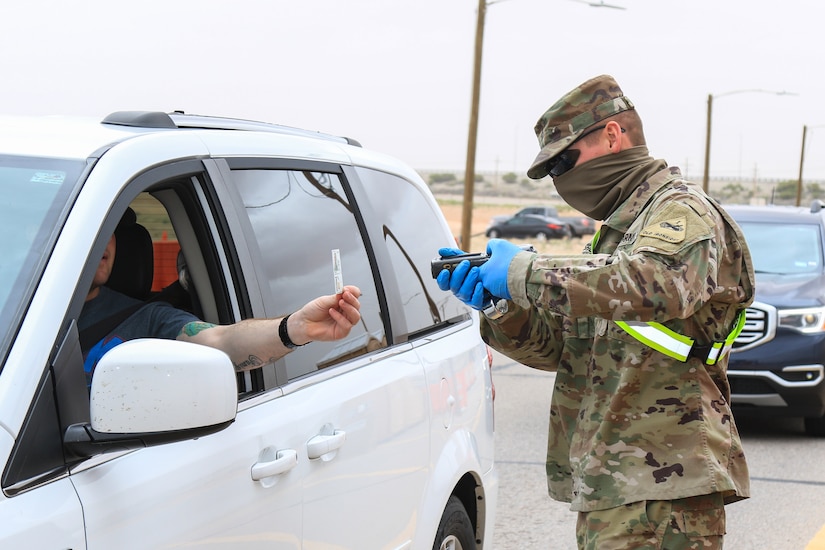
The Defense Department is moving to a tiered COVID-19 testing program to protect service members and ensure they can continue to do the nation's business, the vice chairman of the Joint Chiefs of Staff said.

Air Force Gen. John E. Hyten and Deputy Defense Secretary David L. Norquist described the four-tiered system and all other aspects of DOD's support to civilian agencies against coronavirus during a Pentagon news conference today.

The new system means the department is moving from a diagnostic focus to a diagnostic-plus-screening focus, the general said, noting that DOD now has the means to expand testing to a wider military population. The tiered focus gives priority to the highest-risk forces and will ensure strategic mission assurance, he added.

Tier 1 is testing for those involved in critical national capabilities such as strategic deterrence or nuclear deterrence, Hyten said. Tier 2 will test fielded forces around the world. Tier 3 encompasses forces being forward deployed or those redeploying, and Tier 4 is for all other forces.

Testing will become more frequent as supplies become more available. The military has already started testing those service members in Tier 1, the general said, but he pointed out that testing is not a solution. Service members still must engage in social distancing, wearing masks, washing hands and all other recommendations of medical officials.

The testing is, however, a powerful tool. When used in conjunction with all other preventive measures, it can "improve our overall force availability," Hyten said.

Norquist and Hyten both said the department is adjusting to the new rhythm COVID-19 has enforced on the world. Military and civilian employees continue their missions under the new strictures, including a huge increase in telework. "We now have an estimated 970,000 active duty and civilian personnel teleworking with great success," Norquist said.

For example, the deputy secretary said, the Defense Finance and Accounting Service has 95 percent of its workforce teleworking. "Each month DFAS makes over 5.8 million payments to civilians, active duty, reserve, National Guard and DOD retirees, but because they previously prepared for it and practice extensive telework, they're sustaining regular operations at full capacity," he added.

But some jobs in the military can't be phoned in, and that includes training new recruits, working aboard ships and in cockpits and otherwise working in constrained spaces. The department is working to address those situations, Norquist said.

The department will screen individuals with questionnaires and thermometers to identify people at risk. They will be put in quarantine for 14 to 21 days, depending on the risk tolerance, to identify those who are infected, but are not yet showing it, he said.

"Prior to leaving quarantine, we will conduct a swab test and a temperature check to identify individuals who are infected, but still do not show it. … As the unit then moves to its mission, [we] will keep the group together, but [with] limited outside interaction to prevent introduction of infection from outside."

Again, masks, social distancing, cleaning workspaces and more will continue as the process continues, the deputy secretary emphasized. "These interim measures enable us to reduce the risk," he said. "So we continue to operate until we develop therapeutics and vaccines. And as we learn more about the virus, we will continue to evolve our approach."

DOD Allows Remote Extension of ID Cards


April 22, 2020 | BY JIM GARAMONE , DOD News

Is your military ID card expiring, but with social distancing and various stay-at-home orders in effect, you aren't sure whether you'll be able to renew it?

The Defense Department has changed the process to allow service members and civilians to temporarily extend the life of their cards as the nation battles the COVID-19 pandemic. These extended cards that appear expired on their face can continue to be used for access to benefits, including health care and entry to installations and buildings and to systems and networks.

Matthew P. Donovan, undersecretary of defense for personnel and readiness, and the Joseph D. Kernan, undersecretary of defense for intelligence and security, released the policy changes in memos published April 7 and April 16. The temporary policies are in place through Sept. 30.

The changes allow people to adhere to social distancing practices by updating or renewing their ID cards from their homes with no need to visit an ID card issuing office. Normally, DOD issues between 18,000 and 20,000 ID cards each day at more than 1,600 sites around the world.

Under these new COVID-19 response processes, common access cards, known as CACs, that expire on or after April 16, 2020, and are within 30 days of expiration may have the certificates updated using ID Card Office Online to allow for continued use for logical access through Sept. 30, according to an April 16 Donovan memo. However, officials emphasize that individuals must extend their certificates before the printed expiration date on their CAC.

Individuals must continue to visit an ID card office for first-time CAC issuance, for replacement of a CAC that has already expired, and for CAC PIN resets.

ID card issuance offices will not reissue an ID card simply because of printed changes, the most common being a name change or promotion.

DOD can remotely issue first-time uniformed services IDs — for example, dependent or retiree IDs. DOD also can remotely replace lost or stolen uniformed services dependent and retiree IDs. Remotely-issued uniformed services ID cards will be issued with an expiration date not to exceed one year from the date it's issued. This does not apply to CACs.

Continued use of reserve-component uniformed services ID cards to obtain active duty benefits is authorized for mobilized reservists and their eligible dependents.

For more information go to DOD Response to COVID-19 - DOD ID Cards and Benefits.