Showing posts with label f-16. Show all posts

Tuesday, June 30, 2026

Exercise Venom Forge Strengthens Partnerships, Boosts Combat Readiness

 June 30, 2026 | By Air Force Staff Sgt. Jake Jacobsen, 432nd Wing

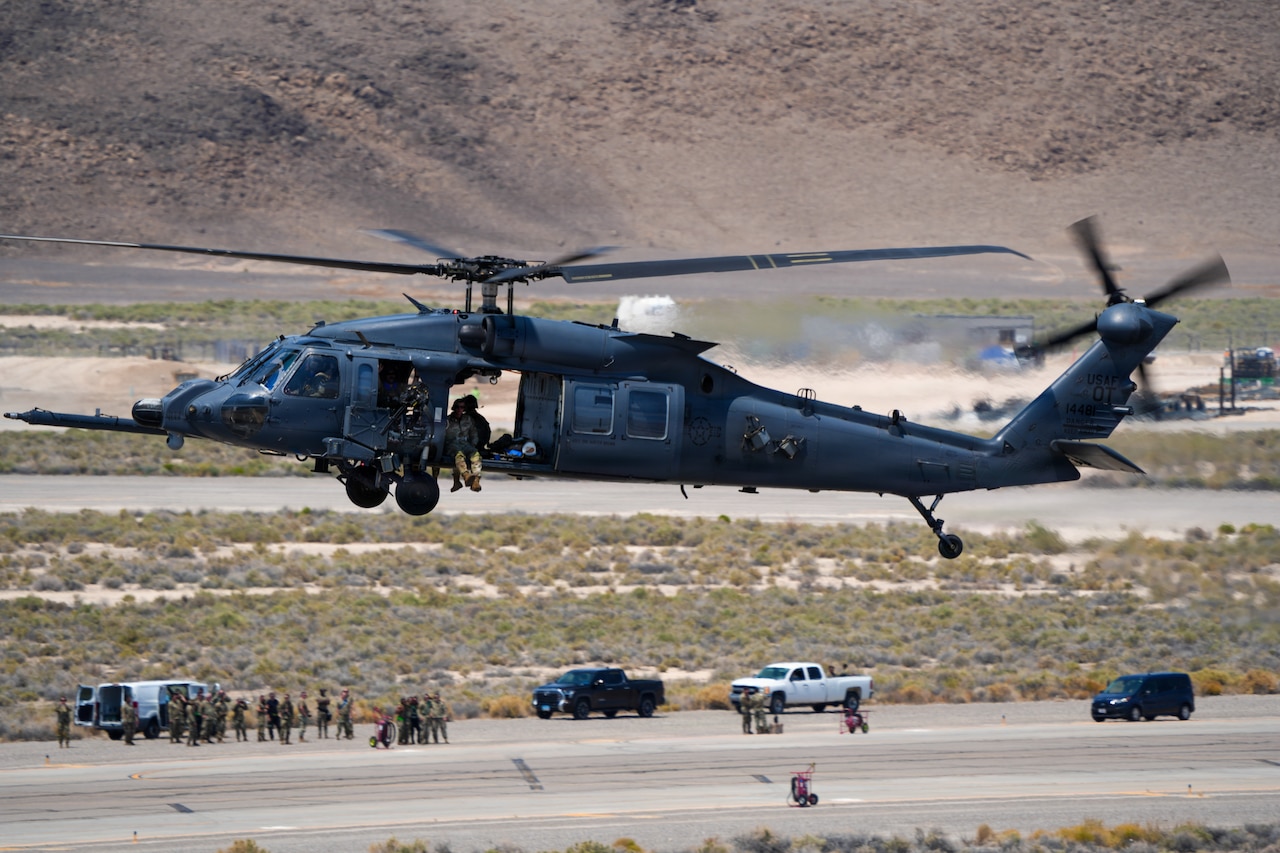
A military helicopter hovers above a flight line as people in military camouflage uniforms stand around on the ground.

An integration exercise designed to develop new tactics, techniques and procedures, combined support from five wings, seven groups and 17 squadrons across a multitude of operations and support at Creech Air Force Base, Nevada, June 17.

Dubbed Venom Forge, this exercise implemented lessons derived from the 57th Maintenance Group's inaugural Agile Maintenance Leadership Course to develop tactical-level maintenance leaders who can build mission-type orders, manage risk, communicate under friction, generate aircraft and create the conditions for combat airpower to happen.

In preparation for the event, mission partners completed a multiplatform hot-pit refueling site certification on base, helping enable contingency hot-pit and integrated combat turn training for multiple fighter platforms. The effort created a foundation for future agile combat employment training iterations.

"Creech [Air Force Base's] support was critical because it gave the capstone an unfamiliar environment and helped turn the course concept into executable training," said Air Force Maj. Yoarmerby Gomez, 57th Maintenance Group maintenance tactics officer. "This exercise required more than ramp space. It required access, support equipment, airfield operations, fuels support, fire emergency services, safety, security, medical response planning, host-base coordination and leadership buy-in."
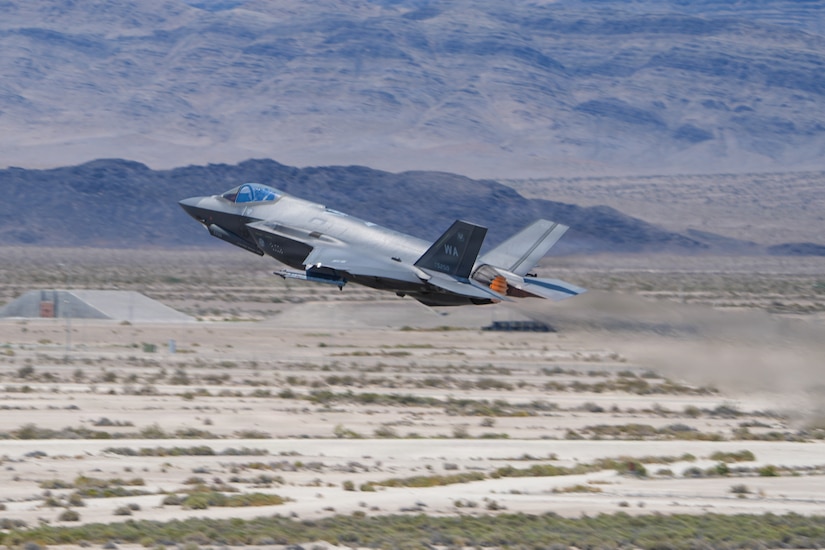
A military jet flies over desert terrain.

To execute the exercise, organizations from the 57th Wing, 99th Air Base Wing, 53rd Wing, 355th Wing and 432nd Wing came together to give students a realistic stage to experience how maintenance decisions affect logistics. The students learned how movement timelines affect aircraft generation, how medical and emergency-response planning affects mission risk, and how base constraints shape execution.

The base provided further support with equipment required for execution, facilitation of access across the installation and aided aircraft integration and operations not part of normal day-to-day mission operations.

"[The base] provided the right balance of proximity, realism and operational value," Gomez said. "It is close enough to Nellis [Air Force Base] to support a controlled hub-to-spoke training model but separate enough to force students to coordinate with a real host base instead of relying on home-station assumptions."

To further test units involved, an inject involving members suffering from simulated heat stroke was enacted, allowing medical teams on HH-60W Jolly Green II helicopters to integrate critical care air transport while aggressor units conducted hot-pit integrated combat turns on F-35A Lightning IIs and F-16C Fighting Falcons.
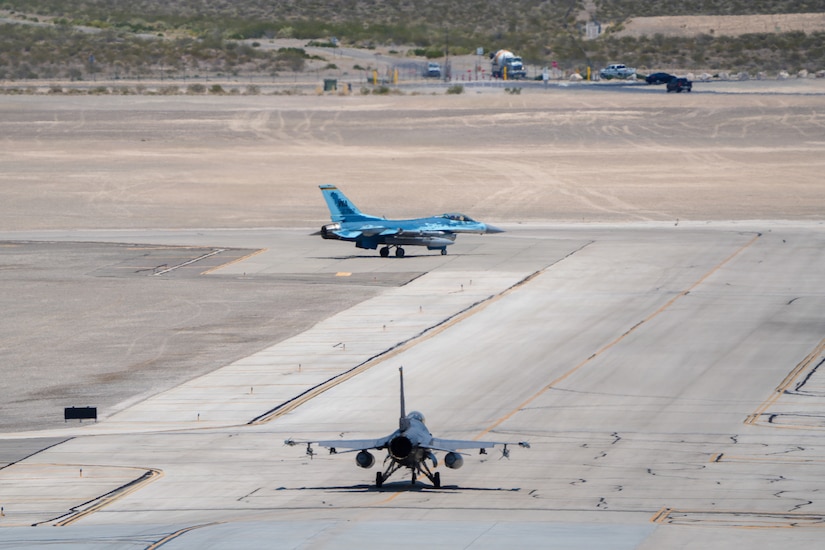
Two military jets taxi on a flight line.

"What made Venom Forge unique was that every organization had its own reason to be there," Gomez said. "One of the clearest examples of the training value was the level of deconfliction required on the airfield. At one point, F-35s and F-16s were being refueled and rearmed while two HH-60s were entering the airspace. These elements of controlled chaos were exactly what we wanted the students to experience. It forced multiple agencies to communicate, deconflict and execute safely in a dynamic environment."

The certification and partnership conducted during the exercise enabled a repeatable foundation for future iterations. These next events could include more students, additional mission partners, different aircraft and more deliberate deconfliction across multiple simultaneous operations.

"For the students, Venom Forge showed that aircraft generation is not just a maintenance action," Gomez said. "Thanks to this exercise, we now have a scalable course model, a stronger relationship with [the base], a multiagency training framework and a better understanding of what it takes to generate combat airpower from a spoke location."

Thursday, September 27, 2012

Carter Visits F-16 International Training School


By Air Force Lt. Col. Christine Rhodes
162nd Fighter Wing Public Affairs

TUSCON, Ariz., Sept. 27, 2012 – Deputy Defense Secretary Ashton B. Carter visited the 162nd Fighter Wing at Tucson International Airport here yesterday to learn about international F-16 Fighting Falcon aircraft pilot training.

The Arizona Air National Guard was one of several stops Carter made throughout the Tucson area.

"It was very good for our airmen to see a senior Department of Defense leader visit our installation," said Air Force Col. Mick McGuire, 162nd Fighter Wing commander. "Dr. Carter left with a strong understanding of our mission and the impact of our global training success."

Carter and his staff met with students and exchange pilots from Iraq, Singapore, Japan, Denmark, Poland, South Korea, Norway and the Netherlands.

Air Guardsmen here train more than 70 international student pilots per year, offering several training programs that range from initial F-16 training to qualify new pilots to an advanced weapons course, officials said.

The 162nd is the "face of the USAF to the world" providing the best-trained coalition warfighting partners for the U.S. Air Force, officials said. The wing has trained pilots from 28 countries that fly the F-16, while developing strategic partnerships and building strong international relationships based on performance, friendship and trust.

Monday, July 02, 2012

Wisconsin National Guard engages community at Rhythm and Booms


By 1st Sgt. Vaughn R. Larson
Wisconsin National Guard

The Wisconsin National Guard howitzers that fire powder charges and the F-16 Falcon fighter jets that fly overhead during the National Anthem at the annual Rhythm and Booms celebration at Madison's Warner Park are more than just show - they are a tangible reminder of the assets, capabilities and missions found in National Guard units in communities across Wisconsin.

"These are real howitzers," Command Sgt. Maj. James Ward of the Wisconsin Army National Guard's 1st Battalion, 120th Field Artillery explained to Mike and Casey McCabe of Madison, Wis., in response to their questions about the four 105-mm cannons lined up at Warner Park June 30. "These are what we would take overseas to war, if needed."

The 115th Fighter Wing also hosted approximately 180 local civic and business leaders and their families at the Wisconsin Air National Guard base in Madison during Rhythm and Booms.

"This is our first event recognizing the Badger Air Community Council, an independent community council that's standing up to support the 115th Fighter Wing Airmen," said Brig. Gen. Joseph Brandemuehl, 115th commander. "It's a great way to demonstrate to local civic leaders and leaders in the community what we have here at the fighter wing - our capabilities, what our mission is, what our people do, and the impact we have on the community."

Among the prominent local business leaders behind the Badger Air Community Council, Brandemuehl said, are Pat Richter, Dave Anderson, Marv Siegert and Dave Lenz. Richter supported the annual Military Achievement Awards when he was an executive with Oscar Mayer Foods, and Lenz retired as a major in the Wisconsin Air National Guard's 176th Tactical Fighter Squadron, a subordinate unit of the 115th Fighter Wing.

"We're trying to show them behind the scenes what goes on - what goes into a fly-by, what goes into an event like this - that there's a lot more behind it than just the jets flying over," Brandemuehl continued. "There's usually about 40 Airmen when you talk about the maintenance side of the house, just to get the jets airborne. It also gives them a slice of what we do on a daily basis Monday through Friday as well."

The event included static displays of an F-16 jet, inert munitions, an F-16 flight simulator, and chairs and sound system for watching the fireworks.

"It's a good way to educate the local people on what an F-16 is," said Maj. Tim Dyer, "and also the munitions we use when we deploy to a foreign location as far as our missions are concerned."

Maj. Mike Palmer, who with Dyer helped organize the event at the 115th Fighter Wing, said the unit was putting greater emphasis on telling its story to the community.

"If you look at the role we play and how efficient we do the job, we're trying to tell that story to the rest of the world," Palmer said. "We know times are tough right now and money's tight, and we think we have a very efficient, highly educated group of people that we want to see continue forward into the future to keep the base open and defend our country at an efficient cost."

"This is our way of showing gratitude for their support," Dyer said.

Back at Warner Park, the public also demonstrated its appreciation for the Wisconsin National Guard, as handshakes and "Thank you for your service" became a common refrain heard near the howitzers.

Tuesday, July 05, 2011

First Moroccan F-16 pilots to complete training with Arizona Air Guard

By Air Force Maj. Gabe Johnson
Arizona National Guard

TUCSON, Ariz. (6/27/11) - Next Month, the Kingdom of Morocco, a strategic partner for U.S. forces in North Africa, will become the 25th country to own and operate F-16 Fighting Falcons. The pilots tapped to fly them are scheduled to finish training here in time to bring them home, July 30.

Four Royal Moroccan Air Force officers, former F-5 pilots, will conclude 15 months of rigorous instruction at the Arizona Air National Guard’s 162nd Fighter Wing; the international F-16 training unit at Tucson International Airport.

They are the first from their country to accomplish consecutive courses in basic qualification, flight lead upgrade and instructor pilot certification in the multi-role fighter.

A handful of Air National Guard pilots will accompany them as they deliver the first four of Morocco’s 24-aircraft purchase.

The new planes, block 52 versions of the fighter, will be fresh off the assembly line and are a considerable step up in technology from the third generation fighters Morocco currently flies.

“We are modernizing our fleet and we’ve chosen the F-16, not only because it is a high-quality airplane, but also because of the close relationship we have with the United States, said Brig. Gen. Abdelali Houari, deputy inspector of the Royal Moroccan Air Force,.

“We are really happy to send our pilots here to be trained. After a year and a half in the United States our pilots are happy, of course they want to return home, but they have gained a lot of experience here with the Arizona Air National Guard.”

Air Force Lt. Col. Steve Haase, the Morocco program manager for the 162nd, worked with the RMAF for the last three years. He’s trained fighter pilots from all over the world and fully understands the scope of the students’ historic accomplishment.

“It’s all them,” he said. “It’s a big commitment to be the first F-16 pilots for Morocco. It’s a testament to their positive attitude and work ethic. They are excited about the F-16 and its capabilities yet they understand how much work there will be to build up an F-16 base.”

As students, the pilots averaged three sorties per week and accumulated more than 150 F-16 hours each. Once home, they will not only be responsible for training others, but will also be instrumental in standing up F-16 operations at Ben Guerir Air Base.

It’s a former U.S. air base located about 36 miles north of Marrakech and once served as a transatlantic abort landing site for the space shuttle. It’s currently undergoing upgrades that, according Moroccan officials, are modeled after U.S. Air Force bases.

“These are the best F-5 instructor pilots for their air force. They think they way we think,” Haase said. “They have really shown that they want to learn how [U.S. fighter pilots] operate with the F-16 so they can do it the same way – not just flying, but everything from maintenance to logistics.”

Six additional Moroccan pilots are currently in the basic F-16 course here with graduation planned for September. They too will return home to help manage Morocco’s growing F-16 fleet.

It's unclear if more student pilots from Morocco will train in Tucson; however, according to Haase, the 162nd stands ready.

“Every country is very different, that’s what’s so fascinating for instructor pilots here,” he said. “We get to know these guys on a personal level and establish trust with them. Training capable fighter pilots and fostering relationships along the way is what this is all about.”

Since 1989, the 162nd has trained with virtually every nation that flies the F-16. In addition to Morocco, the wing currently trains with pilots from Singapore, Norway, Belgium, Chile, the Republic of Korea, and the Netherlands.

Monday, June 27, 2011

Face of Defense: Pilot Supports Ground Fighters

By Air Force Airman 1st Class Daniel Phelps
20th Fighter Wing

SHAW AIR FORCE BASE, S.C., June 27, 2011 – Like many aviators, Air Force Capt. Sarah Eccles, an F-16 Fighting Falcon pilot from San Antonio, caught the flying bug at a young age. On her 15th birthday, her father surprised her by taking her to a Wright Flyers Aviation flight school.

As she sat in the cockpit with the instructor, operating the controls and soaring through the air, Eccles said she realized she'd found her passion.

She began taking flying lessons soon after that test run. At age 17, on March 20, 1999, she experienced her first solo flight.

"It was a little intimidating going airborne, being in charge of this machine," Eccles recalled. "It's a huge responsibility, but such a confidence builder. I thought, if I could do this, what's next?"

After her high school graduation, Eccles attended the Air Force Academy and then two years of pilot training, where she fulfilled her dream and earned her wings as an F-16 pilot. After flying the F-16 for four years, she reached a time all Air Force pilots come to: their Air Education and Training Command lead-in fighter training, forward air controller and air liaison officer tour, also known as an "ALFA" tour.

This tour is a time when Air Force pilots take a break from flying to serve in other, career-broadening roles. Fighter pilots may become instructor pilots, operate remotely piloted aircraft or serve as air liaison officers, providing planning, coordination, and execution expertise to multiservice combat operations.

"The tour is designed to bring experienced flyers away from their main weapons system to other jobs to use their experience and to gain some experience," Eccles said. "The point is for pilots to broaden their careers."

ALFA tours generally are assigned to mid- to senior-level captains, but occasionally pilots will take their tours right after pilot training.

Eccles chose to be an air liaison officer for the 682nd Air Support Operations Squadron here because her husband, Air Force Capt. John Eccles, a 15th Airlift Squadron C-17 Globemaster III pilot, is stationed just a few hours away at Charleston Air Force Base, S.C.

Her responsibility as an ALO is to serve as the link between the Air Force and the Army in combat. Whatever the mission, she is trained to help provide close-air support for ground forces.

Eccles was pleasantly surprised as she stepped away from flying an F-16 and into the role of ALO, she said.

"Being an ALO has been the most personally satisfying job I've had in my career," she said. "Working with the enlisted corps is amazing. As a pilot, you generally don't get to interact with them at this level."

The job, she added, also has given her the opportunity to rest, recharge and redirect her energy.

Through her time as an ALO, she’s had the opportunity to see how the Air Force and the Army relate and work with each other.

Eccles recently returned from a deployment in southwest Asia, where she served as an ALO. Her job was to lead a crew responsible for directing fixed-wing, close-air support assets. At times, missions and priorities would change because ground troops were attacked or ambushed.

The ALO would take "911 calls" and have a map out to organize and plan the close-air support, she said. Eccles was in charge of directing the fighters to the troops on the ground who needed help. She said her close-air support experience as an F-16 pilot came in handy during her deployment.

On an average day, Eccles’ air support operation center would receive more than 20 calls from troops in contact needing close-air support, and, during one day, her team received and handled more than 100 calls from troops.

Because of that day and several other successful coordinated missions, her crew received the 2010 Air Combat Command Team of the Year award.

"Our proudest moment there was being able to help out those who were in the thick of it," Eccles said.

The experience gave her a better understanding of the process that goes into providing close-air support, she said. It’s knowledge she will able to take back to her fighter squadron.

The captain said she will miss being an ALO when her tour is over, but she is excited to be back in the air. She wishes it were possible to do both.

"Of course I've missed flying," Eccles said. "I'd be lying if I said it wasn't hard to watch the same planes I used to command fly overhead and hear the jets rattle the windows. I know I've done it before, and I'll do it again. My experience allows me to share my love of flying with the 682nd."