Showing posts with label Fort Rucker. Show all posts

Wednesday, July 29, 2026

Fort Rucker's Unmanned Advanced Lethality Course Ramps Up Tactical Drone Training

The Unmanned Advanced Lethality Course at Fort Rucker, Alabama, is pushing forward with a series of updates aimed at strengthening tactical proficiency and meeting student expectations, said Army Staff Sgt. Mario Rostran, the course's noncommissioned officer in charge, and Army Chief Warrant Officer 3 Robert Gatta, the course manager.
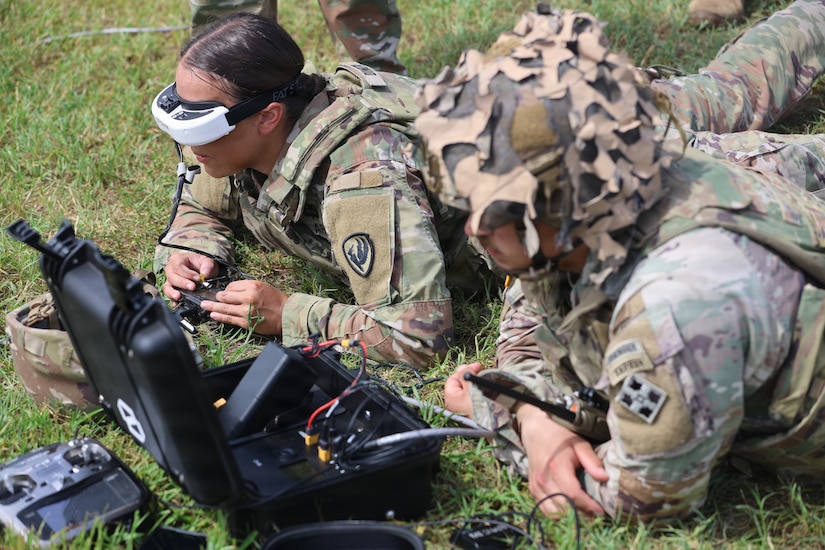
A woman wearing a camouflage military uniform and a tactical headset is lying in the grass in the prone position while a man in similar attire and a helmet looks at a computer screen.

Rostran said the leadership team is focused on refining instruction in response to student feedback to ensure the course delivers the advanced-level rigor it promises.

"We're continuing to improve the course," he said. "We're taking comments as we go and making sure [that] we're meeting the standards students expect. The goal is to make this the advanced course it claims to be."

Working alongside the team, Gatta is helping expand hands-on training and strengthen tactical application throughout the program.

"The most significant update is increasing the amount of physical, kinetic engagements from five to 12," he said. "We have been working to refine the overall course to run smoother and provide the most up-to-date data."

To meet the demand for advanced instruction, the course is shifting to a more tactical framework. Gatta noted the class will complete a culminating exercise this week at the drone training facility in Daleville, Alabama, marking a new experience for the students.

"This exercise will demonstrate a more real-world tactical environment and incorporate a close-quarters battle level of training, whereas previous emphasis has been heavily placed on outdoor live flights," he said. "Our current goal is to make the training more tactical in nature. I believe we have several solid plans to build on moving forward."

During this iteration of the course, students conducted live-engagement training using a purpose-built attributable system, the Shank 1.0, and C-4, a versatile plastic explosive. The event allowed students to apply lessons learned by flying the system, coordinating altitude and executing tactical employment against a designated target.

Army Sgt. 1st Class Riley Watts, assigned to Company A, 1st Battalion, 14th Aviation Regiment, spent months trying to enroll in the course. He said attending has given him a clearer view of how unmanned aircraft systems fit into the future of Army aviation.

"This is a great course to keep you relevant in today's force," Watts said. "Seeing how UAS is being implemented and utilized in today's Army is eye-opening, and it shows you how important it is to understand these systems."
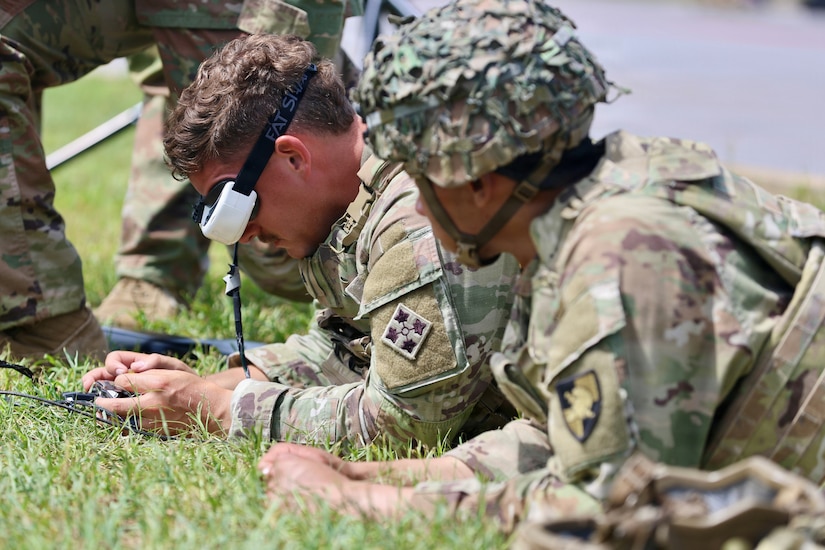
A man wearing a camouflage military uniform and a tactical headset operates a controller while lying in the grass alongside another man in similar attire who is watching.

Matthew Baldwin, a civil engineering major at the U.S. Military Academy, is attending to take tactical drone employment strategies back to the academy's future applied systems and tactics team. His leaders pushed to send two cadets to the course to expand their understanding of drone employment and to share that knowledge when they return.

Baldwin, who hopes to commission into the air defense artillery branch, said the course offers a perspective that will be important to future Army operations.

"One of the big questions is how to counter drones effectively," he said. "You're talking about sending a very expensive rocket to take out a cheap drone. Understanding drones from the operator's side, how they fly, what they look for, helps you understand how to counter them."

Although he arrived with limited tactical flying experience, he said the hands-on instruction has significantly boosted his confidence.

"I didn't know how to tactically fly. It's a completely different flying style," Baldwin said. "I feel better flying them, and now we're trying to develop a training program to help build other pilots on our team."

Beyond flying, Baldwin highlighted the value of the course's mission-planning segments.

"I've really appreciated the planning side, [the military decision-making process], troop-leading procedures, what goes into reconnaissance," he said. "I hadn't learned a lot of that yet. Going into my [fundamentals of small-unit operations] class and eventually into the Army, my knowledge base is definitely better now."

The Unmanned Advanced Lethality Course runs six times per fiscal year, providing recurring opportunities for soldiers seeking advanced UAS training. Upcoming course dates are Sept. 14-Oct. 2, and Nov. 2-20.

Monday, November 24, 2025

Army Aviation Soldiers Begin Training With Stalker UAS at Fort Rucker

Army aviation soldiers began training with the VXE30 Stalker uncrewed aircraft system at Fort Rucker, Alabama, Nov. 18, in preparation for equipment fielding next month.  

This system incorporates observations from the modern battlefield, including reduced noise and visual signature, vertical takeoff capability and cost-saving munitions technology — underscoring the Army's push to integrate cutting-edge systems into training at Fort Rucker and Fort Huachuca, Arizona.

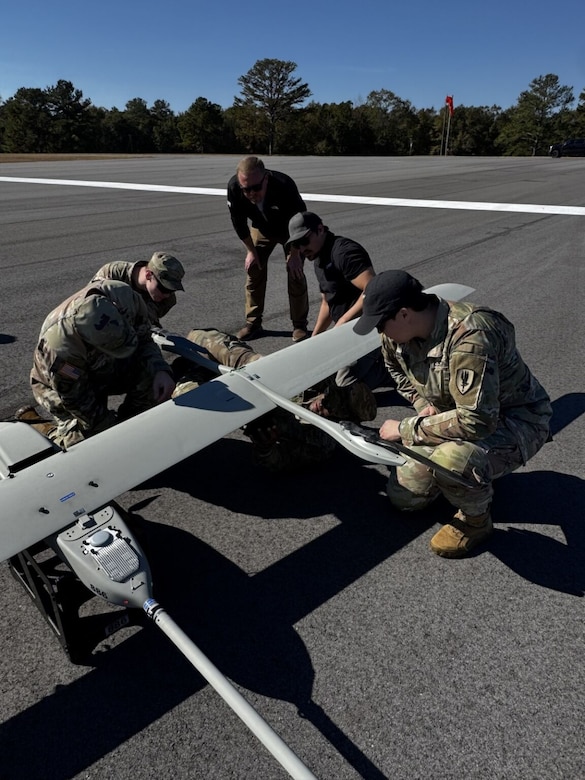
Five people in camouflage attire and some in casual attire kneel on the ground outside, inspecting a small aircraft.
Army Maj. Wolf Amacker, UAS and Tactics Branch chief of the Army Aviation Center of Excellence's Training and Doctrine Directorate, said the event represented a milestone in training the Army's layered reconnaissance strategy. 
 
"This is the first time in years that we will be utilizing a Group 2, almost Group 3 size UAS in support of an Army course at Fort Rucker, since before the Shadow was really employed," Amacker said. 
 
The War Department categorizes UAS into Groups 1 through 5 based on weight, normal operating altitude and speed. Group 1 UAS are small, weighing 20 pounds or less, and operate below 1,200 feet above ground level at speeds of up to 100 knots. Group 2 UAS have a maximum takeoff weight between 21 and 55 pounds, operate below 3,500 feet above ground level and fly at speeds under 250 knots. Group 3 UAS, which included the Army's RQ‑7B Shadow, weigh between 56 and 320 pounds at takeoff, operate up to 18,000 feet above mean sea level and fly at speeds under 250 knots. 
 
The Stalker aircraft is built on a modular open systems approach and can adapt to new sensors, payloads and technologies to support changing operational needs. 
 
Amacker noted that the Army Aviation Center of Excellence's 1st Aviation Brigade identified the Stalker during the recent UAS summit. It moved quickly to acquire the system for training, ensuring students gain hands‑on experience with the latest reconnaissance technology. 
 
Army Maj. Rachel Martin, director of the Air Cavalry Leaders Course and Unmanned Advanced Lethality Course, emphasized the Stalker's flexibility compared to legacy systems.
 
"This system can take off and land vertically like a quadcopter, then transition to forward flight where it goes deadly silent," Martin said. "Its reduced visual and acoustic signature makes striking a target at 300 feet very likely, something that wasn't possible with louder systems, like the Shadow."

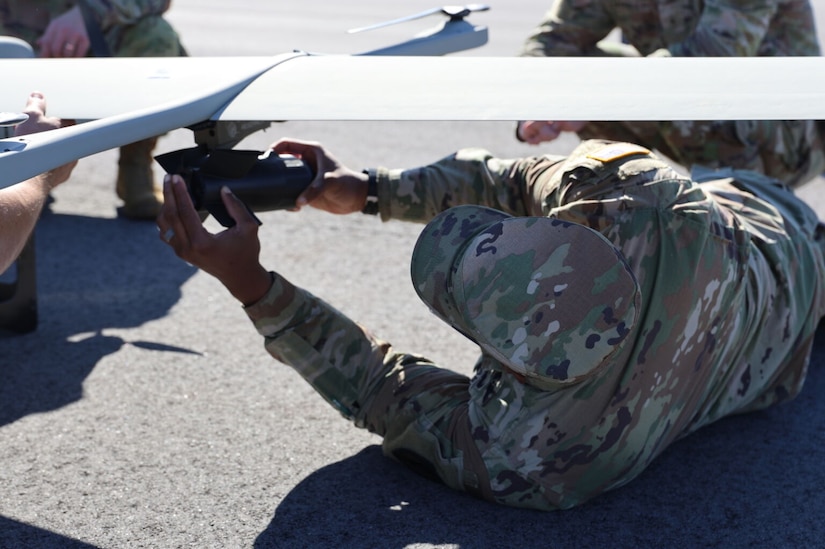
A person in a camouflage military uniform lies on the ground outside, under the wing of a small aircraft, to attach an item.

 
The system integrates into the Army's Common Lethality Integration Kit, allowing soldiers to select warheads at the user level and employ both newly designed payloads and existing munitions, such as 81 mm mortars. 
 
"What's great about this is that it's modular and fits on multiple [uncrewed aircraft systems]," Martin said. "It's a cheaper solution that can be rapidly reproduced." 
 
Martin noted the dramatic cost difference compared to traditional systems.  

"Instead of a Hellfire missile costing $100,000 to $150,000 per round, this solution costs about $800," she said. "That disparity is significant, and it reflects lessons from the Ukrainian fight, where cheaper solutions are proving decisive." 
 
Amacker added that the Army is exploring ways to print training rounds in‑house, further expanding opportunities for instruction while reducing reliance on traditional procurement systems. 
 
"This is the Army thinking outside the box," Martin said. "We're leveraging commercial technology to meet immediate needs in a faster, more affordable way." 
 
Training with the Stalker is scheduled to begin in December, ensuring instructors can incorporate the system into courses and prepare soldiers to employ it in tactical missions at the battalion and brigade levels.

Wednesday, August 27, 2025

Paratroopers Make History With Army's First Drone-on-Drone Strike

 Aug. 27, 2025 

By Army Capt. Jennifer French, 173rd Airborne Brigade

For Army 1st Lt. Francesco La Torre, the Army's first drone-on-drone strike wasn't exactly a Hollywood moment. 

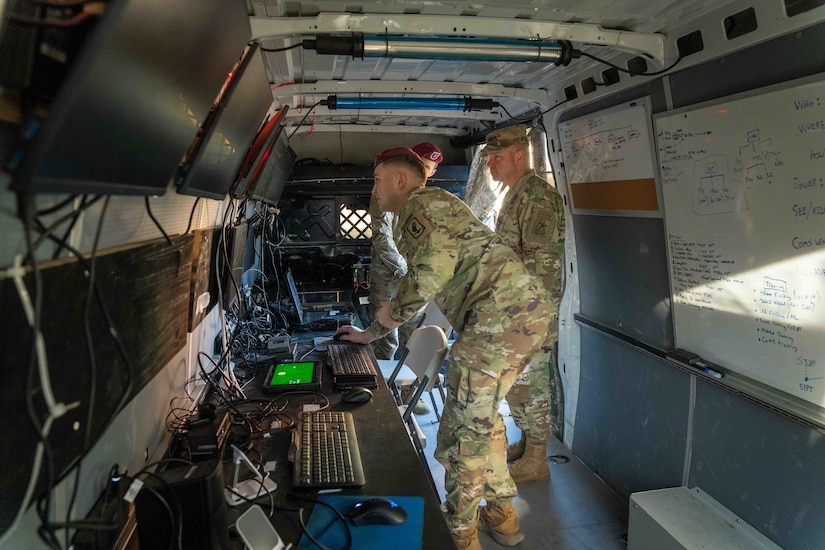
A man in a camouflage military uniform looks at a computer screen while moving a mouse. Another soldier in similar attire looks at the screen. Both men and another soldier in the background are standing in a long vehicle with a line of computers and monitors on the left side.
"In [the Star Wars movie], 'A New Hope,' Luke Skywalker flies an X-Wing through the Death Star trench and blows it up," La Torre said. "This wasn't like that. It was way harder. Honestly, it felt more like Darth Vader shooting down rebel pilots. He might be the villain, but he's also one of the best pilots in the galaxy." 
 
That was the image in La Torre's mind as his team with the 173rd Airborne Brigade achieved a milestone once unimaginable for conventional Army units: destroying an aircraft in flight using a first-person-view drone carrying an explosive charge. 
 
The strike took place earlier this month during the Army's Unmanned Aerial Systems and Launched Effects Summit, held Aug. 11-15 at Fort Rucker, Alabama. The live-fire event was led by the brigade's bayonet innovation team in partnership with the Pennsylvania Army National Guard and engineers from Army Combat Capabilities Development Command. 

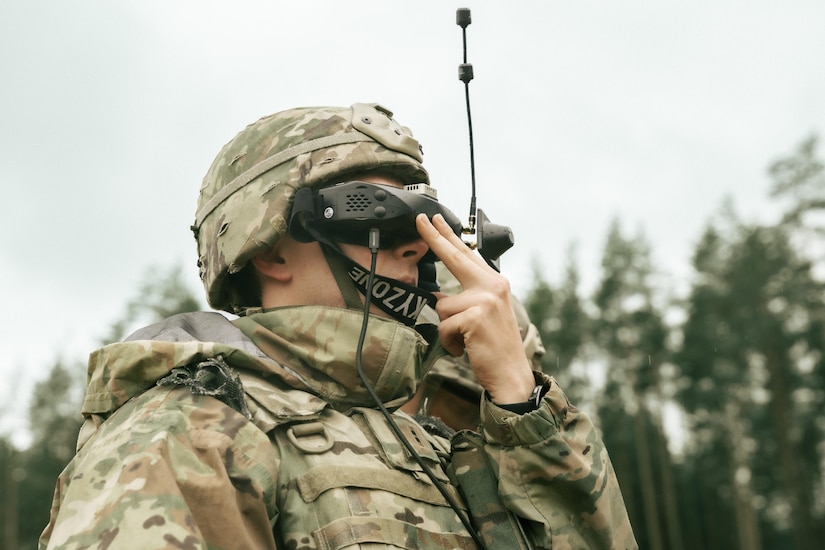
A soldier in a camouflage military uniform and helmet adjusts tactical goggles on his face.

 
"When I heard [Army] Chief [Warrant Officer 2] Nate Shea say, 'Arming,' when he was lined up behind the fixed wing threat UAS, I knew he'd take it down," La Torre said. "A few seconds later he detonated the claymore [mine], and I looked up from my end-user device to see the fixed-wing [aircraft] drop out of the sky." 
 
The success came after weeks of training. Paratroopers flew for hours each day, building muscle memory while rehearsing how to engage a fast-moving aircraft. Army Chief Warrant Officer 2 Andrew Topits familiarized himself with the fixed-wing platform a month in advance, while Shea practiced with inactive claymores. Once on the ground at Fort Rucker, the operators flew daily in changing weather, preparing for a target that could appear anywhere across the range. 
 
Technical skill proved as important as piloting. 
 
"The ability to train and solve problems immediately afterwards was critical to mission success," La Torre said. "The team was soldering, disassembling, reassembling and performing [quality assurance] around the clock while rehearsals were underway. While tactical units and technicians may not share the same language, they do share an intellectual curiosity and desire to succeed." 
 
La Torre emphasized what it means for the average paratrooper. 

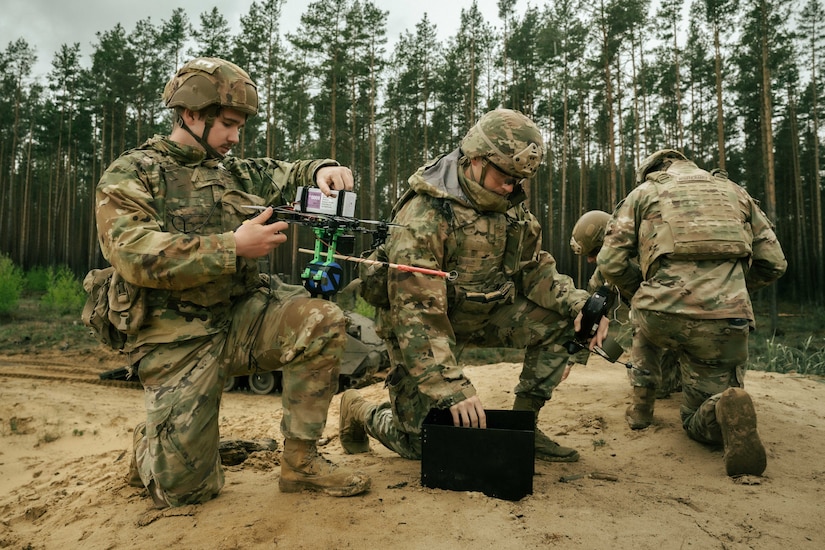
A group of soldiers in camouflage military uniforms kneel in the sand. A soldier on the left is holding a drone, while the soldier to the right is holding a remote. There are trees in the background.

 
"With the right kit, paratroopers will be able to utilize a low-cost system with preexisting munitions to execute a wide variety of mission tasks — and have the power to protect their unit from an endemic threat," he said. 
 
The drone demonstration showed that innovation doesn't have to come from the top. 
 
"It feels extremely satisfying to have this level of impact, but solving these kinds of problems should not be alien to junior officers, or any leader," La Torre said. "Every year the Army produces leaders at all levels who are better educated now than ever before. At the end of the day, rank is immaterial when it comes to problem-solving." 
 
For La Torre, the milestone reflects how far the 173rd Airborne Brigade has come. 

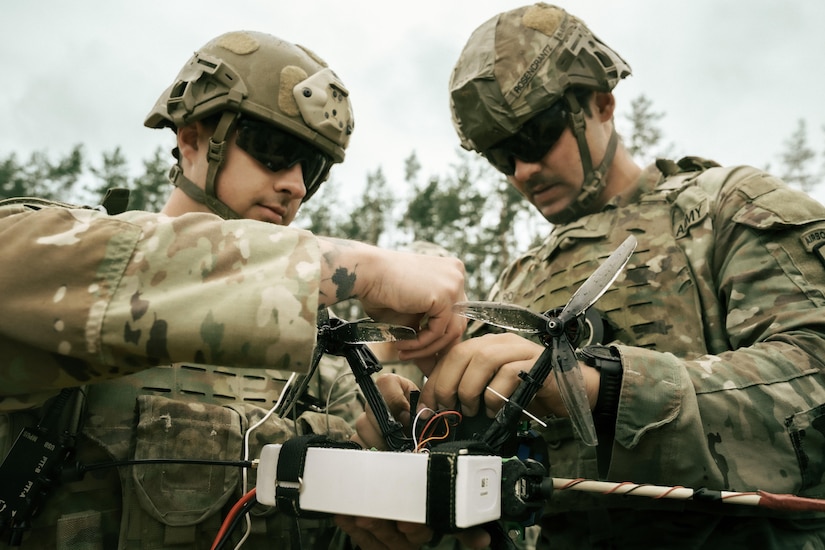
Two soldiers in camouflage military uniforms work on a drone.

 
"At this time last year, this kind of training was a pipe dream for conventional units," he said. "For the engagement itself, Chief Shea did an incredible job and so did Chief Topits. It's such a difficult mission profile for both aircraft." 
 
Lessons from the bayonet innovation team fed directly into Fort Rucker's new lethal UAS course, directed by Army Capt. Rachel Martin and Army Maj. Wolf Amacker. The course consolidates milestones within the Army's UAS community and serves as a hub for education and experimentation. 
 
"The more testing and experimentation we do, the less we must teach theoretically and the more we can back claims with real data," La Torre said. "Safe and effective experimentation allows commanders to understand the true nature of the risks they assume with these systems and helps make this training more commonplace." 
 
For La Torre, the boundaries are clear: safety and scalability. 
 
"We must safely conduct training, testing and experimentation," he said. "We also must make sure everything we do is exportable to other units so they can do the same. I'm confident what we've done is scalable, and the lethal UAS course at Fort Rucker will centralize the growth of lethal UAS engagements while also serving as a hub for subject matter experts to gather and exchange lessons learned."