Monday, February 14, 2011

George Washington Sailors Meet Arizona Cardinals Cheerleaders

By Mass Communication Specialist 3rd Class David A. Cox, USS George Washington Public Affairs

YOKOSUKA, Japan (NNS) -- Sailors aboard USS George Washington (CVN 73) gathered on the forward mess decks for a chance to meet the Arizona Cardinals cheerleaders during their visit to the ship Feb. 7.

Kaylee, one of cheerleaders, said that being able to go out to Japan and meet the Sailors aboard George Washington was a new and rewarding experience for her.

"We are here to lift the spirits of our Sailors because we appreciate everything that they do," said Kaylee. "We are very grateful from the bottom of our hearts for what they do and we wanted to bring them a piece of home."

The cheerleaders visited the ship's bridge, hangar bay, medical facility, and mess decks where they signed posters and took pictures with Sailors.

"In the year that I have been aboard George Washington, this visit has been one of the highlights," said Aviation Machinist's Mate Seaman Sherman King. "This was something to look forward to, especially with a lot of us stuck on the ship for duty while everyone else is out enjoying the Super Bowl."

"Even though my favorite football team is the Dallas Cowboys, this is still something that I can brag to my family and friends back home about," said King. "How many people can claim that they got to interact with real NFL cheerleaders."

George Washington is the Navy's only permanently forward-deployed aircraft carrier, ensuring security and stability across the western Pacific Ocean.

During the Super Bowl, Sailors aboard the ship were able to watch the game in the ship's mess decks and wardrooms. The ship's leadership also provided chicken wings, pizza and sodas for the Sailors to enjoy during the game.

MCB Quantico Breaks Ground on New Child Development Center

By James Johnson, NAVFAC Washington Public Affairs

QUANTICO, Va. (NNS) -- A groundbreaking ceremony was held Feb. 9 for a new child development center (CDC) on board Marine Corps Base (MCB) Quantico, Va.

Managed by Naval Facilities Engineering Command (NAVFAC) Washington, the 31,710 square foot facility will address a critical need for Marines and their families, providing services for up to 290 children aged six weeks to six years.

NAVFAC Washington awarded a $15 million contract to BIG-DESBUILD, Inc. May 10, 2010. Construction is scheduled for completion Nov. 15, 2011.

Col. Daniel Choike, commander, MCB Quantico spoke at the event and directed a portion of his remarks to Capt. Ramé Hemstreet, commanding officer, NAVFAC Washington.

"Thank you and your team for everything that was done to see this project through to get it to this particular point," said Choike. "I know that you'll be looking very closely because I know you understand and your team understands how important this project is to our families."

Existing CDCs at MCB Quantico are at capacity, which requires some personnel assigned to MCB Quantico to find in-home child-care solutions or private child care providers. The new facility will be large enough to accommodate these families.

"We're extremely excited to see this project completed so that we can provide additional child development services for all of our authorized patrons," said Chris Bennett, MCB Marine Corps Community Services deputy director during the event.

The one-story building will feature classrooms, offices and storage spaces, as well as kitchen and laundry areas. An outdoor recreation area with athletic fields, playground equipment, and lighting will be built. The building will comply with anti-terrorism/force-protection requirements.

A unique feature will be a photovoltaic system on the structure's roof, which is expected to provide approximately 30 percent of the building's electrical demands.

"We all have to be really happy and motivated in terms of what this particular project means to this installation," said Choike. "I think as base commander, with all the people that I have that work on base in support of Marines and their families, this I think is right up there in terms of the importance of what it means to take care of our Marine families through the care and education and certain programs we have through our child development centers."

For more news from Naval Facilities Engineering Command, visit www.navy.mil/local/navfachq/.

USS Blue Ridge Hosts Philippine Navy Engineers

By Mass Communications Specialist 3rd Class Brian A. Stone, USS Blue Ridge Public Affairs

MANILA, Republic of the Philippines (NNS) -- Sailors aboard 7th Fleet command ship USS Blue Ridge (LCC 19) welcomed Philippine navy sailors into the ship's engineering department for a professional development exchange.

Blue Ridge engineers demonstrated the use of damage control equipment, U.S. Navy firefighting techniques and gave a tour of the ship's boilers and engine room.

Machinists Mate 2nd Class Pierre Angeles, a boiler technician of the watch, discussed U.S. Navy methods of conventional engine operation and maintenance, as well as propulsion theory with hands-on demonstrations.

A native of the city of Marikina, Philippines, Angeles said knowing the culture and local language of Tagalog made it easier to interact with the tour guests and to share experiences.

"It feels great to see our counterparts here," said Angeles. "We rarely have an opportunity to do something like this."

Damage Controlman 2nd Class William Julian demonstrated the use of firefighting equipment to the visiting sailors during damage control drills.

"I think they learned a lot today," said Julian. "I always think it's good for to work with other militaries like this. It lets us understand each other better and get to know how they work in the same kind of environment."

Ensign Ranier Ybañez, a Philippine sailor assigned to the Philippine navy's Headquarters, Assault Craft Force, said he was particularly interested in learning about the way the U.S. Navy organizes damage control training.

"I've been learning a lot from the Americans," said Ybañez. "We've learned a lot today that we can take back and teach to our troops on our own ships."

Blue Ridge serves under Commander, Expeditionary Strike Group 7/Task Force (CTF) 76, the Navy's only forward deployed amphibious force.

CTF 76 is headquartered at White Beach Naval Facility, Okinawa, Japan, with an operating detachment in Sasebo, Japan.

Blue Ridge is the flagship for Commander, U.S. 7th Fleet.

Officials Invite Spouses to Share Employment Ups, Downs

By Elaine Wilson
American Forces Press Service

WASHINGTON, Feb. 14, 2011 – Defense Department officials are inviting military spouses to air their state licensing issues and concerns as part of an overall effort to boost spouses’ education and career opportunities.

The department has created a discussion board where spouses can describe their experiences -- both good and bad -- with state licenses and certifications as they move from state to state.

“We’d like to eliminate barriers that would enable spouses to pursue their goals, and licensure is a major barrier to spouses as they seek careers,” Aggie Byers, senior policy analyst with the Spouse Education and Career Opportunities program, told American Forces Press Service.

One-third of employed military spouses are in career fields that require a state license, such as some health care professionals, teachers, accountants, pharmacy technicians and medical billers, explained Ed Kringer, director of state liaison and educational opportunity for the Pentagon’s office of military community and family policy.

Officials often encourage military spouses to pursue portable careers, since they may offer easier paths to employment in new locations. However, spouses are running into some issues as they move from state to state, Kringer acknowledged.

A license that’s valid in one state isn’t always valid in another, he explained, rendering spouses unable to work until they can complete the licensing requirements for their new state of residence.

Compounding the issue, some states have stringent application processes or the board may only meet once every three to four months. If spouses miss one board, they’ll potentially have to wait months for another. In worst-case scenarios, some states don’t endorse another state’s license at all, leaving those spouses back at square one in the licensing process, Kringer said.

“The process can be confusing, time-consuming, expensive, and can leave spouses out of the job market for long periods of time,” he said. “We realize that a spouse may only be [in a state] for two to three years, and will be missing six months or more of work.”

This lack of employment can have a snowball effect, he noted. States often require people to demonstrate reasonable competency, which entails expertise gained on the job. A spouse, for example, may be required to have worked two out of the past four years in a career to obtain a license. But military spouses who lived overseas for several years, or in a small town with limited career opportunities, may not be able to meet this requirement, he added.

To counter these issues and others, Defense Department officials are working with states to streamline processes and eliminate licensing barriers, Kringer said.

Officials have focused past efforts on easing the transition process for registered nurses and teachers. For example, Kringer said, officials have worked with states over the past several years on a licensure compact that will ease state-to-state transitions for registered nurses. For teachers, he added, they’ve been asking states to accept one specific certificate across the board rather than requiring a new certificate in each state.

However, only about 11 percent of working spouses are registered nurses or teachers, according to the current population survey, Kringer noted, so officials are working to minimize the challenges facing spouses in all portable careers.

Efforts to institute change already have paid off, he said.

Colorado, for example, passed an endorsement bill last year that’s speeding up the licensing process for military spouses, Kringer said. Colorado has a regulatory agency that oversees 77 different careers that require a license. The legislation gives the agency’s director authority to grant endorsements without board approval, eliminating sometimes lengthy waits for a board to meet. Additionally, the state now accepts continuing education units in lieu of experience, he added.

More than 25 other states have similar regulatory agencies, he said, and officials are hopeful they’ll pass similar bills once they learn of Colorado’s success.

Also last year, Florida passed a bill that enables military spouses with a valid license from another state to automatically obtain a temporary six-month license, Kringer said. This gives spouses the opportunity to seek employment while filing for their permanent license, he explained.

The state also has developed a process to expedite the required background check. Rather than several weeks or months, spouses can have their background checks done in a week.

But despite these efforts, Kringer said, officials know they may be missing an issue or potential solution. “We don’t know if we’re doing it perfectly,” he acknowledged. “We made educated guesses that helped frame these initial efforts, but now we need to hear from spouses.”

Kringer encouraged spouses to use the discussion board so officials can better direct their efforts. They’d like to hear what problems spouses are facing or have faced, he said, and they’re hoping to learn from success stories as well.

The discussion board, he added, also can serve as a source of information to others. Spouses can learn from someone else’s lessons learned, for example.

Although officials hope for extensive input, Kringer cautioned that spouses shouldn’t expect personalized responses. The discussion board isn’t intended to fix individual issues with states, he explained, but rather is an opportunity to offer feedback to ensure officials are moving in the right direction. “This isn’t going to be a quick process, but over the years we should make good headway,” he said.

Leaders understand how disruptive frequent military moves can be to a career, Kringer noted.

“There are benefits, but it’s disruptive,” he said. “And no matter how well we work this, we can’t make it so it’s not disruptive. But we want to minimize that disruption as much as possible.”

This effort is part of an overall, interagency effort to increase spouse employment opportunities, Byers explained, noting that spouse employment was one of the key issues identified in a White House report released last month titled “Strengthening our Military Families: Meeting America’s Commitment.” The report not only identified key issues military families face, but also presented the programs and resources government agencies plan to launch in the coming months to address them.

For example, the Treasury and Defense departments are working together to release a report on licensing and credentialing practices faced by military spouses.

“Spouse education and employment matters because it leads to their fulfillment,” Byers said. “If they feel fulfilled professionally … they’ll have a greater chance to thrive while serving the nation.”

People can find more information about spouse education and career opportunities, including free career counseling, on the Military OneSource website.

U.S. Navy, Coast Guard Reach Out to Mariners to Improve Boater Education

By Chief Mass Communication Specialist (SW/AW) Mary Popejoy, Commander, U.S. 2nd Fleet Public Affairs

NORFOLK, Va. (NNS) -- U.S. Navy and Coast Guard leaders met with local mariners who own or operate a marina in the vicinity of Little Creek and Fishermans Cove, Va., to discuss naval vessel protection zones, Feb. 10.

The meeting focused on naval vessel protection zones, and how they can work together to increase safety and security, and improve recreational boater education and awareness.

The Coast Guard and Navy recently conducted a review of operations in the Little Creek inlet as a result of routine interactions between recreational boaters and Navy warships transiting the inlet channel.

The review revealed there are significant benefits and opportunities to continuously improve and further develop a strong partnership with the recreational boating community to reduce small vessel risk.

"To prevent a Cole-style attack we need to be able to detect the small vessel threat," said U.S. Coast Guard Cmdr. Jerry Barnes, chief, Coast Guard Sector Hampton Roads Prevention Department. "Naval vessel protection zones assist us in that endeavor, which is why we do education and outreach initiatives that focus on naval vessel protection zones. In the Little Creek channel, compliance with the naval vessel protection zone means a boater must exit the channel when a Navy warship is approaching."

According to 14 United States Code 91, vessels within 500 yards of a U.S. naval vessel must operate at the minimum speed necessary to maintain safe course and proceed as directed by the official patrol, and are not allowed within 100 yards of a U.S. naval vessel. These zones are necessary to provide for the safety and security of the U.S. naval vessels in the navigable waters of the U.S.

"By maintaining these required distances, the military can focus on other elements that may pose a threat to our military vessels," said U.S. Navy Cmdr. Michael Brunner, commander, U.S. Second Fleet anti-terrorism officer. "If we're all on the same page, the mariners can enjoy their time on the water and the military can transit without any issues."

In addition to maintaining a safe distance away from military vessels, those in attendance discussed ways to increase outreach effectiveness such as renewing the focus on vessel-to-vessel communication via the Very High Frequency radio, loud hailer, ship whistle, etc.; shore-to-vessel communication through the use of prominently displayed signs; and leveraging existing partnerships to include the local Area Maritime Security Committee, the Coast Guard Auxiliary, state and local law enforcement agencies, the U.S. Power Squadron and local yacht clubs.

"The USCG marina owners/operators also made several suggestions to improve the outreach program by including an offer to post a number of informational signs at the boat ramps and access way to their boat slips, to keep the message current with the boaters," said Brunner.

As the local Coast Guard and Navy leaders and mariners who own or operate a marina in the vicinity of Little Creek and Fishermans Cove, Va., partner together to improve boater education and outreach initiatives of naval vessel protection zones, the overall goal is to ensure safe travels on the waterways.

"They have a central role in homeland security, and their ideas and input can help us strike the right balance between personal freedom, national security, recreation and commerce," said Barnes. "At the end of the day, we want the local mariners to enjoy their time on the water, but we also want them to keep in mind the requirements in place for military vessels."

Atlas Drop

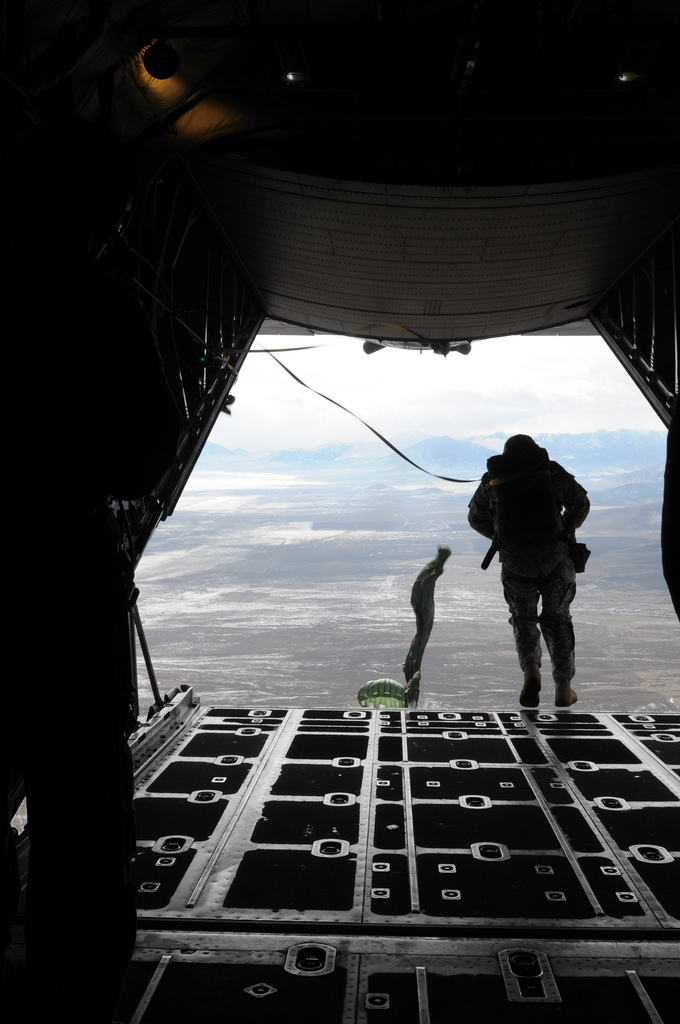
A Utah Guardmember from the 197th Special Troops Company (A) jumps from a C-130 aircraft as part of Operation Atlas Drop. Atlas Drop is an annual joint aerial-delivery exercise that brings together U.S. Army personnel with counterparts from the Uganda People's Defense Force.

‘Don’t Ask’ Repeal Training Set to Begin

By Jim Garamone
American Forces Press Service

WASHINGTON, Feb. 14, 2011 – Training will begin shortly for experts in certain specialties and leaders as part of the plan for finalizing repeal of the law that bars gay men, lesbians and bisexuals from serving openly in the military, the chief of staff for the Defense Department’s repeal implementation team said here today.

Marine Corps Maj. Gen. Steven A. Hummer outlined the process in an interview.

President Barack Obama signed the repeal of the law commonly known as “Don’t Ask, Don’t Tell” Dec. 22, beginning a process that will culminate in full repeal.

The current policy remains in effect until 60 days after the secretary of defense, the chairman of the Joint Chiefs of Staff and the president certify the military’s readiness to implement the repeal.

Gates has said he wants repeal done expeditiously and effectively, and that it can happen this year.

Clifford L. Stanley, undersecretary of defense for personnel and readiness, issued a memo Feb. 10 to the military secretaries on the implementation plan. “The memo continues the pre-implementation process,” Hummer said. Now, the general added, the team is ensuring all the policies are prepared so that when repeal day actually occurs they will go into effect.

The implementation team also is ensuring that training is in place for all 2.2 million members of the military.
The Defense Department, along with representatives from all five services, developed and synchronized the training..

“The services will each put their colors and their appropriate culture into those [plans],” he said. “The Navy will talk about petty officers, and the Marines will talk about sergeants.”

Training is broken into three tiers. “Tier 1 and Tier 2 training will start in earnest soon,” the general said. Tier 1 training is for people who have unique skill sets, such as chaplains, lawyers, personnel specialists, military investigators and recruiters, he explained. Tier 2 training is for leaders, and Tier 3 training is for the force at large.

“This is leader-led training,” Hummer said. “Our over-arching theme is leadership, professionalism, discipline and respect.”

Leaders at every level will be responsible for training their people, he said. “Professionalism is the expectation across all the services,” Hummer said. “This is a disciplined force, and we expect to see that as the training and repeal go into place. Lastly, respect is what everybody expects to receive and what everybody should give.”

The training will include some PowerPoint presentations with vignettes to encourage discussions, as well as presentations by the service chiefs that will introduce the topic and provide their intents for the forces.

The services will deliver the first of many progress reports to Stanley on March 1.

USS New York Holds First Change Of Command Ceremony

By MC1 COREY LEWIS, USS New York Public Affairs

NORFOLK ,Va. (NNS) -- The crew of USS New York (LPD 21) celebrated the ship's first change of command Feb. 11.

Cmdr. William Herrmann relieved Cmdr. Curt Jones as Commanding Officer of the USS New York at a change of command ceremony held aboard the ship at BAE Systems Shipyard on Friday.

The landing platform dock, built with 7.5 tons of World Trade Center steel, recently passed a vigorous Final Contract Trials certification by the Board of Inspection and Survey.

"I could not have asked for a better group of friends or shipmates," said Jones in an emotional goodbye to the crew. "It has been an honor to serve with you."

The change will not take much getting used to for the crew. Herrmann most recently served as New York's Executive Officer before fleeting up to his new job. He has also served as Executive Officer of the USS Whidbey Island.

In attendance were former Secretary of the Navy Gordon England, his wife Dotty, who is also the ship's sponsor, and Admiral James A. Winnefeld Jr., Commander Northern Command. Winnefeld, the event's guest speaker, was the Commanding Officer of USS Cleveland (LPD 7) in the late 1990s while Jones served as the ship's chief engineer.

"Bringing a new ship to life is like owning a brand new house," said Winnefeld. "It's exciting and painful all at the same time. And this being a new class makes it all the more interesting."

Jones was Captain of the ship when she was commissioned in New York City in November of 2009. His next tour will be in Washington, D.C.

Ceremony Honors Service of African Americans in Korean War

By Terri Moon Cronk
American Forces Press Service

WASHINGTON, Feb. 12, 2011 – African Americans fought against Communism during the Korean War of 1950-53 to protect the rights of individuals, even as their own civil rights were denied at home, the Defense Department’s top equal opportunity official said here yesterday.

Speaking during a Pentagon ceremony to honor African American veterans of the Korean War, Ronald M. Joe, acting director of the Office of Diversity Management and Equal Opportunity, said America now remembers the contributions of African American veterans during the war sometimes called “The Forgotten War” or the “The Forgotten Victory.”

“Yours is a distinguished generation in the history of African American military service,” Joe said to a group of seven Korean War veterans in attendance. “You belong to a legacy older than the Declaration of Independence, one that includes the legendary service of the Massachusetts 54th in our Civil War, the Buffalo Soldiers in the West, the 92nd Division and the Tuskegee Airman of World War II.”

For too long, he said, the service of African Americans during the Korean War was forgotten, “but it should be clear to all of you that you are forgotten no more.”

Joe said the armed forces has played a pivotal role in the nation’s pursuit of equity for all Americans, following  President Harry S. Truman’s 1948 Executive Order 9981, which called for the end of segregation in the military.

The Korean War “interrupted” work to desegregate all-black units, so many of those units went into the conflict.

It was when fighting intensified in Korea that the armed forces realized they had “a manpower problem,” Joe said. Increasingly, large numbers of black American draftees and volunteers were in the training pipeline, but no more room existed in the segregated units.

Joe said Army studies showed “integration was a more efficient policy than segregation.” The result, he said, was that “Black Americans were individually assigned to units on an as-needed basis, and the Army began working toward true integration.”

The last two years of the Korean War, after all-black units were disbanded and ended segregation in the U.S. military, African Americans had served in command positions, in elite units such as combat aviation, and served in a variety of technical specialties, Joe said.

The military began a social movement, he said, that served as a model or the nation and as a pattern for other military organizations. The armed force has made impressive progress toward equality, but work is yet to be completed, because women and minorities are still under-represented, Joe added.

A number of other speakers made brief remarks at the ceremony, including members of a panel of Korean War veterans; South Korean Defense Attaché Brig. Gen. General Lee, Seo Young; and Frank Martin, producer of “For the Love of Liberty: The story of America’s Black Patriots.” The audience watched a 15-minute segment of Martin’s four-hour documentary.

Today’s Black History Month observance stems from the Department of Defense 60th Anniversary of the Korean War Commemorative Committee, created by Congress to honor the service and sacrifice of Korean War veterans, their families and those who lost loved ones in the conflict.

Family Members of 1st Navy Pilot Attend Navy Centennial Events

By Communication Specialist 2nd Class (SW/AW) Joseph H. Moon

SAN DIEGO (NNS) -- The daughter and several descendants of the Navy's first aviator visited Naval Air Station, North Island for the base's open house and the Centennial of Naval Aviation's Parade of Flight event for a tour of the facilities and an A-1 Triad demonstration, Feb. 11 and 12.

Elizabeth Gordon Ellyson Carmichael, 89, the last surviving child of Navy Aviator #1 Lt. Theodore Gordon Ellyson, and her family provided a living historical connection to the past of Naval Aviation, said Centennial Parade of Flight Air Boss Lt. Cmdr Ed Chandler.

"I'm aviator number something too big for me even to remember, and he was Naval Aviator number one; the first guy brave enough to go out there and be taught how to fly a Navy airplane," Chandler said.

Family members of the pioneering aviator expressed their appreciation for the attention given to Ellyson.

"We grew up with legends and stories of T.G. Ellyson, so it is neat to see what he was doing 100 years ago at this location, and it has been fun participating," said Tony B. Court, 58, grandson of Ellyson.

Court would later have an opportunity to assist in the preparation of an A-1 Triad demonstration, helping to wheel a replica of the plane his grandfather flew to its launch point in the San Diego Bay. While the replica A-1 Triad did not become airborne, it did skim around the bay, while the family and other observers watched. Ellyson made history when he flew the Navy's first A-1 Triad in its maiden flight in Hammondsport, N.Y.

"The plane is amazing, we've assembled three branches of the family to witness this event and it's one we will certainly remember," said Court.

This event marks the first time some of the family have been to any kind of air show or seen a functional A-1 Triad.

"I'm very impressed that my grandfather flew such a frail plane and did so well at it," said
Bill Court
, 61,grandson of Ellyson. "Being able to see this first hand for the first time, I realize what an incredibly great man my grandfather was," he said.

Touring the flight line and viewing some of the more modern aircraft, the family got to see the evolution of Naval Aviation from that frail A-1 to advanced F-18s.

"One hundred years really isn't that long of a time period when you think about it," said aspiring
Naval Aviator T. Gordon Ellyson Court
, 17, named after his great-grandfather. "When you look at all these Navy fighter planes and aircraft and then see that my great-grand father was the first one to start this whole new business, it is amazing when you think about it."

In 2011, the Navy is observing the Centennial of Naval Aviation with a series of events nationwide celebrating 100 years of heritage, progress and achievement in naval aviation.

For more news from Commander, Naval Air Forces, visit www.navy.mil/local/airpac/.

Golf Tournament Commemorates Centennial of Naval Aviation

By Mass Communication Specialist Seaman Christopher Farrington, Navy Public Affairs Support Element West

CORONADO, Calif. (NNS) -- More than 240 participants took part in a special golf tournament Feb. 11 at the Sea 'N Air Golf Course aboard Naval Air Station North Island (NASNI), Calif., in honor of the Centennial of Naval Aviation (CoNA) celebration taking place in the San Diego area.

The Tournament was sponsored by Commander, Navy Region Southwest's Morale, Welfare and Recreation (MWR) program.

"Putting a tournament of this caliber together is a hard task," said Jim Higgins, NASNI Golf Director. "But I'm glad to have been able to bring this many retired and active duty service members together to celebrate CoNA."

The four-person team tournament included complimentary range balls, goodie bags and prize drawings.

A commemorative CoNA plaque and four $200 MWR gift certificates were given to the first place team. Awards were also presented to the second and third place teams, as well as to the competitors who were closest to the pin and had the longest drive.

"Golf brings officers and enlisted together, which is what aviation is all about," said Dan Smith, a retired Navy senior chief petty officer. "Teamwork and unity is necessary in aviation, all the way from the air crewman up to the pilot, so a four-man team tournament is perfect to celebrate 100 years of naval aviation."

Commemorating 100 years of progress and achievement in naval aviation, CoNA is a year-long tribute to the scope of all naval aviation activities including aircraft, people, ships, innovations and significant milestones.

The highlight of San Diego area CoNA events is the Feb. 12 Open House and Parade of Flight at NASNI featuring more than 75 historic aircraft, ship tours, static display aircraft, and a classic car show.

For more news from Navy Public Affairs Support Element West, visit www.navy.mil/local/pacensandiego/.

This article was sponsored by Military Writers.

Newly-Elected Senator Visits COMUSNAVSO/C4F Headquarters

From U.S. 4th Fleet Public Affairs

MAYPORT, Fla. (NNS) -- The commander of U.S. Naval Forces Southern Command and U.S. 4th Fleet (COMUSNAVSO/C4F) welcomed a U.S. senator to COMUSNAVSO/C4F headquarters during his tour of Naval Station Mayport, Fla., Feb. 11.

Rear Adm. Vic Guillory, COMUSNAVSO/C4F, welcomed Sen. Marco Rubio, a Florida-native who served in the Florida House of Representative from 2000 to 2008.

During that period, Rubio served as a majority whip, majority leader and speaker of the house.

During Rubio's visit, he had the opportunity to step inside the Maritime Operations Center, where he received a brief by Capt. Michael Jacobsen, COMUSNAVSO/C4F's chief of staff.

Jacobsen talked about the command's maritime operations in the U.S. Southern Command's (USSOUTHCOM) area of responsibility (AOR), as well as the functionality of deployed assets in support of the several exercises conducted throughout the AOR.

"I was really impressed with the tour of U.S. 4th Fleet's facilities - I had a lot of questions about their area of operations," said Rubio. "I came away with a better understanding of our Navy's involvement with South America and how it directly impacts our national security and economic interests."

After a brief stop in Guillory's office, Rubio departed COMUSNAVSO/C4F headquarters to continue his tour of the naval installation with Capt. Douglas F. Cochrane, Naval Station Mayport's commanding officer.

COMUSNAVSO is the naval component command for USSOUTHCOM and is responsible for all naval personnel and assets in the AOR. COMUSNAVSO conducts a variety of missions in support of the U.S. Maritime Strategy, including theater security cooperation, relationship building, humanitarian assistance and foreign disaster response, community relations and counter-illicit trafficking operations.

For more information, visit www.public.navy.mil/comusnavso-c4f, on Facebook at www.facebook.com/NAVSOUS4THFLT or on Twitter at www.twitter.com/NAVSOUS4THFLT.

For more news from U.S. Naval Forces Southern Command & U.S. 4th Fleet, visit www.navy.mil/local/cusns/.

This article was sponsored by Military Books.

SECNAV Presents Three Silver Stars to Naval Special Warfare Sailors

By Mass Communication Specialist 2nd Class Dominique M. Lasco, Naval Special Warfare Command public affairs

CORONADO, Calif. (NNS) -- The secretary of the Navy (SECNAV) presented three Silver Star Medals to Naval Special Warfare (NSW) Sailors during a visit to NSW commands, Feb. 11.

Ray Mabus presented the awards to recognize the actions of Senior Chief Special Warfare Operator (SEAL) Jared Tuxill, Chief Explosive Ordnance Disposal Gerardo Sosa and Chief Special Warfare Operator (SEAL) Joseph Molina, while they were deployed to Afghanistan in direct support of Operation Enduring Freedom.

"The awards that I presented today recognize uncommon heroism and uncommon valor," said Mabus. "It shows the skill level, the dedication and the patriotism, and its one of the best things I get to do - to recognize the people for what they do for us."

While the awardees were acknowledged for their courageousness and nerve in combat, they were both humbled and honored to receive their awards directly from the SECNAV.

"It's an honor to have the secretary of the Navy award me the Silver Star," said Sosa. "I'm sure he has a lot on his plate; for him to make the time to be here today means a lot. It's a reflection of all the hard work everybody in our community has accomplished."

The Silver Star is awarded for gallantry in action against an enemy of the United States, while engaged in military operations with a friendly force. It is the fourth highest military honor that can be awarded to a member of the U.S. Armed Forces, and the third highest awarded for valor.

Three bronze stars with combat "V" were also awarded to Molina, Lt. Cmdr. John Green and Chief Special Warfare Operator (SEAL) Thomas Shea, for their actions while deployed in support of Operation Enduring Freedom.

The Bronze Star is awarded for bravery, acts of merit, or meritorious service. It's the ninth-highest military award in the U.S. Armed Forces and the fourth-highest combat award given for bravery.

The valor device, or combat "V," establishes the award as resulting from an act of heroism in combat.

Since 9/11, NSW personnel have been awarded 77 Silver Stars and 765 Bronze Stars for their contributions in Iraq and Afghanistan.

After the ceremony, Mabus was presented with a memento boat paddle by Rear Adm. Garry Bonelli, deputy commander Naval Special Warfare Command; to commemorate the event.

For more information on Naval Special Warfare visit www.seal.navy.mil.

Air Force Casualty

The United States Fire Administration (USFA) has received notice of the following firefighter fatality:

Name: Derek Kozorosky
Rank: Airman First Class
Age: Pending
Gender: Male
Status: Career
Years of Service: Pending
Date of Incident: 02/11/2011
Time of Incident: 1800hrs
Date of Death: 02/11/2011
Fire Department: 18th Civil Engineer Squadron
Address: Kadena Air Base, APO AP 96368
Fire Department Chief: Brig. Gen. Ken Wilsbach

Incident Description: Airman First Class Kozorosky passed away at the Camp Lester Naval Hospital following a vehicle mishap. Details for the fatal incident are pending a full investigation by authorities.

Incident Location: Kadena Air Base, Japan.

Funeral Arrangements: Pending
Memorial Fund Contact and Address: Pending
Tribute is being paid to Airman First Class Kozorosky at http://www.usfa.dhs.gov/fireservice/fatalities/

To date, 18 firefighter fatalities have been reported to USFA in 2011; 16 from incidents that occurred in 2011 and two from a previous year’s incident.  Year-to-date monthly and annual USFA firefighter fatality reports are posted online @ http://www.usfa.dhs.gov/fireservice/fatalities/statistics/ff_stats.shtm

Sunday, February 13, 2011

USS Ronald Reagan Celebrates Namesake's 100th Birthday

By Mass Communication Specialist 3rd Class Alexander Tidd
USS Ronald Reagan Public Affairs

USS RONALD REAGAN, At Sea (NNS) -- Sailors and Marines aboard USS Ronald Reagan (CVN 76) celebrated what would have been President Ronald Reagan's 100th birthday Feb. 6 while underway for a joint task force excersise.

Reagan past away June 5, 2004 at the age of 93.

The ceremony featured a cake-cutting, the singing of "Happy Birthday," and speeches from Sailors personally affected by the accomplishments of Ronald Reagan throughout his lifetime.

"I was born in Transylvania Feb. 6, 1976, and first became familiar with Ronald Reagan through his western movies," said Quartermaster Seaman Ingrid Devin-Kayne. "I didn't know then that he would impact my life so greatly. To share my birthday with the man who dedicated himself to spreading democracy throughout the world means more to me than I can say."

After immigrating to America, Devin-Kayne enlisted in the Navy because she wanted to give back to her country. When the option to serve aboard USS Ronald Reagan arose, Devin-Kayne said she jumped at the chance.

"I asked to come to Ronald Reagan from 'A' school but there were no guarantees," she said. "It was the perfect place for me to be. I'm so happy to have gotten the chance."

Devin-Kayne said she has taken many lessons from the life of Ronald Reagan she now applies to her every day job on the carrier.

"He taught me to communicate with people, to learn and listen," she said. "But most of all, he taught me to fulfill what I say I will do. I like the ship's motto, "Peace through Strength," because it says exactly how to do that—to be strong but keep your cool."

Another Ronald Reagan Sailor greatly influenced by the ship's namesake is Master-at-Arms 1st Class (EXW) Kevin Fahlund, who also spoke at the ceremony.

"For me, Ronald Reagan's impact began a long time ago," he said. "I graduated high school in 1986 and joined the Navy. [Once Reagan was commissioned], I asked to come here, it was something I wanted to do. I wanted to be a part of this family."

With the birth of his daughter, Fahlund made Ronald Reagan's legacy a part of his personal life also.

"I named my daughter Reagan because, as the man himself said, 'freedom is never more than one generation from extinction,'" said Fahlund.

As the crew enjoyed birthday cake in celebration of the legacy of America's 40th president, Devin-Kayne continued to reflect on Reagan's impact on her life.

"Learning English with the help of his western movies was only the beginning," she said. "He taught me that if I have a dream, to never give up. If I make a mistake, I learn from it to get better. He's the reason I'm here in the United States and I'll never forget the impact he had on my life."

The Ronald Reagan Carrier Strike Group is comprised of USS Ronald Reagan, guided-missile cruiser USS Chancellorsville (CG 62) and Destroyer Squadron (DESRON) 7, which includes USS Preble (DDG 88).

Embarked Carrier Air Wing (CVW) 14 includes the "Black Knights" of Strike Fighter Squadron (VFA) 154, the "Argonauts" of VFA-147, the "Blue Diamonds" of VFA-146, the "Death Rattlers" of Marine Fighter Attack Squadron (VMFA) 323, the "Black Eagles" of Airborne Early Warning Squadron (VAW) 113, the "Cougars" of Tactical Electronic Warfare Squadron (VAQ) 139, the "Providers" of Carrier Logistics Support Squadron (VRC) 30 and the "Black Knights" of Helicopter Anti-Submarine Squadron (HS) 4.

Legendary Comic Visits Deployed Carl Vinson

By Mass Communication Specialist 2nd Class Byron C. Linder, USS Carl Vinson (CVN 70) Public Affairs

USS CARL VINSON, At Sea (NNS) -- Sailors on board Nimitz-class aircraft carrier USS Carl Vinson (CVN 70) welcomed a comedian and prop comic aboard Feb. 10 during the ship's deployment to the 5th Fleet Area of Responsibility (AOR) in support of Operation Enduring Freedom.

Leo Gallagher, noted for his signature "Sledge-O-Matic" sketch involving smashing objects with a large mallet, made a long journey during the course of a week for his first visit to a U.S. Navy ship.

"I went to Okinawa, then to Tokyo, then I flew 11 hours to Istanbul, five hours to Bahrain and two and a half hours here. I don't know if I've been up all night or if I've had a long day," said Gallagher. "I like being on the ship. This is a floating city."

Gallagher began his first day aboard Carl Vinson meeting with Sailors in their work spaces. Gallagher finished his first day with a visit to the ship's Medical Department to observe a simulated casualty response.

Gallagher met the Sailors of Aviation Intermediate Maintenance Department (AIMD) in the hangar bays and jet shop and then took the opportunity to meet Carl Vinson Sailors on the aft mess decks for two autograph and photo sessions Feb. 11. At , he took the stage in Hangar Bay 2 to perform his signature show with hundreds of Sailors in attendance. The hour-long routine involved jokes and Gallagher's prop comedy, with several Sailors invited on stage to participate in the sketches.

Aircrew Survival Equipmentman 1st Class (AW) Jamie Faulkner, a Joliet, Ill., native assigned to Carrier Airborne Early Warning Squadron 125, expressed his appreciation for being able to meet the comic.

"You gotta love it. It's a big morale booster to make that extra effort to make us happy," said Faulkner. "Things change with the younger generation, and to have someone who's been around as long as Gallagher was a different flavor but there's still good humor. Our day check and night check were both able to show up."

Aviation Ordnanceman 3rd Class Brandon Trusty, a Nashville, Tenn., native assigned to Weapons Department, was excited to meet a comedic influence.

"I do some stand-up comedy myself, and Gallagher was the first comedian I watched. I was nervous standing next to him and taking a picture," said Trusty. "When I was little, I just saw a guy smashing watermelons and stuff on stage, and that was cool to see. Then I got older and started listening to the jokes, and I realized what he was all about. He carries an old-school comedy style, and it's surprising how funny that can still be."

With Sailors like Trusty working to directly support Carl Vinson's air operations in Afghanistan, the opportunity to take a break and have some fun was welcome.

"For anyone, this is a morale booster. I work on the flight deck, and it's a stressful place. This is a complete break from that," said Trusty.

Gallagher expressed his appreciation for the opportunity to perform for Sailors.

"I wanted to visit some Americans who were not in America, and entertain them where they were. They're appreciative, polite, and deserve to have entertainers come out and brighten their day, so I'm out here doing my part," said Gallagher.

For Gallagher, one highlight was listening to the stories of Sailors growing up and experiencing his work.

"I like hearing they appreciate me coming out. I appreciate when they tell me they saw me when they were kids. They heard their first dirty jokes from me, or their dad used to sit with them and watch my shows. I have some new material, and I figure why make a video when I can tell it to them live," said Gallagher.

Gallagher's trip to the carrier was coordinated by Navy Entertainment. Carl Vinson and embarked Carrier Air Wing 17 are deployed to the 5th Fleet AOR to support theater and maritime security operations.

This article was sponsored by Military Books.

Friday, February 11, 2011

Service Secretaries Receive 'Don't Ask' Repeal Plan

By Karen Parrish
American Forces Press Service

WASHINGTON, Feb. 11, 2011 – Pentagon officials today sent the Defense Department’s implementation plan for repeal of the law commonly known as “Don’t Ask, Don’t Tell” to the service secretaries with a March 1 deadline for their first progress update.

Clifford L. Stanley, undersecretary of defense for personnel and readiness, issued the plan, which outlines the stages of action, including those actions that must be completed before the department reverses the policy barring people who are gay, lesbian, or bisexual from serving openly in the military.

During a Jan. 28 news conference on the implementation plan’s progress, Stanley stressed that Defense Department officials had coordinated closely with the Army, Navy, Air Force, Marine Corps and Coast Guard to craft a plan designed to ensure the continued smooth operation of the services during repeal.

“We are fundamentally focused right now on our leadership, professionalism, discipline and respect,” he said.

The plan issued today closely follows previously released guidance on implementing repeal. The plan does not give dates for the implementation phases; defense officials repeatedly have said the process will be “conditions-based” and will go forward based on the services’ progress, including the training of their people and updating policies.

Defense Secretary Robert M. Gates’ initial guidance stressed the importance of “strong, engaged and informed leadership” at every level to implement the repeal, which he said should take place “properly, effectively, and in a deliberate and careful manner.”

“This is not, however, a change that should be done incrementally,” the secretary’s guidance said. “The steps leading to certification and the actual repeal must be accomplished across the entire department at the same time.”

The pre-repeal phase of the plan released today, now under way, focuses on training the force and setting up channels for services to report progress to the Pentagon and the White House. The Defense Department distributed training toolkits to the services Feb. 4.

Defense officials said all of the services participated in developing the training, and each can adapt the basic package. Training materials are designed to be usable in low bandwidth and nontraditional training settings, and include presentation slides with narration, scripts, frequently asked questions, vignettes, DoD policy guidance, Supplemental Plan for Implementation and Service specific material. Training is centered around the themes of Leadership, Professionalism, Discipline and Respect.

The plan directs the services to submit reports every two weeks, beginning March 1, on units and people trained and regulations updated.

Preparation for certification will begin when, in addition to other objective and subjective criteria, all policies are updated and the first two tiers of service member training are complete. The first tier includes policy makers, chaplains, lawyers and counselors, and the second covers commanding officers, senior noncommissioned officers and senior civilians. The plan also stipulates that prior to certification tier three training for all remaining service members must be under way, with a preparation in place for training completion.

Certification will culminate in the secretary of defense and chairman of the Joint Chiefs of Staff certifying to the president, as commander in chief, that the department is ready to implement the repeal. By law, when the president, secretary and chairman have all certified the services are ready for the policy change, a further 60 days must elapse before the new policy takes place.

During implementation, the services will continue tier three training, begin sustainment training, and monitor the effects of implementation. The services and Defense Department also will continue to prepare progress reports.

The plan outlines ongoing sustainment to begin after repeal, during which policy reviews, training programs and monitoring assessments will continue and be refined as needed.

6th Fleet Commander Visits Enterprise

From Enterprise Strike Group Public Affairs

USS ENTERPRISE, At Sea (NNS) -- Commander, U.S. 6th Fleet, visited USS Enterprise (CVN 65) to meet with senior carrier strike group (CSG) leadership, and to thank the crew at the beginning of their deployment, Feb. 4.

Vice Adm. Harry B. Harris, Jr., and Command Master Chief (AW/SS/SW/FMF/DV/PJ) Jay R. Wood Jr., command master chief of U.S. 6th Fleet headquarters; flew aboard the deployed aircraft carrier as the CSG continued theater security cooperation efforts in the Mediterranean.

"What you are doing is important," said Harris. "You have already visited Portugal and will soon arrive in Turkey, and these visits are important to our nation and important to 6th Fleet. Later, you will be supporting our combat troops in Afghanistan in the 5th Fleet [area of operations]. I applaud you for your energy and I thank you for your service."

The leaders toured the ship and met with Sailors and Marines to thank them personally for their efforts in support of the deployment.

During the ship's recent stop in Lisbon, the ship invited more than 1,000 guests to the ship for a reception, tours and media visits during the four-day visit. The crew participated in three community relations projects, and senior military commanders from both countries held briefings and meetings discussing military-to-military capabilities, while the crew took in the sights and sounds that their host nation provided.

Enterprise Strike Group consists of Enterprise, the guided-missile cruiser USS Leyte Gulf (CG 55), the guided-missile destroyers USS Bulkeley (DDG 84), USS Barry (DDG 52) and USS Mason (DDG 87), USNS Arctic (T-AOE 8), Carrier Air Wing 1 and Destroyer Squadron 2.

For news regarding Enterprise Strike Group's deployment, visit the USS Enterprise Facebook page at www.facebook.com/USS.Enterprise.CVN.65.

Program Collects Protective Equipment to Save Lives

By Cheryl Pellerin
American Forces Press Service

WASHINGTON, Feb. 11, 2011 – A joint program charged with collecting the personal protective equipment of soldiers, airmen, sailors and Marines killed in action is working to save future warfighters’ lives.

The Joint Trauma Analysis and Prevention of Injury in Combat Program links the Defense Department medical, intelligence, operational and materiel-development communities.

Known as JTAPIC, the program is part of DOD’s Medical Research Program for the Prevention, Mitigation and Treatment of Blast Injuries, established in 2006. JTAPIC was created the same year.

The two organizations work together to integrate combat, medical and materiel-analysis information to prevent and mitigate future warfighter injuries by changing tactics or improving equipment, John Uscilowicz, the program’s deputy manager, told American Forces Press Service.

The goal, Uscilowicz said, is to better understand warfighter vulnerabilities to threats and guide the improvement of tactics, techniques and procedures on the battlefield. Program partners include the Army National Ground Intelligence Center, the Office of the Armed Forces Medical Examiner, Program Executive Office Soldier, the Army Research Laboratory, the Army Aeromedical Research Laboratory, the Army Institute of Surgical Research, the Maneuver Center of Excellence Naval Health Research Center, and the Marine Corps Systems Command.

The work starts on the battlefield, Uscilowicz explained, with an event that kills or injures warfighters. Information flows from after-action reports to the program’s operational intelligence partners, he said, “who gather as much information from the field as possible” about mounted operations and dismounted patrols.

Back at the program office, medical information is matched to data about the combat injuries and what personal protective equipment the warfighter was wearing at the time.

A critical element of the data gathering involves getting damaged personal protective equipment back from the battlefield and examining it along with the combat and medical data, Uscilowicz said.

“This has proven to be a real challenge,” he said.

For soldiers killed in action, body armor sometimes comes back with them to the Armed Forces Medical Examiner. For others, or for those who are wounded or fired on and hit but protected by their body armor, collection teams in Afghanistan and a few left in Iraq help to get the damaged equipment back to the United States for analysis.

At Program Executive Office Soldier at Fort Belvoir, Va., Army Col. William Cole, program manager for soldier clothing and individual equipment, is a JTAPIC partner.

“We partner with JTAPIC when the equipment is returned to the states, either at Dover or to the Mortuary Affairs Effects Collection Center at Aberdeen,” Cole said. “When the protective equipment is evacuated to them, they can look at it first and compare what happened with the equipment [to] what happened to the body. Afterward, they let us have the equipment to do further analysis.”

For example, he said, analysts perform a metallurgical analysis on any fragments in the equipment and look at X-rays and CAT scans of the equipment.

Advertising in dining halls, mailrooms and convenience shops helps to increase success in collecting the protective equipment, Cole said.

“We don’t expect to get 100 percent of the damaged equipment back from the field, just because of the nature of war,” he said. “It’s always somewhat chaotic, and leaders on the ground have to make decisions about where to place their priorities.

“Getting every last bit of protective equipment back isn’t realistic,” Cole added, “but I think the more we can advertise it and the more we can explain to soldiers how the things we learn help us make even better equipment in the future, the more successful we will be.”

In Aberdeen, Md., Natalie Eberius is an analyst at the warfighter survivability branch of the Army Research Laboratory’s survivability and lethality analysis directorate. Her group also is a JTAPIC partner.

“Our group, in addition to doing materiel analysis, is what you call personal vulnerability experts,” she said. “We understand injuries and what it takes to get certain injuries. We’re able to take that data and make it make sense.”

Every four weeks, the partners meet to evaluate and learn from events that have occurred for mounted and dismounted warfighters since their last meeting, Eberius said.

“Right now,” she added, “we’re working on a program that is trying to provide body armor protection to a particular region of the body. The soldiers are engaged in a specific threat that is causing very specific injuries, so we’re looking at solutions that could mitigate those injuries and help trauma doctors treat those who are injured.”

On the mounted warrior side of the effort, she said, “one of the things we’re able to do through the JTAPIC program is to look at survivability benefits of adding specific armor enhancements or enhancements to a vehicle.”

Program results for combat vehicles include better seat design, blast-mitigating armor and fire-suppression systems. JTAPIC also has helped to improve personal protective equipment, tactics and procedures, as well as models and simulations.

One procedural improvement that came from the partnership’s deliberations, Eberius said, was to begin providing medics with scissors that can cut through body armor.

“It seems like a simple thing unless you’re a medic and you’ve got these bandage scissors and you’re trying to cut through 18 or 30 layers of Kevlar” to help a soldier on the battlefield, she said. “It was one of those ‘a-ha’ moments –- ‘Why don’t medics have that?’ the analyst said.

The JTAPIC program sent a pair of the scissors to every medic, Eberius added. “Now in their kits, instead of bandage scissors, they have these scissors that can cut through practically anything,” she said.

The power of the JTAPIC program, Eberius said, is through the incorporation of the medical, operational intelligence and materiel and analysis communities.

“If you’re looking just at operational intelligence, you’ll get a feel for what the soldiers are engaging in and the threats,” she explained. “If you are looking just at the medical aspect of it, you’ll understand the injuries. But what we’re doing is combining what’s happening to the soldier in terms of his environment, the system he’s wearing and the medical information that comes from the threats. We pull all that together and try to look at ways to mitigate the effects of those threats.”

Officials are working to get more soldiers to understand the program’s importance, Eberius said.

“They’re the ones who understand the threats they’re seeing in their environments,” she added. “The way we can give them the best equipment is to understand those vulnerabilities.”

Flag Officer Announcement

From Department of Defense

WASHINGTON (NNS) -- Secretary of the Navy Ray Mabus and Chief of Naval Operations Adm. Gary Roughead announced Feb. 9 the following assignments:

Rear Adm. (lower half) Brian L. Losey will be assigned as commander, Special Operations Command, U.S. Africa Command, Stuttgart, Germany. Losey is currently serving as commander, Combined Joint Task Force-Horn of Africa, Camp Lemonier, Djibouti.

Rear Adm. (lower half) Scott P. Moore will be assigned as deputy chief for operations, Office of Defense Representative-Pakistan, U.S. Central Command, Islamabad, Pakistan. Moore is currently serving as deputy director for special operations, J-37, Joint Staff, Washington, D.C.

Rear Adm. Robert O. Wray Jr., will be assigned as president, Board of Inspection and Survey, Norfolk, Va. Wray is currently serving as vice commander, Navy Forces Europe/Africa, U.S. Sixth Fleet, Naples, Italy.