Showing posts with label martin e. dempsey. Show all posts

Saturday, September 26, 2015

President Praises Retiring Dempsey, Incoming Chairman Dunford


By Lisa Ferdinando DoD News, Defense Media Activity

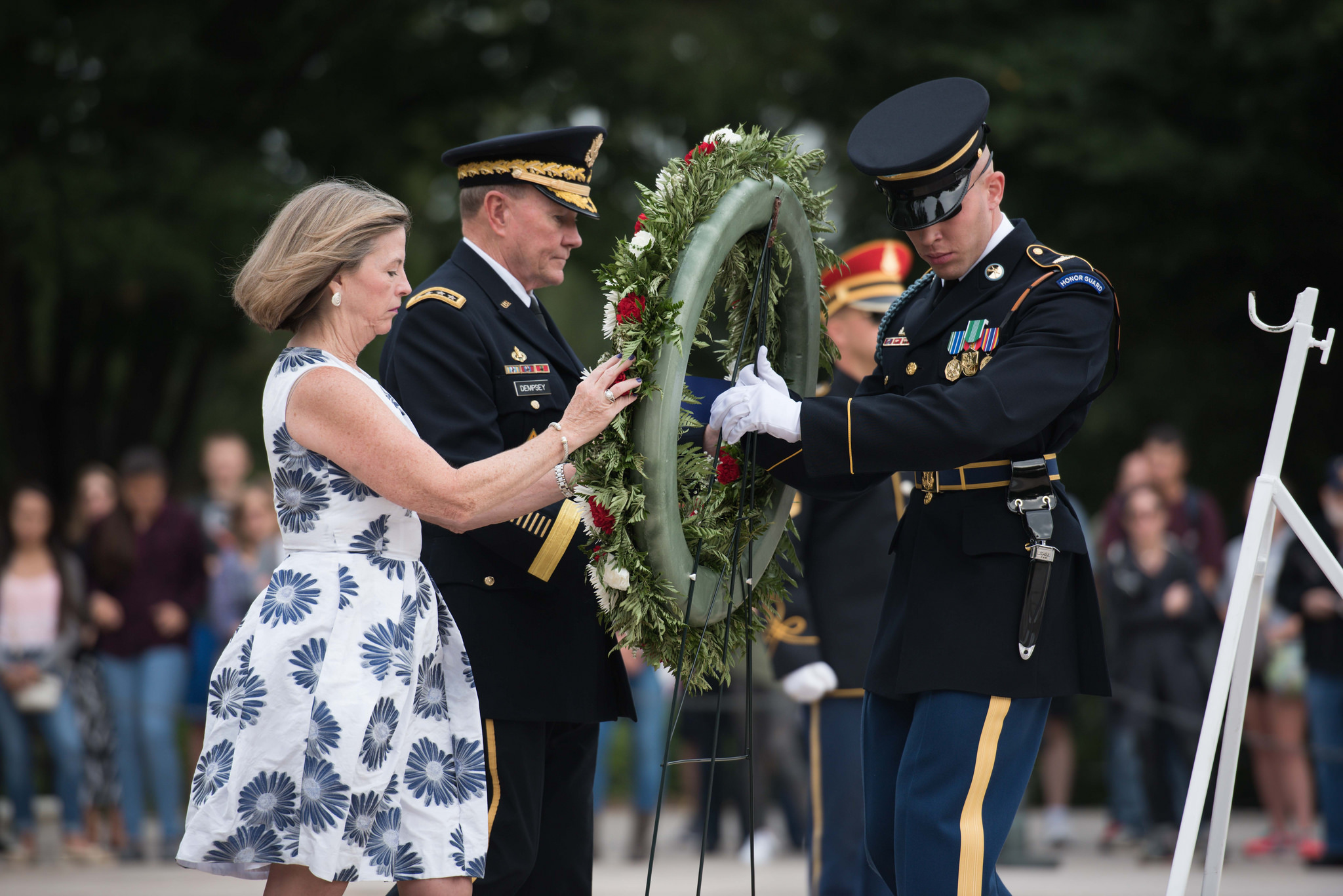
JOINT BASE MYER-HENDERSON HALL, Va., September 25, 2015 — In an armed forces full-honors retirement ceremony, Army Gen. Martin E. Dempsey closed out 41 years of service, and Marine Corps Gen. Joseph F. Dunford Jr. succeeded him as the highest ranking U.S. military officer.

Dempsey swore in Dunford here today as chairman of the Joint Chiefs of Staff, the highest-ranking U.S. military officer.

President Barack Obama and Defense Secretary Ash Carter were among the dignitaries who attended today's retirement and change of responsibility ceremony.

"We all owe this great country our very best and our fellow citizens our very best," Dempsey said. "It was humbling to accept this job four years ago and it's humbling to relinquish it today."

Dunford said he was humbled for the opportunity to represent the men and women in uniform. "They are a true national treasure. My focus in the coming days will be to provide them with the leadership and the support that they deserve," he said.

Dempsey One of ‘Finest Men’ Obama Knows

Obama praised Dempsey for his vision for the military, his moral fiber, and deep commitment to American strength and values

Dempsey served during a time of many challenges, the president said, and managed each one with "integrity and foresight and care." America has reassured its global allies, ended the combat mission in Afghanistan, and forged new partnerships to fight terrorism, the president noted.

"We built a coalition that is combating ISIL in Iraq and Syria and have we bolstered our cyber defenses. We helped halt the spread of Ebola in West Africa," Obama said. "None of this would have been possible without Marty's guidance and leadership."

Obama described Dempsey as "one of the finest men that I know." He picked Dempsey to be chairman of the Joint Chiefs of Staff and previously chief of staff of the Army, he said, because the general had the "steady hand" needed in the moment of transition.

"I can't tell you how much I have appreciated your candor and your counsel, and I have seen you build that trust not just with me, but across our military with our troops and their families, with Congress and our allies abroad and with the American people," Obama said.

"Over the last four years, Marty's wisdom, his vision and his character have helped lead the greatest fighting force the world has ever known," Obama said.

Every Decision Touches Lives of Troops

Defense Secretary Ash Carter said that before Dempsey became chairman he was already a proven military leader who led the 1st Armored Division during "difficult days," returned to reconstitute the Iraqi army, and had been chief of staff of the Army.

"Every decision the military leader makes, large or small, touches the lives of our troops. It touches the lives of countless families, it changes the nature of the world and the destiny of the country," Carter said.

"For the men and women who operate during a time of rapid change and uncertainty, this is the constant weight and responsibility of leadership," Carter said.

Thanks to the unwavering service and commitment of Obama, Dempsey and Dunford to the military, "our nation is nobler and stronger, and will be forever more," Carter said.

All the speakers at the event lauded Dempsey and his wife Deanie for their unwavering commitment to the military, military families and their own family, which includes three children who have served in the Army and nine grandchildren.

Closing Out Career, Passing Responsibilities

Dempsey said it has been his privilege to serve the nation. The men and women who serve the nation are "most precious treasure," he said.

"They and their families inspire us. Today, we entrust them to our new chairman," he said.

"Our nation and its armed forced remain the world's foremost symbols of strength, of hope, and of freedom," Dempsey said. "The generation that is now blessed to serve will do its duty and will ensure that our nation remains strong."

Dunford commended Dempsey for his service to the nation.

"We're all indebted to General Marty Dempsey for his extraordinary leadership, commitment and service, and on a personal note, for many years he has been a great friend, mentor and role model," Dunford said.

Make It Matter

Dempsey forever honors the 132 soldiers who lost their lives under his command in Iraq, Obama said, explaining how Dempsey has a box that contains each soldier's picture and story.

"And on top of the box are three words: make it matter," Obama said.

"Every morning, Marty places three of the cards in his pocket so that every moment as chairman, every meeting, every trip, every decision, every troop review, every moment of every day, some of those fallen heroes are with him," the president said.

Dempsey, in closing his speech said, "To all who will continue to serve after, I ask only this in parting, make it matter."

Saturday, August 22, 2015

Chairman, Korean Counterpart Discuss U.S.-Korea Defense Commitment


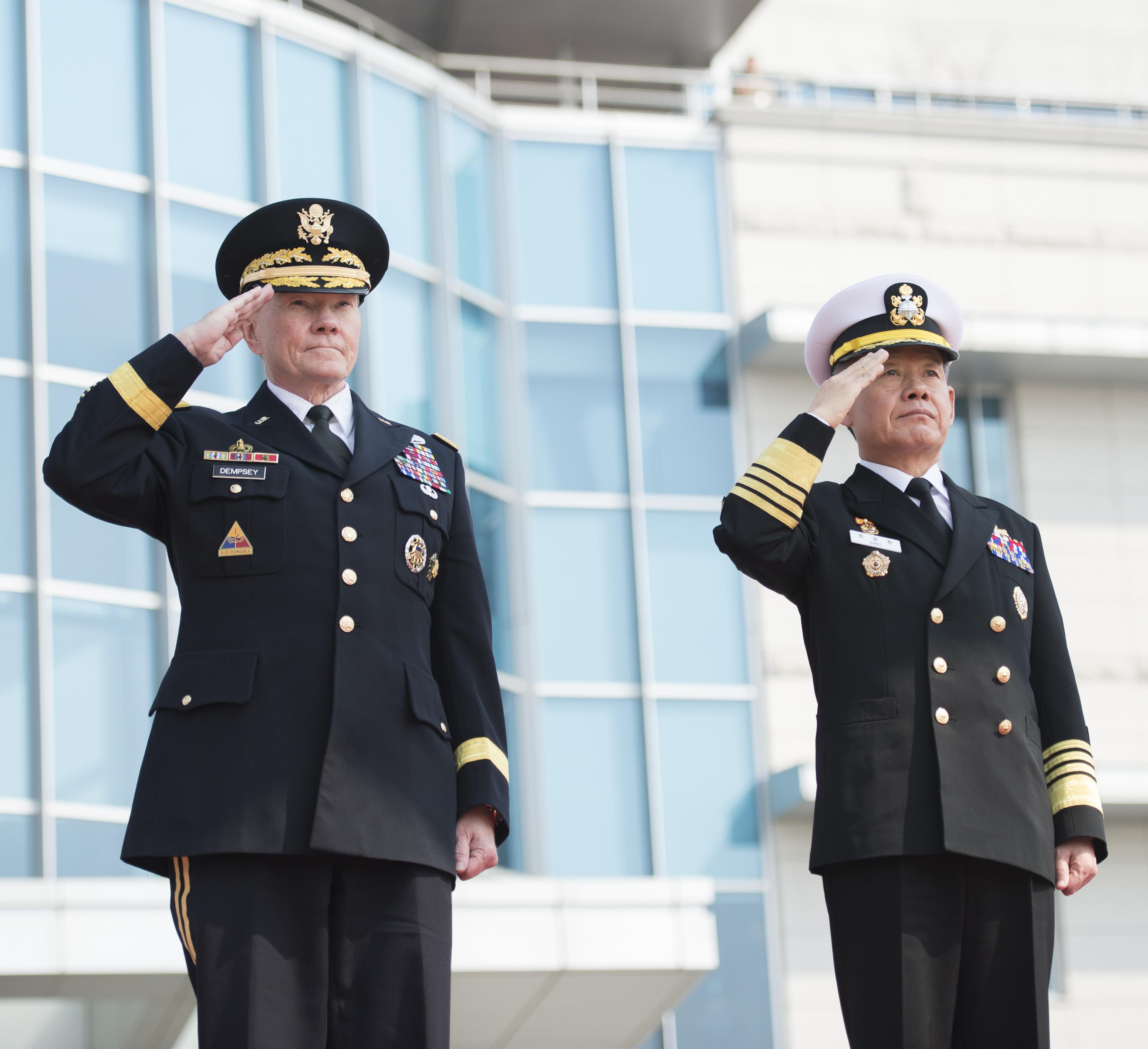
WASHINGTON, August 22, 2015 — Army Gen. Martin E. Dempsey, the chairman of the Joint Chiefs of Staff, called his Korean counterpart yesterday to discuss the unwavering commitment of the United States to Korea’s defense, according to a readout of the call released today.

Dempsey also reiterated the strength of the U.S.-Korea alliance, Navy Capt. Greg Hicks, joint staff public affairs officer, said in the readout.

The two leaders “concurred they would watch North Korea's actions closely in the coming days,” Hicks said, “and would ensure that the U.S. and ROK continue to work closely with one another to deter further North Korean provocations and defuse tensions.”

Friday, July 17, 2015

Dempsey Describes Chairman’s Job as Being ‘The Dash’


By Jim Garamone
DoD News, Defense Media Activity

WASHINGTON, July 17, 2015 – In the world of political-military affairs, Army Gen. Martin E. Dempsey likes to say that he is “the dash.”

The dash is not the name of some superhero. It is the punctuation mark found between “political” and “military” when both factors exist in a given situation.

The chairman of the Joint Chiefs of Staff lives at the intersection of policy objectives and the military activities used to achieve them.

“When we testify, we all get drawn into different discussions about strategic objectives and campaign objectives and political objectives,” Dempsey said during a recent interview. “But the one that lives at that intersection is the chairman of the Joint Chiefs of Staff.”

Dempsey is the 18th officer to hold the chairman position since it was established in 1947. Nominated by President Barack Obama, he was confirmed by the Senate and took office in October 2011, succeeding Navy Adm. Mike Mullen.

By statute, the chairman is the military advisor to the president, the secretary of defense and the National Security Council. The chairman also has the responsibility of consulting with Congress on issues related to national security.

Highest-Ranking Officer, But Commands No Troops

The chairman is the U.S. military’s highest-ranking officer, but he commands no troops. “I’m an advisor on matters related to the use of the military instrument of power,” Dempsey explained. “I’m not intended to be, nor would it appropriate for me to be, an advocate for any particular strategy or policy.”

He said there are three questions asked when developing a strategy, the first being whether the United States can do something. If that something is in the military sphere, it becomes a question for the chairman.

“In that context, in that room, among our elected officials and our appointed officials, I’m the one that is most accountable to answer the question: Can we do something militarily?” Dempsey said.

The chairman shares responsibility for the second question, which is “Will it work?”

“If there’s a particular political objective, I first describe the military capabilities that might be applied against that challenge, and then I integrate that conversation about … the military instrument of power with diplomatic power, economic power, information, [and so on],” he said.

The third question is one for elected officials: Should the United States do it?

“I’m at the table, I have a voice, but at that point, my voice becomes far less prominent in the room than it is in answering the first two questions,” Dempsey said.

Nature of Job Often Misunderstood

The general noted that people who don’t understand the nature of the job -- the idea of the chairman being the dash -- accuse the chairman of being an administration stooge. “It has happened to every chairman since I’ve become aware that there was a thing called the chairman of the Joint Chiefs of Staff,” he said.

Having served as a special assistant to then-chairman Army Gen. Hugh Shelton, Dempsey said, he has some unique insight into this.

“I remember working for General Shelton and [reading] some very hurtful … articles about him … as a lapdog of the president -- by the way, a phrase which has been reprised recently,” he said.

But a chairman has an obligation to provide military advice more broadly, the general said. Dempsey provides military advice and expertise to members of the Senate and House of Representatives, regardless of political party.

The statute is set up so the chairman can give his personal advice. But any chairman quickly comes to the conclusion that consulting with the other members of the Joint Chiefs of Staff -- the vice chairman, the Army chief of staff, Air Force chief of staff, the commandant of the Marine Corps, the chief of naval operations and the director of the National Guard Bureau -- is the preferred way to go, Dempsey said. He meets with the Joint Chiefs at least twice a week.

“They help formulate and articulate what we call best military advice,” he said. Those meetings are part of the chairman’s significant convening power.

“I can convene a meeting of the JCS, which I do,” he said. “I can convene a meeting of combatant commanders, who work directly for the secretary of defense. They understand that the secretary is going to ask me for my advice, so it’s very clear to them and to me that we need to be consulting with each other frequently on issues as they arise around the globe.”

Adjudicating Priorities

The chiefs of the services build their forces, the combatant commanders employ those forces, and the chairman, once again, finds himself in the middle. “I’m kind of the one in the middle of that who adjudicates the priority,” Dempsey said. “Literally, I’m at the intersection of … political objectives, military activities, service chiefs and combatant commanders, and … international partners.”

The president is the commander in chief of the military, and he chairs National Security Council meetings. These happen, on average, about once a week, the chairman said. In addition, Dempsey said, he goes to all of the principals’ committee meetings in the White House -- usually two or three a week.

Defense Secretary Ash Carter and Dempsey also have a scheduled meeting with the president every week.

“From time to time, either I will ask to see [the president] privately or he will ask to see me privately,” the chairman said. “I have access to him, and obviously he has access to me.”

Building Relationships

Being at the center of so many processes made him realize early in his term that the key to being effective was building relationships, Dempsey said. Any chairman must build up relationships with elected officials, appointed officials, other U.S. military leaders and foreign military leaders, he added.

One of those relationships is with the American people, he said, and he feels an obligation to speak periodically about the military to the American people at large.

But also, he said, a private first class wants to know that if he or she is asked to go into harm’s way, someone is thinking about the implications at the national level. “And that happens to be -- generally speaking -- the chairman of the Joint Chiefs of Staff,” he added.