Showing posts with label naval aviator. Show all posts

Monday, February 09, 2026

Medal of Honor Monday: Navy Lt. Carlton Hutchins

Navy Lt. Carlton Barmore Hutchins was a skilled aviator who did his best to save his crew during one of the worst naval air disasters before World War II. He kept his damaged plane in the air long enough for a few crewmates to parachute out. Hutchins went down with his aircraft, but his bravery and selflessness earned him the Medal of Honor.  
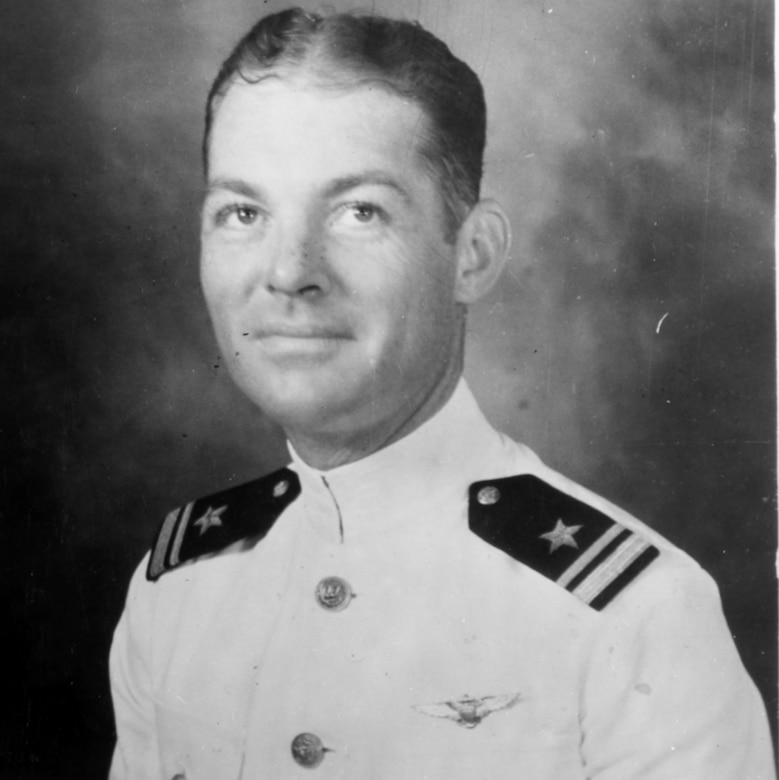
A man wearing a white Navy uniform poses for a photo.

Hutchins was born Sept. 12, 1904, to Walter and Clara Hutchins. He had two younger brothers and grew up in Albany, New York, before graduating high school in 1922 and attending the U.S. Naval Academy.

After commissioning into the Navy in 1926, Hutchins served on the USS Pennsylvania until 1928, when he went to flight training school in Pensacola, Florida. That same year, he married his girlfriend, Elizabeth Poehler. The couple later had a son, Walter.

By February 1929, Hutchins had earned his wings as a naval aviator. He spent the next few years flying fighter aircraft and scouting planes before studying aeronautical engineering at the California Institute of Technology. In 1937, he served with a seaplane squadron in the Caribbean before being transferred to Patrol Squadron 11 aboard the USS Langley based at Naval Air Station San Diego (now Naval Air Station North Island).
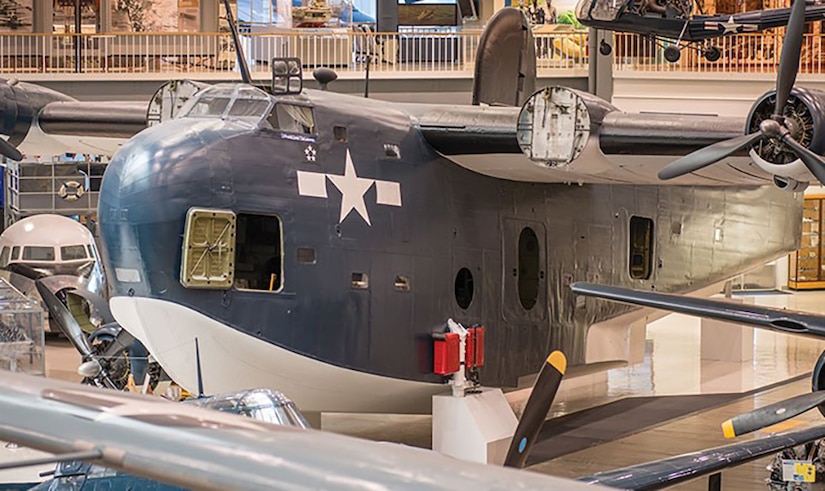
A large seaplane sits on the tiled floor of a museum. Other aircraft and their wings can be seen nearby.

On Feb. 2, 1938, Hutchins was piloting one of several PBY-2 Catalina seaplanes that were taking part in one of the largest fleet exercises of the time about 70 miles off the California coast. According to the Naval History and Heritage Command, nine aircraft were flying in formation at night during a bombing training run when a sudden rain squall began and they flew into a cloud bank without warning. Because of the sudden lack of visibility, Hutchins' aircraft collided with another seaplane.

While the second aircraft crashed immediately, killing all seven on board, Hutchins managed to keep his failing aircraft in the air long enough to give his crewmates the chance to parachute to safety. He was only able to keep the aircraft afloat for a few minutes, but that was enough for four of the six men to jump out. The remaining two were in the plane's forward compartment with Hutchins and died with him as the plane went down.

One of the men who parachuted out died the following day, but three survived thanks to Hutchins' ability to keep calm and steady the aircraft for as long as possible.
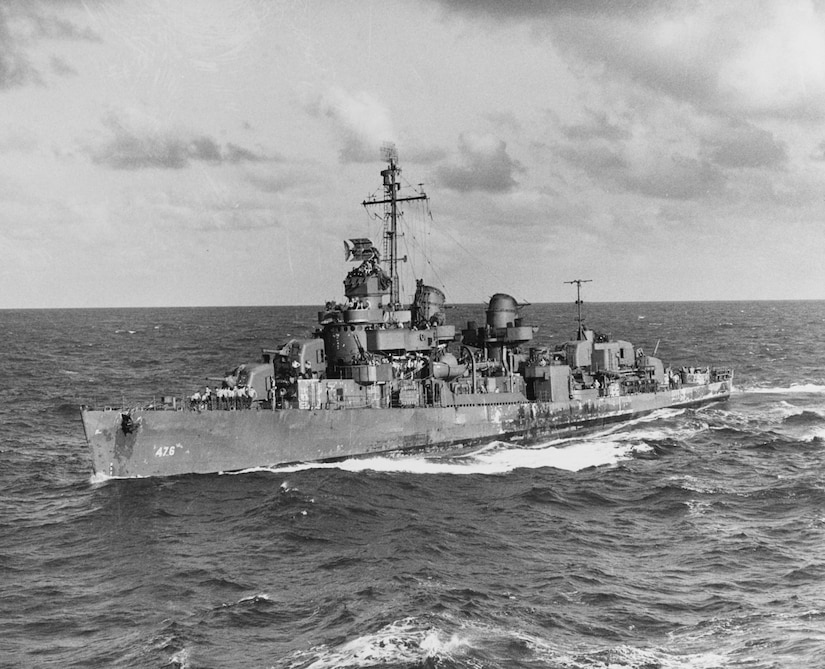
A large ship moves through the ocean.

The crash killed a total of 11 men. At the time, it was considered one of the worst aircraft disasters in Navy history.

On Aug. 3, 1938, Secretary of the Navy Claude Swanson announced that Hutchins would receive the Medal of Honor for his bravery. The nation's highest honor for valor was presented to his widow in a ceremony 10 days later.

Sadly, Hutchins' remains were never recovered.

In his memory, the destroyer USS Hutchins was commissioned in November 1942 and used throughout World War II.

At the Naval Academy's Bancroft Hall, one of the world's largest collegiate dormitories, Hutchins has a room dedicated to him, as do all other Medal of Honor recipients who attended the prestigious school.

Sunday, August 31, 2025

WWII Hero Honored at U.S. Open Tennis Championships

The U.S. Tennis Association hosted the 2025 Lt. Joe Hunt Military Appreciation Day yesterday at Arthur Ashe Stadium, in Queens, New York. 

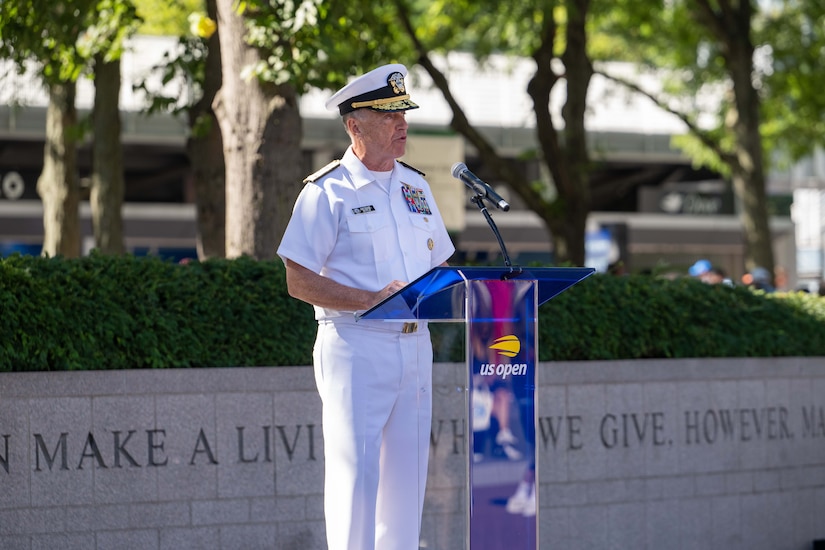
A man wearing a formal military uniform stands at a podium and speaks during an outdoor ceremony.

This U.S. Open tennis tournament event is dedicated to honoring and recognizing members of the U.S. military, named in honor of Hunt, the only U.S. Open champion to die in service to his country. 

Several speakers at the event paid tribute to Hunt. 

More than a tennis player, Hunt was the U.S. Nationals champion, an NCAA champion, a Naval Academy graduate and a Navy football star. Like so many of his generation, he put aside his personal achievement to answer his nation's call, said Navy Rear Adm. Michael Boyle, director of the Navy staff. 

After the Japanese attack on Pearl Harbor on Dec. 7, 1941, Hunt "traded aces on the court for the challenge of becoming an ace in the sky, earning his wings of gold as a naval aviator," he said. 

This year marks 80 years since his sacrifice, and it also marks a historic milestone: the 250th birthday of the United States, Navy, Marine Corps and Army, Boyle noted. 

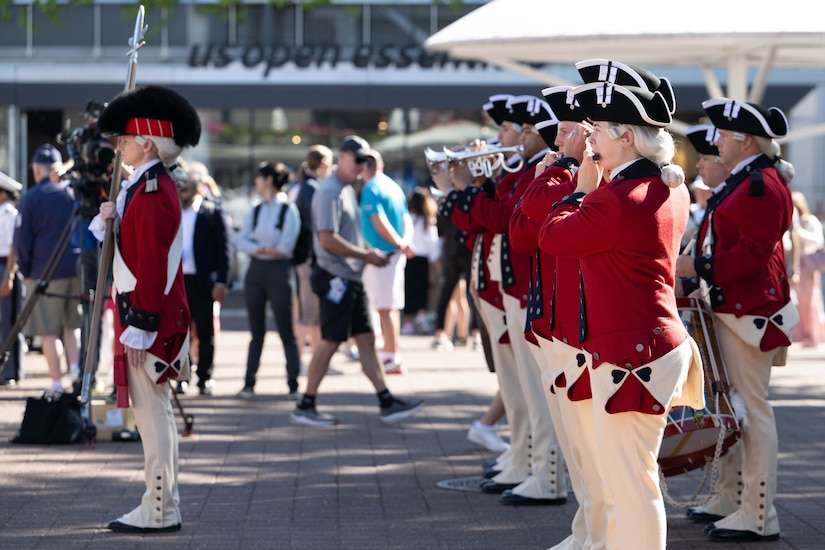
People dressed in colonial period uniforms stand in formation and play instruments at an outdoor event.

"Our sacred duty is to fight with toughness, tenacity and integrity to defend this nation. That is what 250 years of service means," he added. 

Joe Hunt, grand-nephew of Lt. Joe Hunt, said, "The military has a code which says we shall never forget, and that is what this day is very much about. To those of you who wear and have worn the uniform, we will not forget your service.  

"We truly appreciate your sacrifice and the sacrifice of your families, and we will never forget you," he added. 

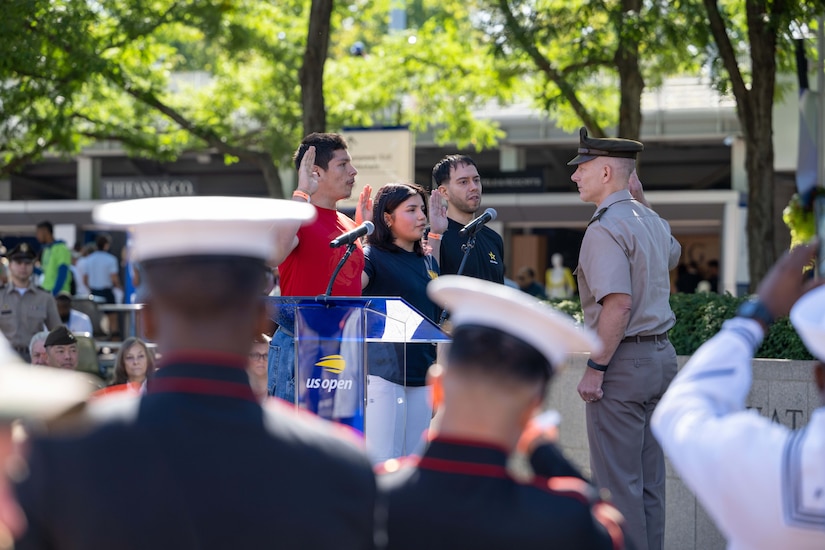
Yesterday's events included an oath of enlistment ceremony, military family engagements and performances by the Old Guard Fife and Drum Corps, as well as the Navy Sea Chanters. 

More About Lt. Joe Hunt 

Hunt won the 1943 U.S. Open Tennis Championships in New York City while on leave from the Navy in early September of that year. 

He is the only man in history to win the U.S. national boys' (then 15-and-under), juniors' (18-and-under), collegiate and U.S. men's singles titles.  

Hunt also played football at the U.S. Naval Academy, winning a game ball in the 1941 Army-Navy game after beating Army 14-6 in Philadelphia, Nov. 29, 1941. Eight days later, the Japanese bombed Pearl Harbor, Hawaii. 

Due to wartime needs, Hunt's class graduated early on Dec. 19, 1941, instead of in the spring of 1942. Upon graduation, he was assigned to the destroyer USS Rathburne, an antisubmarine warfare training ship homeported in San Diego.  

At the end of September 1943, Hunt was assigned to the destroyer USS Kearny, which escorted a merchant convoy to Casablanca, Morocco. However, he wanted to fly and was eager for combat duty, according to his grand-nephew Joe Hunt, a Seattle attorney who was named for his great uncle.  

Hunt requested a transfer to aviation, and it was granted. His training began at Naval Air Station Dallas on Dec. 30, 1943. In May 1944, he received advanced aviation training at Naval Air Station Pensacola, Florida. He wanted to defend his tennis title that year, but his leave request was denied. 

On Feb. 2, 1945, Hunt's F6F Hellcat fighter aircraft crashed into the Atlantic Ocean east of Daytona Beach, Florida, during a training flight. Hunt and his aircraft were never recovered. 

Hunt left behind a wife, Jacque Virgil Hunt, whom he married in 1942.  

Hunt was inducted into the International Tennis Hall of Fame in Newport, Rhode Island, in 1966. 

On Sept. 1, 2014, Hunt was honored on center court at Arthur Ashe Stadium during the U.S. Open, an event he won 71 years earlier.  

Every year since 2019, the U.S. Open has celebrated his service and honored service members and veterans on "Lt. Joe Hunt Military Appreciation Day."