Showing posts with label alaska. Show all posts

Friday, July 10, 2026

Alaska National Guard Rescues 4 People in 2 Days

Soldiers and airmen assigned to the Alaska National Guard executed four missions to save four people in the Alaska wilderness before the July Fourth holiday weekend. 
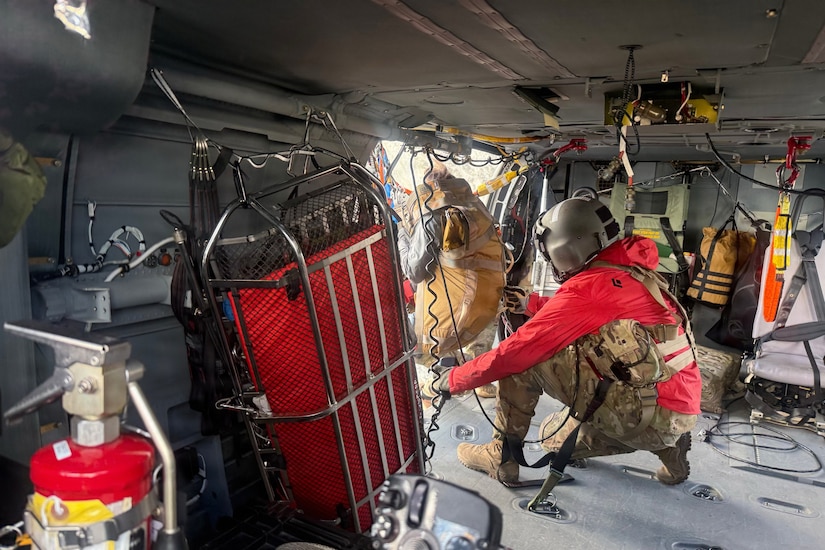
A person wearing a camouflage military uniform is strapped into a helicopter while pressing a controller to lift an attached harness as another person in similar attire guides a person inside the harness into the helicopter.

 
Air Force Maj. Kody Schmidt, Alaska Rescue Coordination Center senior controller, said the first mission started following a request July 2 from the Alaska State Troopers for a hoist-capable helicopter to rescue a critically ill patient from a remote residence on the Kantishna River west of Cantwell, Alaska. 
 
The 176th Wing, Alaska Air National Guard, sent an HH-60W Jolly Green II helicopter and a HC-130J Combat King II aircraft, each carrying pararescuers. 
 
The helicopter special missions aviator hoisted the guardsmen to a spot near the residence, where they made contact with the patient before hoisting everyone into the helicopter for transport to Fairbanks Memorial Hospital in Fairbanks, Alaska. 
 
Later that same day, another mission came in with a request from the National Park Service to medically evacuate a critically ill patient from a remote cabin north of Mount McKinley. 
 
In a similar fashion to the first mission, the helicopter hoisted the airmen near the cabin and then hoisted out the patient for evacuation to Providence Alaska Medical Center in Anchorage, Alaska. 
 
During both missions, the HC-130J provided air-to-air refueling to extend the helicopter's range to reach deep into the interior of Alaska. 
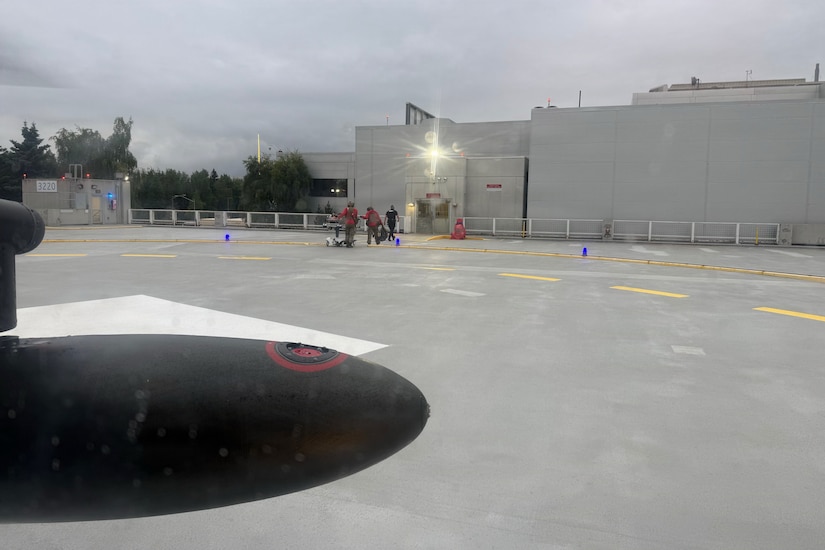
Two people wearing camouflage military uniforms push a person on a stretcher across a helicopter landing pad and into a hospital.

 
Also July 2, a request from the state troopers was received to rescue a stranded hiker who had sent an emergency signal on a satellite communication device on Matanuska Peak in Alaska's Chugach Mountains. 
 
Air Force Capt. Cody McKinney, 207th Aviation Troop Company operations officer, said the Alaska Army National Guard dispatched an HH-60M Black Hawk medical evacuation helicopter. 
 
The Black Hawk crew chief performed a dynamic hoist of the flight medic to contact the hiker, then hoisted both of them into the helicopter for transport to the Palmer Municipal Airport in Palmer, Alaska. During a dynamic hoist, the crew chief lowers the flight medic as the helicopter approaches the patient, preventing spinning and oscillation while decreasing the time required for extraction. 
 
The final mission began July 3 when the National Guard received a request from state troopers to rescue a hiker near Gulkana, Alaska, who was experiencing chest pain. 
 
A Black Hawk crew located the hiker, treated the hiker on site, and hoisted them into the helicopter for transport to Providence Alaska Medical Center. 
 
Schmidt underlined the importance of carrying a satellite communication device when going into the Alaskan wilderness, where cellphone coverage is often unavailable. 
 
The rescue missions involved six aircraft and totaled nearly 21 hours of flying time in less than two days.

Friday, September 26, 2025

Security Forces in Alaska Take Part in Specialized Training

Eight airmen assigned to the 673rd Security Forces Squadron participated in a Fly Away Security Team training course at Joint Base Elmendorf-Richardson, Alaska, Sept. 15-19.

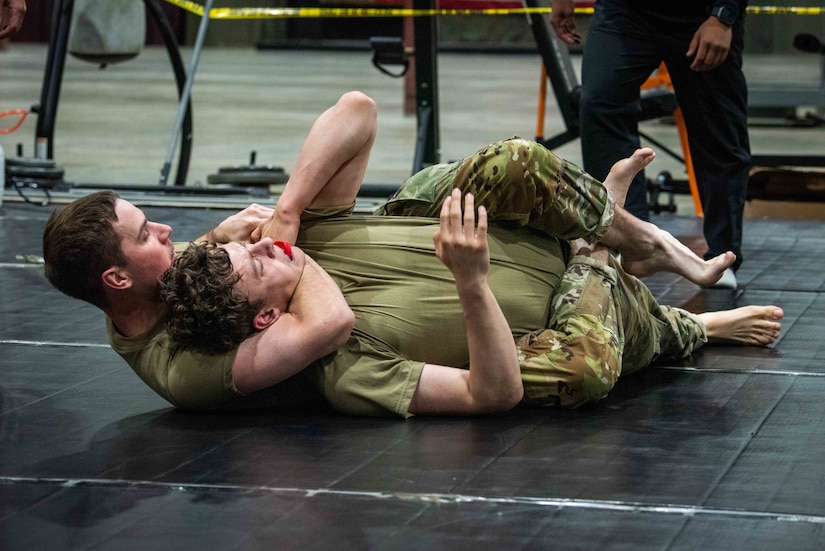
Two men dressed in camouflage military uniforms wrestle during combatives training. One man has a red bite guard in his mouth.

 
Fly Away Security Team training is a five-day, 40-hour course that challenges airmen physically and mentally to enhance their lethality while protecting aircraft, aircrew, cargo and distinguished visitors during operations on austere airfields. 
 
They aid in humanitarian missions and War Department operations; their missions typically involve providing a security perimeter around aircraft at unsecured, foreign airfields.

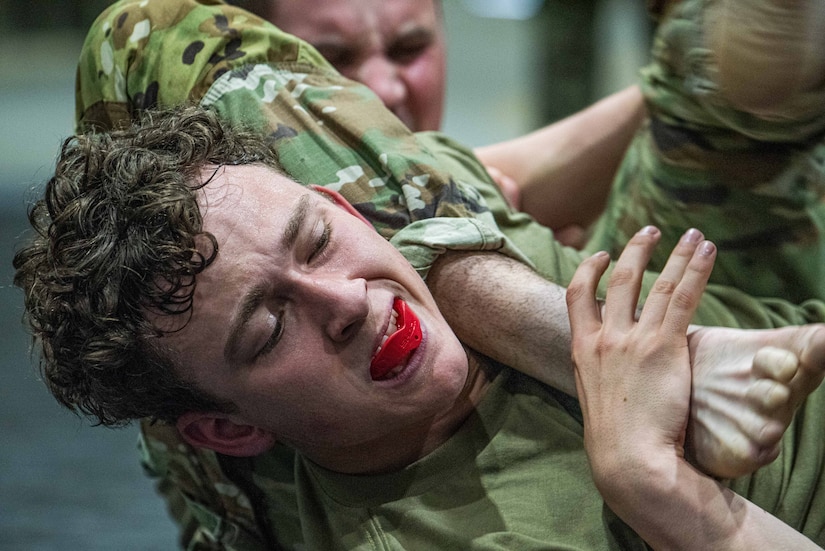
Two men wearing camouflage military uniforms wrestle during combatives training. One man has a red bite guard in his mouth.

 
"Fly Away Security is a certification that should carry a lot of weight — it is not for your average security forces member," said Air Force Staff Sgt. Taylor Davis, 673rd Security Forces Squadron noncommissioned officer in charge of small unmanned aircraft systems. "Here at [Joint Base Elmendorf-Richardson], we hold the FAST to a higher standard, and we train them at a higher standard; we train them to win." 
 
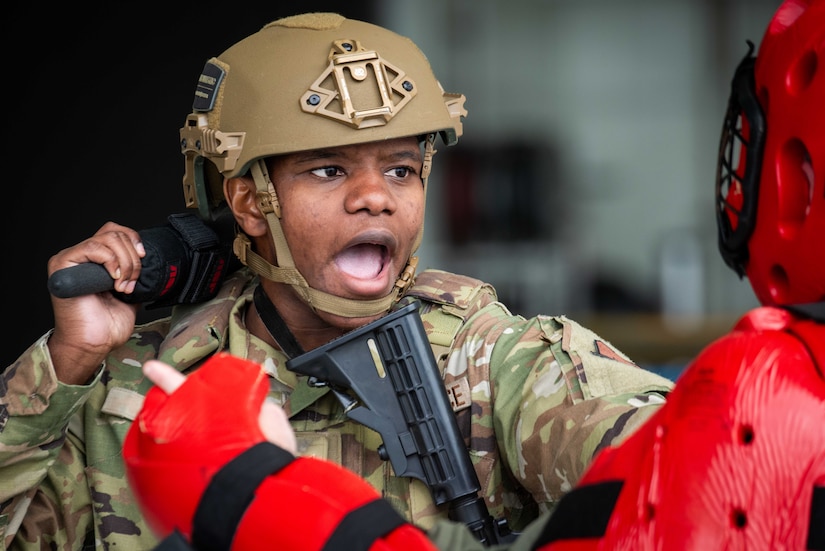
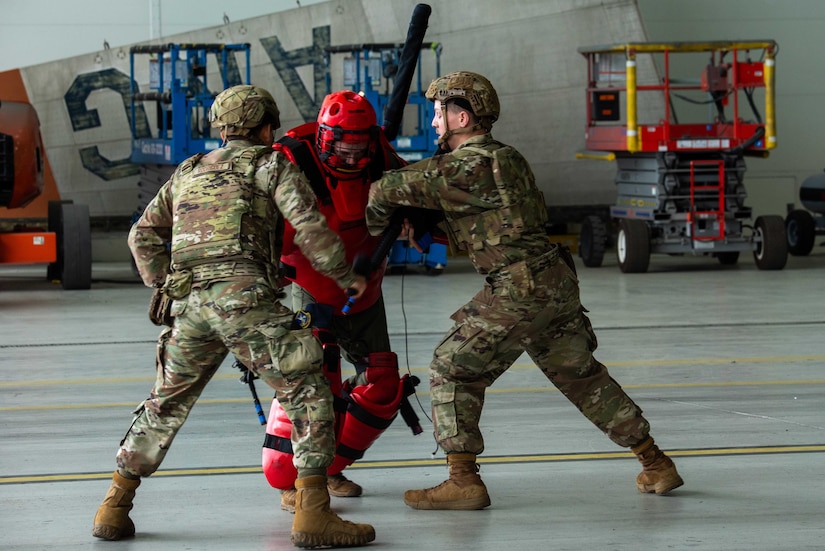
During the course, students undergo combat and hands-on training. They work through real-world simulations, demonstrating skills they have learned throughout the week. Some of the training included peer-on-peer wrestling, baton evaluation and flightline training with a C-17 Globemaster III assigned to the 517th Airlift Squadron.

A man wearing an advanced combat helmet and camouflage military uniform swings a baton at a person wearing a red padded suit during baton combatives training.
Two men wearing advanced combat helmets and camouflage military uniforms push a person dressed in a red padded suit and helmet during combatives training.
"We train our members to go out to these austere locations or airfields that do not have adequate security," said Air Force Tech. Sgt. Adam Stanley, 673rd Security Forces Squadron base defense noncommissioned officer in charge. "They have been trusted in protecting personnel and assets to provide a safer environment within their area of responsibility." 
 
The 673rd Security Forces Squadron conducts FAST training courses multiple times a year, not only for its own members but also for other Air Force units. They plan to expand the program to enhance security for airfields and aircraft.

Tuesday, October 27, 2015

Alaska Reservist presented decoration for Nepal relief efforts

by Tech. Sgt. Dana Rosso
477th Fighter Group Public Affairs


10/27/2015 - JOINT BASE PEARL HARBOR HICKAM, Hawaii  -- An Alaska Reservist was presented with a commendation medal for her work while supporting earthquake relief efforts in Nepal during a ceremony in the Courtyard of Heroes at the Pacific Air Force Headquarters Oct. 16.

"I deployed as the Joint Air Component Coordination Element Public Affairs officer in early May," said Maj. Ashley Conner, 477th Fighter Public Affairs officer. "The JACCE staged out of Thailand, but a small group of us went forward to Nepal with the 36th Contingency Response Group."

Once arriving in Nepal the CRG assisted the Nepalese accelerate airfield operations to increase the capacity to bring in aid via airlift, and ultimately distribute aid faster to those affected by the earthquake. Conner and Staff Sgt. Melissa White made up the Air Force Public Affairs team that went to work documenting the relief efforts, facilitating interviews and building relationships with partner nations.

Then on May 12 a second 7.3 magnitude earthquake hit just more than two weeks after a 7.8 magnitude earthquake devastated the nation.

"I had never felt an earthquake that strong before. In the distance you could see plumes of dust rising in the air as buildings began to collapse," she said.

The JTF had established a flightline aid station to receive injured Nepalese citizens that were transported to the airport from remote villages on U.S. Marine Corps MV-22 Ospreys and UH-1Y Huey helicopters.

"When I arrived I saw children being treated for head injuries and other children being consoled while their parents received care. As a mom of two little girls, it was one of the hardest things to see," said Conner. "There were at least seven military photographers already documenting the activities, so I put down my camera and asked where they needed help."

The medical team lead sent Conner to the litter carry line to assist carrying patients from the aircraft to the medical tent.

"The first woman we transported was an elderly woman who had lost her leg in the earthquake. She was turned toward me on the cot and was chanting.  At one point she reached up to touch my face. I couldn't think of anything to say besides 'You are going to be okay'," said Conner.

"My grandmother saw these photos and said 'if I had been in that woman's situation, seeing your face would have been comforting.' That sentiment really hit home for me. Women, Peace and Security places importance on the need for women in relief and recovery operations to address the specific needs of women and children. My role and involvement that night was very small and there were many others who had a much greater impact, but I hope in some small way that my interaction -- whether through the women I helped that night or just my daily presence at the airport -- that I was able to have a positive impact on others during this operation."

In 2011 President Obama signed an Executive Order instituting a National Action plan on Women Peace and Security which recognizes that that promoting women's participation in conflict prevention, management, and resolution, as well as in post conflict relief and recovery, advances peace, national security, economic and social development, and international cooperation.

"The Air Force and the Department of Defense see the intrinsic value of women's roles in supporting areas affected by natural disasters," said Col. David Piffarerio, 477th Fighter Group commander. "Maj. Conner is a consummate professional and represented the U.S. military well in her support to the relief efforts in Nepal."

Thursday, September 10, 2015

Yup'ik Airman thrives on family, military traditions

by Air Force Staff Sgt. Sheila deVera
JBER Public Affairs


9/10/2015 - JOIN BASE ELMENDORF-RICHARDSON, Alaska -- Growing up in Scammon Bay, a remote village in Alaska with a population of fewer than 600, the Yup'ik native wanted to see the world.

Known as Angiiraq Apakaq to her elders and Janette Ulak to her friends, she grew up surrounded by a small community that thrived on hunting, fishing and picking berries to provide for their families to survive.

"Growing up, the women and children did the housework, while the men would go out hunting," said Senior Airman Janette Ulak, 673d Dental Squadron dental assistant.

"In our culture, women might bring bad luck if they go out hunting because their sole job is to stay home and take care of the family. But it's changing now - some women can go out and hunt."

With only 12 seniors in her graduating class, she pursued college education for a year until she accepted a job as a dental health aide back home.

That experience inspired her to join the military as a dental assistant.

"A lot of people wanted to stay in the village, but I wanted to get out of the community and see what's out there," Ulak said.

Ulak has relatives serving in the Army, Marines, Navy and Army National Guard. After consulting with her family members, she decided to join the Air Force.

She reached out to an Air Force recruiter in Anchorage, Alaska, and, at the age of 24, started a new adventure in 2009.

"At first, some people in my village were concerened about me joining the military," she said. "I just Ulak is the first Airman in her family and village.

When she landed in San Antonio, Texas, 3,000 miles from home and in a bus on her way to Lackland Air Force Base, Texas, Ulak was very observant of her surroundings.

"I was in shock the whole time," the sister of 10 siblings said. "I didn't know what to expect."

In basic training, her training instructor was intrigued to find out she was an Alaska Native.

"My T.I. would ask me to say something in my language," said Ulak, recalling her time in basic training. "I guess he was just interested because he had never met or seen an Eskimo before."

"I was also bombarded with questions such as if I was living in an igloo, can I see Russia from my backyard, or do I know Sarah Palin - all silly questions," Ulak said, laughing.

"I expected to get this mixed reaction when people found out that I am an Alaska Native. I knew questions would come out like that or about my culture because they were just so fascinated about it."

"I remember a day when my family decided to go on a boat to another island so we could go clam digging until we saw a pod of whales spouting in the distance," Ulak said. "There were six of us in a boat and my uncle decided to go after the whale and we started chasing it."

When they came within range, her cousin started shooting the whale when he had a clear sight.

"We would bang on the bottom of the boat if we could not see the whale, when it resurface my cousin would start shooting again repeating the same process until my cousin ran out of ammunition," she said.

"My uncle instructed us to take out our harpoons and started throwing them. Once we successfully got the harpoon in, the second boat started shooting at the whale and killed it.

"We brought it to the shore and since it was my cousin's first catch, he had to share it with the whole community."

Under the Alaska Department of Fish and Game, subsistence hunting occurs throughout Alaska all year long and is central to the customs and traditions of many cultural groups.

The International Whaling Commission allows Alaska Natives to continue the whale hunt.

While stationed at Joint Base Elmendorf-Richardson, Ulak decided to bring some local dishes for her coworkers to try it out.

"I brought raw whale blubber to work and some had mixed emotions," Ulak said.

"Some mentioned that they couldn't taste it, while some focused on the texture."

Air Force Staff Sgt. Destinee Spates, currently assigned to the 18th Dental Squadron, Kadena Air Base, Japan, was one of the few who tasted her dishes - whale blubber and akutaq ["Eskimo ice cream" - a concoction made from reindeer fat or tallow, seal oil, water or milk, fresh berries and sometimes ground fish].

"The whale blubber was hard and crunchy. I could not taste anything so it was more about the texture," Spates said.

"As for the akutaq, I couldn't taste the halibut, but just the berries."

"I was not at work that day when she brought in some Alaskan dishes, but she often shares stories of life in her village," said Tech. Sgt. Andrea Andrews, 673d DS dental assistant. "I like listening to her stories and they are mesmerizing."

Finding out that Ulak was a local native, was an exciting for Andrews.

"My squadron has taken an interest in her culture and it gives our clinic an insight to the real Alaska," added Andrews.

Even though she prefers to be called Janette while in the military, to some she will always be Angiiraq Apakaq.

Sunday, August 30, 2015

USARAK commander sets out priorities for readiness

Commentary by Army Maj. Gen. Bryan Owens
USARAK commanding general


8/28/2015 - JOINT BASE ELMENDORF-RICHARDSON, Alaska -- Greetings to the arctic warrior family. I am thrilled to lead this team and be counted among the cold weather, cold region experts of U.S. Army Alaska. I've been told my family arrived in Alaska during the best time of year, and I have to say I agree completely.

The Alaska community has made us feel extremely welcome, and we look forward to experiencing all the amazing landscapes, activities and culture this state has to offer.

Today, I want to share my priorities for the arctic warriors during my command. Over the coming months, I will be out meeting and talking to our Soldiers, civilians and families to reinforce and expound on these priorities.

My top priority is to provide our Army and our nation with trained and ready forces to accomplish our current and future missions. To do this, Soldiers, and especially leaders, must develop and sustain a field mentality. Exercising field discipline will help Soldiers collectively overcome many of the challenges they face.

Earlier in my Army career when we went to the field, there were only five times we were permitted to remove our helmets.

Those five allowances were during after-action reviews, religious worship, and designated chow, sleep and personal hygiene times. That was it. But it wasn't about the helmet; it was about discipline, a key tenet of our profession and being a professional Soldier. Our leaders enforced the standards, and we learned discipline.

Just as my leaders enforced our unit's helmet standard, I expect all USARAK leaders to steadfastly enforce our standards every day to help instill the necessary level of discipline and through that discipline gain and maintain the trust of the American people.

Thus far, I have been very impressed with the quality of U.S. Army Alaska's arctic tough leaders, the training facilities on our installations and the unique environmental opportunities we have here on the Last Frontier. To live up to our moniker as America's Arctic Warriors, we must always continue to fine tune our skills as the best cold-weather, cold-region combat troops on the planet.

An essential element of achieving a high state of readiness is trust.  I view trust as an equation: credibility + reliability + intimacy (the effort and involvement with getting to know those you lead) divided by the perception of self interest. We've got to maintain trust in each other.

A lot of big changes are coming to our Army, and we don't have a clear sight picture yet. There is a lot of conjecture and rumor about where our Army is heading and especially what will happen here in Alaska. As I get more information about USARAK's future, I will pass it along to our Soldiers, civilians and families.

You are all winners in my book and have my complete trust until you violate that trust. I ask that you in turn trust your leaders. As we move forward in training our units to fight and win our nation's wars, I am confident we will balance our readiness requirements with the force-reduction challenges ahead.

We are working through a very deliberate mission analysis, and we will work closely with our partners to continue achieving the same high training and readiness standards while caring for our Soldiers and families.

I ask that you all continue to be patient, focus on the mission, look out for each other and always give your very best.

Arctic warriors, arctic tough!

Monday, August 03, 2015

Air Force removes nuclear excess from Alaska

by Susan A. Romano
AFTAC Public Affairs


8/3/2015 - EIELSON AIR FORCE BASE, Alaska  -- The Air Force Technical Applications Center, headquartered at Patrick AFB, Fla., removed excess nuclear material from one of the center's seismic arrays on Burnt Mountain, Alaska, and transferred it to a repository at the Nevada National Security Site after nearly 15 years of inoperability.

Ten radioisotope thermoelectric generators, or RTGs, were used as a power source by AFTAC at its array 60 miles north of the Arctic Circle.  Originally placed on Burnt Mountain in 1973, the first RTG was installed to power a single seismometer.  Twelve years later, due to the increase in communications equipment and demand for additional power, nine more RTGs were placed at the site.

For the next 17 years, the RTGs were operated and maintained by AFTAC's Detachment 460 based at Eielson AFB near Fairbanks, and were used because of their high reliability and low maintenance requirements to determine if regional seismic activity was caused by nuclear explosions or naturally-occurring events such as earthquakes, mining explosions, volcanic activity, etc.  AFTAC's primary mission is to verify compliance with nuclear test ban treaties.

But in 1992, a tundra fire encroached on the Burnt Mountain site and damaged some of the data cables.  Despite the fact the fire did not impact the generators themselves, it raised public concern among nearby inhabitants about the safety of using radioactive material as a power source at the station.

The Air Force, in coordination with multiple agencies and mission partners, made the decision to remove the RTGs and relocate them to NNSS.  By regulation, radioactive material determined to be excess must be moved to a facility with a mission, capability and authorization to support long-term storage or recycling of the material.   NNSS fits that bill.

Each thermoelectric generator contains between one to three pounds of a radioactive material called strontium-90.  The material is about the size of a hockey puck and is securely contained in a vessel with an inner shield made of tungsten inner and a cast iron protective housing, weighing approximately 4,000 pounds.

After two years of planning and a dry run in the summer of 2013, relocation operations began July 14 and were based out of Eielson AFB.  Personnel from AFTAC's Florida headquarters, Alaska's Det 460, the Air Force Inspection Agency, the Air Force Radioisotope Committee, Air Force Radiological Disposal, Nuclear Regulatory Commission and Sandia National Laboratories formed the cadre that ferried the RTGs from Burnt Mountain to Eielson via U.S. Army helicopters based at Fort Wainwright in Fairbanks.

Each day, two CH-47 Chinook helicopters transported the crew from Wainwright to Burnt Mountain.  The chinooks were chosen because of their heavy lift capabilities.  A single CH-47 is able to transport 33 troops and their gear, or three pallets of cargo, or a single sling load, or a combination of the three up to 26,000 pounds.

The 10 RTGs were located at five different sites within four miles of each other. Much of the terrain was rocky, pitched and covered in heavy brush, making movement somewhat challenging.  At two of the sites, the crew had to lay several yards of modular interlocking surfacing to help shore up the ground as the RTGs were transferred to the helicopters.

"One of the toughest aspects of this entire operation was working in the rugged terrain amidst challenging Alaska weather," said Scott Lattimer, project manager for the relocation. "Those things, coupled with I-track set-up, tear-down and transport made several of the days a bit demanding."

Once the generators were loaded on the helos and secured for transport, the cadre returned to Eielson, where the RTGs were temporarily stored until all 10 could be relocated to Nevada.

On day three of the operation, the crew hit a significant snag when one of the Det 460 members, who was driving a 6-wheel utility vehicle, became impaled on a 29-inch long, three-quarter-inch thick branch.  The branch speared the staff sergeant deeply in his upper thigh as he drove over extremely rugged terrain in very poor weather conditions.  The extent of his injury required him to be medically evacuated via one of the two available Chinooks to Fairbanks Memorial Hospital.  (Editor's Note:  Surgeons successfully removed the impalement and the Airman is on the road to recovery; he was released from the hospital within days and was present in the hangar when the final RTGs landed at Eielson.)

"The doctors from Fairbanks said the crew did a phenomenal job stabilizing the patient," said Joy Morris, AFTAC's radiation safety officer.  "They were really impressed with their on-scene first aid actions and the fact that the responders had the wherewithal to not remove the impalement from the injured NCO, while simultaneously keeping him calm."

After hurdling the safety incident, the mission continued.  Army Staff Sgt. Matthew Patterson was the senior flight engineer from B Company, 1-52 Aviation Brigade at Ft. Wainwright.  As the eyes and ears in the rear of the aircraft, he was responsible for providing the muscle that handled and oversaw the sensitive cargo, ensured the safety of the passengers and served as the vital communications link to the pilot.  This transport was Patterson's first with radiologic material.

"I've flown to Burnt Mountain a handful of times, but this mission required a lot more training and awareness around the nuclear materials," he said.  "Our biggest challenge wasn't necessarily the cargo or the many moving parts; the weather became the predominant issue we had to overcome.  That, and the very rugged terrain at some of the mountain sites."

When the helos returned to Eielson each day, the pallets were quickly downloaded with fork lifts operated by the 354th Logistics Readiness Squadron.

Tech. Sgt. Rebecca Morin, 354th LRS noncommissioned officer in charge of air terminal operations, was impressed with the organization and fluidity of the RTG removal.

"Out of all the operations I've been a part of during my career, this is one of the best I've ever seen," said Morin.  "It was obvious that a lot of solid planning went into this mission.  We had a few communications obstacles at first, but with so many hands and agencies in the mix, you kind of prepare yourself for that and overcome it as quickly possible to get the job done."

She added, "This was the first time my team and I have worked around nuclear materials.  I'm proud of the hard work by Tech. Sgt. (Brian) Ashton, Staff Sgt. (Rebecca) Bartlett and Staff Sgt. (Michael) Berglin.  Teamwork is definitely the number one key to mission success."

Once all the RTGs were recovered and shuttled to Eielson, a C-17 Globemaster III was dispatched to the base for transport from Alaska to Nevada.

Gradually, each pallet carrying one RTG was forklifted onto a K-loader - a heavy equipment transporter capable of offloading/onloading equipment from military aircraft -- until all 10 were safely strapped down into the Globemaster. The C-17, which was based out of Joint Base Elmendorf-Richardson in Anchorage, then flew to Creech AFB, Nevada, northwest of Las Vegas.

The RTGs were loaded onto ground vehicles and driven to NNSS, where they were accepted by personnel from the Department of Energy for official disposal at NNSS.

"This was, from start to finish, a 100 percent team effort," said Col. Jonathan VanNoord, on-site commander and AFTAC's Director of Operations. "To move the largest non-weapons grade nuclear material in the Air Force inventory was an incredibly intricate and complicated mission, requiring detailed planning and precise mission execution. Despite Staff Sgt. (Richard) Northey's unfortunate accident and some weather challenges in Alaska, the mission was a complete success and everyone who participated in the RTG transfer should be extremely proud of the role they played."

Monday, July 27, 2015

Black Rapids site offers unique opportunities

By Staff Sgt. Sean Callahan
USARAK Public Affairs


7/27/2015 - BLACK RAPIDS TRAINING SITE, Alaska -- From the snow-kissed mountains to the icy rumblings of melting glaciers, Marines from 2nd Platoon, Force Reconnaissance Company, 1st Reconnaissance
Battalion, Camp Pendleton, California, along with instructors from U.S. Army Alaska's Northern Warfare Training Center conducted military alpine operations at Black Rapids Training Site and Gulkana Glacier.

NWTC's remote BRTS offers a wide variety of challenging terrain. Instructors provide training on navigating vertical icy terrain, various forms of rappelling, casualty evacuation, glacial travel and crevasse rescue.

NWTC'S mission is to provide cold regions and mountain warfare training to the U.S. military and designated personnel to enhance warfighting capabilities of the U.S. and coalition partners.

The center is also the Army's cold-region training proponent.

As such, NWTC instructors are versed in all things high-altitude, mountainous and subarctic.

The instructors spend months preparing lesson plans and maintaining their high level of training to pass on.

Challenging terrain and deep blue glaciers aren't the only things which bring these highly-skilled recon Marines to Alaska.

"Our philosophy is we need to be able to do deep reconnaissance in any clime and place," said Marine Capt. Trevor Miller, commander of the platoon. "The training center here in Alaska presents a unique opportunity to train in the mountains, and especially in mountains that have glacial features."

NWTC routinely conducts joint training operations with various Department of Defense agencies and government organizations.

The instructors are experts in their craft and offer both summer and winter courses designed to enable units to achieve fundamental skills in high-altitude mountain warfare training as well as cold weather operations.

"As the entire Department of Defense goes to a more joint outlook and joint operations, it's very helpful for us to train with the Army," Miller said. "The Army sometimes has different ideas than the Marine Corps and will only help us expand and grow as an organization."

The unique location of the Black Rapids Training Site allows these organizations to conduct strenuous and realistic training, focusing on military mountaineering, over-snow mobility, and other types of cold- weather operations.

Miller said the cadre at NWTC have been very accommodating. The instructors opened their training catalogs and allowed the Marines to pick and choose training directly related to the unique mission sets of a reconnaissance unit.

NWTC also offers standardized courses, like any other school house, but it's the flexibility and tailor-made training curriculum which sets it apart from other military schools. This is extremely important when students from other services, countries, and  state and federal agencies come to Black Rapids to conduct training.

Tuesday, July 14, 2015

Face of Defense: All-Army Triathlete on the Road to Pro


By John Budnik
U.S. Army Corps of Engineers, Alaska District

JOINT BASE ELMENDORF-RICHARDSON, Alaska, July 14, 2015 – Underneath his quiet and cool demeanor, Army 1st Lt. Marcus Farris is ready to be unleashed on race days. A disciplined athlete, he has trained for many hours to represent and compete as a member of the All-Army Triathlon team.

Farris, a quality assurance representative in the U.S. Army Corps of Engineers-Alaska District’s construction division, said he realized his passion for running in high school in Huntsville, Alabama. As a cadet in the Junior Reserve Officer Training Corps, he did lots of running to prepare for physical training tests. It wasn't long before he was attending Auburn University and, in his free time, participating in ultramarathons –- distances longer than the standard 26.2 miles.

Now, Farris said, his lifestyle consists of athletics and racing individually and for groups such as the All-Army Triathlon team and U.S. Military All-Endurance Sports team.

“There are some days that feel like workouts and some that feel like I am playing outside,” Farris, 25, described. “It is good to see that your training pays off now and again.”

Army Athletics

On June 7, he competed for the first time with the All-Army Triathlon team in the 2015 U.S. Armed Forces Championships hosted by the Leon’s World Fastest Triathlon at Hammond, Indiana. According to the race results, he finished 17th out of 40 male competitors from all four branches, including members from the Canadian military. Farris completed the Olympic standard triathlon distances of a 1.5 km swim, 40 km bike ride and 10 km run just under two hours.

As part of the Army’s Family and Morale, Welfare and Recreation program, All-Army sports are available to active-duty, Reserve and National Guard soldiers, according to its website. Soldier-Athletes must complete an application process to be considered for each activity, and to compete at national and international levels. Some of the teams include basketball, boxing, bowling, golf, rugby, soccer, softball, triathlon, volleyball and wrestling.

Making it on a team roster can be as competitive as race day, Farris said. Specifically for triathletes in Olympic distances, male applicants must have a confirmed time of less than two hours, seven minutes; for females, it's two hours, 35 minutes. Previous experience as an armed forces team member or past collegiate racing is a bonus.

Expanding Skill Set

Farris keeps his skills sharp while contending for triathlons with the U.S. Military All-Endurance Sports team, a non-Defense Department entity. The program is a division of the nonprofit organization American Service Members Amateur Sports Inc. Its purpose is to support amateur athletes while teaching endurance sports and activities for active-duty, retired and veteran military members, he said.

“This was a team created by service members for service members,” Farris said.

It's not just natural athletic prowess that sets Farris apart from other competitors -- it's also his willingness to apply proven exercise physiology principles, said Graham Wilson, triathlon coach for the endurance sports team.

“He is a focused individual,” Wilson said. “Once he sets his mind on a goal or mission, he will do everything in his power to achieve it.”

Within the next two to three years, Farris said his objective is to continue training and competing with the best.

“I am trying to earn a pro card to race at the professional level, but I still have some work to go,” he said. “Short term, I will be racing in the International Triathlon Union’s World Triathlon in Chicago [in September]. That is my biggest race of the year, other than the All-Army sports team.”

More Than Winning

Meanwhile, Farris broke a seven-year-old record July 11 in the men’s 50-mile time trial at the 13th annual Fireweed 400, according to an Alaska Dispatch News report. In preparation for the World Triathlon, he will race in the Olympic-distance Alaska State Triathlon near Wasilla on Aug. 2.

Since moving to Alaska in 2013, Farris’ greatest challenge has been adapting to indoor training because of the long, dark and cold winters.

“It turns into a mind game of how long you can stay on your trainer [machine] without going insane, but still obtaining the miles you need to stay competitive,” he said.

Maintaining that competitive edge can pay dividends on race days, but it's not all about victories. Farris said his most memorable moment as a triathlete came when he was on stage during a ceremony that honored veterans before the Armed Forces Championships. The special moment made quite an impression.

“It was all very patriotic,” Farris said. “It was a pretty cool moment right before the race. You remember what you are representing and that it is not just a sport, but everybody you are doing it with. They are your competitors, but they are your brothers-in-arms as well.”

Wednesday, June 20, 2012

POW/MIA Team Investigates Alaska Air Crash Site


American Forces Press Service

WASHINGTON, June 20, 2012 – An investigative team from the U.S. Joint POW/MIA Accounting Command arrived in Alaska yesterday to investigate an apparent aircraft crash site in the state’s Knik Glacier area, according to a JPAC news release issued today.

On June 10 an Alaskan Army National Guard UH-60 Black Hawk helicopter crew discovered what appeared to be an aircraft crash site while conducting a routine training mission, the release said.

Following additional search and rescue missions by Joint Task Force-Alaska and the Alaska National Guard at the suspected crash site, JPAC forward-deployed a five-person team to further survey and assess the site and develop recommendations for potential recovery operations in the future, according to the release.

With full knowledge and cooperation of local military units and governmental agencies in Alaska, the team will investigate the site for about three days, searching for any evidence that may positively correlate the aircraft wreckage to a known incident, the release said.

Falling directly under the U.S. Pacific Command and employing more than 500 joint military and civilian personnel, JPAC, based at Joint Base Pearl Harbor-Hickam, Hawaii, continues its search for the more than 83,000 Americans still missing from past conflicts. The ultimate goal of JPAC, and of the agencies involved in returning America’s heroes home, is to conduct global search, recovery, and laboratory operations in order to support the Department of Defense’s personnel accounting efforts.