Army Tech. Sgt. Ted Takayuki Tanouye posthumously received the Medal of Honor for his heroic actions in western Italy during World War II.
Tanouye was born to Nikuma and Momoye Tanouye Nov. 14, 1919, in Torrance, California. He was the eldest of six children.
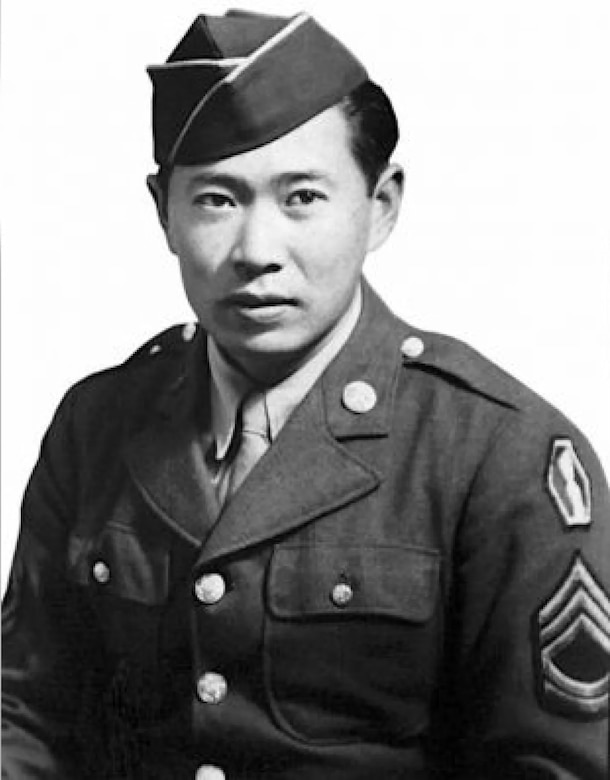
He graduated from Torrance High School in 1938, where he played on the football team and excelled in academics. After high school, he worked for a time in the grocery industry in Torrance.
Tanouye enlisted in the Army Feb. 20, 1942. His parents and siblings were interned in the Jerome War Relocation Center and later the Rohwer War Relocation Center, both in Arkansas, because of growing suspicion of Japanese Americans following the Dec. 7, 1941, attack on Pearl Harbor, Hawaii. They were held until the end of the war.
After serving as a cook in several stateside locations, including at Camp Robinson in Arkansas — ironically, the state where his family was interned — he was deployed to Italy in May 1944.
On July 7, 1944, the day of his Medal of Honor action, Tanouye was assigned to Company K, 3rd Battalion, 442nd Regimental Combat Team, in the hilly countryside near Molino a Ventoabbto, Italy, during the in the Rome-Arno Campaign.
Tanouye led his platoon in an assault to seize the summit of a strategically important hill that had minimal natural cover. When he observed an enemy machine gun crew setting up, he quietly maneuvered into position and opened fire on the position, killing or wounding three and causing two others to flee.
Then, shots came from an enemy position. Tanouye returned fire and killed or wounded three more enemy soldiers. A grenade burst came in quick succession, wounding his left arm.
Sighting an enemy-held trench, Tanouye raked the position with a submachine gun and wounded several of the enemy.
His men were pinned down by enemy fire, so Tanouye crawled forward a few yards and threw a hand grenade into the position, silencing it. He then located another machine gun firing down the hillside and silenced that position as well.
Drawing fire from a machine pistol nest located above him, Tanouye opened fire on it and wounded three of its occupants. After securing his objective, he organized a defensive position on the reverse slope of the hill before accepting first aid treatment and evacuation.
Tanouye recovered from his wound and returned to the front lines. He was wounded again Sept. 1, 1944, after kneeling to inspect a landmine along the Arno River. Another soldier accidentally tripped the wire and Tanouye took most of the blast fragments, saving the life of the soldier beside him. He died Sept. 6, 1944, from wounds suffered from the explosion.
In a letter of condolence to his family from Tanouye's commanding officer, he was described as being an "excellent soldier, a loyal American who was respected and admired by everyone in the company."
In the years after the war, only one Japanese American soldier received the Medal of Honor: Army Pfc. Sadao Munemori, who died in battle. Tanouye posthumously received the Distinguished Service Cross, the nation's second-highest military award for valor.
During the war, the approximately 14,000 Japanese American soldiers who served in the 442nd Regimental Combat Team received 18,143 awards, including seven Presidential Unit Citations.
In 1996, legislation sponsored by Sen. Daniel Akaka of Hawaii and others led to an official review of the many Distinguished Service Cross awards received by Black and Japanese American troops for their heroics during World War II. The review resulted in the military upgrading 19 of the 52 Distinguished Service Crosses to Medals of Honor, which included Tanouye.
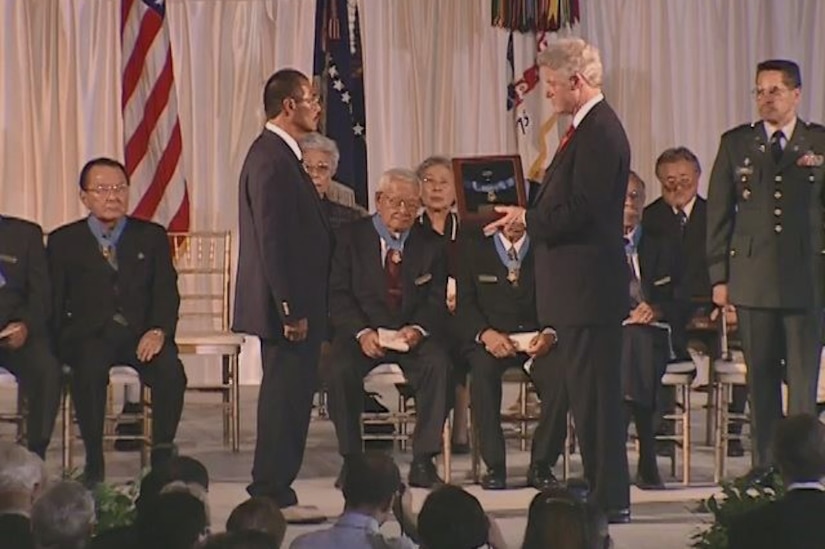
The Medal of Honor was presented to several Japanese American soldiers assigned to the 100th Infantry Battalion and the 442nd Regimental Combat Team during the June 21, 2000, White House ceremony. President Bill Clinton presented the Medal of Honor to Tanouye's younger brother, Isao Tanouye.
Tanouye is buried in Evergreen Memorial Park Cemetery in Los Angeles, alongside a battle buddy, Army Staff Sgt. Akira Shimatsu, who was killed July 16, 1944, in Italy. Also buried nearby are Tanouye's parents and younger brother, Army Pvt. Yukiwo Tanouye, who was killed during the Korean War.
Tanouye's Medal of Honor is on display in the Torrance Historical Society Museum, along with his story.
The National Guard Armory in Torrance was renamed the Ted Tanouye National Guard Armory May 19, 2002. A memorial to him was dedicated in July 2004 at Triangle Park, California, near Torrance High School.
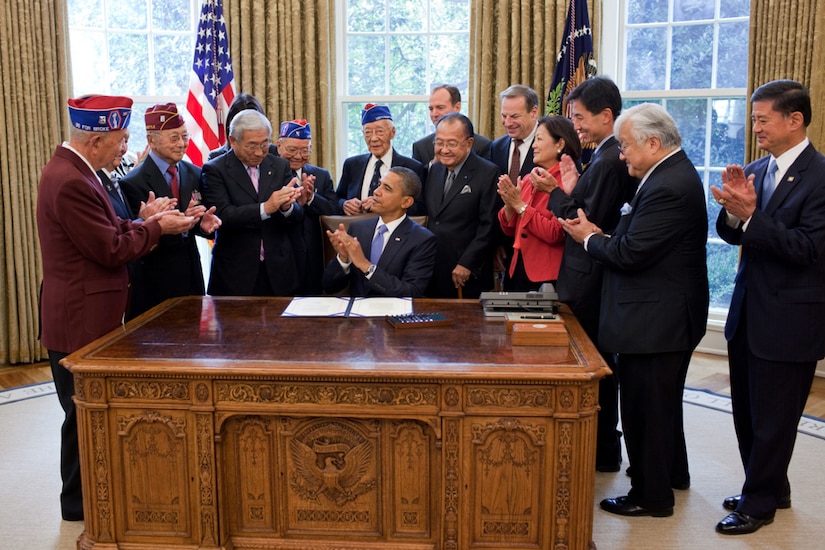
The 442nd Regimental Combat Team was collectively awarded the Congressional Gold Medal in 2011 through Public Law 111-254 that was signed by President Barack Obama Oct. 5, 2010.




 Posts
Posts

