Thursday, September 23, 2021

Readout of Secretary of Defense Lloyd J. Austin III's Phone Call With Israeli Minister of Defense Benjamin "Benny" Gantz

 Sept. 23, 2021

Pentagon Press Secretary John Kirby provided the following readout:

Today, Secretary of Defense Lloyd J. Austin III spoke with Israeli Minister of Defense Benjamin “Benny” Gantz about regional security challenges and Israel’s defense requirements.  

Secretary Austin conveyed the Biden Administration’s support for replenishing the Iron Dome Defense System.  

Secretary Austin and Minister Gantz also exchanged views on the situation in Afghanistan and committed to continue cooperating closely on regional security. 

Paint Job


Navy Petty Officer 3rd Class Brianna Vasquez-Ragan applies primer to a bulkhead aboard the USS Benfold in the Sea of Japan, Sept. 17, 2021.

Deputy Secretary of Defense Hicks Meets With Mr. Benedikt Zimmer, State Secretary, Federal Ministry of Defence, Federal Republic of Germany

 Sept. 23, 2021


Pentagon Spokesman Eric Pahon provided the following readout:

Deputy Secretary of Defense Dr. Kathleen Hicks met with German State Secretary for the Federal Ministry of Defence Mr. Benedikt Zimmer today to reaffirm the U.S.-German bilateral relationship.

The two leaders exchanged views on defense and security priorities, including Afghanistan, the Indo-Pacific, Russia, and NATO.  She thanked the State Secretary for Germany’s support to evacuation operations both in Afghanistan and Germany.  She also shared updates on ongoing U.S. strategic reviews.  

Dr. Hicks congratulated State Secretary Zimmer on Germany’s decision to acquire five P-8 maritime patrol aircraft, increasing German capabilities to address shared security concerns.

Mr. Zimmer and Dr. Hicks expressed their commitment to continued collaboration on a series of issues, to include NATO interoperability, security in the Indo-Pacific, and shared security challenges in Space and emerging technology.

Tyndall Takeoff


An airman prepares for takeoff at Tyndall Air Force Base, Fla., Sept. 20, 2021.


Dusty Landing


A Marine Corps CH-53E Super Stallion prepares to land during a weapons and tactics instructor course near Yuma, Ariz., Sept. 22, 2021.

Technical Toss


An Idaho Army National Guardsman throws a grenade during training in Boise, Idaho, Sept. 11, 2021.

Colorful Ops


Marines participate in a nighttime live-fire range aboard the USS Pearl Harbor in the Pacific Ocean, Sept. 10, 2021.

COVID-19 Vaccine Prep


An airman with the 6th Medical Group prepares a COVID-19 vaccine for distribution at MacDill Air Force Base, Fl., Sept. 17, 2021. This is the second time the 6th MDG has established a point of distribution on base in order to help distribute roughly 1,000 COVID-19 vaccines per day.

Food Bank Delivery

Arizona National Guard service members prepared boxes of groceries for delivery to area residents at a food bank in Queen Creek, Ariz., Sept. 20, 2021. As of Sept. 20, 2021, the Arizona National Guard has completed 8,944 food bank missions, handed out 1,747,238 units of food, prepared and served 943,765 meals, 849 transportation mission with over 1,091,934 miles driven, completed over 700 COVID-19 testing site missions, and completed 1,537 vaccination missions.


Live Fire


Soldiers fire rounds from an Army M1A2 Abrams battle tank at Fort Carson, Colo., Sept. 22, 2021.

Team Training


Marines conduct advanced interdiction team training in the Persian Gulf, Sept. 21, 2021.

Flag Officer Announcement

 Sept. 23, 2021


Secretary of Defense Lloyd J. Austin III announced today that the president has made the following nomination:

Navy Rear Adm. (lower half) Jeffrey S. Scheidt for appointment to the rank of rear admiral, while serving as senior military advisor for cyber policy to the under secretary of defense for policy; and deputy principal cyber advisor to the secretary of defense, Washington, D.C.  Scheidt is currently serving as deputy chief, Computer Network Operations, National Security Agency, Office of the Under Secretary of Defense for Intelligence, Fort George G. Meade, Maryland.

General Officer Announcement

 Sept. 23, 2021


Secretary of Defense Lloyd J. Austin III announced today that the president has made the following nomination:

Air Force Col. James D. Brantingham for appointment to the rank of brigadier general.  Brantingham is currently serving as the command chaplain, Air Mobility Command, Scott Air Force Base, Illinois.

Goat Grub


Navy Petty Officer 3rd Class Leane Alfon feeds a goat during a community relations event at Hoffler Creek Wildlife Preserve in Portsmouth, Va., Sept. 21, 2021.


DLA's Realignment of Industrial Hardware Procurement to Streamline Support, Yield Savings

 Sept. 23, 2021 | BY Beth Reece , Defense Logistics Agency

Transfer of the industrial hardware supply chain from Defense Logistics Agency Troop Support to DLA Aviation and DLA Land and Maritime is expected to better align weapons system support and enable the agency to support growing missions of other defense and federal agencies.

The transfer of procurement responsibility for more than 900,000 items ranging from nuts, bolts and seals began in March 2020 and will be completed Sept. 30, 2021, one year ahead of schedule. DLA Troop Support will officially deactivate the supply chain, and the commodity group will then be referred to as consumable hardware starting Oct. 1, 2021. 

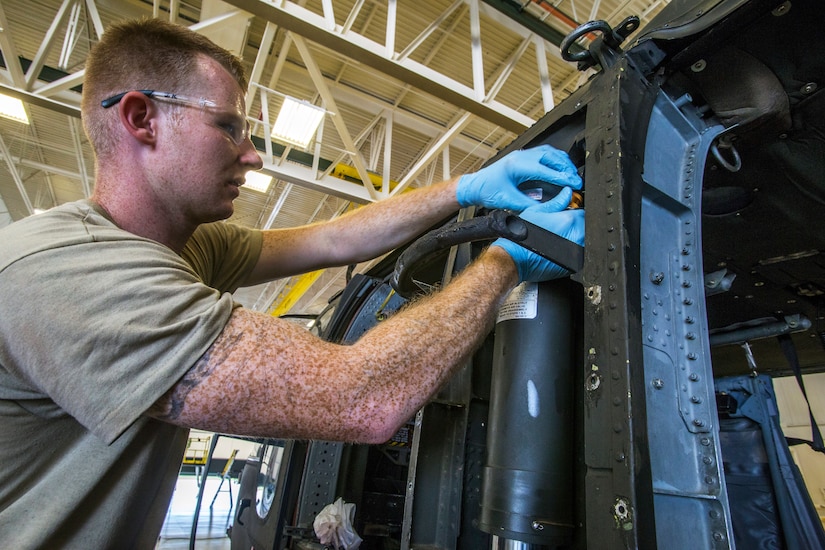
Male soldier wearing a brown t shirt, glasses and blue protective gloves tightens hardware on an aircraft.

Moving industrial hardware work conducted by supplier-facing teams at DLA Troop Support to already existing customer-facing teams at DLA Aviation and DLA Land and Maritime streamlines acquisition functions and will improve communication and collaboration among employees, customers and suppliers, said John Bray of DLA Human Resources.

"Industrial hardware was kind of an anomaly at DLA Troop Support with the parts being much more common in aviation and land and maritime systems," he said. "Although customers shouldn’t notice much difference, they’ll now be able to get answers to all their questions on industrial hardware from one source depending on which type of system is involved."

The nearly 500 employees who handled industrial hardware at DLA Troop Support have gradually transitioned to positions in other supply chains at the Philadelphia-based organization with no loss of grade or pay. Some will undergo reskilling as DLA Troop Support incurs new missions in support of whole-of-government partners. Those missions are estimated to increase DLA Troop Support’s revenue by $7 billion through fiscal year 2023. 

"The plus-up in workloads for supply chains like medical makes this transition even more beneficial and comes at a good time especially for DLA Troop Support," Bray said. 

DLA expects to save about $8 million in annual labor costs as DLA Aviation and DLA Land and Maritime absorb the work using current employees, internal management reassignments and some new hires.

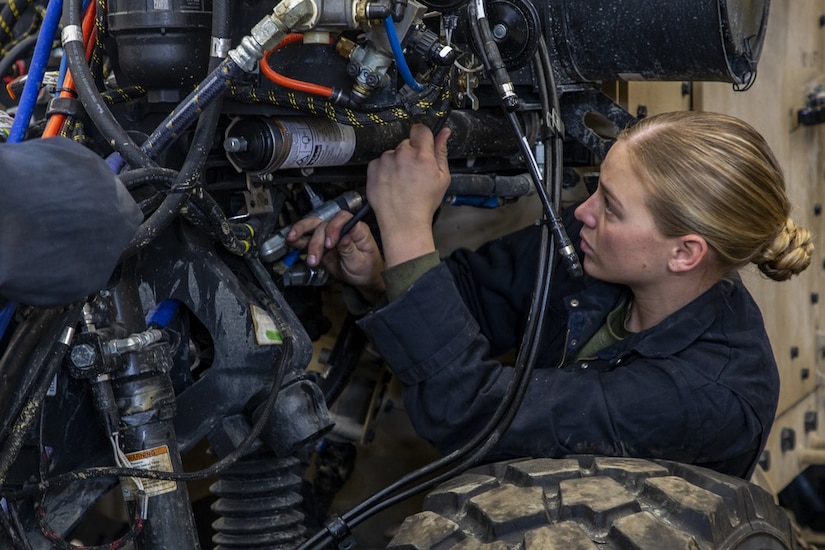
A service member works on a vehicle.

DLA leaders decided to streamline industrial hardware to increase effectiveness and efficiencies in 2018 as part of a series of initiatives to reduce material and operating costs, said Esther Wade, chief of DLA Logistics Operations’ Process Integration Division.  

"Finding smarter ways to support our customers will also help reduce our cost-recovery rate, which is a huge benefit not only to warfighters but to other federal agencies as well," she said. 

The effort has been a collaboration between major subordinate commands and directorates throughout the agency to include business process, finance and human resources representatives. 

"Being able to make this happen sooner than originally scheduled is a testament to our close partnerships and our desire to better serve the warfighters," Wade said. 

DLA has managed industrial hardware since the Navy transferred items like metal sheets, bearings and electrical cable to the Defense Industrial Supply Center in 1962.

 Sept. 23, 2021 | BY Jim Garamone , DOD News

The United States is a global superpower and this means global reach.

"There isn't a scrap of Earth that we can't reach out and touch when we need to," Secretary of Defense Lloyd J. Austin III said during a press conference in Qatar on Sept. 7. "We've demonstrated that time and time again. And again, our job is to make sure we stay vigilant and continue to develop capabilities."

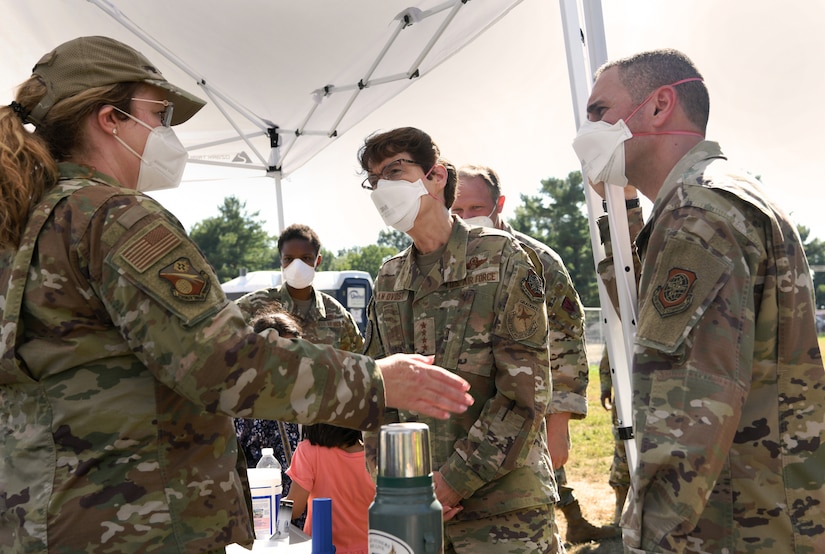
An airman briefs a general.


On the military side, these capabilities run from being able to deploy and sustain service members anywhere in the world to being able to drop a Joint Direct Attack Munition, or JDAM, on some terrorist hideout to being able to steam wherever international law allows. Underpinning this ability are the men and women — military and civilian — of U.S. Transportation Command.

President Joe Biden nominated Air Force Gen. Jacqueline D. Van Ovost to be the next commander of Transcom. Her confirmation hearing before the Senate Armed Services Committee was today.

Van Ovost — who currently commands the Air Force's Air Mobility Command — said Transcom is America's asymmetric advantage over potential foes. "If confirmed, I will ensure United States Transportation Command continues to provide our nation with one of its most important strategic and asymmetric advantages over our adversaries: The ability to rapidly project and sustain joint combat power at strategically relevant speeds, distances and scale at the time and place of our nation's choosing," she said.

The capabilities the command provides is increasingly important in an era of strategic competition with China and Russia, Van Ovost said. "Determined and emboldened strategic competitors, like China and Russia, continue rapid and deliberate development of advanced capabilities, and they challenge international norms with their coercive behavior," she said. "As the national security strategic guidance emphasizes, we must maintain our military competitive edge by continuing to field and train the best force, adopt new technologies and build and maintain key partnerships."

Building relationships with allies and partners is another aspect she emphasized. Access to ports or overflight rights is the lifeblood of the global command. Dealing with commercial companies — who carry vast amounts of military cargo — is also a responsibility for the commander. 

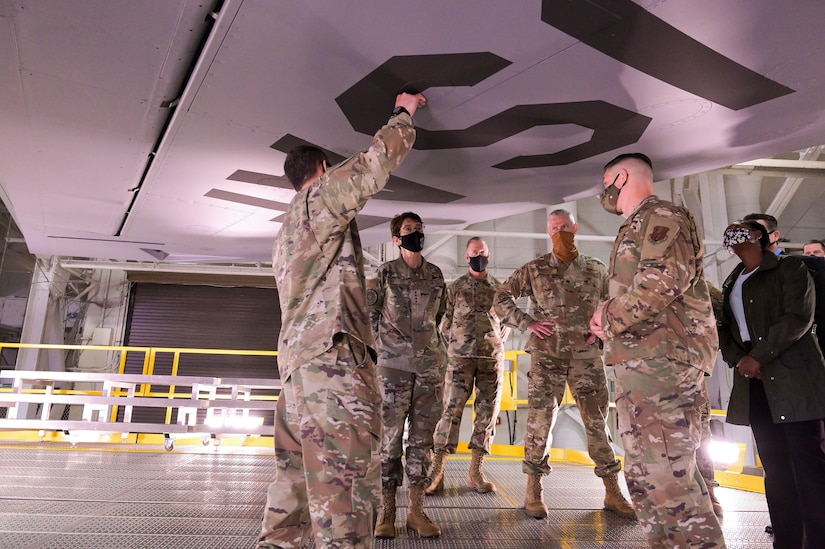
Airmen check the advantages of new aircraft stands.

Cyber abilities are important to the command from tracking shipments, to ensuring communications, to de-conflicting airspaces and more. Van Ovost told senators that malicious cyber operations pose significant threats to logistics. "These attacks target vulnerable supply chain elements and can interrupt the flow of goods and supplies around the world," she said.

The non-combatant evacuation operation from Hamid Karzai International Airport last month highlighted the abilities of the Air Mobility Command — a part of Transom. "AMC played a significant role in the national and coalition effort to airlift more than 120,000 people out of Afghanistan," Van Ovost said. "It was a difficult and dynamic mission, where some of our airmen had to make decisions when lives are on the line. I'm so very proud of the work they did there, and that they continue to do every day."

Readout of Secretary of Defense Lloyd J. Austin III's Meeting With Australian Prime Minister Scott Morrison


Sept. 22, 2021

Pentagon Press Secretary John Kirby provided the following readout:

Secretary of Defense Lloyd Austin III hosted Australian Prime Minister Scott Morrison for his first visit to the Pentagon, Wednesday, to discuss the future of the U.S.-Australia Alliance, after the historic announcement of the Australia-U.K.-U.S. (AUKUS) trilateral security partnership and the successful Australia-U.S. Ministerial Consultations (AUSMIN) held in Washington D.C. last week.

The two leaders discussed AUKUS and the framework for its implementation, emphasizing that it was a long-term partnership that laid the foundation for ensuring peace and stability in the Indo-Pacific region. They also discussed the importance of Alliance engagement with regional allies and partners, and how to strengthen the Alliance’s capabilities across the air, land, sea, cyber, and space domains. 

Prime Minister Morrison thanked Secretary Austin for the United States’ partnership and support throughout the war in Afghanistan, especially for supporting the airlift of 4,100 people from Kabul to Australia last month. 

After the meeting, the Prime Minister laid a wreath at the Pentagon’s 9/11 Memorial to pay his respects following the 20th anniversary of the attack. Both leaders affirmed the enduring strength of the U.S.-Australian Alliance on the 70th anniversary of the ANZUS treaty.

Wednesday, September 22, 2021

Parachute Panache


A U.S. Army paratrooper helps a Dutch paratrooper control his parachute in the Netherlands during Falcon Leap, Sept. 16, 2021. Falcon Leap is NATO's largest technical airborne exercise, with more than 1,000 paratroopers from 12 different nations training with one another's equipment for two weeks.

Australian Prime Minister, Austin Discuss New Aspect of Trilateral Partnership

 Sept. 22, 2021 | BY Jim Garamone , DOD News

Australian Prime Minister Scott Morrison and Secretary of Defense Lloyd J. Austin III sat down at the Pentagon today to discuss how the enhanced trilateral security partnership with the two nations and the United Kingdom will move forward.

Morrison, who met with President Joe Biden yesterday, is in Washington for a meeting of the quad partnership of India, Japan, Australia and the United States.

The new trilateral relationship "is a testament to the strength, resilience and foresight of our relationship," Austin said at the beginning of his meeting with Morrison. "President Biden has noted that no regional divide separates the interest of our Atlantic and Pacific partners, and AUKUS [Australia, United Kingdom and the United States] is designed to build on our existing alliances."

Men sit at a conference table.

The meeting comes a week after the Australia-U.S. Ministerial Consultation that was hosted by the State Department. "Today, our alignment is stronger than ever, including seeing the region's challenges through a similar lens and sharing the same sense of urgency," Austin said. "So, we'll continue to cooperate closely on force posture, strategic capabilities, regional alignment and military operations. And all of this common work strengthens our ability to deter threats [for a] free and open Indo-Pacific."

Morrison said the evacuation of Afghans from Kabul showed the U.S.-Australian alliance at work. Both nations had troops on the ground at Kabul airport. But, he said, there was no way the Australians could have evacuated the 4,100 people they did without the U.S. military, and he thanked Austin for that support. He said the evacuation effort is "a symbol of the nature of our partnership. Australia has always looked to the United States, but we never leave it to the United States.

"That is at the heart of our partnership," he continued. "We both understand our responsibilities in it. We accept them, we share them. We honor them in how we deliver it on the ground in so many theaters."

This continues with AUKUS, he said. The trilateral partnership, "adds to the partnerships that exist within the region, whether it's the quad partnerships and relationships, or the wonderful relationships we have with the [Association of Southeast Asian Nations] in the region," Morrison said. "But importantly, [AUKUS builds on] the relationships with NATO, and relationships with our European partners, and bringing that focus to the Indo-Pacific."

Secretary of Defense Lloyd J. Austin III Welcomes Australian Prime Minister Scott Morrison to the Pentagon

 Sept. 22, 2021

Secretary of Defense Lloyd J. Austin III; Australian Prime Minister Scott Morrison

SECRETARY OF DEFENSE LLOYD J. AUSTIN III: Well, good morning, Mr. Prime Minister. It is, indeed, an honor to welcome you to the Pentagon, and thanks so much for making the trip and for your focus on our defense relationship.

It is especially great to have you here this month, and we'll celebrate the 70th anniversary of ANZUS. Our enduring bond has been deepened through more than a century of shared sacrifice through every conflict of the modern era. Just days ago, we commemorated 20 years since the 9/11 attacks here at the Pentagon. We'll always be grateful to Australia for invoking the ANZUS Treaty for the first time and for sending forces to fight shoulder-to-shoulder with our troops. And I have to tell you, Mr. Prime Minister, I fought alongside many of your troops; been deeply-impressed by their skill and their courage. So we thank you for standing with us to the end of our mission in Afghanistan, and for the close, enduring cooperation of our unbreakable alliance.

Even as -- as we honor the past, our alliance is very much focused on the future and the challenges of the 21st century. And we can see that in your announcement alongside with President Biden and Prime Minister Johnson of the establishment of an enhanced trilateral security partnership among Australia, the United Kingdom and the U.S. AUKUS is a testament to the strength, resilience and foresight of our relationship, and as President Biden has noticed -- noted, no regional divide separates the interests of our Atlantic and Pacific partners, and AUKUS is designed to build on our existing alliances.

Now, I was honored to host Minister Dutton here last week, and together, we joined Minister Payne and Secretary Blinken for the very productive and far-reaching Australia-United States ministerial consultations. Today, our alignment's stronger than ever, including seeing the region's challenges through a similar lens and sharing the same sense of urgency. So we'll continue to cooperate closely on force posture, strategic capabilities, regional alignment and military operations. And all of this common work strengthens our ability to deter threats through a free and open Indo-Pacific.

Again, Mr. Prime Minister, thanks for being here today, and I look forward to a terrific discussion.

AUSTRALIAN PRIME MINISTER SCOTT MORRISON: Well, thank you very much, Mr. Secretary, and thank you for your very generous welcome to me and my delegation, and also, of course, hosting both Minister Dutton and Minister Payne last week. It was a very successful set of meetings, as AUSMIN always is.

There are two places in the United States that I think best describe our partnership. Yesterday, I was in New York, and -- where 9/11 struck so fiercely, and here I am today at the Pentagon, where it also struck. And it is a -- it is a clear reminder of the importance of our alliance and what Australia and the United States mean to each other. So as we mark the 70th anniversary of ANZUS and we also remember those terrible events, I think it only encourages more in the partnership that we have.

I particularly want to say thank you to all the men and women of the U.S. defense forces that we served alongside of -- served alongside with -- in Afghanistan, and I also particularly want to thank all of those who were there on the deck in Kabul as together, we engaged in one of the biggest airlifts and evacuations of people in that situation. There is no way Australia would have been able to airlift 4,100 people out of that terrible site were it not for the sacrifice of the U.S. defense forces, and I want to particularly honor those who lost their lives at the Abbey Gate, where Australians themselves had been standing not that long before and as you assisted us evacuate our own people on that -- that last flight that took our own people out who'd been there assisting so many. It was, I think, a -- a symbol, again, of the nature of our partnership.

Australia has always looked to the United States, but we never leave it to the United States, and that is at the heart of our partnership. We both understand our responsibilities in it. We accept them. We share them. We honor them in how we delivered on the ground in so many theaters, and that continues with AUKUS. AUKUS, I agree, Mr. Secretary, is a partnership that builds on the partnerships that we already have, that adds to the partnerships that exist within the region, whether it's the Quad partnerships and relationships, the wonderful relationships we have with ASEAN in the region, but importantly, the relationships with NATO, the relationships with our European partners and bringing that focus to the Indo-Pacific.

So I'm particularly looking forward to discussing how we now take AUKUS forward and the many projects that I know we will have, about how that will create the free and open Indo-Pacific that is so important to us all. So thank you, Mr. Secretary, for your kind hospitality.