by Justin Oakes
66th Air Base Group Public Affairs
10/28/2015 - HANSCOM AIR FORCE BASE, Mass. -- Last
week the Air Force and the State of Qatar finalized an agreement for
the next step in the delivery of a U.S. integrated air and missile
defense system for the Qatari Emeri Air Force.
The Qatar Air and Missile Defense Operations Center, or ADOC, program
located at Hanscom AFB awarded Raytheon a $160 million contract for
Phase II of the initiative. The contract covers the procurement,
delivery, installation and sustainment of the Qatar ADOC system as well
as training of Qatari personnel.
Qatar -- a key U.S. partner and also a member of the Gulf Cooperation
Council, a political and economic alliance of six Middle Eastern
countries -- requested the purchase of a U.S. missile defense system,
said James Ware, Qatar ADOC program manager.
"By supporting this sale, it will ultimately benefit the U.S. by
providing better interoperability with U.S. Central Command forces," he
added.
U.S., coalition forces and the Gulf Cooperation Council share
information for united defense and work hand-in-hand within USCENTCOM.
The ADOC itself is a command and control center focused on air and
missile defenses. It consists of multiple different weapon systems and
radars, and is composed of a command center, space for operations and
planning personnel as well as senior leader offices.
With the next phase underway and on track, the Hanscom program office
plans to meet with Qatari officials this month to discuss
interoperability requirements to determine what information will be
exchanged between the ADOC and existing and planned systems.
One of the systems that is planned to be integrated into the ADOC is the Army's PATRIOT Air and Missile Defense System.
"Mutual approval is necessary prior to adoption of any planned
integrated system to ensure data protection is commensurate with
prescribed U.S. procedures and standards," Ware said.
Program officials also plan to conduct an Interim Design Review that
will allow Raytheon to receive stakeholder feedback early in the
development cycle.
"Ultimately, the delivery of the ADOC not only improves upon Qatar's
defense infrastructure, but helps solidify an ongoing partnership
between the two countries," said Tom Cook, Qatar ADOC branch chief.
Thursday, October 29, 2015
Wednesday, October 28, 2015
Peterson Airman’s tragic loss exemplifies resiliency
By Senior Airman Rose Gudex, 21st Space Wing Public Affairs
/ Published October 27, 2015
PETERSON AIR FORCE BASE, Colo. (AFNS) -- (This feature is
part of the "Through Airmen's Eyes" series. These stories focus on
individual Airmen, highlighting their Air Force story.)
After getting orders to South Korea, Tech. Sgt. Billy
Gazzaway was missing his family, as anyone would. Far away from them, he
received the horrible news that his 4-year-old son, who had already been
diagnosed, treated and was in remission for leukemia, had relapsed.By the time
Gazzaway made it back to his family almost two weeks later, his son, Kadin, had
already lost his hair due to the aggressive treatment. He battled hard for
around eight months, but passed away just before his fifth birthday.
Gazzaway struggled with the loss of his son throughout the
next several years and through multiple assignments. He said he turned to
alcohol and bottled his emotions inside. The long road to recovery began when
he was able to admit he needed help and sought counseling. By addressing the
hardships head on, Gazzaway was able to get back on track to finding success
and happiness.
He began the journey to recovery at Tyndall Air Force Base,
Florida, when he was depressed and said he didn't have motivation to do
anything after Kadin passed away. He kept thinking about the look on his son's
face in his last moments.
"The whole time, the look on his face was that he's
disappointing us," he said. "For those last minutes, last few
seconds, I've never had anyone squeeze my hand so hard. ... It still haunts me
today."
Lost and angry, Gazzaway even stopped talking to the one
person who knew what he was going through -- his wife, Master Sgt. Emily
Gazzaway, now a senior enlisted aide at the U.S. Air Force Academy.
His wife immediately went to counseling, but he refused,
thinking he didn't need anyone telling him how to grieve the loss of his son,
he said. Emily eventually convinced him to go to at least one counseling
session with her, but still Billy couldn't talk about it and just lied.
"Oh no, I'm doing great," he recalled telling the
counselor. "No, I'm not drinking that heavily."
Two months later, Billy finally went back to work but it
wasn't a stellar performance, he said, adding that he just showed up for work
and went through the motions. There was no volunteering or self-improvement,
just his work in the communication squadron.
To make matters worse, the Gazzaways received orders for
Beale AFB, California, after they were told they would never have to leave the
place where Kadin was buried. Billy's drinking continued to get worse because
he couldn't be there for his son.
"On May 4, 2009, is when I said I'm tired of feeling
sorry for myself," he said. "I (was) tired of living this way and not
doing what the Air Force (was) asking me to do."
Not long after, he heard on the radio about Team in
Training, a fundraising program for the Leukemia & Lymphoma Society. With
this organization, he had something to focus on and ran his first marathon in
Sacramento in 2009.
Seemingly on the right path, Billy started to do what the
Air Force wanted him to do and worked on bettering himself, he said. He won a
couple quarterly awards and was up for an annual award. And then there was a
setback.
"This one was self-inflicted. I got a DUI January of
2010," he said of his driving under the influence charge. "I didn't
know (what to do). I definitely didn't want to be on earth anymore. I cannot
believe I did this."
This all happened five days before he was supposed to be
awarded the wing-level volunteer NCO of the year award. It was decided Billy's
recent mistake wasn't a good example to other Airmen and the award was taken
away.
As a result, he received a poor enlisted performance report
and was not awarded a decoration when he left Beale for Wright Patterson AFB,
Ohio. At first, he said, it was very discouraging but then a new place allowed
him a fresh start.
The first thing Billy did was seek help when he arrived at
his new base. He went to counseling and talked to his leadership about what
happened and what he was going through.
The same thing happened when they received another new
assignment, this time to Peterson AFB. Billy again discussed his past struggles
with his leadership right away and also volunteered to be a mentor for other
Airmen going through tough times, he said.
Things were on the upswing and he began to address his
problems rather than brush them under the rug. A key point he passed on to his
troops was to stop making excuses, as he had.
"I didn't tell Kadin's story," Billy said. "I
didn't want people to think 'this guy got a DUI because his son died.' No, I
got a DUI because I made a stupid mistake."
It may have taken a while for him to get back on the right
track, but he took ownership of his mistakes and now takes pride in helping
others whenever he can. After the rollercoaster of experiences life threw at
him, he encourages Airmen to seek help if there is ever a situation that calls
for it.
"If you ever think you've hit rock bottom ... know that
you can do it, seek help," he said. "It was that moment when I started
talking to people when my life and my career started changing for the
better."
As long as people are willing to seek it, there will always
be guidance and support during times when life gets tough and seem dark, he
said.
Air Force releases new Sexual Assault Prevention and Response Strategy
Secretary of the Air Force Public Affairs / Published
October 27, 2015
WASHINGTON (AFNS) -- Air Force leaders released a five-year
Sexual Assault Prevention and Response Strategy that will guide the Air Force
in developing a robust prevention model while continually honing response
capabilities today.
The secretary, chief of staff and chief master sergeant of
the Air Force signed a foreword to the strategy charging all Airmen with the
responsibility of preventing sexual assault.
“Sexual assault prevention is critical to the health, morale
and welfare of Airmen and ultimately essential to Air Force readiness,” said
Secretary of the Air Force Deborah Lee James. “This strategy lays out the deliberate,
science-based process we will follow to eradicate this crime from our ranks.”
The two-part document outlines both response and prevention
strategies. Although Airmen will likely be familiar with the programs included
in the response portion of the strategy, the prevention strategy presents a new
phase in Air Force SAPR efforts, said Dr. Andra Tharp, an Air Force sexual
assault prevention and response highly qualified prevention expert.
“Using a public health approach to prevention, the strategy
will use proven prevention programs, policies and best practices to reduce risk
factors and enhance protective factors,” Tharp said. “Fostering skills such as
being an active and engaged bystander, managing emotions and resisting peer
pressure are proven approaches to preventing violence.”
The Sexual Assault Prevention Strategy lays out the sexual
assault prevention tenets: preventing violence before it occurs; promoting
prevention at every level; and providing ongoing prevention activities that
reflect the unique roles and development of each Airman.
In line with the Defense Department strategy published in
April 2014, the Air Force strategy promotes a comprehensive prevention approach
that ensures prevention messages and skills are consistent and reinforced
across the different environments in which an Airman may live and work.
“Our Air Force family comes from all walks of life, but we
all work together to protect our nation,” said Air Force Chief of Staff Gen.
Mark A. Welsh III. “Our core values are what bind each of us together, and it’s
on us to take the time to really know our people. We’re all part of the
solution or there is no solution.”
According to the strategy, a key long-term objective of SAPR
programs is to provide every Airman with standardized, developmental education
and training throughout their career, strengthening the Air Force culture of
dignity and respect and sustaining an environment inhospitable to sexual
assault perpetrators. Effective enhanced developmental education and training
will be tailored to address specific populations and behaviors of individuals,
groups, and cultures.
“We’re moving away from a one-size-fits-all approach to
prevention and thinking hard about who needs what and when,” Tharp said. “We
know that risk factors change as people age and that an Airman’s role in
prevention might change as he or she takes on different leadership roles; so,
we are moving towards a more nuanced approach to prevention that focuses on
delivering relevant skills and messages to the right people at the right time.”
The strategy document explains factors that put an
individual at risk for perpetration such as previous unhealthy experiences,
beliefs or relationships, and outlines a plan to tailor training to address
risk factors in every setting.
“We listened to Airmen’s concerns and we’re excited about
the new model that will be introduced to the force,” said Chief Master Sgt. of
the Air Force James A. Cody. “It’s on us to ensure our Airmen are trained
appropriately to shape our culture in a manner that does not allow sexual
assault or harassment to occur.”
Airmen will begin seeing portions of the prevention strategy
in action this year. The Air Force SAPR office is working with a contracted
prevention training company to tailor the company’s training to address
specific populations and behaviors of individuals, groups and cultures within
the Air Force.
Focus groups to assist in this effort are currently ongoing
at Little Rock Air Force Base, Arkansas, and Keesler AFB, Mississippi, and the
new training will be presented to Airmen beginning in January 2016.
Additionally, major commands across the Air Force have already begun to use
advisory boards or existing installation delivery systems to support the
rollout of the prevention strategy and new training model.
“Sexual assault has a direct impact on our Airmen and our
mission. Our Airmen deserve to carry out our vital missions in an environment
where they are treated with respect and dignity,” James said. “We will not stop
looking for ways to improve until we have an Air Force free from sexual
assault.”
Civil engineer teams sustain Bagram runway, ensure combat airpower
By Tech. Sgt. Nicholas Rau, 455th Air Expeditionary Wing
Public Affairs / Published October 27, 2015
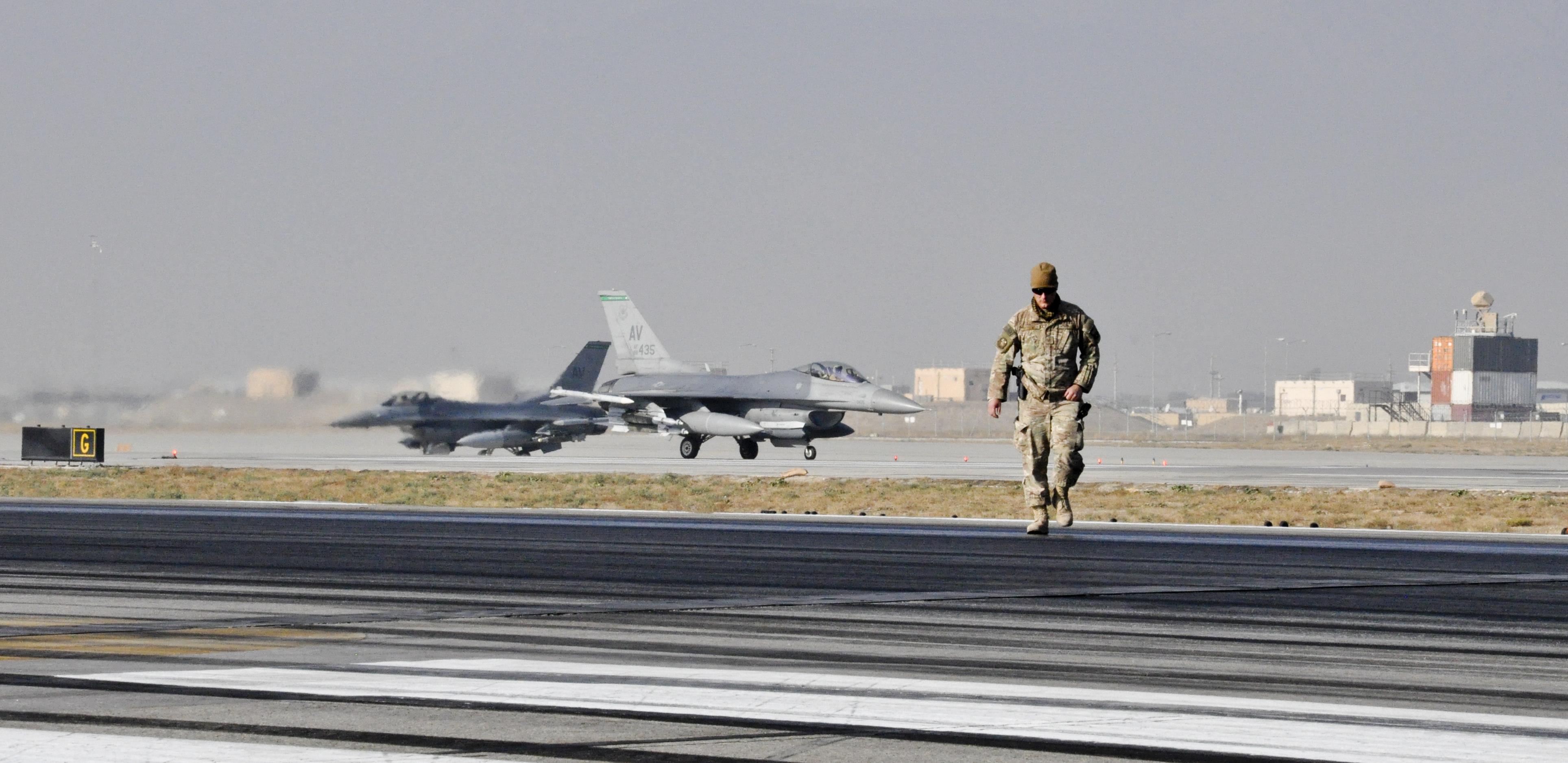
BAGRAM AIRFIELD, Afghanistan (AFNS) -- With combat airpower
operations coming and going from Bagram Airfield nearly every three minutes,
taking care of the flightline is a vital operation.
Airmen from the 577th Expeditionary Prime Base Engineer
Emergency Force Squadron out of Al Udeid Air Base, Qatar, worked to remove
rubber buildup on the runway, while teaming up with the 455th Expeditionary
Civil Engineer Squadron that was performing upkeep on the arresting cable
system and worn reflective markings, all in order to ensure another six months
of runway integrity.
“I believe that this maintenance is a significant part of
what we are trying to keep going (in terms of airpower) in Afghanistan and
around the area of responsibility,” said Tech. Sgt. Christopher Fitzgerald, of
the 577th EPBS, who is deployed from Shaw Air Force Base, South Carolina. “It’s
just a small part of the bigger picture.”
To remove the buildup caused by constant air traffic, the
team from Al Udeid first applied a solvent to begin to break up the rubber.
They then used modified sweepers to grind in the solvent and allow the rubber
to separate. Finally, a biodegradable product was applied that foamed
underneath the rubber, causing it to lift and float away.
To pull off this operation, the Prime BEEF team, made up of
Air Force specialties such as plumbers; heating, ventilation and air
conditioning technicians; and electricians from different bases, bonded
together as a runway maintenance team to time each application.
“This all starts with your teammates. I had an awesome crew
who was willing to adapt and show me how to do this job,” said Senior Airman
Charles Chambers, of the 577th EPBS, who is deployed from Little Rock AFB,
Arkansas. “This has actually helped me grow as a person. With these people
being from different places, you have to humble yourself, and I am glad I did.
It helped me learn who they were and the traits they had, so that I could learn
how to use equipment that I didn’t understand how to operate in the beginning.”
Once the rubber was removed, the 455th ECES applied paint mixed
with reflective beads to the faded runway markings. This simple form of
maintenance, once accomplished, can reduce the need for repainting by a year or
more, and provide pilots with a clear runway picture when coming and going from
Bagram Airfield.
To ensure all safety devices are serviceable and ready for
use, Staff Sgt. Timothy Shearer and his 455th ECES team performed maintenance
on the aircraft arresting cable system. The entire length of both cables, over
300 feet long, was extended and inspected for damage. Once they had trimmed off
and replaced the portions in need of service, they had to make sure it was
meticulously installed to demanding specifications.
These cables catch the jets in case of an emergency landing,
making sure the aircraft lands safely, much like on an aircraft carrier,
Shearer said, adding that they have to be the right length or the aircraft will
be pulled to the side.
Throughout the transition of Bagram’s missions over the
years, two things have remained constant -- airpower and maintenance. Lesley
Ellis, the Bagram Airfield manager, has witnessed both of these firsthand
during his 13 years in charge of the runway.
“We do about 24,000 missions monthly at Bagram. We do combat
sorties and resupply for the units at forward operating bases in the area,”
Ellis said. “I believe that we are the number one enduring air base in
Afghanistan. We are the prime location for anti-terrorism efforts.”
Subscribe to:
Posts (Atom)