Thursday, March 25, 2021

Helping Hand


Soldiers and airmen with one of the Alabama National Guard's mobile vaccination teams operate a pop-up vaccination clinic in Enterprise, Ala., March 24, 2021. The team provided free COVID-19 vaccines for more than 800 local residents. The process included a health screening, provider consultation, vaccination and an observation period. The mission is part of a partnership between the Alabama National Guard, Alabama Department of Public Health, Alabama Emergency Management Agency and local governments aimed at making vaccines available to rural communities in 24 Alabama counties.

Continued Vaccinations


Soldiers and airmen of the Alabama National Guard's mobile vaccination teams operate a vaccination clinic in Enterprise, Ala., March 24, 2021. The team provided free COVID-19 vaccines to more than 800 people. The process consisted of a health screening, provider consultation, vaccination and an observation period. The mission is part of a partnership between the Alabama National Guard, Alabama Department of Public Health, Alabama Emergency Management Agency and local governments to make vaccines available to rural communities in 24 Alabama counties.

Sea Ring


Navy Seaman Monica Smith directs a test of a helicopter on the flight deck of the USS Dwight D. Eisenhower in the Mediterranean Sea, March 19, 2021.

Welding Warrior


Coast Guard Chief Petty Officer Jennifer Spedoske performs a gas metal arc welding at the Naval Engineering Department in Alameda, Calif., March 5, 2021.

Cybercom's Partnership With NSA Helped Secure U.S. Elections, General Says

 March 25, 2021 | BY David Vergun , DOD News

Being both the commander of U.S. Cyber Command and director of the National Security Agency improves the ability to provide the nation with speed, agility and flexible responses to adversaries who are increasingly modernizing, getting quicker and getting more sophisticated, the agencys' director said.

Army Gen. Paul M. Nakasone testified today at a Senate Armed Services Committee hearing on the defense authorization request for fiscal year 2022 and the future years defense program.

"We operate in a domain that changes rapidly, and this change is measured in weeks rather than months. Being able to rapidly react to that, as we've been able to prove in the security of elections in 2018 and 2020, is empowered by that relationship," he said, referring to his dual-hatted role.

A man works with network gear.

To defend against foreign interference in elections the Election Security Group was created, he said, noting that it consists of a combined team from Cybercom and NSA. 

Nakasone also mentioned the importance of partnerships with the Federal Bureau of Investigation, the National Guard Bureau and the Department of Homeland Security's Cybersecurity and Infrastructure Security Agency, which involves sharing information with those who need it as quickly as possible. 

Cybercom conducted more than 2,000 operations to get ahead of foreign threats before they interfered or influenced the 2020 elections, Nakasone said. 

A man climbs a tower.

The general said he wanted to make three important points: "First, Cybercom must be and is able, ready and willing to act. Second, Cybercom's partnership with NSA remains the foundation of our success. And third, we enable our domestic industry, allies and partners by providing critical threat information and insights, which improve their ability to act under their unique authorities."

Cybercom is building on recent guidance from the department, seeking to promote readiness, improve training and attract and retain high-end talent, Nakasone said.

Even with COVID-19 impacts and lengthy security clearance timelines that impact the entire department, Cybercom was able to attract a number of high-end talent to the force, he said.

A woman in a military uniform types on a laptop.

Nakasone mentioned that Cybercom seeks to attract diversity in its force and to root out extremism in the ranks through education, monitoring and good leadership.

"We owe it to ourselves, our workforce and our nation to set and to be the example," he said.

General Officer Assignments

 March 25, 2021


The chief of staff of the Army announces the following officer assignments:

Lt. Gen. James E. Rainey, commanding general, U.S. Army Combined Arms Center and Fort Leavenworth, Fort Leavenworth, Kansas, to deputy chief of staff, G-3/5/7, U.S. Army, Washington, D.C.

Maj. Gen. (Promotable) Maria R. Gervais, director, Synthetic Training Environment Cross Functional Team, Orlando, Florida, to deputy commanding general/chief of staff, U.S. Army Training and Doctrine Command, Joint Base Langley-Eustis, Virginia.

Maj. Gen. Richard E. Angle, deputy commander, Joint Special Operations Command, U.S. Special Operations Command, Fort Bragg, North Carolina, to commanding general, 1st Special Forces Command (Airborne), Fort Bragg, North Carolina.

Maj. Gen. Robert L. Edmonson II, deputy chief of staff, G-6, U.S. Army Forces Command, Fort Bragg, North Carolina, to commanding general, U.S. Army Communications-Electronics Command and Aberdeen Proving Ground, Aberdeen Proving Ground, Maryland.

Maj. Gen. James B. Jarrard, commanding general, 25th Infantry Division, Schofield Barracks, Hawaii, to chief of staff, U.S. Indo-Pacific Command, Camp H. M. Smith, Hawaii.

Maj. Gen. Mitchell L. Kilgo, commanding general, U.S. Army Communications-Electronics Command and Aberdeen Proving Ground, Aberdeen Proving Ground, Maryland, to deputy, The Inspector General, U.S. Army, Washington, D.C.

Maj. Gen. Joel K. Tyler, director, J-3 operations/cyber, U.S. Africa Command, Germany, to chief of staff, U.S. Africa Command, Germany.

Brig. Gen. Shan K. Bagby, commanding general, Brooke Army Medical Center; and deputy market manager, San Antonio Military Health System, Joint Base San Antonio, Texas, to commanding general, Regional Health Command-Central, Joint Base San Antonio, Texas.

Brig. Gen. Edward H. Bailey, command surgeon, U.S. Army Forces Command, Fort Bragg, North Carolina, to commanding general, Regional Health Command-Pacific; and market manager, Puget Sound Enhanced Multi-Service Market, Joint Base Lewis-McChord, Washington.

Brig. Gen. William M. Boruff, deputy commander, Combined Security Command-Afghanistan, U.S. Forces-Afghanistan, Operation Freedom's Sentinel, Afghanistan, to program executive officer, U.S. Army Joint Program Executive Office, Armaments and Ammunition; and commanding general, Picatinny Arsenal, Picatinny Arsenal, New Jersey.

Brig. Gen. Winston P. Brooks, commandant, U.S. Army Field Artillery School, U.S. Army Fires Center of Excellence, Fort Sill, Oklahoma, to deputy chief of staff for operations, Allied Rapid Reaction Corps, NATO, United Kingdom.

Brig. Gen. Timothy D. Brown, director, J-2, U.S. Southern Command, Doral, Florida, to director, J-2, U.S. European Command, Germany.

Brig. Gen. Curtis A. Buzzard, commandant of cadets, U.S. Military Academy, West Point, New York, to deputy chief of staff, operations, Resolute Support Mission, NATO; deputy commanding general (operations), U.S. Forces-Afghanistan; and commander, U.S. National Support Element Command-Afghanistan, Operation Freedom's Sentinel, Afghanistan.

Brig. Gen. Jack M. Davis, commanding general, Regional Health Command-Pacific; and market manager, Puget Sound Enhanced Multi-Service Market, Joint Base Lewis-McChord, Washington, to deputy chief of staff, quality and safety, U.S. Army Medical Command, Washington, D.C.

Brig. Gen. Johnny K. Davis, chief of staff, U.S. Army Futures Command, Austin, Texas, to commanding general, U.S. Army Cadet Command and Fort Knox, Fort Knox, Kentucky.

Brig. Gen. Christopher L. Eubank, commanding general, 7th Signal Command; and deputy commanding general, U.S. Army Network Enterprise Technology Command, Fort Gordon Georgia, to commanding general, U.S. Army Network Enterprise Technology Command, Fort Huachuca, Arizona.

Brig. Gen. Wendy L. Harter, commanding general, Regional Health Command-Central, Joint Base San Antonio, Texas, to deputy chief of staff, G-3/5/7, U.S. Army Medical Command, Falls Church, Virginia.

Brig. Gen. John D. Kline, deputy chief of staff, G-3/5/7, U.S. Army Training and Doctrine Command, Joint Base Langley-Eustis, Virginia, to senior advisor to the Ministry of Defense, U.S. Forces-Afghanistan, Operation Freedom's Sentinel, Afghanistan.

Brig. Gen. Mary V. Krueger, deputy chief of staff, G-1/4/6, U.S. Army Medical Command, Falls Church, Virginia, to commanding general, Regional Health Command-Atlantic, Fort Belvoir, Virginia.

Brig. Gen. Michael B. Lalor, commanding general, Army Medical Logistics Command, U.S. Army Materiel Command, Fort Detrick, Maryland, to commandant, U.S. Army Ordnance School, U.S. Army Sustainment Center of Excellence, Fort Lee, Virginia.

Brig. Gen. Michelle M. Letcher, commandant, U.S. Army Ordnance School, U.S. Army Sustainment Center of Excellence, Fort Lee, Virginia, to chief of staff, U.S. Army Futures Command, Austin, Texas.

Brig. Gen. Paula C. Lodi, commanding general, Regional Health Command-Atlantic, Fort Belvoir, Virginia, to deputy commanding general (Support), U.S. Army Medical Command, Joint Base San Antonio, Texas.

Brig. Gen. Joseph A. Ryan, deputy chief of staff, operations, Resolute Support Mission, NATO; deputy commanding general (operations), U.S. Forces-Afghanistan; and commander, U.S. National Support Element Command-Afghanistan, Operation Freedom's Sentinel, Afghanistan, to commanding general, 25th Infantry Division, Schofield Barracks, Hawaii.

Brig. Gen. Michael J. Talley, commanding general, U.S. Army Medical Research and Development Command and Fort Detrick, Fort Detrick, Maryland, to deputy commanding general (operations), U.S. Army Medical Command, Falls Church, Virginia.

U.S. Army Reserve

Maj. Gen. Gregory J. Mosser, commander (Troop Program Unit), 377th Theater Sustainment Command, Belle Chasse, Louisiana, to deputy commanding general (Individual Mobilization Augmentee), U.S. Army Reserve Command, Fort Bragg, North Carolina.

Brig. Gen. John W. Aarsen, commander (Troop Program Unit), 451st Sustainment Command (Expeditionary), Wichita, Kansas, to deputy commanding general (Troop Program Unit), 79th Theater Sustainment Command, Los Alamitos, California.

Brig. Gen. Christopher Z. Barra, deputy commanding general – Support (Troop Program Unit), 63d Readiness Division, Mountain View, California, to commander (Troop Program Unit), 451st Sustainment Command (Expeditionary), Wichita, Kansas.

Brig. Gen. Mark E. Black, commander (Troop Program Unit), 350th Civil Affairs Command, Pensacola, Florida, to director of operations, (Individual Mobilization Augmentee), J-3 (Wartime), U.S. Forces Korea, Republic of Korea.

Brig. Gen. Aida T. Borras, commanding general (Troop Program Unit), Military Intelligence Readiness Command, Fort Belvoir, Virginia, to deputy commanding general, Southern European Task Force – Africa, Vicenza, Italy.

Brig. Gen. Timothy D. Connelly, commander (Troop Program Unit), 9th Mission Support Command, Honolulu, Hawaii, to deputy chief of staff, G-3/5/7 (Individual Mobilization Augmentee), Office of the Chief of Army Reserve, Fort Belvoir, Virginia.

Brig. Gen. Joseph D’costa, Reserve vice director (Individual Mobilization Augmentee), J-7, Joint Staff, Washington, D.C., to deputy commander - Support (Troop Program Unit), 412th Engineer Command, Vicksburg, Mississippi.

Brig. Gen. William B. Dyer III, assistant judge advocate general - operations (Individual Mobilization Augmentee), Office of the Judge Advocate General, U.S. Army, Washington, D.C., to commanding general (Troop Program Unit), U.S. Army Reserve Legal Command, Gaithersburg, Maryland.

Brig. Gen. Jeffrey M. Farris, commander (Troop Program Unit), 352d Civil Affairs Command, Fort Meade, Maryland, to deputy commander (Troop Program Unit), 108th Training Command (Initial Entry Training), Charlotte, North Carolina.

Brig. Gen. Stephanie Q. Howard, deputy commander (Troop Program Unit), 108th Training Command (Initial Entry Training), Charlotte, North Carolina, to commander (Troop Program Unit), U.S. Army Reserve Sustainment Command, Birmingham, Alabama.

Brig. Gen. Robert T. Krumm, Reserve deputy commander (Troop Program Unit), U.S. Army Corps of Engineers North Atlantic Division, Fort Hamilton, New York, to deputy commanding general - operations (Troop Program Unit), 81st Readiness Division, Fort Jackson, South Carolina.

Brig. Gen. Susie S. Kuilan, deputy commanding general - operations (Troop Program Unit), 200th Military Police Command, Fort Meade, Maryland, to commander, (Troop Program Unit), 95th Training Division (Initial Entry Training), Fort Sill, Oklahoma.

Brig. Gen. Jonathan C. Moyer, deputy commanding general (Troop Program Unit), 335th Signal Command (Theater), East Point, Georgia, to commanding general (Troop Program Unit), 335th Signal Command (Theater) Operational Command Post (Forward), Operation Spartan Shield, Kuwait.

Brig. Gen. Robert S. Powell, Jr., director J6/8/9 (Individual Mobilization Augmentee), Cyber National Mission Force, U.S. Army Element U.S. Cyber Command, Fort Meade, Maryland, to deputy commanding general (Troop Program Unit), 335th Signal Command (Theater), East Point, Georgia.

Brig. Gen. Jeffrey D. Pugh, commander (Troop Program Unit), Mission Command Support Group, 88th Readiness Division, Fort Snelling, Minnesota, to commander (Troop Program Unit), 350th Civil Affairs Command, Pensacola, Florida.

Brig. Gen. David M. Samuelsen, deputy commanding general (Troop Program Unit), 80th Training Command (The Army School System), Richmond, Virginia, to deputy commanding general - operations (Troop Program Unit), 200th Military Police Command, Fort Meade, Maryland.

Brig. Gen. Charles S. Sentell III, commander (Troop Program Unit), 95th Training Division (Initial Entry Training), Fort Sill, Oklahoma, to deputy commanding general - support (Troop Program Unit), 377th Theater Sustainment Command, Belle Chase, Louisiana.

Brig. Gen. Katherine A. Simonson, commander (Troop Program Unit), 2d Medical Training Brigade, Salt Lake City, Utah, to director, research and development (Individual Mobilization Augmentee) Defense Health Agency J-9, Falls Church, Virginia.

Officials Describe Special Operations Forces' Contributions to National Security

 March 25, 2021 | BY David Vergun , DOD News

Although U.S. Special Operations Command makes up just 3% of the joint force, it has suffered over half of all combat casualties over the past few years, said a Defense Department official.

Christopher P. Maier, acting assistant secretary of defense for special operations and low-intensity conflict, testified today at a Senate Armed Services Committee hearing on the defense authorization request for fiscal year 2022 and the future years defense program.

The special operations forces, or SOF, community's priorities, he said, are to defend the nation, take care of its people and succeed through teamwork. 

"We continue to adapt the unique capabilities and problem solving expertise of our special operators to the challenge of great power competition with Russia and China, while strengthening the alliances and partnerships that enhance our ability to compete," Maier said, adding that protecting Americans from terrorist organizations is also a top priority.  

Despite the COVID-19 pandemic, SOF continue to maintain a high level of operational readiness, he said. "We remain focused on and are making progress in easing the strain of high rates of overseas deployments." 

Troops operate in the snow.

Maier said he is concerned about incidents of serious moral and ethical failings within the SOF community. He added that last year, Socom had conducted a comprehensive review of SOF culture and ethics. 

The SOF community is also committed to enhancing diversity, he said. "As we compete against different and more capable adversaries, a more diverse force empowers us to draw upon broader perspectives, different lived experiences and new ideas." 

Army Gen. Richard D. Clarke, the commander of Socom, also testified. He noted that SOF continues to deter and disrupt persistent threats by terrorist and extremist organizations worldwide.

A service member sits on a motorcycle facing a helicopter.

Below the level of armed conflict SOF teams support a wide range of U.S. policy objectives, and generate options to counter China, Russia and other competitors, Clarke said. 

As SOF forge partnerships and build partner capacity, it gains access, placement and influence to counter terrorist extremist organizations, he added.

"Today, as we sit here, nearly 5,000 special operators stand vigilant in almost 60 countries. Their commitment to American security and prosperity is inspirational and their enthusiasm to learn, adapt and serve is infectious. It is my honor to lead them," Clarke said.

Climbing the Course


Navy Seaman Megan Kearns climbs on the forward course yard during training aboard the U.S. Coast Guard cutter Eagle in the Atlantic Ocean, March 9, 2021.

Full Circle


Sailors aboard the USS Laboon refuel a French helicopter in the Arabian Sea, March 18, 2021.

Recovery Mission


Service members with the Defense POW/MIA Accounting Agency build dirt screening stations during a recovery mission in the Ratanakiri Province, Cambodia, Feb. 8, 2021. DPAA’s mission is to achieve the fullest possible accounting for missing U.S. military personnel in countries around the world.

Ashland in Action


The USS Ashland fires a rolling airframe missile during a live-fire exercise in the Philippine Sea, March 20, 2021.

Window Watching


A Navy air-cushioned landing craft approaches the well deck of the USS Essex during routine operations in the Pacific Ocean, March 20, 2021.

Official Addresses DOD Efforts to Clean Up PFAS

 March 25, 2021 | BY David Vergun , DOD News

Officials with the Defense Department and others testified yesterday about efforts to mitigate and clean up PFAS, a group of chemicals that can be harmful to human health.

PFOS, which is perfluorooctane sulfonate, and PFOA, or perfluorooctanoic acid, are two chemicals in the larger PFAS class. The chemicals are used in a firefighting foam that is known as aqueous film-forming foam. 

The foam is used by DOD and civilian firefighting organizations and other industries to rapidly extinguish fuel fires and protect against catastrophic loss of life and property. The foam is also present in other items, such as furniture and carpet.

A chemist pours foam on a small fire as another chemist holds a stopwatch.

Paul D. Cramer, principal deputy assistant secretary of defense for sustainment (Installations), provided testimony at a virtual hearing of the House Appropriations Subcommittee on Military Construction, Veterans Affairs, and Related Agencies.

DOD has a long track record of responsibly addressing issues by following the science and the direction of Congress, he said. This record includes many accomplishments and strong interagency collaboration, such as with the Environmental Protection Agency. 

"This does not mean that there's not room for improvement, specifically in the areas of increased transparency regarding the progress of our work," he said.

Cramer thanked Congress for providing the resources needed to protect the health and safety of service members, their families, and the communities surrounding military installations.

"We recognize that our accomplishments today are not sufficient alone to meet the challenges that we are, that we face, and accordingly, we are continuing our efforts of the DOD PFAS Task Force," he said.

The task force was established in July, 2019, to provide strategic leadership and direction to ensure a coordinated, aggressive and holistic approach on DOD-wide efforts to address PFAS.

"The task force continues to diligently address PFAS and is postured to be responsive to the direction of this administration," Cramer said.

A person wearing fire protection gear sprays foam on a fire in a 28-square-foot container.

Task force efforts are organized along three major lines of effort, he said: mitigate and eliminate the use of AFFF; clean up PFAS; and understand the impacts of PFAS on human health. 

"The department is committed to addressing its PFAS releases to the environment, abiding by federal cleanup law," he said.

As of Sept. 30, 2020, DOD has identified 108 installations that may have used or potentially released PFAS, and the department is conducting a PFAS assessment at these installations, he noted.

DOD's priority is to quickly address PFOS and PFOA in drinking water above the EPA lifetime health advisory levels of 70 parts per trillion, he said.

No one is currently drinking water on or off base with PFAS — including PFOS or PFOA — above those levels where DOD is the known source, he said.

DOD is also investing in research to develop technologies to quantify and clean up PFAS, Cramer said.

These efforts reinforce DOD's commitment to protect human health, he said. "Addressing the challenges of PFAS is a national issue that will require national solutions and interagency efforts."

Missile Exercise


A missile is launched from the guided missile destroyer USS John S. McCain during an exercise in the Philippine Sea, March 20, 20

Hoisting Drills


Marines and members of the Coast Guard conduct medical evacuation hoisting drills in San Diego, March 19, 2021. The exercises were held to familiarize Marines with medevac protocols while aboard a small vessel.

Defense Innovation Leader Stresses Importance of U.S., China Technology Race

 March 25, 2021 | BY Terri Moon Cronk , DOD News

As a pacing threat, China has a well-integrated, systematic, long-term strategy to make sure it's doing the most to achieve its goal to be No. 1 in the world in technology, the director of the Defense Innovation Unit told the National Defense Industrial Association, Tuesday.

"We're not entering a new Cold War," said Michael Brown in a virtual, keynote address to NDIA's National Security Artificial Intelligence Conference and Exhibition.

What he thinks is different from the former Cold War starts with China's economic scale. China clearly has the potential to overtake the U.S. in terms of economic scale because its population is four times as large, Brown said.

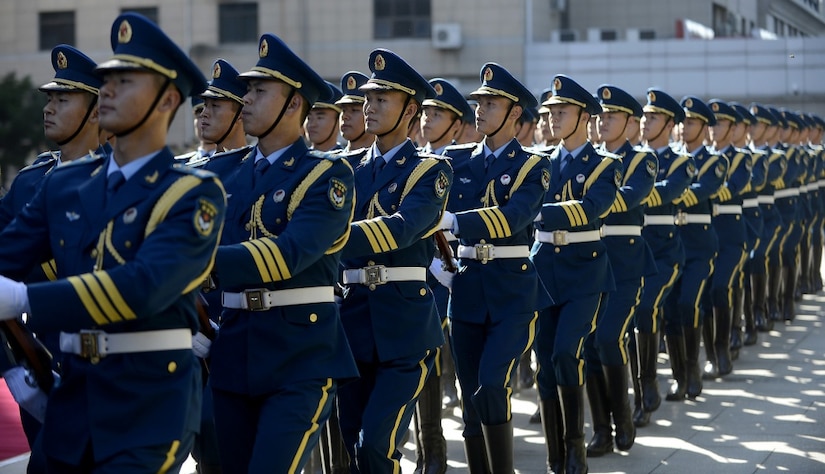
Chinese military service  members march in formation.

The other key difference is China is well-integrated into the global economic system, he said.

"That's part of the reason they've risen so dramatically economically, and they're using global institutions. They want to be well-integrated and, in fact, setting [up] how those institutions operate. China [also] wants to have very successful integration of commercial technology into their military," he said. 

China has quite an impressive set of technologies where they're already leading, Brown said.

"If you look at where they're challenging us [in] AI [artificial intelligence], they are a lot closer than we would like, and we need to continue to invest to make sure that we maintain a lead. I would say AI is just one of the areas where we need to continue to invest to make sure that we — with our allies — have a lead," he said.

The DIU director emphasized that China has more genetic data on U.S. citizens than the United States. They've also made it a point to figure out what they can do with mining that data and combining that with other information they've stolen — like health records, or our security clearance information — which has dramatic implications, both offensively and defensively, he added.

A graphic illustration demonstrating how soldiers interact with drones to provide commanders real-time information using artificial intelligence.

Brown said one of the things the U.S. needs to do in response is think about long-term investments in technologies "[and] not to pick winners and losers to make sure we're setting the table so we have a very robust set of commercial suppliers who can be challenging these Chinese global champions," he explained. 

If the U.S. is thinking out beyond the next 20, 30 or 40 years as China is, such an investment will have untold spillover effects, Brown said. This is where the internet, global positioning systems, miniaturized electronics and other key innovations have come from that lead to tremendous economic prosperity, which, in turn, guarantees U.S. national security, he added.

Brown said he thinks of the technological race with China as a superpower marathon, and there are four steps the U.S. should take that will put it on the best footing for this race:

  • Bolster investment in basic research and development that's both on the federal level and on the private sector side. "I think one of the advantages of federally funded R&D [research and development] is you get a very long-term time horizon and some willingness to take risks," he said. 
  • Invest in its talent. "We did this to create more engineers in the 1960s, and we need to similarly have an effort again, to make sure we're creating the right STEM talent," he said. 
  • Ensure all U.S. departments and agencies work together. "I think this gives us an organizing principle in terms of making sure we're leading in the tech race," he said, noting that China is the sense of urgency that should motivate us.
  • Focus with the shareholder revolution in this country. "Basically, since the 1980s, we've been increasingly focused on efficiency of capital, [such as] what are the short-term measures in a world where you don't have great peer competitors. But in a world where you have challenges from strategic adversaries, you probably don't want the supply chain running through those areas. It would behoove us to make sure our capital markets are focused long enough term so we can make investments in strategic capabilities, in addition to reflecting efficiency of capital," he concluded.

Wednesday, March 24, 2021

Statement From Pentagon Press Secretary John Kirby on Approved Request for Assistance to House Unaccompanied Migrant Children

 March 24, 2021


"Today, the Department of Defense approved a request for assistance from the Department of Health and Human Services (HHS) to temporarily house unaccompanied migrant children at a vacant dormitory at Joint Base San Antonio – Lackland, Texas and an area of land on Fort Bliss, Texas to construct suitable temporary housing facility. DoD will provide HHS officials access to these locations immediately to begin initial actions to prepare for receiving unaccompanied migrant children as soon as preparations are complete. 
 
This support will be on a fully-reimbursable basis, and will not negatively affect military training, operations, readiness, or other military requirements, including National Guard and Reserve readiness. HHS will maintain custody and responsibility for the well-being and support for these children at all times on the installation."

Wait For It ...


Army Sgt. Benjamin Fernandez scans a sector during a leaders course at Joint Base Lewis-McChord, Wash., March 19, 2021.

Red Flight Ready


An Air Force B-1B Lancer prepares for takeoff during Red Flag at Nellis Air Force Base, Nev, March 8, 2021. Participants work with joint and allied partners in 2.9 million acres of land and airspace to advance interoperability.

Command Senior Enlisted Leader Assignment

 March 24, 2021


The Office of the Senior Enlisted Advisor to the Chairman of the Joint Chiefs of Staff (OSEAC) announced today the following assignment:

Army Sgt. Maj. Brant C. Shyrigh, currently assigned as the G-3 sergeant major for the Headquarters Army Material Command, Redstone Arsenal, Alabama, has been selected to replace Navy Command Master Chief Philip R. Ibanez as the command senior enlisted leader for the Defense Threat Reduction Agency, Fort Belvoir, Virginia.

Breach Blast

Marines breach a door during a demolition range event in Jordan, March 6, 2021.


Drill Down


Air Force Airman 1st Class Tyrone Taylor and Airman Destiny Millerd perform during a drill down at Keesler Air Force Base, Miss., March 19, 2021. Airmen competed in a quarterly open ranks inspection and regulation and freestyle drill routines.

COVID-19 Vaccine Ready


Air Force Senior Airman Edgar Carreon, a radiology technician with the 944th Medical Squadron, fills syringes with the COVID-19 vaccination to be administered to local residents in Wikieup, Ariz., March 23, 2021. Airmen assigned to the 944th Medical Squadron are currently serving alongside Arizona National Guardsmen to provide vaccinations across Arizona.

Food Distribution


Members of the North Carolina National Guard and volunteers with the Second Harvest Food Bank of Metrolina fill vehicles with food during a free food distribution event in Hickory, N.C., March 22, 2021. During the event, the Second Harvest Food Bank and the North Carolina National Guard provided nearly 30,00 pounds of food to 550 families.

Vaccination Site


Alabama National Guard soldiers vaccinate Covington County citizens at Jaycee Park in Livingston, Ala., March 23, 2021.

Clean Teeth


Army Cpl. Hannah watches a child practice her brushing techniques on a stuffed animal during an oral health class in Arta, Djibouti, March 23, 2021.

Training Transit


Soldiers participate in a live-fire exercise at the Grafenwoehr Training Area, Germany, March 23, 2021.

Red Range


Marines fire an M777 howitzer during an indirect fire range at Combined Arms Training Center, Camp Fuji, Japan, March 16, 2021.

Polar Plunge


A Marine participates in the polar plunge during extreme cold-weather training in Setermoen, Norway, March 19, 2021.

Playful Pup


Army Spc. Sadie Kinney plays with military working dog Aszlam at Fort Carson, Colo., March 8, 2021.

Tactical Team

Marines perform aircraft salvage and recovery training during a weapons and tactics instructor course in Wellton, Ariz., March 19, 2021.


Northern Exposure


Michigan National Guardsmen conduct decontamination procedures during Northern Exposure 21 in Mount Pleasant, Mich., March 16, 2021.

Target Monitor


Army 2nd Lt. Kristi Newlen monitors a computer system that shows target locations at the Dona Ana Range Complex, N.M., March 8, 2021.

Tuesday, March 23, 2021

Seahawk Signaler


Navy Petty Officer 2nd Class Subrina Hearnes signals to an MH-60R Seahawk during operations aboard the USS Curtis Wilbur in the East China Sea, March 17, 2021.

Contracts Awarded for Next Generation Interceptor Program

 March 23, 2021


The Department of Defense has awarded two contracts to Northrop Grumman Systems Corp. and Lockheed Martin Corp. in support of the Next Generation Interceptor (NGI) program. With an estimated maximum value of $1.6 billion through fiscal year 2022, this contract award is structured to carry two designs into the technology development and risk reduction phase of the acquisition program to reduce technical and schedule risk. This award will ensure NGI is an efficient and effective part of an integrated Missile Defense System (MDS) solution. 

The Missile Defense Agency awards on March 23, 2021 support the department’s goal of increased competition by funding two designs while remaining flexible to align with evolving Defense Department strategies and priorities. 

“Today’s awards are an important step in modernizing our Missile Defense System,” said Stacy Cummings, performing the duties of Under Secretary of Defense for Acquisition and Sustainment. “NGI plays an important role in our homeland defense, and our acquisition strategy is ensuring the department maximizes innovation to keep pace with rapidly advancing threats.”

As the ground-based midcourse missile defense system, NGI is an advanced interceptor designed to protect the nation against intercontinental ballistic missile attack. The department will uphold “fly before you buy” principles to ensure the overall system and components have been rigorously flight-tested prior to making any procurement decisions.

“NGI is the result of the first holistic technical assessment of homeland defenses the department has conducted since initial system operations began in 2004,” added Vice Adm. Jon Hill, Director, Missile Defense Agency. “By planning to carry two vendors through technology development, MDA will maximize the benefits of competition to deliver the most effective and reliable homeland defense missile to the warfighter as soon as possible. Once fielded, this new homeland defense interceptor will be capable of defeating expected threat advances into the 2030s and beyond.”   

For media queries, contact Missile Defense Agency Public Affairs at MDAPressOperations@mda.mil.

Stratotanker Scan


Airmen inspect an Air Force KC-135 Stratotanker before a flight at Royal Air Force Mildenhall, March 18, 2021.

Securing the Box


Navy Petty Officer 1st Class Jessica Mills performs routine maintenance on an aircraft fueling station communications box aboard the USS Gerald R. Ford in the Atlantic Ocean, March 19, 2021.

Flight Prep


Air Force Capt. Brittany Dippel prepares for a flight at Osan Air Base, South Korea, March 16, 2021.

Missile Mission


The USS John S. McCain launches a missile during an exercise in the Philippine Sea, March 20, 2021.

Recovery Mission


Air Force Master Sgt. Reginald Cromier, a life support investigator with Defense POW/MIA Accounting Agency, cleans and sorts through aircraft wreckage during a recovery mission in Ratanakiri Province, Cambodia, Feb. 28, 2021.

Expert Shot


Air Force Tech. Sgt. Cameron Ashe and Staff Sgt. Barbara Walker demonstrate correct positioning and shooting techniques during training at Joint Base San Antonio, March 12, 2021.

Insertion and Extraction


Marines conduct insertion and extraction training off the coast of Okinawa, Japan, March 19, 2021.

Falcon Flier


A pilot flies an Air Force F-16 Fighting Falcon during Red Flag 21-2 at Nellis Air Force Base, Nev., March 17, 2021. Participants work with joint and allied partners in 2.9 million acres of land and airspace to advance interoperability.

Sports Heroes Who Served: Singer, Songwriter, Actor Kris Kristofferson Is Also an Army Veteran

 March 23, 2021 | BY David Vergun , DOD News

Sports Heroes Who Served is a series that highlights the accomplishments of athletes who served in the U.S. military.

Kris Kristofferson is a famous singer-songwriter and actor. He is also an award-winning college athlete, a Rhodes Scholar and an Army veteran. 

Although Kristofferson is a singer, he's more famous for the songs he wrote but were covered by others, such as: "Me and Bobby McGee," "For the Good Times," "Sunday Mornin' Comin' Down" and "Help Me Make It Through the Night."

A singer with a guitar and standing at a microphone sings

As an actor, he starred in a number of films including: "Alice Doesn't Live Here Anymore," "A Star is Born," "Convoy," "Heaven's Gate," "Stagecoach," "Bring Me the Head of Alfredo Garcia," "Pat Garrett and Billy the Kid" and "Blade."

While he is known for his exploits on stage and the big screen, other parts of his life are less well known.

Before his singing and acting career, Kristofferson was a talented athlete in a number of sports. 

In 1958, Kristofferson attended Pomona College in California, where he excelled in rugby, football and track and field. He became so famous that he appeared in Sports Illustrated magazine's "Faces in the Crowd" that year.

A man in an army uniform poses for photo

Clearly, his grades didn't suffer from time spent on the athletic field; he graduated summa cum laude in literature. He also earned a Rhodes Scholarship to the University of Oxford, England.

At Oxford, he was awarded the Blue for boxing, which honors athletes who are at the top of their game. The Blue, the highest honor granted to individual sportspeople at the University of Oxford, depends on very specific criteria within that sport and is a highly sought-after achievement for Oxford student athletes.

Kristofferson also was on the university's rugby team.

Lars Henry, Kristofferson's father, was an Air Force pilot, who would eventually retire as a major general. Henry urged Kristofferson to enter the military after college, which he did.

A man speaks to someone

After joining the Army, Kristofferson received flight instruction at Fort Rucker, Alabama, and became a helicopter pilot. He also successfully completed one of the military's most physically challenging courses: Ranger School.

In the early 1960s, he was stationed with the 8th Infantry Division in West Germany, where he formed a band.

After serving overseas, Kristofferson was offered an Army job, teaching English literature at the U.S. Military Academy.

However, Kristofferson's interests were in music, and he decided to leave the Army in 1965 to pursue songwriting. It is said that his decision to leave the military was a blow to his family.

Two men, one in a military uniform, shake hands.

To supplement his income, Kristofferson worked as a commercial helicopter pilot in Louisiana, splitting his time between there and Nashville, Tennessee, where he'd pitch country songs that he wrote. During his time ferrying people and supplies to an oil platform in the Gulf of Mexico, Kristofferson wrote two major hits:, "Help Me Make It Through the Night" and "Me and Bobby McGee." Janis Joplin recorded "Me and Bobby McGee" just prior to her death in 1971. It reached the top of the charts, and it is credited as being Kristofferson's breakthrough song.

In 2004, Kristofferson was inducted into the Country Music Hall of Fame.