Monday, September 14, 2020

Adm. Richard Discusses USSTRATCOM Operations With Reporters

 Sept. 14, 2020

Adm. Charles A. "Chas" Richard, commander, U.S. Strategic Command

STAFF: With us today is Admiral Chas Richard from U.S. Strategic Command. He'll be speaking about his mission set and the COVID virus. This is on the record.

And with that, sir, over to you.

ADMIRAL CHARLES A. "CHAS" RICHARD: Right. So good morning, everyone, and – I’ll go ahead, I think I'm properly socially distanced here. The -- it is -- for those of you that don't know me, I'm Admiral Chas Richard. I'm the commander of U.S. Strategic Command, and I have the privilege of leading 150,000 soldiers, sailors, airmen, Marines, civilians.

It's actually nice to see everybody's faces this time. Last time I had a chance to talk to you all, I was on a phone bridge. In fact, we didn't realize it was on television. And so it is, I think, a much better opportunity when I can actually see you.

I appreciate taking some time to have a conversation this morning. Before we get to the questions, though, let me offer you a few updates on how we're doing inside U.S. Strategic Command.

First, I'm very pleased to report that throughout the challenge that was presented to us by COVID-19, U.S. Strategic Command has and continues to be fully mission capable. And I'd like to thank my department's leadership in terms of giving us authorities, resources, and understanding of what we were up against. And that was a key in terms of our ability to be able to respond to this unprecedented threat.

The conditions in Omaha are favorable. We're adjusting workforce inside the new LeMay Command and Control Facility to adapt to local conditions. I'm at about 75 percent throttle with the rest on telework, and we're ready to go up or down as conditions dictate.

Very pleased with my component commanders, Admiral Chris Grady, General Tom Ray and -- or Tim Ray, and Dan Karbler at SMDC for the Army, who provided great leadership to adapt to their local conditions and maintain all their forces fully mission-capable.

Bottom line here is we're ready. And why is that important? I think it's important for us to remember that throughout this challenge of COVID-19, no threats went away, right? Nothing else changed, no one gave up a single nuclear weapon based on the fact of COVID-19. In fact, it's going in the other direction.

Our competitors have continued to develop both nonstrategic and strategic capabilities in an effort to outpace us. And we are going into a very different world. The -- we are on a trajectory for the first time in our nation's history to face two peer nuclear-capable competitors who have to be deterred differently, and we're working very hard to meet that challenge.

I think we all know the threat that Russia poses to us, modernizing strategic, conventional, space, counter-space, cyber, they're developing hypersonics, and their gray zone actions. And it's not only what they're developing, it's what they're doing.

China's similar, right? I think you all have seen the recent China military report, I think it's an excellent explanation in terms of what China's overall strategy is, and explains the why behind the things that we see them doing, particularly in my mission sets. Again, looking to -- we like talking about the fact that they're going to double their stockpile by the end of the decade.

 I'd ask you to consider that just measuring a nation's stockpile is a relatively crude measure of their capabilities. You have to look at the totality of it, the delivery systems, what they're capable of, what their readiness is. And China in particular is developing a stack of capabilities that, to my mind, is increasingly inconsistent with a stated no-first-use policy.

We're ready. I think one visible demonstration of that is the bomber task force missions that we've been operating worldwide. We're pleased to be able to support U.S. European Command and Indo-Pacific Command in providing forces that they use to accomplish our objectives. My I.C. wings, my SSBN groups are also continuing to mitigate risk from COVID-19 operations, and again they're fully mission-capable.

The -- I'm also pleased to report that the department has made tremendous progress in its nuclear command and control capabilities. It was a wise decision to establish the NC3 Enterprise Center and we are moving out and making great strides in making sure that the NC3 systems that we have will continue to pace the threat. They're certainly fully mission-capable today, I have absolute confidence in them. And I'm also pleased that we're going to be able to say that going into the future.

We do see future NC3 fitting hand-in-glove into the broader department's Command and Control JADC2, if you will, framework. And we are able to present to the secretary and the chairman an overall view of their NC3 in a way we haven't been able to do in many years.

So bottom line here, as I close and get ready for some questions, we're ready but we'll continue to have to work to maintain our -- in a world with changing threats on us. I'm very proud of the men and women of U.S. Strategic Command.

And I want to leave you with one last thought. The way we have put the strategic forces and capabilities of this nation together from day one, we were always very humble in our ability to anticipate threats -- we always built in margin, we always built in hedge, not only for the risks that we could foresee but the risks that we might not be able to foresee.

And so a big piece of why I can stand in front of you and tell you that we're fully mission capable is because of wise decisions made by my predecessors to give me capability, flexibility and everything I needed to be able to respond to the thing that we didn't see coming, and that's an important thing I -- I -- an important attribute I think we need to keep in mind as we think about the recapitalization of these systems.

And with that, I'd be happy to take questions.

STAFF: Thank you, sir. We'll start on the phone line with Bob Burns.

Q: Thank you. This is -- this is Bob.

Admiral Richard, you mentioned the bomber task force missions of recent months -- excuse me. There have been a number of incidents lately that the Russians have characterized much differently -- for example, just a few days ago, the head of the Russian Air Force was saying that a number of times in August and September that B-52 bombers have flown close to Russian borders and that he saw this as both hostile and provocative action by the United States.

I'm wondering if you could say whether, you know, you have concerns about the escalation of tensions with Russia, you know, that could lead to actual conflict? Thank you.

ADM. RICHARD: I -- so, Bob, thank you for the question and it's nice to hear from you again, sir.

I think the bomber task forces are a -- a iconic example of how we're executing the National Defense Strategy in terms of us being strategically predictable yet tactically unpredictable.

I'm very pleased in the support that we're providing to the other combatant commands and I think that they have done a very good job of showing that the United States is capable of operating anywhere in international air space and is ready to meet any challenge that is presented to us.

STAFF: Okay. We'll come back to the room with Barbara with CNN.

Q: Two quick things, if I may.

On COVID, first of all, could you just walk us back to this past winter when Strategic Command, because it's so critical, really began to understand -- when did you know the severity of the potential COVID threat?

But my other question perhaps first is you referenced China and no-first-use policy. What's your thinking on this? Can you talk about that a little more? Do you believe that China either is rejecting the notion of first-use, is moving towards a no-first-use? What's your assessment of that and what does that mean for the United States?

ADM. RICHARD: So, ma'am, I would start with, as a military commander, what I look at more is another nation's capabilities, less about what their stated intentions are, and I see China developing a stack of capabilities that would be inconsistent with a no-first-use policy. It's not my place to judge whether they intend to honor that or not.

What I can tell you is -- is that they certainly have the capabilities to execute any number of deterrent or employment strategies that are seemingly inconsistent with a -- and a no-first-use policy really drives you back quickly to a minimum deterrent strategy and it just looks inconsistent to me and it's my responsibility to make sure that I have thought through what we have to do to deter what they're capable of doing as opposed to what they say they're going to do.

Q: So an outright offensive attack is what you're saying?

ADM. RICHARD: No, ma'am, I didn't say anything about offensive attack. I'm talking about deterring what they're capable of doing.

Q: And on COVID this past winter, when did you -- when did you really know and told by your people that it was a -- a -- a serious threat?

ADM. RICHARD: Ma'am, we are constantly looking at any number of threats and we take all of them seriously. That -- you know, it's one thing -- I believe the Department of Defense has a plan for just about everything. We had a plan in place for a pandemic infectious disease and we simply, very early on, December time frame, started looking through "what if" scenarios and started devising mechanisms, strategies to address that and that -- that process served us very well.

Q: Okay.

STAFF: Okay, we'll stay here in the room with Lucas from Fox.

Q: Lucas Tomlinson, Fox News.

Admiral, why do you need a low-yield nuclear warhead on your ballistic missile submarines?

ADM. RICHARD: Well, I think the justification for the low-yield ballistic missile was very well laid out in the Nuclear Posture Review and then captured inside our National Defense Strategy. In order to deter, you know, the basic equation of that has not changed over time, right? For any action that your opponent considers, can you deny an aim or impose a cost that is considered greater?

And so as we're opening up a possibility -- and this was looked at basically by the capabilities that were being developed in terms of the thought that someone might think that a small, limited use of a nuclear weapon might drive the U.S. into a situation where any response that we would consider would be considered disproportionate and therefore not credible.

The low-yield ballistic missile submarine closes that perception and enhances security, enhances deterrence.

Q: Is that the new nuclear warhead that the president was referring to recently?

ADM. RICHARD: The -- again, I -- I think you're referring to something that is going to come out in this Bob Woodward book, which I've not seen. In fact, I'm not even sure that it's available to be seen. So I'm not in a good position to help you address that question.

But I will say, look, as the commander of Strategic Command, I have any number of classified capabilities, that if you had my responsibilities to defend the nation, you would find that they're actually quite useful in that, but beyond that I'm -- I'm not in a position to -- to really help you with that.

STAFF: Okay, we'll go out to the phone lines to Idrees Ali with Reuters.

Q: Great, thanks, Tom. Two quick questions.

Firstly, in terms of COVID, what's the timeline you're looking at in terms of when things may go back to -- to the way they were? They -- you know, is it the end of the year, is it indefinite?

And second question, part of your job is to look at the strategic force of other countries. So what are you seeing in terms of the missile forces of Iran and North Korea and the impacts COVID is having on them?

ADM. RICHARD: Well, first, to your -- to your first question in terms of -- I'm not sure that we're ever going to go back to a -- the way we were before. There's any number of things that -- as -- we understand the disease better, the potential for a vaccine. There's a -- any number of things and so we're very well postured to operate for a long period of time, indefinitely in this.

But actually we've learned some things along the way that I -- I don't want to go back on, right? So our ability to operate distributed and remotely, particularly administratively, has been greatly enhanced. We have finally crossed the bridge in terms of being able to do some teleworking.

And in fact, from my -- one small example, my personnel shop, we're never bringing them all in again. I was telling Congressman Thornberry, "I'm going to take 70 cars off the entrance to the base in the morning because we're just more efficient when we operate in a distributed fashion."

So one, I -- no, I don't think we're going back to the way that we used to do business before. In some cases, I don't think we want to.

STAFF: Okay. We'll stay on the phone lines and go to Tony Capaccio with Bloomberg.

Q: Hi, sir. I -- I have a quick follow-up to the -- to the earlier question from Lucas.

At some point, will you be able to discuss what weapon the president was referring to when he told Woodward about this new secret nuclear weapon? And I have a China follow-up.

ADM. RICHARD: Well, I'd be happy to take the China follow-up.

And again, on a question about the Woodward book, I just should make -- not really in a good position to help you. I would refer your question either to the White House or to the Secretary of Defense -- but would enjoy that China follow-up.

Q: Among their new capabilities, are the Jin-class submarines -- are those Jin-class submarines now starting strategic patrols near Hawaii? The China report mentions that their -- their JL-2 missiles could range the United States but they need to be in western Pacific waters near Hawaii. Are you seeing that threat emanate?

ADM. RICHARD: Well, what I would offer is to not shoot behind the duck and I would actually pay more attention to their JL-3 missiles that they're working on, which give them a greatly expanded range. And again, I -- I think this is -- I get apprehensive that we are not fully conscious as a nation of the threats that we face, right? China now has the capability -- and we can get into the specifics -- to directly threaten our homeland from a ballistic missile submarine.

That's a pretty watershed moment and that's why, when I come up here and say that we need to maintain the forces to give us a deterrent capability against that, why we have to go recapitalize our strategic triad, why I say that there's no margin left and why that's the most important mission in the Department of Defense, it is -- you're giving me a great example of why we have to go do that.

The -- it is -- it -- it's important, I think, to remember I say the department frequently says that strategic deterrence is most important mission in the department, it is foundational to everything we do but maybe a way to operationalize that is, I and my forces set the conditions necessary for the rest of the Department of Defense to execute its mission.

If strategic deterrence fails, the complexion and the character of the competition just changed dramatically and it is in everybody's best interest for that not to happen. But to do that, I have to have sufficient force to execute our strategy and you see -- from -- say -- a great example of what other nations are doing to threaten that.

STAFF: Okay. We'll come back in the room to Lara Seligman, Politico.

Q: Hi, sir. Two questions.

One, I wanted to follow up on Barb's question about the China report, just to ask you to clarify a little bit more what you mean when you say you think they are in -- you know, that they have -- are moving forward the no -- no first use nuclear policy.

I mean, the -- the 200 missile figure that was in that report is a fraction of the size of the arsenals of both the U.S. and Russia. So I'm just wondering again what you're basing this -- this conclusion on? And then I also wanted to ask --

ADM. RICHARD: Well, let me address that first, right?

Again, don't shoot behind the duck, right? It's not where they are, it's where they're going, right? And when China sets its mind to something, they are very impressive in their ability to go accomplish it.

They're -- and you've got to be careful about mirror imaging. They're not put together the same way that we are. But one of my favorite examples, and I think I have it here because it -- I want to get the numbers right -- you know, China just established a Coast Guard in 2013, right? And again, they've had other forces but they -- they decided they wanted a Coast Guard and in 2013 -- they have 255 ships today -- or I'm sorry, 255. In seven years, they go build 255, on -- on top of all of the other ships they're building. I just think that their strategic forces are next on their to-do list, right, and I'm trying to posture us for the threat that we're going to face, not the one that we have today.

Q: And then on a different subject, I wanted to ask you about the GBSD contract that was recently awarded from Northrop. Are you concerned at all about the lack of competition on this contract and what that means going forward?

ADM. RICHARD: The -- the short answer -- and I -- I do need to clarify, I'm a combatant commander, so in some respects I'm the customer for the capability, that your question might be better asked to the Air Force. That said, I am fully confident in the Air Force's ability to deliver the requirements and capabilities that I ask for on time, in the budget that they say that they're going to need.

In fact, I was just out at Hill Air Force Base myself doing some reviews with both the program manager for GBSD as well as the contractor that you're talking about, and I have to tell you I walked away very impressed with the cutting edge ways that the GBSD program is not only going about accomplishing the acquisition tasks that they've been handed but actually -- I mean, we talk about it -- you -- you all haven't gotten to it yet but if you ask me what keeps me up at night, it is our ability to move fast.

I just gave you an example of how China can move fast and in the end, we're going to have to move equally as fast in order to pace that threat. In the end, it is time for us to start getting some of our bureaucracy out of our way, and I think that is the fundamental thing that slows us down.

I’d point to the GBSD program as a -- a pathfinder in terms of how to achieve the old standard by a new way.

STAFF: Okay. We'll go back to the phone lines to Sangmin Lee with Radio Free Asia.

Q: Yeah. I have a question on Operation Plan 5027, which is a military operation plan made by U.S. and South Korea for the defense against a possible North Korean invasion. Does this plan include the use of nuclear weapon?

ADM. RICHARD: Well, one, obviously I can't go into any specifics of any operational plan but what I will say is -- is that we maintain a very close alliance and partnership with South Korea. Longstanding, it's formally documented, proud that the United States extends extended deterrence and assurance commitments to South Korea, which has been beneficial to both nations, and I'll tell you that whatever the situation is or whatever OPLAN needs to be considered, my forces will be ready to support what they'll be asked to do.

STAFF: And we'll stay on the phone lines and go to Jeff Schogol with Task & Purpose.

Q: -- deterrence threats against North Korea after a five B-52s deployed in Guam from U.S. homeland?

ADM. RICHARD: Oh, I'm sorry, sir, I don't think I understood the question.

Q: Okay. Is there any change in nuclear deterrence strategy against North Korea ever since B-52 deployed in Guam or returned to U.S. homeland?

ADM. RICHARD: Well, I -- I go back to I think the decision to employ dynamic force employment, which I think is what you're referring to as opposed to a continuous bomber presence on Guam, has actually enhanced deterrence by being strategically predictable, tactically unpredictable.

It has given us a good opportunity to improve both short term and long term readiness and is a great example of the wisdom in the way that the National Defense Strategy has been put together.

STAFF: Okay, now we'll go to the phone line to Jeff Schogol, Task and Purpose?

Q: Thank you.

Admiral, I have a question about the W76-2. Is it STRATCOM's belief that if the United States explodes a low-yield nuclear weapon over Russia or China, that Russia or China will not retaliate with strategic weapons?

ADM. RICHARD: Well, the first part is, is remember that the whole idea is to prevent any of that from happening in the first place. The mission is deterrence, and it's sometimes a hard thing to wrap your head around, that in my mission set, victory looks like nothing happened, right? And we have been successful in that inside of -- for over 70 years.

And so where I think the particular value is, is the deterrent effect that the 76-2 provides, to see to it that we never go down the path that you're describing to begin with.

Q: My question is, can you limit a nuclear exchange to tactical weapons or is there no such thing as tactical nuclear weapons?

ADM. RICHARD: Sir, you're asking one of the greatest unanswered questions in military theory -- deterrence theory -- of all time, right? The answer is nobody knows if that's the case. But I do think it's an obligation for the United States to do everything in its power should a nuclear weapon be used by somebody else to stop the exchange as soon as possible, to limit damage to the U.S. to the maximum extent possible, and to end it on terms favorable to the United States.

The short answer to your question is, is that nobody knows. Fortunately we don't have any real-world experience in that, and I would just as soon keep it that way.

STAFF: We'll come back in the room to Lucas?

Q: Admiral, the Pentagon recently stood up a UFO task force. Has that given you something that you have to plan for as the head of America's strategic arsenal?

ADM. RICHARD: I -- Lucas, I can't go into a lot of detail on any number of things that we're working on. I'll just offer that Strategic Command looks at a wide range of threats. In fact, I've probably let this conversation get too narrowly focused on nuclear capabilities, right?

I think the 2000 -- the last NPR wisely acknowledged that you can have a strategic attack that is non-nuclear in nature. That is something that has changed in the current environment. So we're looking at any number of threats, not just nuclear, to make sure we understand them, understand what might happen to us, and do we have a strategy in place, tailored to deter that?

Q: And that includes UFOs?

ADM. RICHARD: That includes any number of threats.

STAFF: We'll go to Kris Anderson.

Q: AWPS News. So, New York Times has an article this morning about the risk -- legal risks to the United States from the use of -- supporting Saudi Arabia using -- and other countries, but Saudi Arabia in this case -- using weapons against civilians.

So my question is, does it also bring up the question of the risk that increases as we proliferate arms sales to countries around the world? And is that something that we should look at as a strategic risk?

ADM. RICHARD: So, ma'am, I have no direct responsibility in the area that you're talking about, and I would defer your question back to the secretary of defense, who's better positioned to answer it.

STAFF: And we have time for one last question, so we'll go to Barbara with CNN.

Q: Can I ask you to go back and just explain a little more about one thing that you said. And you said, "We are not fully conscious of the threats that we face." I think that's pretty close to what you exactly said, we are not -- you're worried that we're not fully conscious of the threats we face.

What -- tell us what you mean by that. I mean, is -- is the military not conscious, is the American --

ADM. RICHARD: It’s -- it's the American people, Barbara. I think we've had a little conversation about this. I think you and I have done duck-and-cover drills back when we were a kid, right? If you remember that. I certainly have. So we knew that there was a threat to us that might require us to respond strategically.

We don't even think about that any more. We take strategic deterrence for granted in a lot of cases, not acknowledging the fact that we have never had a nuclear attack on the nation, haven't had a great power war in 70 years, was not just some accidental fate in history or event in history, it was a lot of hard work by a lot of people to maintain systems ready to go such that we deterred that from happening, that's what I'm talking about.

Q: Okay, thank you.

STAFF: All right, thank you, ladies and gentlemen. If you have any other questions, I'll be in the press office area.

ADM. RICHARD: Thank you all very much.

Hawaii National Guard Conducts COVID-19 Testing on Freeway

 Sept. 14, 2020 | BY ARMY 1ST LT. ANYAH PEATROSS

The Hawaii National Guard Joint Task Force is continuing to help the city and county of Honolulu with a COVID-19 surge testing program through Sept. 14.

Navy Vice Adm. (Dr.) Jerome M. Adams, U.S. surgeon general, coordinated with Honolulu County Mayor Kirk Caldwell to administer a total of 60,000 tests ​on Oahu, with 5,000 tests being conducted daily since Aug. 26.

COVID-19 cases in the triple digits remained steady, causing the state to increase public access to test sites. Within days, thousands of residents took advantage of the free, self-administered COVID-19 swab test. Despite traffic congestion and prolonged wait times, the residents were thankful for help from first responders and the guard.

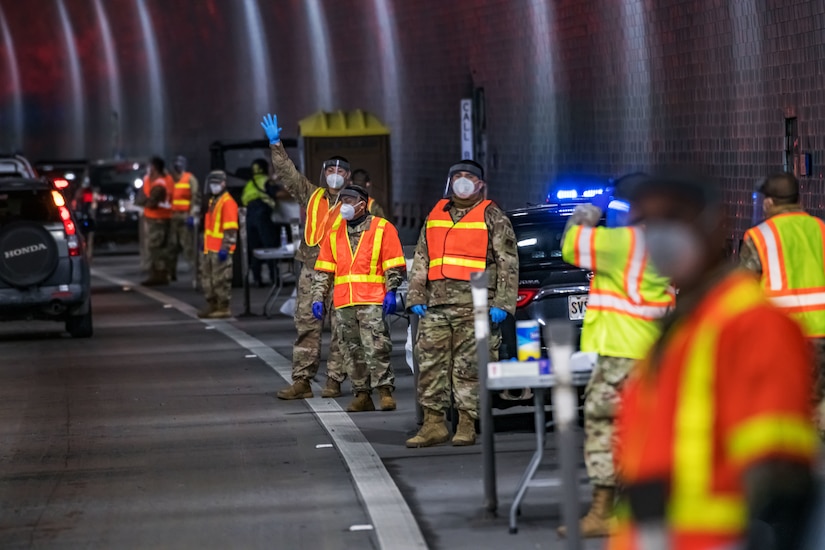
Several soldiers wearing face masks and gloves stand in a line.

''Task Force Oahu is supporting Honolulu County's efforts to mitigate the spread of COVID-19 while meeting the general public's needs, such as safety, security and community health protection,'' said Army 1st Sgt. Lane Martinez, the senior noncommissioned officer assigned to Company Bravo with Task Force Oahu, HING JTF. ''Two units from the HING are also assisting the city and county of Honolulu by providing onsite surge testing registration support.''

Oahu leaders came up with a solution to temporarily use Hawaii's largest interstate, the John A. Burns Freeway (H-3), and it's Tetsuo Harano Tunnels as drive-thru test sites. Normal access in both directions on the H-3 were suspended and only people interested or registered to participate in the drive-thru COVID-19 surge tests were allowed to access the freeway.

''This is a remarkable, one-of-a-kind collaboration,'' said Hawaii Gov. David Ige. ''The H-3 freeway is a place where we can do mass testing without disrupting lives and traffic in urban neighborhoods.''

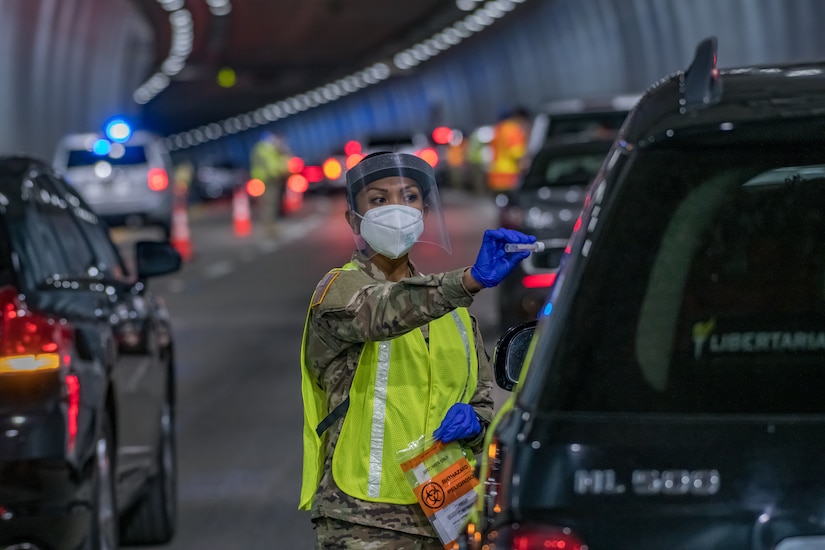
Three officers with the task force shared their experiences of taking a COVID-19 test themselves at the H-3 test site. They handed their pre-registration forms to a fellow guardsman wearing a safety vest, gloves, a KN95 mask and a face shield. He shortly thereafter returned their forms along with individual test kits each containing a labeled vial, nasal swab and napkin. Then the guardsman instructed the driver to reenter the flow of traffic and continue further into the tunnel to an open station manned by nurses who provided guidance on performing the self-administered swab test.

Army Col. Michael Tougher III, commander of Task Force Oahu, was excited to see soldiers and airmen supporting the registration for surge testing and remarked on its simplicity.

''It was much quicker than I expected," Tougher said "It seemed to be well organized and well run. Overall, I thought the testing was simple and did not feel too invasive, not uncomfortable.''

Guardsmen were stationed at both entries of the tunnels wearing personal protective equipment. The tunnels are equipped with powerful heating, ventilation and air conditioning systems, making it safe for workers wearing PPE while minimizing their exposure to carbon monoxide. Martinez recognizes the similarities at the H-3 site compared to other sites, noting some of its advantages and challenges.

A guardsman helps administer a COVID-19 test to someone in a car stopped on the roadway.

''The H3 site is similar to other surge test sites, as they have been categorized as either drive-up or walk-up,'' Martinez said. ''As a drive-up site, the H-3 location provided more protection from the elements, but the tunnel added the challenges of channeled wind and vehicle noise.''

Conducting COVID-19 support on a freeway is unprecedented for the Hawaii National Guard. The soldiers and airmen who are a part of the task force have deployed to war zones, supported communities after hurricanes and lava flows, but with COVID-19, everything that they have been asked to do is new. Airport medical screening, distributing PPE to communities, swabbing prisoners for the virus and assisting the Hawaii Health Department with COVID-19 mapping.

According to Army Lt. Col. Wesley Kawakami, former commander of the HING element on the island of Hawaii, the test wasn't bad at all.

''It was very comfortable,'' Kawakami said. ''The size of the swab is as big as a coffee stirrer. I would do it again.''

For Army 2nd Lt. Alnor Cabonce, this was his first COVID-19 swab test and first experience witnessing surge test operations. He understands that Hawaii is going through a difficult time and is hopeful that these opportunities will help the state get well soon.

''It's important to have these tests because it allows us to determine how many people actually have COVID,'' Cabonce said. ''I think, overall, it's better to get tested so that there is data to analyze and improve upon the way we’ve been combating COVID."

About 800 guardsmen support more than three-dozen missions carried out on a daily basis on six islands. The guard works alongside its partners at all levels of government, healthcare organizations and volunteers, and together they are trying to keep the frontlines safe and the people of Hawaii informed.

(Army 1st Lt. Anyah Peatross is assigned to the State of Hawaii, Department of Defense).

Sunday, September 13, 2020

General Officer Announcement

 Sept. 10, 2020


Secretary of Defense Mark T. Esper announced today that the president has made the following nomination:

Marine Corps Maj. Gen. Michael S. Groen for appointment to the grade of lieutenant general with assignment as director, Joint Artificial Intelligence Center.  Groen is currently serving as deputy chief of computer network operations, National Security Agency, Fort Meade, Maryland. 

[Eds. Note:  The information in this announcement has been updated with the correct name of the officer being nominated.]

Friday, September 11, 2020

Landing Signal


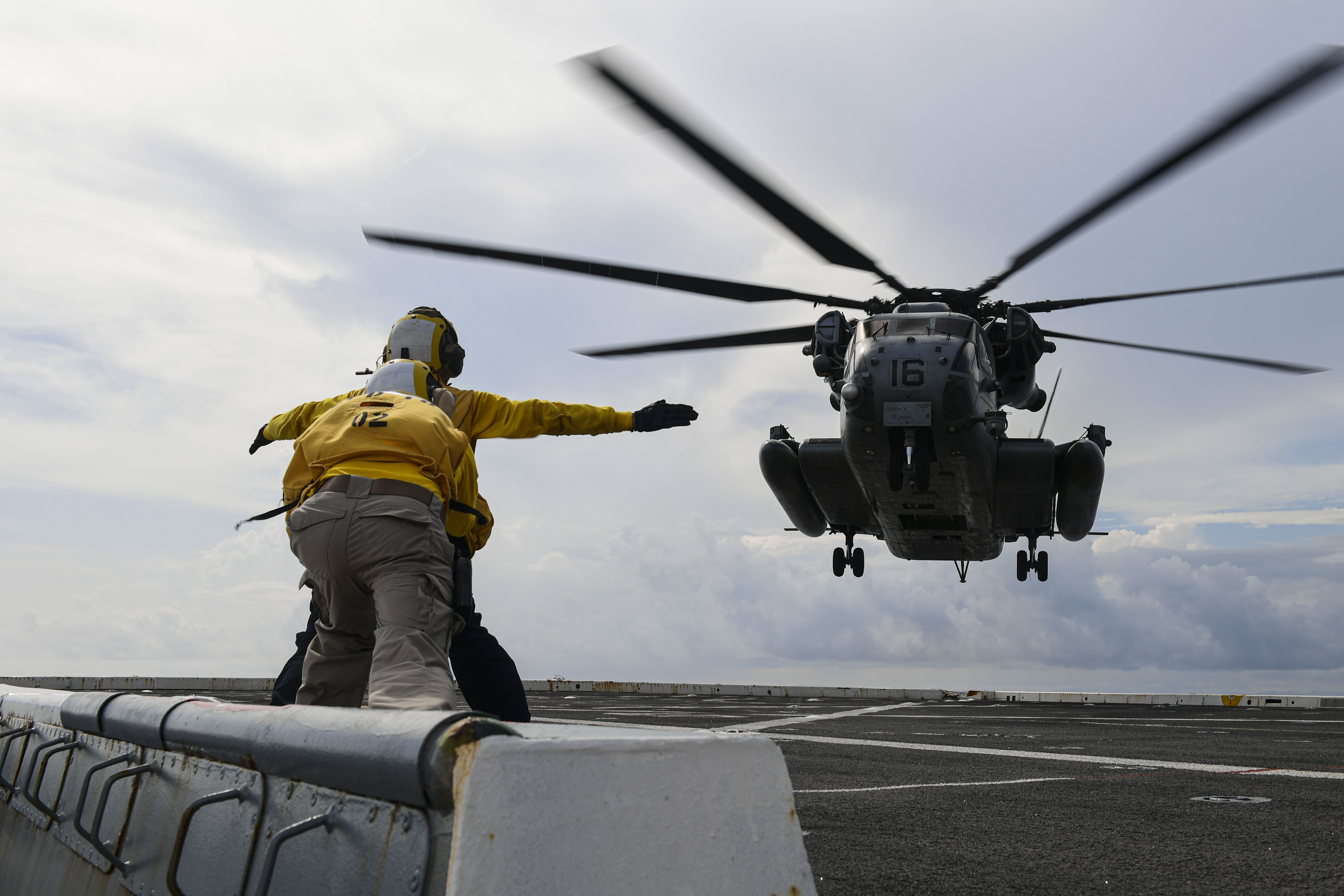
Navy Petty Officer 3rd Class Michael Aguda and Chief Petty Officer Joan Revilla direct the landing of a Marine Corps CH-53 Sea Stallion helicopter on the flight deck of the USS New Orleans in the Philippine Sea, Sept. 10, 2020.

Navy to Christen Submarine Montana

 Sept. 11, 2020


The Navy will christen one of its newest attack submarines, the future USS Montana (SSN 794), during a 10 a.m. EDT ceremony Saturday, Sept. 12, 2020, at Newport News Shipbuilding, a division of Huntington Ingalls Industries, in Newport News, Virginia.

The principal speaker will be Under Secretary of the Navy (Acting) Gregory J. Slavonic. Ms. Sally Jewell, former Secretary of the United States Department of Interior, will serve as the ship’s sponsor. In a time-honored Navy tradition, she will christen the ship by breaking a bottle of sparkling wine across the bow and state, “in the name of the United States I christen thee.”

“The future USS Montana will play an important role in the defense of our nation and maritime freedom,” said Slavonic. “She stands as proof of what teamwork – from civilian to contractor to military – can accomplish. I am confident USS Montana and her crew will ensure our Navy remains safe and strong to proudly serve our nation’s interest for decades to come.”

The future USS Montana (SSN 794) honors the Treasure State. She will be the second commissioned warship bearing the name. The first USS Montana (ACR-13), an armored cruiser, was also built at Newport News Shipbuilding and commissioned July 1908. She served in the Atlantic and Mediterranean, landed Marines during unrest in Haiti in 1914 and escorted convoys during World War I. She was decommissioned in 1921. 

Construction of the current Montana began April 2015 and is the third of the ten Block IV Virginia Class submarines. 

Virginia Class submarines are built to operate in the world's littoral and deep waters while conducting anti-submarine warfare; anti-surface ship warfare; strike warfare; special operation forces support; intelligence, surveillance and reconnaissance; irregular warfare; and mine warfare missions. Their inherent stealth, endurance, mobility and firepower directly enable them to support five of the six maritime strategy core capabilities – sea control, power projection, forward presence, maritime security and deterrence. They are replacing older Los Angeles Class submarines as they retire.

Media may direct queries to the Navy Office of Information at (703) 697-5342. More information about the Virginia-class Attack Submarines is available online here

Additional information about the Naval History of Montana can be found online here.

Senior Defense Officials Discuss 2030 Missile Defense

 Sept. 11, 2020 | BY TERRI MOON CRONK , DOD News

Three senior Defense Department officials took part in a discussion about missile defense capabilities in 2030 and the demands of tomorrow at the Missile Defense 2030 symposium.

Yesterday's panel included James H. Anderson, acting undersecretary of defense for policy; Navy Vice Admiral Jon A. Hill, director of the Missile Defense Agency; and Army Lt. Gen. Daniel L. Karbler, commander of the Army Space and Missile Defense Command.

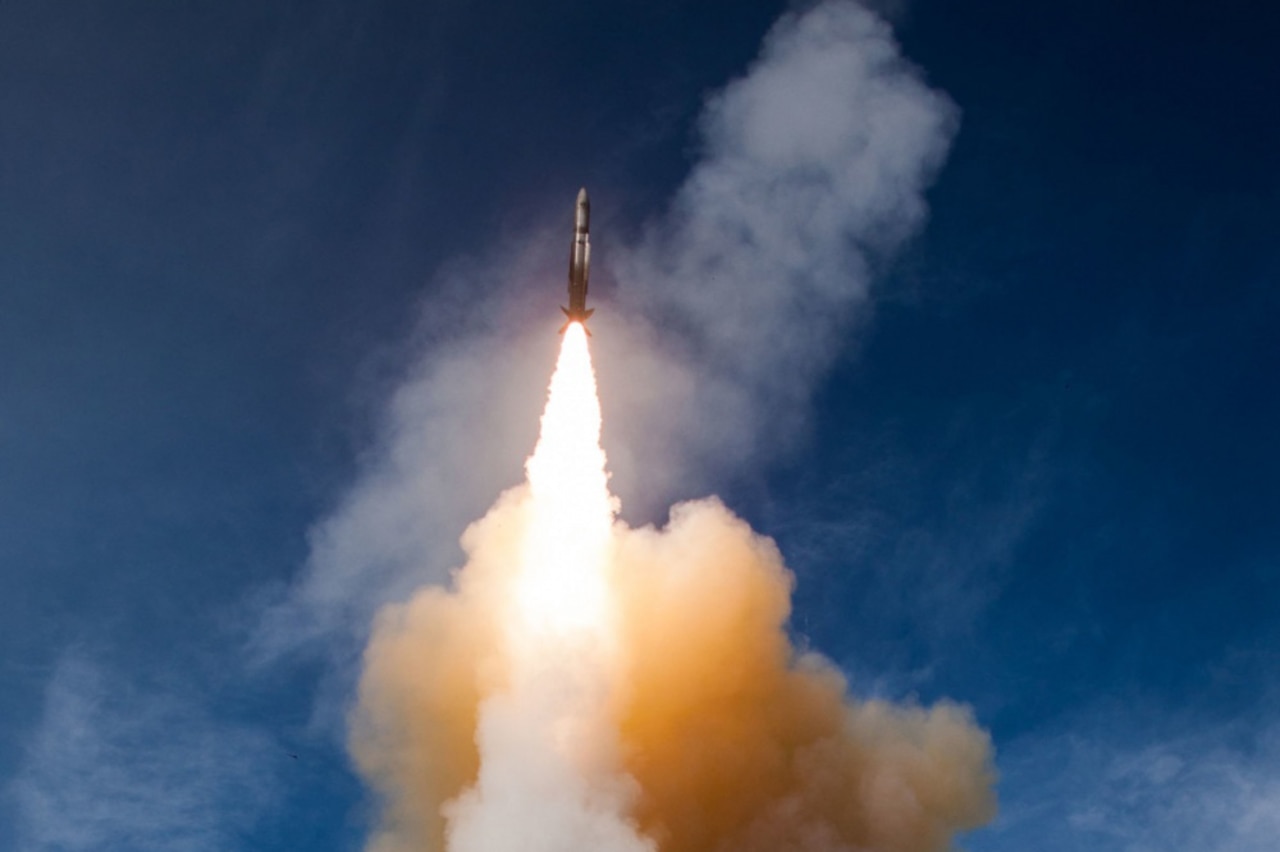
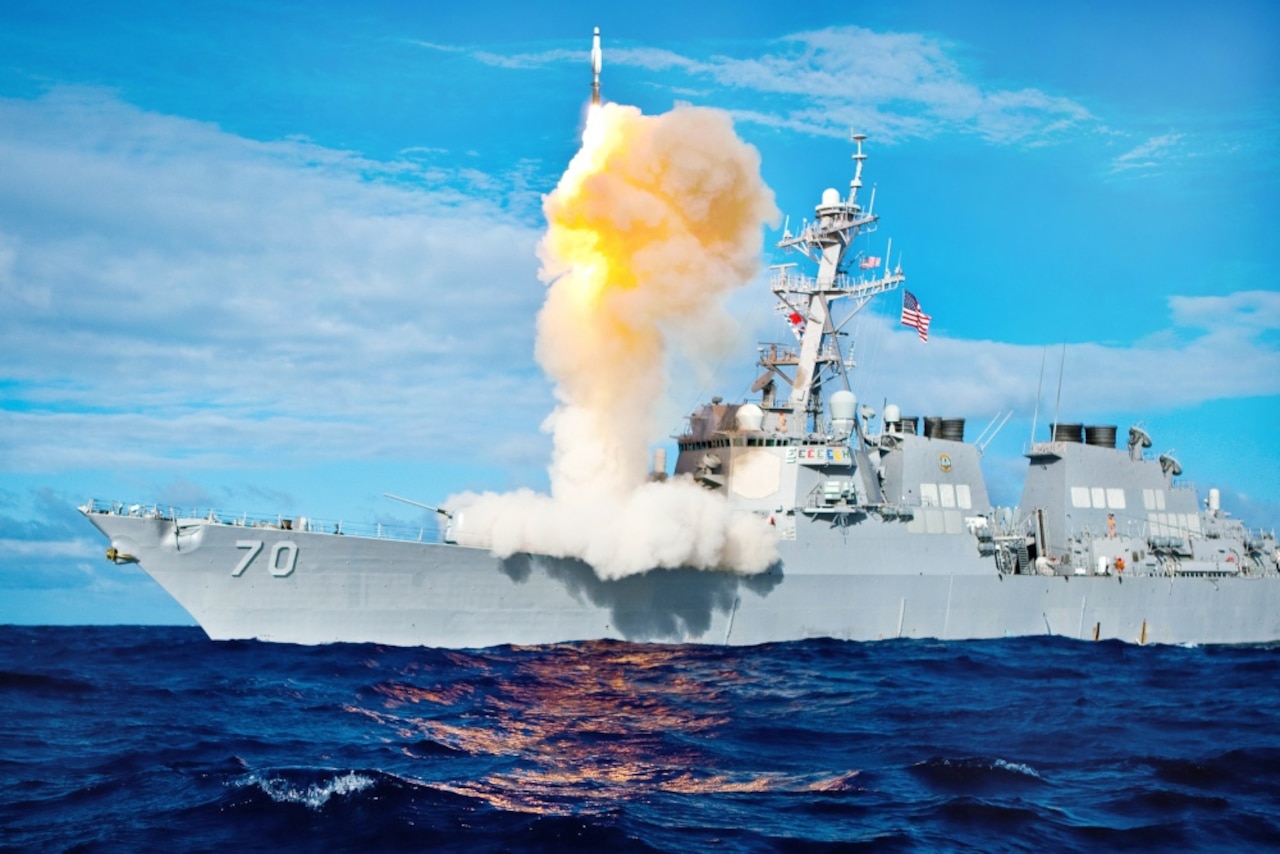
A missile is launched from a ship.

 
"When you look at 2030, we're looking at advanced ballistic missiles, [and] we know they're going to maneuver hypersonic threats and cruise missile threats," Hill said. "That's a very challenging place to be."

When you get into ground-based missile defense or midcourse defense for protection of the United States, we are working very Intensely on the service-life extension program, along with the reliability program that takes us beyond just the analytical, he added. "We now have hardware and equipment tied into that thanks to very great support coming from Congress, as well as the department."

That support, Hill said, will help DOD increase and extend the life of the existing fleet, which he said is vital. 

"While we have to also compete in parallel with the next generation interceptor, … by closing that gap with a very strong liability program for the fleet today, and bringing on a new interceptor that will tie into the ground systems and into the sensors, [it] is going to be pretty formidable," Hill said.

A ship deploys a missile.

The joint kill web has to enable DOD's defensive systems and its offensive systems, Karbler said. 

"If the adversary launches at us, we're going to the joint kill web [to] enable us to censor any sensor by shooter to engage," he said. He noted it also will allow DOD, integration-wise, to offensively respond with whatever capability that it might have from air to surface.

"The Army is working very hard on long-range precision fires to be able to counter what that adversary brings to us," Karbler said.

In terms of DOD's vision for 2030, the department will seek out those opportunities where it makes sense to work with allies and partners in missile defense, Anderson said.

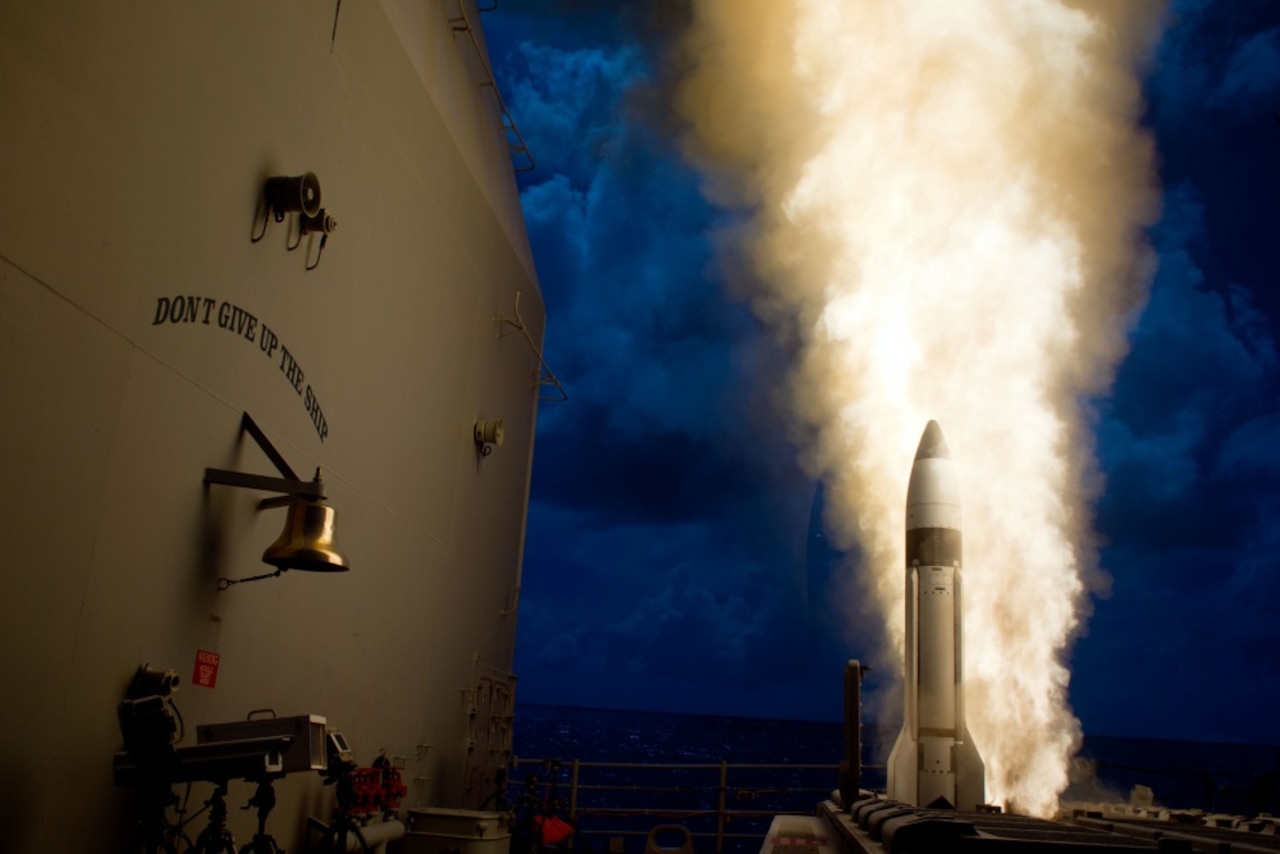
Interceptor is launched.

"We talked before about defending the homeland. What's also very critical when we talk about missile defense is the regional context," he noted. 

Anderson also said both China and Russia would seek to overwhelm the U.S. and its allies early in a particular theater  and impede the flow of allied forces.

Because of this, it's vital in a regional context for the United States to have a robust integrated air and missile defense. "That's why we have had these collaborative efforts, and we will seek out them going forward, as well," he added.

DOD Awards Contracts for COVID-19 Reusable Isolation Gowns

 Sept. 11, 2020


Today, the Department of Defense, on behalf of the Department of Health and Human Services, signed contracts with a maximum value of $136 million with five American businesses to manufacture up to 15 million Covid-19 reusable isolation gowns for the replenishment of the HHS-managed Strategic National Stockpile.  

Delivery of the gowns will be complete by January 2021 ensuring HHS is poised to meet the Nation’s critical medical needs. 

Today’s contract awards, along with additional planned US-sourced gown contracts, will boost the domestic industrial base for textiles and reduce dependency on foreign sources for critical personal protective items.  There was robust competition for the contracts, which were executed by the Defense Logistics Agency. 

All of the gowns procured adhere to the Berry Amendment, an acquisition regulation that requires DOD to give preference to domestically produced clothing and textiles.  All of the contract awardees are American small businesses, with the largest portion of the quantities going to a woman-owned small business.

Hornet Launch


An F/A-18E Super Hornet launches from the flight deck of the aircraft carrier USS Ronald Reagan in the Philippine Sea, Sept. 7, 2020.

Sunny Sail


The guided missile destroyer USS Mustin conducts a replenishment with the aircraft carrier USS Ronald Reagan in the Philippine Sea, Sept. 7, 2020.

Cockpit Climb


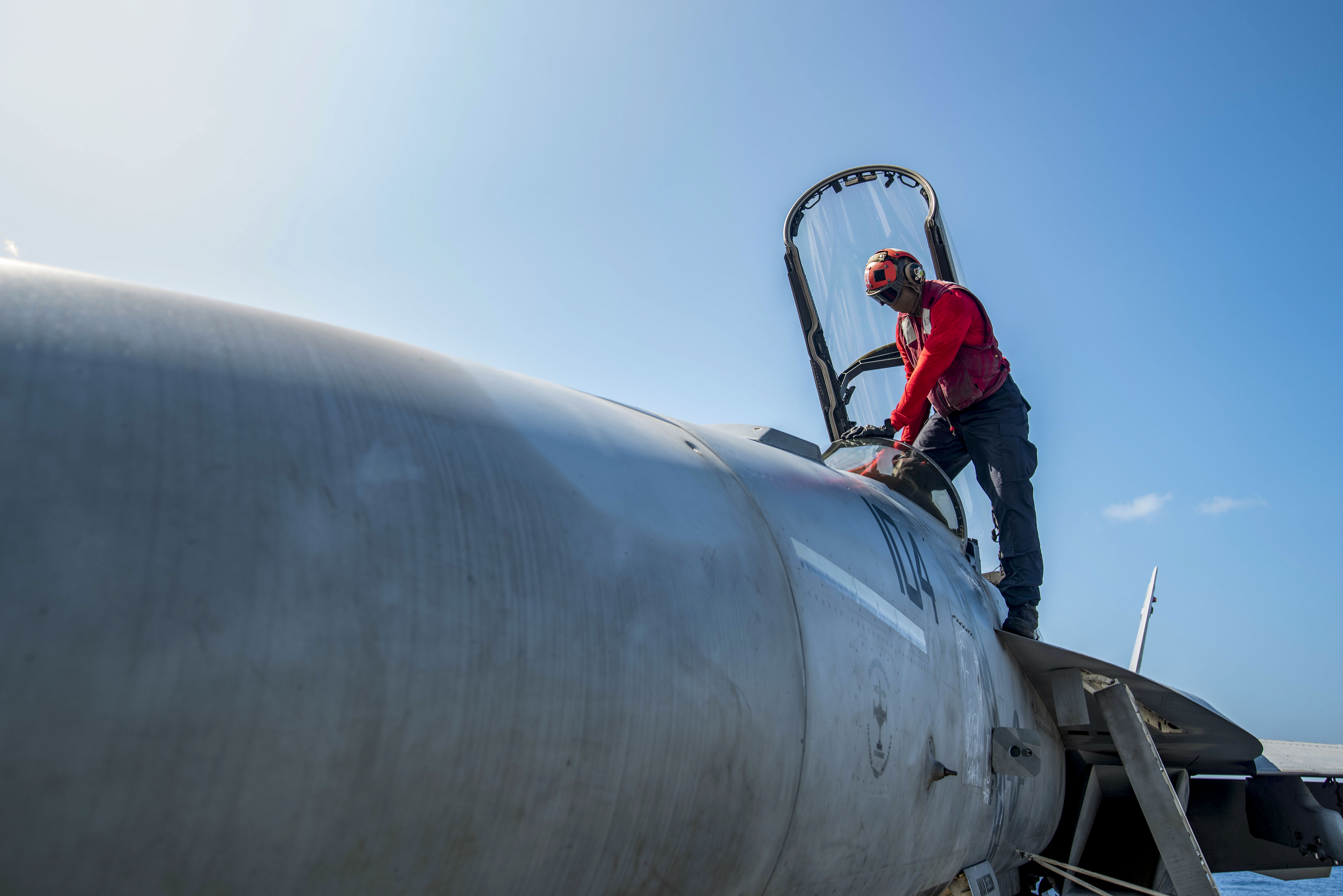
Navy Seaman Isaiah Washington climbs into the cockpit of an F/A-18F Super Hornet on the flight deck of the aircraft carrier USS Ronald Reagan in the Philippine Sea, Sept. 9, 2020.

Iroquois Exit


Air Force Staff Sgt. Patrick Grandison and military working dog Tek exit a UH-1N Iroquois during aircraft familiarization and detection training at Sagami Depot in Sagamihara, Japan, Sept. 2, 2020.

Delivery Duty


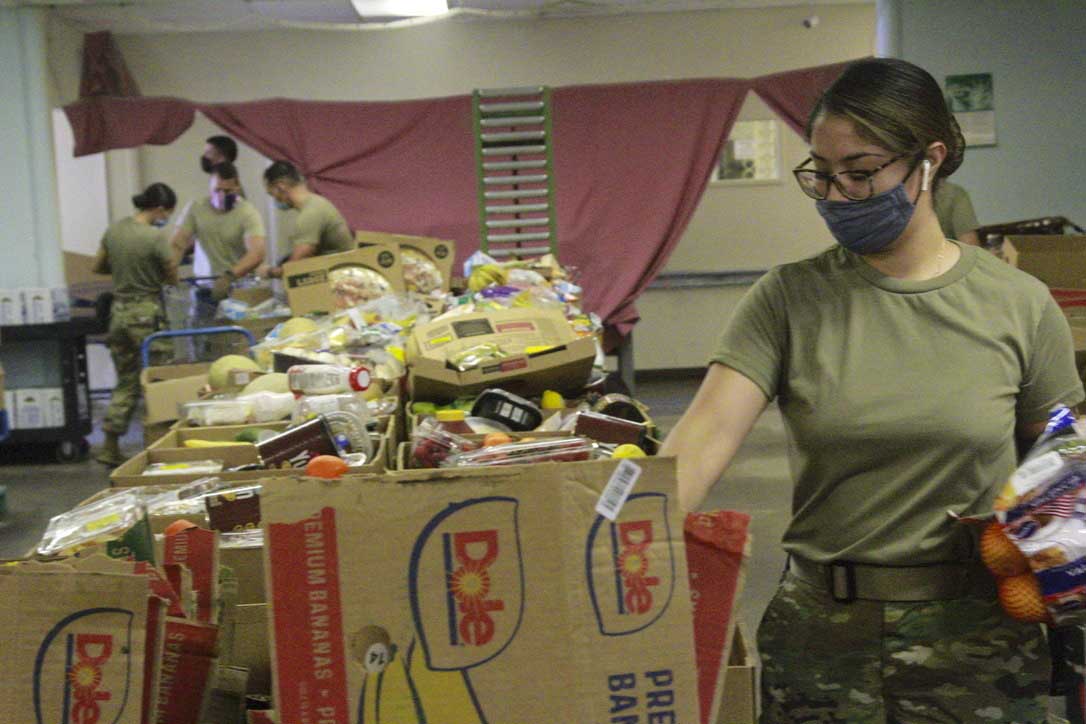
Arizona Army National Guardsmen prepare boxes of groceries for delivery in Phoenix, Sept. 8, 2020, as part of COVID-19 relief efforts.

Advancement Exam


Navy Petty Officer 2nd Class Camille Harrington takes an advancement examination at Naval Base Ventura County, Calif., Sept. 9, 2020. The examinations were administered with a tailored approach to ensure safety during the COVID-19 pandemic.

Joint Press Statement for the 18th Korea-U.S. Integrated Defense Dialogue

 Sept. 11, 2020


The Republic of Korea (ROK) Ministry of National Defense (MND) and the United States (U.S.) Department of Defense (DOD) held the 18th Korea-U.S. Integrated Defense Dialogue (KIDD) September 9-10, 2020. Due to ongoing travel restrictions related to the coronavirus (COVID-19) pandemic, the two sides held a robust exchange on a range of ROK-U.S. Alliance priorities via secure video teleconference. ROK Deputy Minister Chung Sukhwan and David Helvey performing the duties of Assistant Secretary of Defense with U.S. Deputy Assistant Secretary of Defense for East Asia Heino Klinck led their respective delegations.

The leaders underscored the importance of strengthening the combined readiness posture of the ROK-U.S. Alliance to address the current security environment on the Korean Peninsula as well as mutual regional security concerns. The two sides also committed to continue bilateral security cooperation including senior-level policy consultations, information sharing, and personnel exchanges to promote peace and stability on the Korean Peninsula and throughout Northeast Asia. 

Concurring on the importance of establishing stable access to training facilities and other critical sites and resources as essential to maintaining a steadfast combined defense posture, the two leaders also reviewed the progress made in the combined joint multi-purpose live firing range joint study and discussed the way ahead to ensure continued progress in advance of this fall’s Security Consultative Meeting (SCM).

Both sides also reaffirmed the common objectives of establishing permanent peace on the Korean Peninsula and the complete denuclearization of North Korea. The delegations agreed to continue close coordination on the implementation of the Armistice Agreement, Comprehensive Military Agreement (CMA), and other relevant agreements.

The two leaders additionally reviewed the progress made in relocating the ROK-U.S. Combined Forces Command (CFC) headquarters and committed to expeditiously pursue the CFC HQ relocation.

The delegation heads affirmed the progress made in preparation for eventual wartime OPCON transition. They also concurred that the Combined Command Post Training (CCPT) in August was a step toward realizing the conditions necessary for FOC certification. Both sides recognized the importance of the ROK forces’ acquisition of critical military capabilities and committed to continue joint assessments through meetings of the special Permanent Military Committee (sPMC) to ensure a successful outcome. Both sides will provide a progress report on COTP requirements and discuss next steps at the SCM later this year.

The two sides celebrated the recent completion of the Comprehensive Joint Study on Extended Deterrence and discussed a range of issues to improve the Alliance’s effective deterrence against North Korean nuclear and missile threats. Moving forward, the two sides committed to enhancing the efficacy of the tailored deterrence strategy.

Both delegations noted that the KIDD reaffirmed the steadfast solidarity of the ROK-U.S. Alliance and further strengthened coordination between the respective defense authorities of the two countries. The leaders pledged to advance the aforementioned issues at the SCM in October, 2020.  

Takeoff Ready


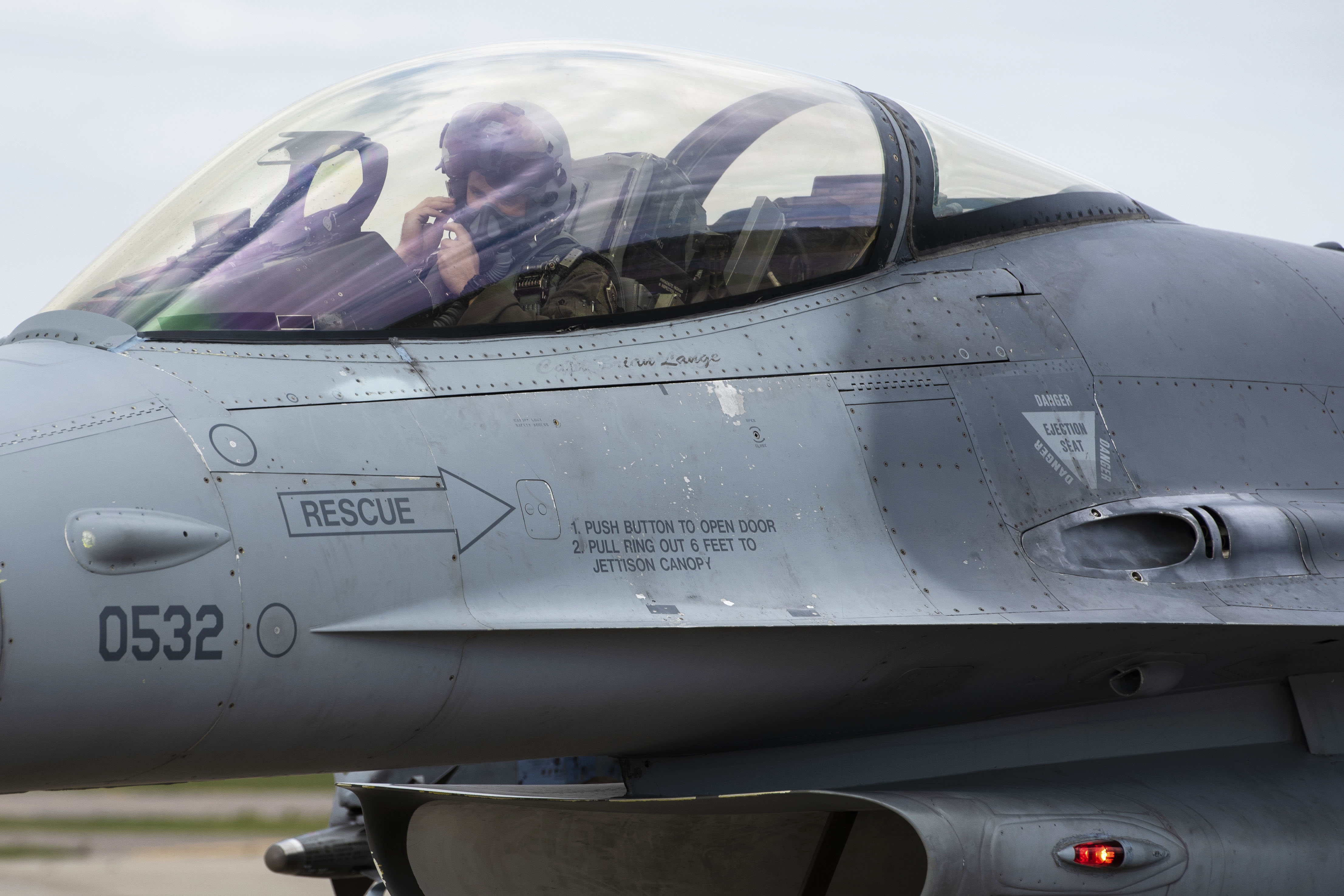
An Air Force pilot gets ready to takeoff from Royal Air Force Lakenheath, England, Sept. 10, 2020.

General Officer Announcement

 Sept. 10, 2020


Secretary of Defense Mark T. Esper announced today that the president has made the following nomination:

Marine Corps Maj. Gen. Patrick M. Shanahan for appointment to the grade of lieutenant general with assignment as director, Joint Artificial Intelligence Center.  Shanahan is currently serving as deputy chief of computer network operations, National Security Agency, Fort Meade, Maryland.   

General Officer Announcement

 Sept. 11, 2020


Secretary of Defense Dr. Mark T. Esper announced today that the president has made the following nomination:

Air Force Maj. Gen. Robert J. Skinner for appointment to the grade of lieutenant general with assignment as director, Defense Information Systems Agency/commander, Joint Forces Headquarters-Department of Defense Information Network, Fort George G. Meade, Maryland.  Skinner is currently serving as director, Command, Control, Communications, and Cyber, J6, Headquarters United States Indo-Pacific Command, Camp H.M. Smith, Hawaii.

Flag Officer Announcement

 Sept. 10, 2020


Secretary of Defense Mark T. Esper announced today that the president has made the following nomination:

Navy Vice Adm. Lisa M. Franchetti for reappointment to the grade of vice admiral with assignment as director for strategy, plans, and policy, J-5, Joint Staff; and senior member, United States Delegation to the United Nations Military Staff Committee, Pentagon, Washington, District of Columbia.  Franchetti is currently serving as deputy chief of naval operations for Warfighting Development, N-7, Office of the Chief of Naval Operations, Washington, District of Columbia. 

Partner Flight


An Air Force B-52H Stratofortress leads a formation of U.S. and Dutch aircraft over the North Sea during Point Blank, a recurring exercise.

Intersessional Meeting of the U.S.-India 2+2 Ministerial Dialogue

 Sept. 11, 2020


Principal Deputy Assistant Secretary of State for South and Central Asian Affairs Dean Thompson and Principal Deputy Assistant Secretary of Defense for Indo-Pacific Security Affairs David Helvey joined their Indian counterparts today for a virtual Intersessional Meeting of the U.S.-India 2+2 Ministerial Dialogue.  The two sides welcomed the opportunity to discuss the U.S.-India Comprehensive Global Strategic Partnership, noting increased closeness and cooperation across multiple areas of the bilateral relationship.

The United States underscored the importance of India’s status as a Major Defense Partner, growing military-to-military cooperation, and other defense priorities.  The two sides discussed a range of bilateral, regional, and multilateral issues, including combating COVID-19, counterterrorism, India’s membership on the UN Security Council, support for good governance and sustainable development in the Indo-Pacific region, and efforts to counteract recent destabilizing actions in South Asia and the broader Indo-Pacific region.  Both sides agreed to further strengthen consultation through United States-India-Australia-Japan Quadrilateral consultations.

Principal Deputy Assistant Secretary Thompson and Principal Deputy Assistant Secretary Helvey pledged to continue working with their Indian counterparts to advance the U.S.-India partnership for the benefit of both countries, the region, and the world.  They looked forward to preparing for the U.S.-India 2+2 Ministerial Dialogue later this year.

Drone Drill


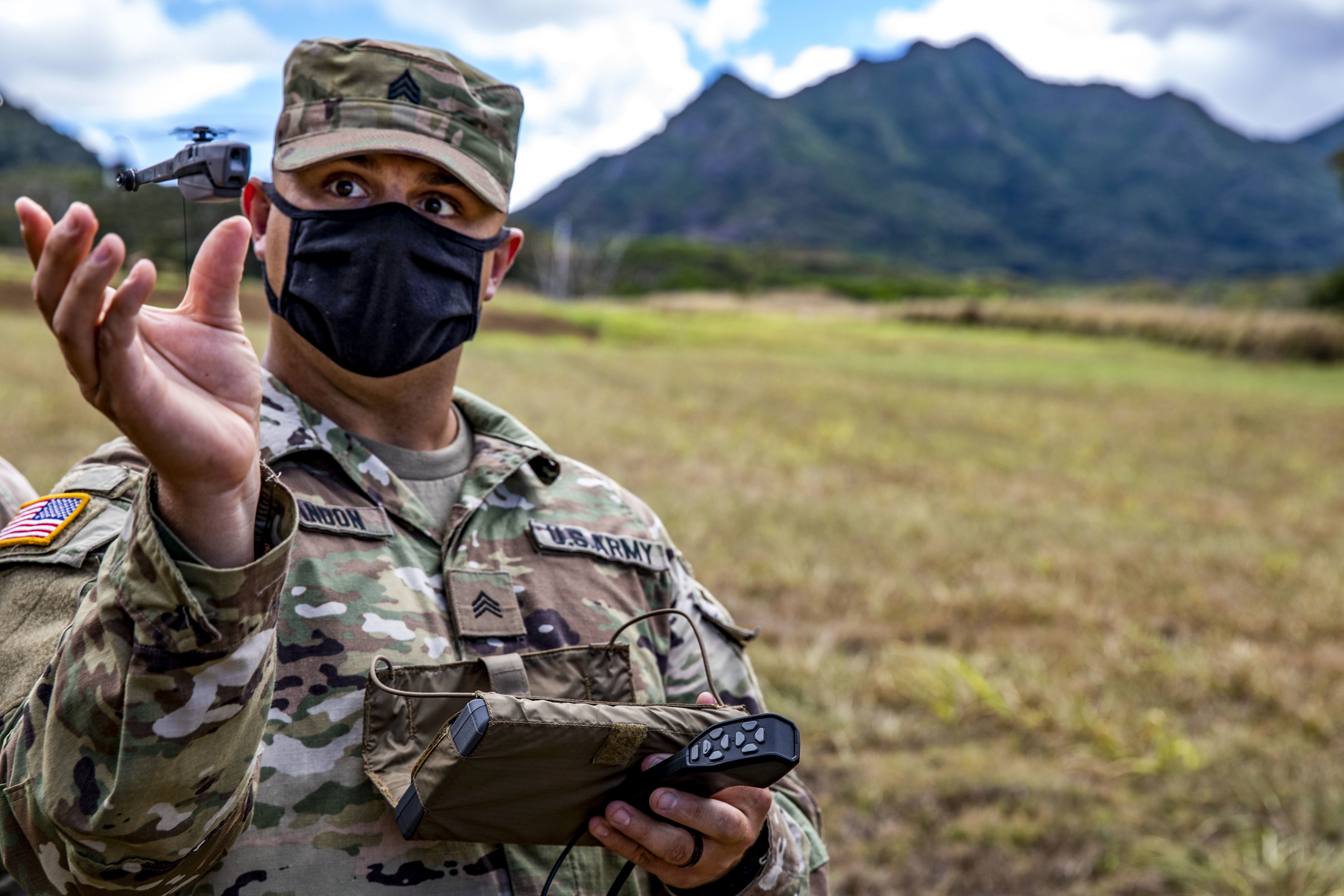
Soldiers train and certify on a soldier-borne sensor at Schofield Barracks, Hawaii, Sept. 3, 2020. The sensor enables soldiers to deploy a micro-drone to gain situational awareness and observe where a soldier cannot physically reconnoiter.

The Maldives and U.S. Sign Defense Agreement

 Sept. 11, 2020


Deputy Assistant Secretary of Defense for South and Southeast Asia Reed Werner and Maldivian Minister of Defense Mariya Didi signed the “Framework for U.S. Department of Defense-Maldives Ministry of Defence Defense and Security Relationship” in Philadelphia on September 10.  
 
The Framework sets forth both countries’ intent to deepen engagement and cooperation in support of maintaining peace and security in the Indian Ocean, and marks an important step forward in the defense partnership.  
 
DASD Werner and Minister Didi also discussed U.S. support for the Maldives’ response to COVID-19 and areas for future cooperation, and agreed to work toward scheduling the first Defense and Security Dialogue. Both sides reiterated their commitment to a free and open Indo-Pacific that promotes the security and prosperity of all nations in the region.

DOD announces $2.9 million in Defense Production Act Title III COVID-19 Actions

 Sept. 11, 2020


Statement attributed to Ms. Jessica Maxwell, Department of Defense spokesperson:

Today the Department is announcing two Defense Production Act Title III actions to sustain and strengthen essential domestic industrial base capabilities and defense-critical small businesses.  These actions will help to retain critical workforce capabilities throughout the disruption caused by COVID-19 and to restore some jobs lost because of the pandemic. The Department remains closely partnered with FEMA and HHS, providing almost $2.9 billion in life-saving medical services, supplies and equipment to service members and federal agencies in the nation's whole-of-government approach to the pandemic.

DOD announces $1.9 million Defense Production Act Title III Agreement with Control Vision, Inc to Strengthen Domestic Microelectronics Industrial Base

As part of the national response to COVID-19, the Department of Defense has signed a $1.9 million agreement with Control Vision, Inc. to sustain and advance domestic capabilities for aerospace grade optical sensors during the COVID-19 pandemic.

Using funds authorized and appropriated under the CARES Act, this DPA Title III investment will maintain and protect aerospace grade advanced optical sensor domestic industrial base capabilities essential for national defense. This project will fund Control Vision, Inc., a Arizona-based small business, to develop and mature an optical payload and produce a unit for a future flight test. This investment will improve future data gathering opportunities on flight tests by enabling improved sensors and software for future missions and ensure the U.S. Government continues to have access to this critical domestic capability. Additionally, this project will enable Control Vision, Inc. to retain high skill staff positions put at risk during the pandemic that would be difficult to fill if lost.

Control Vision, Inc.’s headquarters and manufacturing is in Tucson, AZ, which is the principal place of performance for this project.

DOD announces $1 million Defense Production Act Title III Agreement with Radio Design Group to Strengthen Domestic Shipbuilding Industrial Base

As part of the national response to COVID-19, the Department of Defense entered into a $1 million agreement with Radio Design Group to sustain critical domestic industrial base capability and capacity for U.S. Navy communication equipment and manufacturing.

Radio Design Group provides the U.S. Navy with cutting edge communications equipment that is vital for maritime missions.  Using funds authorized and appropriated under the CARES Act, this DPA Title III investment will allow Radio Design Group to continue production of critical communications equipment and invest in future communications capabilities to drive future cost savings for the U.S. Government while ensuring the U.S. Navy continues to have access to this vital domestic capability.   Additionally, this investment will enable Radio Design Group to retain critical workforce capabilities throughout the disruption caused by COVID-19 and to restore some jobs lost due to the pandemic.

This investment will ensure the U.S. Government retains production and supply chain continuity of a vital, domestic small-business supplier of communication equipment to meet the needs of the nation while maintaining and protecting a skilled workforce during the disruption caused by the pandemic.

Radio Design Group headquarters in Grants Pass, Oregon will be the principal place of performance.

Website resources:

More Hands Make Less Work: SurgeMain Reservists Support Norfolk Naval Shipyard

Sept. 11, 2020 | BY Hannah Bondoc, Navy

The Norfolk Naval Shipyard's mission is to support the U.S. Navy by fixing ships and submarines and returning them to the fleet. This goal became more challenging to meet with the emergence of COVID-19 and its impact on shipyard employees. In early July, SurgeMain stepped up to assist with the first phase by mobilizing more than 480 Navy Reserve sailors.

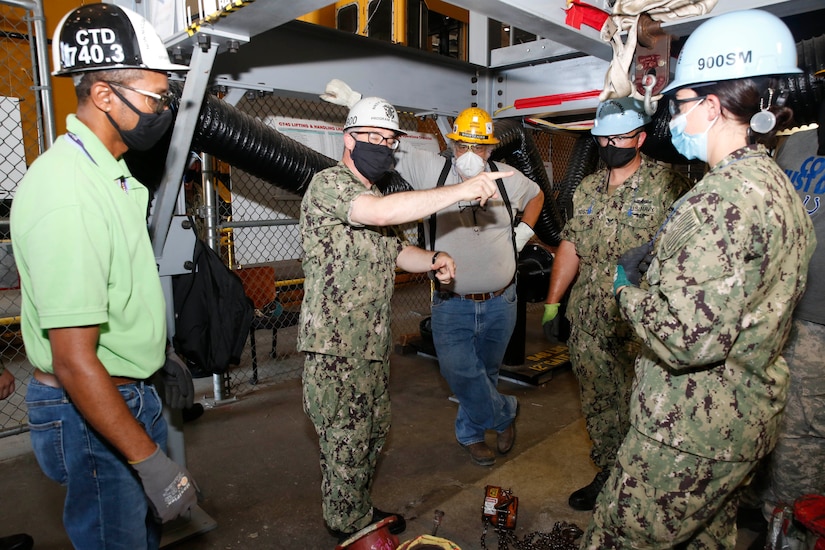
A Navy officer speaks with shipyard workers.

"This mobilization is Naval Sea Systems Command's [NAVSEA] COVID-19 recovery response," said Navy Lt. Cmdr. Manny Sayoc, SurgeMain program manager. "Our program has been around for 15 years, and this is the first time we have been mobilized to help out with shipyard production."

The sailors reported for duty in several phases. More than 1,620 SurgeMain sailors are being mobilized in total to the four public naval shipyards based on production resource demands.

They have left their civilian jobs, said goodbye to their family and loved ones, and jumped into the fray of uncertainty to serve their country right here in Portsmouth, Virginia."
Navy Lt. Cmdr. Manny Sayoc, SurgeMain program manager

"This initiative required a culmination of several months of co-preparation between the shipyards, Navy Reserve units, the Secretary of the Navy's office, and many major commands in between," Sayoc said. "Countless days of planning and coordination were spent considering production, personnel administration and benefits, support and leadership staff, logistics and transportation, supply, berthing, training, and COVID-19 protective measures."

Sayoc pointed out that many of the sailors have come from across the country on short notice — a lot of them under the minimum mandatory notification period.

"They have left their civilian jobs, said goodbye to their family and loved ones, and jumped into the fray of uncertainty to serve their country right here in Portsmouth, Virginia," he said.

With the help of its local reserve units, SurgeMain called upon its most senior local sailors first, some of whom have worked in similar civilian positions.

"We wanted to provide deckplate leadership and guidance of local knowledge to help our incoming reserve workforce," Sayoc explained.

As part of the mobilized force, several people also went on short-term military orders to serve as instructors, drivers, administrative staff and logistical support.

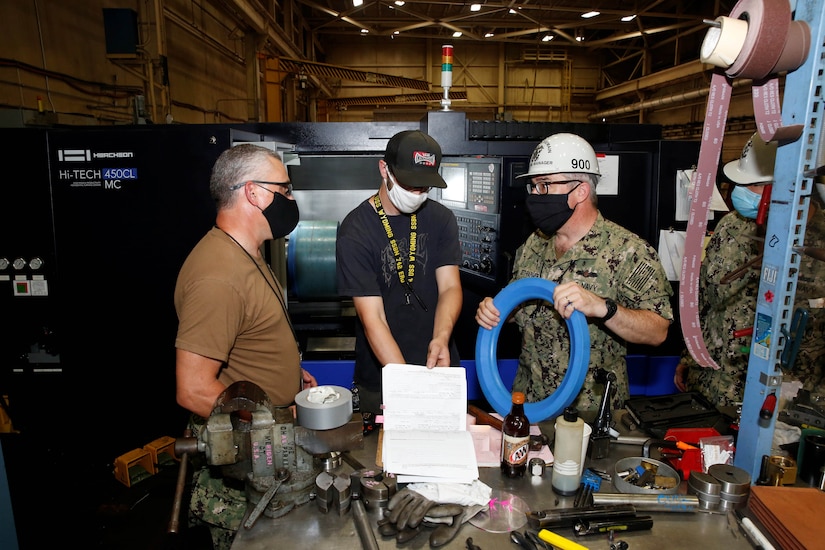
A Navy officer speaks with shipyard workers.

"We never expected to have to pull off a project as big as this, but we had a strong leadership staff and everyone wanted this mobilization to be a success," he said.

Safeguarding the reservists against COVID-19 was among the most unique and challenging components in engaging this initiative.

"In order for us to help backfill this hole of work, we have — and still need to manage our precautionary methods of minimizing exposure of transmission while staying on task," said Navy Capt. Jonathan Jett-Parmer, SurgeMain east regional executive officer. "Methods to do so include managing bubble-to-bubble transitions, putting people on restricted movement when it is applicable, providing personal protective equipment, and all sorts of means to protect our SurgeMain sailors and the community," Sayoc added.

Despite these challenges, the drive to help accomplish the mission is still present with SurgeMain's personnel, and the goal of the mobilization is not lost on them.

"These sailors are on orders to be here for 15 months," Jett-Parmer explained. "It is going to be a long mobilization to help dig the Navy out of this workload caused by the pandemic, but it's the right thing to do."

There is one goal that SurgeMain has when it comes to this mobilization: fix Navy ships and get them back to the fleet.

"We are in a time of crisis," Jett-Parmer explained. "There has been a large [number] of irreplaceable man-days lost because of this virus."

"That is the purpose of this mobilization," Sayoc added. "Our program has been training and preparing for such a situation such as this."

SurgeMain sailors might not be in the shipyard long-term, but they are here to help while they are at NNSY. Civilians and SurgeMain sailors will fight the good fight against this backlog and work together to accomplish the mission.

(Hannah Bondoc is assigned to the Norfolk Naval Shipyard)

Arizona Base's Pharmacy Continues All Operations During COVID-19

 Sept. 11, 2020 | BY AIR FORCE AIRMAN 1ST CLASS DOMINIC TYLER

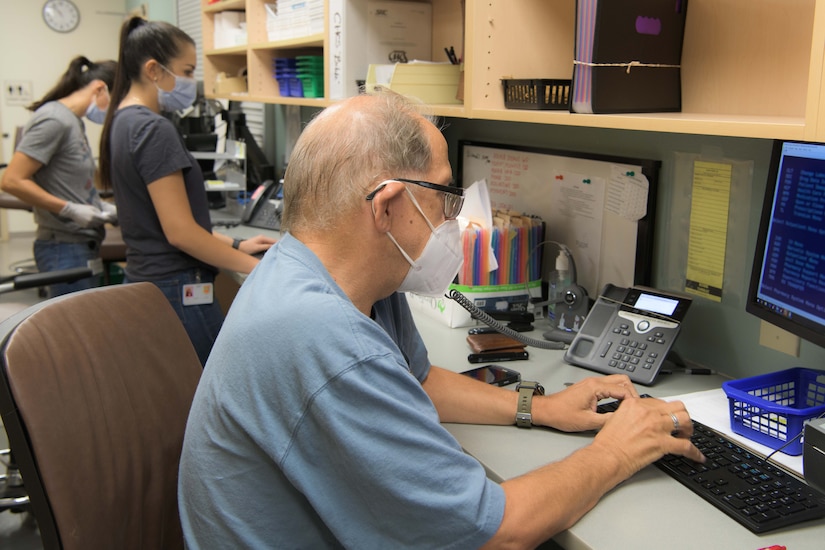
The 56th Medical Group pharmacy at Luke Air Force Base in Arizona continues to serve its patients while implementing preventative safety measures during the COVID-19 pandemic.

"Our pharmacy hasn't closed down at all throughout COVID-19," Air Force Maj. Brandy Renner, 56th MDG pharmacy flight commander, said. "We made an on-the-spot shift in operations to keep our patients safe while still maintaining 100% of our services to 100% of our beneficiaries."

In the initial days of COVID-19, the pharmacy's goal was to provide services to patients with the least amount of physical interaction possible. The pharmacy staff immediately implemented minimum manning which reduced the number of people on a shift by half.

The pharmacy supports a patient population of about 130,000 beneficiaries associated with the Defense Department mission, including active duty members and their families, retirees and civilians. They serve patients from all over the Phoenix area and process about 380,000 prescriptions a year.

A man wears a face mask while working on a computer.

According to Air Force Master Sgt. Stephen Iles, 56th MDG pharmacy flight chief, COVID-19 might have brought on unique challenges, but this only proved his teams' ability to adapt and innovate on the fly.

"In the beginning, things seemed to be changing every day," Iles said. "But we haven't skipped a beat as far as the service we provide to all of Luke's beneficiaries. It really goes to show how flexible our team is and how efficient we can be, even with half the staff."

Cryst'al Williams, 56th MDG pharmacy technician, believes the most notable change was the closing of the pharmacy lobby and implementing a new drive-thru system.

"After we got the drive-thru window working and figured out where to direct traffic, everything was pretty much the same," Williams said. "It was something new, but things happened, and we just had to roll with it and come up with the right solutions."

Over a six-week period, the pharmacy filled 33,500 prescriptions and helped about 600 vehicles per day in the drive-thru while at minimum staffing.

According to Renner, along with the significant increase of drive-thru traffic came an increase in traffic on the phone lines. Before COVID-19, the pharmacy could only answer about 100 calls a day to activate prescriptions.

She added that with the increased demand for patients to activate prescriptions over the phone, the pharmacy has implemented a new phone queuing system that allows patients to call and wait for a technician rather than receiving a busy tone. This enabled pharmacy technicians to service 250 to 300 calls a day with a wait time of less than 15 minutes per call.

A line of cars winds through a parking lot and down a street.

Williams explained that COVID-19 may have slightly changed pharmacy operations, but getting the right medicines to her patients in a timely manner is of the utmost importance.

"We're dealing with people's health here, and that's extremely important," Williams said. "That's why we've remained open throughout COVID-19. I'm happy to be at the forefront of getting people the medication they need."

Though COVID-19 may bring new problems to light, Iles said this pandemic presents an opportunity for his team to innovate and grow. He said the unique challenges have given him great confidence in the 56th MDG pharmacy's ability to thrive in the future.

"The pharmacy is constantly working to innovate our processes to make obtaining our services easier and safer for our patients, and we want to be their choice for their prescription needs," Iles said. "COVID-19 doesn't change our overall mission. We care for our own. We are here to maintain the Luke warfighters' readiness through health care."

(Air Force Airman 1st Class Dominic Tyler is assigned to the 56th Fighter Wing).

Readout of Secretary of Defense Dr. Mark T. Esper's Phone Call With Prime Minister Sheikh Hasina

 Sept. 11, 2020


Secretary of Defense Dr. Mark T. Esper spoke with Bangladesh Prime Minister and Minister of Defense Sheikh Hasina over the phone today on September 11, 2020.  During the call, Secretary Esper commended the Prime Minister for Bangladesh’s response to the COVID-19 pandemic and the recent goodwill missions to its neighbors.  The two leaders discussed their shared commitment to a free and open Indo-Pacific that ensures the sovereignty of all nations, and specific bilateral defense priorities including maritime and regional security, global peacekeeping, and initiatives to modernize Bangladesh’s military capabilities.  Both leaders expressed their commitment to continue building closer bilateral defense relations in support of shared values and interests. 

Thursday, September 10, 2020

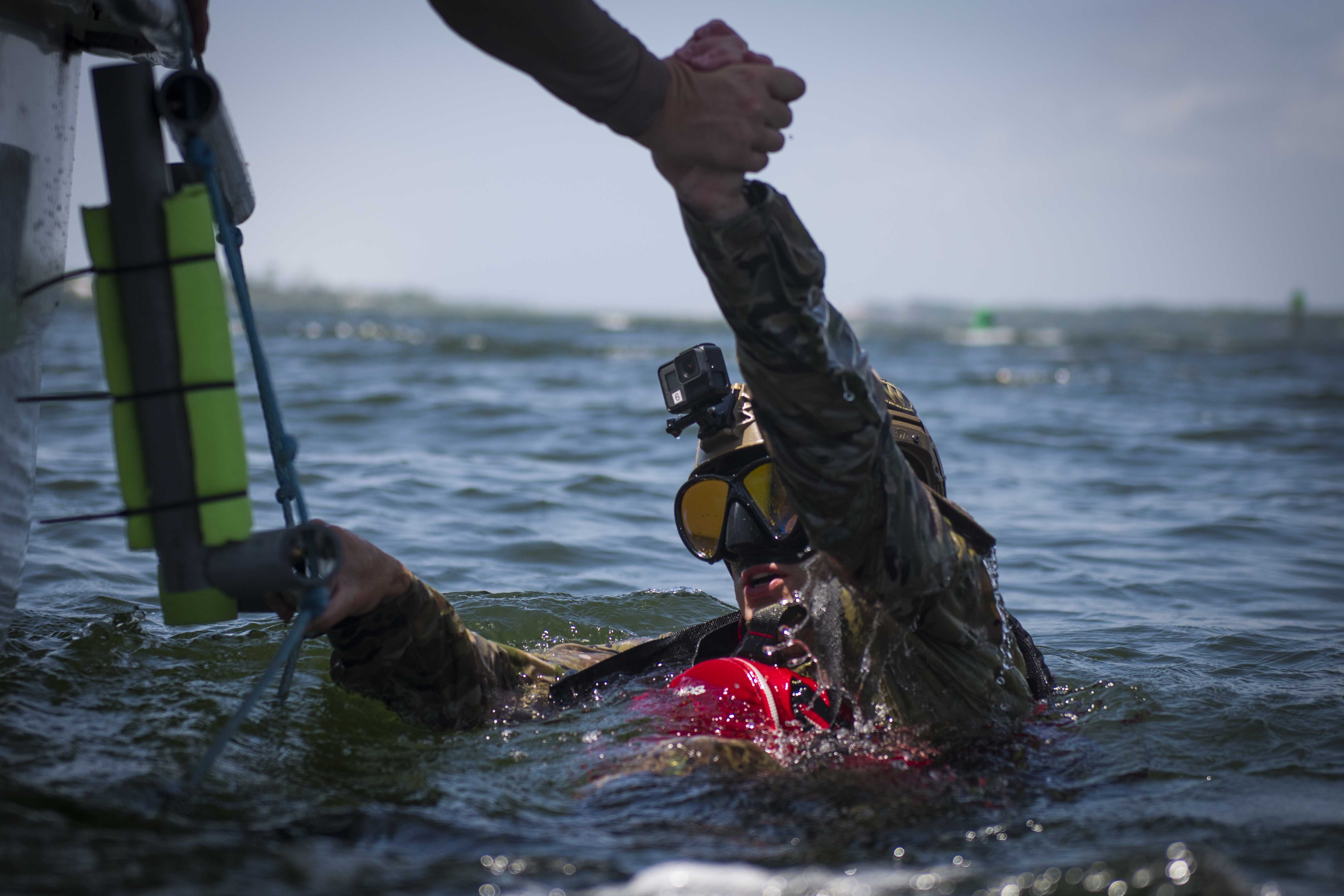
Helping Hand


An airman receives assistance from a teammate while entering a safety vessel during rescue hoist training near Hurlburt Field, Fla., Sept. 2, 2020.

Competition Course


Army Spc. Catherine Downes moves through an obstacle during the 2020 U.S. Army Reserve Best Warrior Competition at Fort McCoy, Wis., Sept. 5, 2020.

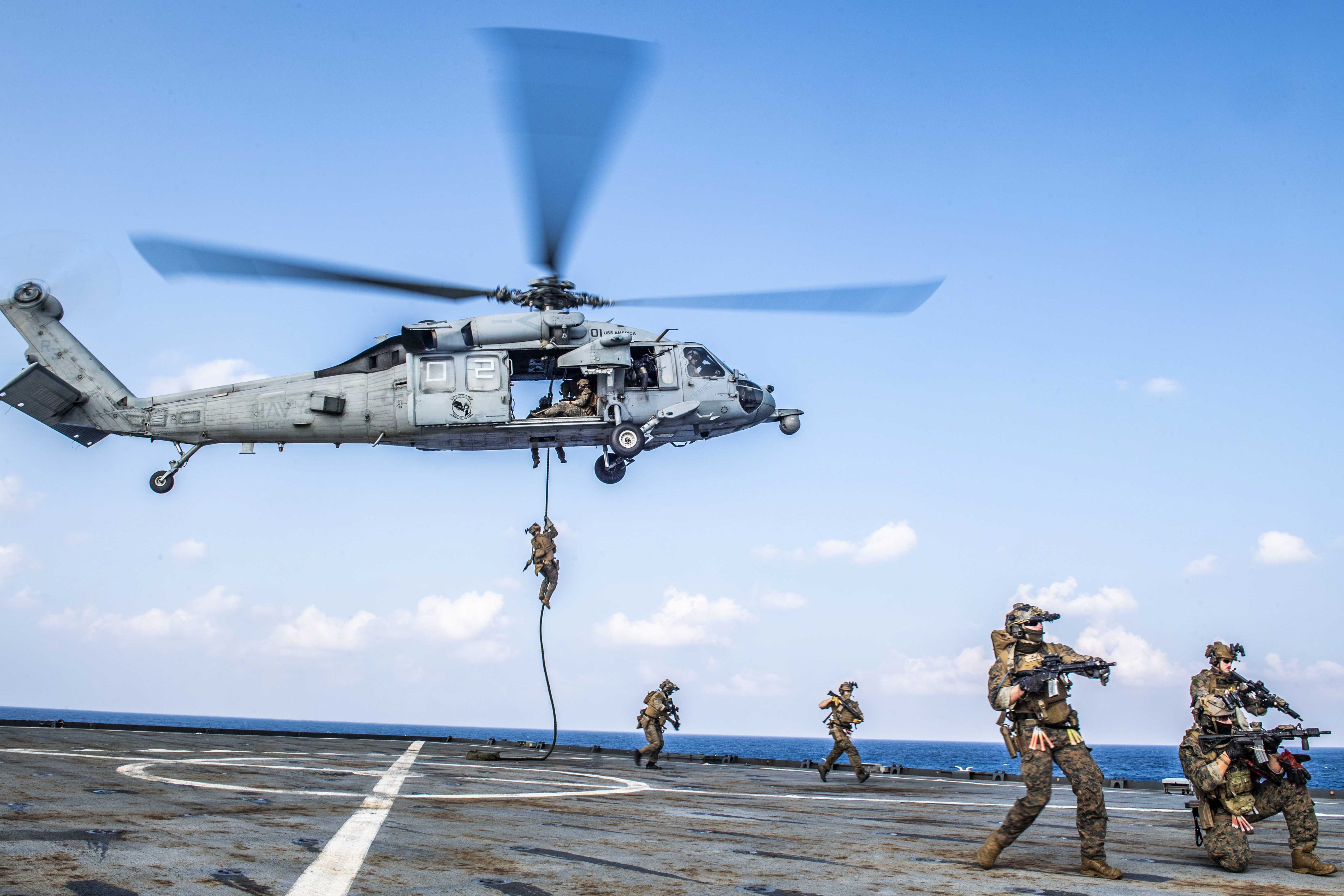
Group Exercise


Marines fast-rope from an MH-60S Seahawk helicopter during a visit, board, search and seizure exercise aboard the USS Germantown in the South China Sea, Sept. 6, 2020.

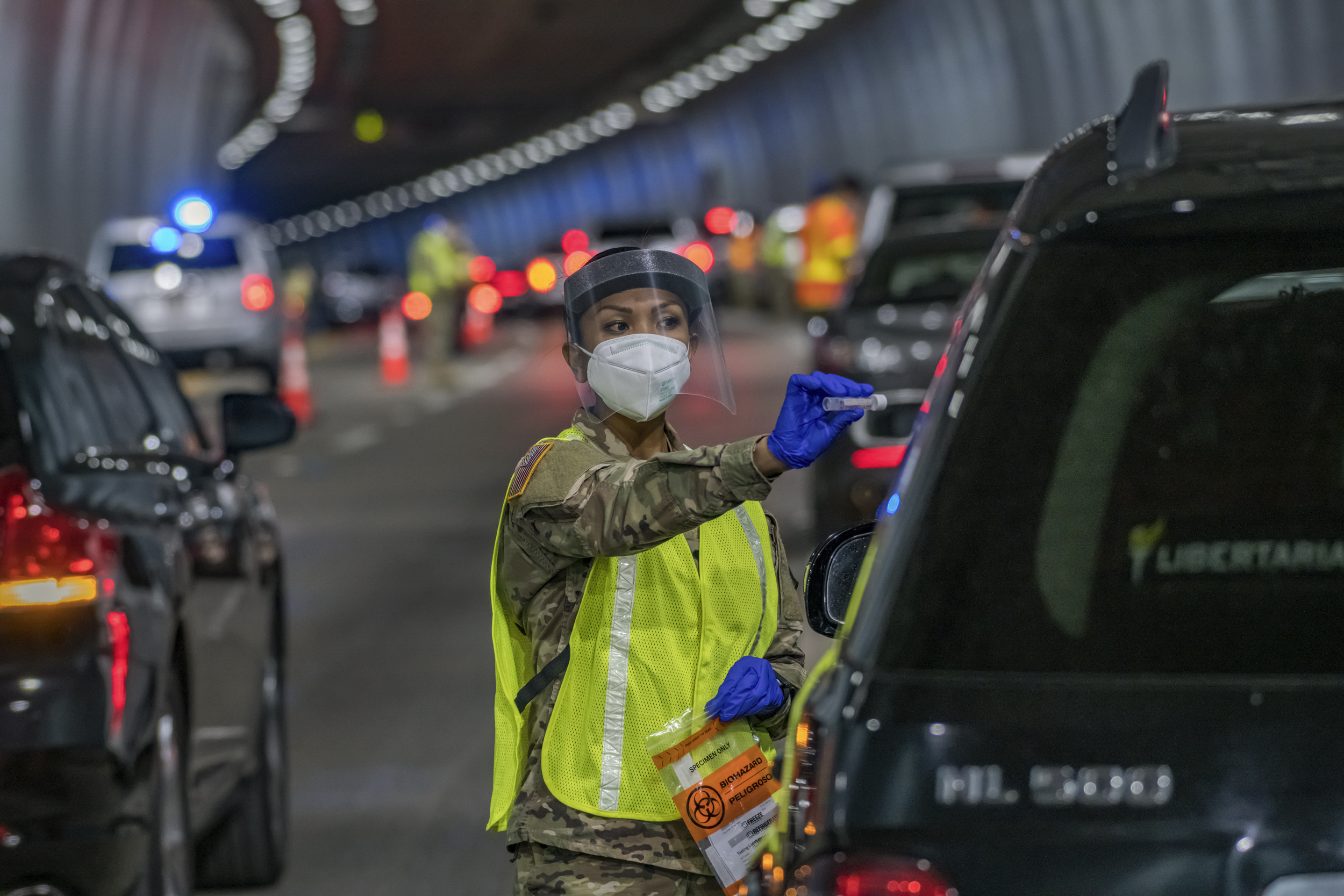
Road Test


Army Spc. Kris-Anne Basilio shows a motorist a vial before issuing a COVID-19 test in Oahu, Hawaii, Sept. 3, 2020.

Temp Check


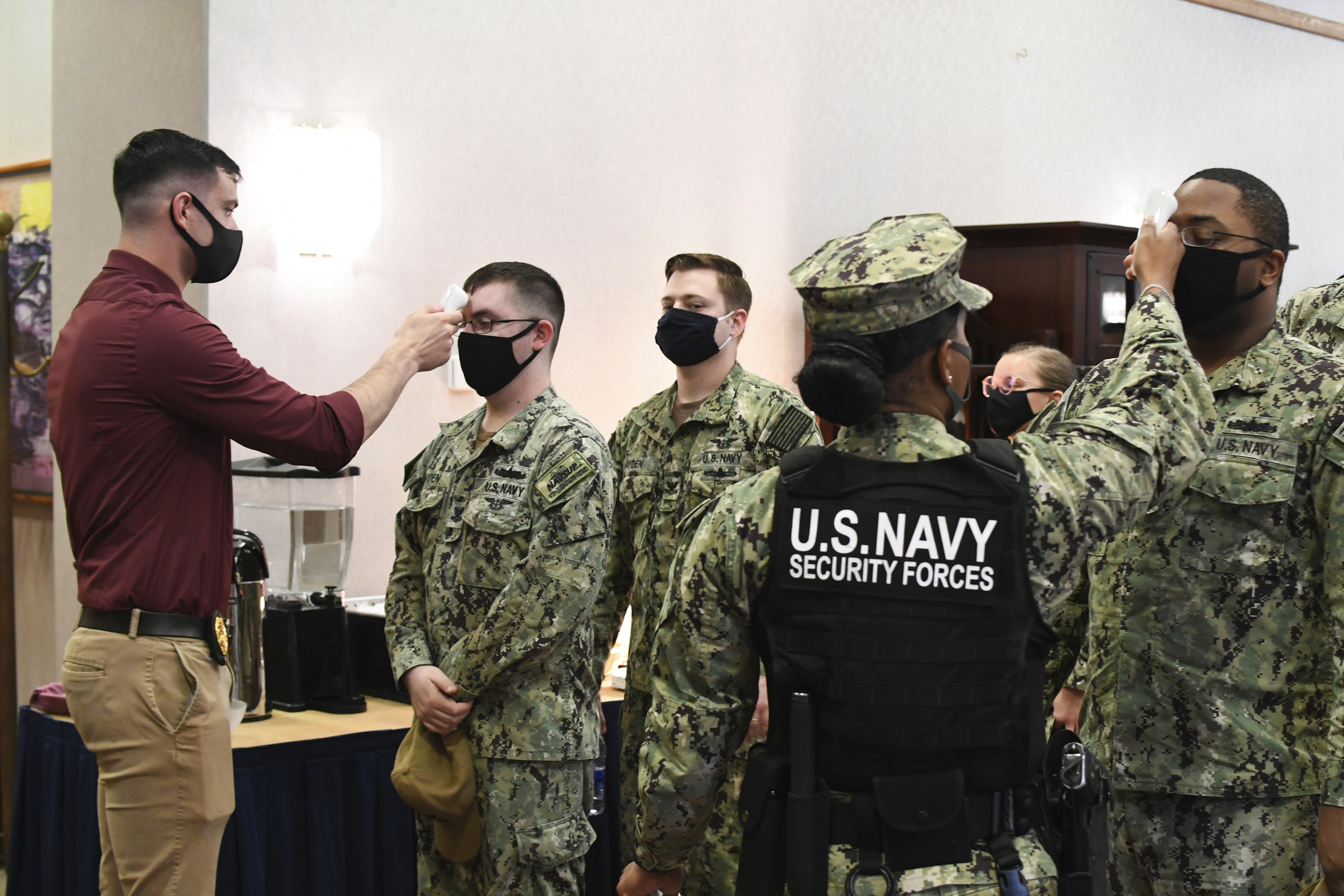
Navy Petty Officers 1st Class Alan Ranks and Krystal Peterson take the temperatures of other sailors preparing to take an exam in Misawa, Japan, Sept. 3, 2020, as part of COVID-19 response efforts.

Flare Focus


A soldier deploys pyrotechnic flares to illuminate an area during an M4 night fire range event as part of the 2020 Army Reserve Best Warrior Competition at Fort McCoy, Wis., Sept. 7, 2020.

DSCA Encourages Partners to Look Beyond Gear to Multi-Domain Ops

 Sept. 10, 2020 | BY C. Todd Lopez , DOD News

While it's true the Defense Security Cooperation Agency is most-closely associated with foreign military sales,  that is not all they do. When it comes to working with security partners, there's an effort now to focus on multi-domain operations to improve teamwork in regards to air operations, Heidi H. Grant, DSCA's new director said.

"To effectively build a partnership and team in air operations, we work with our allies to bring them into a multi-domain environment," Grant said, during a conversation at the Defense News Conference today. "In this era of renewed great power competition, our adversaries will not be operating in singular land, air or sea domains. They will be operating in multi-domain environments to include cyber and space."

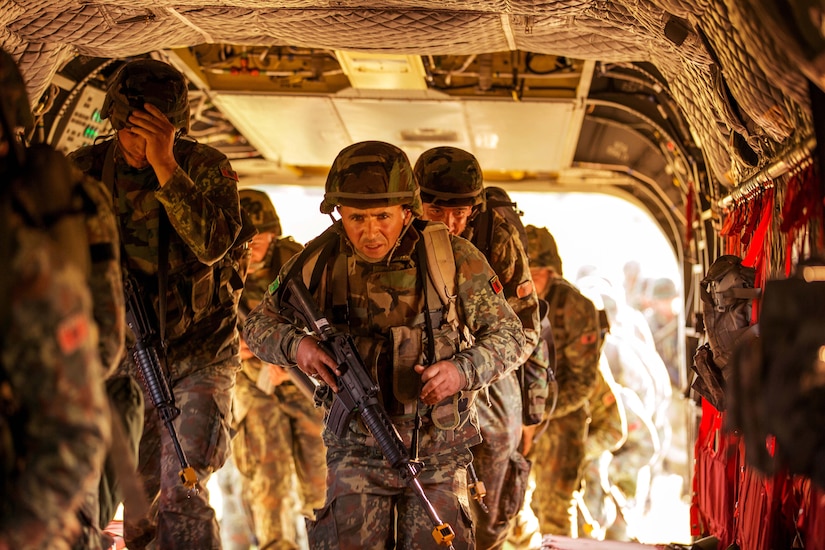
Military personnel carrying rifles enter the back of a helicopter.

Operationalizing a multi-domain approach, she said, allows for more effective air-power teaming, for instance.

"One of the challenges is to get our partners to look beyond what I call the 'bright and shiny aircraft' to the added necessity to connect and develop a net-centric capability, which will ... make it more effective," she said.

To further push the multi-domain approach, Grant said the DSCA team works actively with geographic combatant commands, military departments and the U.S. defense industry to ensure defense sales are more holistic. She also said the agency monitors international competitions to create further opportunities to expand the use of U.S. platforms with allies and partners.

"Currently, we're monitoring 48 international competitions with 24 partners," she said. "Of those, 70% are air-power based and primarily rotary wing and fighter jets."

Grant also said that DSCA is working to ensure that the exportability of U.S. capabilities is built-in to both programs of record and non-programs of record so that defense partners can have access to the capabilities they need more quickly.

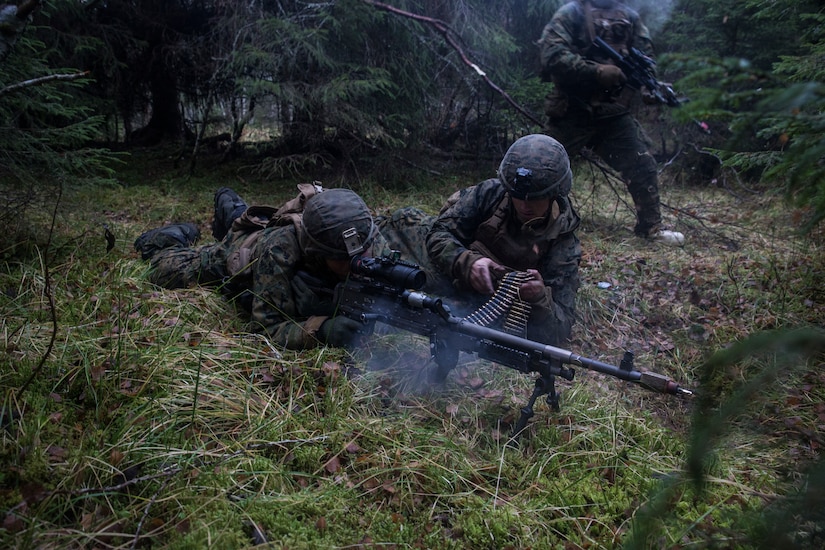
Two Marines lie on the ground and fire machine guns.

"We're doing our best to lean forward with new emerging technologies to ensure we have a determination on release in advance of actual system deployment by the U.S. military forces," she said.

While it makes sense that U.S.-developed capabilities would be fielded to the U.S. military first, she said partners have said that more could be done earlier in consideration that they also might want access to those capabilities.

"I think this has been one of the complaints of FMS ... we think about the U.S. first, and we don't think about our allies and partners in advance," she said.

Now, she said, there's significant effort across the U.S. government and within industry to consider the exportability of U.S. military hardware early on in its development so that it will be easier to share that technology with partners. That way, partners will consider U.S. technology first — and the compatibility that comes with it — rather than looking elsewhere.

"I think it's ... important to recognize the market is becoming increasingly competitive overall," she said. "Allies and partners don't want to wait to procure the most advanced technology."

New Director

Grant has been on board as director of the DSCA, an agency with a civilian and military workforce of about 20,000 personnel, for just over four weeks now.

As the new director, she said she plans on implementing a "partner culture" within the agency to better serve stakeholders.

"This is something that's been important to me in the last couple of ... leadership roles that I've held, this 'partner culture,' and it fits very nicely here in the organization. It's what I value," she said, during an earlier telephonic conference Sept. 9.

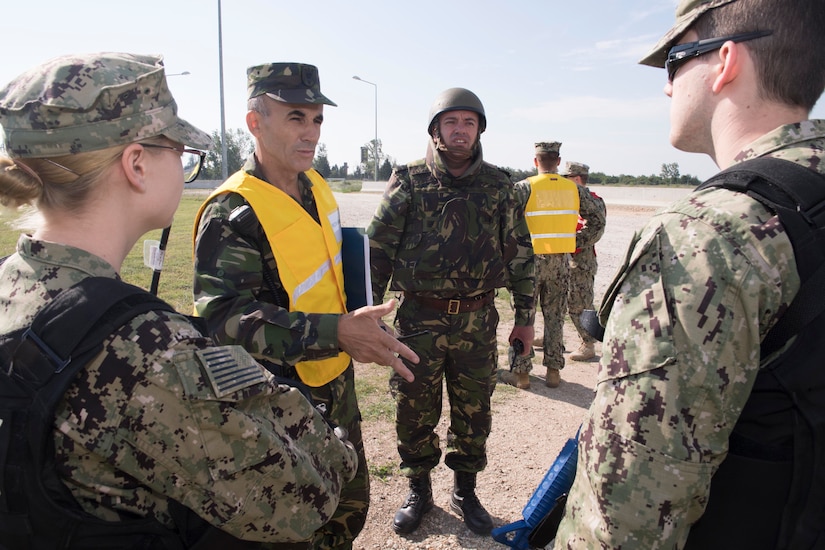
A uniformed service member wearing a yellow vest addresses service members wearing U.S. military uniforms.

Grant used the word "partner" as a mnemonic device to spell out the priorities she thinks will enhance the partner culture she hopes will grow within DSCA.

"I want the agency to be proactive, in how we do business — proactive in identifying what our stakeholders need so that we can develop policies and plans to ensure they're successful," she said.

The DSCA will also remain accountable to stakeholders, including Congress, she said.

"I can tell you my predecessors have done a tremendous job in reforming our processes to streamline how we do business. And I want to build on that success and will hold the organization accountable for achieving the tangible results," Grant said.

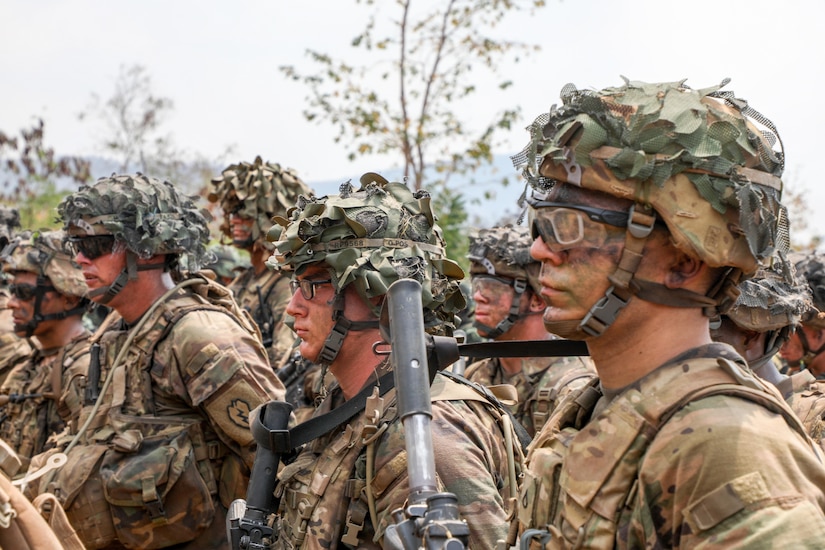
Military personnel in camouflage uniforms stand outdoors in formation.

Agency work will also be conducted with respect, she said. With a diverse array of stakeholders, including the defense industry, foreign partners and agencies within the U.S. government, there are bound to be disagreements on how to proceed with agency work.

"What we'll do is navigate our work, leading a diverse stakeholder group, with respect for each other's organizations, equities and responsibilities," she said. "I really believe in order to make progress, we really need to roll up our sleeves and understand each other."

As with nearly every government agency, transparency is also a key facet of Grant's partner culture, she said.

"I want to make sure our stakeholders understand the context associated with process improvement, policy development or funds management and have the opportunity to contribute and provide feedback," she said.

The National Defense Strategy has called for building new partnerships and alliances and strengthening existing ones — DSCA is a key part of that. But as the Defense Department and the DSCA make greater pushes into areas like space and cyber, Grant said, the DSCA itself will need to grow its network of stakeholders — that's the 'n' in partner — to be successful.

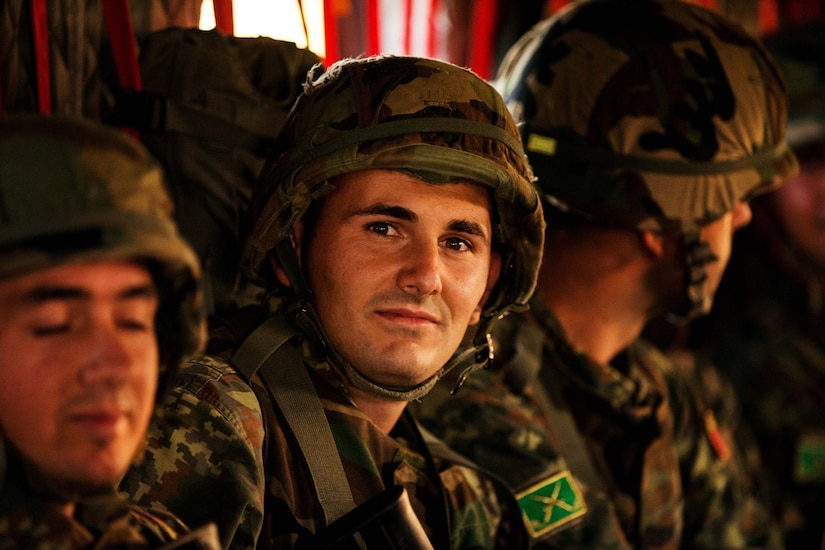
Military personnel in camouflage uniforms and combat helmets sit side by side in a helicopter.

"The importance of this mission has grown, and it will only continue to grow and expand into new mission areas," she said. "As the opportunities increase, we'll continue to build our network of stakeholders who will contribute to our success."

Grant also said that there's significant talent within the 20,000 personnel inside DSCA, and that agency success will require empowering those individuals to work closely with foreign governments and industry counterparts to advance agency efforts.

Finally, she said, DSCA's work must always represent the values of the United States and its people.

DOD Officials Describe Modernization Priorities That Will Benefit Warfighters Sept. 10, 2020

 Sept. 10, 2020 | BY DAVID VERGUN , DOD News

Defense Department officials spoke about the DOD's modernization strategy, including the development and procurement of high priority systems — such as artificial intelligence, directed energy, small satellites, hypersonics, a 5G network and unmanned aerial systems — which could potentially offer game-changing results on the battlefield.

Dr. Mark J. Lewis, the acting deputy undersecretary of defense for research and engineering, and Michael Brown, the director of the Defense Innovation Unit, spoke today at the Defense News Conference.

Lewis noted that Congress has been very supportive with the direction of the DOD's research and engineering work.

One of the important reasons for this support on the Hill, Lewis said, is that the DOD has demonstrated that it has adopted an approach to "accepting risk intelligently." That means supporting research and engineering efforts that either result in success or in some measure of success, such that even if an experiment fails, some learning about the physics and process results in enlightenment for the successful creation of a future capability.

The types of failures that the DOD wants to avoid are "dumb failures," such as a fin falling off a rocket or use of a wrong type of battery, said Lewis, who is also the director of defense research and engineering for modernization.

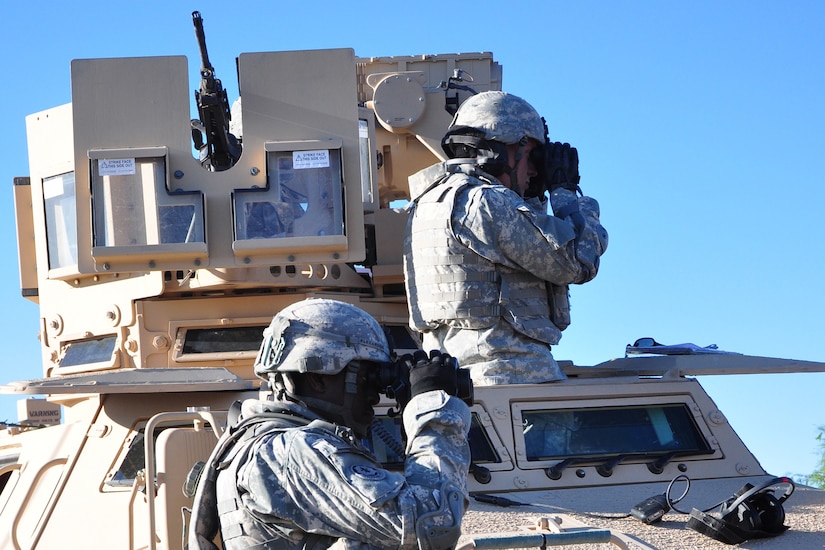
Soldiers look through binoculars.

A second strategy of the department, Lewis said, is ensuring each of the services and DOD organizations — including the Defense Advanced Research Projects Agency — are researching and developing systems that are complementary across the department and are not duplicative.

A third strategy, Lewis said, is working with industry and academia on important research or technologies that could benefit the warfighter. 

The other portion of this strategy is working with allies and partners across the globe, even those that are less traditional partners. This benefits the department because it gets a variety of perspectives and viewpoints, he said, adding that all 11 of DOD's top modernization priorities involve working with allies and partners.

The department's modernization priorities are rapidly developing, Lewis said. "The most important thing is that we're moving beyond the research lab. We're moving beyond the development phase. We're really moving to actual procurement."

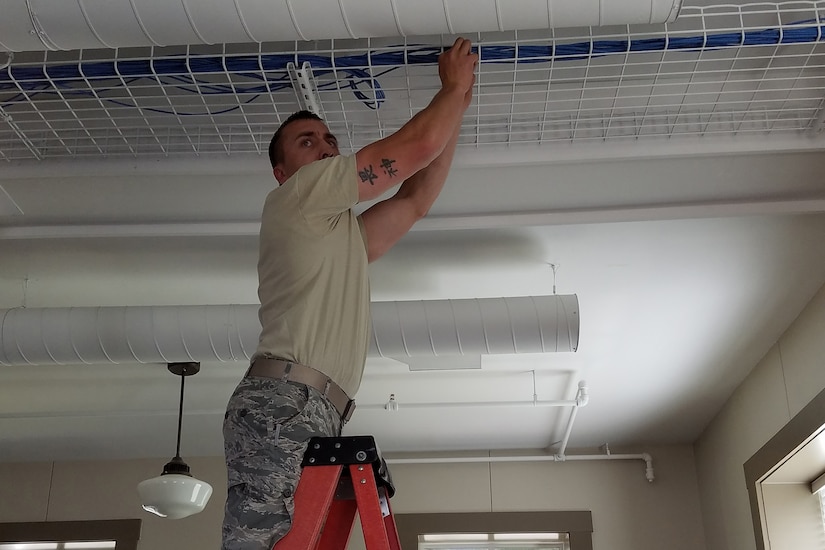
Man works on a ladder.

Some examples Lewis cited are:

  • The Space Development Agency just awarded contracts for low-Earth orbit satellites that will benefit the military's command, control and communications systems.
  • Several programs across the department are involved in testing hypersonic prototypes, including an air-breathing cruise missile with plans to deliver these to the warfighter before the end of the decade.
  • The department is experimenting with AI for numerous applications, including for UAS flights. 

In addition, Brown provided the following examples:

  • Testing of AI-assisted augmented reality is being done with microscopes that will look for precancerous cells that a radiologist might not be able to otherwise spot unassisted.
  • AI algorithms are helping National Guard troops and California firefighters pinpoint areas they need to be or avoid in fighting wildfires.
  • DIU is supporting the Army's small UAS program known as Blue sUAS. Five suppliers are already on the General Services Administration schedule and two more will be added next week. Although it was an Army program, the Air Force and Marine Corps are ready to buy, and talks are underway with the Department of the Interior and Customs and Border Protection. Allies have also expressed an interest.