Thursday, April 09, 2020

Mobility Airmen Transport Medics, Supplies in COVID-19 Fight


April 9, 2020 | BY Air Force Tech. Sgt. James Hodgman

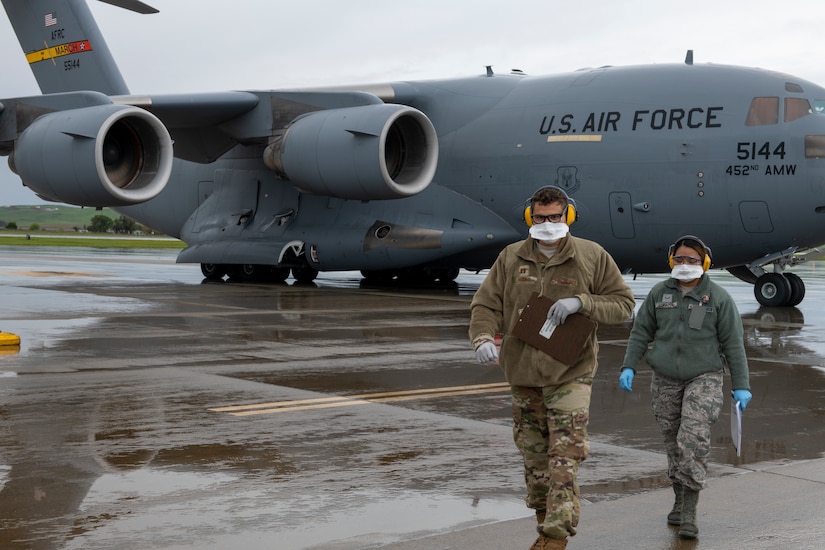
Air Force Reserve mobility airmen from California answered an urgent request to deploy medical personnel to New York to help combat COVID-19.

Within a few hours of notification April 5, an aircrew from March Air Reserve Base took to the sky in a C-17 Globemaster III transport jet, bound for Joint Base McGuire-Dix-Lakehurst, New Jersey.

A crew from March's 452nd Air Mobility Wing departed with Air Force Reserve medics from the 940th Air Refueling Wing at Beale Air Force Base, the 349th AMW at Travis Air Force Base and the 452nd AMW at March.

''It's important to get our reservists out the door quickly to help combat the spread of COVID-19 and take care of Americans,'' said Brig. Gen. Stacey Scarisbrick, Air Force Reserve Command Force Generation Center commander.

Air Force Reserve Command mobilized more than 120 doctors and nurses, along with respiratory technicians, who were flown to New Jersey for further in-processing with the U.S. Northern Command's Joint Forces Land Component Command.

The medical professionals were slated for follow-on movement to New York City's Jacob K. Javits Convention Center, a 2,910-bed field hospital, which is one of the largest in the United States.

''California is stepping up to help our fellow Americans in New York and across the country who are being impacted the hardest right now by the COVID-19 pandemic,'' said California Gov. Gavin Newsom.

The governor announced April 6 that the state would loan 500 state-owned ventilators to the states most affected by COVID-19, starting with New York, which had more than 122,000 cases of the virus as of April 6.

Air Force Command Chief Master Sgt. Derek Crowder of the 60th Air Mobility Wing, said the country must come together to fight COVID-19 and that Travis Air Force Base is ready to help the nation in any way.

''It doesn't matter if you're an active-duty airman, civilian or a reservist — we are here to answer the call at a moment's notice,'' he said. ''We are in this together, and we will get through this together."

(Air Force Tech. Sgt. James Hodgman is assigned to the 60th Air Mobility Wing.)

China Coast Guard Sinking of a Vietnam Fishing Vessel


April 9, 2020

The Department of Defense is greatly concerned by reports of a China Coast Guard vessel's collision with and sinking of a Vietnam fishing vessel in the vicinity of the Paracel Islands in the South China Sea.

The PRC's behavior stands in contrast to the United States' vision of a free and open Indo-Pacific region, in which all nations, large and small, are secure in their sovereignty, free from coercion, and able to pursue economic growth consistent with accepted international rules and norms.  The United States will continue to support efforts by our allies and partners to ensure freedom of navigation and economic opportunity throughout the entire Indo-Pacific.

The COVID-19 pandemic underscores the importance of the rules based international order, as it sets the conditions that enable us to address this shared threat in a way that is transparent, focused, and effective.  We call on all parties to refrain from actions that would destabilize the region, distract from the global response to the pandemic, or risk needlessly contributing to loss of life and property.

Guardsmen Remain Adaptable in Face of Coronavirus


April 9, 2020 | BY Jim Garamone , DOD News

More than 28,000 National Guardsmen are helping to fight the coronavirus across America, the chief of the National Guard Bureau said.

Air Force Gen. Joseph L. Lengyel and Army Brig. Gen. D. Keith Waddell, Louisiana's adjutant general, remotely briefed Pentagon reporters yesterday on the Guard's contribution to the fight.

The Guardsmen have been seamlessly working with state and territory civilian officials and the Federal Emergency Management Agency since the beginning of the pandemic. Guardsmen have set up testing stations, helped establish overflow hospital beds, delivered food and necessities, and delivered critical protective gear for medical workers.

After New York, Louisiana is one of the states most hit by the pandemic. Waddell briefed on what his soldiers and airmen are doing. "Our motto in the Louisiana National Guard is 'Protect What Matters'" he said.

Guardsmen have delivered protective equipment to medical workers in all 64 parishes of the state, he said. This has covered 120 medical facilities. "The 139th Regional Support Group has completed over 600 distribution missions," he said.

Guardsmen also are providing medical support. "Soldiers from the 256th Infantry Brigade Combat Team and the [airmen of the] 159th Fighter Wing have been providing medical support to the drive-through testing sites in Orleans and Jefferson Parish," the general said. "These soldiers and airmen have swabbed over 11,000 symptomatic citizens from these two parishes. And we have more medics supporting other medical testing sites throughout Louisiana."

Louisiana expects a surge of COVID-19 patients in the coming days and weeks. Waddell noted that the 225th Engineer Brigade is working with the State Fire Marshal's Office, the Louisiana Department of Health and the Army Corps of Engineers to conduct engineer assessments of overflow medical facilities throughout Louisiana. "This collaborative effort by all stakeholders resulted in over 70 assessments, some of which were chosen for construction or remodeling," he said.

The National Guard is aimed at battlefield medicine. Guard capabilities are more involved with transporting soldiers and airmen from the battlefield to trauma clinics to longer care facilities. Still, members of the National Guard are actually supplying staff for alternate care facilities, in some cases right alongside active duty personnel, Lengyel said.

But the Guard is flexible — as demonstrated in past years as guardsmen from one state moved to others to help in natural disasters like hurricanes. That is already happening, Lengyel said, as Oregon and California, for example, have transported ventilators to New York and New Jersey.

But the Guard is already looking beyond the immediate needs. Planners are looking to understand what the peak of the coronavirus pandemic means in any given locale. "Is it a sustained peak, or is there going to be some sort of a drawdown on the other side that makes the supplies or staff available to go someplace else?" Lengyel said. "I think that one of the most stressing things on the hospital system has been the duration of this event."

Lengyel said he believes that as the coronavirus event continues, the Guard will adapt. "We anticipate that people will be able to share supplies, and perhaps some staff as well," he said. "So that's how we're looking at this in the future."