By Amy Perry, U.S. Army Garrison Fort Lee
FORT LEE, Va. -- “You’re not smart enough to be a doctor.”
That statement, spoken by Daniel Cash’s mother when he was
10, echoed in his mind for years, motivating him to prove her wrong.
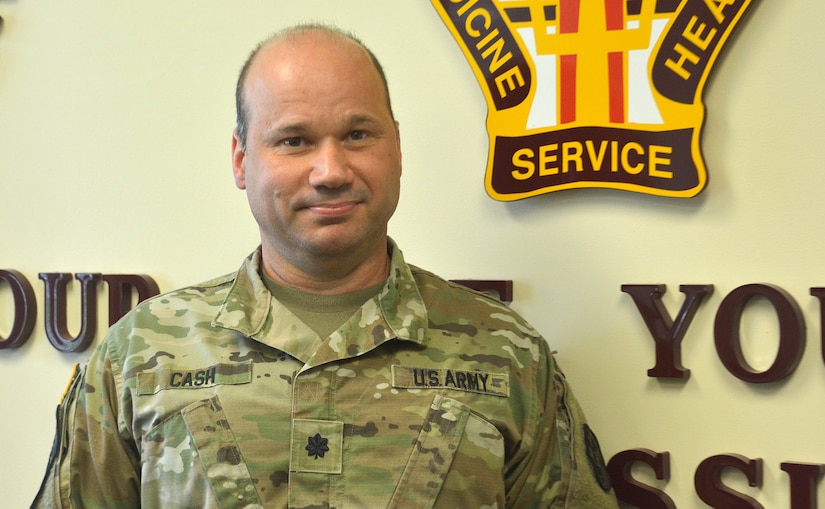
Now a doctor and a lieutenant colonel serving as the deputy
commander for clinical services at Kenner Army Health Clinic here, Cash said a
childhood accident was the impetus for his desire to practice medicine.
“When I was 10, I crashed a moped into a house when the
accelerator got stuck, and I almost died,” he said.
He was rushed to the hospital by ambulance and monitored for
24 hours. In those days -- the early ‘80s -- CAT scans weren’t readily
available at most medical facilities, so Cash said he was fortunate they kept
him for monitoring because he had an undiagnosed subarachnoid hemorrhage --
bleeding in the space between the brain and its outer tissue.
“I’ve been told I went a little crazy in the hospital, and
they had to do an emergency burr hole in my head to release pressure,” he said.
“After I recovered, that’s when I knew I wanted to be a physician. However, my
parents didn’t think school was important, and when I told them, that’s when
they said I wasn’t smart enough.”
Reflecting on the moment, Cash said he didn’t think the
comment was meant to hurt him but had more to do with their life situation.
Since his parents didn’t push education and his family was very poor, advanced
schooling was hard to fathom – and a run at a medical degree clearly pie in the
sky.
“It was an issue of poverty for sure. The way they saw it, I
would never have enough money to pay for school,” he mused. “That made
education a luxury … and they didn’t care about that. It was all about work.
“I don’t think my mom even remembers what she said,” Cash
continued, “but when you’re a child you always remember a putdown. That kind of
thing sticks with you.”
Paycheck to Paycheck
Painting an even broader picture of his childhood, Cash said
his family was continuously in need of an immediate paycheck and at times
struggled to keep a roof over their head. When he was 14, the family moved from
their home in South Carolina to Homestead, Florida, where his father had a job
lined up as a correctional officer. He was fired two months later.
“We relocated to Fort Lauderdale, where my father continued
to look for work because there were no jobs available in Homestead,” he said.
“We were homeless for 2-3 weeks, and we sort of lived in a park; then we lived
in a shelter for two months before my parents got enough money for a place to
live.”
Despite his tough childhood, Cash -- the fifth of six
children -- was the first in his family to graduate high school. While he was
anxious to begin his medical school journey, the first order of business was to
get a job and earn some money. A year later, he applied for financial aid for
advanced schooling and was told he had “made too much money” as a landscaper to
qualify for the assistance. So, he put his dreams back on hold and returned to
the blue collar grind.
“Over the next 9-10 years, I worked at the same job,” he
said. “In the evenings, I ran orders for places like Pizza Hut and Dominos,
hours after an already full day of landscaping.”
During those years, Cash met and married his wife, Enereida,
an immigrant from Panama. When their daughter was born, his college aspirations
returned with a fervor. He enrolled at a community college and worked a full-time
job while also juggling his undergraduate coursework. He managed to earn a
bachelor’s degree in 3 years by increasing his credit hours each semester.
After he graduated, he was accepted into medical school.
Nagging Doubts
“Throughout this process, my wife was pitching in big time.
She was working full time while also taking care of our daughter,” Cash said.
“She worked as an au pair, so it was great because our daughter could go with
her and grow up and play with those kids.”
Despite earning mostly A’s and a few B’s and maintaining at
least a 3.5 grade point average, Cash said he couldn’t shake the nagging
suspicion that he wasn’t good enough to follow such dreams.
“The thought still lingered in the back of my mind; that I
wasn’t smart enough to be a doctor,” he said. “Going through it, I wondered ‘am
I really able to do this?’ In a lot of ways, I still saw myself as the blue
collar worker landscaping under the hot sun and doing back-breaking work. How
could I become something totally different?”
A lucky break from the draining effects of constant work and
seeking loans to keep his dream alive came in the form of the Army’s Health
Professional Scholarship Program. It would pay for his medical school on top of
a monthly stipend. He signed on, and reaped the reward of the free ride through
the remaining three years of medical school, after which there would be a
three-year service obligation.
Cash did his residency at Fort Bragg, North Carolina’s
Womack Army Medical Center. Other highlights of his now 13 years of military
service include a squadron field surgeon gig while deployed to Iraq; a stint as
108th Air Defense Artillery Brigade surgeon; and several postings as a family
practice or primary care physician in Army clinics.
In It to the Finish
In reflection, Cash realized he had never been in doubt that
he had signed up for the long haul.
“I did a lot of stuff [hard labor] over the years and didn’t
have much to show for it,” he said. “I didn’t want to do my time in the Army
and not have anything to show for it.
“So, I tell anyone who comes through Kenner and is thinking
about getting out to remember things like the great military retirement plan,”
Cash said. “You’re going to be working most of your life. What makes it easier,
in my opinion, is working toward something. To be able to retire after 20 years
is worth it, and some can have a full second career after that.”
There are moments along the path he has traveled, Cash said,
when it felt like a dream.
“I wondered how I was doing it -- how I was attending
school, making good grades,” he said. “But here I am, 13 years later, and I’ve
been working up the chain. I’ve done … pretty well.”
Now, Cash knows his mother and entire family are proud of
what he has made of his life. To this day, his younger sister uses him as an
example where she works.
“My sister graduated high school after me, the second one in
my family to do so,” he said. “She’s now a police officer, and when she arrests
someone and they try to make excuses about being poor and having to make a
living, she tells them about me and how I became a doctor. She doesn’t let
anyone use being poor as an excuse. She says, ‘If [he] could do it, anyone
could.’”
Family Success
And it seems as though Cash’s daughter, Maria, will be
walking in his footprints. She’s set to attend his civilian medical school alma
mater -- Nova Southeastern University College of Osteopathic Medicine -- at the
end of July. She’s also using the same military scholarship program her father
did but will contribute her skills to the Air Force.
In her formative years, while he was going through
undergraduate coursework, medical school and his residency, Cash said she was
always interested in what he was learning about.
“One day while in first grade, Maria came home crying
because other kids made fun of the drawing she made for show and tell,” he
said. “She drew a picture of a brain with all the optic nerves coming out, the
circulatory system and a bladder with the kidneys. The kids were laughing
because the bladder is where the urine comes out.
“I told her she shouldn’t be upset because the children did
not understand all the stuff she did,” Cash said.
When Maria told her father she wanted to be a doctor, Cash
says he told her, “You can be whatever you want to be. You can do anything.”




 Posts

