Monday, December 11, 2017

Face of Defense: Navy Recruiter Credits Success to Hard Work


By Navy Petty Officer 2nd Class Giselle Christmas, Navy Recruiting District San Antonio

JOINT BASE SAN ANTONIO-FORT SAM HOUSTON, Texas, Dec. 11, 2017 — A recruiter assigned to Navy Recruiting District San Antonio has proved that refusing to shy away from hard work and responsibility does not go unnoticed.

Navy Petty Officer 1st Class Jalisa Green, a gas turbine system technician, said she longed to travel and see the world beyond her hometown of Baton Rouge, Louisiana, and that joining the Navy would give her that opportunity.

After enlisting in 2009, she was stationed in Yokosuka, Japan, serving on the guided missile cruiser USS Cowpens, with follow-on assignments on the guided missile destroyers USS Spruance and USS William P. Lawrence.

“Working on a ship was challenging. It meant long hours, a lot of sweat, dirt and wrench cranking, but I loved it,” Green said.

Although her passion is to travel as much as possible, she said, early in her career she knew that one day she would transition to shore duty as a recruiter.

“I had a great recruiter, who has been a positive influence from Day One in my decision to become a recruiter, and continues to support me throughout my career,” Green said.

Ambassadors in Their Communities

Recruiters are representatives of America’s Navy and act as ambassadors in their communities. To become one requires previous experience in the Navy or other branch of the military, an outgoing personality, creativity, initiative and strong organizational and time-management skills, among other qualities. For some sailors, transitioning from the fleet to recruiting can be challenging -- many find it difficult adapting to office work after spending time in more operational rates on a ship.

“For me, the biggest difference was all the paperwork,” Green said. “But the long hours and dedication you have to put in are the same. Ship life had already groomed me for that.”

Green has proven her strength and ability to adapt within the recruiting world. As a second class petty officer, she was named her division's leading petty officer, or LPO -- a role traditionally filled by a petty officer first class.

“Becoming an LPO was a tough experience. I had to make sacrifices in my personal life for my career,” Green said. “It was hard, at first, to find that balance and to remember to take care of myself and make time for other goals, like college.”

Green said she finds strength through her many mentors in the recruiting community, as well as through her family. “I reach out often to my chief, division leading chief petty officer and my first class petty officers,” she said. “They all encourage me to never back down and to always strive for more from myself and my recruiters.”

Meritorious Advancement

Green’s grit and strong work ethic made her a standout sailor within the recruiting community and led to her meritorious advancement to petty officer first class through the Meritorious Advancement Program on June 30. Earning meritorious advancement was a huge milestone for Green, who said she was completely surprised by her selection.

“I honestly did not think it was an achievable goal for me,” she added. “It is hard to be competitive within your rate as a recruiter, so I did not think it would happen.”

Successful recruiters can apply for reclassification under the Navy’s Career Recruiting Force program. Green has chosen instead to one day return to the fleet.

“As much as I have enjoyed recruiting, shore duty has reminded me of why I joined the Navy in the first place, which was to travel and do something different,” she said. I have not traveled enough.”

Green said making first class has not been a big change for her. “Serving as the LPO for my division as a second class made me already think like a first class, so this advancement is only the beginning and makes me want to work harder to achieve my goals,” she explained.

Those goals, Green said, are to eventually finish college and make chief petty officer or become a commissioned officer. “I am thankful for this opportunity, but personally it is not enough," she added. "I need to keep pushing. I also need to humble myself and remember all the recruiters and chiefs who have gone before me and to those whom have given me guidance to get me where I am today. I wouldn’t be here without their help.”

Innovative Physical Therapy Program Increases Readiness


By Air Force Tech. Sgt. Louis Vega Jr. 386th Air Expeditionary Wing

SOUTHWEST ASIA, Dec. 11, 2017 — An innovative system here is helping airmen remain physically capable, allowing them to be more productive and mission-ready in their duties.
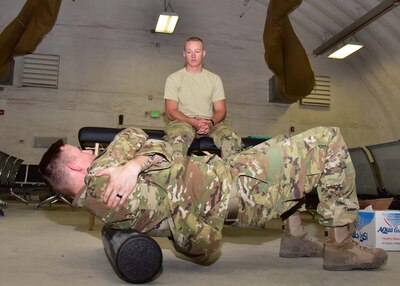
With the help of a colleague, Capt. Eric Walter, 386th Expeditionary Medical Group physical therapy element chief, has developed a proactive approach to physical therapy at an undisclosed location in Southwest Asia.

With the help of a colleague, Air Force Capt. Eric Walter, the 386th Expeditionary Medical Group physical therapy element chief, has developed a proactive approach to physical therapy.

“We embed into a unit for a set number of weeks,” he said. “We bring out two tables and all our gear, treating patients as if they had come to the clinic.” While Walter evaluates and re-evaluates, his assistant, Air Force Staff Sgt. David Dillow, a physical therapy technician with the 386th EMDG, executes the plan of care.

“We try to help patients with injuries obtained from the [area of responsibility],” Dillow said. “But we don’t turn people away who have had past injuries. We know past injuries can flare up and affect job-related duties.”

Maximum Help, Minimum Time

The program is intended for units where airmen are performing heavy labor jobs with limited ability to get to the medical clinic, as well as frequent patients of the clinic.

It is designed to help as many people as possible in a short amount of time, the physical therapy duo explained, adding that it saves the time of going through the clinic’s appointment process and increases morale, as the airmen know the team is thinking about their unit.

The team’s overall goal is to see fewer people every week, Walter said. “We want to be a jump-start and provide coaching for each patient and give them tools to become more fit-to-fight airmen,” he explained.

This is the first -- and so far the only -- deployed embedded physical therapy program. It started in August with a pilot unit.

“On the first day, we evaluated 21 patients, and on the final day after seven weeks of embedment, we only saw four, with no returning patients,” Walter said. “We ask each person we see to follow up with us the following week if things get better. We keep track of everything we did the week before to provide high-quality care.”

A Big Help

Air Force Senior Airman Calvin Lourens, 386th Expeditionary Logistics Readiness Squadron passenger service specialist, said the team has been a big help for him.

“We work around a mission,” he said. “When they come down here, it makes it easier for us. After they visit, I feel refreshed and more comfort. I am able to take what they teach me and work with it.”

Lourens suffers from shoulder pain. Walter treated him, and Dillow gave him exercises to strengthen specific muscles during his second visit with the physical therapy team.

Walter said he has received feedback from the units and their commanders, highlighting the program’s benefits. He has tracked fewer units coming into the clinic for therapy after the physical therapy team embedded with their unit. The plan going forward is to use the system for upcoming rotations to help ensure airmen are mission-ready, he added.

Sunday, December 10, 2017

Black Knights Squeak Past Midshipmen in Army-Navy Game


By Jim Garamone DoD News, Defense Media Activity

WASHINGTON, Dec. 9, 2017 — In a day dominated by tradition, the only one that really counted was Army “sang second.”

The student bodies of the U.S. Military Academy and the U.S. Naval Academy sing the school song at the end of the Army-Navy football game. The winner sings last.

The game went right down to the wire with Navy missing a field goal and Army winning 14-13.

Army also won the Commander-in-Chief's Trophy as both Army and Navy beat the Air Force Academy this year. It was the 118th meeting in the rivalry. Nearly all midshipmen and cadets of the academies attended the game.

Philadelphia looked more like Lambeau Field in Green Bay, Wisconsin, as the midshipmen and cadets marched into Lincoln Financial Field in driving snow that intensified as the game went on.

The Army Black Knights wore white uniforms honoring the 10th Mountain Division and they seemed to merge into the snowy field. The Navy Midshipmen wore blue uniforms honoring the Blue Angels.

For the past week, the Army and Navy corridors in the Pentagon were abuzz about the game. Army and Navy “spirit squads” roamed the halls on Friday before they headed to Philadelphia.

Senior Leaders Attend Rivalry

Deputy Defense Secretary Patrick M. Shanahan attended the game along with Navy Secretary Richard Spencer and Army Secretary Mark Esper, Army Chief of Staff Gen. Mark Milley, and Chief of Naval Operations Adm. John Richardson.

The game – carried by CBS – is truly a worldwide draw and the network showed troops in Kandahar, Afghanistan, troops deployed to Puerto Rico, aboard the USS Abraham Lincoln and “spirit videos” from around the world.

Army began the game with an 11-play drive for a touchdown. Army followed its game plan for the season with not one pass during the series. In fact, Army threw only one pass in the whole game. It was complete.

Navy answered with a drive that yielded a field goal – again with no passes.

Both teams battled the elements as much as each other, and at the end of the first quarter, the Black Knights were ahead 7-3.

At the beginning of the second quarter, Navy quarterback Malcolm Perry burst free and ran 68 yards for a touchdown, and the half ended with Navy ahead 10-7.

The midshipmen began the third quarter with a field goal pushing the score to 13-7, and that is how the quarter ended.

Army charged back in the fourth quarter scoring a touchdown by quarterback Ahmad Bradshaw, and with the extra point took the lead 14-13. But there was plenty of time left as Navy got the ball with good field position. Navy drove, but an attempted 48-yard field goal sailed just wide left as time expired in the game.

The cadets and midshipmen in the stands moved to the field and Navy sang the alma mater – followed by Army.