Friday, September 01, 2017

Security Forces Defend Airmen, Nuclear Assets


By Air Force Airman 1st Class Daniel Brosam 341st Missile Wing

MALMSTROM AIR FORCE BASE, Mont., Sept. 1, 2017 — Fifteen missile alert facilities lie spread out over 13,800 square-miles in north central Montana -- structures that house missileers, chefs, facility managers and security forces airmen who operate, maintain and defend the facilities and 150 of the nation’s intercontinental ballistic missiles.

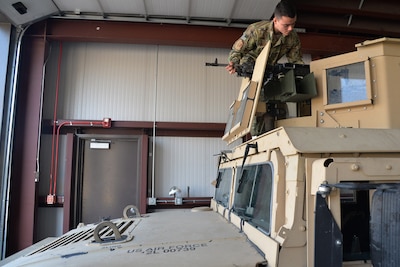
Air Force Airman 1st Class Dillan Caceres, a response force leader with the 341st Missile Security Forces Squadron here, is one of the airmen whose duty takes him to the MAFs, to live for days at a time, sworn to protect some of America’s most valuable assets, to deter adversaries and allow the United States and its allies to sleep peacefully at night.

Caceres said his job is simple -- to be the first line of defense in the missile complex.

“My job is to deny unauthorized access to missile alert facilities and launch facilities, and to defend our assets,” he said.

Tour of Duty

Caceres’ first day of his tour in the missile field begins around 5:45 a.m. at the motor pool here, where he and other security forces airmen check out vehicles for their drive out to their assigned missile alert facilities. They inspect all of the vehicles ensuring they are ready to go, and account for all ammunition and weapons that will go on the journey with them.

The closest alert facility to Malmstrom is approximately 30 minutes away from base, while the furthest is nearly three hours. Today, Caceres and his team will make the shorter drive.

Once inside the concertina-wire-topped fence surrounding the facility, the defenders unload their equipment and conduct a changeover with other security forces airmen. During changeover, the new team receives a shift-change briefing, relieves the previous team of defenders and begins their shift.

“During our shift, we will perform perimeter checks along the fence line to make sure the fence is intact and that the warning signs around the area are visible,” Caceres said. “We will also respond to alerts at launch facilities to ensure the locations are safe and secure.”

Launch facilities are the locations where the ICBMs rest in the ground.

Other duties include checking vegetation around the launch facilities to prevent false alarms and security concerns and verifying all the lights and alarms are working properly.

“I like to be busy,” Caceres said. “It makes me feel like I am contributing and preventing any incidents from occurring.”

The Gatekeeper

Air Force Staff Sgt. Michael Taku, a flight security controller with the 341st MSFS, works as a gatekeeper at the alert facility. The gatekeeper provides command and control in alarm and duress situations, is the last line of defense for the missileers and coordinates with other agencies to ensure the security of the nation’s assets.

Though the duty days sometimes extend to 16 or more hours, Taku said the time is not wasted.

“We work long hours in rain, hail and snow in the largest missile complex, and we don’t do this job for the fame or glory,” he said. “We do this because without our constant presence out here in the missile field, we leave our families, allies and nation vulnerable.”
“These are troubled and unpredictable times at home and around the world, but the one thing that is certain is nuclear security remains as strong as ever,” Taku said.

Service Members Continue Aid in Harvey Relief Efforts


By Jim Garamone DoD News, Defense Media Activity

WASHINGTON, Aug. 31, 2017 — National Guard and active duty service members are making a huge difference in the areas affected by Hurricane Harvey, saving thousands and preparing for recovery efforts, Defense Department officials said here today.
Marines with the 26th Marine Expeditionary Unit, II Marine Expeditionary Force, come aboard the amphibious assault ship USS Kearsarge at Naval Station Norfolk, Va., Aug 30, 2017.

Service members are bringing capabilities to the rescue effort that is still ongoing. The priorities for the Harvey effort are lifesaving, housing and feeding refugees, power restoration, law enforcement, health care and medical support.

Texas National Guard rescued 3,801 personnel and assisted thousands more. Guard search and rescue assets include 244 high-water vehicles, 271 Humvees, 22 wreckers, 23 fuelers, 30 Blackhawk helicopters, four Chinook choppers and 16 boats.

Relief Efforts Continue

Active duty service members have rescued 1,234 people. U.S. Northern Command has deployed 100 high-water vehicles to Katy, Texas. The command has also sent 73 helicopters, three C-130 Hercules aircraft and eight pararescue teams to the region.

The U.S. Coast Guard has 42 helicopters and seven fixed-wing aircraft conducting missions. The service has also deployed 65 shallow-water rescue boats to help conduct block-by-block rescue efforts. More than 4,700 people have been rescued/assisted by air and shallow-water boats.

Texas currently has 5,209 National Guardsmen on duty, and that number is expected to gradually grow to 12,000. On the active duty side, about 6,300 service members have been deployed with another 1,100 alerted for movement.

Airlifters are flowing to the area including seven C-17s from Charleston Air Force Base, South Carolina, and two C-5 Galaxy airlifters at El Paso, Texas.

Medical facilities in Houston and the surrounding area have been hit by flooding. Brooke Army Medical Center in San Antonio is providing treatment for victims. Texas also asked for the DoD Disaster Aeromedical Staging Facility to deploy to George H. W. Bush International Airport in Houston. The facility has already started seeing patients.

Supplies, Fuel, Water

The Defense Logistics Agency is flooding the area in a good way -- with supplies, potable water, generators to bring power grids back up, aviation and vehicle fuel, and with millions of meals for victims.

The Army Corps of Engineers is conducting air and ground post-storm assessments and harbor surveys in coordination with interagency partners. Two dredges are on standby, with two corps dredges in ready reserve.

The Navy has dispatched the USS Kearsarge and USS Oak Hill – amphibious ships that are transporting members of the 26th Marine Expeditionary Unit -- that should arrive off Texas Sept. 6.

Louisiana National Guard Aids in Texas Nursing Home Rescue


By Army Staff Sgt. David Kirtland Louisiana National Guard

BATON ROUGE, La., Aug. 31, 2017 — The Louisiana National Guard joined in Texas rescue efforts yesterday, including helping to evacuate a nursing home in Orange.

The Louisiana Guard is providing Guard members, high-water vehicles, buses and helicopters to conduct search and rescue operations and to transport people from the Texas border to shelters that have been established in Lake Charles, Louisiana.

"Louisiana is prepared to help Texas in any way possible," said Gov. John Bel Edwards. "Fortunately, we are able to take care of the needs of Louisiana as well as provide the manpower and resources necessary to help Texas in its time of need. We've all been through this as partners in the past, and there is no doubt that we will get through this event together as well."

The Louisiana National Guard is acting at the direction of the Governor's Office of Homeland Security and Emergency Preparedness. It's working with the Coast Guard, U.S. Marine Corps Forces Reserve, Louisiana State Police and the Department of Wildlife and Fisheries to rescue citizens from the rising floodwaters in southeast Texas.

As the disaster brought by Hurricane Harvey's landfall continues to unfold in Texas, Air National Guard and Army National Guard units join civilian emergency partners and other military units in rescues and providing services to the thousands of people displaced by flooding.

More than 3,500 people have been rescued, National Guard Bureau officials said. More troops -- including active-duty service members, guardsmen and reservists -- will be phased in as necessary, military officials have said.

As of today, Alaska, Arizona, California, Colorado, Delaware, Florida, Georgia, Kentucky, Louisiana, Mississippi, Missouri, North Carolina, Nebraska, New Jersey, New Mexico, New York, Oklahoma, Oregon, Pennsylvania, South Carolina, Texas, Utah and Virginia are providing National Guard personnel to the efforts.

Army Maj. Gen. Glenn H. Curtis, Louisiana's adjutant general, said Louisiana and Texas have a long-standing history of helping each other in times of need.

"They were here during Katrina, and they helped us last year during the floods," he said. "That bond, that feeling you get when you cross state borders to help those in in need, to provide relief -- that's what makes the National Guard special."

The Coast Guard and the Marines Reserves are conducting air search and rescue operations in the Port Arthur, Texas, area. Airmen with the Louisiana Air National Guard's 122nd Air Support Operations Squadron, headquartered in Pineville, are providing aircraft communication support to the Coast Guard at the Southland Airport in Sulphur.

"We are setting up communications at Southland Field," said Air Force Master Sgt. Mark Simpson, who is with the 122nd Air Support Operations Squadron. "We are linking the Coast Guard's tactical operations centers to the air assets so messages as far as Orange, Port Arthur and Beaumont [Texas] to help coordinate rescue efforts."

Also, soldiers with the Louisiana Army National Guard's 139th Regional Support Group have staged commodities, which include packaged meals, tarps, sandbags and bottles of water at various points throughout the state to provide quick distribution to affected areas. To date, they have issued more than 1,152 meals, 3,000 bottles of water and 415,000 sandbags.

Louisiana has more than 530 Guard members activated in parishes around the state responding to the weather emergency response, including eight helicopters for search and rescue and Guard troops with high-water vehicles and boats pre-positioned in Calcasieu, Vermillion, Orleans, Lafayette, Red River, Natchitoches, Caddo, Ouachita and Rapides parishes.