Thursday, January 21, 2016

Face of Defense: Army NCO Outlines Secrets to Success


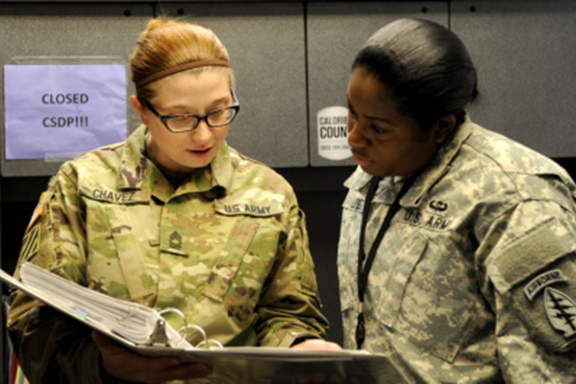
By Army Staff Sgt. Jorden M. Weir, 10th Special Forces Group (Airborne) DoD News, Defense Media Activity

FORT CARSON, Colo., January 21, 2016 — What does it take to succeed in today’s Army? It’s a question that many soldiers ponder, and one that has many different answers.

For Army Master Sgt. Amber Chavez, the logistics noncommissioned officer in charge at the 10th Special Forces Group (Airborne) here, success has been earned through inspiration from others and her own personal inner drive.

Chavez, an El Paso, Texas, native, was like many teenagers across the country, a high school student trying to figure out what to do after graduation, when she met a retired Army master sergeant while working a part-time job. It was this chance encounter that set her on her path to be a soldier.

“He was a former paratrooper and Golden Knight [U.S. Army Parachute Team member],” Chavez said, “and he opened my eyes to the different opportunities that the Army had in a way that the recruiters at the time just couldn’t.”

Chavez, who was leaning toward a teaching career at the time and wondering how she could pay for college, suddenly saw the Army as a way to pave her own way toward her goal.

She enlisted in the Army Reserve in her junior year of high school and attended basic training and Airborne School during the following summer. She served in the reserve during her senior year, but was already falling in love with the idea of serving full-time. She served active-duty for two years in 1998 before moving back into the reserve component.

She remained in the Army Reserve until Sept. 9, 2001, when she decided to transfer to active duty for good. Chavez said s divine intervention that led her back to full-time service just two days before the country was shaken to its core by the worst terrorist attack in U.S. history. It was then, she said, that she knew she had made the right choice.

A Knack for Leading Junior Soldiers

“I never considered myself a super soldier by any means,” Chavez said, “but I have always had a knack for leading junior soldiers, and I felt like this was where I was meant to be at this time in my life.”

Chavez, who has deployed six times in five different countries, credits much of her success as a leader to her family. Her husband is a soldier as well, and her mother-in-law is a veteran. Her husband and mother-in-law, she said, have formed a foundation of support and mentorship for Chavez for the last 18 years.

Chavez said her biggest family-oriented challenges are determining the best career enhancement paths for herself and her husband.

“Sometimes,” Chavez explained, “it’s just as important to take a step back from your career and focus on family, so that your spouse or significant other can focus on their career.”

Chavez also credits her Army leaders for instilling a drive for higher education in her early on. When she was a private first class, her NCOIC pushed her into college and gave her the time she needed to complete her studies, while also fulfilling her duties to the Army. It’s something Chavez has continued with her own soldiers.

“Civilian education is paramount, whether you want to stay in or get out after your first contract,” Chavez said.

Chavez encourages her soldiers to take a college-level English class first to develop effective writing and communication skills.

“Lots of communication now is done through emails,” she said. “You have to be able to communicate effectively, using proper grammar and punctuation, if you want to be taken seriously in a professional environment. It’s an often overlooked skill, and it can put you head and shoulders above your peers if you can do it well.”

Chavez also has taken an interest in her military education, dating back to the beginning of her career when she insisted that Airborne School be a part of her initial enlistment contract. She had never seen herself as a paratrooper growing up, she said, and it was just one of those things that came up while talking with the retired master sergeant who inspired her to be a paratrooper.

“I still have a great respect for gravity,” she said. “But you just have to trust your equipment to get you through.”

In addition to Airborne School, Chavez has graduated from Air Assault School, Survival Evasion Resistance and Escape School, Level C, as well as several courses in the logistics field, along with her required noncommissioned officer education system courses.

A Willingness to Teach

Chavez’s biggest asset, according to those who know her, is her willingness to teach soldiers. Even as a senior NCO, they said, she has never lost sight of what it was like to be a brand new sergeant, sometimes overwhelmed and uncertain. It’s something she strongly recommends for leaders at all levels.

“Don’t forget what it took to get where you are,” she said. “If you forget how to function at the lower level, how can you expect to lead?”

Ultimately, Chavez credits her success to those she has served with.

“I wouldn’t be successful if I didn’t have soldiers who went above and beyond and leaders who went above and beyond,” she said. “The key to being successful is realizing that it is always a team effort.”

Chavez also charges everyone to strive for excellence at all times.

“No matter how small the mission or tasking is, you have to put forth your best effort, all day, every day,” she said. “If you do that every day, you’ll find that the overwhelming obstacles in your way aren’t really obstacles at all.”

Chavez also encourages everyone to remember why they became soldiers in the first place.
“If you have the right attitude, then success will come to you,” she said. “If you have the wrong attitude, you probably won’t live up to either your professional or personal goals. Remember that you came into the Army to serve and not to be served.”

Team Dover Airman loses work partner but gains a new family member

by Senior Airman William Johnson
436th Airlift Wing Public Affairs


1/19/2016 - DOVER AIR FORCE BASE, Del. -- It is a dream come true for every military working dog handler; retire your MWD and adopt them to come home and live a relaxing lifestyle for their remaining years. That dream is coming true for one 436th Security Forces Squadron MWD handler as his K-9 trades in his kennel and cement floors for a comfortable couch and a familiar companion.

MWD Rico/M137 retired from Air Force active duty after seven years and eight months of faithful and dedicated service Jan. 15, 2016, at Dover Air Force Base, Del. Rico is now in the process of being adopted by his former handler, Staff Sgt. Jason Spangenberg, 436th SFS MWD trainer.

"Being able to retire your military working dog and take him home is probably one of the coolest things that can happen to you as a handler," said Spangenberg. "After everything Rico has sacrificed for himself and the military, it's just time for him to go home and chill. I'm extremely excited to let him go home and finally be a dog for once."

Even though Rico will go home with Spangenberg, he has had several handlers over his eight years of service. Rico was born Sept. 1, 2006, and entered the Air Force on May 5, 2008. Rico excelled through his initial training at the 341st Training Squadron at Joint Base San Antonio-Lackland, Texas, and arrived to Dover AFB on August 27, 2008.

Upon arrival to Dover AFB, Rico was assigned to then Staff Sgt. Matthew Salter, 436th SFS MWD handler. Salter was a green handler and Rico was his first assigned MWD.

"I didn't know what to think of Rico at first because he was trained differently than every other dog at Dover," said Salter. "They had just started using newer methods to train the dogs at that time so I had to learn how to work him in that manner and I also had to teach myself on how to train him."

Rico was initially trained as a single purpose explosive dog, however while on his first deployment to Camp Arifjan, Kuwait, Salter worked with a former Navy K-9 trainer and trained Rico to conduct patrol work. Once Salter and Rico returned from their deployment, the pair traveled to back to Joint Base San Antonio-Lackland, and Rico was certified as a dual purpose explosive and patrol K-9.

The pair later deployed again in 2012 to Manas Air Base, Kyrgyzstan. While on the deployment, Salter was promoted to technical sergeant and when he returned to Dover AFB, he was reassigned as the kennel trainer and Rico was assigned to Spangenberg on July 9, 2012. However, it was anything but love at first sight. At the time, Spangenberg was just arriving to Dover AFB and was eager to be assigned a Belgian Malinois.

"In the beginning, I wasn't a big German Shepherd fan," said Spangenberg. "I wanted the mal. As handlers, we always want the mal. We always want the new-new of dogs and Rico was, you know, a German Shepherd."

Spangenberg said Rico and he often butted heads at first and Rico frequently misbehaved in his cage. He said it was not until their pre-deployment training that they started to build that unbreakable bond between K-9 and handler.

In 2013, Spangenberg and Rico deployed to Village Stability Platform Tash Guzar, Afghanistan, in support of Operation Enduring Freedom. They spent every minute of every day during their eight month deployment together and even shared a twin sized bed when they slept. The pair served with U.S. Army Special Operation Forces in more than 160 combat missions and discovered more than 200 pounds of homemade explosives and detected five improvised explosive devices. Spangenberg and Rico were awarded the Army Combat Infantry Badge, Air Force Combat Action Badge and a Bronze Star.

"I can honestly say if it wasn't for my dude here next to me in Afghanistan, I wouldn't be standing here in front of all of you today," said Spangenberg during Rico's retirement ceremony.

It seemed that nothing could separate the two until Spangenberg was injured and required surgery. In January 2014, Rico was reassigned to Staff Sgt. Andrew Aninsman, 436th SFS MWD handler and deployed for a fourth time to Eskan Village, Saudi Aribia, in support of Operation Enduring Freedom.

After a short year, Rico was assigned back to Spangenberg in January 2015. They had 90 days to be certified to work together again but it took only a fraction of the time.

"It was literally like we didn't miss a day," said Spangenberg. "We picked right back up and validated and certified within two weeks."

But as with all good things, and careers, it must come to an end. Rico is being retired due to medical conditions.

U.S. Army Capt. Amanda Jeffries, Dover AFB Veterinary Treatment Facility officer-in charge and veterinarian, said Rico has spondylosis deformans along the underpart of his spine, making it extremely difficult and painful for him to work and search high and run long distances.

"It's really an arthritic change, similar to what age-related changes people get and have a lot of pain when they get older," said Jeffries. "The new bone formation along the spine makes mobility more difficult and can make it much more painful to do the same things over and over again as he did when he was younger."

Luckily for Rico, Spangenberg has no plans of working him hard after adoption. Spangenberg said Rico's future encompasses warm carpets and comfortable furniture for him to relax on.

"He's just going to chill," said Spangenberg. "He's going to be spoiled, well I mean he's spoiled now but I'm going to spoil him even more.

I am grateful and honored to adopt him," said Spangenberg during Rico's retirement. "As a handler, there is no other joy than to be able to have your partner become a part of your family and I can honestly say this is the coolest thing that has ever happened to me."

Carter Expresses Condolences for 12 Missing Marines


DoD News, Defense Media Activity

WASHINGTON, January 21, 2016 — Defense Secretary Ash Carter provided the department’s condolences to the loved ones and families of 12 Marines who’ve gone missing since two Marine Corps CH-53E Super Stallion helicopters, each with six crew members aboard, are presumed to have crashed off Hawaii’s Oahu Island Jan. 14.

The U.S. Coast Guard suspended the search for the missing Marines Jan. 19.

“Our hearts go out to the loved ones and family members of 12 Marines missing since an apparent helicopter collision off the coast of Hawaii last week,” Carter said in a DoD news release issued yesterday. “While there is no way to comprehend the grief their families feel today, this we do know: These proud Marines died as they lived, in service to a country they loved and in dedication to a cause greater than themselves.”

Carter said he also wanted to extend his gratitude to the Air Force, Coast Guard, Navy, and Marine personnel “who have been absolutely unwavering in their efforts to locate and rescue their colleagues.”

He added: “For the men and women who encountered rough seas and heavy swells over the course of these operations, ‘leave no man behind’ was not a simple slogan; it was a solemn oath. We deeply appreciate their determination and the strong support they received from state and local authorities and the people of Hawaii.”

According to the Marine Corps Base Hawaii website, the missing 12 Marines are:

-- Maj. Shawn M. Campbell, 41, of College Station, Texas;

-- Capt. Brian T. Kennedy, 31, of Philadelphia;

-- Capt. Kevin T. Roche, 30, of St. Louis;

-- Capt. Steven R. Torbert, 29, of Florence, Alabama;

-- Sgt. Dillon J. Semolina, 24, of Chaska, Minnesota;

-- Sgt. Adam C. Schoeller, 25, of Gardners, Pennsylvania;

-- Sgt. Jeffrey A. Sempler, 22, of Woodruff, South Carolina;

-- Sgt. William J. Turner, 25, of Florala, Alabama;

-- Cpl. Matthew R. Drown, 23, of Spring, Texas;

-- Cpl. Thomas J. Jardas, 22, of Fort Myers, Florida;

-- Cpl. Christopher J. Orlando, 23, of Hingham, Massachusetts; and

-- Lance Cpl. Ty L. Hart, 21, of Aumsville, Oregon.

"The loss of these 12 brave Americans is a tragic reminder of the risks our men and women in uniform take each day in service to our country,” Carter said in the release. “Today and on all days, we remember that it is because of their dedicated efforts that we live in peace and security.”

Oklahoma City Air Logistics Complex units earn star status

72nd Air Base Wing Public Affairs

1/21/2016 - TINKER AIR FORCE BASE, OKLAHOMA -- Three Oklahoma City Air Logistics Complex maintenance groups recently earned the highest honor for workplace safety and health under the nationwide Voluntary Protection Program.

The Occupational Safety and Health Administration awarded Star status this month to the 76th Propulsion Maintenance Group, the 76th Commodities Maintenance Group and the 76th Maintenance Support Group.

The simultaneous award hat trick is a first for the Oklahoma City Air Logistics Complex, which now has four VPP Star organizations. The 76th Software Maintenance Group and OC-ALC Staff office previously earned Star status.

"I'm extremely proud of these three groups achieving VPP stars," said OC-ALC Commander Brig. Gen. Mark Johnson. "It demonstrates just how committed our workforce, our union partners, and our leadership team is to workplace safety. The entire enterprise should be extremely proud of these accomplishments!"

Jim Bligh, part of the VPP program management team and first vice president of the American Federation of Government Employees, Local 916, said the feat is also significant because it's the first Star status achieved by Tinker industrial operations.
"It's really been good that our industrial areas have taken on the challenge of this program and done what it takes to get that recognition," Mr. Bligh said. "We get the airplanes and engines out, we do what has to be done and we've proven that we can all work together to get an elite safety status."

VPP is an "above and beyond" optional safety and health program for private and federal employers that already have outstanding safety and health programs.
Organizations typically work for years to become VPP Stars, undergoing rigorous inspections that involve dozens of employee interviews, workplace evaluations, safety management analysis and more.

An OSHA team evaluated the three Tinker groups here last fall.

"We're extremely excited," said Mike Mowles, deputy director of the 76th CMXG, which has more than 1,600 employees. "We've been working toward this for years. To finally get it done and have OSHA come out and validate what we already thought we knew, it's a tremendous win."

Tinker management, unions, employees and OSHA worked together for the Star honor. It recognizes "exemplary achievement in the prevention and control of occupational safety and health hazards, and the development, implementation and continuous improvement of their safety and health management system," according to OSHA.

A formal celebration coordinated with Air Logistics Complex leadership and Local 916 of the American Federation of Government Employees Union is set for February 3rd in Building 9001.

Face of Defense: Airman Finds Relative’s WWII Crash Site in Belgium


By Air Force Senior Airman Shane S. Karp, 177th Fighter Wing DoD News, Defense Media Activity

ATLANTIC CITY AIR NATIONAL GUARD BASE, N.J., January 20, 2016 — The date is Dec. 24, 1944, in the midst of World War II, and while most Americans are at home preparing for a Christmas with their families, 1st Lt. Cuno Vernal Becker, an armament officer with the Army Air Force's 836th Bomb Squadron is boarding his B-17 Flying Fortress to take part in mission No. 760 -- one of the largest air missions of the war.

Vern, as he was known by his family, was not originally meant to be part of that mission. But, as Air Force Chief Master Sgt. James McCloskey, Becker's great nephew, has heard the story told, Vern gave one of his enlisted members the day off for Christmas Eve and decided to man the tail gun.

It would be the last mission of Becker's life. The crew of nine was shot down that day over Aywaille, Belgium. Seven of the nine were killed in action. Two survived.

Chance Investigation

More than 70 years later, the New Jersey Air National Guard's 177th Fighter Wing is taking part in a two-week temporary duty assignment on Spangdahlem Air Base, Germany. During some down time, part of the group took off to explore Europe.

"When we were driving back from Amsterdam, we happened to drive through Belgium," McCloskey said. "As soon as we passed through Belgium, I thought about my grandmother, who passed last year. She would always tell stories about Vern. It's hard for me to be in Germany, or anywhere in Europe, and not think about my great uncle and the pictures of the war."

McCloskey said he took this opportunity to dive deeper into the history of his family, and he began to further research the events that unfolded on Christmas Eve, 1944.

"I immediately texted my dad to see if he could give me more info about Uncle Vern, and he sent me info about him and the town he went down in," McCloskey said. "I was able to narrow it down to the hamlet of Septroux in Aywaille, Belgium."

McCloskey said did not stop there -- he took to the streets of Aywaille, asking the elder locals if they could recall anything from that day. The survey was unsuccessful, he said.

'A Tiny Museum'

"After we came back that day, I felt like I could have made a better effort to find out more," McCloskey said. "I decided to do some Internet searching and found a tiny museum in Aywaille dedicated to World War II called 40-45 Memories."

This led the chief to Frédéric Winkin, he said, a resident of Aywaille and the curator of the museum.

"He said he knew exactly what I was talking about," McCloskey said. "Not only that, but he knew the exact location by the river where the main fuselage came down, as well as an idea of where my uncle came down in the tail section. From there, we set a date to meet up."

Now for most, this alone is a once-in-a-lifetime opportunity already, but Winkin had something else planned for the chief.

"A couple days later, Frédéric emailed me to say that he had one more surprise for me. He had found the man who pulled my uncle out of that plane, 70 years ago, and that he was willing to meet with me," McCloskey said. "Honestly, that made me nervous. I, a great nephew of Vern, was going to represent my whole family and meet this man."

So on Aug. 12, 2015, McCloskey, accompanied by Winkin and two 177th FW members, went to the exact location on the banks of the Ambleve River near Aywaille, Becker's B-17 came down more than 70 years prior.

Directly after, the group was taken to the home of Gaston Mean, the older Belgian who was at the crash site in 1944.

Shared Revelations

Mean, accompanied by his wife, invited the group inside, sat them down, and pulled out a hand-written letter. McCloskey said all eyes were focused on the older man while he precisely detailed what took place that day, in classic French dialect, as Winkin translated for the group.

"Since Mr. Mean was the one who found my uncle, he obviously had an emotional bond with him," McCloskey said. "He never knew what happened to my uncle after that day. He wondered if he survived or died; he wondered if he went on to have a life in America."

McCloskey then informed Mean of something that had been unknown to him for more than 70 years. Becker tragically died two days later at an allied hospital in Belgium, from injuries sustained in the crash.
"I can't put into words how much all of this meant to my family," McCloskey said. "Everyone is fascinated and touched. I get calls from different family members all the time now who want to hear the story. I wish I could tell them more. I wish they were all in that town and that living room with me."