Friday, October 30, 2015

ACC intel officer shares new ISR perspective


By Staff Sgt. Alyssa C. Gibson , Secretary of the Air Force Command Information / Published October 29, 2015

WASHINGTON (AFNS) -- Air Combat Command’s senior intelligence officer shared her perspective on fusion warfare with the intelligence community, defense industry and media during an Oct. 22 assembly at the Air Force Association’s Mitchell Institute for Aerospace Studies.

Maj. Gen. VeraLinn Jamieson explained fusion warfare as “an asymmetric decision advantage, integrating and synchronizing multi-source, multi-domain information in a specific time and space,” ultimately benefiting tactical, operational and strategic leaders.

“The reason we need fusion warfare is to maintain our tactical edge, meaning the outer boundary of warfighting, not just today but specifically in 2035,” Jamieson continued. “By then, our competitors will probably be near-peer technologically, and some will have advanced us.”

Fusion warfare is achieved by combining the observe, orient, decide and act loop across multiple domains. Currently, the Air Force has multiple platforms working to achieve their own objectives -- they’re not necessarily integrated to affect the target or influence strategic decision makers.

“Our current tactics, techniques and procedures (TTPs) are based off of lessons learned,” Jamieson said. “Fifth-generation technology is going to increase the amount of data available -- it’s going to be and produce a hub of data that’s going to flood us, known as big data. Fusion warfare provides an opportunity for a much faster pace via air, space and cyber multi-domain operations. Current TTPs won’t keep pace by 2035; they’re based on single inputs, not multi-source or multi-domain. This is why we must act now.”

This new idea is an answer to the secretary of the Air Force and chief of staff of the Air Force’s challenge for Airmen to quickly adapt and respond to evolving operations, and is one approach to achieving the Air Force Future Operating Concept for 2030.

The intelligence officer said it’s about integrating and synchronizing multi-source, multi-domain information to know the adversary’s processes better than they know it themselves to make the unpredictable become predictable. She also highlighted that the U.S. military and its allies, the defense industry and academia must be included in fusion warfare conversations to create the TTPs of the future.

“The innovative Airmen teaming with academia and industry in a collaborative, environment, integrating, focusing and fusing data, will result in fusion warfare,” Jamieson said. “At the end of the day, it takes Airmen to deliver that asymmetric decision advantage in advance of real time in a time and place of our choosing. We’re not going to wait until 2035.”

Survivor speaks out about domestic, sexual abuse

by Airman 1st Class Kyle Johnson
JBER Public Affairs


10/29/2015 - JOINT BASE ELMENDORF-RICHARDSON, Alaska -- (Editor's note: The story contains descriptions from a personal account of a domestic and child abuse victim - may not be suitable for all readers.)

"Go get undressed and get into bed," her father said. "I'll be there in a minute."

Helen Holston, not yet old enough to go to elementary school, did as her father told her. He then proceeded to beat her with a leather belt from neck to toe; he called it branding.

"My dad was in the Army for 22 years, and married my mom while he was stationed overseas," Holston said. "Things were very rocky between [my parents] and there was a lot of domestic violence between them. Lots."

Holston said she lived in fear for most of her young life, and when her parents quit beating up on each other, they started beating up on her.

Forty years later, Holston said she has reached a place in her life where she feels it's important to tell her story.

By raising awareness of domestic, child and sexual abuse, Holston said she hopes to empower victims who feel there is no way out and empower military organizations like the family advocacy program to help those people.

"I went to a lot of schools on military bases," Holston said. "I never told anybody because at our house, everything was secret. You don't tell, ever."

So she didn't. All through her adolescence, Holston was abused by both her parents. Her mother would beat her with whatever was nearby; her father, with belts she fetched and brought to him herself.

Eventually, Holston's father's command forced him to go to counseling with his family.

They went twice.

As a preschooler, Holston often cleaned up used contraceptives and vomit after the parties her parents frequently hosted at their house.

"I was the adult, and they were the crazy kids," Holston said. "When I was five, my dad and his buddies came into my room."

They were drunk.

"I acted like I was sleeping," Holston said. "And they - they did whatever they did to me."

Holston said she tried to tell her mother, but she wouldn't listen. Her mother told her she stayed with her dad because he didn't "bother" her. She meant sexually.

"I had nowhere to turn," Holston said. "He took showers with me until I was 11. I did not know that was strange."
The molestation ended when Holston reached the age of 11, but the physical abuse didn't stop. She became hyper-involved in school. The teachers thought she was an overachiever, a hard-charger, but Holston knew better. She was just doing anything she could to stay away from home.

When she made it to high school, she found solace in the structure of the Junior ROTC.

"At home, there was no structure. I never knew what I was coming home to. Everything was crazy and chaotic," Holston said. "JROTC had structure, and it saved my life."

During high school, Holston was seriously contemplating suicide until she was given a mundane little award. To her, it wasn't mundane at all. It was a glimpse of light in the perpetual darkness which enveloped her life.

"I'll never forget when I quit thinking of suicide; it was the stupidest little award I got from drill team. I'd won the six-week drill competition," Holston said. "It clicked. I could be really good at something."

Holston went on to be named student of the year and cadet of the year, and become the first female battalion commander for her school. The abuse carried on.

Holston entered the delayed enlistment program, and when she graduated high school, she stayed at a friend's house for three days before leaving for basic training at Fort Dix, New Jersey.

After graduating from Advanced Individual Training, Holston went to her first duty station, fully intending to create a career for herself in the Army; and away from her parents.

However, she would find out escaping her parents' influence would be a lot more difficult than moving almost 4,000 miles away.

Holston's time at Fort Wainwright was rife with conflict; she was married and divorced twice and a noncommissioned officer threatened her life if she did not perform sexual favors for him.

She did not reenlist.

For more than 20 years, Holston hopped from one state to the next, never quite settling down.

She continued to flit in and out of one abusive relationship and another. Chaos was where she was comfortable; it was all she knew, Holston said.

Then she met Mark Holston, a police officer and former Marine.

"It was like Alice in Chains meets the Brady Bunch," Helen said. "It's strange with Mark; he's kind, he's calm, generous and compassionate. Those are things I've never experienced. It's odd for me."

Now, as they approach their 10-year anniversary, Mark said he jokes about growing old together with Helen. He knows it makes her uncomfortable to think about reaching this milestone in their lives, but it's important she knows he's not going anywhere.

"I don't drink anymore, but when I did," Mark said. "I would see her staring at me; evil-eye staring at me, because the smell of alcohol was triggering bad things."

Holston said she finally found help through the Department of Veteran's Affairs in Pensacola, Florida.

"I've been out since [19]90. I had not met a counselor I trusted enough to really deeply share; until 2013," Helen said. "She helped me through a process called dialectical behavior therapy, and I did a course with her once a week for six months."

"Pensacola VA was a big pivot point in my life. After DBT, I did nine sessions of trauma-recovery management," Helen said. "After Pensacola, we came back to Alaska so I could start taking college classes, and Mark could get a job.

"Now I've got all this new training from Pensacola. We've relocated back to Anchorage. Mark's got a job on JBER, and I've been approved for school."

Helen was able to connect with a tax preparation class through JBER. And she's been approved to start taking college classes in the spring through the Alaska Department of Veteran's Affairs.

"I have run for office. I have served on the governor's board here in Alaska. I've served on the governor's board in Alabama," Helen said. "My dream job, with 20 years of built-up experience [helping veterans], is to work in [Washington] D.C. at central VA to make policy change for continuity for veterans; to make it less of a hardship for veterans to get service-connected disability [benefits]."

Helen has kept her past largely a secret until now. But she has decided it's time to make a change.

"Ninety-nine percent of my friends never knew I have this background. I just don't trust people enough to share that," Helen said. "Now, I think, 'If it saves one life, it's worth it.'"

Helen said she isn't sure where her future will lead, but she is sure of her goals.

"I want to write a book. I want to help people. I want to change my name," Helen said. "I think I'll change it to Back, Helen Back; because I have been to hell and back.  It's perfect."

Mark said he wonders how different Helen's life could have been, if someone had intervened, if someone had stood up for Helen as a 5-year-old girl.

"They have these wonderful programs to educate people on looking out for signs; if this had been around 20 years ago when she was going to all these military schools, one of the teachers might have done something," Mark said. "It could have saved her. Who knows what she could have been."

The tragedy is, the family advocacy program was established in 1974, when Helen was 7 years old, as a way of detecting child maltreatment. It was later extended to domestic abuse in 1981, but the program was so new, people simply weren't aware of it.

October was Domestic Violence Prevention Awareness Month and the JBER Family Advocacy Program was all over base attempting to make people more aware of the resources available. Though the month may be over, the desire to help is still there.

"There are programs out there now, and people have to be willing to take a leap of faith and just do it," Helen said. "You have to take that chance."

For information on the JBER Family Advocacy Program and other resiliency resources, visit www.jber.af.mil/resiliency.asp.

AF announces KC-46A preferred, reasonable alternatives


Secretary of the Air Force Public Affairs / Published October 29, 2015

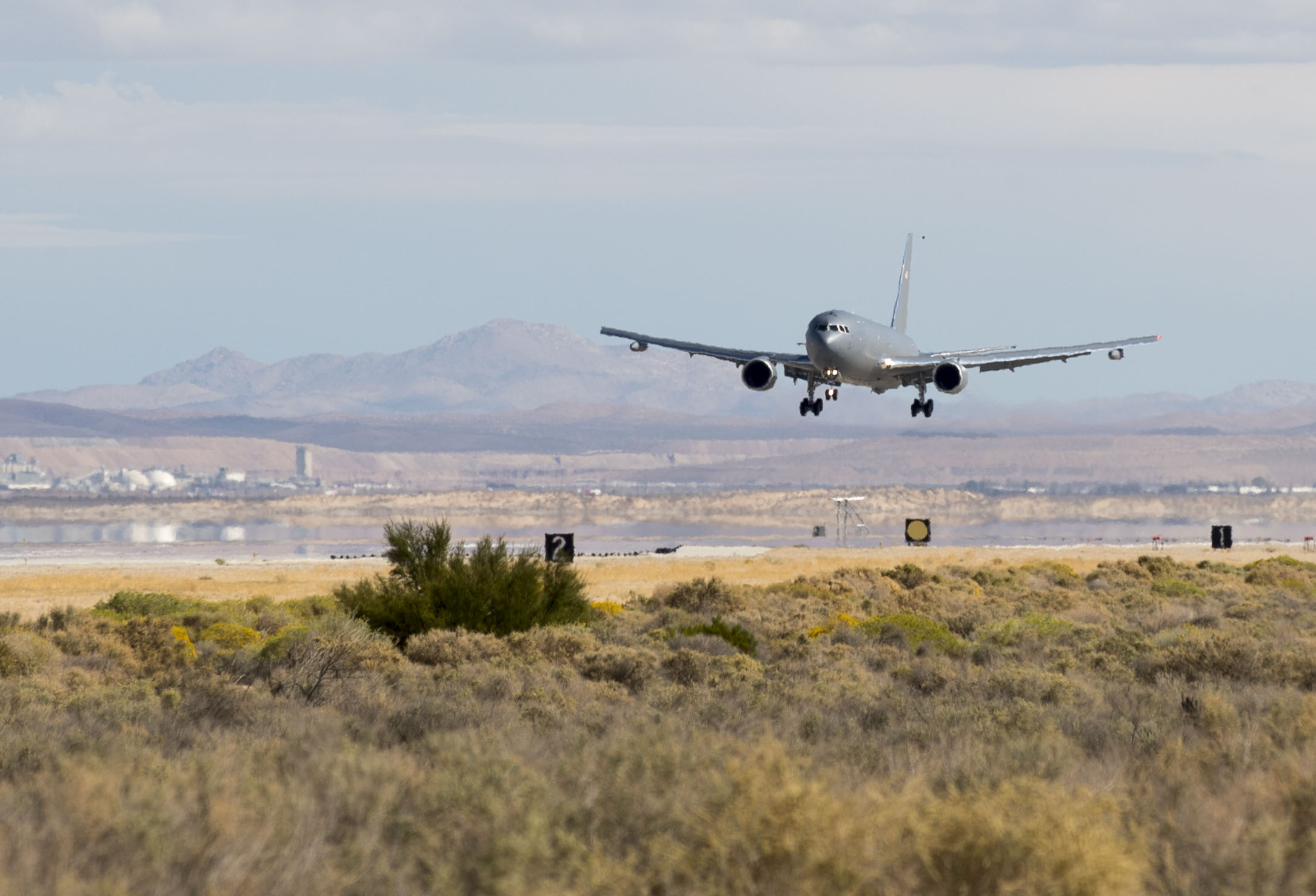
WASHINGTON (AFNS) -- Seymour Johnson Air Force Base, North Carolina, has been chosen as the preferred alternative for the first Reserve-led KC-46A Pegasus main operating base, Air Force officials announced Oct. 29. The KC-46As are expected to begin arriving in 2019.

Tinker AFB, Oklahoma; Westover Air Reserve Base, Massachusetts; and Grissom ARB, Indiana, were named as the reasonable alternatives.

"It is absolutely critical that we replace our aging tanker fleet with the KC-46A Pegasus aerial tanker," said Secretary of the Air Force Deborah Lee James. "I am pleased to announce Seymour Johnson AFB as the first Reserve-led location because it is a testament to the Air Force's commitment to the total force.

“We must use all three components -- active, Guard and Reserve -- operating cohesively and seamlessly as one team so we can realize the full potential of airpower."

James also explained the 179 planned KC-46A aircraft are just the first phase of a three-phase effort to replace the aging tanker fleet. The first phase of tanker recapitalization will complete deliveries in fiscal year 2028.

During detailed, on-the-ground site surveys of each candidate base, the major commands evaluated the bases against operational and training requirements, potential impacts to existing missions, housing, infrastructure, and manpower.

The site survey teams also developed cost estimates to bed down the KC-46A at each candidate base. The results of the surveys were briefed to James and Air Force Chief of Staff Gen. Mark A. Welsh III, who selected the preferred and reasonable alternatives for this mission.

"Seymour Johnson (AFB) was selected based on operational analysis, results of site surveys, cost, and military judgment factors," said Jennifer Miller, the Air Force deputy assistant secretary for installations. “The primary drivers for selecting this location as the preferred alternative were its lower costs and its highly successful existing active-duty association, which will lead to the lowest active-duty manpower required to stand up the KC-46A Reserve unit.”

Selection of this total force unit will minimize costs and the challenge of fielding a new weapons system while simultaneously establishing a new active association.

"Bringing the KC-46A online is a huge first step in recapitalizing a tanker fleet that has been the world leader in air refueling for more than five decades," Welsh said. "The incredible Airmen who will fly this great machine, and the joint and coalition partners they support in contingency and humanitarian operations around the world, deserve the improved aircraft availability rates, reliability and capability it will bring to the fight. Rapid global mobility has always been a core mission of our Air Force; the KC-46A will help us take it to the next level!"

The Air Force will also ensure Reserve component involvement from day one by establishing active/Reserve associations at all U.S. main operating base locations.

“The Air National Guard and Air Force Reserve are vital to accomplishing our air refueling mission,” James explained. “Therefore, the ability to recruit for and maintain a strong Reserve component association was a major consideration in this basing action.”

“We will now begin the Environmental Impact Analysis Process (EIAP),” Miller said. “We look forward to the inputs provided from the communities as we proceed through the environmental impact analysis.

“Once the requirements of the environmental impact analysis process are complete, the Air Force will make its final basing decision.”

Reasonable alternatives will continue to be evaluated during the EIAP. Subsequent KC-46 decisions will use similar criteria; therefore, candidate installations will likely compete for future continental U.S. basing decisions.

The KC-46A will provide improved capabilities, including boom and drogue refueling on the same sortie; worldwide navigation and communication; cargo capacity on the entire main deck floor; receiver air refueling; improved force protection and survivability; and multi-point air refueling capability.

AFRICOM leaders meet, sync future focus

by Senior Airman Nicole Sikorski
86th Airlift Wing Public Affairs


10/29/2015 - RAMSTEIN AIR BASE, Germany  -- More than 200 U.S. service members from the U.S. Africa Command and NATO partners attended the annual Regional Synchronization Working Group conference kickoff Oct. 26, at Ramstein Air Base, Germany.

The event brought together Africa-focused security cooperation leaders from the Department of State, the Department of Defense, the U.S. Agency for International Development and other personnel to synchronize efforts across the diplomatic, defense and developmental sectors in AFRICOM.

The five-day conference began with an all-call, where U.S. Army Gen. David M. Rodriguez, AFRICOM commander, gave his opening comments.

"It is always great to be here at Ramstein," he said. "I want to thank everyone for their planning and execution efforts and the teamwork required to pull this all together. ... I appreciate the work it took to bring people together from all of these different countries to the conference and for taking care of that many people."

During the conference, Rodriguez and other AFRICOM leaders spoke about the 50-year theater campaign plan to build defense capabilities, respond to crises, deter and defeat transnational threats in order to advance U.S. interests, and promote regional security, stability and prosperity.

U.S. Army Capt. Ross Hertline, executive aid for U.S. Army Maj. Gen. Darryl A. Williams, U.S. Army Africa commander, shared the importance of the integration of partnered nations and joint forces at the conference.

"It is important to come together because nothing that we do within the DOD is a sole service," said Hertline. "Everything we do in Africa involves the (U.S.) Air Force, Army, Navy and Marines; so it's critical that we are synchronized both amongst ourselves and when we go to the continent so we can present that same united front to the Africans, showing them the benefits of joint operability."

Although leaders within AFRICOM work closely, they are geographically separated; so coming together to align their focus is a must to meet their commander's intent.

"It's important to coordinate with agencies we don't normally get that face-to-face feedback with," said U.S. Air Force Lt. Col. Nels Nelson, U.S. Air Forces in Europe African region operational plans branch chief.

The RSWG conference will conclude Oct. 30.

Rear Adm. Nowell visits Guam, Frank Cable


By Mass Communication Specialist 2nd Class Brian T. Glunt
USS Frank Cable (AS 40) Public Affairs

POLARIS POINT, Guam (NNS) -- Capt. Drew St. John, commanding officer, USS Frank Cable (AS 40), welcomed aboard Rear Adm. John B. Nowell Jr., commander, Expeditionary Strike Group 7, Amphibious Force 7th Fleet, Task Force 76, Oct. 27.

Nowell traveled to Guam to visit with leaders and crew members of the many Navy commands on the island. The admiral also toured Frank Cable - one of only two submarine tenders still active in the U.S. Navy - to meet with Sailors and learn about the ship's repair and maintenance capabilities offered to the fleet.

"I'm in Guam to visit our helicopter sea combat squadron, HSC-25, the 'Island Knights," said Nowell. "But I'm also using the visit to meet with the leadership and Sailors of Commander, Task Force (CTF) 71, CTF-75, and to get to Frank Cable to see the maintainers who keep the submarines and ships at the tip of the spear, maintained and ready."

Nowell toured the ship's repair work centers including the carpentry, sheet metal, pipe repair and machine shops, along with the ship's medical and dental spaces.

"I think the capabilities of Frank Cable and the capabilities that her Sailors bring are incredible," the admiral commented. "As we look at the forward-deployed naval forces here in the western Pacific, they are so critical to our national security and the national security of our partners. As we look at what these maintainers aboard this great ship can do for both submarines [and] surface ships, it is really magnificent."

Frank Cable, forward deployed to Guam, conducts maintenance and support of submarines and surface vessels deployed in the U.S. 7th Fleet area of responsibility.