Tuesday, October 20, 2015

Combat weather forecasters help keep pilots out of harm’s way


By Staff Sgt. Tyler Alexander, 386th Air Expeditionary Wing Public Affairs / Published October 19, 2015

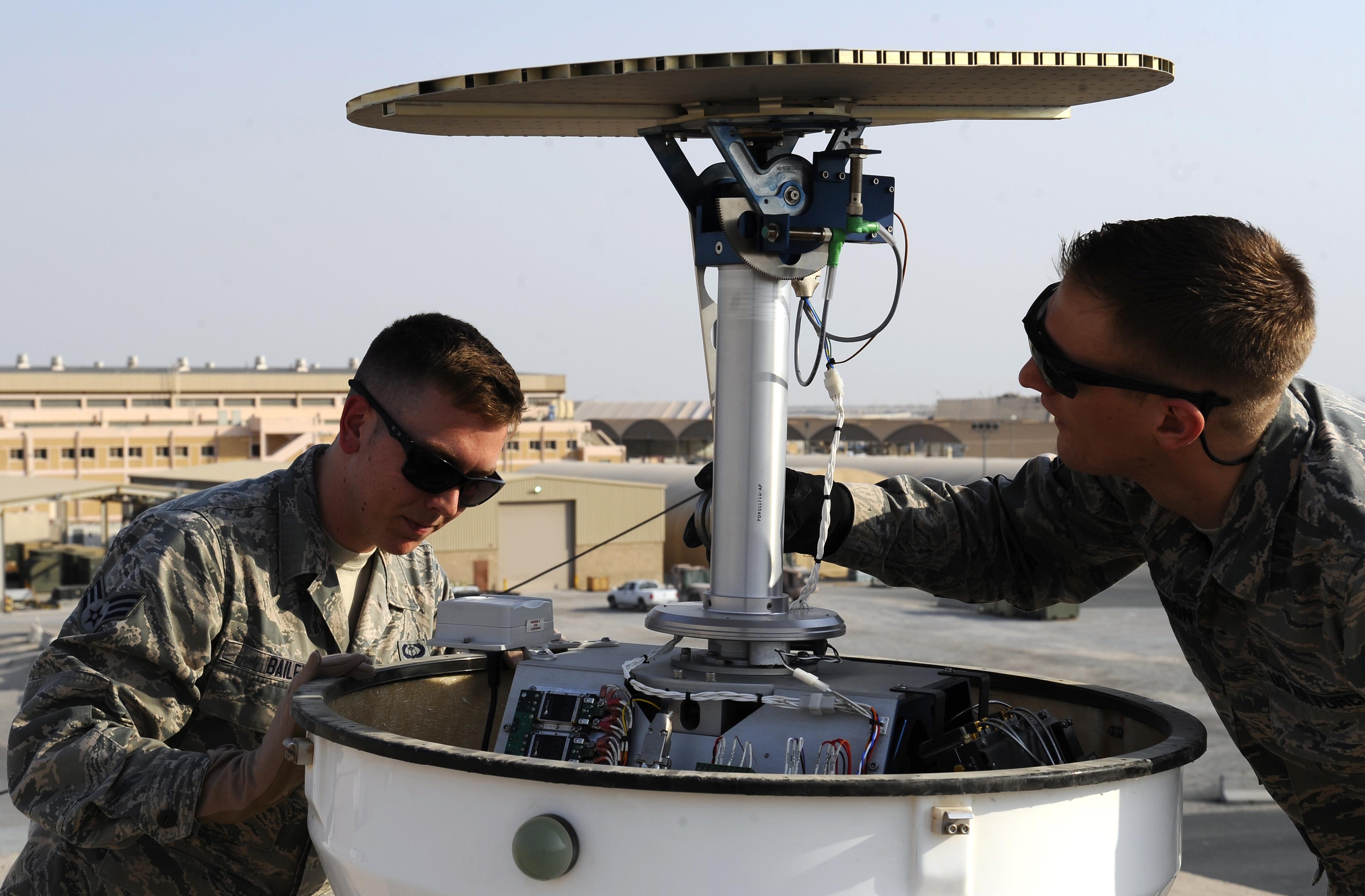
SOUTHWEST ASIA (AFNS) -- It’s a tough job trying to predict Mother Nature and when it comes to weather, everyone’s a critic. Thinking the day holds nothing but sun and your picnic gets rained out can be aggravating. Now try to tell a pilot he can’t fly because the weather patterns shifted. This dilemma is something deployed weather forecasters face every day.

“When we’re talking visibility, you kind of have to be as accurate as you possibly can,” said Senior Airman David Baily, a 386th Expeditionary Operations Support Squadron weather forecaster. “They have limitations on whether they can safely get into an airfield or not. We really try to stay on top of it and kick out the weather observations to keep aircrew updated.”

Deployed in support of Operation Inherent Resolve, members of the 386th EOSS weather team do what they can to keep the aircraft flying. Every hour they step outside to collect weather data through observation. Their equipment collects air speed, pressure and gives them the chance to visually inspect the atmosphere surrounding the flightline. In a sparse region, like Southwest Asia, observation data is gold to a forecaster. With the limited points of terrain around, these forecasters also rely on host nation partnerships to help gather as much information as possible.

The more data they receive, the more accurate their forecasts are. The more accurate their forecasts are the greater chance a flying mission receives the green light. It’s a relationship pilots come to trust and rely on.

“In the Air Force, having an accurate forecast can determine the success or failure of a mission,” said Capt. Benjamin De La Cruz, the 386th Air Expeditionary Wing flight safety officer in charge. “In the C-130 (Hercules) community, it not only plays a major part in the beginning stages in mission planning, but also during airdrops, tactical missions and max effort landings. It is also the leading cause of many aviation mishaps or is a contributing factor.”

Changing weather isn’t the only challenge these Airmen face. Forecasters trust in experience, but deployments usually last only six months. At their home station they have years to learn the ins and outs of a region. When the winds change, forecasters can look back over their time and realize these changing winds signal a storm and plan accordingly. To mitigate this in a deployed environment, forecasters learn to trust their observations and higher headquarters.

“The biggest thing in weather is experience,” said Staff Sgt. Gregory Everson, a 386th EOSS weather forecaster. “We are overseen by 28th Operational Weather Squadron at Shaw (Air Force Base, South Carolina), and they rely on us and we rely on them. They have the subject matter experts and the continuity and we can reach back if we need to.”

Despite the challenges faced, these forecasters feel what they are providing to the base, and the pilots, are helping the Air Force play a vital role in Operation Inherent Resolve.

“Depending on what the weather is, it could change an entire base’s day. There’s a lot of pressure but the people we work with trust us to do our job and do it correctly,” Bailey said.

Continuously training with Coalition partners key to success

by Capt. Gerald Underwood
USAFE-AFAFRICA


10/19/2015 - LOS LLANOS AIR BASE, Spain -- The commander of 3rd Air Force and 17th Expeditionary Air Force at USAFE-AFAFRICA visited the participants of the Tactical Leadership Programme's 15-3 Flying Course on Sept. 24, in Albacete, Spain.

During his visit, Lt. Gen. Timothy Ray stressed the importance of continuously training as a coalition in order to meet future security challenges. Nearly 80 pilots, crew, and staff from 12 nations gathered to hear Ray speak, and he thanked them for their commitment to building partnership capacity.

"Working well together is an integral part of our shared security," Ray said. "In NATO, we have the benefit of strong national friendships, and programs like TLP build on those bonds to improve Composite Air Operations."

The purpose of the TLP program is to increase the effectiveness of Allied Air Forces by training side-by-side, and is one of the many ways the Air Force works with its NATO allies to face security challenges as a unified force.

Ray also discussed the multi-faceted nature of operations in Africa. "What we do in Africa has to be flexible. It's not one issue but a series of challenges that require a different approach to each one," Ray stressed. "Our French allies have been doing some great work along with several other countries, and we need to continue those efforts and be able to adapt to changing situations."

Ray was updated on operations, academics, and the future of the program by Col. Antonio Bernal Fuentes, TSP commandant, Col. Cloyce Adams, Warrior Preparation commander, and Lt. Col. Ethan Myers, Detachment 1 commander.

Earlier in his visit, Lt. Gen. Ray coined TSgt LaBrake, SSgt Rivera, and SSgt Clark for their contributions to their units.

Dirt Boys set foundation for OIR recovery mission in Turkey

by Airman 1st Class Cory W. Bush
39th Air Base Wing Public Affairs


10/13/2015 - DIYARBAKIR AIR BASE, Turkey  -- Eight 'Dirt Boys' from the 435th Construction Training Squadron and 786th Civil Engineer Squadron deployed to Diyarbakir Air Base, Turkey, Aug. 12, 2015, in support of Operation Inherent Resolve.

The team's sole mission for deploying to the Turkish installation is to build a bare base to support Airmen and assets that will conduct personnel recovery operations in Syria and Iraq. Over the past 36 days, the Airmen have dumped, graded, leveled and rolled more than 78,000 tons of rocks and gravel.

"Everything starts and ends with the foundation," said Staff Sgt. Jack DeMato, 435th CTS pavements and construction equipment operator. "You have to have a solid foundation to build a base. We started right away so that the other Airmen could build the facilities that the follow-on forces will being using throughout their deployments."

For DeMato, the type of work he is doing in Diyarbakir is what he practices and teaches on a daily base at his home station.

"The majority of the dirt boys deployed here are from the training flight where we actually teach bare base construction planning and layout to other Airmen," DeMato said. "What we're doing here today is practicing what we preach."

DeMato also mentioned that the project is special to him.

"I have a great sense of pride in the work I am doing here," Demato said. "This is the largest sized project I have ever been a part of. To be able to look back and see where it all began as a grassy field with a few trees to where it is now, really makes this mission special to me."

According to Demato, the biggest challenge the team has faced throughout their deployment to Diyarbakir is unseen objects below the surface.

"This area was filled with massive boulders, which made it a tad bit more difficult to flatten everything out. But, it wasn't a showstopper," DeMato said. "Whether we have to do it by hand or heavy machinery, dirt boys are going to get it done one way or another."

Since arriving, the dirt boys have worked approximately12 to 15 hour days to build up and ensure mission readiness of the deployment site. According to DeMato, it's the Airmen he works with every day and 'not stopping till the job is done' mentality that gets him through the long hour days.

"I came here with some really hard working guys," Demato said. "We haven't stopped working since we got here and they still have a smile on their face. There is the big goal of going home in the end, which is a driving factor to keep going, but for me it's the 'cradle to the grave', finished product I want to see to be able to hand over to the next Airmen deployed here."

NATO partners break the ice, builds partnerships

by Andrea Jenkins
23rd Wing Public Affairs


10/13/2015 - AMARI AIR BASE, Estonia  -- Nearly 300 U.S. Air Force Airmen from the 74th Expeditionary Fighter Squadron gathered with Estonian and German air force members during an icebreaker event at Amari Air Base, Estonia, Oct. 1, 2015.

Hosted by Estonian air force leadership, the icebreaker event was designed to bring the deployed Airmen together with the NATO allies they will spend the next several months working alongside to build relationships and further develop interoperability.

"The event is a great way to start to the deployment," said U.S. Air Force Master Sgt. Joe Gully, 74th EFS first sergeant. "I think it will help not only our Airmen, but our NATO partners, get to know each other. This event let us meet the allies whom we'll be working alongside during this deployment, start building more effective relationships and camaraderie and increase interoperability."

U.S. Air Force and Estonian air force leadership agree the benefits of events like these are endless and build relationships.

"The importance of an event like this is for people to get to know each other," said Chief Master Sgt. Janis Jallai, Estonian air force command chief. "Estonians are shy people but events like these allow us to loosen up and get talking more."

The event allowed the NATO allies a chance to take a break from work and interact with each other in an informal setting.

"Usually we are sitting in one corner sitting quietly around ourselves and this icebreaker is an opportunity to interact with you guys and get to know your culture better than what we are used to," said Estonian air force Maj. Hardi Lammergas, air surveillance wing commander. "It's a great opportunity that (allows us) to get to know each other as allies."

"We are such close allies," added Lammergas. "It is a great opportunity for (the U.S. Airmen) to get to come over here, get to know the Estonian people and our culture. It's one thing to study things on paper and another thing to come and meet face-to-face with each other, see the landscape and work closely together."

Ogden ALC repairs firefighting C-130 after emergency landing

by Bill Orndorff
Ogden Air Logistics Complex


10/16/2015 - HILL AIR FORCE BASE, Utah -- The 572nd Aircraft Maintenance Squadron, like other squadrons within the Ogden Air Logistics Complex, sometimes does "drop-in" work on C-130 Hercules aircraft, adding them into its repair schedule where possible.

On Oct. 7, 2015, the unit did a final flight check on a C-130 that literally dropped in a year before -- that is, made an emergency landing on the Hill Air Force Base runway with its nose gear stuck in the wheel well -- and remained here for repairs.

It all started on Aug. 17, 2014, when the crew of aircraft 92-1533, a Modular Airborne Fire Fighting System C-130, belonging to the Wyoming Air National Guard, discovered its nose landing gear wouldn't extend.

"It wasn't scheduled to land at Hill," said Jack Clay, 572nd aircraft lead mechanic, one of the 30-plus people who worked on the plane. "They were working on a firefighting assignment when the emergency occurred. I'm amazed at how the pilot handled the airplane."

With fire department and emergency crews standing by, the aircraft landed in a bed of fire-retardant foam around 1 p.m. No one was injured and the runway wasn't damaged.

"The pilot made a smooth landing," recalled William Ferrell, a C-130 crew chief and a member of the Crash Damage, Disabled and Recovery Team. "The only damage was to the underside of the aircraft."

Ferrell and eight others used a crane to lift the front of the aircraft, tow it to a maintenance area and secure it with an emergency nose landing gear extension, a process that took a little more than four hours, which minimized the time the runway was closed.

Following a five-month investigation into the cause, it was determined that a broken support rod for the landing gear uplock actuator caused the failure. This damage eventually led to a fleet-wide inspection and resulted in identifying several other defective rods in the C-130 fleet.

Repairs included replacing the landing gear, floorboards and rails, and the sheet metal crews had to rebuild several parts of the 23-year-old airplane including its exterior skin. The entire forward belly section of the aircraft had to be rebuilt, Clay said.

"The heat generated by the landing melted the wiring harnesses in the belly of the aircraft, so our electricians had to completely rebuild and replace them," Clay added. "It was a big team effort within the 572nd."

A 35-member crew of sheet metal mechanics, general aircraft mechanics, electricians, planners, structural engineers, crash damage recovery experts, supply chain management, material expeditors, and representatives from Defense Logistics Agency Aviation and Lockheed Martin Corp. helped get the aircraft flying again.

"We followed the AFSC Leadership Model to rebuild and successfully return the aircraft to the customer," said David Mann, 572 AMXS squadron director. "We all shared a common goal of getting the aircraft back in the fight as soon as possible. Our highly skilled artisans focused on removing constraints from the processes of repairing a crash damaged aircraft by maximizing all the resources available to them throughout Team Hill."

The maintenance team focused on speed, quality, safety and cost effectiveness.

"Through the efforts of the logisticians and maintainers the aircraft was completed in a timely manner, under budget and was built utilizing the highest quality standards," Mann said. "In fact, all systems checked 'good' on the very first functional check flight. It truly was a remarkable performance by the entire team!"

The C-130 was returned to its unit, the 153rd Airlift Wing, Wyoming ANG, on Oct. 13. The MAFFS 3 air tanker is used for water and fire retardant bombing of fires throughout the United States, according to a 153rd fact sheet.

U.S. and ROK Submarine Forces Bolster Alliance


By Mass Communication Specialist 2nd Class Brian G. Reynolds, Commander Submarine Group 7 Deputy Public Affairs

YOKOSUKA, Japan (NNS) -- Commander, Submarine Group (COMSUBGRU) 7 conducted bilateral talks with the Republic of Korea Navy (ROKN) Oct. 12-13 at Jinhae, Korea.

The 42nd Submarine Warfare Committee Meeting (SWCM) brought together representatives from the U.S. and ROK navies.

Rear Adm. William R. Merz, commander, Submarine Group 7, met with Rear Adm. Youn Jeong Sang, commander, Submarine Force (CSF) (ROKN) to discuss planning combined exercises, training and continued development of integrated anti-submarine warfare plans.

"This provided an excellent opportunity to bolster the alliance between the U.S. submarine force and our Korean counterparts," said Merz. "I am confident that staff talks like these reinforce our partnership in ensuring peace and stability in the region."

At the conclusion of the conference, a formal agreement was signed between COMSUBGRU 7 and CSF, reaffirming the longstanding relationship and pledging continuing support between the two submarine forces.

Established in 1994 during the birth of the ROKN submarine fleet, the conference has evolved into a discussion between U.S. and ROKN submarine forces focused on submarine tactics, force integration and future submarine development.

Monday, October 19, 2015

Trilateral Air Defense Exercise Launches Malabar 2015


By Mass Communication Specialist 2nd Class Danica M. Sirmans, USS Theodore Roosevelt (CVN 71) Public Affairs

BAY OF BENGAL (NNS) -- Naval forces and liaisons from India, Japan and United States begin Exercise Malabar 2015, Oct. 16, through air defense collaboration.

The featured cooperation consists of aircraft carrier USS Theodore Roosevelt (CVN 71), Carrier Airwing (CVW) 1, Ticonderoga-class guided-missile cruiser USS Normandy (CG 60) and Indian frigate INS Shivalik (F 47).

Exercise Malabar is an annual event designed to enhance naval cooperation through engagement with India and Japan while demonstrating U.S. Naval presence in the Indo-Asia region.

"We launched aircraft from TR to simulate scenarios to exercise the Indian's self-defense," said Lt. Sean McDonnell, Normandy's air defense officer. "[It] supports the overall Malabar exercise by sharing how we control aircraft and learning how the Indian navy controls their aircraft. We're up on the same voice circuit, so it's a nice opportunity to collaborate and compare and contrast our procedures. We've sent liaison officers to the Indian vessels and welcomed their officers aboard our vessels as well to observe and learn."

McDonnell embarked TR as a liaison officer to the Normandy to help facilitate the coordination.

"My captain's responsibility is air defense of the strike group," he said. "I pass along the word from the strike group to help coordinate between the needs of the strike group and that of my commanding officer."

Capt. Scott Robertson, Normandy's commanding officer, welcomed liaison officers from both Malabar participants aboard and was pleased with the collaboration so far.

"I've been very impressed by the professionalism and maritime skill of our Indian and Japanese navy partners, and the Normandy crew is enjoying this unique opportunity," said Robertson. "The [air defense portion] kicked off a great first underway day for the Malabar exercise. The purpose of this particular [exercise] was to build familiarity and appreciation for the capabilities each of the participating navies brings to the modern air defense environment with a special emphasis on control of fighter aircraft."

The exercise allowed for hand-in-hand, shared communication to learn from each other.

"... As overall observers to manage the exercise ...," said Normandy's Senior Chief Fire Controlman Jeremiah Lawrence. "... we learned a lot about the willingness to learn from our partner nations and they performed excellently under the guidance of the tasking at hand."

Planning for the exercise began long before any of the partners embarked to the other's vessels. Lt. Cmdr. Erin Ceschini, Carrier Strike Group 12's future plans and staff meteorological and oceanographic officer, started coordination in July via video teleconferencing.

"We've got a lot of different events planned," said Ceschini, "We have air defense exercises, search and rescue, anti-submarine warfare events with Indian and U.S. submarines, along with a dry hook up with an Indian oiler and a war-at-sea exercise.

"This exercise is a big deal to the Indian, Japanese and U.S. navies," said Ceschini. "We are three democratic countries that are working together to strengthen our military relationships as well as the relationships between our nations. The success of these exercises is important especially considering the effort, planning and resources put into this exercise for these great navies to work together."

Malabar is a continuing series of complex, high-end war fighting exercises conducted to advance multi-national maritime relationships and mutual security. It will include collaboration between Theodore Roosevelt, Normandy, Freedom-class littoral combat ship USS Fort Worth (LCS 3), Los Angeles-class submarine USS City of Corpus Christi (SSN 705), Japanese Maritime Self-Defense Force Akizuki-class destroyer JS Fuyuzuki (DD 118), Indian Navy Deepak-class fleet tanker INS Shakti (A 57), Brahmaputra-class guided missile frigate INS Betwa (F 39), Rajput-class destroyer INS Ravijay (D 55), Sindhughosh-class diesel-electric submarine INS Sindhuraj (S 57) and INS Shivalik.

Theodore Roosevelt is operating in the U.S. 7th Fleet area of operations as part of a worldwide deployment en route to its new homeport in San Diego to complete a three-carrier homeport shift.

CSAF civic leaders visit SMC, Aerospace Corporation's STARS facility

By James Spellman, Jr.
Space and Missile Systems Center Public Affairs

10/16/2015 - LOS ANGELES AIR FORCE BASE, El Segundo, Calif.  -- Members of the Air Force Chief of Staff Civic Leader Program visited the Space and Missile Systems Center's Schriever Space Complex and neighboring Aerospace Corporation Tuesday afternoon to learn about the SMC mission and operations of Air Force Space Command.

Lt. Gen. Samuel Greaves, SMC commander and Air Force Program Executive Officer for Space, Tom Fitzgerald, SMC acting executive director and Col. Donna Turner, commander of the 61st Air Base Group hosted the Honorable Mike Gin, former mayor of Redondo Beach, Rhoda Weiss, a marketing consultant and Michael Jackson, chairman of the South Bay Association of Chambers of Commerce during their four-hour immersion. The visit included a brief stop in the SMC courtyard of the Schriever Space Complex to observe the Combined Federal Campaign kickoff event.

Gin and Weiss are members of the CSAF Civic Leader Program.

Air Force Civic Leaders serve as a civilian interface between the Air Force and the civilian community. In this role, they explain and interpret Air Force programs, positions, and problems to other key, local communicators through personal contact and correspondence, and to the general public through statements, appearances and speeches.

"It's always a pleasure and a privilege to tell the SMC story to our civic leaders," said Greaves. "We have active duty, reserves, civilians, federally-funded research and development center personnel, our sister services and liaisons from our coalition partners that are all part of this team effort. I know our civic leaders are floored when they see the 'Big Picture' here on such a small installation."

After viewing a 60th anniversary video and receiving mission overview briefings on SMC and the 61st ABG by Greaves and Turner, discussion turned to potential engagement between SBACC and SMC on an Air Force community partnership program that could lead to additional, affordable housing for single Airmen residing within the Redondo Beach area.

A "roof top" tour of the Schriever Space Complex and Los Angeles AFB followed before the group was escorted across El Segundo Blvd. to the neighboring STARS facility at The Aerospace Corporation.

Tom Warner, Aerospace Corporation director of external communications presented the CSAF civic leaders with an overview of the federally funded research and development center, with emphasis on space security and up-front capabilities of the Spacelift Telemetry Acquisition and Reporting System. Looking much like NASA's mission control center, the STARS facility is the center of action for launch operations supported by Aerospace.

During a typical launch, Aerospace analysts are on console in the STARS facility supporting SMC and AFSPC. The STARS facility processes the transmitted data which gives these analysts the ability to monitor the health of the vehicle and assist in anomaly resolution.

"The mission of Air Force Space Command, SMC and the Aerospace Corporation is a critical part of our nation's defense," said Weiss, one of the CSAF civic leaders. "I'm impressed by their roles in developing and acquiring space-based support for all of our service members. The hard work and ingenuity of these Airmen, civil servants and partners from throughout the greater Los Angeles metropolitan area and neighboring counties is something we should all be grateful for."

The CSAF Civic Leader Program's membership is composed of respected community leaders nominated by the Air Force major commands, the National Guard Bureau and Headquarters Air Force. These civic leaders are unpaid advisors, key communicators and advocates for Air Force issues. They provide ideas and feedback to advise the Secretary of the Air Force, Air Force Chief of Staff, and Air Force senior leaders about how missions can best be accomplished in their respective areas and about public attitudes toward the Air Force and Air Force activities in their areas.