Monday, August 24, 2015

Secretary of the Navy Ray Mabus Names Virginia-Class Submarine


Secretary of the Navy Ray Mabus hosted a ship-naming ceremony Aug. 22 in Boise, Idaho to announce that SSN 799, a Virginia-class attack submarine, will bear the name USS Idaho.
           
The submarine will be named to honor the history its namesake state has with the Navy.  Idaho is home to the former Farragut Naval Training Station, which was the second largest training facility in the world during World War II. From the early 1950s to the mid-1990s, the Naval Reactors Facility (NRF) located within the Idaho National Laboratory, trained nearly 40,000 Navy personnel in surface and submarine nuclear power plant operations with three nuclear propulsion prototypes including the first nuclear-powered submarine prototype, S1W.  The facility continues to support the Navy by examining Naval spent nuclear fuel and irradiated test specimens, which are used to develop new technology and to improve the cost-effectiveness of existing designs.  And nearby, Lake Pend Oreille, the fifth deepest lake in the United States, continues to conduct tests of large-scale submarine and surface ship prototypes in a setting with acoustic properties similar to that of the ocean.

The future USS Idaho will be the fifth naval vessel to bear the name. The first, commissioned in 1864, was a steam sloop that served as a store and hospital ship; the second, commissioned in 1905, was a battleship that largely supported American Foreign Policy in Central America and conducted operations and exercises in Guantanamo Bay. The third Idaho was a motorboat commissioned in 1917 that patrolled New Jersey and Pennsylvania harbors. The last Idaho was a New Mexico-class battleship launched on June 30, 1917 and saw action in World War II.

Virginia-class attack submarines provide the Navy with the capabilities required to maintain the nation's undersea supremacy well into the 21st century. They have enhanced stealth, sophisticated surveillance capabilities and special warfare enhancements that will enable them to meet the Navy's multi-mission requirements.

These submarines have the capability to attack targets ashore with highly accurate Tomahawk cruise missiles and conduct covert, long-term surveillance of land areas, littoral waters or other sea-based forces. Other missions include anti-submarine and anti-ship warfare; mine delivery and minefield mapping. They are also designed for special forces delivery and support.

Each Virginia-class submarine is 7,800-tons and 377 feet in length, has a beam of 34 feet, and can operate at more than 25 knots submerged. They are designed with a reactor plant that will not require refueling during the planned life of the ship, reducing lifecycle costs while increasing underway time. The submarine will be built under a unique teaming agreement between General Dynamics Electric Boat (GDEB) and Huntington Ingalls Industries-Newport News Shipbuilding (HII-NNS) wherein both companies build certain portions of each submarine and then alternate deliveries. Idaho will be delivered by GDEB located in Groton, Connecticut.

Reserve pilots drop JDAMs from upgraded F-22s

by Maj. Ashley Conner
477th Fighter Group Public Affairs


8/24/2015 - JOINT BASE ELMENDORF RICHARDSON, Alaska  -- During a recent Unit Training Assembly weekend Alaska Reserve pilots from the 302nd Fighter Squadron dropped Joint Direct Attack Munitions from F-22s equipped with increment 3.2A, a software upgrade package.

"Performing this mission on a UTA is critical to readiness because it allows our unit to practice actual weapons build, loading, pre-flight, and employment," said Col. David Piffarerio, 477th Fighter Group commander. "In addition, this validates the maintainers, aircraft and pilots are ready to employ downrange with the new increment 3.2A capability."

The 422nd Test and Evaluation Squadron, based out of Nellis AFB, Nev., validated the software upgrades, which add electronic protection against jamming, better Link 16 receive capability and combat identification among other improvements, before it was added to the operational F-22s.

Dropping air to ground ordinance is not only good training for the pilots but also for active duty and Reserve Airmen from the 3rd and 477th Munitions flights, who build the bombs, and the 477th Aircraft Maintenance Squadron, who load the bombs on the jets allowing for the entire Arctic Warrior team to receive valuable training.

"This training is important because it provides our traditional Reservists with the opportunity to perform their respective functions in a realistic environment," said Master Sgt. Timothy Tuttle, 477th AMXS, Weapons Section Flight chief. "It is especially valuable training for weapons loaders to load munitions in a setting other than the Weapons Load Training facility. There is always a sense of pride when you are able to load munitions onto an aircraft and the aircraft returns home having expended its weapons, because you know that you performed your job correctly and directly impacted the mission."

During the UTA the Reserve pilots successfully dropped all seven JDAMs over the Joint Pacific Alaska Range Complex, a 2,490 square mile range equipped with live emitters and targets which create a realistic training environment.

"Every operations and maintenance Airman is critical to this mission," said Piffarerio. "Our cadre of experienced F-22 pilots validated this new capability and in turn passed along lessons learned to our active duty counterparts. The 3rd Wing and 477th FG are integrated in every aspect of F-22 operations and maintenance and is critical to our combat readiness."

Saturday, August 22, 2015

Defense Officials Praise Troops' Actions in Train Attack


WASHINGTON, August 22, 2015 — In a statement released today, Defense Secretary Ash Carter praised three Americans for their actions yesterday on a train outside of Brussels, Belgium.

"On behalf of all the men and women of the Department of Defense, I want to thank the brave individuals, including two members of the U.S. military, who stepped forward to prevent an even greater tragedy from taking place aboard that train," Carter said.

U.S. Air Force Airman 1st Class Spencer Stone, assigned to the 65th Air Base Group, Lajes Air Base, Azores, Oregon Army National Guard Spc. Alek Skarlatos and a civilian friend were traveling together via train on personal leave. The men took immediate action to subdue an armed gunman before he could engage his automatic weapon on the train.

"My thoughts and prayers today are with those injured in the attack, including Airman 1st Class Spencer Stone, whose selfless actions saved lives. I wish him a speedy recovery," the defense secretary said.

"These men are heroes," said U.S. European Command Commander Air Force Gen. Philip M. Breedlove.

"Actions like this clearly illustrate the courage and commitment our young men and women have all the time, whether they are on duty or on leave," he said. "We are extremely proud of their efforts and now are praying for our injured airman to have a speedy recovery."

Stone, who suffered non-life threatening injuries in the attack, is currently being treated in a French medical facility.

"(Stone and Skarlatos) are two reasons why -- on duty and off -- ours is finest fighting force the world has ever known," Carter said.

Commander, U.S. Air Forces in Europe, Air Forces Africa, commends actions of Americans in French train incident

8/22/2015 - RAMSTEIN AIR BASE, Germany -- General Frank Gorenc, U.S. Air Forces in Europe and Air Forces Africa commander, shared his praise for the three Americans who took heroic measures on a train by stopping a gunman before he could engage his automatic weapon.

"I continue to learn more about the heroic actions of three brave young men on a train headed from Amsterdam to Paris. As an Airman, I also feel a sense of deep pride in the selfless response shown by all three; Airman 1st Class Spencer Stone and his friends, Oregon Guardsman Specialist Alek Skarlatos and Mr. Anthony Sadler. All three courageously stepped into a dangerous situation, and their gallant actions saved the lives of countless innocent civilians from the hands of an armed assailant. I am deeply thankful these men took action and averted tragedy, and I wish a speedy recovery to all those who were impacted by this event."

Chairman, Korean Counterpart Discuss U.S.-Korea Defense Commitment


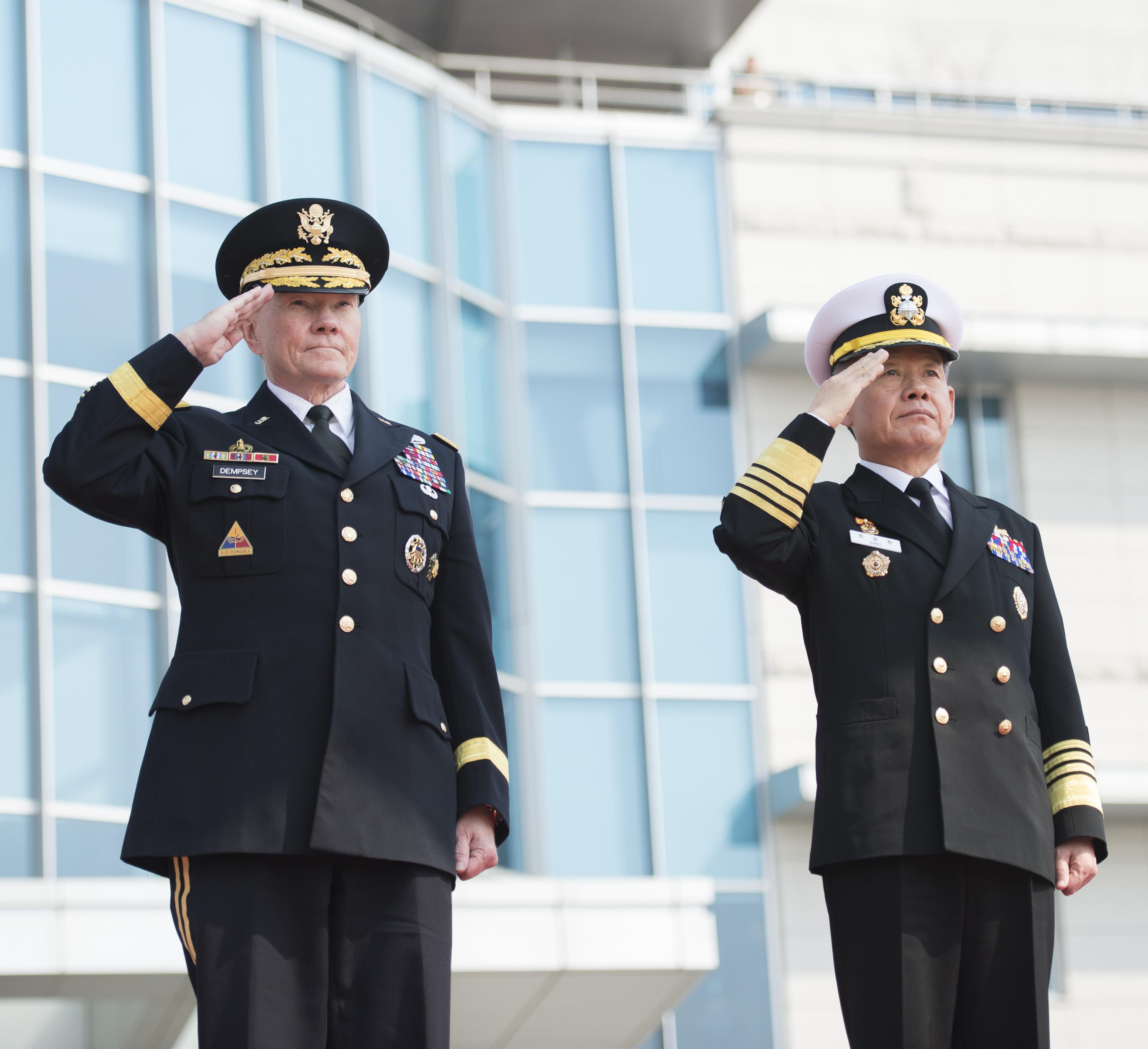
WASHINGTON, August 22, 2015 — Army Gen. Martin E. Dempsey, the chairman of the Joint Chiefs of Staff, called his Korean counterpart yesterday to discuss the unwavering commitment of the United States to Korea’s defense, according to a readout of the call released today.

Dempsey also reiterated the strength of the U.S.-Korea alliance, Navy Capt. Greg Hicks, joint staff public affairs officer, said in the readout.

The two leaders “concurred they would watch North Korea's actions closely in the coming days,” Hicks said, “and would ensure that the U.S. and ROK continue to work closely with one another to deter further North Korean provocations and defuse tensions.”

A-10s deploy to Estonia

U.S. Air Forces in Europe and Air Forces Africa

8/22/2015 - RAMSTEIN AIR BASE, Germany  -- Eight U.S. Air Force A-10 Thunderbolt IIs and approximately 170 Airmen deployed to Ämari Air Base, Estonia, as part of a flying training deployment in support of Operation Atlantic Resolve.

Operation Atlantic Resolve is a demonstration of our continued commitment to the collective security of NATO and dedication to the enduring peace and stability in the region.

Aircraft and Airmen from the 303d Fighter Squadron, 442d Fighter Wing, Whiteman AFB, Missouri, arrived in Estonia, 22 Aug. These reservists, along with guardsmen from three Air National Guard units, will train with their Estonian counterparts for three weeks. During this deployment, they will also participate in simultaneous but unrelated training with Finnish air forces.

All of the training will focus on maintaining joint readiness while building interoperability capabilities and demonstrating the shared commitment of the U.S. to a safe and secure Eastern Europe.

The training will include some low-level flying designed to help maintain joint readiness and strengthen our relationships within the North Atlantic Treaty Organization.