Sept. 14, 2020
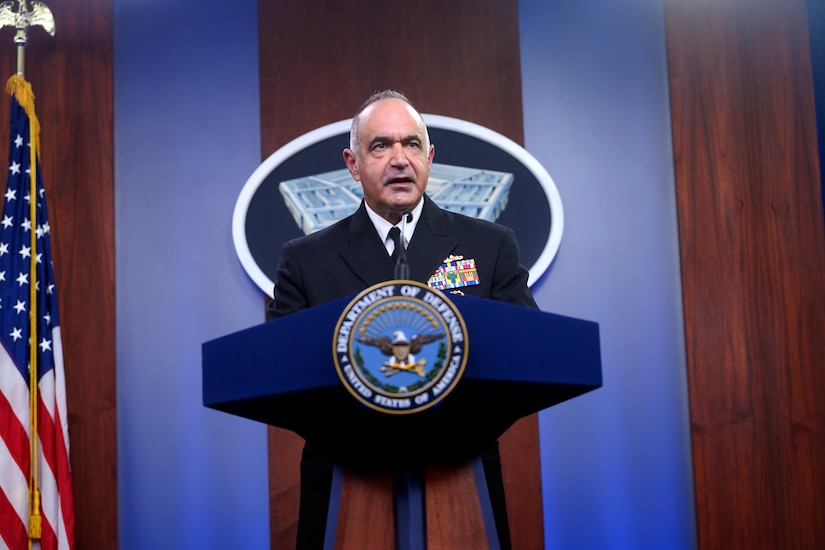
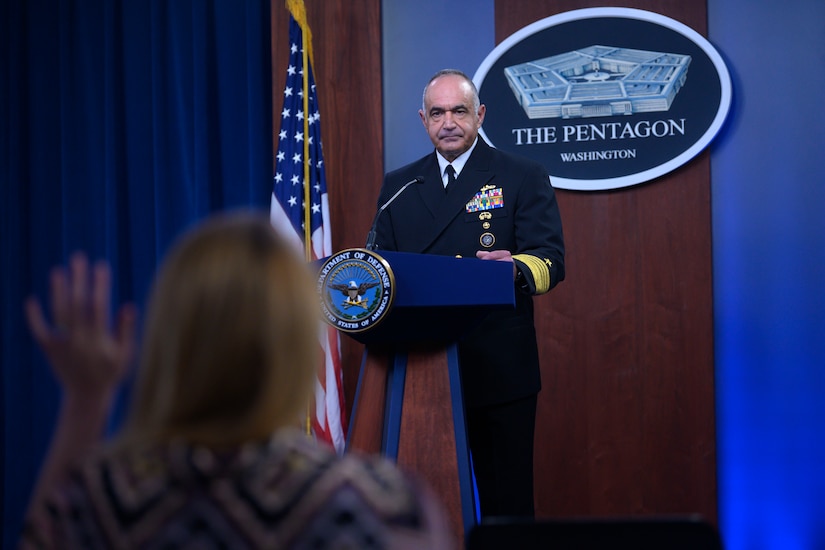
Adm. Charles A. "Chas" Richard, commander, U.S. Strategic Command
STAFF: With us today is Admiral Chas Richard from
U.S. Strategic Command. He'll be speaking about his mission set and the
COVID virus. This is on the record.
And with that, sir, over to you.
ADMIRAL CHARLES A. "CHAS" RICHARD: Right. So good morning, everyone,
and – I’ll go ahead, I think I'm properly socially distanced here. The
-- it is -- for those of you that don't know me, I'm Admiral Chas
Richard. I'm the commander of U.S. Strategic Command, and I have the
privilege of leading 150,000 soldiers, sailors, airmen, Marines,
civilians.
It's actually nice to see everybody's faces this time. Last time I
had a chance to talk to you all, I was on a phone bridge. In fact, we
didn't realize it was on television. And so it is, I think, a much
better opportunity when I can actually see you.
I appreciate taking some time to have a conversation this morning.
Before we get to the questions, though, let me offer you a few updates
on how we're doing inside U.S. Strategic Command.
First, I'm very pleased to report that throughout the challenge that
was presented to us by COVID-19, U.S. Strategic Command has and
continues to be fully mission capable. And I'd like to thank my
department's leadership in terms of giving us authorities, resources,
and understanding of what we were up against. And that was a key in
terms of our ability to be able to respond to this unprecedented threat.
The conditions in Omaha are favorable. We're adjusting workforce
inside the new LeMay Command and Control Facility to adapt to local
conditions. I'm at about 75 percent throttle with the rest on telework,
and we're ready to go up or down as conditions dictate.
Very pleased with my component commanders, Admiral Chris Grady,
General Tom Ray and -- or Tim Ray, and Dan Karbler at SMDC for the Army,
who provided great leadership to adapt to their local conditions and
maintain all their forces fully mission-capable.
Bottom line here is we're ready. And why is that important? I think
it's important for us to remember that throughout this challenge of
COVID-19, no threats went away, right? Nothing else changed, no one gave
up a single nuclear weapon based on the fact of COVID-19. In fact, it's
going in the other direction.
Our competitors have continued to develop both nonstrategic and
strategic capabilities in an effort to outpace us. And we are going into
a very different world. The -- we are on a trajectory for the first
time in our nation's history to face two peer nuclear-capable
competitors who have to be deterred differently, and we're working very
hard to meet that challenge.
I think we all know the threat that Russia poses to us, modernizing
strategic, conventional, space, counter-space, cyber, they're developing
hypersonics, and their gray zone actions. And it's not only what
they're developing, it's what they're doing.
China's similar, right? I think you all have seen the recent China
military report, I think it's an excellent explanation in terms of what
China's overall strategy is, and explains the why behind the things that
we see them doing, particularly in my mission sets. Again, looking to
-- we like talking about the fact that they're going to double their
stockpile by the end of the decade.
I'd ask you to consider that just measuring a nation's stockpile is a
relatively crude measure of their capabilities. You have to look at the
totality of it, the delivery systems, what they're capable of, what
their readiness is. And China in particular is developing a stack of
capabilities that, to my mind, is increasingly inconsistent with a
stated no-first-use policy.
We're ready. I think one visible demonstration of that is the bomber
task force missions that we've been operating worldwide. We're pleased
to be able to support U.S. European Command and Indo-Pacific Command in
providing forces that they use to accomplish our objectives. My I.C.
wings, my SSBN groups are also continuing to mitigate risk from COVID-19
operations, and again they're fully mission-capable.
The -- I'm also pleased to report that the department has made
tremendous progress in its nuclear command and control capabilities. It
was a wise decision to establish the NC3 Enterprise Center and we are
moving out and making great strides in making sure that the NC3 systems
that we have will continue to pace the threat. They're certainly fully
mission-capable today, I have absolute confidence in them. And I'm also
pleased that we're going to be able to say that going into the future.
We do see future NC3 fitting hand-in-glove into the broader
department's Command and Control JADC2, if you will, framework. And we
are able to present to the secretary and the chairman an overall view of
their NC3 in a way we haven't been able to do in many years.
So bottom line here, as I close and get ready for some questions,
we're ready but we'll continue to have to work to maintain our -- in a
world with changing threats on us. I'm very proud of the men and women
of U.S. Strategic Command.
And I want to leave you with one last thought. The way we have put
the strategic forces and capabilities of this nation together from day
one, we were always very humble in our ability to anticipate threats --
we always built in margin, we always built in hedge, not only for the
risks that we could foresee but the risks that we might not be able to
foresee.
And so a big piece of why I can stand in front of you and tell you
that we're fully mission capable is because of wise decisions made by my
predecessors to give me capability, flexibility and everything I needed
to be able to respond to the thing that we didn't see coming, and
that's an important thing I -- I -- an important attribute I think we
need to keep in mind as we think about the recapitalization of these
systems.
And with that, I'd be happy to take questions.
STAFF: Thank you, sir. We'll start on the phone line with Bob Burns.
Q: Thank you. This is -- this is Bob.
Admiral Richard, you mentioned the bomber task force missions of
recent months -- excuse me. There have been a number of incidents lately
that the Russians have characterized much differently -- for example,
just a few days ago, the head of the Russian Air Force was saying that a
number of times in August and September that B-52 bombers have flown
close to Russian borders and that he saw this as both hostile and
provocative action by the United States.
I'm wondering if you could say whether, you know, you have concerns
about the escalation of tensions with Russia, you know, that could lead
to actual conflict? Thank you.
ADM. RICHARD: I -- so, Bob, thank you for the question and it's nice to hear from you again, sir.
I think the bomber task forces are a -- a iconic example of how we're
executing the National Defense Strategy in terms of us being
strategically predictable yet tactically unpredictable.
I'm very pleased in the support that we're providing to the other
combatant commands and I think that they have done a very good job of
showing that the United States is capable of operating anywhere in
international air space and is ready to meet any challenge that is
presented to us.
STAFF: Okay. We'll come back to the room with Barbara with CNN.
Q: Two quick things, if I may.
On COVID, first of all, could you just walk us back to this past
winter when Strategic Command, because it's so critical, really began to
understand -- when did you know the severity of the potential COVID
threat?
But my other question perhaps first is you referenced China and
no-first-use policy. What's your thinking on this? Can you talk about
that a little more? Do you believe that China either is rejecting the
notion of first-use, is moving towards a no-first-use? What's your
assessment of that and what does that mean for the United States?
ADM. RICHARD: So, ma'am, I would start with, as a military commander,
what I look at more is another nation's capabilities, less about what
their stated intentions are, and I see China developing a stack of
capabilities that would be inconsistent with a no-first-use policy. It's
not my place to judge whether they intend to honor that or not.
What I can tell you is -- is that they certainly have the
capabilities to execute any number of deterrent or employment strategies
that are seemingly inconsistent with a -- and a no-first-use policy
really drives you back quickly to a minimum deterrent strategy and it
just looks inconsistent to me and it's my responsibility to make sure
that I have thought through what we have to do to deter what they're
capable of doing as opposed to what they say they're going to do.
Q: So an outright offensive attack is what you're saying?
ADM. RICHARD: No, ma'am, I didn't say anything about offensive
attack. I'm talking about deterring what they're capable of doing.
Q: And on COVID this past winter, when did you -- when did you really
know and told by your people that it was a -- a -- a serious threat?
ADM. RICHARD: Ma'am, we are constantly looking at any number of
threats and we take all of them seriously. That -- you know, it's one
thing -- I believe the Department of Defense has a plan for just about
everything. We had a plan in place for a pandemic infectious disease and
we simply, very early on, December time frame, started looking through
"what if" scenarios and started devising mechanisms, strategies to
address that and that -- that process served us very well.
Q: Okay.
STAFF: Okay, we'll stay here in the room with Lucas from Fox.
Q: Lucas Tomlinson, Fox News.
Admiral, why do you need a low-yield nuclear warhead on your ballistic missile submarines?
ADM. RICHARD: Well, I think the justification for the low-yield
ballistic missile was very well laid out in the Nuclear Posture Review
and then captured inside our National Defense Strategy. In order to
deter, you know, the basic equation of that has not changed over time,
right? For any action that your opponent considers, can you deny an aim
or impose a cost that is considered greater?
And so as we're opening up a possibility -- and this was looked at
basically by the capabilities that were being developed in terms of the
thought that someone might think that a small, limited use of a nuclear
weapon might drive the U.S. into a situation where any response that we
would consider would be considered disproportionate and therefore not
credible.
The low-yield ballistic missile submarine closes that perception and enhances security, enhances deterrence.
Q: Is that the new nuclear warhead that the president was referring to recently?
ADM. RICHARD: The -- again, I -- I think you're referring to
something that is going to come out in this Bob Woodward book, which
I've not seen. In fact, I'm not even sure that it's available to be
seen. So I'm not in a good position to help you address that question.
But I will say, look, as the commander of Strategic Command, I have
any number of classified capabilities, that if you had my
responsibilities to defend the nation, you would find that they're
actually quite useful in that, but beyond that I'm -- I'm not in a
position to -- to really help you with that.
STAFF: Okay, we'll go out to the phone lines to Idrees Ali with Reuters.
Q: Great, thanks, Tom. Two quick questions.
Firstly, in terms of COVID, what's the timeline you're looking at in
terms of when things may go back to -- to the way they were? They -- you
know, is it the end of the year, is it indefinite?
And second question, part of your job is to look at the strategic
force of other countries. So what are you seeing in terms of the missile
forces of Iran and North Korea and the impacts COVID is having on them?
ADM. RICHARD: Well, first, to your -- to your first question in terms
of -- I'm not sure that we're ever going to go back to a -- the way we
were before. There's any number of things that -- as -- we understand
the disease better, the potential for a vaccine. There's a -- any number
of things and so we're very well postured to operate for a long period
of time, indefinitely in this.
But actually we've learned some things along the way that I -- I
don't want to go back on, right? So our ability to operate distributed
and remotely, particularly administratively, has been greatly enhanced.
We have finally crossed the bridge in terms of being able to do some
teleworking.
And in fact, from my -- one small example, my personnel shop, we're
never bringing them all in again. I was telling Congressman Thornberry,
"I'm going to take 70 cars off the entrance to the base in the morning
because we're just more efficient when we operate in a distributed
fashion."
So one, I -- no, I don't think we're going back to the way that we
used to do business before. In some cases, I don't think we want to.
STAFF: Okay. We'll stay on the phone lines and go to Tony Capaccio with Bloomberg.
Q: Hi, sir. I -- I have a quick follow-up to the -- to the earlier question from Lucas.
At some point, will you be able to discuss what weapon the president
was referring to when he told Woodward about this new secret nuclear
weapon? And I have a China follow-up.
ADM. RICHARD: Well, I'd be happy to take the China follow-up.
And again, on a question about the Woodward book, I just should make
-- not really in a good position to help you. I would refer your
question either to the White House or to the Secretary of Defense -- but
would enjoy that China follow-up.
Q: Among their new capabilities, are the Jin-class submarines -- are
those Jin-class submarines now starting strategic patrols near Hawaii?
The China report mentions that their -- their JL-2 missiles could range
the United States but they need to be in western Pacific waters near
Hawaii. Are you seeing that threat emanate?
ADM. RICHARD: Well, what I would offer is to not shoot behind the
duck and I would actually pay more attention to their JL-3 missiles that
they're working on, which give them a greatly expanded range. And
again, I -- I think this is -- I get apprehensive that we are not fully
conscious as a nation of the threats that we face, right? China now has
the capability -- and we can get into the specifics -- to directly
threaten our homeland from a ballistic missile submarine.
That's a pretty watershed moment and that's why, when I come up here
and say that we need to maintain the forces to give us a deterrent
capability against that, why we have to go recapitalize our strategic
triad, why I say that there's no margin left and why that's the most
important mission in the Department of Defense, it is -- you're giving
me a great example of why we have to go do that.
The -- it is -- it -- it's important, I think, to remember I say the
department frequently says that strategic deterrence is most important
mission in the department, it is foundational to everything we do but
maybe a way to operationalize that is, I and my forces set the
conditions necessary for the rest of the Department of Defense to
execute its mission.
If strategic deterrence fails, the complexion and the character of
the competition just changed dramatically and it is in everybody's best
interest for that not to happen. But to do that, I have to have
sufficient force to execute our strategy and you see -- from -- say -- a
great example of what other nations are doing to threaten that.
STAFF: Okay. We'll come back in the room to Lara Seligman, Politico.
Q: Hi, sir. Two questions.
One, I wanted to follow up on Barb's question about the China report,
just to ask you to clarify a little bit more what you mean when you say
you think they are in -- you know, that they have -- are moving forward
the no -- no first use nuclear policy.
I mean, the -- the 200 missile figure that was in that report is a
fraction of the size of the arsenals of both the U.S. and Russia. So I'm
just wondering again what you're basing this -- this conclusion on? And
then I also wanted to ask --
ADM. RICHARD: Well, let me address that first, right?
Again, don't shoot behind the duck, right? It's not where they are,
it's where they're going, right? And when China sets its mind to
something, they are very impressive in their ability to go accomplish
it.
They're -- and you've got to be careful about mirror imaging. They're
not put together the same way that we are. But one of my favorite
examples, and I think I have it here because it -- I want to get the
numbers right -- you know, China just established a Coast Guard in 2013,
right? And again, they've had other forces but they -- they decided
they wanted a Coast Guard and in 2013 -- they have 255 ships today -- or
I'm sorry, 255. In seven years, they go build 255, on -- on top of all
of the other ships they're building. I just think that their strategic
forces are next on their to-do list, right, and I'm trying to posture us
for the threat that we're going to face, not the one that we have
today.
Q: And then on a different subject, I wanted to ask you about the
GBSD contract that was recently awarded from Northrop. Are you concerned
at all about the lack of competition on this contract and what that
means going forward?
ADM. RICHARD: The -- the short answer -- and I -- I do need to
clarify, I'm a combatant commander, so in some respects I'm the customer
for the capability, that your question might be better asked to the Air
Force. That said, I am fully confident in the Air Force's ability to
deliver the requirements and capabilities that I ask for on time, in the
budget that they say that they're going to need.
In fact, I was just out at Hill Air Force Base myself doing some
reviews with both the program manager for GBSD as well as the contractor
that you're talking about, and I have to tell you I walked away very
impressed with the cutting edge ways that the GBSD program is not only
going about accomplishing the acquisition tasks that they've been handed
but actually -- I mean, we talk about it -- you -- you all haven't
gotten to it yet but if you ask me what keeps me up at night, it is our
ability to move fast.
I just gave you an example of how China can move fast and in the end,
we're going to have to move equally as fast in order to pace that
threat. In the end, it is time for us to start getting some of our
bureaucracy out of our way, and I think that is the fundamental thing
that slows us down.
I’d point to the GBSD program as a -- a pathfinder in terms of how to achieve the old standard by a new way.
STAFF: Okay. We'll go back to the phone lines to Sangmin Lee with Radio Free Asia.
Q: Yeah. I have a question on Operation Plan 5027, which is a
military operation plan made by U.S. and South Korea for the defense
against a possible North Korean invasion. Does this plan include the use
of nuclear weapon?
ADM. RICHARD: Well, one, obviously I can't go into any specifics of
any operational plan but what I will say is -- is that we maintain a
very close alliance and partnership with South Korea. Longstanding, it's
formally documented, proud that the United States extends extended
deterrence and assurance commitments to South Korea, which has been
beneficial to both nations, and I'll tell you that whatever the
situation is or whatever OPLAN needs to be considered, my forces will be
ready to support what they'll be asked to do.
STAFF: And we'll stay on the phone lines and go to Jeff Schogol with Task & Purpose.
Q: -- deterrence threats against North Korea after a five B-52s deployed in Guam from U.S. homeland?
ADM. RICHARD: Oh, I'm sorry, sir, I don't think I understood the question.
Q: Okay. Is there any change in nuclear deterrence strategy against
North Korea ever since B-52 deployed in Guam or returned to U.S.
homeland?
ADM. RICHARD: Well, I -- I go back to I think the decision to employ
dynamic force employment, which I think is what you're referring to as
opposed to a continuous bomber presence on Guam, has actually enhanced
deterrence by being strategically predictable, tactically unpredictable.
It has given us a good opportunity to improve both short term and
long term readiness and is a great example of the wisdom in the way that
the National Defense Strategy has been put together.
STAFF: Okay, now we'll go to the phone line to Jeff Schogol, Task and Purpose?
Q: Thank you.
Admiral, I have a question about the W76-2. Is it STRATCOM's belief
that if the United States explodes a low-yield nuclear weapon over
Russia or China, that Russia or China will not retaliate with strategic
weapons?
ADM. RICHARD: Well, the first part is, is remember that the whole
idea is to prevent any of that from happening in the first place. The
mission is deterrence, and it's sometimes a hard thing to wrap your head
around, that in my mission set, victory looks like nothing happened,
right? And we have been successful in that inside of -- for over 70
years.
And so where I think the particular value is, is the deterrent effect
that the 76-2 provides, to see to it that we never go down the path
that you're describing to begin with.
Q: My question is, can you limit a nuclear exchange to tactical weapons or is there no such thing as tactical nuclear weapons?
ADM. RICHARD: Sir, you're asking one of the greatest unanswered
questions in military theory -- deterrence theory -- of all time, right?
The answer is nobody knows if that's the case. But I do think it's an
obligation for the United States to do everything in its power should a
nuclear weapon be used by somebody else to stop the exchange as soon as
possible, to limit damage to the U.S. to the maximum extent possible,
and to end it on terms favorable to the United States.
The short answer to your question is, is that nobody knows.
Fortunately we don't have any real-world experience in that, and I would
just as soon keep it that way.
STAFF: We'll come back in the room to Lucas?
Q: Admiral, the Pentagon recently stood up a UFO task force. Has that
given you something that you have to plan for as the head of America's
strategic arsenal?
ADM. RICHARD: I -- Lucas, I can't go into a lot of detail on any
number of things that we're working on. I'll just offer that Strategic
Command looks at a wide range of threats. In fact, I've probably let
this conversation get too narrowly focused on nuclear capabilities,
right?
I think the 2000 -- the last NPR wisely acknowledged that you can
have a strategic attack that is non-nuclear in nature. That is something
that has changed in the current environment. So we're looking at any
number of threats, not just nuclear, to make sure we understand them,
understand what might happen to us, and do we have a strategy in place,
tailored to deter that?
Q: And that includes UFOs?
ADM. RICHARD: That includes any number of threats.
STAFF: We'll go to Kris Anderson.
Q: AWPS News. So, New York Times has an article this morning about
the risk -- legal risks to the United States from the use of --
supporting Saudi Arabia using -- and other countries, but Saudi Arabia
in this case -- using weapons against civilians.
So my question is, does it also bring up the question of the risk
that increases as we proliferate arms sales to countries around the
world? And is that something that we should look at as a strategic risk?
ADM. RICHARD: So, ma'am, I have no direct responsibility in the area
that you're talking about, and I would defer your question back to the
secretary of defense, who's better positioned to answer it.
STAFF: And we have time for one last question, so we'll go to Barbara with CNN.
Q: Can I ask you to go back and just explain a little more about one
thing that you said. And you said, "We are not fully conscious of the
threats that we face." I think that's pretty close to what you exactly
said, we are not -- you're worried that we're not fully conscious of the
threats we face.
What -- tell us what you mean by that. I mean, is -- is the military not conscious, is the American --
ADM. RICHARD: It’s -- it's the American people, Barbara. I think
we've had a little conversation about this. I think you and I have done
duck-and-cover drills back when we were a kid, right? If you remember
that. I certainly have. So we knew that there was a threat to us that
might require us to respond strategically.
We don't even think about that any more. We take strategic deterrence
for granted in a lot of cases, not acknowledging the fact that we have
never had a nuclear attack on the nation, haven't had a great power war
in 70 years, was not just some accidental fate in history or event in
history, it was a lot of hard work by a lot of people to maintain
systems ready to go such that we deterred that from happening, that's
what I'm talking about.
Q: Okay, thank you.
STAFF: All right, thank you, ladies and gentlemen. If you have any other questions, I'll be in the press office area.
ADM. RICHARD: Thank you all very much.













 Posts
Posts

