Friday, November 13, 2015

President Presents Medal of Honor to Army Captain


By J.D. Leipold Army News Service

WASHINGTON, November 13, 2015 — Yesterday, medically retired Army Capt. Florent A. Groberg became the 10th living service member to receive the Medal of Honor for selfless actions on the battlefield in Iraq or Afghanistan.

President Barack Obama draped the nation’s highest military award for conspicuous gallantry around the 32 year old’s neck in the East Room of the White House in front of the soldiers who were part of the personal security detachment he was leading in Afghanistan’s Kunar province on Aug. 8, 2012.

Obama told Groberg’s story of how the French-born former soldier had come to America. Groberg became a naturalized citizen in 2001, the same year he graduated high school in Maryland. He next attended the University of Maryland, competing in track and cross-country before graduating and receiving his commission in the Army in 2008.

“Training, guts, teamwork -- what made Flo a great runner also made him a great soldier,” Obama said. “In the Army, Flo again took his training seriously -- hitting the books … paying attention to every detail in field exercises -- because he knew that he had to be prepared for any scenario.”

Greatest Test

Groberg’s greatest test of his training happened on his second deployment to Afghanistan, where he was hand-picked to head up a security detail. On that day in 2012, he was leading his security detail by foot in a diamond-shape formation tasked with protecting two brigade commanders, two battalion commanders, two sergeants major and an Afghanistan National Army brigade commander.

As the formation approached the provincial governor’s compound, Groberg noticed off to his left a man dressed in dark clothing, walking backward, some 10 feet away. The man spun around and turned toward the captain who simultaneously sprinted toward him and began pushing him backward and farther from his detail. As he pushed him away, Groberg noticed a bomb under the man’s clothing.

Instincts, Courage

“And at that moment, Flo did something extraordinary -- he grabbed the bomber by his vest and kept pushing him away,” the president said. “In those few seconds, he had the instincts and the courage to do what was needed. One of Flo’s comrades, Sgt. Andrew Mahoney, had joined in, too, and together they shoved the bomber again and again … pushing him so hard he fell to the ground onto his chest … ball bearings, debris, dust exploded everywhere.”

Groberg was thrown 15 to 20 feet and knocked unconscious. When he awoke he found himself in the middle of the road in shock, an eardrum blown out and his left leg broken with most of his calf muscle torn away and bleeding badly.

Deadly Blast

What Groberg didn’t know, was at the time the suicide bomber blew up, a second suicide bomber released his bomb killing four others outside the perimeter.

“That blast by the bridge claimed four heroes Flo wants us to remember today,” Obama said. “One of his mentors, a 24-year Army vet who always found time for Flo and any other soldier who wanted to talk -- Command Sgt. Maj. Kevin Griffin. A West Pointer, who loved hockey and became a role model to cadets and troops because he always cared more about other people than himself -- Maj. Tom Kennedy. A popular Air Force leader known for smiling with his whole face, someone who always seemed to run into a friend wherever he went -- Maj. David Gray. And, finally, a USAID foreign service officer who had just volunteered for a second tour in Afghanistan, a man who moved to the United States from Egypt and reveled in everything American, whether it was Disneyland or chain restaurants or roadside pie -- Ragaei Abdelfatah.”

These four men “believed in America … they dedicated their lives to our country … they died serving it,” the president said.

Extensive Wounds

Obama added that Groberg suffered significant nerve damage and has endured more than 33 surgeries to keep his leg.

“He’s not running, but he’s doing a lot of CrossFit -- I would not challenge him to CrossFit,” Obama joked. “He’s putting some hurt on some rowing machines and some stair climbers … I think it is fair to say he is fit.”

Groberg is medically retired today, “yet like so many of his fellow veterans of our 9/11 generation,” he continues to serve, the president said.

Continues to Serve

“They are incredibly highly skilled, dynamic leaders always looking to write that next chapter of service to America,” Obama said. “For Flo, that means a civilian job with the Department of Defense to help take care of our troops and keep our military strong.”

The president added, “And, every day that he is serving, he will be wearing a bracelet on his wrist -- as he is today -- a bracelet that bears the names of his brothers-in-arms who gave their lives that day. The truth is Flo says that day was the worst day of his life. And that is the stark reality behind these Medal of Honor ceremonies -- that for all the valor we celebrate and all the courage that inspires us, these actions were demanded amid some of the most dreadful moments of war.”

Face of Defense: Soldier Tackles Professional, Personal Goals in Kosovo


By Army Sgt. David Marquis, Multinational Battle Group - East (KFOR) DoD News Features, Defense Media Activity

CAMP BONDSTEEL, Kosovo, November 13, 2015 — A newly promoted North Carolina National Guard member here who has developed a plan for his life is pushing himself to ensure he gets the job done.

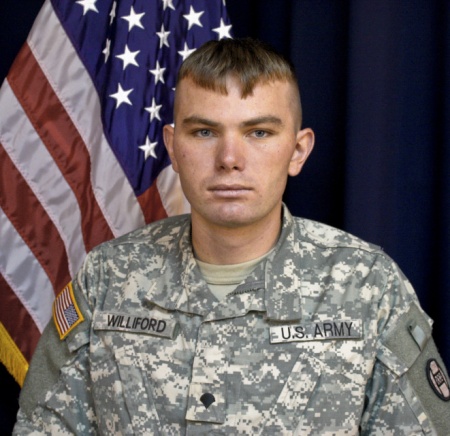
Army Spc. Blake Williford hails from Burgaw, North Carolina, and is an analyst with the 30th Armored Brigade Combat Team headquarters.

“Since I started the deployment process I’ve gone from private to specialist and dropped 22 pounds. It has been a life-changing experience,” Williford said. “When I get home I’m going to work on school, find a full-time job, and stay in shape.”

Preparing for More Responsibility

Even though he will not be putting on sergeant stripes for a few years, he is already preparing himself for the next grade.

“I’ll be doing the Basic Leadership Course in January, and after that I just need to wait on time in grade and service for my promotion to sergeant,” Williford said. “I’m reading more regulations, and taking notes from soldiers in my leadership, like Staff Sgt. [Kyle] Burke.”

He added, “I have watched and learned from them about how I can become a good noncommissioned officer. II have a lot of good examples around me.”

Burke, a senior analyst also deployed with the 30th ABCT, has been Williford’s supervisor for only one month and says he is already impressed with how he conducts himself on the job. Williford, Burke said, goes above and beyond in his role providing the 30th ABCT and Multinational Battle Group-East commander situational understanding and awareness of the complex environment in Kosovo.

“Williford is confident and knows what he needs to do his job well,” Burke said. “He relies on his training and his NCOs, but isn’t afraid to ask for guidance or clarification.

“I’ve been overseeing his daily work and making sure he understands his tasks,” Burke continued. “But since he is very reliable and dependable, I never have to worry if he is going to get the job done.”

Learning the Job

Williford has been a soldier in the North Carolina National Guard for two-and-a-half years, and is serving on NATO’s peace support mission in Kosovo during his first deployment.

He said he was apprehensive when he first arrived in the new environment, but over time he’s found ways to adapt to his surroundings -- an essential skill for a soldier and a future sergeant.

“It was stressful in the beginning,” he said. “It wasn’t what I thought it would be. But once I got in the right mindset and learned the flow of work, it has been enjoyable.”
Williford and his 30th ABCT headquarters teammates are serving as the MNBG-E headquarters on the 20th rotation of U.S. troops into Kosovo since the late 1990s. In this mission, the headquarters and its subordinate U.S. and multinational forces work to ensure a safe and secure environment and freedom of movement in eastern and northern Kosovo.

Horsham Guardsmen interact with petite patriots in character education program

by Tech. Sgt. Andria Allmond
?111th Attack Wing Public Affairs


11/12/2015 - HORSHAM AIR GUARD STATION, Pa. -- Nearly 20 Guardsmen from the 111th Attack Wing, here, participated in a character education program held Nov. 10, at Mary, Mother of the Redeemer Catholic School in North Wales, Pennsylvania.

The Guardsmen visited with the students to demonstrate various qualities of citizenship, while also providing insight about life in the military.

"The goal of the event is to help the children develop skills to be good citizens," said Anita Fleming, former teacher at the school and event coordinator. "We are integrating Veteran's Day as part of the program. The military members here can share the Air Force's core values of Integrity First, Service Before Self and Excellence in All We Do as qualities of a good citizen, while they serve as a representation of our nation's veterans."

Wing members visited students from kindergarten to third grade. During their time in the classrooms, they discussed specific attributes of courteous citizens, read a book and completed a patriotic-themed craft.

111th ATKW members and volunteers partnered with students to complete the project and then answered questions - ranging from uniforms and saluting to combat and deployments.

"Programs like this have a positive effect on the kids," said Nicole Foulke, second-grade teacher at MMR. "Unfortunately, they may see some negative things about the military on television; so, it's really nice for them to see (Air National Guardsmen) come here in military uniforms and take part in working on a (craft) project just like we do on a normal day. Because it's something that they don't always get to see, they might be a little apprehensive at first. But they definitely have a lot of questions."

Additionally, the event bolstered a sense of community and provided a feel-good experience for the volunteers.

"I am really grateful to come out here today and get involved in the community," said Airman 1st Class Igor Karlov, a supply technician from the 111th Logistics Readiness Squadron. "Seeing the kids get so enthusiastic to have us visit made it a great experience - I loved it. I remember looking up to military members when I was growing up and being inspired by what they did. And now, I'm here doing the same for these kids today."

Not only did volunteers have an enjoyable time at the event, the students appeared to have fun as well.

"I believe that as members of the military and of the community, we have a responsibility to serve as positive role-models," said Master Sgt. Joe Sommers of the 111th LRS. "Being involved in an initiative that promotes good citizenship is a win-win situation for everyone here.

"Overall I had a really good time. And with the amount of high fives we all received, I believe the students did too," said Sommers.

Aside from fun, gratitude was also a shared sentiment by those involved in the school-sponsored event.

"The kids were really excited to have military members here and they seemed to enjoy the interaction," said Foulke.  "Everything went over really well. We're grateful that (Wing members) took the timeout of their day to come and see us."

Volunteers from the Airman & Family Readiness Center and the Veterans of Foreign Wars Post 3258, Chalfont, Pennsylvania, also participated in the event.

Art Therapy Provides Lifeline for Wounded Warriors


By Terri Moon Cronk DoD News, Defense Media Activity

WASHINGTON, November 12, 2015 — Service members who take part in art therapy to soothe the symptoms of war’s invisible wounds display acts of courage and resilience to put them in control of their lives, the assistant secretary of defense for health affairs said today.

Speaking at the 2015 Wounded Warrior Healing Arts Recognition “Show of Strength” event at the Pentagon, Dr. Jonathan Woodson said service members, professionals, families and other caregivers have critical roles by supporting art therapy and ensuring its success.

Woodson said a wide variety of wounded service members’ “museum quality” art on display at the event caught his eye.

“I was reminded of the infinite potential of art to assess the human emotion, access the human emotion, and exploring … to understand emotions are complex issues,” the assistant secretary said.

“Today is a celebration of recovery and rehabilitation,” he said, noting that the celebration includes the expanding partnership of the Military Healing Arts partnership between the Defense Department and the National Endowment for the Arts as part of the Warrior Care Month observance.

NEA Supports DoD to Heal the Wounded

The NEA supports music, writing and visual art therapy at military care facilities for those who might not benefit from traditional therapy, Woodson said, adding that the partnership represents some of the “finest institutions in America coming together to aid in the healing of wounded warriors.”

Nine service members whose artwork was displayed received certificates of recognition for artistic achievement. Healing-arts therapy was a key part of their recovery and rehabilitation, explained James Rodriguez, deputy assistant secretary of defense for warrior care and policy.

Acknowledging that healing arts might not benefit every service member, because each case is individual, Woodson said the option to enter the program should be included for all as an option to expand their therapy plan.

“The progress of creating can lead them places they otherwise [might not] access,” he said. “It is safe to say we are all just beginning to understand how engagement in the arts can change lives of military members affected by traumatic brain injury to post-traumatic stress syndrome and other conditions. We know [the arts] can be an extremely powerful tool in assisting with recovery.”

And there are many reasons why the DoD-NEW partnership is important, he noted.

Art Therapy Has Calming Effects

Studies show creating art can produce calming effects on invisible wounds, because art therapy can decrease stress hormones, which can relax and lessen anxiety – especially for those used to staying hypervigilant in high-stress environments, Woodson said. Creating art to express feelings and help them externalize what they might have repressed for a long time can help return service members to a normal existence, he added.

Because of what they’ve experienced, service members often deal with a complex set of feelings and emotions that make it difficult to relate to people, Woodson said. The invisible wounds can lead to feelings of shame, guilt and identity crises that might cause them to retreat and engage in isolating behaviors,” he added.

“Art therapy is a lifeline out of that isolation,” the assistant secretary said.