Friday, October 13, 2017

Disaster Relief Exercise Concludes in Bangladesh


DHAKA, Bangladesh, Oct. 13, 2017 — The  eighth annual Pacific Resilience Disaster Response Exercise and Exchange, or PR DREE, came to a successful close during a ceremony here yesterday.

The theme of the five-day exercise was civil-military integration and humanitarian assistance/disaster response in preparation for a massive earthquake.

The event was co-sponsored by the Bangladesh Armed Forces Division, the Ministry of Disaster Management and Relief and U.S. Pacific Command.

U.S. Army Pacific sent 15 soldiers and airmen from the its headquarters battalion, the 8th Theater Sustainment Command and the Oregon National Guard, which has a state partnership with Bangladesh.

Air Vice Marshal Mashiuzzaman Serniabat of the Bangladesh Armed Forces Division officially closed the exercise at the seremony, which also featured remarks from Brig. Gen. Bryan E. Suntheimer, the deputy commanding general of U.S. Army Pacific, and Deputy Gen. Reaz Ahmed of the Bangladesh Department of Disaster Management.

Exercise Tests Disaster Relief Mission Coordination

"I do believe over the last five days you have developed some a collective understanding among yourselves and built up networking for improved interactions, which will help effective coordination while working together for disaster management," Serniabat said.

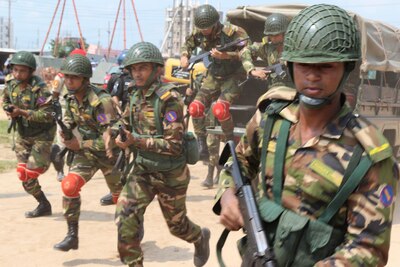
The event brought together more than 1,400 participants from 13 nations, as well as dozens of government, nongovernment and international organizations. Personnel worked together either through a phased tabletop exercise here or a field training exercise held in Mymensingh, while testing out earthquake preparation plans, response capabilities and command and control organizational design.

"Partnerships play a critical role in meeting global challenges, from maintaining peace to providing humanitarian assistance after natural disasters," Suntheimer said. "Bringing your talents, ideas and resources together magnifies our impact far beyond the immediate region. Multinational partnerships are force multipliers for good around the world."

The PR DREE, which has been held annually since 2010, is built on the accomplishments of previous years' exercises. These years of planning have enabled partners to test out doctrine and verify the validity of the National Disaster Response Coordination Center's plans for disaster response, while strengthening partnerships and communication between multiple agencies, nations and stakeholders.
2017 South Asia Pacific Resilience Disaster Response Exercise and Exchange in Dhaka, Bangladesh

Army Lt. Col. Demian San Miguel with the Oregon National Guard has attended the PR DREE in Bangladesh for the last three years.

'There Was Excellent Coordination Across All Agencies'

"Every year the exercise gets better and better," San Miguel said. "There was excellent coordination across all agencies."

San Miguel went on to say that the increased interaction and immediate feedback to participants' questions made the event successful. The inclusion of college students who study disaster management, he said, brought an exciting, fresh perspective to the event.

The tabletop exercise familiarized participants with an earthquake scenario, their various roles and responsibilities, and the numerous themes of the exercise. Participants were assigned to cell groups, where they deliberated over the proper emergency response to various scenarios. The multinational, interagency teams developed search-and-rescue response procedures, coordinated logistical support plans, verified shelter/relief plans and procedures now in place, and increased coordination among international and domestic organizations and agencies.

After three days working through strategic-level scenarios, tabletop exercise participants gathered at the Bangladesh Staff College here to review an operational execution of the plans during an earthquake field training exercise by emergency responders. This was followed by an after-action review on the final day.
Pacific Resilience is U.S. Army Pacific's main platform to engage, partner with and prepare U.S. allies in the region in a whole-of-government approach using the military and civilians to plan and execute DREEs and other humanitarian aid/disaster response events, officials said. It uses medical, engineering, humanitarian assistance and disaster response and other related activities to implement, corroborate and exercise plans, equipment and personnel against a variety of emergency scenarios that continuously affect the Indo-Asia-Pacific region

Face of Defense: Airman Shows Resilience in Cancer Battle


By Air Force Tech. Sgt. James Hodgman 60th Air Mobility Wing

TRAVIS AIR FORCE BASE, Calif., Oct. 13, 2017 — “You have Stage-2 unfavorable Hodgkin’s lymphoma.”

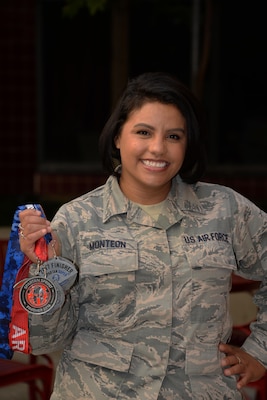
Those were the words Air Force Staff Sgt. Teresa Monteon heard her doctor say on Oct. 19, 2015. The weight of those words hit her hard and she cried.

“I was scared,” Monteon said. “My whole world just shifted. I was so excited to come to Travis and work in the intensive care unit. It was a great chance for me to be a medic and I was looking forward to testing my skills and facing new challenges. When the doctor said that, I felt like my whole world was pulled from me.”

Monteon, a medic from San Jose, California, joined the Air Force in January 2010 and arrived at Travis Air Force Base, California, in May 2015. She was assigned to work in the ICU at David Grant U.S. Air Force Medical Center. However, she discovered a lump on the left side of her neck in August 2015 that would change everything.

“It was probably the size of a golf ball and egg combined, she said.” “I thought it could be cancer.”

One week later, Monteon was evaluated by her primary care manager, who referred her to a specialist in the medical center’s general surgery office.

He thought it was probably a clogged lymph node and instructed Monteon to apply a warm compress to it and come back in a month, she said. A month later, she returned and the lump was the same size.

Monteon was referred to the radiology clinic for a CT scan. After the scan was conducted, she said she knew something wasn’t right after seeing the looks on the technicians’ faces.

‘I Knew Something Was Wrong’

“I know that face -- that ‘something’s wrong’ face,” she said. “All medics have it when we see something scary. I knew something was wrong.”

The following week, Monteon was scheduled for a biopsy, a procedure where a sample of tissue is taken from the body to examine it more closely.

The results were shocking to hear.

“The interventional radiology surgeon said, ‘I hate to be the one to tell you this, but I’m 90-percent sure it’s Hodgkin’s lymphoma,’” Monteon said. “I was shocked. I didn’t know how to process that information.”

Hearing those words felt like being slammed in the face, she said.

Additional testing confirmed Monteon had Hodgkin’s lymphoma, a cancer of the lymphatic system, which is part of the immune system. This form of cancer causes cells to grow abnormally, which could lead to cancerous cells spreading to other parts of the body. As the disease progresses, it compromises the body’s ability to fight infection.

Air Force Master Sgt. Jennifer Mitchell, now the 343rd Reconnaissance Squadron’s first sergeant at Offutt Air Force Base, Nebraska, was working as the ICU flight chief on the day Monteon received her diagnosis.

“One of the nurses called me and said, ‘We need you to come downstairs right away,’” Mitchell recalled. “I ran down the stairs and Monteon was on the bed crying. The doctor confirmed she had Hodgkin’s lymphoma. I know for her it was devastating, and I felt the same way. To see such a young person go through cancer knowing how difficult that would be … to know she was going to have to go through that just broke my heart.”

Tests revealed cancerous tumors on the left side of Monteon’s neck and chest above her heart. She began chemotherapy on Oct. 26, 2015. The treatments took a profound effect on her, both physically and mentally.

Treatment, Recovery

“I was extremely nauseous and tired instantly after the first treatment and I had treatments every two weeks,” Monteon said. “That first week after two or three days, my body was really heavy, I had immense fatigue. It’s not like you can sleep and be better. You’re just always tired. I lost all energy. Even getting dressed was difficult.”

Monteon also experienced blisters in her mouth, as well as severe bone and jaw pain.

An avid runner and hiker prior to her diagnosis, she shared what it felt like not being able to do the things she loved.

“I would get so winded just trying to walk around my apartment complex,” she said. “I cried because I couldn’t walk as far as I did before I got sick. It was so frustrating because I couldn’t run or train.”

At one point, Monteon wondered if she should even wear the Air Force uniform.

“When I was bald, people would stare and I felt like people were taking pity on me and I hated that feeling because I didn’t want pity,” she said. “I have an image in my head of what it means to wear the [Air Force] uniform. It means you’re doing well in life; you’re healthy and able to contribute to the mission. I didn’t feel like I should’ve been wearing [the uniform] because I was so sick.”

Monteon added, “It was so hard for me to come into work and put a smile on my face because I felt like I didn’t represent the image the Air Force should uphold.”

While Monteon battled through this difficult time, she said her friends and Air Force family supported her in several ways.

Mitchell attended every one of Monteon’s chemo treatments, checked on her while she was hospitalized with an intestinal infection and even went grocery shopping for her.

Friends Provide Support

“She needed support -- physically and mentally. And she needed to know she wasn’t alone,” Mitchell said. “I’m a huge believer in people always come first. Her health and getting her through those difficult days was the No. 1 priority. Some days, I had to give some tough love and ensure she took in fluids and ate. Other times, I made her laugh or simply held her hand.”

While Monteon was hospitalized for nine days due to neutropenic enterocolitis, an acute life-threatening condition, she was on a strict diet of clear fluids. Mitchell provided the staff sergeant with a reason to laugh.

Monteon was eating popsicles and she threw up after she ate a lot of them, Mitchell recalled.

“At least it smells good,” Mitchell recalled telling Monteon. “It smelled like grape popsicles. Just making her laugh, holding her hand and just being there for her for whatever she needed was the most important thing. I wanted to take her pain away, but unfortunately, I couldn’t.”

Air Force Tech. Sgt. Krystal Foster, the 60th Diagnostics and Therapeutics Squadron’s noncommissioned officer in charge of patient tray services and one of Monteon’s friends, visited her often.

“I cooked for her, brought her food, played video games with her, joined her for walks and even spent the first night of her hospitalization with her,” Foster said. “Whatever she needed, I was there.”

Foster said she’s proud of how her friend faced each day.

“She never gave up and she was always smiling,” Foster said. “Even when she lost her hair, she didn’t let anyone know that it bothered her. She had the strength to endure and push through everything.”

Remission

Monteon underwent four months of chemotherapy, receiving her last treatment on Feb. 16, 2016. She also underwent a month of proton therapy, a form of radiation treatment, in San Diego.

On April 25, 2016, her oncologist told her she was in remission, she said. While she is aware cancer could return to her body, Monteon is wasting no time living the life she loves.

In November 2016, she traveled to St. Lucia, an island nation in the eastern Caribbean Sea for six days. While there, she went zip-lining, kayaking, hiking, snorkeling and bathed in volcanic mud.

She also ran her first Reebok Spartan Race that month in Sacramento, California. Spartan races are endurance events ranging in distance from 3 to 14 miles. During a race, participants are required to overcome between 20 and 35 obstacles.

“Running is how I de-stress and relax,” Monteon said. “Going from being barely able to go up my stairs to running 4.3 miles while overcoming obstacles and challenging myself again felt amazing.”

Monteon has also completed Spartan races in Monterey and San Jose, California, and she is planning trips to Australia and Italy.

She said her cancer battle taught her a valuable life lesson, one she wants to share with her fellow airmen.

“The biggest take away for me, is knowing there’s going to be adversity and challenges in life, but what matters is getting yourself back up,” she said. “Whatever challenge you’re facing, it’s likely for a very short period in your life and there’s so much out there to experience.”

Monteon added, “Airmen need to know there’s always a light at the end of the tunnel. If you’re stressed, get outside of your head and try something fun. Think positively. If you believe and say ‘I’ll get better,’ you will. You have the power within yourself to make your life better.”

Puerto Rico Air National Guard Helps to Build 'Air Bridge'


SAN JUAN, Puerto Rico, Oct. 13, 2017 — For all the airlift missions that the pilots and the loadmasters of the 198th Airlift Squadron have planned over the years, there is one major difference between those and the ones they are scheduling now as the Puerto Rico Air National Guard's representatives to Hurricanes Irma and Maria relief efforts on the island.

"We worked 14 days straight on Hurricane Katrina. That was hard. This is far harder. This is us," said Air Force Senior Master Sgt. Raul Vidal, noncommissioned officer in charge of current operations for the 198th.

Several officers and senior noncommissioned officers from the 198th are working with the Federal Emergency Management Agency and numerous other federal military and civilian agencies as part of the response and relief effort on Puerto Rico.

Their task is to support the "air bridge" that the military has established between the U.S. mainland and Puerto Rico and other islands in the Caribbean, including St. Thomas and St. Croix in the U.S. Virgin Islands. The air bridge is the dozens of daily flights flown by the military that bring in personnel and supplies to the islands.

'Large, Complex Mission'

"This is such a large, complex mission; it is multiple sorties every day to bring food and water -- and our main priority is just that -- [airlifting] food and water to the islands. We are working to coordinate every flight to maximize the relief efforts that can be brought in," said Air Force Lt. Col. Evanisto Orengo, a C-130 pilot and the commander of the 198th Airlift Squadron.

"We are working very closely, not just with multiple units of the Air Force, but also with the Army and the Navy and Marine Corps, with the civilian agencies, to coordinate all this movement," Orengo said. "All my experience as an airlift planner, all my experience as an airlift pilot is being put to use in this mission."

While the Air Force is handling most of the heavy airlift between the mainland and Puerto Rico, the other services are providing helicopter support for other missions on the island.

Coordinating Movement of Supplies

The air cell is also coordinating the movement of supplies that arrive in Puerto Rico and then have to be transferred to another aircraft for movement to the U.S. Virgin Islands. On Puerto Rico, Vidal said, the Puerto Rico Air National Guard is also working to coordinate air movement at four different airports and air bases around the island, in addition to San Juan.

Along with the movement of personnel and materials in to the Puerto Rico, the air cell at the emergency operations center also helps to coordinate the movement of personnel -- including military dependents and other federal employees -- off the island as empty cargo aircraft return to the mainland.

"That's another piece of all this that needs to be coordinated," said Air Force Master Sgt. Adoniram Nieves, a 198th loadmaster working at the EOC air cell. "There's a lot of information that needs to flow to many places."

Orengo said even as Puerto Rico's airmen are working on the airlift missions, many of them -- and their family members -- are also working as volunteers in their off hours, supporting relief efforts to friends and family, making responding to Hurricane Maria "a very personal mission."
"Everyone on Puerto Rico has to put in their own grain of salt," he said. "We have much to do, but if everyone contributes, we can accomplish the mission."