Wednesday, December 30, 2015

Face of Defense: Marine Employee’s Path Leads Him Back to Birthplace


By Monique Randolph, Marine Corps Systems Command DoD News, Defense Media Activity

MARINE CORPS BASE QUANTICO, Va., December 30, 2015 — On the day before the U.S. Marines Corps celebrated its 240th birthday, one Marine Corps Systems Command civilian employee -- and former active-duty Marine -- celebrated his own birthday in a very special place.

Kevin Scott was born on the second floor of Naval Hospital Quantico, located on historic Hospital Point and now headquarters to the Marine Corps acquisition workforce. Today, you’ll find him working two floors below that birthing room as the head of manpower, personnel and training for Program Manager Combat Support Systems supporting program teams in the development and evaluation of acquisition training products against service standards. Scott never imagined his career path would take him full-circle to where he was born.

“I find it neat to say that I was born in this building and now I work here,” Scott said.

Idolizing Dad

When Scott was born, he said, his father was a first lieutenant in the Marines and a combat engineer on base.

“Growing up, I remember going to the emergency room and the pediatrics all the time to get bones fixed,” he said.

The former hospital was built in 1939 and commissioned as a Naval Hospital on July 1, 1941. During World War II, the hospital expanded with an inpatient capacity swelling to over 600 beds. Today, the old emergency room is the Riverside Café.

As he got older, Scott said he followed his father’s example, receiving a commission as a Marine Corps infantry officer in 1980.

“I can honestly say that my father was my idol growing up,” he said. “Not a sports legend or sports guy or anything. My father was my idol. I always wanted to do better than he did.”

Transitioning to Civilian Life

While serving thirteen years in the Corps, Scott, his wife Lisa, a former Navy nurse, and their two children saw the country, living in such places as Hawaii and Maine. After years away, he said he completed his service in 1993 and returned to Northern Virginia to be closer to family. Scott said he eventually rejoined his Quantico family as well, taking a position writing training standards at Marine Corps Training and Education Command.

In 2004, he accepted a position at MCSC and has served the past 11 years as a Marine Corps civilian employee in the very building where he was born.

Scott said he seldom thinks about the fact that he now works in the same building listed on his birth certificate, but his lifetime in the Marine Corps -- both as a child and adult -- left a lasting impression.

Nova Scott, his mother, said she is proud of the man her son has become.

“When we were raising our children we wanted to instill in them to be truthful and respectful,” she said. “But it had to be a learning experience. I think we did a good job.”
As the Marine Corps' only systems command, MCSC oversees the development, acquisition and lifecycle logistics of Marine Corps ground weapon and information technology system programs.

Tuesday, December 29, 2015

Pentagon says F-35 program on the right track


By Mitch Shaw , Hilltop Times correspondent / Published December 29, 2015

F-35A Lightning II Conventional Takeoff and Landing Variant
HILL AIR FORCE BASE, Utah (AFNS) -- Lockheed Martin and the Pentagon's F-35 Joint Program Office say they've finished delivering jets for 2015, increasing their yield from last year by 25 percent.

Joe DellaVedova, a spokesman with the F-35 office at the Pentagon, said 45 F-35s were delivered, which met Lockheed and the program office's delivery goal for the year and exceeded last year's deliveries by nine jets.

"Meeting aircraft production goals is a critical stepping stone in demonstrating the program is ready for the expected significant production ramp up," Lt. Gen. Chris Bogdan, the F-35 program’s executive officer, said in a press release.

Lorraine Martin, Lockheed's F-35 program general manager, said the 2015 deliveries were "a clear demonstration of our growing maturity and stability."

The performance boost represents good news for Hill Air Force Base, which accepted its first two jets in September and will continue to count on a steady income of fighters until 2019 to fill three F-35 squadrons.

Base spokesman Rich Essary said it has received a total five jets so far, with the next one scheduled to arrive in January. Essary said the plan is for Hill AFB to continue to accept jets at a rate of one or two each month until they receive their full allotment of 72.

By August 2016, the base hopes to have 15 jets in place in order to reach what the Air Force calls "initial operational capability," which means Hill AFB has met the minimum goal to use the jets for normal operations.

On Dec. 11, Maj. Jayson Rickard, a reservist with the 466th Fighter Squadron, flew the 100th F-35 sortie at Hill AFB since the first combat aircraft arrived in September.

Of the 45 jets delivered in 2015, the lion's share has gone to the Air Force, which has received 26 F-35As. The Marine Corps received eight F-35Bs and the Marines and the Navy each accepted four F-35Cs, which can take off and land vertically from aircraft carriers.

DellaVedova said 154 operational F-35s have been delivered to the Department of Defense and partner nations since the program's inception. The fleet has more than 45,000 flight hours. The multirole fighter will eventually replace the Air Force's entire fleet of F-16 Fighting Falcons and A-10 Thunderbolt IIs.

Hanscom employee captures DOD-level award

by Patty Welsh
66th Air Base Group Public Affairs


12/23/2015 - HANSCOM AIR FORCE BASE, Mass. -- The Department of Defense has recognized a Hanscom employee with a prestigious product support award.

Perry Hill,  product support manager and chief of logistics for the C3I and Networks Directorate's Space, Aerial and Nuclear Networks Division, recently won the 2015 Secretary of Defense Product Support Manager Award in the category of Major Weapon System/Other Weapon System, acquisition category II or below.

According to DOD, the award recognizes PSMs as "important partners" in providing the best product support for warfighters. In the memo from the Undersecretary of Defense for Acquisition, Technology and Logistics soliciting nominees for the award, it says "the Product Support Manager (PSM) is a critical program position in delivering weapon system readiness affordably and effectively."

"Perry revolutionized our support to critical warfighting systems," said Col. Todd Krueger, Space, Aerial and Nuclear Networks Division senior materiel leader. "His initiatives and innovative solutions are paying huge dividends in controlling life cycle costs while ensuring world class sustainment."

Hill's ability to create efficiencies helped him garner the award.

For example, his multi-program executive officer's approved process for linking product support execution across the division's 20-plus programs and projects connected development and sustainment and resulted in the creation of a combined life cycle planning and execution team. He also looked for opportunities to create business models to eliminate overlapping capabilities, leading to savings for the Air Force and, ultimately, the taxpayer.

"He is simply the best in his field," Krueger said. "Perry is renowned for his exceptional knowledge and skill. You can't effectively accomplish full life cycle management responsibility without an outstanding product support manager, and Perry sets the example."

Hill delivered weapon system support by driving development of an integrated maintenance schedule that enabled sustainment of the $1.6 billion Battlefield Airborne Communications Node fleet in theater with a 90 percent aircraft availability rate and a 100 percent mission effectiveness rate.

According to Krueger, Hill is also responsible for sustainment planning, execution and transition for numerous airborne networking and satellite communication (SATCOM) terminal programs. In addition, he led product support efforts for the division's nuclear command, control and communications (NC3) programs, ensuring the entire life cycle was considered during initial strategy development.

And technical expertise was not the only area noted. According to his nomination package, Hill worked to improve professional development of the life cycle logistics workforce by developing a monthly academic and leadership development program to enhance critically needed skillsets.

"Perry is a phenomenal leader and teacher," Krueger said. "He saw the need for strong mentoring and on his own initiative he developed his unique and informative program."

Hill praised others for helping him win.

"The credit goes to HNA [Space, Aerial and Nuclear Networks Division] and C3I&N PEO who have provided me with strong leadership support and an outstanding support cast to make this happen," he said. "I'm certainly indebted to them and the team for all they've done."

The winners of the PSM awards will be acknowledged at the Spring 2016 Office of the Secretary of Defense Product Support Manager/Performance-Based Logistics Workshop.

Chaplain helps others through own experience

by Airman 1st Class Gabrielle Spradling
460th Space Wing Public Affairs


12/23/2015 - BUCKLEY AIR FORCE BASE, Colo. -- The road to faith can be a rocky path, but the attitude along the way is what makes the trip worthwhile.

Chaplain Jim Bridgham, 140th Wing chaplain, believes that every good story has drama and shapes who a person becomes.

Throughout his life, Bridgham had many bumps in the road, but he always used them as learning experiences.

Bridgham grew up in government housing in a poor suburb of Boston, with a very limited faith background. However, he received a scholarship to attend a local Catholic school because of his family's occasional attendance to the church. Both of Bridgham's parents worked full time and his father also went to school, so he was left to take public transportation. While his parents were at work Bridgham's grandfather, a retired Navy chief, took care of him.

"The only thing I remember wanting to do as a kid was to be in the military," Bridgham said.

According to Bridgham, the education he received through the Catholic school allowed him to receive a ROTC scholarship. That was the only way he was able to go to college.

While at the University of Tampa, Bridgham met his wife and, through a local group, they both became Christians. This changed the course of their lives and, throughout his college career, Bridgham led several Bible studies and worked at a local church.
After college Bridgham commissioned as an active duty intelligence officer in the U.S. Air Force. During his time on active duty, he travelled around the United States and also had three overseas deployments. Bridgham then decided to attend Denver Seminary in Littleton, Colorado, and during his first year there became a chapel candidate, which meant starting back at the bottom of the officer tier.

"I got to be a second lieutenant twice in my career, which is my little claim to fame," said Bridgham.

During his three years in seminary, Bridgham did not make much money to support his wife and their two children so he worked as a janitor every day, before and after class. His family also received aid from local churches and a food bank.

The stress that he felt throughout seminary caused him to gain a lot of weight from drinking Mountain Dew to stay awake and get all of his work done.  After one tough day of physical assessments and school testing failures, Bridgham decided it was time to ditch the Dew and start a healthier lifestyle.

"Over the course of six months I lost over 90 pounds and ran my first half marathon," said Bridgham. "I also scored nearly perfect on my fitness assessment, with a 99 percent."

Running helps Bridgham in his everyday life by providing a stress relief and he continues to be a runner today.

As a father of three, a husband and now a Colorado Air National Guard chaplain, Bridgham juggles a lot of tasks, such as activities for his kids and helping all branches of the military in not only work but also personal matters.

The people of Team Buckley are the focus of Bridgham's work and he wants everyone to be as successful as they can be.

"I genuinely care for the people I interact with, what I do is who I am," said Bridgham.
A big way that the chaplain helps people is by being there as a guiding light during times of tragedy. He supports people during the deaths of loved ones, internal struggles and issues with deployments. The hardest part of the job is notification of death when there are children involved, said Bridgham. It doesn't matter whether it is suicide or wartime death, the family still hurts.

Chaplain Bridgham prides himself on relating to everyone so that he can help them in the way they need.

"I love being with people, I love seeing their stories and helping them connect the pieces, so they can see when they've had a rough patch that that's just part of a great story that they're writing," said Bridgham. "I believe that with all my heart."

Bridgham finds that if he can connect with people on their level then he can help them sort through their problems better.

"One of my big passions is gaming and working with folks who love games," said Bridgham. "Recently I started an initiative where I've been writing and talking at venues about the intersection of faith and gaming."

The goal of Bridgham's project is to show people that you can connect faith to any interest you may have.

"I will never shove my faith down your throat, but what I will do is help you get through whatever it is you are going through no matter what it is," said Bridgham.

The job of being a chaplain is difficult, and requires a lot of understanding, passion and caring. Chaplain Bridgham exudes all these characteristics and he asks for little in return. His simple request is he wants to leave a great legacy.

All of the hardships Bridgham encountered during his childhood, college years and adult life have shaped him into a valuable resource for Team Buckley. He hopes to continue to serve Buckley AFB and make an impact on as many people as possible, both in and out of the chapel.

Monday, December 28, 2015

Security forces tests active shooter and lockdown procedures

by Master Sgt. Charles Delano
153rd Airlift Wing Public Affairs


12/18/2015 - CHEYENNE, Wyo. -- Everyday armed military personnel provide security for installations across the globe. But, what if, the very same airman tasked to protect personnel and assets becomes an active shooter? This is the scenario the Wyoming Air National Guard's 153rd Security Forces Squadron tested Dec. 18 at the Cheyenne Air National Guard base.

Secretary of Air Force Deborah James recently issued a memorandum for military bases to test the effectiveness of active shooter and lock down procedures. The 153rd Airlift Wing's exercise involved a lone gunman, armed with a M-4 assault rifle and 14 magazines filled with blanks, "shooting" airmen and attempting to evade capture.

"We wanted to test the worst-case scenario where an armed security forces airman is the gunman," said Capt. Sean Deveau, 153rd Security Forces Squadron commander. "Our No. 1 priority is the security of the base. We train and test our response to these types of situations to make us better at securing the base."

The exercise began around 9:30 a.m. The "shooter," for the exercise, exited a vehicle and began his shooting spree outside the newly renovated wing headquarters building. Airmen within the building observed the member as an active shooter and informed security forces.

The base initiated lockdown procedures while the shooter attempted to enter several other buildings.

"This was a good exercise. It was realistic and helped me see how fast a situation like this can develop," said Senior Airman Karen Klein, a member of the 153rd Logistics Readiness Squadron. "My adrenaline was pumping."

Several security forces airmen chased down and fatally wounded the active shooter as part of the training exercise. Upon completing all the necessary building sweeps, emergency responders attended to injuries and the exercise ended.

Observers from the153rd inspector general wing inspection team graded security forces personnel on base lockdown and response, security forces response, and recovery after the active shooter was eliminated.

Security forces airmen assigned to the 90th Missile Wing, F.E. Warren Air Force Base, also observed the exercise to get an understanding of how the National Guard wing conducts active shooter exercises.

Observers said they concluded the exercise was a success with the most notable aspects being how difficult it was for the shooter to enter the buildings. They also commended the communication between members of the sweep teams.

Air National Guard security teams use virtual reality to train for active shooters


By Tech Sgt. Matt Hecht | 108th Wing | December 21, 2015

LAWRENCEVILLE, N.J. - It was a day like any other – blue sky, tranquil breeze, when suddenly the unexpected happened: gunshots rang out. Swiftly responding, Security Forces Airmen made their way through numerous rooms, past injured people, and neutralized the threat.

Luckily, this was all part of their training.

On Dec. 12, these New Jersey Air National Guard members got some highly technical virtual reality training at the U.S. Marshals training site in Lawrenceville, New Jersey.

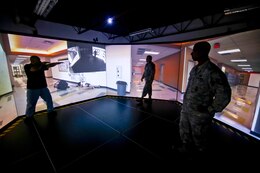
The V-300 VirTra firearms training simulator offered an unprecedented 300 degree view of interactive screens lit by five high-definition projectors and a sound system that would fit into any major movie theater. A box, strapped to the cops’ belts, shocked them when they were struck by enemy fire.

The U.S. Marshals instructors quipped, "These can be a real motivator."

The Airmen got to go through several scenarios, including a high-risk traffic stop they did as individuals, and an active-shooter scenario where they got to work with a partner.

"Remember to keep watching, and to keep communicating," said one of the instructors from the Marshals office. "Keep your head on a swivel."

One of the event's organizers, Tech. Sgt. Heather Perez, from the 108th Security Forces training section, had nothing but praise for the day's training, a first of its kind for the 108th and the Marshals.

"This is great hands-on training," Perez said. "The Airmen get to see how they react to these various events individually, as well as with a partner. The technology is amazing."

Perez also noted that this would hopefully be the first of many joint training ventures with the U.S. Marshals, and that the younger tech-savvy Airmen loved the virtual reality aspect.

"This training is very interesting and fun for the young Airmen, this kind of technology is hopefully keeping them motivated to stay in Security Forces," said Perez.

Maj. Gen. Dean returns home to Oregon for formal retirement observance

by Tech. Sgt. John Hughel
142nd Fighter Wing Public Affairs


12/9/2015 - PORTLAND AIR NATIONAL GUARD BASE, Ore. -- Returning home to Oregon with family and friends, Maj. Gen. Garry C. Dean formally retired after nearly 41 years of military service during a ceremony held in his honor on base, Dec. 6, 2015.

Lt. Gen. Joseph L. Lengyel, Vice Chief, National Guard Bureau accompanied Dean from Washington D.C. and hosted as presiding officer for the ceremony. Maj. Gen. Dean most recently served as The Special Assistant to the Chief, National Guard Bureau, where he acted in the capacity of Director, National Guard Joint Staff.

Ceremony attendees included Brig. Gen. Jeffrey Silver, interim Commander, Oregon Air National Guard; Chief Master Sgt. Andy Gauntz, State Command Chief, Oregon Air National Guard; and State Command Sgt. Maj. Shane Lake, Joint Senior Enlisted Leader, Oregon National Guard and other men and women of the Oregon National Guard.

During the ceremony, Lt. Gen. Lengyel presented The Distinguished Service Medal to Maj. Gen. Dean along with his official Certificate of Retirement from the United States Air Force and Oregon National Guard.

Lengyel said that the first time he met Dean was not at an Air Force endeavor, but rather at the Delta Airlines pilot lounge in Atlanta, Georgia, as they both flew commercially for the airline at the time.

"Over the last 10-15 years I've worked with him and as a colleague in other capacities.  One thing I can say about Garry Dean is that it's never been about him, but rather about him helping grow future leaders, Airmen and organizations," said Lengyel.

Lengyel said he witnessed this first hand when they served together at Tyndall Air Force Base, Florida, serving as Dean's vice commander at 1st Air Force, Continental United States North American Aerospace Defense Command.

The mission of 1st Air Force is to ensure the aerospace control and air defense of the continental United States, U.S. Virgin Islands and Puerto Rico.

"The responsibility is immense, this is our biggest job in the Air National Guard," Lengyel said. "The commander is charged with the air sovereignty and air defense of the United States."

In concluding his remarks, Lengyel described Dean's subsequent assignment and Dean's unique ability at building relationships as the Deputy Chief of Staff for Operations, Allied Joint Forces Command in Naples, Italy.

"Who better to bring together a collation of 28 nations, who all have to agree on something before it is done? Gen. Garry Dean of course," Lengyel said.

In his statements, Dean described the experience of working in Italy with other NATO [North American Treaty Organization] partners:

"There is no doubt that given the resources, their pilots and officers are as good as ours," he said.

The distinction that Dean found during his two-year assignment, and "took to heart," was the role of the senior enlisted and the total force development within the United States military.

"Airmen and Soldiers who get the job done; the professional expertise, discipline and education of our enlisted corps is what make us special and it's our future," he said.

Dean touched on other duties during his career, from attending the United States Air Force Academy, to his active duty assignments and later becoming a member of the Oregon Air National Guard. He served in various leadership capacities in Oregon from 1990 through 2003 - including his role as the 142nd Fighter Wing Commander from January 2001 through January 2003.

"In the early 1990s we saw a cultural shift, beyond a UTA (Unit Training Assembly) or a normal drill weekend in the National Guard," Dean said.

"This was a seminal moment. It was about building what our nation needed: a sustainable combat reserve," he said.  "This development is what our nation has now come to expect of our 54 National Guard states and territories."