Showing posts with label air force fitness. Show all posts

Wednesday, July 01, 2026

Face of Defense: Airman Conquers 7 World Marathon Majors in 365 Days

Six days after crossing the finish line in Boston, one Air Force colonel laced up again and ran the London Marathon. 

Still sore and fatigued, Air Force Col. Alfredo "Juny" Laboy knew quitting was not an option because he was too close to completing his goal of becoming the only active-duty service member to complete all seven Abbott World Marathon Majors within a single calendar year.
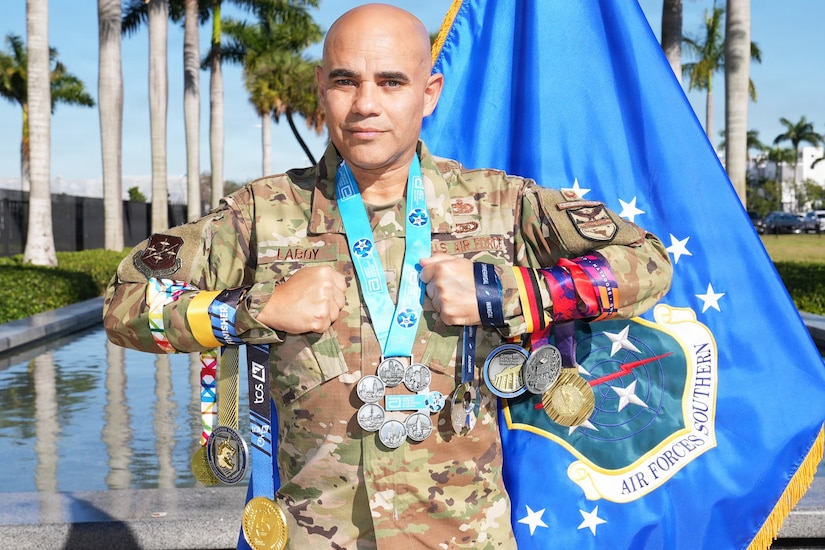
Air Force Col. Alfredo "Juny" Laboy
An airman wearing a camouflage uniform stands outdoors during daytime and holds seven medals wrapped around his arms; another large medal hangs around his neck, with a flag, tall trees and a reflecting pond in the background.
Job: Liaison Officer
Stationed: U.S. Southern Command Headquarters, Doral, Fla.
Unit: Air Forces Southern
Hometown: Humacao, Puerto Rico
According to Abbott World Marathon Majors data, he is also among just 44 athletes worldwide to accomplish this milestone for the first time within a single year. The World Marathon Majors are considered the pinnacle of endurance racing, consisting of premier marathons hosted across the globe. 

In 2025, Sydney was added as the seventh major, requiring Laboy to incorporate a new benchmark, along with additional travel, recovery and preparation within an already compressed timeline. 

That back-to-back stretch captured what defined Laboy's entire year: the ability to adapt when the conditions change and remain ready when the mission demands it. 

Throughout 2025, Laboy, 54, ran marathons in Tokyo, Boston, London, Sydney, Berlin, Chicago, Arlington, Virginia, and New York City, all while serving as the Air Forces Southern liaison officer to U.S. Southern Command. 

"I was driven by a combination of curiosity and purpose," Laboy said. "After completing marathons on all seven continents, I asked myself what would truly challenge me next. Completing all seven World Marathon Majors in one year wasn't about chasing a medal — it was about testing discipline, consistency and resilience, the same traits the Air Force has demanded of me throughout my career." 

Pursuing Excellence

For Laboy, the pursuit was inseparable from his identity as a service member, woven together through physical, mental and professional readiness; the thread linking the racecourse to the operations center. 

"Understanding what the achievement represented made it feel bigger than a personal milestone," he said. "Becoming the only active-duty service member to earn the Six Star Medal and complete all seven World Marathon Majors in a single year carried a strong sense of pride and responsibility. 

"This accomplishment allowed me to represent the United States Air Force and my hometown in Humacao, Puerto Rico, while also showing that being over 50 is not a limitation," Laboy added. "You can pursue excellence in fitness and set meaningful goals at any stage of life."


An airman wearing running gear stretches his shirt with both hands while jogging on a road during daytime, with other people in athletic attire running in the background.
An airman wearing running gear holds both arms in the air on a road during daytime, with other people in athletic attire standing in the background.
An airman wearing running gear holds one hand in the air and smiles as he jogs on a road during daytime, with other people in athletic attire also running in the background.
That readiness was tested repeatedly. Among the seven races, the Boston-to-London sequence required Laboy to compress recovery, recalibrate his physical expectations and execute without the preparation that most elite runners consider a minimum standard. 

"The London Marathon was the most challenging because I ran it just six days after completing the Boston Marathon," he said. "Physically, my body was still fatigued, and mentally, it took every ounce of focus and determination to push through with almost no recovery time." 

The effort mirrored another demanding stretch later in the year, when he completed the Marine Corps Marathon, followed by the New York City Marathon just one week later. Sustaining that output alongside a full-time operational workload required the same kind of structured adaptability Laboy applies to planning missions. 

"Balancing training with my role required flexibility," Laboy said. "Most runs happened during the workday, fitting them in between meetings, when possible, while weekends were reserved for longer distances. That structure allowed me to stay consistent without stepping away from my operational responsibilities." 

Finding His Stride

This approach also supported Secretary of War Pete Hegseth's military fitness guidance, which emphasizes physical training as a daily duty requirement for service members. Laboy approached physical performance and professional execution with the same framework. 

"I treated training like operations — plan, execute, assess and adjust," he said. "Consistency mattered more than intensity, and everything had to complement the mission, not compete with it." 

Adaptability was not an option; it was a defining trait. Midway through the year, Laboy was diagnosed with an umbilical hernia, a development that would have ended the pursuit for most. Instead of quitting, he persevered. He restructured his approach and pressed forward.
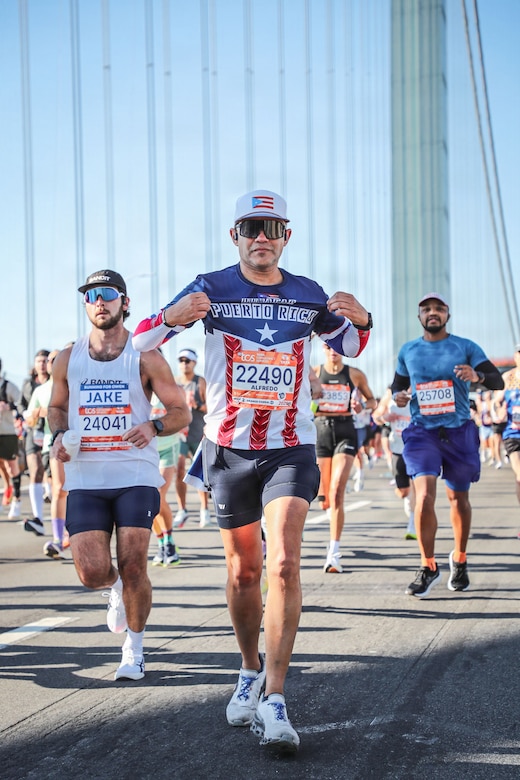

An airman wearing running gear stretches his shirt with both hands while jogging on a bridge during daytime, with other people in athletic attire running in the background.
An airman in winter athletic gear and carrying Puerto Rico's flag on his back runs on ice during daytime; a snowy mountain is in the background.
An airman wearing running gear jogs on a road during daytime, with other people in athletic attire also running in the background.
"There were moments of doubt, especially after I was diagnosed with an umbilical hernia following the London Marathon," Laboy said. "Under strict medical guidance, I was able to delay surgery and complete the remaining races safely." 

Laboy also managed preexisting conditions throughout the year, including bilateral hip bursitis, plantar fasciitis and vestibular neuritis, a condition that affects balance. Each of these conditions required ongoing adjustments to keep him mission-capable on and off the course. 

"Following medical guidance and adjusting expectations allowed me to keep moving forward without missing a single day of work due to running-related injuries," he said. 

'There Are No Shortcuts'

Overcoming these obstacles further reinforces that the parallels between endurance sports and military leadership are direct, not metaphorical, according to Laboy. 

"There are no shortcuts," he said. "Both require preparation, accountability, adaptability and the ability to lead yourself before leading others." 

Air Force Lt. Gen. Evan Pettus, Southcom deputy commander, said Laboy's accomplishment is a model of the readiness and adaptability the command requires of its leaders. 

"I've had the opportunity to follow and talk with Juny throughout this journey, and what stands out isn't just the mileage — it's the discipline behind it," Pettus said. "He never let a demanding schedule or personal setbacks distract him from the mission. He trained around his responsibilities, not the other way around. That balance and commitment to excellence while remaining fully engaged in the fight reflects the steady resilience and adaptability we expect from our leaders."

An airman wearing athletic attire and a hat and standing outdoors during daytime holds up a large medal with one hand and points at it with his other hand; around his neck are multiple other medals.

Laboy said the year reinforced that readiness is not a product of youth, but of discipline sustained over time. 

"Readiness isn't limited by age, but it's sustained by mindset," he said. "Resilience is built over time through discipline, physical fitness and mental toughness. When airmen take care of themselves, they're better prepared to take care of the mission." 

More Miles To Go

Standing at the finish line of his final race, Laboy said gratitude outweighed his exhaustion. 

"I felt gratitude for my health, my mother, my kids and everyone who supported the journey," he said. "I also felt excitement for what comes next and the goals still ahead." 

In April, Laboy completed the Coast Guard Marathon in Elizabeth City, North Carolina, followed by the Cape Town, South Africa, Marathon in May. Finishing the Cape Town race, now recognized as the eighth Abbott World Marathon Majors event, makes him one of fewer than 2,000 runners in the world to complete the entire series.

Looking forward, Laboy is scheduled to run the Air Force Marathon in September at Wright-Patterson Air Force Base, Ohio, and in October, the Army Ten-Miler in Washington, which completes the Armed Forces Series Challenge.  

Additionally, he aims to position himself among the first athletes in the world eligible for the Nine Star Medal, expected to be introduced in December 2027, pending the Shanghai Marathon's formal acceptance as the ninth and final World Marathon Major. 

Beyond these milestones, Laboy is setting his sights on the ultimate test of endurance: running at the geographic North Pole. By racing on ice floes covering 12,000 feet of the Arctic Ocean, he hopes to earn membership in the exclusive Marathon Grand Slam Club — a distinction reserved for elite athletes who successfully complete a marathon on all seven continents, plus the grueling North Pole Marathon.

Thursday, June 18, 2026

Crush the Mountain, Ace the Test

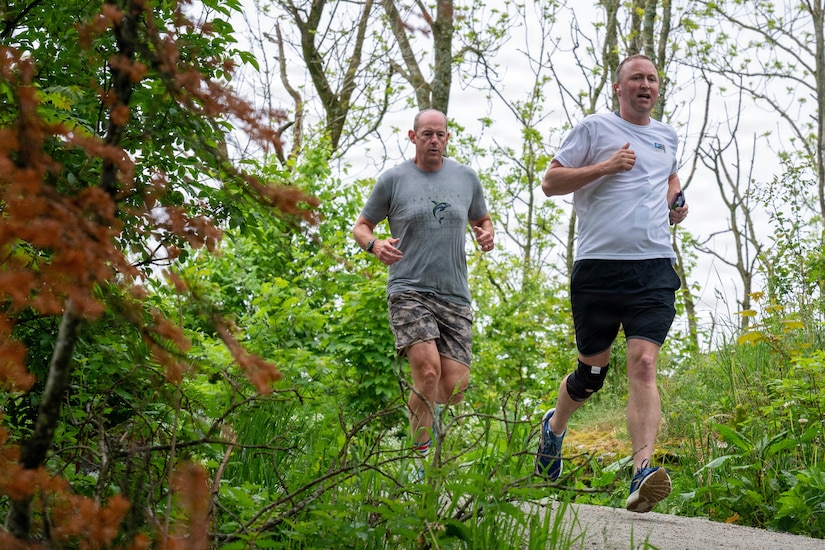
A woman and a man in athletic attire run down a path in a forest.

The sound of running shoes crunching against gravel echoed through the forest as airmen made their way up the hillside.

Some focused on maintaining their pace. Others kept their eyes on the runner ahead. The climb was steep, but nobody stopped.

Below them, the city slowly came into view.

Airmen assigned to the 426th Air Base Squadron, 501st Combat Support Wing, in Stavanger, Norway, regularly take to the trails surrounding the nearby NATO Joint Warfare Centre as part of a mountain run that has become a staple of squadron life.

The run has been a tradition for several years, but leaders recently began timing participants as the Air Force transitioned to its new 2-mile fitness assessment. Overlooking the city, the squadron found a natural training ground just outside its workplace.

Two men in athletic attire run down a path in a forest.

"We believed that consistent physical fitness drives performance, morale and unit cohesion," said Air Force Lt. Col. Daniel A. Hayes, outgoing commander of the squadron. "Particularly valuable during Norway's long, dark winters."

The route has also sparked friendly competition throughout the squadron.

"The competitiveness brings out the best in all of us because we want to win," said Air Force Tech. Sgt. Bryan K. Genobles, superintendent of the Financial Analysis Flight, 501st Combat Support Wing.

According to Hayes, airmen have consistently improved their 2-mile runs since the squadron began timing them.

"Our mountain runs are intentionally harder than what the standard track will give you," he said. "We developed the motto: 'If you can crush the mountain, you'll ace the test.'"

The run also gives new squadron airmen a goal to reach for as they attempt to run down people in front of them, effectively making themselves and the unit better, Genobles said.

A man in athletic attire runs down a path overlooking a town on the water with mountains in the background.

According to Hayes, the shared challenge has helped new members integrate into the squadron more quickly, while strengthening relationships throughout the unit.

The tradition continues after the run ends with airmen gathering for lunch, giving them an opportunity to relax, compare times and spend a moment together outside the workplace.

"The Norwegians have a saying: 'There's no bad weather, only bad clothes,'" Hayes said. "By embracing the environment's natural challenges, we prepare airmen not only to thrive on the Air Force fitness assessment but, more importantly, to build sustainable health and resilience."

For Hayes, who recently completed his final mountain run before relinquishing command, the people he served alongside stand out above all else.

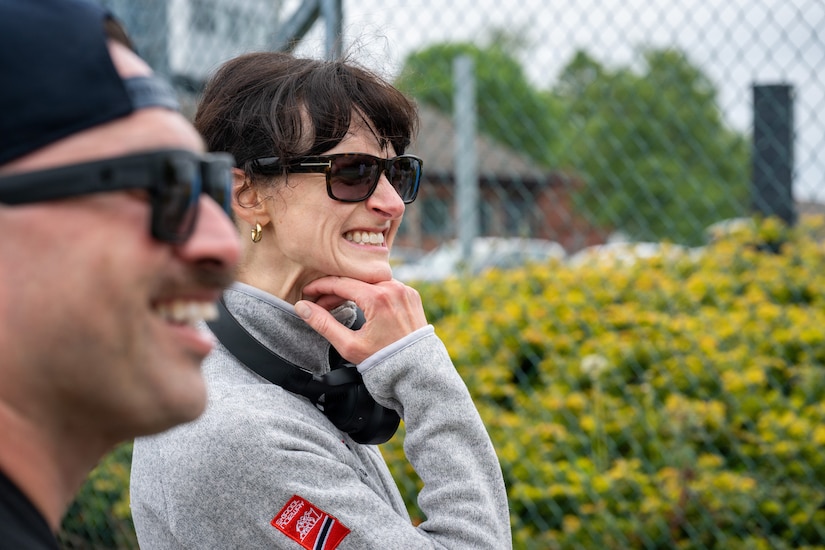
A close-up of a man and a woman in athletic attire and sunglasses smiling, while standing outside.

"I will most remember the great camaraderie we had together, both in the office and on the mountain," he said. "That is a special team of people that I feel lucky to have been part of."

As the final runners crossed the finish line during the morning June run and conversations shifted from race times to lunch plans, the trail grew quiet once again. The mountain remained, waiting for the next group of airmen ready to take on the climb.

Thursday, March 19, 2026

Fit to Fight, Fit to Finish: 18-Time Marathoner Models Air Force Readiness

The sound of pounding feet on asphalt synchronized to Air Force Senior Master Sgt. Tiffany Hallmark's heartbeat as she crossed the mile 20 mark. Doused in sweat, stomach involuntarily empty since mile 7, Hallmark anguished through the final 6.2 miles toward the finish line. In her 18th marathon, she knew the feeling of triumph would follow this pain.

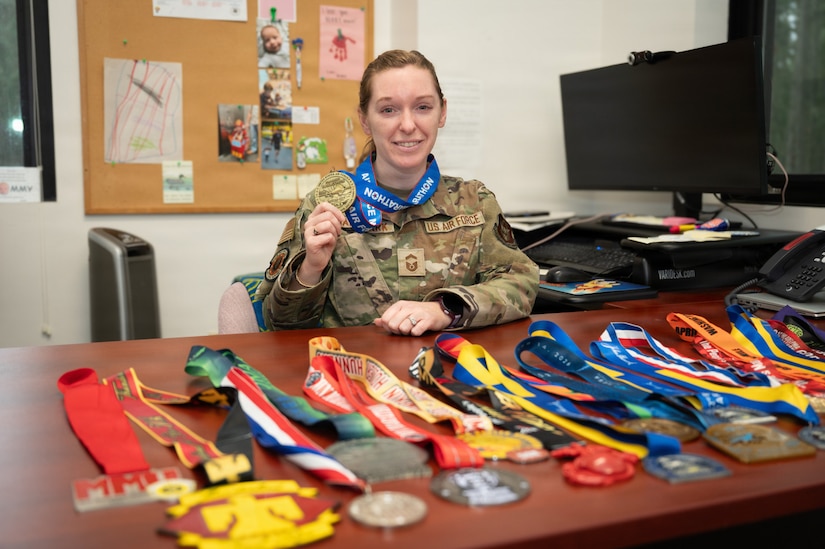
A woman wearing a camouflage military uniform sits at a table with multiple racing medals and awards. The woman is holding up one of the medals as it hangs around her neck.

"At some point in every one of those races I've wanted to walk off the course," she explained. "And I can tell you there have been many points in my military career when it'd been like that ... but it's about being able to persevere through those hard things while also concentrating on what you're in right now." 

This mental resilience has been crucial during her diverse Air Force career. She credited her success to mindfulness and treating professional challenges like miles in a race. 

"When you're running, it's about concentrating on the mile you're running right now," Hallmark said. "I know I have 20 miles left, but I am only going to think about mile 6. And so, in the military, I've really tried to do that."

That focus is the bedrock of a grueling training regimen that precedes every race. Preparing for a marathon is a monthslong commitment involving more than just long-distance runs.

A woman wearing athletic gear jogs around a track.

Hallmark's typical training week consists of speed workouts, tempo runs to build endurance, recovery days, cross-training and one progressively longer run that can last for hours — all supported by a strict focus on nutrition and hydration. Her daily running habit evolved into a more balanced and sustainable approach to fitness. 

"Before I had my kids, I was running 80-90 miles a week and the amount of food you have to eat for that is ridiculous," she confessed. "Even though I was eating what most people would consider, for my weight and size, an insane amount of food … it was not enough."

Running has always been a constant in Hallmark's life, something she can rely on. But finding the balance of fitness that works for her body, mind and busy schedule was a challenge. Now, she compares her running routine to being as normal as having a morning coffee. 

"Now that I have a coach helping me, I am running 55 miles a week," she said. "My weight maintains, and I feel strong on my runs."

A woman wearing athletic gear bends down to tie her sneakers.

That philosophy of finding a balanced, effective approach extended directly to her work. As the chief of cyber operations for the 446th Force Support Squadron at Joint Base Lewis-McChord, Washington, her leadership focuses on her people. Air Force Senior Master Sgt. Dwyane Williams, her noncommissioned officer in charge, praised her mentorship.

"Hallmark exemplifies the Air Force core values, and she motivates us in more than just fitness," Williams said. "She is a great asset to the team." 

Her holistic approach to readiness embodies a recent shift in the service. The Air Force introduced new standards and scoring models to its Physical Fitness Readiness Program. This new program is designed to better prepare airmen for modern challenges and to help them stay healthy for their entire careers. 

For Hallmark, this focus on the whole person has always been her primary mission.

A woman wearing athletic gear jogs around a track.

"We are all giving something to the military, but I want to help my people become the best version of themselves too," she explained. "I am passionate about that, about taking care of people — that's what I want to do every day." 

In the end, Hallmark said every finish line crossed serves as a powerful reminder. That feeling of hard-won triumph as she crossed the finish line of that 18th marathon is what she strives to replicate in her squadron. By showing her people how to endure the race with a steady pace, she ensures they are not only fit to fight, but ready to finish strong, delivering the resilient and combat-ready airmen the Air Force needs to succeed.