Thursday, August 16, 2018

New York, Pennsylvania Guardsmen Assist Flood Response Efforts


By Eric Durr, New York National Guard

BINGHAMTON, N.Y. -- Two hundred New York National Guard soldiers and airmen were placed on state active duty yesterday after nearly seven inches of rain fell on parts of the state’s Finger Lakes region Aug. 14.

New York Gov. Andrew M. Cuomo ordered the guard response as the state declared a disaster area in 14 counties in the Finger Lakes area and counties in New York’s Southern Tier region, where heavy rains caused streams and lakes to rise. The declaration allows the state to move assets -- including National Guard members -- to assist local governments.

On Aug. 14, 30 airmen from the 174th Attack Wing, based at Hancock Field Air National Guard Base in Syracuse, were deployed to Ovid, New York, to assist local governments there in clearing debris. A priority was to clear roads and keep drainage ditches and culverts from clogging and overflowing.

Flood Response

The 204th Engineer Battalion in Binghamton mobilized 25 soldiers with high-axle vehicles for immediate storm response. The Susquehanna River flows past Binghamton, and the river’s water level was 4 feet over flood stage at one point before it subsided later on Aug. 14.

Yesterday, an additional 150 soldiers and vehicles were placed on duty in Auburn, Binghamton, Walton and Horseheads, New York. All elements were equipped with military vehicles capable of negotiating flooded areas. The soldiers came from additional companies of the 204th Engineer Battalion and the 102nd Military Police Battalion in Auburn.

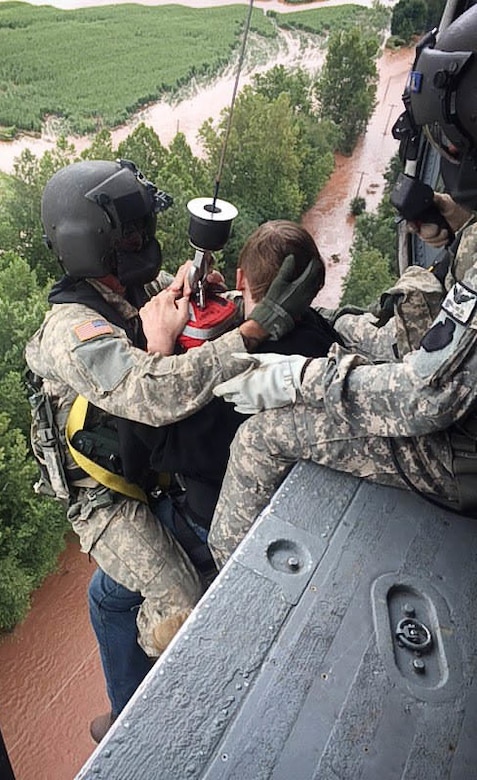
The New York National Guard also placed an additional 50 members of the 369th Sustainment Brigade on standby at Camp Smith Training Area in the Hudson Valley near Peekskill, New York. The New York Army National Guard also has two UH-60 Black Hawk helicopters with hoist capability standing by at the Rochester International Airport Army Aviation Support Facility.

The Finger Lakes region of New York stretches through the middle of the state and includes 11 lakes, the longest of which is 38 miles long. The region is a major tourism destination and wine industry center.
In Pennsylvania, where National Guard assets have been mobilized for several days because of flooding, aerial rescues took place Aug. 14 in the Benton area north of Bloomsburg, where three helicopters with a group run by the National Guard and the state Fish and Boat Commission performed about 10 rescues, including people plucked from the roofs of their homes, according to the Pennsylvania Emergency Management Agency.

Wednesday, August 15, 2018

Face of Defense: Transportation Specialist Enjoys Job, Furthers Education


By Army Sgt. Claire Charles, 109th Mobile Public Affairs Detachment

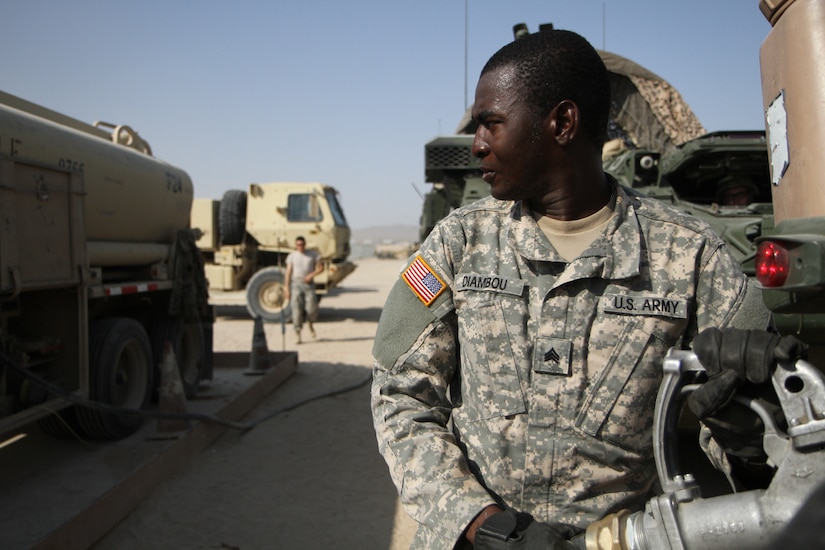
FORT IRWIN, Calif. -- Army Sgt. Siaka Diambou was born in Mali and immigrated to the United States eight years ago to seek an education and provide a better life for his wife and daughter.

Now a motor transport operator for the Pennsylvania Army National Guard’s 1067th Composite Truck Company, 213th Regional Support Group, Diambou played a key role in his unit’s sustainment mission at the National Training Center here.

The Fort Irwin National Training Center is the Army’s premier training center. Soldiers train here to conduct counterinsurgency and counterterrorism operations in desert environments. Complex scenarios test every aspect of unit readiness, including solving social, ethical and moral dilemmas presented by operating in civilian areas while facing near-peer opposing forces and insurgent forces.

Ready to Train

To ensure the units assigned to the 213th Regional Support group were properly equipped and ready to train, Diambou and his soldiers received equipment from Marine Corps Logistics Base Barstow’s Yermo Annex, located 35 miles south of Fort Irwin, and convoyed trucks and unloaded supplies.

“I find my job very exciting and satisfying because I transport key supplies, such as food, clothing, fuel and equipment, to the units I am assigned,” he said.

Diambou said he not only enjoys his job, but has taken advantage of the educational opportunities available to National Guardsmen.

He qualified for the National Guard’s Commercial Driver’s License Program and enrolled at the Aviation Institute of Maintenance.

He plans to continue his military service and use his certification as an aircraft technician in the aviation field.
“As a soldier,” Diambou said, “I get to meet interesting people from all over the world, serve my country and make my education and career dreams come true.”

U.S., Kenyan Military Dog Handlers Share Knowledge, Experience


By Navy Petty Officer 2nd Class Timothy M. Ahearn, Combined Joint Task Force Horn of Africa

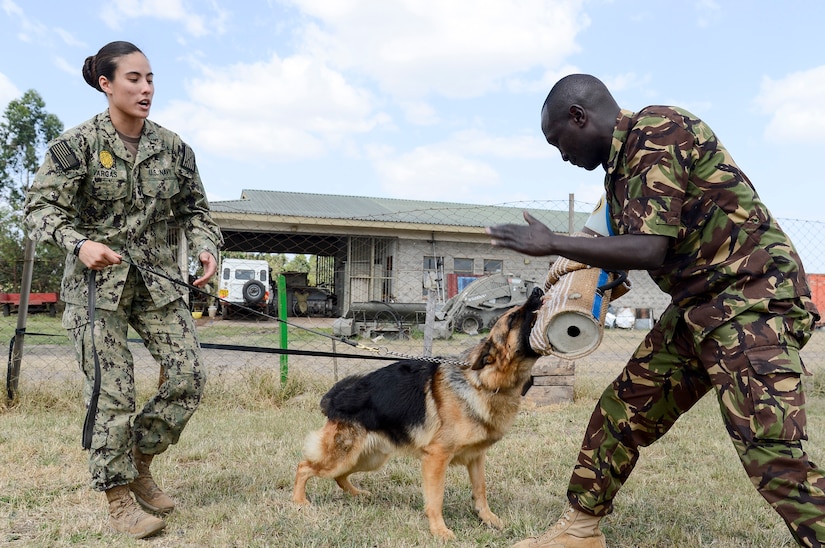
NAIROBI, Kenya -- Kenyan and American service members teamed up at the Kenyan army’s 1st Canine Regiment headquarters here to share the best ways to treat and train military working dogs in the field, Aug. 6-10.

A U.S. Army veterinary team assigned to Combined Joint Task Force Horn of Africa’s 404th Civil Affairs Battalion’s Functional Specialty Team and a U.S. Navy military working dog kennel master based at Camp Lemonnier, Djibouti, took part in the training.

Founded in 2012, the 1st Canine Regiment’s mission is to provide dogs as a force multiplier in war and peacetime in order to address the current threat of asymmetric warfare. To that end, they specialize in explosive detection, patrolling, road and building clearance, and search and rescue, said Kenyan army Maj. Marion Amulyoto, a veterinarian with the 1st Canine Regiment.

Dangerous Work

“We have been a valuable resource to our commanders, especially along the borders,” Amulyoto said. “Our explosive detection dogs deter violent extremists, because they are able to pick up on residual odors from explosives.”

This mission often brings dogs and their handlers to the Kenya-Somalia border to deter transnational threats, such as poachers, and violent extremist organizations, said U.S. Army Maj. Steven Pelham, the veterinarian officer in charge with the 404th Civil Affairs Battalion FXSP.

The FXSP veterinarians’ portion of the exchange included information on bandaging, wound care, heat stroke, canine CPR, fractures and suturing. The 1st Canine Regiment veterinarians shared their knowledge of the dangers the dogs face, specifically in East Africa.

“Heat injuries and threats from wildlife our dogs do not normally encounter, such as snakes, spiders and scorpions, are likely, given the environment that the U.S. and Kenyan MWDs operate in East Africa,” Pelham said, “We want to ensure that all MWD handlers recognize and treat their partners in case they suffer from these injuries.”

This exchange also marked the first time that members of the 1st Canine Regiment could share knowledge with a U.S. Navy dog handler.

Common Ground

“I am really excited to work with the 1st Canine Regiment’s MWD handlers; to share working knowledge with our Kenyan partners is an amazing opportunity,” said Navy Petty Officer 1st Class Kristina Vargas, a master-at-arms and Camp Lemonnier’s kennel master.

While learning the various techniques that the 1st Canine Regiment uses in their daily operations, Vargas shared knowledge of basic explosive detection, patrolling, building clearing, and improvised explosive device recognition.

Vargas said it is easy to find common ground among military working dog handlers, regardless of what nations the handlers are from.

“When you get MWD handlers together, regardless of their branch of service, or even if they are from another country, at the end of the day we are all dog handlers helping out dog handlers, we share the same passion for our respective MWD programs,” she said.

Kenya is the only country in East Africa with a canine unit organic to its military. Learning from one another helps both the 1st Canine Regiment and CJTF-HOA to maintain security and stability in their shared area of operations.

“We are very grateful to CJTF-HOA for this exchange program and we hope to have more in the future to better both of our capabilities,” Amulyoto said.
Vargas said the exchange strengthened the relationship with a key East African partner. The Kenyan dog handlers can incorporate the training into their existing working dog program to help counter threats from violent extremists and promote national and regional security.