Thursday, April 19, 2018

Face of Defense: Army Helicopter Mechanic Earns Officer Scholarship


JOINT BASE LEWIS-MCCHORD, Wash. -- In 2010, the most destructive earthquake in Haiti’s history struck the Caribbean island, killing more than 100,000 people and leaving about 1.5 million others homeless.

Sixteen miles from the 7.0 magnitude earthquake’s epicenter, Army Spc. Carl Denis and his family, natives of Port-au-Prince, Haiti, were among the people suffering in the aftermath.

More than eight years later, he is one of four soldiers in the 7th Infantry Division selected this year to receive a Green to Gold scholarship to be a commissioned officer upon college graduation.

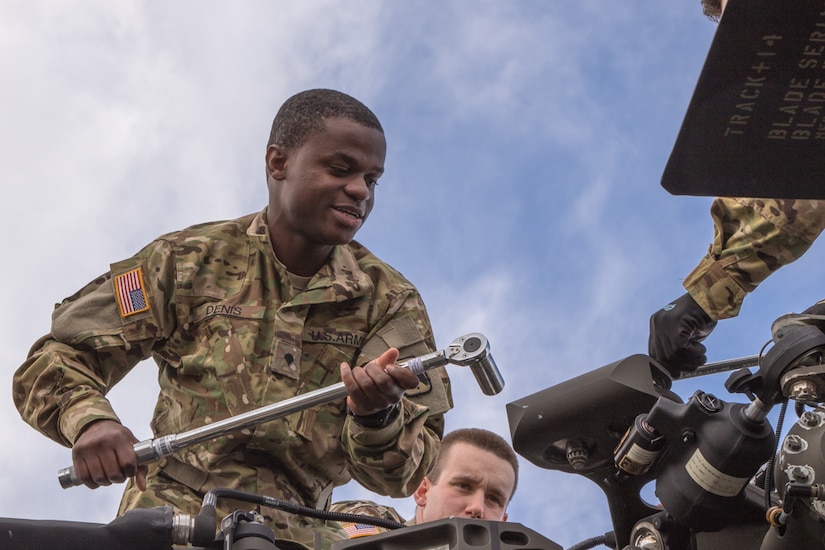
Green to Gold is a two-year program that provides eligible active duty enlisted soldiers an opportunity to complete a baccalaureate degree or a two-year graduate degree and earn a commission as an Army officer. “It was my own determination that helped me out and my initiative as well,” said Denis, who works as a mechanic repairing UH-60 Black Hawk helicopters with the 2nd Assault Helicopter Battalion, 158th Aviation Regiment.

'Like an Impossible Feat'

“When I finally got the [scholarship] letter, it was pretty much like an impossible feat that came into reality,” he said.

This achievement continues his path forward.

Denis will enroll at Arizona State University this fall to major in information technology with a focus on cybersecurity.

“When I commission, I plan to enter the cyberwarfare field, which is a pretty new career field in the Army,” Denis said.

Commitment, Dedication

The competition to receive a Green to Gold Scholarship is fierce, and it takes commitment and dedication to earn the scholarship -- both common concepts to Denis.

From his humble life in Haiti, at age 16, Denis moved to the United States shortly after the natural disaster. As a teenager, Denis struggled to speak English. “It wasn’t a language I spoke regularly in Haiti,” he said. “I knew some English, but I wasn’t as proficient as I am now.”

Despite the adversity, Denis took advantage of his bilingual skill, joining the Army through the Military Accessions Vital to the National Interest program.

“I enlisted under the MAVNI language program because I speak Creole,” Denis said. “I received my citizenship when I graduated [from basic training].”

Despite living in an earthquake-stricken country and immigrating to a country with an unfamiliar language, Denis continues forward down his path.
“It’s great to see a young soldier like Specialist Denis receive the Green to Gold [scholarship],” said Army Sgt. 1st Class Sakpraneth Khim, Denis’ flight platoon sergeant. “We always want our soldiers to do better than us. He is a shining example of that.”

Service Dog Lends War Veteran a Helping Paw


TRAVIS AIR FORCE BASE, Calif. -- What if you are screaming for help, but no one can hear you? What if your life starts to crumble? Do you know where to turn or what options are available to veterans and service members?

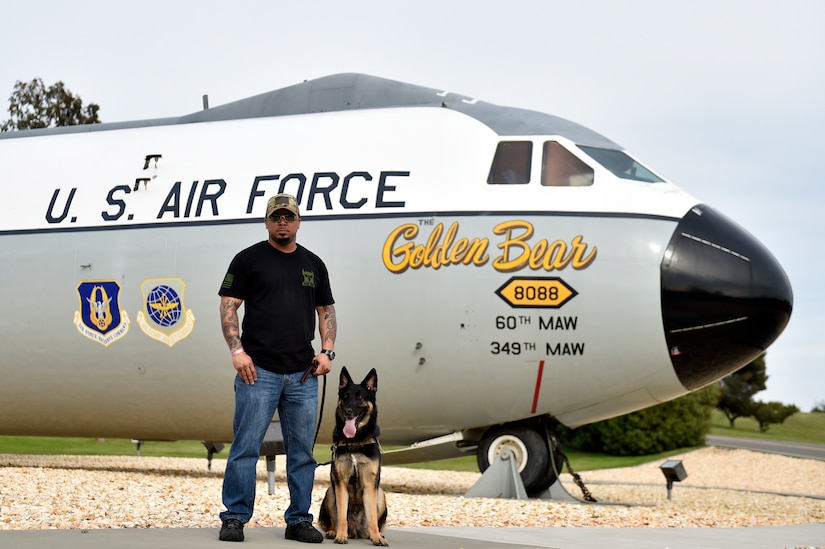
That is exactly how retired Air Force Tech. Sgt. Brandon Jones felt as he reached a breaking point in his military career and decided it was time to reach out to military agencies to get the help he desperately needed.

Jones reminisced on his childhood days growing up in Fayetteville, Georgia, and his love for airplanes.

“My dad would take me to the store and ask what I wanted for my birthday,” Jones said. “I would always pick an airplane. I just loved them so much.”

Post-Traumatic Stress Disorder

His love for airplanes is what brought him into the Air Force where, he honorably served for 11 years until he was medically retired due to post-traumatic stress disorder. The National Center for PTSD at the Department of Veterans Affairs describes PTSD as a mental health problem that some people develop after experiencing or witnessing a life-threatening event.

Jones served seven tours overseas as a logistics planner in support of operations Iraqi Freedom and Enduring Freedom.

“The level of stress that the combat tours bring takes a toll on you mentally, physically and psychologically,” he said. “It was hard to come home and adjust.”

Jones said he found himself coming home and being angry all the time. All he wanted was to be left alone.“I’d often have nightmares and flashbacks about my comrades that didn’t get to come home with me,” he said. “I’d feel guilty, and I kept asking myself what I could have done differently?”

Seeking Help

After years of silence, he decided it was time to seek help; he reached out to the local chaplain and visited the mental health office. “I desperately needed help,” he said. “I was figuratively drowning and I needed a helping hand.”

While searching online for answers or others who might be going through the same problems, Jones found the link to a website for service dogs. He reached out to Carol Borden, founder and executive director of Guardian Angels Medical Service Dogs in Williston, Florida, hoping he could find the answer he had been looking for.

“My medications weren’t doing it for me, my counselors weren’t doing it for me, and the therapy wasn’t doing it for me,” Jones said.

Individually trained medical service dogs can be obtained through nonprofit organizations such as Guardian Angels, Freedom Service Dogs, K9s for Warriors and many other organizations that rescue, raise, train and then donate these service dogs to veterans. After reviewing his application, Borden decided Jones was the right candidate to receive a service dog.

“I want to make it possible for people like Brandon to get the help they need through our amazing dogs,” Borden said. “We custom train each one of our dogs to mitigate the challenges that someone might be having.”

Jones visited the dog farm weekly while waiting to be paired with the right service dog. He needed a service dog that could alert him during PTSD triggers and help him ease through those anxieties.

Apache Provides Comfort, Companionship

“Never did I think that I would have a dog that would help me get back to a stable life,” Jones said. “If I’m having nightmares, he will literally come and lick me until I wake up. When he senses an anxiety attack, he will put himself on me and he will force me to pet him.”

Jones credits his service dog, Apache, for saving his life.

“It’s been a life-changing experience for me,” he said. “He is the reason why I can go outside now. He is the reason why I can interact with people. And, most importantly, I can spend time with my family again.”

Jones urges others who may be going through a similar situation to reach out to military agencies that can help them get PTSD treatment.

“If one option doesn’t work, there is always something else available,” he said. “For me, the answer was getting a service dog. But every person heals differently. Find what works for you and know there is light at the end of the tunnel.”
No matter where you live, PTSD treatment in the Department of Veterans Affairs is available. According to the National Center for PTSD, each medical center within VA has PTSD specialists who provide treatment for Veterans with PTSD and there are nearly 200 specialized PTSD treatment programs throughout the country.

Gold Star Children Take on Business World Thanks to TAP


WASHINGTON -- With the help of a Tragedy Assistance Program for Survivors initiative, 12 Gold Star children participated in a variety of life-enhancing activities April 11-15 in New York City.

They met Wall Street executives on the floor of the New York Stock Exchange for the opening bell, toured CBS News headquarters with producers and news anchor Jeff Glor and visited National Football League headquarters with commissioner Roger Goodell.

“I got to see a new perspective of the world,” said Chelsea Briggs, from Kapolei, Hawaii. Gold star children have lost a parent while he or she was serving on active duty. Briggs is the daughter of Air Force Staff Sgt. Raymond Briggs, who died in an accident Dec. 1, 2010.

Briggs said being a member of TAPS and participating in events like this have helped her.

“In the beginning, it was really hard, just graduating from high school and starting college,” she said. “My dad was always the one to talk to me about going to college or how to do certain things in life when I get older. For TAPS to fill that void, it’s very special for me because I still have that connection. I have that part of my life where I can get that advice I need about growing up without my dad.”

Bridge From Childhood to Adulthood

The young adults were outfitted in business attire by stylists at Macy’s. This was TAPS’ way, sponsored by the NFL, to help establish the bridge from childhood into adulthood for those who must face that challenge without the guidance of their missing parents, said Bonnie Carroll, TAPS president and founder.

“We have to go through life differently. We’re no longer normal children. We don’t have that dad to teach us how to tie a tie,” said Wesley Greene, from Washington, D.C., surviving son of Marine Corps Lt. Col. David Greene, a helicopter pilot who was killed in Iraq on July 28, 2004.

At every stop, the 12 Gold Star children met with professionals in the careers they hope to pursue, and they spoke about the importance of public and government service as a leadership skill. These 12 Gold Star children are known as “legacy mentors.” They were chosen from hundreds of applicants, and they are now mentoring others. 
“Legacy mentors are extraordinary young adults who have sacrificed so much for our country, and it is inspirational that they have chosen to give back to grieving military children in a way only they can,” Carroll said. “They are living legacies of American service and sacrifice, and they honor their parent’s life by turning their grief into compassion for others. They are wonderful examples of resilience who will go on to do great things for our country.”