Monday, May 25, 2015

The Night's Watch: The blue and yellow ABHs


By Mass Communication Specialist Seaman Jessica Gomez

WATERS SOUTH OF JAPAN (NNS) -- After sunset, the Navy's only forward-deployed aircraft carrier USS George Washington (CVN 73) steams on into the night. The movement of aircraft never stops and Aviation Boatswain's Mates (Handling) or "ABH" night-check crew make this possible.

All ABHs wear yellow or blue shirts to indicate what their responsibilities are. As the day winds down, the ABH night shift "yellow shirts" and "blue shirts" are ready to start their day and work until the job is done.

All hangar bay ABHs start out wearing blue jerseys, holding the 'chock and chain' position of securing aircraft to the deck. Upon completion of various qualifications that include conflagration watch, tractor driver, elevator operator and "hot suitman," an ABH will earn a yellow jersey and become an aircraft director.

"At night, hangar bay [Sailors] conduct movement operations for aircraft, and more importantly, the maintenance we provide for the squadrons," said Chief Aviation Boatswain's Mate (Handling) Terrell Jones, hangar bay chief. "The most challenging part is not being able to accommodate every squadron, every night. We want to make sure everyone gets a fair share of maintenance and attention, but sometimes there's just not enough time."
ABHs are constantly in dangerous situations, and at times hangar bay night workers have to overcome additional obstacles during inclement weather.

"Being on the [aircraft] elevators is a very dangerous part of the job," said Aviation Boatswain's Mate (Handling) Airman Elijah Vann, from Fort Bragg, N.C. "You can't see anything. It's dark, raining and foggy, and sometimes waves can reach us on the elevator."

The night crew may not always get recognized for their work because it is usually unseen, but they know that what they do is important to the ship's overall mission.

"The crew works extremely hard night in and night out to help with the ship's mission," said Jones. "Their job is just as important as anyone else's, but sometimes it goes unnoticed because it's not seen. I tell my guys they're doing an amazing job, and as long as they know, that's all that matters."

"The day timers could not run without us," said Vann. "The night-check crews are pure animals. We train the blue shirts then the yellow shirts get briefed on the movement for the night. We move aircraft all night until the sun comes up, and sometimes even after that."

George Washington and its embarked air wing, Carrier Air Wing (CVW) 5, are on patrol in the 7th Fleet area of responsibility supporting security and stability in the Indo-Asia-Pacific region. George Washington will conduct a hull-swap with the Nimitz-class aircraft carrier USS Ronald Reagan (CVN 76) later this year after serving seven years as the U.S. Navy's only forward-deployed aircraft carrier in Yokosuka, Japan.

USS Antietam Practices Safety During Ammo On-Load


By Mass Communication Specialist 3rd Class Ricardo R. Guzman, USS Antietam Public Affairs

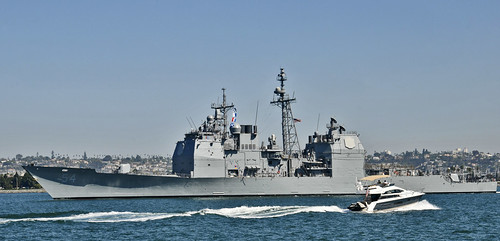
YOKOSUKA, Japan (NNS) -- The Ticonderoga-class guided-missile cruiser USS Antietam (CG 54) completed an ammunition on-load May 20, while at anchorage off of Commander, Fleet Activities Yokosuka.

Sailors assigned to Antietam's weapons department took charge of the shipboard evolution and were responsible for the planning of safely receiving and moving the ordnance within the ship.

"Safety is our number one priority," said Fire Controlman 2nd Class Jacob Kimble, a safety observer from Antietam's weapons department. "We have many safety observers on station ensuring the proper handling of tools, gear, rigging and line handling. Many of them provide hands-on training to the less experienced Sailors."

Prior to each shipboard evolution, a brief is held in the ship's wardroom where a variety of topics are discussed in preparation for the on-load.

"We've been planning this evolution for over a month" said Chief Sonar Technician (Surface) Michael Deleon, Antietam's ammo on-load safety officer. "We receive our briefs and training by personnel who are safety qualified, mainly officers and chiefs with experience."

The ship receives multiple types of ammunition at different locations, such as the forecastle, the flight deck, aft missile deck and fantail.

"We conduct multiple safety briefs at every location receiving ammo on the ship," said Kimble. "We train and qualify personnel in the specific armament the location is receiving. We do this by providing simulations, going through lessons learned and providing reading material."

The location of anchorage, sea state, weather and winds also play a major role in the successful and safe completion of the on-load.

"Sea states and winds can stop the evolution," said Deleon. "It can cause the armament to swing around in the crane which makes it difficult to maintain positive control."

Lack of communication and not paying attention is the biggest issue added Kimble.

"Everybody works hard during this evolution and makes sure we do everything by the book," said Deleon. "We don't want to mess up because that can make the evolution last longer. Cutting corners can omit steps that are paramount to safety. Our safety observers are there to guide personnel and make them aware of their surroundings."

With cranes moving ordnance overhead, it is imperative that Sailors receiving ammo on any ship should always keep their head on a swivel and pay attention to any discrepancy they may find.

"Every safe evolution is a good evolution," said Kimble. "If we have any issue, we'll try to fix it then and there. It doesn't matter how long it takes as long as we do it carefully and safely."

Antietam is on patrol in the U.S. 7th Fleet area of operations supporting security and stability in the Indo-Asia-Pacific region.

USS Chafee Deploys to 7th Fleet in Support of Maritime Security


From USS Chafee Public Affairs

WESTERN PACIFIC OCEAN (NNS) -- The Arleigh Burke-class guided-missile destroyer USS Chafee (DDG 90) entered the U.S. 7th Fleet area of responsibility (AOR), May 22, after departing from her homeport of Joint Base Pearl Harbor-Hickam, Hawaii, May 18.

Commanded by Cmdr. Shea Thompson, the ship and crew of more than 300 Sailors, is scheduled to conduct theater security cooperation engagements and maritime security operations while maintaining stability in the Indo-Asia-Pacific region.

"Chafee's fundamental mission is to conduct prompt and sustained combat operations at sea," said Thompson. "A disciplined and fearless crew, Chafee provides an agile, flexible, responsive and robust set of capabilities to the 7th Fleet AOR. We have spent a year preparing for this deployment and are ready for whatever tasking comes our way."

Chaffee's will initially participate in the Oceania Maritime Security Initiative (OMSI), a joint Department of Defense, Department of Homeland Security and Department of Commerce program, which supports maritime law enforcement operations to administer U.S. and Pacific Island Nations fisheries laws and the suppression of illicit activities.

Chafee is a multi-mission ship with strike warfare, anti-air warfare, anti-submarine warfare and anti-surface warfare capabilities designed to operate independently or with an associated strike group.