Friday, September 01, 2017

Hawaii National Guard Hazmat Specialists Sharpen Skills


By Air Force Senior Airman Orlando Corpuz, 154th Wing

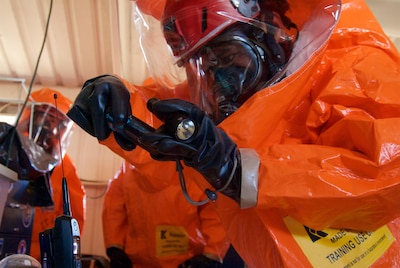
PACIFIC MISSILE RANGE FACILITY BARKING SANDS, Hawaii, Sept. 1, 2017 — Hazmat specialists from the Hawaii National Guard’s 93rd Civil Support Team, brought their unique capabilities here to participate in Kauai County Exercise 2017, Aug. 28-30.

The exercise is a chemical, biological, radiological, nuclear, explosive threat and response exercise. The three-day training event tested the coordination between federal, state, county and non-governmental units responding to natural or man-made hazmat incidents.

A host of first responders ranging from Kauai County Police and Fire departments, Hawaii Department of Health, Pacific Missile Range Facility, Kauai Emergency Management Agency, and National Guard civil support teams from Hawaii, Guam, Alaska and Utah came together to practice and validate the tactics, techniques, and procedures needed to effectively respond to a real-world CBRNE incident.

Civil support teams are joint Army and Air National Guard units designed to support local, tribal, state and federal emergency response organizations in the event of a large-scale terrorist attack or where specific technical capabilities to identify CBRNE materials are required. They also have access to other technical and analytical experts who can assist, if needed.

Collaborative Effort

“We are here to support the first responders in the event of a catastrophic event,” said Air Force Lt. Col. Alvin Sato, commander of the 93rd CST. “By working collaboratively together with the first responders ... the more times we work with them the more times we understand each other’s strength and weaknesses.”

Incident command during a domestic CBRNE event would fall to civilian authorities. It’s the job of the 93rd CST and the 57 other CST units spread throughout the nation to support civil authorities by identifying CBRNE substances, assessing current and projected consequences, and advising on response measures.

Large exercises such KCE17 are held throughout the year within different counties with planning starting one year in advance.

The Pacific Missile Range Facility, with its large area and multitude of structures allowed exercise planners to develop complex and challenging scenarios. Simulated drug cooking labs, hostile personnel, and bunkers with possible anti-personnel traps were some of the challenges posed to first responders.

Next-Level Training

“The exercise gave us the opportunity to push our new guys as well as our seasoned personnel,” said Air Force Tech. Sgt. Noah Raymond, a recon team leader with the 93rd CST. “It allowed all of us to bump up to another level and experience new positions and situations that we aren’t necessarily use to.”

As the science officer for the 93rd CST, Army Capt. Sean Cripps analyzed the data and intelligence collected by the joint teams sent into hot zones.

“My main duty is to provide technical advice on the hazards that are found and interpret the meaning and significance,” Cripps said. “I look at the downrange readings, the instrumentation data that’s collected, intelligence data and synthesis that into the ‘so what’ component…what is the impact of this to our public and to the response effort.”

KCE17 also included tabletop and demonstration sessions between the various agencies.

According to Cripps, being able to work with agencies from multiple levels was a valuable part of the experience.

“This is a great opportunity for us to work with our first responder community from the county, state, and federal levels. This is important because we always want to work with people before something actually happens.” he said.

The 93rd CST is made of eighteen Hawaii Army National Guard soldiers and four airmen from the Hawaii Air National Guard.

Mattis, Japanese Counterpart Discuss Latest North Korean Missile Launch


WASHINGTON, Aug. 31, 2017 — Defense Secretary Jim Mattis and Japanese Defense Minister Itsunori Onodera spoke by phone yesterday to discuss North Korea's launch of a ballistic missile over Japan on Aug. 28, chief Pentagon spokesperson Dana W. White said today.

In a statement summarizing the call, White said Mattis and Onodera agreed that this launch is "an unacceptable act that undermines security and stability in the region."

Ironclad Commitments

"Secretary Mattis reaffirmed that the United States' defense commitments to Japan remain ironclad, including its extended deterrence commitment," she added.

Mattis also underscored the U.S. commitment to assist Japan in enhancing its ballistic missile defense capabilities in the face of North Korea's escalatory actions, and both defense leaders agreed on the importance of trilateral cooperation with South Korea to strengthen deterrence and to maintain the peace and security of Northeast Asia, White said.

Face of Defense: Air Force Couple Takes Journey to Citizenship


By Air Force Staff Sgt. Chris Gross 14th Flying Training Wing

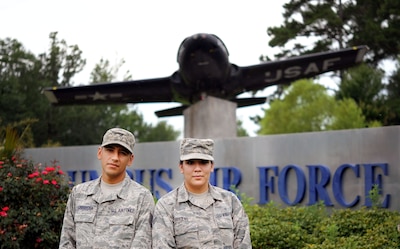
COLUMBUS AIR FORCE BASE, Miss., Aug. 31, 2017 — Air Force Staff Sgt. Luis Chiriboga and Airman 1st Class Estefania Briceno Ron travelled far from their former home in Ecuador and today they’re both airmen, U.S. citizens and married to each other.

Chiriboga is now an engineering technician with the 14th Civil Engineer Squadron here and Briceno Ron is a personnel and administration technician assigned to the 14th Medical Support Squadron here.

Chiriboga’s Journey

Chiriboga’s road to citizenship began much earlier than his wife’s. A native of Quito, Ecuador’s capital city, he arrived in Long Island, New York, with his parents and three brothers in 2003 when he was 15.

“A major part of why we moved is because [my] parents thought we were going to have a better future here than [in Ecuador],” Chiriboga said. He added that Ecuador was a very hard place for people to find jobs even with an advanced education and degree.

Moving to New York came with its challenges for Chiriboga and his family. His family had to overcome a language barrier and adjust to American culture, as well as find jobs to support themselves. His mom found a job cleaning houses with his aunt, who was already living in New York. His dad, who was a surgeon in Ecuador, found jobs sporadically and eventually started practicing natural medicine.

Chiriboga said he was surprised how young people were when they began working in the U.S. He said it seemed normal for someone to have a job at age 16, where in Ecuador, a 16-year-old would be focused on school.

To help pay for bills and rent Chiriboga and his three brothers all found jobs at a restaurant about a year after arriving in the United States.

“I was helping my mom and dad pay for the house; we were all trying to pitch in and pay for everything,” he said.

After graduating high school, Chiriboga earned his bachelor’s degree in digital electronics from Suffolk Community College, New York. Constantly going to work and school was eventually too much for him, he said, and he didn’t have enough time to focus on himself.

“I didn’t want to go to school anymore … by that time I was kind of working full-time and going to school full-time, trying to help my parents,” he said.

Chiriboga said knew he was destined to join the Air Force.

“I always wanted to join the Air Force since I was a kid,” he said as he recalled the countless times he passed a big mural of the Ecuadorian air force as he rode the bus on his way to school in Ecuador.

Enlisting in 2008, Chiriboga went on to receive his U.S. citizenship while stationed at Scott Air Force Base, Illinois. In fall 2009, he ventured to St. Louis by himself, where he and many others took the Naturalization Oath of Allegiance to the United States of America.

“I was pretty excited,” he said.

Marriage

While home on leave in 2010, Chiriboga attended a Christmas party with his parents. Briceno Ron and her family were also there. Although both were originally from Ecuador, they had not known each other previously.

The two began dating, and Chiriboga said their common life objectives and her goal-oriented drive is what attracted him to her.

They married in March 2011. Briceno Ron joined Chiriboga at Scott Air Force Base and the two would move to Joint Base Elmendorf-Richardson, Alaska, before moving to Columbus Air Force Base several months ago.

Briceno Ron’s Journey

Briceno Ron and her family moved to Long Island from Guayaquil, Ecuador, when she was 12.

Growing up, Briceno Ron said her family lived in Ecuador during a time when they changed from Ecuadorian currency to the U.S. dollar. Young at the time, Briceno Ron said, “When you are a kid you don’t notice stuff, but my mom said it was pretty rough.”

After arriving in New York, Briceno Ron also said the language barrier and American culture proved to be obstacles, just like during her husband’s transition.

After attending a primarily Hispanic middle school, she said the transition to high school was more difficult because not many people spoke Spanish.

“It was really hard to communicate with people … I was kind of like thrown in there to learn,” she said.

The big-city landscape was also an adjustment. Briceno Ron said the part of Ecuador in which she grew up wasn’t a big city and Long Island was a tremendous change for her.

“It was a different culture, I was used to little, tiny Ecuador,” she said.

After high school, Briceno Ron earned her bachelor’s degree in psychology. But school proved to be costly and she said it was time to look at another approach to help further her education, because she wants to earn her doctorate in clinical psychology.

That’s where the Air Force came in.

“I wanted to join for school, education; I wanted a way to pay for my doctorate,” she said.

Her husband, who at the time had eight years of service, was able to prepare Briceno Ron and ensure she was ready for the voyage ahead of her.

“He did a pretty good job of telling me, ‘Here’s what to do,’” she said.

Briceno Ron started basic military training in July 2016, and less than six months later she was in Memphis, Tennessee, accompanied by her husband, giving her Naturalization Oath of Allegiance to the United States of America.

She said giving her oath was a time filled with “mixed emotions, because I am the first one in my family to be a U.S. citizen. It [felt] good.”

Briceno Ron said her decision to join the Air force more than a year ago has opened many doors.

“I’m definitely grateful and I’m definitely thankful for the opportunities,” she said, “Like my citizenship, and by being able to do more than just being a resident.”

Briceno Ron said she’s now looking to earn her doctorate degree and to become an Air Force commissioned officer, something she said she couldn’t do before obtaining her citizenship.