Tuesday, June 01, 2021

Sport Heroes Who Served: Tennis Star Served in Coast Guard During WWII

June 1, 2021 | BY David Vergun , DOD News

Sports Heroes Who Served is a series that highlights the accomplishments of athletes who served in the U.S. military.

John Albert "Jack" Kramer was a World War II Coast Guard veteran who became a major tennis star in the 1940s. For several years, he was ranked No. 1 in the world.

A tennis player hits a ball.

Some of his many wins included:

  • 1940: U.S. Open (grand slam doubles)
  • 1941: U.S. Open (grand slam doubles and mixed doubles)
  • 1943: U.S. Open (grand slam doubles)
  • 1946: U.S. Open (grand slam singles); Wimbledon (grand slam doubles); Davis Cup (team competitions)
  • 1947: Wimbledon (grand slam singles and doubles), US Open (grand slam singles and doubles), Davis Cup (team competitions)
  • 1948: U.S. Pro
  • 1949: Wembley Pro

In the 1950s and 1960s, he was the leading promoter of professional tennis and a relentless advocate for the establishment of open tennis between amateur and professional players. 

Two men wearing military uniforms smile as they hold a newspaper and talk to two women.

Kramer also created the Men's Grand Prix points system. In 1972, he helped found the Association of Tennis Professionals.

He was particularly known for his powerful serve and forehand, as well as his ability to play "percentage tennis." This strategy maximized his efforts on certain points and in certain games during the course of a match to increase his chances of winning. The key was to hold serve at all costs, which was one of many things that made Kramer one of the greatest players of all time.

A man wearing a military uniform holds a rifle.

Born Aug. 1, 1921, in Las Vegas, Kramer enlisted in the Coast Guard during World War II in 1943 and was attached to a commissary supply depot in Long Beach, California. 

In early 1944, he transferred to New London, Connecticut, for Officer Candidate School at the Coast Guard Academy.

Military men pose for photo.

During his Coast Guard duties, Kramer played tennis matches to raise money for war bonds. A match against Army Air Force tennis player Don Budge raised $2.5 million in war bonds.

In late March 1944, Kramer was commissioned a Coast Guard ensign. He was assigned to Alameda, California, and then to Brisbane, Australia, in January 1945. In the summer of 1945, he embarked on a cutter in the Pacific. He was honorably discharged from the Coast Guard as a lieutenant in January 1946.

A tennis player poses for a photo.

Kramer wrote his autobiography "The Game: My 40 Years in Tennis" in 1979. In it, he calls Helen Wills Moody the best women's tennis player that he'd ever seen.

Kramer died from cancer on Sept. 12, 2009, at his home in the Bel Air neighborhood of Los Angeles. He was 88.

In the 2012 Tennis Channel series "100 Greatest of All Time," Kramer was ranked the 21st greatest male tennis player of all time.

Arlington Honors


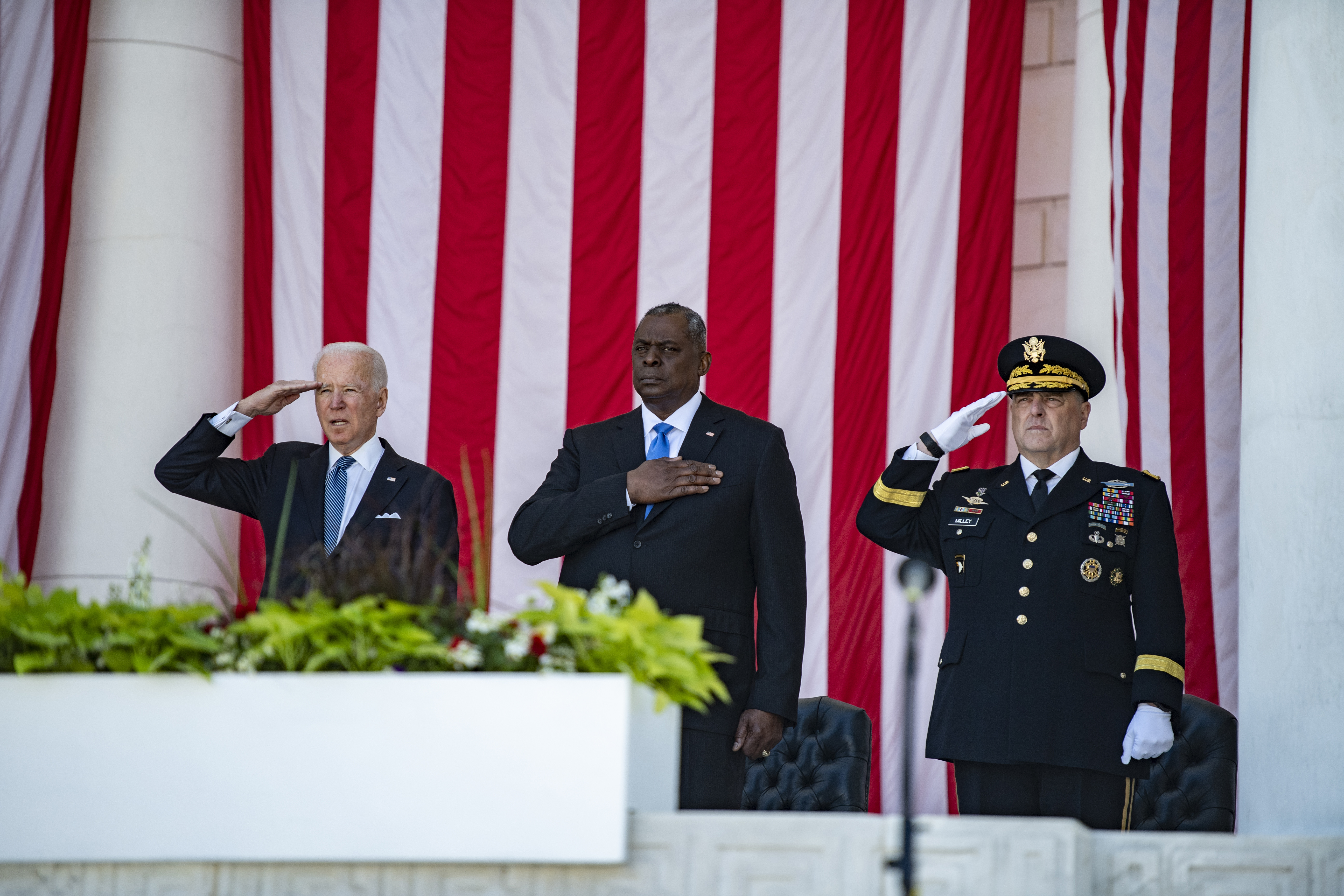
President Joe Biden, Secretary of Defense Lloyd J. Austin III, and Army Gen. Mark A. Milley, chairman of the Joint Chiefs of Staff, render honors during the Memorial Day ceremony at Arlington National Cemetery, Arlington, Va., May 31, 2021.

Department of Defense Press Briefing on the President's Fiscal Year 2022 Defense Budget for the Department of the Air Force

 May 28, 2021

Air Force Deputy Assistant Secretary for Budget Maj. Gen. James D. Peccia III and Associate Deputy Assistant Secretary for Budget Carlos Rodgers, Office of the Assistant Secretary of the Air Force for Financial Management and Comptroller

STAFF:  Good afternoon, ladies and gentlemen.  I'm Captain Jacob Bailey with Secretary of Air Force Public Affairs.  In just a moment Major General James Peccia, Deputy Assistance Secretary of Budget will be presenting the Department of the Air Force Fiscal Year 2022 President's Budget Overview briefing.  If you were unable to pick up a packet of budget materials earlier please get with me I'll be sure you get one.

Following the briefing, Major General Peccia and Mr. Carlos Rodgers our Associate Deputy Assistant Secretary of Budget will be taking your questions.  In the interest of time and so that we can get through as many questions as possible I ask that you limit it to one and one follow-up. We also have reporters joining us virtually today and we'll be taking their questions as well.

Without further ado, Major General James Peccia.

MAJOR GENERAL JAMES D. PECCIA III:  Thank you.  Good afternoon, ladies and gentlemen.  I'm Major James - Major General James Peccia, the Deputy Assistance Secretary for the Air Force for Budget and I'll be rolling out our Air Force's portion of the President's for FY '22. 

If we could go to the first slide, please; the Department of the Air Force fiscal year 2022 budget request $173.7 billion to accommodate the Department of the Air Force's ability to operate jointly across all domains, the development of the United States Space Force, the recapitalized elements of the nuclear enterprise and to accelerate weapon system modernization. 

The focus is not only on the capabilities needed today but also those required for future competition.  Necessary risk is taken in legacy missions to enable the investment in modernization required to outpace our adversaries in the 2030 timeframe.  During today's presentation I will address the strategic environment, priorities in (themes ?) used to build the Department of the Air Force budget along with the appropriation details.

Next slide, please.  Without the Department of the Air Force's unprecedented control of the air and space domains no other U.S. military mission can enjoy full freedom of maneuver.  The Air and Space force have the unique ability to project power from afar independent of forward access and lengthy prepositioning timelines. 

The strategic environment is rapidly shifting as a result of global health and climate crisis, declining resources and rapid technology development.  China and Russia continue to be aggressive in their effort to negate long enduring U.S. war fighting advantages while challenging the United States interest in geopolitical position.  The Department of the Air Force has to be ready to deter our competitors attempt to hold the U.S. homeland at risk with unconventional, conventional and even nuclear forces. 

Amidst an environment of exponential technological advancement, the Department of the Air Force must continue to adapt and move with purpose now to win tomorrow.  The foundation of this budget request is the Secretary of Defense's priorities, the Air Force core missions and the Space Force mission focused areas.  The Department of the Air Force efforts are guided by the three overarching Department of Defense priorities of defending the nation, taking care of people and succeeding through teamwork.

Next slide, please.  Secretary of Defense Austin has stated, we need resources to match strategy, strategy to policy and policy to the will of the American people. As illustrated, F.Y. '22 budgetary programs are aligned to the interim national security strategy and the Secretary of Defense's priorities.  The Department of the Air Force is committed to investing in empowering airmen and guardians, capability-focused modernization, connecting the joint force, and expanding partnerships.  This budget is the beginning of a journey to the Air and Space Forces of 2030.

The F.Y. '22 budget provides the Joint Force with an unequivocal advantage in air power and space power.  This budget funds the Space Force as an equal branch of the armed forces, developing the capabilities, war fighting doctrine, and expertise needed outpace future threats.  Also this budget focuses on capability-focused modernization which will allow the United States to continue to negotiate from a position of strength.

I'll get into the specifics of these highlights as we look at the budget breakdown by appropriation, but first I'd like to turn your attention to the overall details of this budget request.  Next slide.

In the following charts you'll see two sets of numbers with the F.Y. '21 enacted budget request on the left and the F.Y. '22 president's budget request on the right.  The stacked columns here highlight the department's budget request, consisting of the Air Force and Space Force budgets.  The direct war and enduring costs formally broken out as Overseas Contingency Operations or OCO are called out to the right of each bar chart.  In F.Y. '22 these amounts are included in the baseline operations or baseline appropriations.

Looking at the bar chart for F.Y. '22, excluding the $39 billion in non-blue funding, the Department of the Air Force is requesting $173.7 billion.  This is a $5.5 billion or 3.3 percent increase over the '21 enacted budget.  The Air Force budget of $156.3 billion is 2.3 percent increase over F.Y. '21.  And the Space Force budget of $17.4 billion is a 13.1 percent increase over F.Y. '21.

On the right side of the slide the upper pie chart breaks out the Air Force baseline and Space Force baseline by appropriation. The next slides will detail our efforts with a look at each appropriation for the department's budget request.  Next slide, please.

On each appropriation slide you'll see a similar format.  The funding tables now show the overall department budget by Air Force and Space Force.  You'll also see key budgetary highlights for the department and for both services. 

Operation and maintenance is the largest appropriation, making up 38 percent or $66.6 billion of the overall budget. These dollars go directly toward funding day-to-day operations and are critical to sustaining readiness.

The $3.1 billion in growth from F.Y. '21 is largely driven by increases to civilian pay, mission support, installation support and facilities sustainment, restoration and modernization.

This request continues to prioritize investments in people, the Department of the Air Force's greatest resource.  First, it funds an additional $542 million to support a 2.7 percent civilian pay raise, 1 percent civilian award increase, and a 1 percent federal employees retirement system increase. 

Additionally the budget funds $94 million to increase several training efforts to include the establishment of joint all domain training, learning next innovation, and investing in Wi-Fi service facilities to improve training centers. Also, the Air Force continues its initiative to transform its information technology model into an as-a-Service construct with a $383 million increase.

This effort allows airmen to focus on employment and defense of networks rather than maintenance.  This budget also takes action to address the difficult challenges of sexual assault, suicide, and disparate treatment of airmen and guardians.

Funding is increased by $7.7 million to develop prevention programs within the Department of the Air Force focused on the prevention of readiness detracting behaviors, including sexual assault, interpersonal violence, and self-harm.

Additionally, $6 million is added to the diversity and inclusion initiatives to include new training and recruiting scholarships.  The Department Air Force Facility, Sustainment, Restoration and Modernization Program increases by $687 million and maintains a facility sustainment baseline funding level of 80.2 percent.

In line with the Secretary of Defense's priorities of tackling the climate crisis this budget funds an additional $23 million for climate and energy assessments to include funding for electric vehicles and charging stations.

Air Force weapon system sustainment requirements continue to grow due to our aging platforms and acquisition of new, highly technical, and complex weapon systems.  The Air Force weapon system sustainment request is $15.4 billion and funds 83.7 percent of the requirement. This request sustains 109 programs from the newest F-35s to the oldest B-52s.

Turning to the Space Force, the F.Y. '22 O&M budget grows by $837 million.  Weapon system sustainment increases by $68 million to fund 79.1 percent of the requirement.  This budget adds $20 million to establish the National Space Intelligence Center to address the growing threat to U.S. space-based equities and adds $6 million to increase the analytic capacity of the Space War Funding Analysis Center.

Major transfers to the Space Force include $143 million for satellite communication and a combined $347 million for facility operations, facility sustainment, restoration, and modernization.  Additionally, this budget includes $313 million for radar and optical space domain awareness operations and data integration.

Bottom line, the operation and maintenance prioritizes people, sustains department readiness, and funds daily operations while advancing the Space Force.  Next slide, please.

Total military end strength for F.Y. '22, which includes Air Force active, guard, and reserve and Space Force active duty, is 515,300 military members.  The Department of the Air Force military personnel request is $38.4 billion, which is $942 million more than F.Y. '21.

The F.Y. '22 request increases the Department of the Air Force end strength by about 3,400 personnel.  The main driver is attributed to the retention of medical personnel.  The F.Y. '21 National Defense Authorization Act delayed reduction of the medical personnel due to the impact it would have on pandemic support operations.

The F.Y. '22 request also includes a $2.7 million or 2.7 percent military pay raise, a 3.8 percent increase to the basic allowance for housing, and a 2.3 percent increase to the basic allowance for (assistance ?).  Additionally, this budget funds $1.2 billion for the permanent change of station moves, and $573 million for bonuses of critically manned career fields.

The funding represents an investment in airmen and guardians, and assist in attracting and retaining high quality recruits to support technology driven services. And this request as Space Force grows by nearly 2,000 to 8,400 guardians. This is largely driven by mission transfers from the Air Force, Army, Navy - and Navy. Also, the Air National Guard increases by 200 personnel for logistics, special operations, rescue, special warfare, cyber, and intelligence.

Now let's turn to research, development, test, and evaluation. Next slide please. The department RDT&E request for FY '22 is $40.1 billion. This is a $3 billion increase over the FY '21 enacted levels. The Air Force portion of the budget request is $28.8 billion, a $2.2 billion increase, largely driven by the modernization - modernization efforts in nuclear and air superiority programs.

To retain a high - highly reliable and secure deterrent, the nation must replace the Minuteman-III. This budget adds $1.1 billion for ground-based strategic deterrent to ramp up engineering, manufacturing, and development activities for a 2029 initial operating capability and a 2036 full operational capability. Additionally, the budget increases long-range standoff weapons development by $224 million to keep the program on track.

This budget also adds $48 million for the nuclear command, control, and communications programs. The Air Force also - request also continues to invest in air superiority with next generation air dominance and hypersonic capabilities. NGAD is not a single platform, but a mix of capabilities including manned and unmanned aircraft.

Its budget grows NGAD by $623 million and supports the design efforts in advanced open system architecture, radar, infrared sensors, resilient communication, and air vehicle technologies. NGAD will provide survivability, lethality, and persistent whilst seamlessly integrating with the advanced manage - battle management system.

Additionally, hypersonic weapons development increases by $52 million to fund the southern cross integrated flight research experiment and air breathing prototype in partnership with Australia, and the hypersonic attack cruise missile prototype while continuing to fund the airlines rapid response weapon for an early operational capability in 2022.

Other Air Force RDT&E areas of note include growth for the B-21, B-52, F-35, ABMS, and climate initiatives. This request adds $46 million for upgrades to increase aircraft fuel efficiencies to assess alternative fuel options. This budget progresses toward the bomber force of the future with the new B-21 and modernization of the B-52.

The B-21 program increases by $30 million to fund two test aircraft and scale manufacturing for initial production. $233 billion is added to the B-52 budget for the most comprehensive modernization in its history, including new engines, new radar and communications systems.

Looking at the F-35, the budget continues to build a cornerstone of air superiority with a $239 million increase for technical refresh three and block four capabilities needed to counter rapidly evolving threats.

Moving to ABMS, this budget requests a $46 million increase to add - continue - or to continue building a secure digital network, enabling sharing of data across fifth-generation tactical aircraft and providing superior situational awareness to KC46 and command-and-control notes.

ABMS is the Department of the Air Force primary technology enabler of JADC2. Continued ABMS investment will allow delivery of multi-domain secure processing and data management, connectivity, and applications to synchronize sensors, shooters, and networks for the joint force. On the next slide, we'll look at the Space Force RDT&E. Next slide, please.

The request for Space Force is $11.3 billion, a $725 million increase over FY '21. In addition to growth and classified programs, next-generation overhead persistence infrared grows by $132 million, providing initial launch capability for the first polar satellite in 2028.

This creates a resilient constellation when combined with the geosynchronous satellites and associated ground system to increase missile warning, missile defense, battle space awareness, and technical intelligence. Additionally, funding for deep space advanced radar capability increases by $90 million to detect, track, and maintain custody of deep space objects.

An additional $14 million is also added to upgrade legacy ground-based optical and radar systems. These upgrades modernize space domain awareness data transport to enable decision-making on tactical timelines. This budget increases protected tactical SATCOM by $43 million to develop capabilities beyond the current advanced extremely high frequency system to provide worldwide secure, jam resistant, and survivable communications.

This request also adds $75 million to enterprise ground services, also known as EGS, to provide cyber secure tactical command-and-control for all Space Force satellite programs by 2028. An additional $53 million is added for military GPS user equipment, developing receiver circuit cards to provide war fighters with secure and accurate positioning, navigation, and timing data in contested environments.

Like O&M, $37 million is added to the space war fighting analysis centers RDT&E budget for analysis, modeling, wargaming, and experimentation to generate new optional concepts and force design options for the Defense Department. Now let's look at highlights for procurement, next side please.

The Department of the Air Force procurement request is $25.6 billion, a $2.7 billion decrease from the FY '21 enacted level. This drop is a result of the department balancing sustainment and modernization with future procurement. Procurement funding increases include the JASSM-ER and the hypersonic air-launched rapid response weapon known as ARRW.

Additionally, the joint air to surface standoff missile budget request - request adds $211 million to ramp to maximum production capacity. ARRW is a new start, and $161 million is added to procure 12 weapons in FY '22. This budget continues to modernize the Air Force by replacing aging legacy aircraft and procuring the capabilities needed to meet readiness requirements.  This request continues recapitalization of the DOD's only combat search and rescue helicopter to purchase a total of 14 HH-60 whiskeys in FY '22.  This request also includes purchase of 40 F-35, 14 KC-46s, 12 F-15EXs, and three MC-130Js.  The Space Forts request is $2.8 billion, a $456 million increase over FY '21. 

$341 million is added to procure five national security space launch vehicles providing an assured access to space for the nation's war fighting and intelligent satellites.  It precures two GPS3 Three follow on space vehicles and increases technical support by $64 million to provide enhanced on orbit management.  These satellites provide new capabilities, including a spot beam, providing anti-jam improvement 100 times better than the current encrypted military code.  With this request, the Department of the Air Force strives to build and maintain a force capable of successfully challenging and deterring today's great power competitors while recognizing tomorrow's threats continue to evolve.

Next slide please.  Here we highlight the procurement quantities funded in the FY '22 request.  Several of these quantities I covered during the previous side, to summarize, this budget procures Air Force aircraft to modernize the fleet for a high-end conflict in 2030 and beyond.  Additionally, the Air Force is reducing munition procurements as program approach war fighter inventory objectives.  For example, the joint direct attack munition and small diameter bomb increment one are at or approaching healthy inventory levels.  Decreasing production of these weapons allows for increased investment in advanced weapons like (jazz ?) MER and hypersonics such as the Arrow Program.  Next slide please.

The military construction and family housing request increases by $1.1 billion in FY '22 and includes $185 million for enduring construction costs.  This budget focuses on accelerating installation readiness, resilience, modernization, and continues to prioritize planning and design funds to reinforce program stability and consistency.  This budget request continues to display the Department of the Air Force commitment to take care of the force and their families while also focusing investment on modern weapon system bed downs and enhancements to global war fighter capabilities. 

This budget funds 56 major construction projects, including six B-21, five F-35, three GBSD, two F-16, one KC-46, and one C-130J weapon system bed down across six bases.  Also included is $572 million for Indo-Pacific projects to increase joint force lethality and enhance the nation's posture in the INDOPACOM theater. 

Additionally, this request continues to focus on the health and safety of the Department of the Air Force members and their families, including $105 million in military family housing projects and $172 million for two new basic training dormitory complexes.  No cut in family housing or the final budget appropriation accounts.  Now we'll turn to the direct war and enduring costs.  Next slide please.

This slide highlights direct war and enduring costs.  While direct or enduring costs are now in the Department of the Air Force baseline budget, we separated the requirement for better visibility.  The first category is direct war, which includes direct combat support costs which will not continue when combat operations end.  The second category is enduring costs which include requirements for in theater and in conus activities likely to continue after combat operations cease. 

In total, the Department of the Air Force's request of $10.1 billion is $2.3 billion less than the FY '21 enacted amount.  The Air Force direct war request is $1.1 billion.  This includes ONM funds for combat operations, logistics and air mobility in line with evolving posture and troop level requirements.  This request secures one C-130J aircraft and one E-11 battlefield airborne communication node while replacing the munitions used during operations.  Also included in our T&E (funding ?) is a distributed common ground system and the Tactical Exploitation of National Capabilities Program.

The Air Force is $9 billion enduring costs request sustains multiple locations outside Iraq and Afghanistan and fund weapon systems sustainment in (life ?) with our requirements.  Additionally, this request includes $542 million for the European Deterrence Initiative which includes $185 million for the five MILCON projects.  Turning to the Space Force enduring costs, the 700 -- or the $76 million request funds deployed operations of space, electronic warfare, theater missile warning to deployed forces, and protected tactical satellite communications. 

This request continues to support worldwide operations and funds combatant commanders most urgent requirements.  Let me close with a few final thoughts before opening up to your questions.  Next slide please.  Air and Space dominance is not guaranteed.  We must be postured to fight and win in these domains. 

Without control of the air and space, no military mission can enjoy full freedom of maneuver.  The Department of the Air Force faces increasing budget pressure based on growing costs of sustainment for current and aging force structure, continuous combat operations, and long deferred modernization.  Continued prioritization is necessary in the context of key competitions over time. 

Decisions and trade-offs are framed with both near and long term view of what is needed to ensure the Department of the Air Force is prepared to answer our nations call, both today and tomorrow.  It is essential to right size aging, costly,  and less than capable legacy systems so we can build, deliver, and direct resources for the capabilities needed for future competition.  This budget takes action to empower airmen and guardians, modernize, connect the joint force, and expand partnerships to achieve success and secure the nation's future. 

We asked for continued partnership and support with Congress and stakeholders to make required changes to build the Department of the Air Force designed to act with the speed and indecisiveness necessary for continued dominance in the air and space domains.  Thank you, very much.  We'd be happy to take your questions. 

STAFF:  Thank you, sir.  All right, we'll open it up to questions.  Brian.

Q:  Thanks for doing this.  I was hoping to talk about the divestments...

MAJ. PECCIA:  Sure.

Q:  ... on the tankers.  Can you talk about what -- what is the schedule for these?  Will they be retired as KC-46s come online or are the divestments, kind of, front-loaded as the deliveries are pretty -- pretty slow?

MAJ. PECCIA:  Well -- and so the KC-46s are being delivered, as you know, already.  And we'll be continuing to deliver.  Part of it is to clear the way for ramp space for the KC-46s to come in.  Part of it is to use the manpower that is already in the KC-135 and KC-10 programs and transfer that over so we can get them trained and ready to go. 

So part of it is really to clear the way and to lead us -- or to give us some space for the KC-46s to come in.  And so within this budget for the -- for example, the KC-135, we're requesting a divestment of 18 and for KC-10s it'll be 10 -- I'm sorry, 14.

Q:  And on the A-10, are these 42 going to come from basically a couple units?  And will there be a mission backfill if that is the case?

MAJ. PECCIA:  So yes, that is the current plan, absolutely.

Q:  Steve Trimble, Aviation Week.  On the -- on the B-21, I think you said that there's money in there to buy two B-21 test aircraft?

MAJ. PECCIA:  That's correct.

Q:  Is that the advance procurement money for $108 (billion ?)?

MAJ. PECCIA:  Yes, Carlos, you...

(CROSSTALK)

ADAS (USAF) CARLOS RODGERS:  No, no.  So the -- so the development money will be used for the -- to built the test aircraft.

Q:  OK.  So we've already got two on the line, so that's four test aircraft total...

MR. RODGERS:  No...

(CROSSTALK)

MAJ. PECCIA:  No, two.  Two total.

Q:  There's already two on the line in (CON though ?).

MR. RODGERS:  That's...

(CROSSTALK)

MAJ. PECCIA:  Yes, it's the two.  It's the RDT&E for those two.

Q:  Oh, they weren't in previous budgets?

MR. RODGERS:  They're being built so they're part of the budget.  That's what was (set ?).

Q:  But that advance procurement, is that for one or two aircraft?

MR. RODGERS:  We can't disclose the number of aircraft, but.

STAFF:  (Rachel ?)?

Q:  So the Air Force has said that, you know, in part due to the pandemic you've had record-high retention and I'm wondering how that affected your (entry ?) numbers.  You know, it's up 3,600-ish...

MAJ. PECCIA:  Sure.

Q:  ... you know, but a much of that is medical people.  Did you say, you know, let's just keep it level this year?  Did you say let's only add a little bit?  You know, how -- how did that affect things?

MAJ. PECCIA:  Yes, so -- so definitely you're right.  I mean, the pandemic has slowed what we would see in terms of people leaving the Air Force and people have stayed in.  And to your point, it's up to 3,000 people in F.Y. '21. 

And so when we looked out into the future, I wouldn't say that played a part into our future end strength.  Our future end strength was really -- or the growth was really based on putting the medical personnel back in.  We've been paying for those medical personnel because they haven't actually left since F.Y. '20 but we've been paying for them in the year of execution. 

This year we've actually added the end strength back with the dollars and that will most likely be temporary, we'll see where we go within (next ?) year or so.  But if that program takes off and we do reduce those medical personnel they'll come out in future, most likely in '23.

Q:  OK, but outside of the medical people it didn't really have an effect on everything else, you mean?

MAJ. PECCIA:  No, no.

Q:  And for the flying hour program, you know, flying hours are down by about 87,000.  Can you talk about what's behind that and how that might affect training and ops?

MAJ. PECCIA:  So a couple of things, I think number one is the change in global posture overseas, right.  That reduced 66,000 of those 87,000 hours that you mentioned.  The other 22,000 hours were really risks that we could take on peacetime flying.

What we've done over the last several years is we've built our flying hour program to match what we believe our requirement is, but we haven't been able to execute that full amount.  So in F.Y. '21 we reduced the flying hours to actually execute more in line with what we can do in each given fiscal year.  In F.Y. '22 we've done the same thing but we've taken just a little bit more risk in the flying hours and lowered it by about 22,000 for peacetime missions.

Q:  Thanks.

STAFF:  OK, (Valerie ?).

Q:  Hi, so I wanted to ask about the combat rescue helicopter.  In F.Y. '21 the plan was buy 20 of those.  And so, you know, today you guys are only buying 14 -- or 14 in '22.  What is the reason for that?  Is there any issues in terms of development or production?

MAJ. PECCIA:  So no issues.  I think the enactment for F.Y. '21 was 19, I believe.  And then that was three more than we had planned.  It was put in our OCO program.  And so in F.Y. '22 we had reduced the quantity to buy down to 14 because we had bought three additional in F.Y. '21. 

We had hoped to buy a couple more with OCO this year but because of the changes in contingencies and our -- our posture downrange there's less funding in OCO.  And so we weren't able to add more back in.  But we're absolutely committed to the program.  We'll continue to buy the program of record out, and so there are no issues with the helicopter.

Q:  OK.  And for the...

MAJ. PECCIA:  And Carlos, anything that you'd like to add...

(CROSSTALK)

MR. RODGERS:  No, that...

MAJ. PECCIA:  ... to that?

MR. RODGERS:  ... that's correct.  There's -- no, it -- the fact that we are buying 14, it does not have any bearing on the status of the program.

Q:  OK.  And with the F-16s, can you talk a little bit about why those are being divested this year?  I mean with the F-15s we've heard quite a lot...

MAJ. PECCIA:  Sure.

Q:  ... about the structural issues there.  Haven't heard so much about F-16, why those should go immediately.

MAJ. PECCIA:  Yes, so these are -- we have well over 900 F-16s.  The F-16s that we're talking about here are pre-Block F-16s.  These are not aircraft that we'll be able to modernize and be able to use in a heavily contested environment in the 23 -- '30 time frame so that's why we're divesting these upfront.  And it's really to put a little bit of risk in the fighter force where we can to then reapply those dollars for modernized programs such as NGAD that will really be applicable in the 2030s and 2040s time frame.

Q:  Thank you.

STAFF:  (Jen ?)?

Q:  Thank you.  (inaudible) with state (news ?).  I have a question about the Space Force funding.  The...

MAJ. PECCIA (?):  Sure.

Q:  ... The Space Force got a significant increase and, you know, with DOD constrained by a flat budget, how were you able to allocate more funding to the Space Force?  Was money taken from Air Force programs, from other services programs?  How did you come up with that -- that amount to be able to increase the Space Force money?

MAJ. PECCIA:  Right.  So great question, a long answer -- I don't know if I'll be to get to all of it, but we'll get you a better answer so you can have the details.  But the bottom line is, so there's a $2 billion increase within the Space Force, half of that is related to transfers into the Space Force from Air Force, from Army, and from Navy.  I can give you a couple examples.

So the Wideband Enterprise SATCOM came from the Army.  That transferred into the Air Force.  MUOS program came from the Navy that -- or into the Space Force -- came from the Navy, transferred into the Space Force. 

A large chunk of that money that you see is Facility Sustainment, Restoration, and Modernization and Facility Operations.  That was in the Air Force O&M line and we had -- we had to use Air Force dollars to support Space Force locations in '21.  In '22 we transferred those dollars to the Space Force.

So those are a couple of examples.  There's a long list that we have here that we are happy to share with you.

Q:  (Because ?) the O&M funding -- that's where most of the increase is, in the O&M account.

MAJ. PECCIA:  Sure.

Q:  Is that because of these facilities upgrades?  I mean, if -- I'm just not clear.  Why is that in O&M and not in -- not in MILCON?

MAJ. PECCIA:  So these are our restoration and modernization programs that don't meet a military construction threshold.  For example, a building -- something happens to a building, you need to renovate the building, fix the building.  That's what the restoration and modernization funds pay for versus MILCON which is new construction. 

And so that, again, had been in the Air Force line last year, and it was time to transfer it over to the Space Force. 

And then on top of that, there are about -- the chart showed a lot of the plus-ups in the unclassified programs, but there are well over $800 million in classified programs that went to the Space Force this year for new programs.  But we can't talk about those. 

Q:  Thank you. 

MAJ. PECCIA:  You bet. 

STAFF:  And now we'll go to the call-in line.  (Courtney Albon ?), Inside Defense.  

Q:  Hi, yes.  I first wanted to ask about the MQ-9 production line.  I didn't see that referenced in the overview book, and I wondered if you could tell us if you all are planning to, again, look to shut down the production line there.  And then, related to that, if there is funding for MQ-Next in this year's budget? 

MAJ. PECCIA:  So, first question, is there money to shut down the procurement line for MQ-9 in the '22 budget?  The answer is no, there is not.  When we -- we're not procuring any more MQ-9s in FY22, but we're also not looking to shutdown the production line.  In fact, we have modernization efforts that are tied to the MQ-9 in the '22 budget. 

In terms of MQ-Next, I think I would probably back it up a little bit and talk ISR.  As we look for the future for ISR, we need to build survivable ISR in our platforms.  So what we are looking at is really a family of interconnected systems that we will use in the future.  That could come from space.  It could come from aircraft.  It could come from non-traditional means. 

And so that's really the approach as we move forward.  But we're not looking specifically at a platform-for-platform replacement, rather, we're looking at technology that's available today to build a survivable ISR platform as we move forward to that 2030 time period. 

Carlos, did you want to add anything? 

MR. RODGERS:  No, other than for MQ-9, we also have in the budget, as General Peccia mentioned, some investments, about $200 million, which continues to modify the aircraft so that they are upgraded to provide the capability that we need today. 

MAJ. PECCIA:  Right.  And the other thing I guess on the MQ-9 is, you know, a lot of people are talking about the replacement for the MQ-9.  The MQ-9 is going to be with us for a long time, at least another 15 years, perhaps longer.  And so we're not looking to get rid of the MQ-9s by any means.  And we certainly have a lot of time to figure out what we will do next in terms of ISR. 

STAFF:  OK.  Next, (Stew Magnuson ?) with National Defense. 

Stew, are you on? 

Q:  Yes.  I was looking for the MH-139 Grey Wolf.  Can't find it anywhere.  Is that just not starting yet?  What's its status? 

MAJ. PECCIA:  Yes, great question.  Carlos, why don't you answer that? 

MR. RODGERS:  So you will not see the MH-139 in the budget this year.  Basically what we are doing is we are deferring the procurement of the MH-139 until '23.  It's not into the budget in FY22 due to a FAA certification issue that we have experienced.  And so at this point we do not have a procurement plan in '22 budget. 

Q:  On page 33, you say there are 10 trainer aircraft, is that the Red Hawk?  What is that? 

MAJ. PECCIA:  I'm not...

(CROSSTALK)

MAJ. PECCIA:  ... page 33. 

MR. RODGERS:  Yes, I'm not...

(CROSSTALK)

Q:  Yes, it's not the briefing, it's the overview. 

MAJ. PECCIA:  Yes, so we're not procuring any new T-7s in this budget.

(CROSSTALK)

MAJ. PECCIA:  ... won't come until later.  So I'm not familiar with that particular one. 

STAFF:  Thanks, Stew.  If you've got a question you want to follow up with me, give it to me afterwards and I'll get that to you, Stew. 

Ladies and gentlemen, that's all we have time for today. 

Again, General, I appreciate your time today. 

If you've got any follow-ons, please come see me afterwards.  And we'll get those to you.  Thank you. 

MAJ. PECCIA:  Thank you all very much.  Appreciate your time today.   

Monday, May 31, 2021

President: America's Fallen Defended 'Vital, Beating Heart of our Nation'

 May 31, 2021 | BY C. Todd Lopez

Memorial Day originated 153 years ago to commemorate the lives of those who died defending the United States during the Civil War. Today it is the day set aside to honor and recognize all who have died while fighting in the nation's service.

Many of the service members who died most recently in Iraq and Afghanistan are now buried in Section 60 of Arlington National Cemetery. While speaking today at the Memorial Amphitheater at the cemetery, President Joe Biden said that while walking though Section 60, he is reminded of the cost of war.

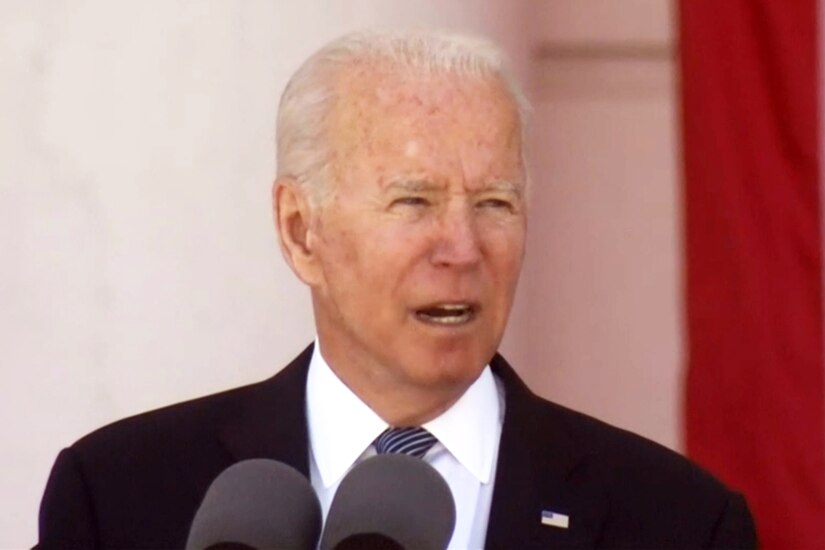
President Joe Biden speaks during a Memorial Day commemoration.

"Hundreds of graves are here from recent conflicts," Biden said. "Hundreds of patriots gave their all ... each of them leaving behind a family who live with their pain in their absence every single day. I want to assure each of those families — we will never forget what you gave to our country. We will never fail to honor your sacrifice."

Biden said that as vice president, he began to carry with him in his pocket the number of troops who had died in Iraq and Afghanistan. Today, he said, that number stands at 7,036.

"[That's] 7,036 fallen angels who have lost their lives in these conflicts," he said. "And on this Memorial Day, we honor the legacy and their sacrifice: duty, honor, country. They live[d] for it. They died for it. And we as a nation are eternally grateful."

What America is grateful for, the president said, is the freedom those men and women secured by conducting operations on the nation's behalf, and dying while doing so.

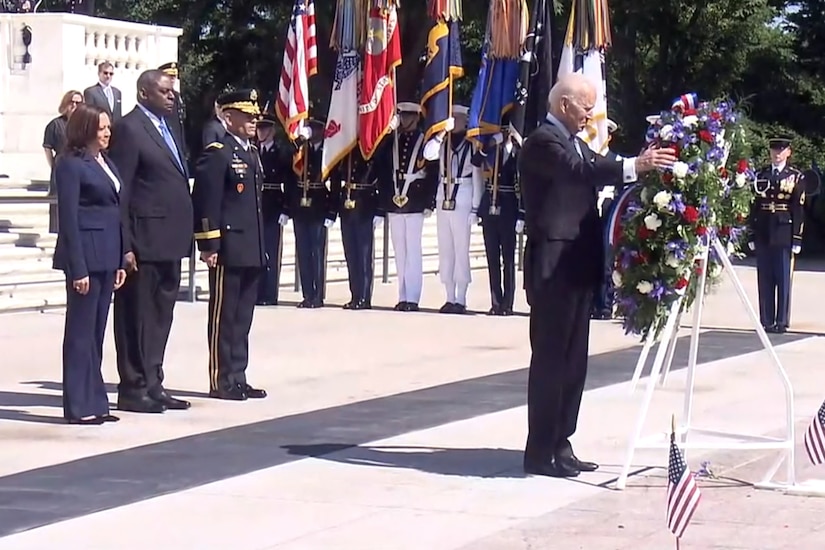
A man places his hand on a wreath, which is hanging on a metal stand.  Behind him, three people stand side-by-side with their hands at their side.

"America has been forged ... in the fires of war," Biden said. "Our freedom and the freedom of innumerable others has been secured by young men and women who answered the call of history, and gave everything in the service of an idea."

The idea, he said, is that every American is created equal.

"We're all created equal in the image of almighty God ... we're all entitled to dignity, as my father would say, and respect. Decency and honor, love of neighbor — they're not empty words, but the vital beating heart of our nation.

Democracy must be defended, Biden said, because it is democracy that makes possible the idea that is the United States.

"Democracy — that's the soul of America," he said. "I believe it's a soul worth fighting for, and so do you — a soul worth dying for. Heroes lie in eternal peace in this beautiful place, this sacred place, [and] they believed that too."

President Joe Biden, Vice President Kamala Harris, Secretary of Defense Lloyd J. Austin III, and Maj. Gen. Omar J. Jones, commander of Joint Force Headquarters-National Capital Region and U.S. Army Military District of Washington, laid a wreath today at the Tomb of the Unknown Soldier.

Secretary of Defense Lloyd J. Austin III speaks at the Memorial Day ceremony at Arlington National Cemetery.

Austin recalled meeting with the widow of one of the service members who was killed in Afghanistan, and who now lies buried in Section 60 of Arlington National Cemetery. Marine Corps reservist Staff Sgt. Chris Slutman was killed by a suicide bomber in Bagram in April 2019; his widow Shannon and their three children today struggle with the loss.

"She told us that before her husband left on one of his deployments, she sat him down and said, 'God forbid something happens to you, but if it does, where do you want me to bury you?' And he told her, 'I don't care -- I just want to be near you,'" Austin said.

Gold Star families, such as Shannon and her children, Austin said, continue to struggle long after the funerals for their loved ones have ended.

"It is our sacred duty to do more to ease the burden that they shoulder, on Memorial Day and every day," he said. "For as long as America has sent our sons and daughters into harm's way, those on the homefront have also been on the front lines."

More than 1.3 million American service men and women have died as a result of American wars. Memorial Day commemorates their sacrifices.

"For the loved ones of those who have fallen, let me simply say: We know the depth of your sacrifice," Austin said. " But we can never truly know the depth of your loss. What we can do is honor the memory of those you lost — by caring for those who mourn them ... by seeking to perfect our union and defend our democracy ... and by striving to live our lives in ways that advance the ideals for which they gave their own."

Saturday, May 29, 2021

Department of Defense Press Briefing on the President's Fiscal Year 2022 Defense Budget for the Missile Defense Agency

 May 28, 2021

Navy Vice Admiral Jon A. Hill, director, Missile Defense Agency; Michelle C. Atkinson, director for operations

STAFF:  Ladies and gentleman -- ladies and sir -- hey guys, welcome to the Missile Defense Agency's briefing on our portion of the president's budget for fiscal year '22 -- 2022. On my left are your briefers today. Vice Admiral John Hill is the Director of the Missile Defense Agency, and Miss Michelle Atkinson on his left is the Director for Operations for the Missile Defense Agency.

We'll go through a brief slide deck, and then the Admiral and Ms. Atkinson will take your questions. When the Q&A begins, please wait for me to call on you, and please identify yourself and your outlet when we do so. And I'll ask the Admiral to begin.

VICE ADMIRAL JON A. HILL:  Okay, thanks Mark. Good afternoon everybody, thanks for staying late for us on a Friday before Memorial Day weekend. It's great to be here. Again, I'm John Hill, the Director, and my Director for Operations who also owns a human resources and facilities and budget, is the good Michelle Atkinson, and she'll walk you through the brief and then we'll take questions afterwards. So, over to you Michelle.

MICHELLE C. ATKINSON: Thank you, Admiral. Good afternoon everyone, I know that we are the only thing standing between you and a three day weekend, so we'll be -- we'll be quick here. I appreciate the opportunity to brief you today on the Missile Defense Agency's FY '22 budget request. Next chart please. Our current missile defense system can defeat today's ballistic missile capabilities of our adversaries.

However, the threats posed by both ballistic and non-ballistic systems from rogue nations and strategic competitors can deter -- can used -- in gross -- increase and grow in complexity. There are several trends with respect to the nature of this growing threat worth noting.

First, ballistic missiles continue to proliferate, and will be a threat in future conflicts involving U.S. forces. Ballistic missiles have been used in several conflicts over the past 30 years, and will continue to be used.

Second, adversary ballistic missile systems are becoming more sophisticated. Their systems are becoming more mobile, survivable, reliable and accurate, and can achieve longer ranges. New ballistic missile systems also feature multiple and maneuverable reentry vehicles, along with decoys and jamming devices.

Third, as recently emphasized by Secretary Austin, the lines between ballistic and non-ballistic missile threats have become increasingly blurred, as we are seeing with the new hypersonic missile threats. Hypersonic glide vehicles delivered by ballistic missile boosters are an emerging threat. These threats can travel at exceptional speeds with unpredictable flight paths. This poses new challenges to our missile defense systems.

Fourth, the cruise missile threat to our U.S. forces is increasing. The majority of land attack cruise missiles will still be subsonic, but supersonic and hypersonic missiles will be deployed in the future. Land attack cruise missiles will also have increased survivability by minimizing radar signature and also the use of countermeasures.

These are the challenging realities of the emerging missile threats. U.S. missile defense policy, strategy, and capabilities must continue to evolve in order to address these threats. The Missile Defense Agency FY '22 budget request addresses these realities as I will discuss throughout this briefing. Next chart please.

The Missile Defense Agency mission remains unchanged. Our missile defense capability must be able to address the full spectrum of missile threats, both ballistic and non-ballistic. The continual improvement of our missile defense system is especially critical.

Without further development and technology investments, our current system will not have the capability to address the more advanced threat, such as the cruise missiles and hypersonic glide vehicles I spoke of. Next chart please.

The agency's foundations are focused on delivering missile defense capability to our war fighters, and the FY '22 budget request reflects this commitment. This request continues to operate and maintain our fielded systems, such as ground-based midcourse defense, AEGIS, and THAAD to the highest level of system readiness and reliability.

This budget continues to produce and field missile defense cap -- capacity to address the expanding threat, including delivery of additional interceptors and radars.

Finally, this budget prioritizes investments in new capability development and advanced technologies to address the emergence of a new and more advanced threat I spoke of earlier, with efforts such as the hypersonic and ballistic tracking space sensor, or HBTSS, hypersonic defense, and the next generation interceptor, or NGI. Next chart please.

Our total request of $8.9 billion FY '22 strengthens and expands the deployment of defenses for our nation, our deployed forces, allies, and international partners against increasingly capable missile threats. Of the $8.9 billion FY '22 request, $7.2 billion, or 80 percent of our budget, is for research and development efforts.

This budget request balances the numerous requirements and priorities against available budget. Our FY '22 budget request is only slightly lower than the FY '21 budget request of $9.1 billion. Our procurement budget request is slightly lower this year as we prioritize development of new capabilities in order to counter the emerging missile threats. Next chart please.

This chart outlines the highlight of the FY '22 budget request. This request allows us to maintain operations and readiness of deployed missile defense systems, and also our C2BMC network. This request also continues production and fielding of missile defense capability and production of additional SM 3 block 1B and 2A missiles for the Navy, and THAAD interceptors for the Army.

Finally, in response to the increasing threats I spoke of earlier, this request includes several development and technology efforts. Examples of these development efforts include the hypersonic and ballistic tracking space sensor, development on which we are working very closely with the U.S. Space Force and the Space Development Agency. This budget fully funds the next-generation interceptor program to maintain two industry teams through the critical design review. We awarded two contracts in March of this year to this important Homeland Defense program.

This budget also requests funds for the development of a regional hypersonic defense glide phase intercept capability. In response to a request from INDOPACOM, the budget request also includes funding for the defense of Guam. The next set of charts will address some of the specific budget line items in the missile defense agency's FY22 budget requests. The charts are an order of the missile defense system battle sequence - detect, control, and engage. Next chart, please.

As I mentioned earlier, in coordination with U.S. Space Force and SDA, we are developing a hypersonic and ballistic tracking space sensor. This capability meets critical Warfighter requirements and provides fire control quality data to track dim ballistic threats and global maneuvering hypersonic threats. The program is focused on deploying the first two satellites in FY 23. The Space Tracking and Surveillance System, or STSS, remains in orbit now, supporting DoD and the intelligence community.

The budget request supports the passivation of these two STSS demonstration satellites, which operated well beyond their expected service life and provided the foundation for future space-based sensor capability to include HBTSS. We are developing, deploying, and sustaining ground-based radars to counter current and future missile threats, build Warfighter confidence, and increase force structure. The FY22 budget request includes upgrading and sustaining 12 AN/TPY-2 radars, with a 13th radar being procured now with FY 21 funds from Congress. Completing and fielding the Long Range Discrimination Radar, or LRDR, in Alaska.

LRDR construction continued this year despite a temporary work stoppage that lasted several months because of steps taken to mitigate the spread of COVID-19. This advanced radar is a critical midcourse sensor that improves the missile defense system threat discrimination capability and also allows for more efficient use of the ground-based midcourse defense system. The Sea-Based X-Band Radar, or SBX, provides precision midcourse tracking and threat discrimination to protect our homeland.

The FY22 request continues operations in support of this critical radar. We will continue to sustain and provide updates to the Upgraded Early Warning Radars or UEWRs and continue to Cobra Dane radar refurbishment and life extension effort in partnership with the U.S. Air Force. C2BMC is the integrating element of our missile defense system. The FY22 budget request sustains the fielded C2BMC capability across 18 time zones with hardened networks supporting all of the combatant commands. The budget request also integrates new capabilities into C2BMC, such as LRDR. Next chart, please.

The department is committed to improving U.S. homeland missile defenses to counter limited missile threats from rogue states. The Ground-based Midcourse Defense system, or GMD, serves as a continuously available homeland missile defense capability for defending against today's rogue state ballistic missile threats. To ensure continued operability of the GMD system, we have requested funding to continue with the service life extension program that will include upgrades and replacement of ground system infrastructure, fire control, and co-vehicle software to improve reliability, capability, capacity, availability, and cybersecurity. The request supports the currently deployed Ground-Based Interceptors, or GBIs, and completion of the additional missile field in Alaska to enable future fielding of the next generation interceptors.

As I mentioned earlier, the FY22 budget request includes funding for two NGI industry teams through the critical design review. This plan reduces technical risk, secures competitive production pricing, and creates incentives for early delivery to the Warfighter. The Aegis missile defense request continues to upgrade the Aegis Weapon System and procure additional missiles. 40 Aegis SM-3 Block IB missiles and eight SM-3 Block IIA missiles will be procured for deployment on land at the two Aegis Ashore sites in Europe and at sea on multi-mission capable Aegis ships.

Our request continues the multi-year procurement for the SM-3 Block IB missile. We will continue to develop and implement Aegis Weapon System upgrades to support the Navy's newest Destroyers with the new SPY-6 radar, as well as upgrade sensors on the older ships in the Aegis fleet. Currently, construction is over 90% complete at the Aegis Ashore site in Poland. Jointly with the Army Corps of Engineers, we recently installed four SPY radar arrays and the fire control system there. Aegis weapon system installation and checkout have also commenced.

The THAAD weapons system is a globally transportable ground-based missile defense system, which is highly effective against short-range, medium-range, and intermediate-range threats. In FY22, we will procure 18 THAAD interceptors, obsolescence mitigation efforts, and training support. We will also continue the development and integration of multiple independent THAAD software builds to address the evolving threat, improve the Warfighters defense planning and improve system capability. The FY22 budget request includes funding to continue testing of THAAD and Patriot interoperability to improve the overall missile defense capability and increase the defended area. As I mentioned earlier, we were responding to requests from INDOPACOM to begin the development of a defense of the Guam system. Next chart, please.

The FY22 budget request includes investment in innovative technologies to address the emergence of new and more advanced threats. The budget request continues our advanced research program to explore innovative and disruptive technologies and also to develop emerging capabilities to enhance our missile defenses. This budget also includes funds for system engineering to continue to provide critical products and processes needed to combine element missile defense capabilities into a single, integrated and layered system. Testing is a critical aspect of the Missile Defense Agency mission. Validating system performance through flight and ground tests is paramount to building Warfighter confidence in our system.

To that end, the FY22 request includes flight, ground, and cybersecurity testing and the development of threat representative targets used during testing. FY22 test highlights include FTX 26, which is the LRDR Operational Acceptance Test, and FTM-46 which is required for the SM-3 Block IIA missile full-rate production decision. We are taking steps to develop and deliver regional layered hypersonic defense capability to the Warfighter. We are developing a glide phase intercept capability for a future demonstration, leveraging our existing missile defense systems.

In response to USNORCOM's requirement for cruise missile defense of the homeland, the FY22 request includes funding to develop the systems architecture and to conduct a demonstration of cruise defense capabilities using the joint tactical integrated fire control capability. Missile Defense Agency and the Israel Missile Defense Organization continue to cooperate on engineering, development, co-production, testing, and fielding of the Israeli missile defense system. The FY22 funding request remains consistent with a memorandum of understanding between the United States and Israel. Next chart, please.

In summary, the Missile Defense Agency's FY22 budget request is $8.9 billion. An important part of the department's strategy to defend the nation, this budget request prioritizes funding for the development of new capabilities to counter the expanding threats. This budget request continues the development, rigorous testing, and fielding of reliable, increasingly capable state-of-the-art missile defenses. It focuses on the readiness, capability, and capacity of fielded homeland and regional missile defense systems. The FY22 budget request enables the Missile Defense Agency to outpace future offensive missile systems in order to defend the United States homeland, our deployed forces, our allies, and international partners.

Thank you. The admiral and I will now take a few questions.

STAFF:  Steve, lead us off, please.

QUESTION:  So back in February, MDA published an RFI for a pulsed laser that could be air or space, or even ground operated. So is anything like that in the fiscal 2022 budget? Or if not, where do you see that going? And also, for that matter, air-launch kinetic intercept, if that's in the FY22 budget anywhere?

ADM. HILL:  Yeah, the second one I know is not in the budget. I do remember when we put out the pulse laser work, and that was to get that feedback from the industry for potential investment in the future. Michelle, do you have anything to add?

MS. ATKINSON:  We also received an FY21 congressional toss-up for the DPAL laser program.

QUESTION:  That was supposed to be eliminated last year, but I didn't realize there was a plus-up? Oh, OK. I see.

STAFF: Sandra?

QUESTION:  Thank you. Can you clarify what is the request for BBTSS and for SKA? You had it in the chart, but I couldn't tell there. There were two numbers there.

MS. ATKINSON: OK. So the -- let me find it. The HBTSS budget request is roughly $260 million this year.

QUESTION: OK. So and then SKA was $32 million? Is that what...

MS. ATKINSON:  No, it was what the other number was.

QUESTION: OK. So does that funding fund the two prototypes, the two satellites? And do you plan to downselect and only launch one satellite? Or do you plan to launch both?

ADM. HILL:  Thanks, a great question. You're talking specifically about hypersonic ballistic tracking (space) sensors. So yeah, HBTSS is on the path to launch two interoperable satellites that are built by two separate industry partners. So the idea is to keep competition in early, given the complexity of the mission. It is the only program within the space portfolio that provides fire control quality data down to a weapon system like Glide Phase Interceptor.

QUESTION:  And are these payloads going to be also the payloads that SDA will use in the tracking layer?

ADM. HILL:  They'll be interoperable with the tracking layers. So if you look at the overall architecture, what SDA is doing with the transport layer, and what they're doing with a wide field of view, a queuing source for HBTSS as an example, they're connected that way, but they are separate.

QUESTION:  So, you will not be developing payloads for them. Will they be doing their own payloads?

ADM. HILL:  Yes. We have different missions, and so each HBTSS fire control, wide field of view for early warning that would then queue those satellites. So they're connected within the architecture, but they are separate.

QUESTION: OK. Thank you.

ADM. HILL:  Thank you.

STAFF:  And let's go to our online folks. Do you have a question?

QUESTION:  Yeah, thanks for doing this. I just wanted to clarify. I see the MDA requested $248 million in defenses against hypersonic speed weapons, and you mentioned the Glide Phase Interceptor. But are there other projects within that $248 million, or is that all for GPI?

ADM. HILL:  Do you want to talk about it?

MS. ATKINSON:  Yeah, so GPI is the majority of that funding. We also have engineering, and we're starting to plan for the targets and testing of that capability in the future.

QUESTION:  Thank you.

STAFF:  Okay, Jen, please.

QUESTION:  (inaudible) I wanted to ask a little bit more about defense of Guam effort.  Is that now sort of in lieu of -- I know originally you were looking at a radar at -- somewhere in the Pacific, a Hawaii radar.  They were talking about like a 360 Aegis Ashore-like capability.  What are you looking at for Guam, a defense of Guam capability?  And what's on the timeline, it looks like you're investing a $100 million on that, but if you can give a little more detail on what the architecture may be looking like for this effort (inaudible)

ADM. HILL:  So we're not really positioned to do that yet.  So you referred a little bit to what's in the INDOPACOM Pacific defense initiative.  So, there's that and the request from INDOPACOM, but right now we're in the middle of doing that architecture analysis with the CAPE and with the joint staff and others to make sure that we have the options on the table, so that we can make use of the resources that we have to give the best defense possible for Guam.  And so we're working through that now. 

And part of that -- the real focus on those dollars in the '22 budget is to do things like spectrum analysis in the area because we know we the sensing capability.  We know that we have varying topology there across the island so how would you place those sensors?  Where would the fire control systems go?  Where would the weapons go?  So there's work there and there's likely some long lead material items that we'd want to procure.  But we're keeping that option space open now within the Department until we've come through all of those trades.

QUESTION:  OK.  Can you provide a little more detail in terms of what systems might be on the table in terms of what you're looking at?  I mean, especially if you're already looking at long lead items I'd imagine you have some sense of maybe where you want to go?

ADM. HILL:  Sure.  Yes.  What I think we'll do, and I say I think because it's still in the trade space, but we're going to focus heavily on the regional systems today that are prudent, that have program of record that can be evolved.  And so when you look at that, there's a fair amount of capability by which we can construct a really great architecture.  We're just doing that work now and this funding helps us to robustly go after that so we can meet the timeline.

QUESTION:  OK.  Are you hoping to have a more fleshed out plan of this, you know, by some time in FY '22…

ADM. HILL:  Yes.

QUESTION: …so then you can fund a path forward more robustly in FY '23?  Is that sort of the plan?

ADM. HILL:  Yes.  Yes.  That's -- that is the plan.

STAFF:  OK.  And let's go back to our remote audience.  Mr. Peter Loewig.

QUESTION:  Hi, thanks very much.  My Guam question got covered, so can you talk about other -- are there other -- are there other missile defense initiatives in the Indo-Pacific?  And then specifically because Aegis Ashore has been mentioned so much with Guam, has there been anything done to reflect the fact that the Japanese public has slowed, delayed, stopped, the Aegis Ashore in Japan?

ADM. HILL:  Great -- great question.  So, I'll answer specifically to the missile defense for Japan.  We're working very closely with the Japan Ministry of Defense to assess options.  And you're absolutely right, a decision was made by the government of Japan to no longer pursue the two Aegis Ashore sites. 

And so what we're doing now is answering questions for the Ministry of Defense to help them make their decision on what the configuration would be for the equipment that they have procured through FMS and through the direct commercial sales programs tied to Aegis Ashore, but how can you take those and make them sea based.  So that's in the Japanese trade space now and we're in full support.

QUESTION:  Thank you.  And no other -- no other missile defense elsewhere in the Indo-Pacific in this request?

ADM. HILL:  If you -- if you look at the details of the capability that we bring forward into Aegis ships as an example, and when we talk about the investments going towards a hypersonic missile-defense regional glide based capability, that would have a contribution in the -- in the INDOPACOM theater, HBTSS as a space asset.  When we get those two satellites built by two different companies into space in the '23 timeframe, they're meant to be in an operational position.  We will use those up for testing in the region initially and based on the how we characterize their performance they could be used operationally.

QUESTION:  Great, thank you very much.

ADM. HILL:  Great, thank you.

STAFF:  Jen, please.

QUESTION:  So what's not super clear in the document that we've received so far on the budget is your plans for the homeland where, you know, looking at potentially incorporating that or you just -- some of these other systems?  So could you walk us through how that is taking shape for you now and what we might be able to expect in FY '22 budget for potential plans for this?

ADM. HILL:  So for '22 that -- the real focus would be to pick up where we -- we did a feasibility test for FTM-44, an aegis ship engaging an ICBM outside the requirement space, so operated outside the combat system's requirements space, outside the missile's requirement space.  It was a congressionally directed test to be done last year, we completed that in November.  And so what that does is that now, you know, leads you to questions about how would the system perform against a more complex type target. 

So when you look into the budget, which you'll see is that look at the command control battle management, what would it take to bring together the homeland defenses and incorporate an Aegis capability?  What can be done within the THAAD program, terminal high altitude air defenses system, and how would you link all those together to give options to the combatant command? 

Those decisions have not been made to-date, what we're really doing is coming through the feasibility and the technical approaches of bringing those together as a layered homeland defense perspective.

QUESTION:  OK.  So in FY22 we would -- the funding to look at this would be in terms of the things you mentioned.

ADM. HILL:  Yes.

QUESTION:  OK.

STAFF:  And let's go to our remote audience, Jason Sherman from Inside Defense please.

QUESTION:  Thanks.  Hill, I wondered if you could say a little bit more about the Hypersonic Defense Program and walk us through this shift that MDA when through when thinking with the -- the program that you kind of re-designed and then sort of repackaged as the GPI.  Could you talk to us about the timing of that program and your efforts to accelerate it?  Sort of what -- what's the -- what -- what -- what was the -- the time that -- that -- that you -- under the old program?  What is the target for fielding under the new program?  And could you say something about the interceptors? 

Will you basically be using off-the-shelf or a modified variants of what already available for that in the first iteration and then going to a completely new design for something further down the road?  And -- and -- and when does the terminal capability begin to come online?  I'm -- I'm -- I gather that's not in this budget but you have a request (inaudible) industry.  So you could talk us through all of that, sort of the change for the program, what interceptors the interceptors are that you -- you are looking at the near-term, far-term, and yes, thanks.

STAFF:  Let’s just let him go ahead and get to those questions...

ADM. HILL:  You know, Jason, I thought you did a great job outlining the -- the strategy.  So -- so the way I'll answer it is I'll kind of give you a sense of where we are today and then I'll kind of walk you forward, all right.

So -- so where we are today from a protection of sea base, Sea-Based Terminal, you mentioned that.  And that's tied in and controlled by the Aegis Combat System, leveraging off-board sensors to protect the high-value units set within the sea base.  That -- that capability is designed to handle what I will call the advanced maneuvering threat, right.  So that's sort of that first layer of defense against hypersonics - a pretty important capability.

Now, how do we build on top of that?  Where we were a couple years ago, it was a science and technology focus that the Regional Glide Phase Weapon System -- so when we say weapon system that covered everything from sensors through fire control through weapons systems -- and what technology needed to be matured.

So when you're in the glide phase -- which is higher up from the terminal, right, where a hypersonic vehicle is likely in its most vulnerable phase -- that's actually a pretty tough environment to be in.  And you can't take an air defense weapon and operate it there nor can you take a space weapon like an SM-3 and operate there, it's just a different environment. 

And so we are risk-reducing and maturing technologies to operate there -- things like seekers and coatings and materials for operating in that area, propulsion techniques, divert techniques.  That was the focus of that and it was a much longer term -- you know, it wasn't set for transition into a firm development program so that would have delivered something for hypersonic defense in the glide phase out in the '30s. 

So based on real-world data collections, we were able to take our system models, Aegis models, sensor models, ground-based systems and run the -- the data collected from actual live fires.  And we found that we can close the fire control loop with an Aegis ship that has already proven queuing launch-on-remote and engage-on-remote capability. 

So what the ship needs is an early look at a threat flying through the glide phase and leveraging its engage-on-remote or launch-on-remote capabilities in order to have -- and build that track.  Then it needs a weapon to get there.

So when you talk about that change from the Regional Glide Phase Weapon System into, now, the Glide Phase Interceptor program, in order for us to accelerate and deliver something faster -- because that threat exists today, as you know -- we have the terminal system, the Sea-Based Terminal which is in a state of evolution that's got more increments coming downstream to get even better at what it does, but we want to engage further back into the trajectory, into the glide.

So we looked at a number of different propulsion systems and front-ends and we released a broad area announcement recently.  And we just received the industry responses to that and so we'll be evaluating those.  And so I can't give you a firm timeline on what the acceleration is until we evaluate the industry concepts and then move forward.

What we're really doing in '22 is preparing ourselves for a very firm Systems Requirements Review.  So what -- what we get from industry today helps us to set those requirements and get them right before we commit towards going to a more -- you know, a development program.

And so I think that may answer your question, I'll just give you a couple more.  So if you understand where we are today, where we want to go in the future from a weapons perspective -- we talked about HBTSS, right -- so right now we can leverage seaborne sensors, we can leveraged land-based sensors, we have incorporated the ability to track hypersonic threats, but as you know it's a globally maneuvering kind of threat so you need to be up in space looking down.

So in coordination with Space Force and with SDA -- you know, the question going back to the use of the Transport Layer and the great work that SDA's doing for communications, you know, within the low-Earth orbit -- we're going to have a very robust and resilient space capacity to get data down to that ship from space if we can't catch it with our land-based or sea-based sensors. 

And so, HBTSS, C2BMC moving data to weapons systems, initially Aegis ships, we want to make sure that what we do within the confines of a Mark 41 Vertical Launching System for a ground -- for a Glide Phase Interceptor can be transported and be used at a land-based battery. 

So Jason, how's that for a long answer to your long question?

QUESTION:  That's great.  And just...

ADM. HILL:  OK.

QUESTION:  ... when does the terminal program begin to kick-in?

ADM. HILL:  The terminal program is deployed today and -- and is continuing to test.  And there is a future increment to that program, but that is funded and in development.  And -- and it's in the -- it's in the '22 budget and it's continuing.

QUESTION:  Great.  And you've got a cruise missile defense architecture line in the budget this year.

ADM. HILL:  Right.

QUESTION:  When -- when you look out beyond '22, when are you looking to -- ideally to deliver a capability for U.S. NORTHCOM -- Northern Command on that?

ADM. HILL:  So I'll -- I'll stick to the PB22 story today which is really to continue our work with NORAD and NORTHCOM to, you know, build out that architecture.  So I'm not at liberty today to talk about timelines.

QUESTION:  Great.  Thank you.

ADM. HILL:  Thanks, Jason.

STAFF:  OK, any other questions here?  Dan or Peter, any further questions on your end?

QUESTION:  Do I have the floor?  Sorry.

STAFF:  I -- I -- who is this?

QUESTION:  This is Jason Sherman, sorry.

STAFF:  Hey, Jason.  Did you have another question?  Go ahead.

QUESTION:  Yes, if there aren't any others.  Admiral, I wonder if you could talk about this -- this funding that you are seeking for long-lead items and studying a defensive system for Guam.  As the material developer, are -- is MDA on track to potentially deliver a capability by 2026, as INDOPACOM has said they need this by?

ADM. HILL:  Yes, well, I would say it's -- it's -- it's broader than MDA.  So it is a department-level decision so I don't want to get out in front of the department on -- on where we're going. 

But when we talk about long-lead items, if you look at the architecture that you discussed earlier that was Aegis-focused, if you look at other architectures that are being considered, what we're looking for is the commonality in those in -- in '22 for -- for long lead.  And there's -- there's lots of commonality. 

When I say regional systems, right, there's -- there is a set of regional systems that, you know, we have options to deploy to Guam.  So the idea is to look at these differing architectures.  And right now, if you see commonality in those areas on things that we can procure to accelerate that timeline to hit that timeline then we'll want to move out and do that in '22.

QUESTION:  Great.  And I just want to pick up on the question that Jen asked about the -- the homeland defense underlayer.  Is it -- is it -- is it fair to characterize that as basically on the backburner?  That -- I mean, last year it was -- it was the centerpiece of your budget request but it has not found favor in -- you know, in the enterprise, shall we say, and no longer a priority.

ADM. HILL:  I wouldn't say it's no longer a priority, since -- since we do have investment in the budget.  But there -- there are some very serious policy implications, and so we want to make sure that we get the policy angles right. 

We want to make sure that it's still a need for NORTHCOM because what we've been able to accomplish in '21 -- and Michelle mentioned the Service Life Extension Program.  You know, the big concern back when layered homeland defense was first discussed was the concern that the existing fleet would start to lose its reliability over time while we also had this timeline for next-generation interceptor off to the right. 

Two big things, now we have a Service Life Extension Program and we're moving out there and that will increase and give us a hardware-based data capacity to really understand reliability.  You know, where we were back when we had this conversation last year or year before was that it was purely analytical.  And so it was arguable as to whether that reliability was going to fall off or not, and how early, right.  So you always assume worst-case. 

But now we're going to have real hardware because we're going to remove interceptors from the ground, we're going to upgrade propulsion, we're going to update one-shot devices, we're going to update the processors, update the threat categories, and if that makes those older missiles perform like the newer missiles, and so reliability goes up, capacity goes up when you do that. 

And so you start to close the gap, and NGI and the competitive award with two great companies moving forward with the number one requirement coming from the JROC being speed and schedule we're now being able -- we're going to pull in that timeline on first in placement, for example, which means we'll be testing a little bit earlier. 

And then with the reliability moving to the right we may close this gap to where the policy decision could be this is great the work that we've done with FTM-44 and what we'll do with the future tests, and it helps to make the regional systems more robust and we may not have to do the integration work in order to do the layered work.  So that's really where we are today. 

QUESTION:  Great.  Thanks. 

ADM. HILL:  Great. 

QUESTION:  You mentioned that NGI potential accelerated fielding, what -- you know, 2028 has been the date that was on the wall, and is there -- in your estimation, now that you have these two companies under contract developing this, what's the soonest possible date that you think they could deliver? 

ADM. HILL:  So Jason, I know it's been proposed, and it's a competitive -- make sure as we're running through we have two separate program offices firewalled away and all that.  And -- but I'm a ‘you've got to show me’ kind of guy.  So we just got started, right?  We just made the awards, the teams are just coming together. 

I think it's too early for me to declare that I believe those schedules yet, right?  I want to see them hit the knowledge points that we have in the contracts to prove to us that they are in fact delivering what they said they will deliver.  It's a really complex threat set, there's a lot of complex technology coming forward.  And so I want to hold on answering that question until we come further down the path. 

QUESTION:  (Inaudible) General. 

ADM. HILL:  All right.  Thank you. 

All right, Jen, you have one final one?  We're coming up to four minutes left, so (inaudible). 

QUESTION:  So just, on the top line, I mean, $8.9 billion a year ago your request was for $9.2 billion, I believe.  Congress gave you another $1.3 billion, so I'm just curious -- obviously Congress thought you needed more funding and now you're looking at a budget that's just ever so slightly lower than your request.  So can you talk a little bit about why you don't need to maybe kind of align with what Congress is giving you a year ago in terms of just ensuring that you are aligning with the strategy and things that Congress was concerned with? 

MS. ATKINSON:  Well first of all, I'd like to say that Congress has been very supportive and generous to the Middle Defense Agency mission over the past few years, and we greatly appreciate that.  Our FY22 budget request represents the best balance of -- like I said all those requirements and priorities across the entire department as well as the available resources across the department.  The department had to make really hard decisions this year as briefed earlier in today's briefings. 

We feel that the Missile Defense Agency FY22 budget represents the best balance of all those things within the top line that Defense Missile Agency has.  We can still -- even with the $8.9 billion that we've requested we can fill, maintain, and support the readiness and availability of the systems that are fielded.  We can still procure and deliver capacity to our war fighter, and as I mentioned we've reprioritized funding to be able to develop and expand on these new capabilities to get at the emerging threats. 

QUESTION:  Will you sending an unfunded requirements list to the Hill this year? 

MS. ATKINSON:  We're still determining that.  We have not yet submitted anything to the Hill.   

STAFF:  And I think we'll close it up there and let you guys go about two minutes early and start your long weekend.  Thank you all very much for ... 

ADM. HILL:  Hey, Happy Memorial Day. 

STAFF:  ... attending today, and your questions.  And have an incredible weekend.  Admiral. 

ADM. HILL:  Thank you, (Inaudible).  Thanks everybody, really appreciate it. 

MS. ATKINSON:  Thank you. 

ADM. HILL:  Thank you.