Nov. 16, 2020
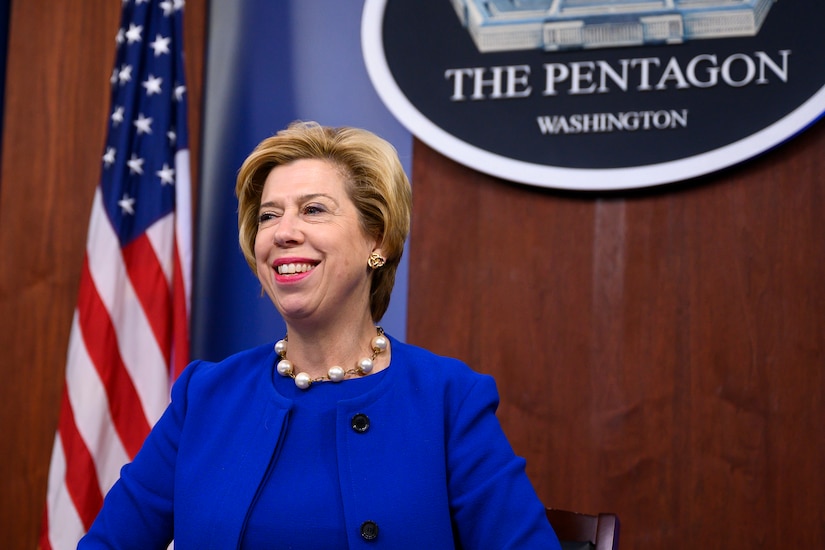
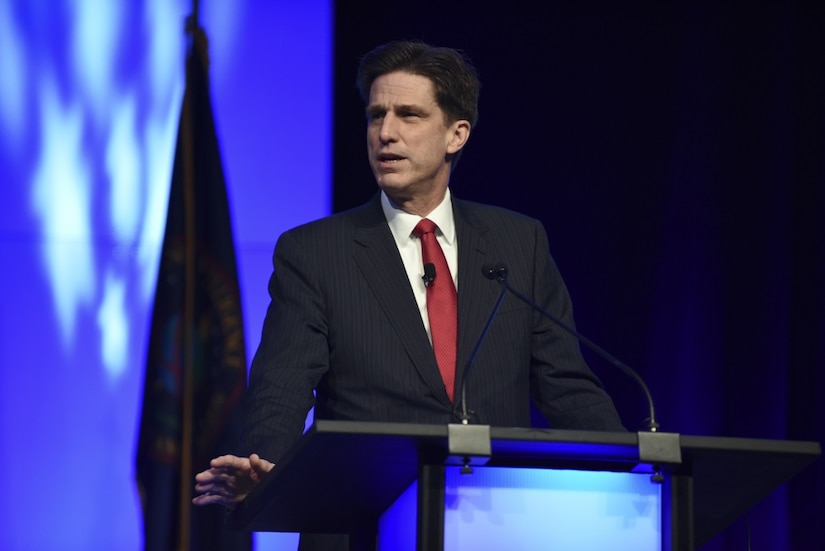
Thomas W. Harker, Assistant Secretary Of The Navy,
Financial Management And Comptroller (Performing The Duties Of The
Undersecretary Of Defense Comptroller And Chief Financial Officer)
CHRISTOPHER SHERWOOD: Okay, good morning. I'm
Christopher Sherwood. I'll be moderating the press briefing today and
follow-on discussion.
The topic of today's briefing is the department's results of the F.Y.
'20 full statement audit -- full financial statement audit. Our speaker
is performing the duties of the Undersecretary of Defense Comptroller
and Chief Financial Officer Thomas W. Harker. Our discussion is on the
record, embargoed until you receive an e-mail from me later this evening
once the Office of the Inspector General sends out agency-wide results
to the comptroller. I will send an e-mail to you releasing the embargo.
We have 30 minutes for this -- for questions from those attending
here in person and attending by phone. I will provide a five-minute
warning. Please introduce yourselves and your organization, and limit
your question -- questions to one initial question and one follow-up.
With that, I would -- I will turn it over to Undersecretary Harker. Sir?
PTDO COMPTROLLER THOMAS W. HARKER: Thanks, Chris.
Good morning, everybody. My name's Tom Harker, for those who don't
know me. I'm the assistant secretary of the Navy for financial
management and comptroller, performing the duties of undersecretary of
defense comptroller. I've been performing those duties since June, and
anticipate continuing for a while.
I'm pleased to report this year that DOD has completed its third
annual comprehensive financial statement audit, covering the entire
enterprise. We also have a couple of organizations who are still under
audit because they need a little more time to show positive results this
year.
There's two key themes that I want you to take away from this session
today, and that's continued progress and value to the warfighting.
We continue to conduct one large audit of the Department of Defense,
which consists of 24 standalone audits of the military services and the
larger defense agencies. Our goal is to get a clean financial statement
audit opinion for the Department of Defense as a whole, and we believe
that the best path to accomplish that is to conduct standalone audits on
each of our services and defense agencies.
We've been clear that this is a journey that will require a sustained
effort over several years, and we remain committed to this goal and
continue to make significant progress.
Each year, we work to sustain the current clean opinions, increase
the number of agencies or military services with clean opinions, and
eliminate material weaknesses at both the department level as well as
the component agency level.
For sustainment this year, every agency that had a clean opinion last
year sustained a clean opinion this year, in spite of significant
challenges due to COVID. They're all listed on the fact sheet that I
believe Chris is going to provide you, but suffice it to say that it
still takes a lot of work to maintain an opinion, and these agencies
have done that in spite of the size and complexity of their agency and
the challenges we faced this year with COVID which prevented us from
doing a lot of testing, travel and that sort of thing, as you'd imagine.
The audit for the OIG has not been completed yet, but we anticipate
completing that by the second quarter of fiscal year '21, and they
anticipate getting another clean opinion, as well.
For continued progress, this year we're very pleased to report that
we anticipate getting a new clean opinion for the DISA working capital
fund. DISA's worked real hard this year to improve their business
processes and controls. That's resulted in several operational
improvements such as decreasing the time required to deliver property to
their customers, improving the accuracy of their property records, and
improve the accuracy of their financial statements. It also generates a
clean opinion on the working capital fund, but I spoke about the three
operational things first because those are really more important to
warfighting than just the financial statement audit opinion. They had a
80 percent decrease in the time from award to delivery for a lot of
their equipment that they have done, based on the improvements they've
made to the business processes and controls over the last several years.
They also were able to increase their data reliability through the use
of robotic process automation and other tools, which has improved the --
or, the -- decreased the cost and improved the accuracy of their
financial data.
In addition to the clean opinion on their working capital fund this
year, we also anticipate them getting a clean opinion on their general
funds next year, so this is an area where they've made a lot of
investment in time and effort to improve their business processes, and
we'll see the audit results this year, as well as next year.
In addition to the new opinion for DISA's working capital fund, we
also have had several material weaknesses be eliminated from last year,
two of them at the department level. The Navy also eliminated three
material weaknesses, two on their general fund, one on their working
capital fund, and the Marine Corps eliminated one material weakness.
We've also had a number of the Defense agencies eliminate material
weaknesses because we made an accounting change that moved all of our
real property onto the balance sheets of the military departments or the
Washington Headquarters Service, so that was a change in accounting
procedure that resulted in elimination of material weaknesses. Putting
it all on the military departments improves our ability to account for
property, and it puts it all in the hands of the services and WHS.
Lastly, we continue to progress in the elimination of
auditor-identified discrepancies. We had 3,248 discrepancies identified
by all of the different auditors over the 24 component audits during
F.Y. '19. We've cleared 530 of those to date, and we anticipate clearing
a couple hundred more between now and the end of December, when the
auditors finish all of their work. This is a significant accomplishment
in spite of COVID, which has prevented a lot of the auditors from
getting out and doing testing, and we'll be able to close more than 20
percent of the findings, which is similar to the progress we made last
year.
So the bottom line in simple terms is the auditors found certain
areas have gotten much better this year, in spite of the challenges
faced it by COVID, and that we understand this audit is a massive
undertaking. We have a fact sheet that we'll be providing that gives you
a lot of these things I mentioned in more detail. But the audit, the
bottom line is, it's part of our key component of our reform effort.
It's how we go in and we make our business processes more effective so
that we have better data and better outcomes.
So some of the value that comes from audit, I want to talk about that real quick.
First off, one of the things the auditors do is they look at our I.T.
systems, and they go in and they test the controls around our I.T.
system so we have good access controls, we have good segregation of
duties -- that kind of thing. All of the steps we take to fix the things
that they find helps decrease our cyber vulnerabilities. So it's not
just the audit; it's also improving our cybersecurity.
The next thing that is key is the audit has taken a deep dive into
our property, plant, and equipment, and our inventory and operating
materials and supplies. During the first couple years of audit they
found significant deficiencies in these areas, but we've made a lot of
progress identifying areas where we had errors, going in and doing a lot
of the cleanup work. And so you see now, as they go forward, they've
cleaned up our accuracy of our property records. That helps us
significantly because it lets us know what to order, what we already
have.
In a lot of cases, auditors found things that weren't on the books
anymore, things where we bought it out of the working capital fund and
taking it to the end user, and the end user didn't need it right then,
so they put it on a shelf, and then people forgot that it was on the
shelf. Navy did a lot of work in this area. They were able to find, I
think, $3.4 billion over the last several years, and they've put more
than $50 million-worth of items onto aircrafts and ships as immediate,
"Hey, we found this. We need it. Let's put it out there." And they've
put another $2.7 billion back onto the books, as these items are
available for people to order. So it's a significant improvement in how
they manage their property.
We've also had another improvement from the audit in that it's helped
us identify that we have too many systems. We're spending a lot of
effort to go in and consolidate those systems and eliminate the legacy
ones. That improves both our cybersecurity by eliminating old legacy
COBOL-based software systems, and also saves us a lot of money. When you
run nine systems and you can get that down to two, that saves you a
significant amount of money. And so you're seeing that across all the
defense agencies, as well as the military services not just on their
financial systems, but on a lot of the other business systems that feed
into the financial like H.R. or logistics.
So the last thing is as we get better, more accurate financial data,
that gives us better ability to use that data to make decisions and it
gives senior leaders the ability to ask better questions. We've been
able to go through and build a data analytics tool called AVNA. It's for
advancing analytics -- that we pull all of the general ledger data from
the various I.T. systems, and that gives information available in
real-time to senior leaders. They can combine that information with H.R.
information, logistics information, and it gives them more ability to
ask better questions. It also gives people at lower levels ability to
ask better questions too, because they can see things at a more granular
level that help them make better decisions, as well.
So we remain committed to sustaining this effort and demonstrating
greater progress each year until the department receives and sustains a
clean audit opinions. We've prepared the press release -- Chris will
provide that -- and I'm ready to answer any questions. One thing I want
to let you all know is that I'm hard of hearing. I have hearing aids,
and so I would ask that we're all socially-distanced here. If you could
please remove your mask, it enables me to read your lips, and also speak
loudly so that I can hear you. I'd appreciate it. Thank you much.
MODERATOR: Okay. So we'll start with the room, and we'll start with Tony Capaccio.
Q: Hi, sir. Tony Capaccio with Bloomberg. We -- we've been covering
this for the last couple years. Now, last year the general funds and the
working capital funds of the Army, Navy, Marines, DLA, and SOCOM and
TRANSCOM and D.H. -- the health programs all received disclaimers of
opinion, which is not a good thing in your world.
MR. HARKER: Yes.
Q: Have those improved, or do -- do -- have those disclaimers of opinion continued?
MR. HARKER: We continue to receive disclaimers of opinion for the
ones listed on the sheet. We have an overall disclaimer, and there's
also several significant large agencies that have disclaimers. The only
improved opinion we had this year was the DISA working capital fund.
Q: Okay. Can I ask a follow-up, too? Last year DOD said this -- the
effort about a billion dollars. Is that roughly the -- the amount? And
how many trillions of dollars of assets, just for -- for the layperson,
did you audit that were reviewed?
MR. HARKER: How many did we --
Q: Okay, last -- last year the -- the press release said that $2.9 trillion of DOD assets --
MR. HARKER: Oh, that's -- yes.
Q: -- were -- were reviewed. I just -- for size and scope.
MR. HARKER: Yes. So we reviewed similar total assets, about $2.9
trillion of -- roughly. The challenges we've had are ensuring the
accuracy of that. So when we look at elements of our property plant and
equipment and our other assets, about a trillion of it is in government
bonds. That's money that we have invested in government bonds which we
hold as an offset to our actuarial pension liability. So the military
service members have a pension liability. We also have assets that
support that.
Q: Yes.
MR. HARKER: So those are all clean. The good news is we have a
trillion dollars-worth out of our $2.9 trillion where we have a clean
opinion on the audit that looks at that. The $2. -- the liability, our
biggest liability is that pension, and that also is clean. So when we're
looking at these things, we have significant areas -- real property,
there's been a lot of improvement there. I mentioned that we're moving
real property from all of the defense agencies' balance sheets onto the
military services and the Washington Headquarters Service. That gives us
only four places where we have to hold real property data, which makes
it easier for us to audit. It also gives us better visibility into what
real property we have, where it is, what condition it's in so that we
can make better operational decisions about the acquisition of property.
As you can imagine with COVID, we've had people increase telework
significantly. And so now we look at all of our real property, we say
"what do we own, what are we leasing, do we need to continue leasing or
do we bring people back into -- behind the fence line?" So it's -- it's
given us a lot more better data.
Q: Great, thanks.
MR. HARKER: Yep.
MR. SHERWOOD: Okay, we'll -- we'll go to the phones here for a
second, and Richard Sisk with Military.com. Do you have a question
please?
Q: Yes, can you hear me, sir?
MR. SHERWOOD: Yeah, we can hear you.
Q: Okay. Mr. Harker, did I hear you say, you know, it'll be several
years before you could expect a clean audit? And as -- as a follow, did
this audit -- did you look at Afghanistan and what you might have to
counter, not count -- considering -- considering that the troops might
be withdrawing? What -- what's the status of Afghanistan as far as an
audit goes?
MR. HARKER: So -- so the -- sir, could you repeat the question please?
MR. SHERWOOD: I can -- I can repeat that absolutely. So Richard asked
if -- basically in Afghanistan, if -- with regards to a count or in --
in the audit, was anything with regards to a troop drawdown that the
audit had captured? And Richard, can you repeat your first question? It
was before the --
Q: Yeah, I thought Mr. Harker said it'd be several years he expected before there -- there really would be a clean audit.
MR. SHERWOOD: Thank you.
MR. HARKER: Okay, so first, going through the process of being
audited, each year the auditors dive deeper and they find more things.
So you look at the process of getting to a clean opinion for federal
agencies, it can take a long time.
DHS is the most recent agency to get a first clean opinion and it
took them 10 years. We had a meeting last week where each of the
military services presented their timelines to get to a clean opinion
for us and that's roughly similar to what the DHS timeline was. If you
look at when we first started being audited in 2017, we're on track or
we have plans that are resourced to get us to a clean opinion around
that same timeframe.
Second question was dealing with assets and expenditures in
Afghanistan. As the audit unfolds, the auditors pull items to test as
part of their audit. When they do tests of property, one of the
challenges we faced this year during COVID was the travel bans and we
were not able to send auditors out and do that much travel, so they
weren't able to do as much testing on the ground.
In some cases, they were able to do virtual testing, where they --
where they weren't on a classified location and they could use cell
phones to do FaceTime or Zoom meetings and actually see the serial
numbers on assets but it was limited because of COVID. I don't know
specifically whether any of our auditors went to Afghanistan but we can
get back with you that information.
MR. SHERWOOD: Okay. And we'll go back to the room. I think Ryan, you had your hand up first. Go ahead.
Q: Excuse me. Thank you, sir, for doing this. I -- I just wanted --
Tony had asked how much the audit had cost, and I don't know if I -- I
had heard that, but I actually just -- you said something at the
beginning, where you said you expected to be doing this for some time to
come.
I guess -- so has there been any impact by the shakeup here at the
Pentagon leadership on the audit or the proof -- getting sign off from
Secretary's office? Did that delay anything? And then do you expect to
be carrying out this audit next year?
MR. HARKER: So the department is required to be under audit for
several different laws. It's written into the NDAA that we start -- and
we did start, and 2017 was the first year -- that continues to be a
priority for the committees. It's also a requirement of the CFO Act of
1990. So the audit will continue.
The cost of the audit, you asked, that was around $203 million this
year for all of the different audits that were conducted at the 24
sub-component level, as well as some of the -- and if I get too
technical, I apologize -- but we do statement of standards of
attestation agreements, number 18 service organization control reports,
which is a mini audit of a process at places like DFAS or other areas,
where they perform a process of the service provider for large elements
of DOD.
So we do a small audit of one of those processes, we call it a SOC
Report, Service Organization Control Report, and then other auditors
rely on that work. So -- but the total cost was $203 million for all of
that. So second question?
Q: So any of the, I mean, leadership -- obviously you said you've
been here and -- and obviously there's been a lot of change. Has that --
did that impact getting sign off on the audit, did that impact any of
the processes at all?
MR. HARKER: It did not. We have a process in place where our DCFO
Office inside the OSD comptroller shop goes and routes materials up for
explanation and signature. The -- in various years, the Deputy Secretary
or the Secretary has signed the reports. This year, the Deputy
Secretary signed it. As you know, Secretary Norquist is very familiar
with everything we're doing because of his role as Comptroller. I mean,
he's meeting with the Secretary today to walk him through everything
that he needs to know about the audit but, you know, the -- the Deputy
Secretary is an expert on this.
Q: Great, thanks.
MR. HARKER: So --
MR. SHERWOOD: We're going to stay in the room. Lara?
Q: Hi, sir, thanks for doing this.
MR. HARKER: Thank you.
Q: Can I just clarify -- you -- you told Tony that you reviewed
roughly 2.9 trillion assets this year. Is this -- and you said that was
similar to last year. Is that on top of what you did last year or is it
the same number?
MR. HARKER: 2.9 trillion is the total assets on our balance sheet.
And so all of those assets are under audit. So it's the same 2.9
trillion, it's just when the auditors do their samples, they look at
different things.
Q: Okay. And then also, can you just say a little it more about the
-- can you quantify the impact that COVID had, what didn't get done, did
things get done less efficiently? Can you just say more about that?
MR. HARKER: Certainly. So when -- when auditors do test work, their
best way to do test work was to go out and see and touch an asset and
say "yes, this asset exists," and to walk around an area and look and
say "are there other assets that exist in this area that might not be in
your books?"
So the best thing for them is to be able to go out and come in and,
you know, assuming these chairs are assets, it's like "Okay, look at
that one, look at that one, look at all of them, check the serial
numbers, make sure that verifies everything that's on the books," then
also look and say "are there some here that aren't on your books?" So
they call that existence testing and completeness. Existence is "does
everything that's on your books exist?" Completeness is "is everything
that does exist on your books?"
Because of COVID, they had a hard time doing completeness testing.
It's hard for them to be able to go and validate that there's something
that -- that everything's on your books, because they're not physically
there.
They were able to do existence testing for a lot of the items by
going and using digital media for things or pictures, take a picture of
the serial number and a picture of the asset, you can kind of see the
progression. So a lot of the agencies that had clean opinions were able
to do things that way. Some of the ones that were progressing were able
to do things that way, but it did create challenges.
The other challenge is just the lack of face-to-face ability to look
over things and talk through it. Zoom meetings are useful, but it's not
as good as being in the same room, looking at the same piece of paper
and talking about it, the face-to-face communications has made a
challenge.
Q: Were there any agencies, though, that maybe didn't get a clean audit because --
MR. HARKER: Sorry?
Q: Were there any agencies though that maybe didn't get a clean audit
or didn't make as much progress because of the challenges due to COVID?
Like what was the impact?
MR. HARKER: I would say there were a number of challenges that
everyone dealt with for COVID. When you talk to private sector
companies, a lot of them had challenges in their audits as well because
of the same things I just talked about with regard to property testing.
The audit standards folks went around and they identified ways of
providing assurance, so they worked with all the big audit firms on how
can they do the testing, and then we incorporated a lot of those same
standards.
Specific agencies, the focus for us was let's get -- for the ones
that have clean opinions and do everything we need to do to support them
in sustaining those clean opinions. And then for the agencies that
didn't, let's figure out how we can help them in executing their
corrective action plans.
You know, the Navy was able to clear three material weaknesses,
that's a huge accomplishment in spite of COVID. They might have gotten a
fourth if we hadn't had COVID. The one that they came close on was
their environmental and disposal -- I'm sorry, no. Their utilities. They
got environmental and disposal liabilities.
So they were looking at the utilities on the bases when in a lot of
cases that's underground, sewage pipes, power transmission facilities,
all that, stuff where having the auditors on-site would have made that
easier.
MR. SHERWOOD: Okay, we'll go back over to the phone lines.
Aaron Mehta, Defense News, do you have a question, please?
Q: I do, thanks.
This follows up a little bit on a few things you said. With the
understanding that this is a likely 10-year process -- you said that's
how long it took DHS -- are you at all, I guess, disappointed or did you
expect more progress this year versus last year?
MR. SHERWOOD: More progress this year over last year, did you expect more?
MR. HARKER: Do we expect more next year or did we make more this year than last year?
Q: Did you expect more this year compared to last year? I think,
like, last year there was a lot of stuff that Ms. McCusker told us had
gotten close and had just kind of crossed that threshold. But it sounds
like, from what you've said, only one major working capital fund seemed
to have improved this year.
MR. SHERWOOD: So, bottom line, yeah, we got it -- thank you, Aaron. So the bottom line is did you expect more this year?
MR. HARKER: We didn't expect more than we received. I mean, I think
any time you have a new agency get a clean opinion, that's a huge
accomplishment. So for us, last year, we did not have any agencies make
-- get new clean opinions, this year we did. So DISA's working capital
fund getting a clean opinion there was a significant improvement.
We also were able to eliminate material weaknesses this year, which
is something that, last year, only Navy did it. And it was one material
weakness. This year we had two material weaknesses at the department
level, three at Navy, one at Marine Corps, and then we were also able to
clean up a lot of the smaller ones for real property by consolidating
real property.
So what you're seeing is a maturation of the process. Many of the
individual agencies or services are developing more capability and
better accounting skills so that they can resolve a lot of the problems,
and you're seeing significant process in certain areas.
I may be a little biased because I came from Navy, but the Navy and
Marine Corps have both made huge progress this year. The Marine Corps
did make a push for an audit opinion this year. They were initially at
the start of the year really focused on trying to get there, and they
fell short.
A lot of that was due to COVID, but some of it was due to just
lessons learned during the process of being audited and going for a
full-scope audit opinion. That enabled them to clear a material
weakness, and also increase the accuracy of a lot of their property
planning and equipment balances, and their inventory and operating
materials and supplies.
They cleaned up military payroll so that when the auditors tested
military payroll -- and with our own internal testing -- they got 100
percent accuracy, which is the first time any of our services have done
that.
So the Marine Corps made a ton of progress, it just didn't quite
result in that audit opinion. And I think that was primarily due to
COVID.
MR. SHERWOOD: Aaron, did that answer your question? Do you have a follow-up?
Q: That's good, thank you.
MR. SHERWOOD: All right, I'll go over to Jeff Schogol with Task and Purpose. Do you have a question, please?
Q: Hi, thank you very much. If I understood you correctly, you said
the Defense Department did not pass the audit this year. And since it
first started getting audited in 2017, and it will take 10 years, it
will be until 2027 until the Pentagon passes this audit. Is that right?
MR. HARKER: The -- yes, I would say that's right. We did not pass --
we had a disclaimer on the consolidated opinion, we had several other
disclaimers on the individual audits. And this is similar in timeline to
what the Department of Homeland Security experienced during their quest
for an audit.
Q: If I could ask a follow-up question, if it's taking the Pentagon
10 years to pass an audit, what is it doing wrong? Can you elaborate on
where it's overspending and money being wasted, which is the purpose of
the audit?
MR. HARKER: So one of the things that -- if I could come at your
question from a different point of view, we spent $200 million being
audited this year. But when we look at the return on investment for the
process improvements that we're making around accountability for
property, accountability for inventory, that type of thing, we've
identified more than $700 million in savings based on these process
improvements.
So it's one of those things that it's not that anyone's doing
anything wrong, it's that there's -- this is something that's never been
done for an entity of the size and complexity as the Department of
Defense. And so we have not built up a robust capability in financial
accounting. Our focus has been many other things: executing the budget,
acquiring weapons systems, and whatnot.
So as we're building that capability, we're executing corrective
actions to the things that don't comply with accounting principles in
order to get into compliance. But more importantly, we're improving the
accuracy of our financial information so that decision-makers can make
better decisions.
MR. SHERWOOD: Okay, we have time for one last question in the room. Tony, please?
(CROSSTALK)
Q: -- can you clarify the cost issue? The billion dollars, the cost
issue. The $230 million you talked about was preparing the
infrastructure for audit, but there are audit fees and then there's cost
to remediate deficiencies. Those cumulative were over a billion dollars
last year. I just want to -- if Chris could -- because there's going to
be people saying, "Oh, it went from a billion to $200 million."
MR. HARKER: (inaudible) --
Q: You -- you had a subset. That's -- I -- (inaudible) --
MR. HARKER: The cost -- the cost of the audit this year was $203
million for when you add up all the audits. Somewhere last year, I think
last year was around $195 million. The year before that was around $200
million. So the cost of the audits has stayed the same.
The investment that we've put into cleaning up deficiencies, that's
always been a hard one to quantify. It was around a billion last year,
but it's -- that's kind of a modeled number, and it's around the same
this year. We're -- we're pulling that data together.
Q: Okay, and then the auditor fees for Ernst & Young and all the companies, that's a separate subset?
MR. HARKER: That's the $200 million.
Q: Oh, that's part of it?
MR. HARKER: That's the auditor fees. That's what we're paying the independent public accounting firms that come audit us.
Q: Okay.
MR. HARKER: That's -- and that's part of the -- the $1 billion that you cited for last year.
Q: Okay, I just want to be -- just see if Chris can get just the
cumulative cost remediation auditor fees and preparations. So it's --
MR. HARKER: There's a report to Congress that we prepare, and we'll make sure that you get a copy of that.
Q: (inaudible) --
MR. HARKER: It goes over all of that.
Q: I'm trying to reconcile your figures from last year.
MR. SHERWOOD: All right. And sir, I'll offer any closing comments you have, and then we'll wrap it up.
MR. HARKER: Appreciate you-all's interest, and thank you for coming
out and dialing in, if you're on the phone. This was something where
we've invested a lot of time and effort in getting to the audit, and
being audited these last several years has revealed a lot of information
to us on the areas where we can improve our processes, become more
efficient, more effective, and better stewards of taxpayer resources.
MR. SHERWOOD: Okay. Thank you for your time.










 Posts
Posts

