Monday, September 14, 2015

Dempsey: 'Terrible Human Suffering' in Syrian Conflict


By Lisa Ferdinando DoD News, Defense Media Activity

TALLINN, Estonia, September 14, 2015 — The Syrian refugee crisis and the "terrible human suffering" could cause Europe to become "more involved in the Syrian conflict," according to the top U.S. military officer.

Army Gen. Martin E. Dempsey, the chairman of the Joint Chiefs of Staff, did not predict what sort of additional actions Europe could take, but he did note the refugee crisis in the Balkans in the 1990s "galvanized" European political leaders and eventually led to NATO intervention in the Balkans.

Dempsey spoke to reporters aboard his plane Sunday as he traveled from a NATO Military Committee Conference meeting in Istanbul, on to Estonia for meetings with military and government leaders.

Refugee Crisis Impacts Strategy

"One of the things we are going to carry back home and recommend to elected officials, in Europe in particular, is greater collaboration with the European Union on this crisis," he said. "There's already collaboration."

Dempsey, who retires at the end of this month, said he could not predict if the current U.S. strategy for Syria would change. "The reason I don't know is literally the refugee crisis," he said.

The U.S. strategy, the chairman said, focuses on efforts against the Islamic State of Iraq and the Levant. The efforts include a partnership with the Iraqi government, trying to create a diplomatic path to Syria, and conducting air strikes in Iraq and Syria against ISIL.

He said he was satisfied with the actions of the United States in carrying out the mission it planned. But he said, speaking as "General Dempsey" and "citizen Dempsey," there is no way anyone could be satisfied with the outcome.

Spillover Effects

"It would be inconceivable for me to say I'm satisfied with the way things have evolved given the terrible human tragedy," Dempsey said.

The chairman added, "I ask myself, is this one of those moments where we will see kind of a convergence of this terrible human suffering in the form of refugees … and will at some point, Europe have to become more involved in the Syrian conflict, because of the spillover effects?

"I think the answer is probably yes," he said.

The Office of the United Nations High Commissioner for Refugees says there are more than four million registered Syrian refugees in countries neighboring Syria.

The UNHCR says thousands of Syrians are fleeing deteriorating conditions inside Syria and neighboring countries, and risking "everything on perilous journeys to Europe."

COMACC visits Seymour Johnson AFB, talks priorities, future

by Senior Airman Brittain Crolley
4th Fighter Wing Public Affairs


9/11/2015 - SEYMOUR JOHNSON AIR FORCE BASE, N.C. -- U.S. Air Force Gen. Hawk Carlisle, commander of Air Combat Command, visited Seymour Johnson Air Force Base, North Carolina, Sept. 8-9, to further immerse himself in the 4th Fighter Wing's mission and one of its most prominent initiatives, the "Make It Better" program. The "Make It Better" campaign directly contributes to multiple quality of life programs across the installation.

During the event, the general received briefings on base programs, visited numerous Airmen around the installation and held an all call to discuss his priorities and vision for ACC and Seymour Johnson AFB.

"I've been thoroughly impressed with some of the things the 4th Fighter Wing has done to take care of our Airmen and their families," Carlisle said. "The Make It Better campaign is a template we can use across the Air Force to further invest in the great men and women we have in our service."

Another positive trend Carlisle noticed in the wing's efforts to take care of Airmen and their families was the rapid development in the Key Spouse program, which has nearly doubled its numbers to more than 160 members during the past year. As an all-volunteer force, key spouses dedicate countless hours to making sure Airmen and their families are well taken care of, especially when service members are separated from their families.

The program falls directly in line with one of Carlisle's main priorities he set upon becoming ACC commander.

"It's our job to take care of our Airmen and their families," Carlisle said in a note to the men and women of ACC. "Our Airmen are our asymmetric advantage over any adversary that we may face, so we must make sure they're resilient and have everything they need to face the unique challenges of military life."

Carlisle also took time to visit the source of Strike Eagle airpower, the base's F-15E formal training units, to learn more about Exercise Razor Talon, the 4th FW's massive, monthly air-sea exercise.

The exercise incorporates assets from multiple bases along the East Coast to promote joint service synergy and expand on the air-sea battle concept.

With the divestiture of the A-10, Carlisle said he believes the Strike Eagle could soon see an increase in roles, from combat search and rescue to airborne forward air control missions, which will keep it in the Air Force's arsenal for "a long time to come."

"The F-15E community is the bedrock of our ability to do our mission anywhere in the world," Carlisle said. "It's an airplane that can survive and operate in a contested environment, and as we continue to modernize it and we look at avionics upgrades and the weapons that we're developing for the airplane, we're going to continue to take advantage of it. The F-15E, with its capabilities, is so much a key to our future."

That future, Carlisle acknowledged, holds a lot of uncertainties. He said although ACC is currently in a good state, he fully recognizes that it is spread thin, and the demand for combat air power far exceeds the supply our Airmen can provide.

"We simply can't continue at the pace we're currently working at," he said.

The visit concluded with an all call to discuss these upcoming challenges and changes, but moreover, Carlisle wanted to thank Seymour Johnson Airmen for their service and sacrifice as well as their continued excellence in completing the mission.

"To the 4th Fighter Wing and all the men and women doing their job, and their families, thank you for what you're doing. You're great Americans, you're great Airmen, and I can't thank you enough. We've got a lot of challenges ahead of us, and we need you."

Sunday, September 13, 2015

Breedlove: Terrorism, Russian Aggression Concerns NATO


By Lisa Ferdinando DoD News, Defense Media Activity

ISTANBUL, September 13, 2015 — Russian aggression is of concern to the 28-member NATO alliance, with Moscow likely knowing that going into Ukraine is much different than "crossing a NATO border," the commander of U.S. forces in Europe said.

"The issue of a revanchist Russia, which is now changing borders in Europe by force, has sort of brought everybody's attention," said Air Force Gen. Philip Breedlove, the Supreme Allied Commander in Europe and Commander of U.S. European Command.

He spoke to reporters yesterday, after a day-long meeting here of NATO chiefs of defense.

"Today one thing came up again and again, and that thing is unity," Breedlove said. "Our alliance is as unified as I've ever seen it."

The threat of terrorism is another problem facing the alliance, as returning foreign fighters or other extremists take advantage of refugee migrations and move in the flow of people, Breedlove said.

‘Ungoverned Space’

Host nation Turkey, he noted, borders "ungoverned space" in Syria and Iraq. It is a challenge not only for Turkey, but also for NATO.

The bloc will address both Russia and the Islamic State of Iraq and the Levant, he said.

"Our alliance is big enough to do it, our nations have the capability to do it," he said. "With the political will, and the military will, which I saw here, I am encouraged by the fact that we see this as something we don't have to decide one or the other."

While NATO does not have a mandate to address the migrant crisis in Europe, Breedlove said, the alliance could do a mission in conjunction with other organizations such as the European Union or United Nations.

"We could play a part if asked and if our political leadership gives us the mandate," he said.

Resolute Support

The military chiefs discussed NATO's mission in Afghanistan, Resolute Support.

"Our commitment to Afghanistan is firm," Breedlove said. "Our focus is on the future and our enduring partnership shows our determination to help the Afghans preserve the gains we have achieved together."

The chairman of the NATO Military Committee Conference, Czech Gen. Petr Pavel, said the military leaders stressed the need to ensure NATO forces and equipment can move rapidly across the alliance.

NATO’s greatest responsibility, he said, is to protect and defend the 28 member states against any threat.

"Terrorism poses a direct threat to the security of NATO, and to international stability and prosperity more broadly and will remain a threat for the foreseeable future," Pavel said in his closing remarks Saturday.

"The security of the alliance is indivisible. We stand in solidarity against terrorism of any kind, its root causes and its wider consequences," he said.

Russia in Syria

The United States and international community, Breedlove said, are "watching with concern" Russia's activities in Syria. However, he said he does not know what exactly those activities are.

"We have heard everything from humanitarian operations to combat operations, so it remains to be seen what this will be in the end," Breedlove said. "What we are most concerned about is any operations that would continue to support the Assad regime and its terrible actions against its own people."

While Russia has crossed into Ukraine, Russian President Vladmir Putin would understand "fully what crossing a NATO boundary is," Breedlove said.

"Clearly, Mr. Putin has made decisions and they have used force to invade and now occupy Ukraine's Crimea and they have used force to invade and now occupy portions of the Donbas, but I think that crossing those international borders is clearly different than crossing a NATO border," Breedlove said.

Alliance Unity

There is an "intense period of training exercises across the land, sea and air domains" coming up in October, he said, adding "I'm extremely confident that our military capability is remaining and will remain as potent as ever."

He hailed U.S. cooperation with Turkey in the fight against ISIL. Turkey recently joined the air campaign and allows its Incirlik Air Base in southern Turkey to be used for air operations against ISIL.

The cooperation at Incirlik is "spectacular," with a "superior team forming," Breedlove said. "Right now, I cannot be more complimentary of the team as they work together against this tough problem."

Saturday, September 12, 2015

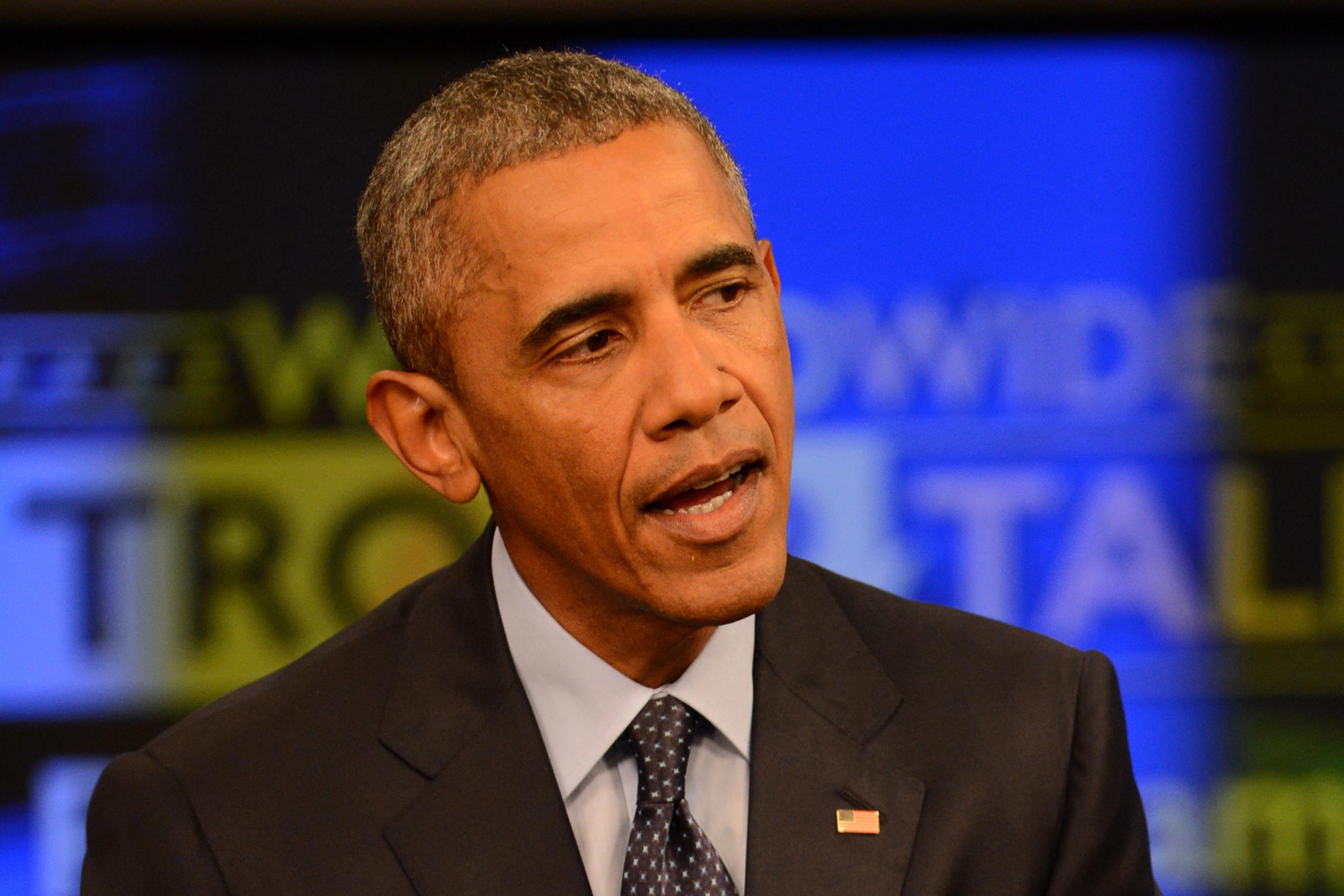
Obama Discusses National Security During Worldwide Troop Talk


By Amaani Lyle DoD News Features, Defense Media Activity

FORT MEADE, Md., September 11, 2015 — President Barack Obama addressed a variety of national security topics during his unprecedented live multimedia Worldwide Troop Talk here today.

The president’s broad discussion ranged from Russia’s effect on the Islamic State of Iraq and the Levant in the Middle East to the future of U.S. cyber efforts. It took place at the Defense Media Activity’s television studio.

“Here at Fort Meade, we do some of the most important work in helping to coordinate our efforts to make sure that we are bringing to bear all elements of American power against those who would try to do us home here in the homeland or overseas” he told the military audience gathered in the studio.

In addition to the troops with him in the studio on Fort Meade, Obama answered questions and addressed issues brought up by service members around the world, who spoke over teleconference lines or submitted them through social media channels.

‘An Incredible Job’

“We’ve done an incredible job in going after and systematically dismantling the core al-Qaida network that was operating primarily in the Fatah region between Afghanistan and Pakistan,” the president explained in response to a question from a deployed service member about the situation in Syria.

Radical violent extremism, Obama said, has “metastasized” and spread to other areas. He noted that currently ISIL has settled in Syria as “ground zero” for violence, which he said calls for U.S. presence and air domination.

“We are pounding [ISIL] every single day,” Obama said. “Our airmen are doing extraordinary work with the support of all the other service branches, and we’re providing training, assistance and support to the Iraqi security forces on the ground, as they continue to push back ISIL from the territory that they have taken.”

Leverage Air Power

Obama explained that the United States’ strategy has consistently been to leverage air power to support the Iraqi security forces’ ground efforts and, where when possible, the efforts of opposition groups inside Syria to push back ISIL.

These push-back efforts, he said, include thwarting their financing, networks, supplies and infrastructure.

However, Obama lamented that Syrian President Bashar al-Assad has brought such destruction upon his people and cities, and created sectarian conflict between Shia and Sunni populations inside Syria, so the country has become “a magnet for jihadists throughout the region.”

Also, the president explained, if Assad remains in place, he will have alienated so much of the Syrian population that a peaceful ceasefire and political settlement will not be possible. “You’ll continue to have this vacuum that’s filled by extremists,” he said.

According to the president, the “good news” is that Russia and the United States share concerns about countering violent extremism and concur that ISIL remains a danger.

Converging Interests

“Despite our conflicts with Russia in areas like Ukraine, this is an area potentially of converging interests,” the president said. “The bad news is that Russia continues to believe that Assad, who is their traditional partner, is somebody … worthy of continuing support.”

The president recounted that Russian President Vladimir Putin ignored his advice in recent years to cease financial support and arms sales to Assad. “[Putin] did not take my warnings and as a consequence things have gotten worse,” he said.

As the situation in Syria deteriorated, Obama said the Syrian president has  invited Russian advisors and equipment in, but that won’t change the United States’ core strategy to continue pressure on Iraq and Syria.

“We are going to be engaging Russia to let them know that you can’t continue to double down on a strategy, if it’s doomed to fail,” the president said.

“If they’re willing to work with us and the 60-nation coalition that we put together, then there’s the possibility of a political settlement in which Assad would be transitioned out and a new coalition of moderate, secular and inclusive forces could come together to restore order in the country,” he said.

Persistent Threats

Still, the president acknowledged significant threats from terrorist organizations and ideologies persist in Iraq, Syria, Afghanistan and North Africa.

The military must also be prepared for traditional threats, from a new Pacific region, where historically the United States has underwritten the security and prosperity of a region that returned after World War II, and where the U.S. role continues as the cornerstone of NATO.

Ultimately, Obama stressed the need to work at every level to ensure service members have the strategy, resources, equipment, and training they need to succeed.

But, the president asserted, in this era those elements are not just a matter of “tanks and rifles.”

Cyber Adversaries

“Cyber security is opening a whole new era in which we have to watch out for our adversaries,” Obama said of the new theater for potential conflict.

Obama said he’s seen State and non-state actors have demonstrated an increasing sophistication of hacking and the ability to penetrate systems previously thought to be secure. “Offense is moving faster than defense,” he noted.

At least part of the problem, he said, lies in the original design of the internet. “It was not designed with the expectation that there’d end up being 3 or 4 or 5 billion people doing commercial transactions … they thought this would be an academic network to share papers and formulae.”

Although the United States continues to best understand cyber, the president acknowledged that other countries such as Russia, China and Iran have “caught up.”

Coordinated Response

As a result, Obama said the United States in recent years has developed a coordinated response, bringing together the military and other government agencies with the private sector to better strengthen defenses.

There is still work to be done, and the president anticipates the United States will need to do more and coordinate with other actors more effectively.

“We going to have to both strengthen overall networks, but we’re also going to have to train millions of individual actors, small businesses, big vendors, [and] individuals in terms of basic cyber hygiene and be much more rapid in responding to attacks,” he said.

“One of our first and most important efforts has to be to get the states that may be sponsoring cyberattacks to understand there comes a point at which we consider this a core national security threat, and will treat it as such.”

On a more personal note, looking down the road to a time when he will no longer be commander in chief -- his term concludes on Jan. 20, 2017 -- Obama said one of the things he will miss most will be working with service members, whom he described as “ambassadors who spread good will” at enormous sacrifice to themselves.