With the addition of Captain P. T. Deutermann's USN (ret), latests miliary novel, Military-Writers now lists 3946 books authored by 1239 current, former and retired US Servicemembers.
Captain P. T. Deutermann, USN (ret.) “was commissioned in 1963 at Annapolis into the surface line, where he was ordered to the new destroyer USS Morton (DD-948). He served in Morton for two years, and was onboard for the second Gulf of Tonkin incident in September,1964, which precipitated the first significant aircraft carrier strikes against North Vietnam.
Following his tour in Morton, Captain P. T. Deutermann was assigned to class 13 of the destroyer department head school in Newport, Rhode Island. Upon graduation he was diverted from the destroyer forces to Coronado, California, to train in the new Swift class gunboats. Upon completion of training, he went to Manila, Philippine Islands, as officer in charge of a mobile training team which trained Philippine navy crews to use Swift boats against the pirates plaguing Manila Bay and the waters off Corregidor. From Manila, he went in-country Vietnam as officer in charge of PCF-39, based at the mouth of the main Mekong river channel that led up to Saigon. After a year there, he was assigned as operations officer in USS Hull (DD-945), which operated intermittently for the next two years off the coasts of North and South Vietnam providing naval gunfire support for Army and marine forces ashore.”
Between 1972 and 1976, Captain P. T. Deutermann attended the Naval War College and was assigned to the Pentagon. For the next thirteen years he would work in a variety of assignments, including in 1985 “command of Destroyer Squadron 25, based in Pearl Harbor, Hawaii, for two years, during which he made one deployment to the Indian Ocean, where he visited Kenya, Pakistan, Singapore, and Japan.” Captain P. T. Deutermann “retired from active duty after 26 years in 1989 with nineteen military awards and decorations.”
Captain P. T. Deutermann is the author of The Firefly; The Moonpool; Hunting Season; The Edge of Honor; Scorpion in the Sea; The Cat Dancers; Sweepers; Spider Mountain; Zero Option; Official Privilege; Train Man; Darkside; Nightwalkers; and, Pacific Glory.
Booklist said of Pacific Glory, “Savo Island, Midway, and the Battle of Samar, three of the defining naval battles of WWII in the Pacific, will draw history buffs to this riveting novel. It’s largely the story of Annapolis friends Marsh Vincent, who barely survives the Savo debacle, and Mick McCarty, whose dive bombing at Midway sinks a Japanese aircraft carrier that helped devastate Pearl Harbor, and Glory Hawthorne, a woman both love who has become a navy nurse. Having seen the savagery of naval war, Marsh fears he may not have the courage to face it again. Mick, an Annapolis football hero, has problems with alcohol and authority. He fears that he may be grounded. Ultimately, both are off Samar when a small group of tiny escort carriers and destroyers finds itself facing an overwhelming force of cruisers—and the Yamato, the largest battleship ever built. The Japanese are there to wipe out the American landing in the Philippines. Deutermann, known primarily as a writer of suspense novels, was a destroyer captain, and his evocation of naval life and naval war seem virtually note perfect. Battle scenes are filled with the sights, sounds, and smells of horrific chaos. The love triangle might seem a bit familiar, but he makes it work, and he’s completely faithful to the remarkable history that is his subject.”
Wednesday, April 06, 2011


Transcom Stays on Schedule Through Contingencies
By Lisa Daniel
American Forces Press Service
WASHINGTON, April 5, 2011 – U.S. Transportation Command remains on schedule with the drawdown in Iraq and continued operations in Afghanistan, despite near monthly contingencies that challenge the focus of its operations, its commander told a congressional committee today.
“2010 was a banner year,” Air Force Gen. Duncan J. McNabb told the House Armed Services Committee. “Whether delivering combat power to Afghanistan through logistics, or humanitarian relief to the people of Pakistan, Haiti and Japan, our team kept our promises and delivered on time, on target and at the best value to the taxpayer.”
The 145,000 people who make up Transcom “overcome colossal obstacles” to do their job, McNabb said. “This is the best performance I’ve seen in my nearly 37 years of service.”
McNabb called Transcom the U.S. military’s “greatest asymmetric advantage” in its ability to move people and equipment and deliver supplies to troops anyplace in the world.
“We view our success through the eyes of the warfighter,” the general said, referring to the Transcom’s focus on supporting the combatant commands.
Transcom is successful because of “the power of the total force team,” he said, noting the command’s joint use of active and reserve military members, federal civilians and contractors to accomplish its missions.
“If we do this right, our warfighting commanders do not worry about their distribution pipeline,” he said.
In its service to U.S. Central Command, Transcom brought together partners throughout government and industry “to make logistics magic” in drawing down from Iraq, while surging in Afghanistan, McNabb said.
The command met President Barack Obama’s Aug. 31 deadline for having 30,000 additional troops in place in Afghanistan, McNabb said, while responding to a “record-breaking pace” of events last year, including disaster relief in Haiti, the Philippines, Indonesia, and Pakistan.
“Daily, I’m amazed and humbled by what our people accomplish,” he said.
The command met its requirements while also saving money, McNabb said. It has saved $110 million per month by using a combination of commercial surface and military air transport to move mine resistant, ambush-protected vehicles into Afghanistan, he said.
Expanding capacity in surface networks that supply Afghanistan is a focal point, the general said, and the Northern Distribution Network -- the main artery for traversing 30,000 containers last year into Afghanistan through other countries -- remains a priority. Transcom added two additional routes to the network last year, he added.
Transom delivered more than 60 million pounds of equipment and supplies into Afghanistan last year, nearly double the amount from 2009, the general said.
Transcom’s “ultimate ace in the hole,” however, is air, McNabb said. About 35 percent of what is delivered to Afghanistan -- and everything of high value -- is taken by air, he said.
Acquiring a new aerial tanker, McNabb said, is Transcom’s No. 1 acquisitions priority. “The faster we can get a tanker on board, the better for us,” he said.
Transcom air assets delivered 60 million pounds of supplies into Afghanistan last year -- compared to 2 million in 2005 -- and is on its way to dropping 100 million pounds there, McNabb said.
General Officer Announcements
Secretary of Defense Robert M. Gates announced today that the President has made the following nominations:
Army Lt. Gen. Thomas P. Bostick, for the appointment to the rank of lieutenant general and assignment as chief of engineers/commanding general, U.S. Army Corps of Engineers, Washington, D.C. Bostick is currently serving as deputy chief of staff, G-1, U.S. Army, Washington, D.C.
Air Force Maj. Gen. David S. Fadok, for appointment to the rank of lieutenant general and for assignment as commander and president, Air University, Air Education and Training Command, Maxwell Air Force Base, Ala. Fadok is currently serving as commander, Curtis E. LeMay Center for Doctrine Development and Education, and vice commander, Air University, Air Education and Training Command, Maxwell Air Force Base, Ala.
Air Force Col. Timothy J. Leahy, for appointment to the rank of brigadier general. Leahy is currently serving as director, knowledge and futures, J-7/J-9 Headquarters U.S. Special Operations Command, MacDill Air Force Base, Fla.
General Officer Announcements
The chief of staff, Army announced today the following assignments:
Maj. Gen. Karl R. Horst, commanding general, U.S. Army Military District of Washington/commander, Joint Force Headquarters-National Capital Region, Washington, D.C., to chief of staff, U.S. Central Command, MacDill Air Force Base, Fla.
Maj. Gen. Patricia E. McQuistion, commanding general, 21st Theater Sustainment Command, U.S. Army Europe and Seventh Army, Germany, to commanding general, U.S. Army Sustainment Command, Rock Island, Ill.
Brig. Gen. Edward F. Dorman III, commanding general/commandant, U.S. Army Transportation School, Fort Lee, Va., to deputy chief of staff, logistics, C/J-4, International Security Assistance Force, Operation Enduring Freedom, Afghanistan.
Brig. Gen. Stephen R. Lyons, deputy chief of staff, logistics, C/J-4, International Security Assistance Force, Operation Enduring Freedom, Afghanistan, to director for operations and logistics readiness, Office of the Deputy Chief of Staff, G-4, U.S. Army, Washington, D.C.
Brig. Gen. Aundre F. Piggee, deputy assistant chief of staff, C-4/J-4, U.N. Command/Combined Forces Command/U.S. Forces Korea/deputy commanding general (Support), Eighth U.S. Army, Korea, to commanding general, 21st Theater Sustainment Command, U.S. Army Europe and Seventh Army, Germany.
Brig. Gen. Bryan G. Watson, commandant, U.S. Army Engineer School/deputy commanding general, concepts, doctrine and organizations, U.S. Army Maneuver Support Center of Excellence, Fort Leonard Wood, Miss., to director, J-7, engineering, U.S. Forces-Afghanistan, Afghanistan.
Brig. Gen. Mark W. Yenter, director, J-7, engineering, U.S. Forces-Afghanistan, New Kabul Compound, Afghanistan, to commandant, U.S. Army Engineer School/deputy commanding general, concepts, doctrine and organizations, U.S. Army Maneuver Support Center of Excellence, Fort Leonard Wood, Miss.
Chaplains, Religious Program Specialists Hold First Joint Graduation
By Cmdr. Yolanda Gillen, Naval Chaplaincy School and Center
FORT JACKSON, S.C. (NNS) -- The inaugural group of chaplains and religious program specialists (RPs) to be trained together graduated during a ceremony held at the Naval Chaplaincy School and Center (NCSC), on board Fort Jackson, S.C., Mar 30.
Guest speaker, Capt. Michael White, chief operating officer, Naval Education Training and Education Command, encouraged the students to realize the impact of their position as chaplains and RPs.
"As you arrive at your first command, you will be introduced to the routine - meetings, office hours, services," said White. "My advice is to make sure you break free and walk the deck, the flight line, the post, a few minutes with 'Chaps' or 'RP' will make their day."
The 20 chaplains who graduated from the basic leadership course (BLC) and the 17 RP's who graduated from RP 'A' school are the first group of students to be introduced to NCSC's concept of religious ministry team (RMT) training.
While at NCSC the chaplains and RPs experienced more than 100 hours of learning together, including working as a team during field expeditionary training.
"I thought the training was helpful because it put us in the real world of learning how to work with chaplains before we get to the fleet," said Seaman Recruit Donald Bishop."
Prior to arriving at NCSC, the RPs spent eight weeks in Great Lakes, Ill. for basic training, while the chaplains completed five weeks of basic military instruction at the Officer Development School (ODS) in Newport, R.I.
The joint training at NCSC is designed to have chaplains and RPs acquire basic knowledge of military chaplaincy, fundamental RP skills, and formalize the importance of the religious ministry team concept before going to the fleet.
The RP's were also the first to qualify on the weapons range before going to their first command. Three of them earned their expert medal and six shot sharpshooter.
In October 2009 the Naval Chaplains School located onboard Naval Station, Newport, R.I. and the RP School located at Naval Technical and Training Center Meridian, Miss. moved to Fort Jackson.
The school was renamed Naval Chaplaincy School and Center to reflect chaplains and RPs training in the same location. Having the chaplains and RPs train together at the same location is a result of the 2005 Base Realignment and Closure (BRAC).
Rear Adm. Margaret Kibben, chaplain of the Marine Corps, concluded the ceremony by leading the chaplains in the re-affirmation of the officer's commissioning oath.
Capt. Michael Langston, NCSC's commanding officer gave his closing remarks saying, "Wherever the Navy sends you, be strong and courageous for the Lord will be with you wherever you go."
"It was inspiring to look around the auditorium and see graduating chaplains and RPs, who came to NCSC as a bunch of individuals, but were now graduating to the fleet with a new identity of what it means to be a religious ministry team," said NCSC graduate Lt. j.g. Travis Coffey.
Pentagon Makes Plans in Case of Shutdown
By Jim Garamone
American Forces Press Service
WASHINGTON, April 5, 2011 – Defense officials believe that a government shutdown can be avoided, but they are making prudent plans in the event one does occur, Pentagon Press Secretary Geoff Morrell said today.
Deputy Defense Secretary William J. Lynn III is formulating guidance for the military services and defense agencies in the event that Congress does not approve a fiscal 2011 budget by the deadline April 8.
“While the administration believes that a government shutdown will be averted, the department, including the service leadership, is engaged in prudent planning so that we will be ready if one were to occur,” Morrell said during a news conference. “While a shutdown would be extremely disruptive to the department and those who work here, I want to underscore that we would still have the authority and the ability to continue key national security activities, including the wars in Afghanistan and Iraq, operations in Libya, and humanitarian assistance in Japan, to name a few.”
The Obama administration is working with congressional leaders to avert a shutdown. “I think negotiations are clearly at a very sensitive point, so I don't think it is wise for me to delve too much into this,” Morrell said. “But it is certainly our hope here that we can avoid a shutdown come midnight on Friday evening.”
Lynn is in the process of putting out guidance to major DOD components about how they should go about planning for a possible shutdown. This would include guidance on what would constitute an exempt or essential operation or mission, and who would be needed to man those missions.
Morrell said there has been no determination yet on how a potential shutdown would affect military pay.
“We have not been able yet to arrive at a conclusive determination about how everyone’s pay would be impacted by this,” he said. “We are still working through that. So I don’t have a definitive answer for you to relay to our forces in Iraq or Afghanistan. Unfortunately, that’s still an issue that's being worked.”
Emergency Operations Training Essential to Guantanamo Personnel
By Mass Communication Specialist 3rd Class Leona Mynes, Naval Station Guantanamo Bay Public Affairs
GUANTANAMO BAY, Cuba (NNS) -- Personnel assigned to Naval Station (NS) Guantanamo Bay, Cuba, and its tenant commands began their second day of Emergency Operations Center (EOC) Incident Management Training, April 5.
Commander, Navy Installations Command's (CNIC) Shore Training Group is instructing 23 service members and civilians on how to operate an EOC during an incident.
Preparedness for incidents that affect the base is imperative, said Kevin Robarge, NS Guantanamo Bay's installation training officer.
The training is especially important aboard Guantanamo as local resources are limited because the U.S. does not have diplomatic relations with the base's host country.
"We are isolated from many resources and need to be able to manage the resources and personnel we have on-hand until relief and support can reach us," said Robarge. "Because of that, we must continually train our personnel to prepare, manage and respond to any type of situation in order to save lives, property, and to restore quality of life services to our residents as quickly as possible."
Guantanamo Bay's location near a strike-slip fault line, called the Oriente Fracture, and its location in the Caribbean increases the likelihood that the base may experience an earthquake or hurricane, said Robarge. Additionally, all personnel should be prepared if an active shooter incident occurs.
"Last year's Haiti relief effort, recent and past active shooters, and a number of recent catastrophic events, to include what Japan is currently going through, are examples of why we need to train and prepare to better handle incidents," said Robarge.
The training is scheduled to conclude April 7 with an EOC exercise.
U.S. Forces Show Reach in Crises Response
By Jim Garamone
American Forces Press Service
The U.S. Japan Benghazi , Libya
The earthquake struck off Japan Japan
So far, more than 20,000 U.S. U.S. Japan
A week later, U.S. Libya Egypt Tunisia Benghazi
“All told, since operations began on March the 19th, the U.S. U.S. Libya U.S.
Meanwhile, about 100,000 American troops are fighting a war against extremism in Afghanistan Iraq
“That we have been able to respond to these crises without missing a beat in either of those efforts is a testament to the strength and versatility of our forces and, most of all, to the men and women in uniform who are prepared to take on any mission assigned to them,” Morrell said.
Today in the Department of Defense, Wednesday, April 06, 2011
Secretary of Defense Robert M. Gates and Deputy Secretary of Defense William J. Lynn have no public or media events on their schedules.
Commander, U.S. Pacific Command Navy Adm. Robert F Willard and Commander, U.S. Forces Korea Army Gen. Walter (Skip) Sharp testify at a hearing of the House Armed Services Committee on U.S. Pacific Command and U.S. Forces Korea budget request 2012 at 10 a.m. EDT in room 2118, Rayburn House Office Building.
Tuesday, April 05, 2011
Military Family Appreciation Day in South Carolina
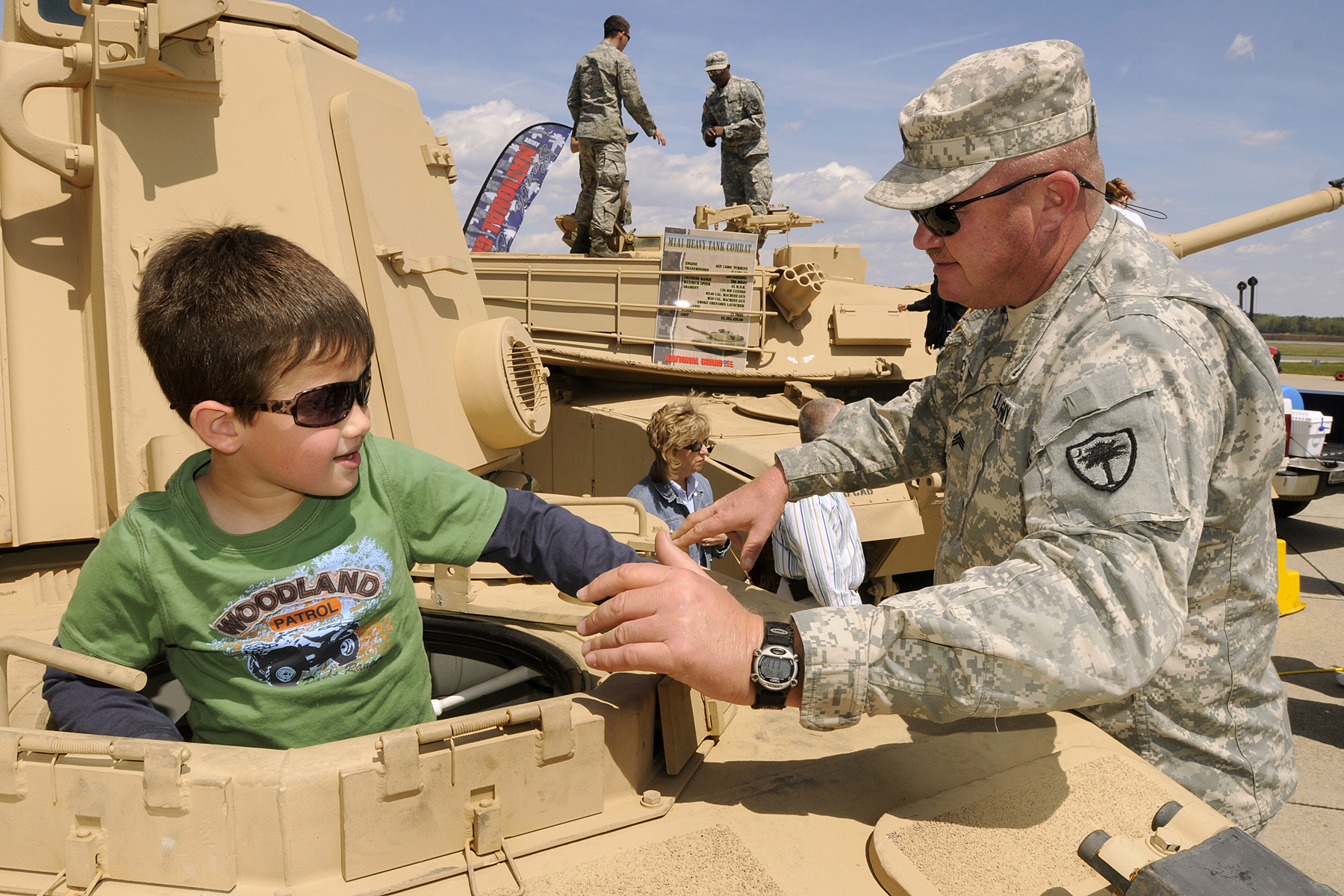
Sgt. David Patrick, of Lake City S.C. April 2, 2011 at McEntire Joint National Guard Base. Spafford was attending the family day with his cousins and uncle, Major Robert Spafford, of the S.C. Army National Guard. (SC Air National Guard Photo by: Tech. Sgt. Caycee Cook, 2 April 2011 – RELEASED)
Puget Sound, Norfolk Naval Shipyard Workers Depart USS George Washington

By Mass Communication Specialist 3rd Class Juan Pinalez, USS George Washington Public Affairs
"We are dropping off 300 hundred shipyard workers because their work here is done," said Ken Koemmpel, the civilian maintenance project superintendent. "About 150 workers will remain to finish miscellaneous jobs, but most projects have been completed."
The shipyard workers have been aboard George Washington since the ship pulled out of her forward operating port of Commander Washington Japan
The decision to conduct the maintenance at sea, something many consider a "historic first" for the Navy, proved to be challenging, but the shipyard workers were confident in their ability to get the job done.
"There were approximately 600 individual jobs accomplished in the past few weeks - which equates to about 10,000 man-days, and that's quite a lot of work in a short amount of time," said Koemmpel. "It would normally take us about five weeks in port to get the same job done, and we did it in two weeks at sea with limited resources."
"We worked on the main engines, replaced lagging, upgraded electrical wiring and performed maintenance from bow to stern," said Joel Winborne, Norfolk Naval shipyard painter. "We painted more than I could imagine; we must have gone through three hundred gallons. I've done my job, and now it's time to go home."
While some of the shipyard workers are prior enlisted Sailors, the majority have never been to sea despite their decades of experience as shipbuilders. The two weeks underway aboard George Washington gave some of them a new found respect for the men and women who serve in the Navy.
"I've had a great time being deployed," said Michael Hagstrom, Puget Sound Naval Shipyard ship fitter. "I have a brother that's in the Navy, and I signed up to do a Tiger Cruise with him on the Lincoln Japan Japan
For many of the maintenance projects, George Washington Sailors worked side-by-side with their civilian counterparts, coming together as one team. On many of those projects, the craftsmen of Puget Sound and Norfolk Naval Shipyard served as teachers to their younger students.
"I'm responsible for every one of the workers on board, and I really appreciate the support the crew has shown, especially the senior leadership," said Koemmpel. "It's been a unique opportunity to do something that hasn't been done before, and for us to be able to support the crew and the ship in a time of crisis in Japan
"What this past couple of weeks has shown is that whenever there is a crisis, the shipyard workers can come together and get the job done and on time, no matter what," said William Dewhirst, Puget Sound Naval Shipyard electrician.
George Washington is the Navy's only permanently forward-deployed aircraft carrier, ensuring security and stability across the western Pacific Ocean .
Gates, Shinseki Agree to Joint Electronic Records
By Donna Miles
American Forces Press Service
Gates and Shinseki agreed in concept to create the joint common platform during a March 17 session, giving their staffs an early May deadline to come up with an implementation plan, VA Deputy Secretary W. Scott Gould told American Forces Press Service.
“They slapped the table and said, ‘Okay, in concept we agree,’” Gould said during an interview while attending the 25th National Disabled Veterans Winter Sports Clinic in Snowmass Village , Colo.
Now DOD and VA are at work to determine if a joint e-platform will support their separate processes. DOD currently uses the Armed Forces Health Longitudinal Technology Application, or AHLTA system, and is transitioning to the more comprehensive, real-time Electronic Health Record Way Ahead system. VA uses the 20-plus-year-old Veterans Health Information Systems and Technology Architecture, or VistA .
Gould expressed confidence that a joint system will work for both the Defense Department and VA.
“And the reasoning is pretty sound,” he said. “Ninety percent of the medicine in DoD and VA is the same. So why shouldn’t we have one system, and only have the taxpayer pay to build it once?”
The 2010 Defense-VA Interagency Program Office report to Congress noted that the two departments share nine of the 13 core functional capabilities for an electronic health record, Gould said.
“This shows the kind of leadership that both Secretary Shinseki and Secretary Gates bring to the table,” he said. “They are committed. They want to make a difference. And they are challenging both their deputies and their entire organizations to cut through the red tape and get it done. And [Deputy Defense Secretary] Bill Lynn and I are hard at work to make that happen.”
Shinseki told a Senate Appropriations Committee subcommittee March 31 the deal followed about two years of discussions. He said DOD is “looking for new direction” for its own electronics record system, while noting the need to update VA’s own aging system.
"We have a terrific electronic health record, but again, it's about 20 years in being,” Shinseki said of VA’s VistA system. “So, we're going to have to adjust also to ensure the sustainability of that system. It's a great opportunity for both of us to put our heads together.”
Undersecretary of Defense for Personnel and Readiness Clifford L. Stanley called the initiative an example of closer inter-departmental cooperation that’s improving efficiencies and providing better patient care.
“We are working even ever more closely with our colleagues in the Department of Veterans’ Affairs to ensure our activities are better coordinated to include the disability evaluation process, the sharing of personnel and health information, and collaboration on our future electronic health record,” Stanley told the House Armed Service Committee’s Military Personnel Subcommittee March 15.
During the same hearing Army Lt. Gen. Eric Schoomaker, Army surgeon general, said that creating a single electronic health record will increase information-sharing between the two departments and provide a better way to transfer patient data.
“No two health organizations in the nation share more non-billable health information than the DOD and the VA,” Schoomaker noted. “The departments continue to standardize this sharing activity under delivering information technology solutions that will significantly improve the sharing of appropriate electronic health information.”
The agreement to pursue a joint common platform for their electronic medical records follows the two departments’ decision in April 2009 to create a Joint Virtual Lifetime Electronic Record to smooth the flow of medical records between the Defense and Veterans Affairs departments.
Five pilot programs are up and running to test out the initiative before it goes nationwide, Gould said.
Obama, in announcing the joint initiative, described the advantages of a common joint lifetime record.
“When a member of the armed forces separates from the military, he or she will no longer have to walk paperwork from a [Defense Department] duty station to a local VA health center,” the president said. “Their electronic records will transition along with them and remain with them forever.”
Obama explained that the new system will include both administrative and medical information from the day recruits enter military service, throughout their military careers, and after they retire or leave the military.
“This would represent a huge step toward modernizing the way health care is delivered and benefits are administered for our nation's veterans," Obama added. “It would cut through red tape and reduce the number of administrative mistakes.”
IKE Awarded 2010 CNO Afloat Safety Award

By Mass Communication Specialist 3rd Class Nathan Parde,
USS Dwight D. Eisenhower Public Affairs
PORTSMOUTH, Va. (NNS) -- Nimitz-class aircraft carrier USS Dwight D. Eisenhower (CVN 69) (IKE) was announced as a winner of the 2010 Chief of Naval Operations (CNO) Afloat Safety Award April 1.
The award marks IKE as having the top safety program of Atlantic-based aircraft carriers.
During the prior calendar year, the ship deployed to th eU.S. 5th Fleet area of responsibility in support of U.S. Afghanistan
During the time, IKE and embarked Carrier Air Wing 8 safely executed more than 17,300 aircraft launches and recoveries in support of Operation Enduring Freedom, while receiving the 2010 Safety Battle E award, said IKE's Safety Officer, Cmdr. Thomas Stanley.
IKE's safety record is most notable in the fact that while the number of sorties rose 30 percent in 2010 from their 2009 deployment, there was a decrease in the number of personnel injuries.
The decrease in the rate of injuries can be attributed to an enhanced safety culture as well as procedures and engineering controls that instituted throughout the command, said Stanley
IKE's Commanding Officer, Capt. Marcus Hitchcock, said the CNO Safety Award could not have been earned without every Sailor on the ship taking measures to build a safety-minded climate.
"This was an all hands effort, and you should be proud of your record," said Hitchcock. "Thanks to your continued focus on doing the job right, on time and safely."
Nothing is more important than safety in the workplace, and no mission is so urgent that it could ever justify endangering personnel by cutting corners on health or safety, said Aviation Ordnanceman 1st Class Fredrick Harden, leading petty officer of IKE's Safety Department.
"When it comes down to it, safety comes first, and the mission second," said Harden. "You must first ensure the safety of an operation before you are able to carry it out."
One of the smallest departments on the ship, IKE's Safety Department relies on the assistance of departmental representatives to review and address their individual department's safety concerns.
"Each department has its own safety risks and challenges, so we rely on our departmental safety officers to make sure that we are all synced and prepared to meet these challenges safely," said Stanley
According to Stanley
"The board looks for aggressive safety programs that contribute to the prevention of injury and benefit of the community," said Stanley
With those programs now in place, IKE will be competing for the 2010 Secretary of the Navy Excellence in Safety Award in the category of safest large-deck combatant ship over the next several months, said Stanley
In the meantime, IKE will receive a plaque and a citation to represent the award and will proudly be able to display a green safety "S" on IKE's bulwark when the ship returns to sea.
U.S., Philippine Forces to Kick Off Annual Exercise

By Donna Miles
American Forces Press Service
The 10-day exercise will proceed “despite a reduction in the number of participating U.S. Japan Manila
About 6,500 U.S.
The 8th U.S. Army, with headquarters at Yongsan Garrison in South Korea U.S.
The goal, officials said, is to increase the two militaries’ ability to respond quickly and work together effectively to provide relief and assistance in the event of natural disasters and other crises that threaten public safety and health.
U.S. Ambassador to the Philippines Harry K. Thomas Jr. called the bilateral training vital to both armed forces’ readiness capabilities.
“Balikatan is all about our partnership and friendship,” he said. “Our forces train together to help communities where assistance is needed and I look forward to visiting the communities they will serve.”
This year’s exercise, the 27th in the series, will feature four events, officials said. The first, which began before the official exercise start date, involves a series of humanitarian and civic assistance initiatives, including medical, dental, veterinary and engineering projects throughout the country.
Also planned is a scenario-based command-post exercise that practices joint and combined force planning at the headquarters level, and field training exercises that promote cross-training and increase interoperability. In addition, U.S.
The term “Balikatan,” a Tagalog word that means “shoulder to shoulder,” symbolizes the partnership between the two countries as they work together toward a common goal. The annual Balikatan exercise is conducted under the auspices of the Mutual Defense Treaty of 1951 and Visiting Forces Agreement, with U.S. Army Pacific serving as executive agent.
Naval Postgraduate School Welcomes Former Astronaut as New Dean of Students
By Mass Communication Specialist 1st Class Leonardo Carrillo, Naval Postgraduate School
The graduation was the first under command of Capt. Alan Poindexter.
During the ceremony, Poindexter reflected on his new position and the opportunity he'll have to shape Navy leaders.
"I'm very glad to be back serving in this position," said Poindexter. "I think it's a great opportunity for me to lead and influence officers as they're going to school here. I think I have a lot to offer them and I hope I can serve them and help them make their way through the school."
A veteran NASA astronaut who commanded the STS-131 mission, one of five final space shuttle missions, Poindexter attributed part of his success to the technical education he received at NPS.
"The technical knowledge and the technical education certainly assisted me," said Poindexter. "I learned about systems management, systems engineering and it allowed me to be more analytical in my thought process. So when I became a project officer and then an astronaut, I was able to think through problems and find a solution. My NPS education was instrumental in my follow-on tours."
Poindexter considers education to be an important part of an officer's career path and summed up his thoughts on that subject in one word -- critical.
"Critical," he stated. "I think it's critical. Graduate education is one of the key items in an officer's bag of tools as he or she progresses in their career. Whether it be in engineering, management, business or one of the many other great degrees we offer here, it will serve the individual and the Navy or their service very well to have that capability and that background."
Poindexter affirmed that his strategic goal is to continue to serve the student population. He said that it was his job to ensure that the students reach their educational goals and succeed, while at the same time making sure that their families are taken care of.
"My job is leadership," said Poindexter. "I have to make sure that students make it through the school successfully and graduate on the other end with a diploma in their hand. But it's also important not to forget to take care of your family and enjoy Monterey Monterey
In addition to the educational and auxiliary benefits NPS offers, Poindexter said that the school also offers a unique environment, an environment in which students get to interact with officers from different backgrounds.
Poindexter suggested that students make use of this unique environment by participating in courses outside of their curriculum, as well as the Enrichment Week activities, and also to get to know their classmates from other services and countries. This is one of many ways in which NPS has evolved, Poindexter said, while the school is a naval institution, it has greatly expanded its student base.
"Take advantage of the opportunity to interface with people from all over the world and from our other services," said Poindexter. "Learn from their experiences as well as your own and broaden your network … you can learn a lot from them.
I'm really honored to be back here in this job working for the school and working for the students," he continued. "I have an open door policy and I would be glad to talk with or counsel anyone, and I hope that I can influence them in some small way."
USS Robert G. Bradley Begins Third Africa Partnership Station Hub

By Mass Communication Specialist 1st Class Darryl Wood, Commander, U.S. U.S.
Bradley Sailors will conduct maritime training, participate in military-to-military sporting events, and host community relation (COMREL) projects during their port visit.
"COMREL helps strengthen our relationships with our African partners and allow us to interact with host nation's civilians and military," said Chief Logistics Specialist Ed Lafond, USS Robert G. Bradley COMREL coordinator. "For some of the Sailors this is the first time for them to interact with the host nation civilians and is an opportunity for them to have a good time helping others, and see sights other than what they would see on a tour."
APS training conducted with the Nigerian navy will cover areas in visit, board, search and seizure team operations; search and rescue planning; damage control and signals familiarization. These areas of training were selected with the assistance of Nigerian officials to better enhance maritime safety and security, along the coast of West and Central Africa .
"We have started to really see the impact of our training on our partner navies," said Lt. William Pollak, USS Robert G. Bradley operations officer. "They inspire our Sailors to keep up their energy level, knowing that what we are doing here is well received."
APS is an international security cooperation initiative, facilitated by Commander, U.S. Naval Forces Europe-Africa, aimed at strengthening global maritime partnerships through training and collaborative activities in order to improve maritime safety and security in Africa .
Robert G. Bradley, an Oliver Hazard Perry-class frigate, is homeported out of Mayport , Fla.
Wisconsin National Guard names Soldier, NCO of Year

By Sgt. Eric Liesse
112th Mobile Public Affairs Detachment
Two Soldiers from the same battalion of the 32nd Infantry Brigade Combat team will represent the Wisconsin Army National Guard at next month's regional Soldier of the Year and Noncommissioned Officer of the Year competition.
Sgt. Steven Dahl of Oconto, a member of Company A, 1st Battalion, 128th Infantry in Menomonee, was named Soldier of the Year from a field of six competitors representing Wisconsin National Guard units across the state. Though recently promoted, he competed in the junior enlisted category.
Sgt. Brandon Swanson of St. Croix Falls Chippewa Falls
The three-day competition, which began April 1, tested Soldiers' abilities in marksmanship, physical fitness, land navigation, Soldier task knowledge and military bearing.
Wisconsin Army National Guard State Command Sgt. Maj. George Stopper, who directed the event, praised each competitor.
"Our state-level competition is a pretty grueling process," Stopper said. "Unfortunately, there can be only one Soldier of the Year, and only one NCO of the Year."
"I'm relieved all the hard work paid off," Swanson said after the closing ceremony. "If you give it everything you've got, no one can take that away from you if you don't win."
"I learned there are other people who can compete at this level, people you wouldn't expect," Dahl said.
Both competitors hold high expectations for themselves.
"We're probably going to start training this week," Swanson said.
"[I'll do] the same thing," Dahl said of his training for May. "I'll go in pretty confident and not get down when the competition gets a little tougher."
That echoed Stopper's guidance to competitors the night before Friday's first event.
"The one tip I have for you is never give up," Stopper said Thursday night. "You'll fail at something, and that's when you need to know to step back and reload."
Command Sgt. Maj. Brad Shields, of the Milwaukee-based 157th Maneuver Enhancement Brigade, offered the same advice prior to the obstacle course on Saturday.
"We understand that you may not be able to complete each obstacle," Shields said. "But what matters the most is that you give it your all."
Events included a physical fitness test, pistol and rifle marksmanship under normal and stress conditions, combatives (hand-to-hand combat based on mixed martial arts), land navigation in daylight and at night, combat water survival, an obstacle course, common Soldier skills, a written exam, simulation grenade course, a nine mile road march and an appearance board.
The combat water survival event was new this year, and required competitors to complete a 15-meter swim while holding their weapon above water, a blindfolded jump, and removing a load-bearing vest while submerged. Soldiers completed these tasks while in their PT uniforms, including running shoes.
"They aren't flippers, that's for sure," said Sgt. John Eckert, St. Francis, a member of Racine Battery A, 1st Battalion, 121st Field Artillery.
During the closing ceremony, Stopper lauded each competitor's sponsor - another Soldier tasked with preparing and assisting the competitors - and singled one out for special recognition.
"You know I'm pretty adamant with this being a purely enlisted event," Stopper said. "And 99.9 percent of it was."
But one sponsor, officer candidate Randy Fendryk, represented the Wisconsin Army National Guard as a finalist at last year's National Guard Bureau's Best Warrior Competition as a private first class.
"I wanted him to bring that skill set back and share it with the other Soldiers," Stopper explained. "You'll never see another cadet here, all right?"
Spc. Kimberly Gass of Wausau
Stopper also mentioned the many units that supported the competition. "It was because of you that these competitors had an outstanding experience," he said. "A dog-tired experience, but an outstanding experience."
Stopper kept the grueling weekend competition in perspective.
"At the end, it does boil down to great and wonderful Soldiers."
Spc. Joseph Wong of Milwaukee Fort Atkinson
Today in the Department of Defense, Tuesday, April 05, 2011
Secretary of Defense Robert M. Gates and Deputy Secretary of Defense William J. Lynn have no public or media events on their schedules.
Chairman of the Joint Chiefs of Staff Adm. Mike Mullen delivers remarks at at a community town hall at Marquette University 1324 W. Wisconsin Ave , Milwaukee , Wis.
Secretary of the Air Force Michael B. Donley participates in the Defense Writers Group at at the Fairmont Washington Hotel, Washington, D.C. Media interested in attending should contact the Center for Media and Security at 914-762-4603.
Commander, U.S Northern Command/Commander, North American Aerospace Defense Command, Navy Adm. James A. Winnefeld Jr., and Commander, U.S. Southern Command, Air Force Gen. Douglas M. Fraser testify at a hearing of the Senate Armed Services Committee in review of the fiscal 2012 budget at in room SD-G50, Dirksen Senate Office Building
Pentagon Press Secretary Geoff Morrell will conduct a press briefing at in the Pentagon Briefing Room (2E973). Journalists without a Pentagon building pass will be picked up at the River Entrance only. Plan to arrive no later than 45 minutes prior to the event; have proof of affiliation and two forms of photo identification. Please call 703-697-5131 for escort into the building.
Commander, Transportation Command, Air Force Gen. Duncan J. McNabb and Commander, Africa Command, Army Gen. Carter F. Ham testify at a hearing of the House Armed Services Command at on the fiscal 2012 budget in room 2118, Rayburn House Office Building
This Day in Naval History - April 04
From the Navy News Service
1776 - The Continental Navy frigate Columbus
1854 - Sailors and Marines from sailing sloop Plymouth U.S. Shanghai
1898 - Appointment of the first Civil Engineering Corps officer, Rear Adm. Mordecai Endicott, as chief of Bureau of Yards and Docks.
1949 - NATO is established.
Monday, April 04, 2011
Japanese Minister Thanks U.S. Service Members

By Lisa Daniel
American Forces Press Service
The work of U.S. United States Japan Kan.
“To all U.S. Japan U.S. U.S. Japan
The USS Ronald Reagan responded immediately after the disaster, and its sailors, as well as other service members, continue their humanitarian mission in Japan Japan
As of March 25, more than 1,000 sailors and Marines were deployed in support of Operation Tomodachi and had flown more than 450 missions for recovery, transport and supplies distribution, according to the U.S. Tokyo
Kitazawa said he received a call from President Barack Obama right after the earthquake, pledging American support.
“The entire Japanese people are deeply moved and encouraged by scenes of U.S. Japan United States
Faced with such a disaster, Kitazawa said, “in no time like the present do I feel so strongly about our friendship with the United States Japan
U.S. Ambassador to Japan John V. Roos was part of the delegation that included senior Japanese military officials aboard USS Ronald Reagan today.
“Looking out over this spectacular view, in front of all you great Americans, I am awed to be here, and I can’t tell you how deeply moved I am by all you’ve accomplished in the last several weeks,” he said.
Roos offered U.S. Japan
“I met with people who lost almost everything in their lives, including their loved ones,” he continued. “I could not help but be moved by their calm dignity and resilient spirit.”
VA Budget Request Signals Commitment to Vets

By Donna Miles
American Forces Press Service
“It says that VA and veterans are the president’s top priority,” Gould said during an interview in Snowmass Village , Colo.
Gould said the budget request reflects a renewed commitment to VA’s charter as President Abraham Lincoln enunciated it in his second inaugural address: “to care for him who shall have borne the battle, and for his widow and his orphan.”
“If you look at our fiscal year 2010 budget, it was the largest in 30 years,” Gould said. “It was followed by another roughly 7 and a half percent in 2011, and now we have another 3 and a half percent on top of that. So it is a striking level of investment by the administration.”
Gould cautioned, however, that VA can’t take this commitment for granted. “We are working really hard to make sure we use every dollar wisely,” he said.
The fiscal 2012 budget request supports VA’s five-year strategic plan, with priority goals to:
-- End veteran homelessness by 2015, with $940 million in the fiscal 2012 request for programs to reduce and prevent homelessness among veterans and their families;
-- Implement a paperless claims-processing system by 2012, a major step toward eliminating the disability claims backlog so no veteran has to wait more than 125 days for a decision;
-- Build and deploy an automated Post-9/11 GI Bill benefits system to speed tuition and housing payments for all eligible veterans;
-- Create the next-generation electronic record system that begins when service members enlist in the military and remains with them through retirement or after they return to civilian life;
-- Improve the quality, access and value of mental health care provided, with $6.2 million in the fiscal 2012 request for mental health programs, including $68 million for suicide prevention; and
-- Deploy a new management program to improve client access to VA services and benefits by June 2012.
“We have a very bold strategy,” Gould said. “And we are very focused on making sure that we get the resources to support it in a way that ties the budget to this strategic strategy.”
Much of VA’s focus is on making the organizational changes and systems improvements required for it to function more efficiently and effectively, Gould said.
“We want to invest in the people, their training and the systems that make our organization more intelligent, more able to deliver on the promise of these priorities and the overall strategy,” he explained.
VA is working to transform into Secretary Eric K. Shinseki’s vision of a veteran-centric, results-driven, forward-looking organization, Gould said.
This, Gould said, involves new management systems that ensure accountability as well as maximum efficiency and effectiveness, while eliminating waste and improving the delivery of high-quality and timely veterans benefits and services. Toward that end, VA is seeking nearly $3.2 billion for fiscal 2012 to maintain and improve its information technology systems.
Gould reported progress already made on the IT front. “Two years ago, only 20 percent of projects were on time, on budget and to technical standards,” he said. “Today, 80 percent are.”
Similar improvements are bearing fruit in how VA manages its human resources. “Two years ago when we started hiring people, it took us 108 days,” Gould said. “Now we have it down to 76, and will achieve a goal by the year’s end of 60 days, the private-sector standard.”
Another improvement uses strategic sourcing, with VA’s separate operating units pooling their buying power to get the best price for their goods and services. Previously, the department’s separate operating units did their buying separately.
In addition, VA adopted a strategic capital investment plan that improves the way it manages its capital infrastructure –- 6,500 buildings nationwide, with a replacement value of $87 billion.
“Two years ago, there was no integrated process for evaluating where you would invest your next dollar in that physical infrastructure,” Gould said. Today, VA makes a business case for every proposal, pools these proposals, then evaluates and prioritizes them to identify the best use of its infrastructure funding.
“So now we can go to the secretary and say, ‘For the limited dollars we have, here is the best investment we can make to improve the security and safety of our veterans and improve quality and access,’” Gould said.
Gould noted an adage in the health care realm: health care is 85 percent business systems and 15 percent medicine.
The VA’s health-care providers, who make up the country’s largest direct-care health system, receive consistently high marks in the quality of care they provide, he said. In fact, he added, many are on par with their counterparts at the nation’s most prestigious hospitals and medical centers.
“So think about how much cost [savings] and how much potential efficiency is created if you can improve the underlying systems” that support them, Gould said, “while giving the doctors the maximum freedom to make the best judgment they can based on health care principles.”
Subscribe to:
Posts (Atom)


 Posts
Posts

