Friday, October 16, 2015

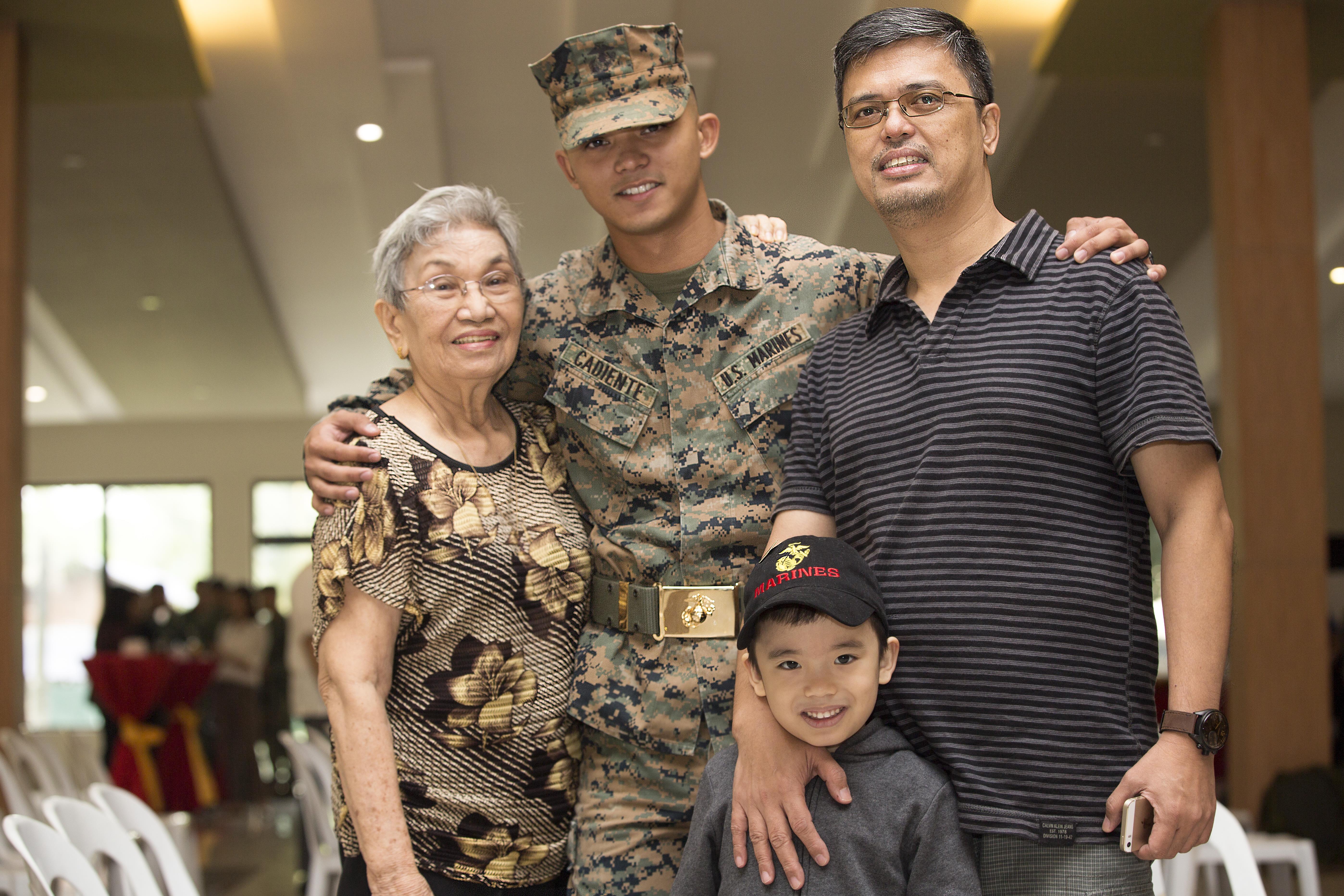
Face of Defense: Marine Returns to Native Philippines for Exercise


By Marine Corps Cpl. Joey Holeman 3rd Marine Expeditionary Force

CLARK AIR BASE, Philippines, October 15, 2015 — For the first time in nearly four years, Marine Corps Sgt. Viktor Cadiente is back in his homeland, and he's not on leave. He's here to support Amphibious Landing Exercise 2015.

"It's a nostalgic feeling to be in the country in which I was brought up in,” Cadiente said. “It makes me realize how much I've grown, how far I've come, and it gives me that humbling feeling to be reminded where I came from.”

Cadiente, a joint fires observer assigned to 3rd Marine Expeditionary Brigade, said this trip is the first time his father has seen him in uniform. “It is a good feeling to physically see my dad and see how proud he is of me,” the sergeant said.

Dreams of Service

Cadiente, who grew up in the Philippines until he was 16, said he always dreamed about serving in the military.

“Viktor has always been independent-minded and held a fascination with military life since he was a kid,” said Arnulfo D. de Vera, Cadiente’s father. “He nurtured that fascination by himself, and I wasn't the least surprised when he finally decided to pursue his dream.”

Both Cadiente and his father said they believe serving in the Marine Corps has given him opportunities that might not have been available to him if he had stayed in the Philippines.

“The Marine Corps has given my son the maturity and outlook that he wouldn't have gotten as fast as he did from living a civilian life,” said de Vera, a Manila native. “I am very proud with the fact that he joined the Marines.”

Importance of Education

During his sophomore year of high school, Cadiente moved to Hawaii, where he stayed with his mother, who worked as a hospital janitor to support him and his little sister. He said he credits his mother for making it possible for him to better his education.

“The one thing I appreciate the most is the opportunity [he has] to obtain higher education while serving his country,” de Vera said.

Driven by the support of his wife, his mother and his family in the Philippines, Cadiente said, he will continue to pursue his goals, which include continuing his education and eventually applying for the Marine Enlisted Commissioning Education Program.
“He has grown to be a smart and responsible grandson,” said Virginia Cadiente, his grandmother. “He is a man who strives really hard to achieve his dreams.”

Chinese People's Liberation Army Navy Ship Visits Pearl Harbor


By Mass Communication Specialist 2nd Class Laurie Dexter

PEARL HARBOR, Hawaii (NNS) -- China's People's Liberation Army Navy (PLAN) midshipmen training vessel Zheng He (Type 679, Hull 81) arrived at Joint Base Pearl Harbor-Hickam Oct. 12 and is expected to stay until Oct. 16.

As part of a planned series of military-to-military exchanges between the two nations, Zheng He will be hosted by the guided-missile cruiser USS Chosin (CG 65).

Chinese and U.S. naval officers will conduct dialogues to build confidence and mutual understanding.

According to Capt. Eric Weilenman, chief of staff of Naval Surface Group, Middle Pacific, the visit is a good chance for both navies' Sailors to interact with one another.

"It's a great opportunity for a mil-to-mil exchange, to develop trust, build confidence in each other's abilities, a great opportunity for the midshipmen to experience Hawaii and to interact with the host ship Sailors," said Weilenman. "They've planned soccer games, tug-of-war, basketball games -- basically an opportunity to interact with our Sailors."

According to Capt. Kevin Brand, commanding officer of USS Chosin, during the ship's visit, U.S. and Chinese Sailors plan to engage in deckplate level events, giving both navies the opportunity to exchange professional knowledge.

"While the Zheng He is here, we'll be doing some naval planning exercises on board. We're going to do a search and rescue planning event -- a table-top exercise -- to show them how we go about planning a search and rescue," said Brand. "We'll also do a recovery exercise where we'll actually put a man in the water to show them how we would recover on board the ship and do some medical care. In addition to that, we're also going to do a damage control exercise, where we're going to share some of our best practices."

The U.S. Navy is committed to continued engagement to improve mutual understanding, build trust, enhance transparency, and reduce the risk of misperceptions and miscalculations. Military-to-military engagement is an important tool to build trust, encourage multilateral cooperation, enhance transparency and mitigate risk.

US, Indian, Japan Navies to Participate in Malabar 2015


From Commander Task Force 70 Public Affairs

CHENNAI, India (NNS) -- Naval ships, aircraft and personnel from India, Japan and the United States will participate in exercise Malabar 2015, Oct. 14-19, 2015.

Malabar 2015 is a complex, high-end warfighting exercise that has grown in scope and complexity over the years and is the latest in a continuing series conducted to advance multi-national maritime relationships and mutual security issues.

The exercise will feature both ashore and at-sea training. While ashore in Chennai, training will include subject matter expert and professional exchanges on carrier strike group operations; maritime patrol and reconnaissance operations; surface and anti-submarine warfare; medical operations; damage control; explosive ordnance disposal (EOD); helicopter operations; and visit board search and seizure (VBSS) operations.

The at-sea portions will be conducted off the east coast of India and are designed to advance participating nations' military-to-military coordination and capacity to plan and execute tactical operations in a multinational environment.

Events planned during the at-sea portions include liaison officer professional exchanges and embarks; photo exercise; submarine familiarization; high-value unit defense; air defense exercises; mine exercise; medevac; surface warfare exercises; communications exercises; search and rescue exercises; helicopter cross-deck evolutions; underway replenishments; gunnery exercises; visit, board, search and seizure (VBSS) exercises; and anti-submarine warfare.

Participants from the U.S. Navy include the Nimitz-class aircraft carrier USS Theodore Roosevelt (CVN 71) with embarked Carrier Air Wing 1, the guided-missile cruiser USS Normandy (CG 60); the littoral combat ship USS Fort Worth (LCS 3); a P-8A Poseidon aircraft; and a Los Angeles-Class fast-attack submarine.

The Indian, Japan and U.S. navies have a common understanding and knowledge of a shared working environment at sea. Each iteration of this exercise helps to advance the level of understanding between our Sailors and we hope to be able to continue this process over time.

As members of Pacific nations, our navies are natural partners, and we look forward to continuing to strengthen our bonds and personal relationships.

For a list of participating Indian forces, please refer to the Indian Navy Headquarters. For a list of participating Japan forces, please refer to the Japan Maritime Staff Office.